
This article was originally published in the author’s personal Substack on June 15, 2026.
Representative Kevin McCabe published a Substack post today titled “The Gasline Tax Bill Without the Drama.” His own subtitle reads: “HB 381 is not a conspiracy theory, not a giveaway, and not a loss to Alaska.”
Let us take those three claims in order. No serious critic of HB 381 called it a conspiracy theory. The documented record shows it is a giveaway. And the arithmetic from the Department of Revenue’s own slides shows it is a loss.
McCabe also dismisses concerns about the bill as “scare tactics” and “drama,” and accuses critics of misrepresenting the bill. Those are the words of someone who does not want to answer the questions being asked.
The questions being asked are not dramatic. They are the exact questions McCabe and the five Republican members of the Stapp floor coalition chose not to ask when they had the authority and the obligation to ask them.

Representative Stapp. Representative Allard. Representative Bynum. Representative Moore. Representative Tomaszewski. And McCabe.
These are the six members who pushed through floor amendments on June 10, 2026, cutting the AVT rate below what DOR said was already insufficient, eliminating the municipal election mechanism that would have let boroughs decide their own fate, and sheltering the entire federal credit-generating infrastructure from local taxation. Permanently. By statute. Without asking the questions that any one of them had the power to demand answers to.
Now that others are asking those questions, McCabe calls it drama.
It is not drama. It is the work they did not do.
Claim One: “HB 381 barely touches” the major revenue streams.
McCabe states that royalties, production taxes, and corporate income taxes “make up the bulk of the revenue Alaska would receive” and that HB 381 “barely touches any of that.”
The corporate income tax exemption for the midstream entity is structural and permanent. This is not a minor provision. The midstream in a project of this scale is a substantial taxable enterprise under current law.
The Stapp coalition floor amendments, adopted on June 10, 2026, set the AVT rates at the following levels, documented in the adopted amendment record (34-GH2038/T.47) and confirmed by a subsequent Schrage conceptual amendment (T.72) that was also adopted:
• $0.06 per Mcf for the gas pipeline component
• $0.13 per Mcf for the gas treatment plant and carbon capture facility component
• $0.13 per Mcf for the liquefied natural gas plant component
These are cents per thousand cubic feet of gas throughput. Not dollars. Cents.
DOR’s own analysts, Dan Stickel and Brandon Spanos, testified on the record that the prior version T rate of $0.15 per Mcf “would not materially decrease the cost of gas or make the project more attractive to investors.” The Stapp coalition cut the pipeline and GTP rates further, to $0.06 and $0.13 respectively. No corrected DOR fiscal note was produced showing what those rates would actually generate for municipalities or the state at any throughput scenario before the vote.
The legislature voted on a bill whose actual fiscal impact was never presented to them under the rates that passed.
What Six Cents and Thirteen Cents Actually Produce
McCabe and his coalition colleagues have described the $0.13 rate as an improvement over the original $0.12. That is technically true. It is also nearly irrelevant when measured against what Alaska was entitled to collect under current law.
The Department of Revenue projected the following combined state and municipal property tax revenues if the project proceeds under current law, without modification:
• 2029 (first year of operations): $75 million combined state and municipal
• 2033 (full ramp-up): $741 million combined state and municipal
• State share alone in 2033: $244 million per year
• Municipal share alone in 2033: $497 million per year
At full project throughput, the adopted AVT rates of $0.06/$0.13/$0.13 per Mcf produce approximately $145 million per year in combined state and municipal revenue. The state’s share, limited to the roughly 12 percent of the project located in the unorganized borough, is approximately $17 million per year.
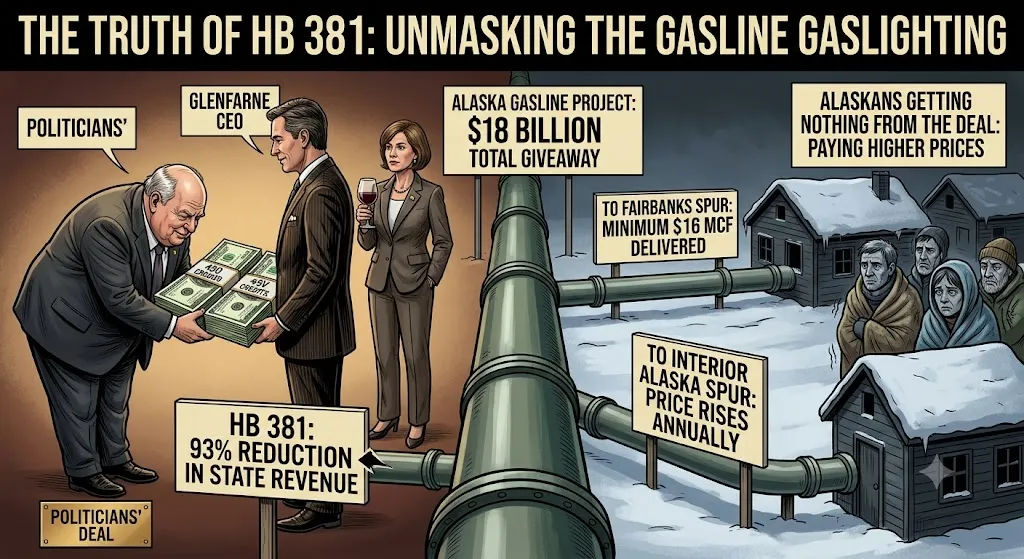
The state goes from $244 million per year under current law to approximately $17 million per year under the Stapp coalition’s rates. That is a reduction of roughly 93 percent in state property and midstream tax revenue from this infrastructure.
Combined with municipalities, the adopted rates generate approximately 20 cents for every dollar that current law property tax would have produced. Alaska and its boroughs give up roughly $596 million per year at steady state.
The Schrage One-Cent Amendment Did Not Change the Picture
The GTP and LNG rates in the original Stapp amendment were $0.12 per Mcf. Representative Schrage offered a conceptual amendment (T.72) raising those two components to $0.13 per Mcf. It was adopted. McCabe and coalition supporters have cited this as evidence the bill was strengthened in committee.
At full project throughput, the difference between $0.12 and $0.13 per Mcf on the GTP and LNG components produces approximately $6 million per year in additional combined AVT revenue. The gap between what passed and what current law would have generated remains approximately $596 million per year.
A one-cent rate adjustment that produces $6 million in additional annual revenue does not meaningfully close a $596 million annual gap. Presenting it as a significant improvement to the bill requires the audience not to run the arithmetic.
Over the life of the project from 2026 to 2062, GaffneyCline’s own analysis presented to Senate Finance in May showed aggregate property tax revenue of $23.1 billion against aggregate AVT revenue at 6 cents flat of $2.6 billion. At the blended effective rate of the adopted $0.06/$0.13/$0.13 structure, the aggregate AVT estimate scales to approximately $4.9 billion. Alaska collects roughly 21 percent of what its own property tax law would have produced over the project’s life. The state and its municipalities give up approximately $18 billion in aggregate revenue compared to current law.
This is what the Stapp coalition described as getting the project financed.
This is what McCabe described as “barely touching” the revenue streams.
Claim Two: AVT is “how business is done in virtually every other gas field on the planet.”
This claim is false. The documentary record is unambiguous.
Qatar captures value through state equity in LNG trains and upstream operations, corporate tax on joint venture entities, and export duties embedded in state take. No AVT.
Australia imposes property tax on LNG plants and pipelines, corporate income tax, and the Petroleum Resource Rent Tax on super-profits. Local governments rely on property tax from LNG facilities. No AVT.
Canada taxes pipelines and LNG plants through property tax and corporate tax at both federal and provincial levels. Local governments rely heavily on property tax from linear infrastructure. No AVT.
US Gulf Coast LNG facilities pay property tax on plants and associated infrastructure and corporate income tax. Even in the most pro-industry states, property tax is not structurally replaced by a volumetric mechanism for a single private developer. No AVT.
The combination HB 381 creates does not exist in any other jurisdiction on the planet. A resource-owning state that takes no equity, exempts the midstream from corporate income tax, eliminates property tax authority, pre-empts local governments by state statute, fixes a volumetric rate for decades, and allows the developer to collect potentially $2 billion annually in federal credits with no state share is not a global norm. It is a global anomaly.
McCabe did not document this claim before making it. He should have.
Claim Three: Federal tax credits “were never Alaska revenue in the first place” and are therefore irrelevant.
This is the most consequential claim in McCabe’s piece, and it is the most technically incomplete.
It is correct that 45Q and 45V are federal programs and that Alaska does not directly receive those credits.
But federal credits create substantial value for the developer. That value is leverage the state can use to negotiate fiscal terms. This is standard practice in resource-owning jurisdictions worldwide. When a private developer receives a large federal subsidy, and that subsidy depends on access to the state’s resource and right-of-way, the state uses that value to negotiate stronger terms for itself. HB 381 does the opposite.
Section 45Q provides $85 per tonne for qualified carbon capture and sequestration. Against approximately 7 million tonnes of projected annual CO2 capture from the Gas Treatment Plant, that is approximately $595 million per year flowing to the operator. Alaska’s current statutory share under HB 50 is $2.50 per tonne. The gap between $85 per tonne federally and $2.50 per tonne to Alaska is not a rounding error. It is the core fiscal asymmetry of this project.
Section 45V provides up to $3 per kilogram for clean hydrogen production. Against projected production volumes, the annual credit value may reach $1.5 billion per year. This number did not appear in any DOR fiscal note presented to the legislature during the special session. Not once.
Combined, those two streams potentially exceed $2 billion annually flowing to the operator, entirely outside Alaska’s tax reach under the AVT framework as drafted.
The Stapp coalition amendments also ensured that the property tax exemption covers carbon capture facilities, underground storage, and hydrogen production infrastructure, meaning the credit-generating assets are permanently exempted from local borough taxation as well.
McCabe says these credits were never hidden. But no DOR fiscal note quantified the 45V stream before the legislature voted. GaffneyCline senior director Nicholas Fulford testified before Senate Finance on May 27 that gas “is not the driver” and gas “is not worth much,” then declined to name what the actual driver was when directly asked. No member of either finance committee followed up. No member of the Stapp coalition asked Fulford what secondary revenue streams actually carry the project’s investment case.
That omission is documented in the public record. It is not a conspiracy theory. It is a gap that McCabe and his coalition colleagues had every opportunity to close and chose not to.
Claim Four: McCabe Says “Alaska Is Asking for Something in Return.” Here Is What the Bill Text Actually Shows.
Let us examine each of McCabe’s cited items against the actual adopted amendment record and bill text.
Community Benefit Agreements
There are no community benefit agreements in HB 381. The term does not describe any legal instrument in the bill. What exists is a Municipal Impact Grant Fund, created by Amendment T.21 and modified by Amendment T.79, both adopted on June 10. The fund receives a developer deposit of $40 million initially, with up to $80 million total if DCCED requests additional amounts. The legislature may then appropriate those funds to DCCED, which distributes them at its discretion.
Future legislatures are not bound to appropriate. Municipalities have no legal recourse if the funds are never appropriated. That is not a community benefit agreement by any standard definition of that term. It is a contingent deposit into a discretionary fund.
The Impact Fund
The $40 million initial deposit is split across six impacted municipalities: the North Slope Borough, Fairbanks North Star Borough, Denali Borough, Municipality of Anchorage, Mat-Su Borough, and Kenai Peninsula Borough. Those boroughs are permanently losing property tax authority over infrastructure that DOR projected would generate $497 million annually by 2033 from municipal property tax alone.
Six boroughs permanently lose $497 million per year in property tax authority at steady state. In exchange, a $40 million one-time contingent fund requiring future legislative appropriation before any municipality sees a dollar. That is not a fiscal trade. It is a gesture packaged to look like one.
The Mat-Su Borough did not consent to this. No borough assembly voted on the elimination of its taxing authority. The Stapp coalition’s Amendment T.47 deleted the municipal election mechanism that was in the prior version of the bill, which would have let boroughs vote on whether to accept the AVT structure. That option was removed by state statute, from Juneau, without a borough vote. McCabe did not address that distinction in his piece.
The Project Labor Agreement
The bill requires the developer to “negotiate” a project labor agreement. The adopted language in T.47 requires negotiation of a comprehensive collective bargaining agreement “to ensure expedited construction with labor stability by employing qualified residents of the state.” It does not require execution. It does not guarantee a majority-Alaskan workforce. It does not give individual workers any choice about union membership.
What it guarantees is that any worker who wants employment on this project, whether a lifelong Alaskan tradesperson or an out-of-state worker brought in to fill a skills gap, must join the relevant union and pay initiation fees and ongoing dues as a condition of employment. The benefit flows to union organizations. TAPS construction is the relevant historical precedent: a project of this scale and technical complexity will draw a substantial share of its skilled workforce from Outside because the qualified labor pool in Alaska is not large enough.
Workers do not gain employment flexibility under this provision. They gain a mandatory fee obligation as the price of access to the job. Paying for the privilege of working is not a worker benefit. It is a union revenue mechanism.
The Fairbanks Spur
The spur line provision in T.47 and T.76 requires the developer to begin permit applications and regulatory proceedings on or before completion of 730 miles of the main pipeline, and to begin construction within one year of receiving required permits. It is a commitment to pursue the permitting process. It is not a commitment to deliver gas at an affordable price.
DOR’s own break-even modeling shows weighted average in-state delivered prices starting at $12 to $16 per Mcf at the utility level in 2033 under base capital assumptions, with approximately $4.36 per Mcf added for final delivery to the consumer. Delivered prices at the meter start at $17 to $21 per Mcf at optimistic assumptions. At a 20 to 40 percent capital cost overrun, which is historically common for megaprojects of this scale, delivered prices reach $20 to $28 per Mcf.
These are DOR’s own numbers, in DOR’s own slides, presented to the Senate Finance Committee. They are not a scare tactic.
The AVT rate escalates annually between 1 and 2 percent per year. The Fairbanks spur gas price escalates on the same trajectory. A price starting in the mid-to-upper teens per Mcf and rising every year with no end date is not a guaranteed affordable energy outcome for Interior Alaska households.
The Consumer Protection Provision
McCabe cites a consumer protection provision from adopted Amendment T.50, which amends AS 42.05 to add a maximum price cap on gas supply contracts between the AKLNG project and in-state utilities, adjusted annually using the five-year CPI average for urban Alaska.
There are three structural problems with presenting this as consumer protection.
First, it is a utility-level supply price cap, not a consumer price cap. Distribution costs, utility overhead, and local infrastructure charges sit on top before the price reaches the consumer’s meter.
Second, the cap escalates indefinitely with CPI. Over 30 years at 2 percent annually, a starting cap of $16 per Mcf becomes approximately $29 per Mcf in nominal terms. The cap grows every year and never stops growing.
Third, the cap guarantees only that in-state gas is cheaper than imported LNG. If imported LNG costs $20 per Mcf, the cap lands below $20 per Mcf. That is not affordable energy. That is a slightly less expensive version of an expensive outcome.
Framing an inflation-escalating utility supply cost ceiling as consumer protection requires the reader not to run the numbers.
The “Zero Is Also a Number” Argument
McCabe’s closing argument is that the alternative to HB 381 is no gasline, no royalties, no production taxes, no jobs, and no energy solution. He asks: “The real question is compared to what?”
This argument is not an argument. It is an emotional sound bite designed to foreclose the policy conversation rather than advance it.
The actual alternatives to HB 381 include a better-negotiated fiscal package, a phased in-state gas project, a smaller-scale pipeline, a hydrogen-first project with enforceable revenue sharing, a tariff structure that protects local governments, a state equity model used by resource-owning jurisdictions globally, and a royalty-based midstream valuation structure. Alaska is not choosing between HB 381 and nothing. It is choosing between HB 381 and every other possible deal structure.
More importantly, the urgency framing behind the “zero or nothing” argument rests on a false premise. Nothing in global LNG markets requires a 2026 fiscal bill, a 2027 construction start, or floor amendments adopted at rates never modeled in a corrected DOR fiscal note. The only hard deadline affecting this project is the IRS Section 45V physical work test deadline of December 31, 2027. That deadline exists because the developer needs to qualify for the clean hydrogen production credit. It has nothing to do with Asian LNG market windows.
The urgency is the developer’s urgency. Not Alaska’s.
A developer who must break ground by January 1, 2028 to preserve a $1.5 billion annual federal credit stream cannot walk away from the negotiating table because Alaska asks for a higher AVT rate or a negotiated property tax floor for municipalities. The leverage was Alaska’s. The Stapp coalition chose not to use it, and then called the people pointing that out dramatic.
What McCabe Did Not Ask
McCabe characterizes the questions raised by critics as “drama,” “scare tactics,” and “conspiracy theories.” The questions being asked are these:
• What is the hydrogen plan?
• What is the carbon sequestration plan and what are the geological risks of CO2 injection in a seismically active Cook Inlet basin?
• What is the full tariff model?
• Why are local governments permanently losing property tax authority without a vote?
• Why is Alaska reducing its own taxes while the developer pursues federal credits potentially worth $2 billion per year?
• Why does Alaska receive $2.50 per tonne under HB 50 when the developer receives $85 per tonne federally?
• Why did no DOR fiscal note quantify the 45V credit stream before the legislature voted?
• Why did GaffneyCline’s expert witness decline to name the project’s primary revenue driver when asked directly on the record?
These are fiduciary questions. They are the questions a resource-owning state’s legislature is constitutionally obligated to answer before permanently restructuring municipal taxing authority, exempting a private developer’s midstream entity from corporate income tax, and pre-committing Alaska’s fiscal posture before negotiations on gas price and tariff structure are even concluded.
McCabe and the Stapp coalition had the authority to demand answers to every one of these questions. They had the committee process, the expert witnesses, the DOR analysts, and the time. They chose instead to adopt AVT rates of six cents, thirteen cents, and thirteen cents per Mcf, delete the borough election mechanism, shelter the federal credit infrastructure from local taxation, and pass a bill whose fiscal impact was never modeled in a corrected DOR fiscal note at the rates that actually passed. The result is a structure that generates approximately 20 cents for every dollar Alaska was entitled to collect under current law.
The people asking these questions now are doing the work the Stapp coalition declined to do when it had the chance.
HB 381 is not a conspiracy. It is a giveaway. The record shows it. The math confirms it. Calling that drama is not a rebuttal. It is an admission that the questions remain unanswered.
References
HB 381 CSHB(FIN) bill text 34-GH2038/W; Adopted House Finance Amendments 34-GH2038/T.47, T.50, T.21, T.72, T.79, and related conceptual amendments, June 10, 2026; Stapp amendment explanation letter, June 6, 2026; DOR Revised Presentation June 2, 2026; DOR Additional Modeling Requests June 8, 2026; LFD Fiscal and Sectional Analysis of SB 2001, June 10, 2026; GaffneyCline Senate Finance testimony and comparison analysis, May 27-28, 2026; AKLNG Continuity Memo June 2026.



