Thursday, May 7, 2026
Home Blog Page 966

Dan Fagan to return to airwaves Tuesday

Dan Fagan, a popular conservative talk show host, returns to the airwaves on Tuesday, Jan. 4, after more than two weeks of sick leave.

Fagan has been released from then hospital and said he is feeling well again. His heart started failing shortly after he had his second Covid vaccine on Aug. 12, he said, but he ignored the symptoms until two weeks ago, when he couldn’t breathe well enough to do the show. He called for an ambulance. After tests, doctors determined that his heart and other organs are healthy, but there was a buildup of fluid on the outside of the tissue around his lungs.

Fagan said that at one point he was close to death. He doesn’t know if the condition he suffered is a result of the vaccine but said it’s a “huge coincidence” that it started a week after the second Covid shot. However, he acknowledged that he had not been taking good care of his health, was overweight, and needed to exercise more. He said with better health habits, his heart should be able to repair the damage; there was no evidence of a heart attack, but his heart was not pumping properly.

Since then, he has lost weight, been exercising regularly and is eating healthy, he said, adding that he expects to live for many years.

Fagan, a conservative icon in Alaska who pioneered a now-retired conservative news blog, The Alaska Standard, and now broadcasts his morning show from New Orleans, can be heard on 650 KENI between 5:30 and 8 am weekdays; his is the highest-rated morning drive time radio show in Alaska.

Wasilla police: ‘Stay home –seriously,’ and Thane Road in Juneau closed by avalanche

The New Year is coming in like a lion. Hurricane-force wind howling through the Mat-Su Valley has flipped planes at the Palmer Municipal Airport, toppled trees, and taken the roofs off of buildings as the new year begins. Schools are closed in the Mat-Su Valley due to the wind and damage. City of Wasilla offices are closed, including the Wasilla Police Department’s administrative office.

Winds at the Palmer Airport clocked 81 mph at one point, with blowing snow and debris.

Wasilla Police have asked people to shelter in place. On Facebook, the department pleaded for help from the public to stay off roads and stay home “unless absolutely necessary.” Heavy winds are expected to last until Monday evening.

Wind damage at the KFC-A&W building in Wasilla.

The KFC-A&W building on the Palmer-Wasilla Highway was heavily damaged by wind starting at about 7 pm Sunday, and debris is blowing throughout the valley, hitting and damaging vehicles and buildings. Many homes and businesses are without power, as the temperature is in the single digits. On Facebook, Wasilla Police warned:

“AVOID THE AREA OF KFC MEANS AVOID THE AREA.”

“Stop trying to get close to take pictures. Our officers vehicles are being hit with debris trying to keep people out of the way. Seriously. GO home and stay there. ‼️AVOID KFC AND FRED MEYER‼️ KFC/A&W has suffered a catastrophic collapse. Please avoid the area due to flying debris and emergency vehicles. There have been multiple reports of debris (not just from KFC) hitting and damaging vehicles. STAY HOME. The borough has advised a shelter in place. The NWS has extended the wind warning to 6pm tomorrow. All City of Wasilla administrative offices are closed tomorrow (including the WPD admin office). Seriously folks, stay home unless absolutely necessary.”

The power is out for thousands who are staying home. In Wasilla, 44 percent of the city is out of power, and in Palmer proper, 52 percent lack power. Palmer Fishhook and Sutton homes are about 99.5 percent out of power. The MEA power outage map is here.

Meanwhile, in Juneau, Thane Road is closed due to a major avalanche after an epic snowstorm brought as much as 16 inches of snow at sea level over the weekend, combined with “Taku winds” of 35 to 45 mph with gusts up to 70 mph.  Power is out in Thane, a neighborhood south of the town center. AEL&P said that line workers can’t access the lines by road, due to the avalanche that went all the way into Gastineau Channel and will attempt to fly in a crew in the morning on Monday, but advised that “Customers affected should be prepared for an extended outage.”

Sugar Fegley posted a photo on Facebook of the avalanche covering the road on Sunday.

Thane Road covered by avalanche as seen from Douglas Island. Credit: Sugar Fegley, Facebook.

Alexander Dolitsky: Worldwide migration of Old Believers in Alaska

By ALEXANDER DOLITSKY

The darkest time of the day is before the sunrise. America is the sunrise for the Russian Old Believers in Alaska.

Within a few decades of the schism, many Old Believers escaped Russia to densely wooded areas of Belorussia and northern Ukraine, southward to the Don and Kuban Rivers, northward toward the Baltic Sea and Arctic shores and, beyond the boundaries of the state—to neighboring Romania, Turkey, and Poland. Others settled in southern Siberia (Altay Mountains), the Far East and Central Asia. 

Through the centuries, these remote groups, not necessarily in contact with each other, and, in spite of minimal levels of modernization, acculturation, and adaptation to new climates, not only survived but also preserved and maintained their religious form of worship and their cultural ways.

All of the Old Believer groups that settled east of Lake Baykal in the 17th and 18th centuries, maintained contact with the Buryats, Evenks, and other neighboring ethnic groups who were engaged in hunting, reindeer breeding, fishing, and raising sled dogs. 

Trans–Baykalian Old Believers, whose ancestors were banished to eastern Siberia from the Chernigov Province of Ukraine and Vetka of Poland in the 18th century, moved with their families and are known, therefore, as semeyskiye (of the family)—from the Russian word semya (family).

The Russian newcomers found themselves in conditions radically different from their customary life. Long winters, bitter frosts, harsh physical and social environment, and a shortage of Russian women—all these necessitated urgent acculturation in line with the centuries–old experience of the aboriginal population in economic activities and in coping with the severe natural conditions. 

Although Old Believers of the Trans–Baykal fanatically followed the patriarchal traditions of the pre-reform Russian Orthodox Church, their members, including women, were better educated than their neighbors. Many of them were kuptsy(traders), kazaks (free peasants and border guards), remeslenniki (craftsmen), or farmers.

Many Trans–Baykalian Old Believer communities moved to Manchuria (China) during the construction of the East Chinese Railroad (1897–1902) and the city of Kharbin. They subsequently gave rise to the Old Believer community of Kharbinskaya; residents are called Kharbintsy

After the eruption of the Socialist October Revolution in 1917, Russian Old Believers faced the atheistic Soviet government. During the 1920s, in desperation, many of the Siberian Old Believers escaped over the border to China, where they once again lived in isolated and remote areas of Manchuria, in the cities of Kharbin and the Sinkiang.

As a result of the Chinese Communist Revolution of 1949, many of them were forced onto collective farms, provided a meager food allowance, and given mandatory work requirements. Many, eventually, were sent back to the Soviet Union. Finally, after 10 years, a minority of them—as families, groups, or single individuals—either escaped or received permission to leave for Hong Kong; then a territory under jurisdiction of the United Kingdom. The United Kingdom, the Red Cross, and the United World Council of Churches provided them assistance in Hong Kong while arrangements were being made for emigration to other regions of the world. 

Later, in 1958–59, they relocated from Hong Kong to various immigrant–seeking countries under sponsorship of the Intergovernmental Committee for European Migration. In Hong Kong, they were given the choice of countries they could go to, including Australia, New Zealand, Brazil, Argentina, Paraguay, Bolivia and Uruguay; the largest groups went to Brazil and Australia.

The majority of Old Believers arrived in Brazil between 1959–61. There, the United World Council of Churches provided 6,000 acres of land at Curitiba (about 200 miles southwest of Sao Paulo) and promised to provide them with the means and assistance necessary to get started in farming their land. Life in Brazil appears to have been difficult from the start. The soil and climatic conditions were vastly different from anything Old Believers had known in Russia and China. 

After several discouraging years of attempting to adapt to a new bio–physical and socio–cultural environment, some were able to voluntarily leave for the United States and Canada, with the help of the Tolstoy Foundation in New York and the personal intervention of the U.S. Attorney General Robert F. Kennedy. Most Old Believers began their migration to North America between 1964–69. 

Eventually, most of them settled in Oregon, where an existing community of Old Believers continues to prosper. The population has since increased to approximately 10–12,000 within a two-county area. Today, there are eleven sobors(prayer halls) in Oregon, reflecting the community’s internal social division into three principal sub–groups that migrated from their former residences—Kharbintsy from Manchuria and Sinkiangtsy from Sinkiang in China, and Turchany from Turkey.

The Turkish group left Russia about 230–240 years ago and lived in Turkey until 1963. In 1963, some of them immigrated to the United States. The three groups settled in the same area of Woodburn, Oregon in the 1960s. Although there are minor differences in dialects and customs, they share common cultural traditions, customs, and beliefs.

Within KharbintsySinkiantsy and Turchany divisions, they are further subdivided on the basis of kinship groups. Although the Oregon contingent is no longer located in a cohesive village, the Old Believers continue to congregate in prayer halls (molelnyy dom) for worship and gather at kin homesteads for marriages and other major socio–cultural events. To attend any of these activities is to re–live aspects of the historical accounts of pre–revolutionary (October 1917) peasant Russia.

The most orthodox group, recoiling under the threat of cultural erosion resulting from the compromises necessary to co–exist with the host culture, exercised the ultimate strategy of exodus to a more remote and isolated region. Eventually, in 1967, five Old Believer families (10 adults and 12 children) from Woodburn, Oregon, purchased 640 acres of land and leased an additional two and one-quarter acres of adjacent land on the Kenai Peninsula, along the Anchor River, in Alaska. 

They began building a community near Anchor Point in the summer of 1968 when the vanguard of families arrived from Oregon. They named this community Nikolaevsk. Two smaller satellite villages in the vicinity were named Nakhodka and Klyuchevaya. In 1969, the community installed a water system in Nikolaevsk, and connected electricity from the Homer Electric Association.

The group constructed a sawmill to produce the lumber needed to construct houses, barns, sheds and boats for drift fishing. In 1971, 15 of the Old Believers formed the Russian Maritime Company, built a shop in Nikolaevsk, and by 1975 had produced sixteen 34–foot fiberglass, diesel–powered commercial fishing boats; at least 35 of the villagers became successful commercial fisherman.

In the early 1970s, other families from Oregon split off to form new settlements in northern Canada, near Edmonton, Alberta, and on the Kenai Peninsula and Kodiak Island in the state of Alaska. The Alaskan communities have prospered and grown in the last 54 years from 70 residents in 1970 to a few hundred residents in 1975 and today’s population numbers about 2,000 statewide. 

The Alaska settlements attract families from Oregon and other locations world–wide. Initially founded in 1968 by five families, the village Nikolaevsk has become the largest Old Believer settlement in Alaska. As of June 2015, the village had a population of nearly 400, or about 70–80 nuclear families and 100 households. The village has a public school that is managed by the state of Alaska and that is attended almost exclusively by Russian–speaking children from Nikolaevsk. The advantage of a cohesive community eased the strain of continual enforcement of traditional cultural norms, values and behavior.

In the summer of 1983, when I visited Nikolaevsk for the first time, I noticed an emerging controversy in the village between two factions of its residents—priestly (popovtsy) and priestless (bespopovtsy). Two years later, the Anchorage Daily News (January 27, 1985: A1, A9–10) reported about the confrontation among Old Believers on the Kenai Peninsula. The conflict centered on differences in religious conduct: some Old Believers, led by Kondratiy Fefelov, who had studied in a monastery in Romania, “uncorrupted,” as he stated, “by religious reforms,” favored ordaining priests.

Many of the villagers, however, refused to accept Fefelov as a priest and denounced his idea. During 1983–84, as a result of this dilemma, five priestless (bespopovtsy) nuclear families left Nikolaevsk to establish a new Old Believer settlement, Berezovka (birch tree in Russian), in a rural area of interior Alaska near the existing community of Willow.

A while later, on July 6, 1984, the prayer hall (molelnyy dom) of the bespopovtsy (priestless) in Nikolaevsk burned to the ground under suspicious circumstances. Kondratiy Fefelov and his nephew Paul were accused by several villagers in this action, but Anchor Point Fire Chief Bob Craig reported that no conclusions were reached on this matter.

A few days before the old church (praying house) burned down, a priestly grouping (popovtsy), led by priest Kondratiy Fefelov, completed construction of a new church, the Church of Saint Nikolas, according to the theological principles of the Belokrinitsky Hierarchy tradition. The new priestly church was built across the street from the original priestless prayer hall that burned down. 

The “schism” (raskol) of the 1980s in Nikolaevsk has been settled. In protest, the most traditional Old Believers left the estranged community and moved to other remote regions of Alaska.

As Andron Martushev (priestless) once told me during my visit to Berezovka village in May of 1986, “I want it to be the way it was before the split in the community, I don’t want to live near evil.”

Today, although priestly and priestless groupings’ interactions are limited to occasional acknowledgements on the streets of Nikolaevsk and other Old Believers villages in the Kachemak Bay (e.g., Voznesenka), people have learned how to coexist as neighbors and live in peace.

For the Russian Old Believers in Alaska, “…the darkest time of the day is before the sunrise.” America is their sunrise!

Alexander B. Dolitsky was born and raised in Kiev in the former Soviet Union. He received an M.A. in history from Kiev Pedagogical Institute, Ukraine, in 1976; an M.A. in anthropology and archaeology from Brown University in 1983; and was enroled in the Ph.D. program in Anthropology at Bryn Mawr College from 1983 to 1985, where he was also a lecturer in the Russian Center. In the U.S.S.R., he was a social studies teacher for three years, and an archaeologist for five years for the Ukranian Academy of Sciences. In 1978, he settled in the United States. Dolitsky visited Alaska for the first time in 1981, while conducting field research for graduate school at Brown. He lived first in Sitka in 1985 and then settled in Juneau in 1986. From 1985 to 1987, he was a U.S. Forest Service archaeologist and social scientist. He was an Adjunct Assistant Professor of Russian Studies at the University of Alaska Southeast from 1985 to 1999; Social Studies Instructor at the Alyeska Central School, Alaska Department of Education from 1988 to 2006; and has been the Director of the Alaska-Siberia Research Center (see www.aksrc.homestead.com) from 1990 to present. He has conducted about 30 field studies in various areas of the former Soviet Union (including Siberia), Central Asia, South America, Eastern Europe and the United States (including Alaska). Dolitsky has been a lecturer on the World Discoverer, Spirit of Oceanus, andClipper Odyssey vessels in the Arctic and sub-Arctic regions. He was the Project Manager for the WWII Alaska-Siberia Lend Lease Memorial, which was erected in Fairbanks in 2006. He has published extensively in the fields of anthropology, history, archaeology, and ethnography. His more recent publications include Fairy Tales and Myths of the Bering Strait Chukchi, Ancient Tales of Kamchatka; Tales and Legends of the Yupik Eskimos of Siberia; Old Russia in Modern America: Russian Old Believers in Alaska; Allies in Wartime: The Alaska-Siberia Airway During WWII; Spirit of the Siberian Tiger: Folktales of the Russian Far East; Living Wisdom of the Far North: Tales and Legends from Chukotka and Alaska; Pipeline to Russia; The Alaska-Siberia Air Route in WWII; and Old Russia in Modern America: Living Traditions of the Russian Old Believers; Ancient Tales of Chukotka, and Ancient Tales of Kamchatka.

A few of Dolitsky’s past MRAK columns:

Read: Neo-Marxism and utopian Socialism in America

Read: Old believers preserving faith in the New World

Read: Duke Ellington and the effects of Cold War in Soviet Union on intellectual curiosity

Read: United we stand, divided we fall with race, ethnicity in America

Read: For American schools to succeed, they need this ingredient

Read: Nationalism in America, Alaska, around the world

Read: The case of the ‘delicious salad’

Read: White privilege is a troubling perspective

Read: Beware of activists who manipulate history for their own agenda

Read: Alaska Day remembrance of Russian transfer

Read: American leftism is true picture of true hypocrisy

Read: History does not repeat itself

Read: The only Ford Mustang in Kiev

Read: What is greed? Depends on the generation

Secretary of Defense at home with Covid

Secretary of Defense Lloyd Austin III tested positive on Sunday for Covid-19. He requested a Covid test after exhibiting symptoms while at home on leave. 
 
“My symptoms are mild, and I am following my physician’s directions,” he said in a statement. “In keeping with those directions, and in accordance with CDC guidelines, I will quarantine myself at home for the next five days.”

Austin is fully vaccinated for Covid. His last meeting with President Joe Biden was on Dec. 21, more than a week before he began to experience symptoms. He tested negative that day and has not been in the Pentagon since Thursday, meeting with a few members of his staff.
 
“Stemming the spread of this virus, safeguarding our workforce and ensuring my own speedy and safe recovery remain my priorities.  To the degree possible, I plan to attend virtually this coming week those key meetings and discussions required to inform my situational awareness and decision making. I will retain all authorities. Deputy Secretary Hicks will represent me as appropriate in other matters,” he said.
 
“As my doctor made clear to me, my fully vaccinated status — and the booster I received in early October — have rendered the infection much more mild than it would otherwise have been. And I am grateful for that,” he said.
 
“The vaccines work and will remain a military medical requirement for our workforce. I continue to encourage everyone eligible for a booster shot to get one. This remains a readiness issue,” Austin said.

Party on: Alaska Republican Party issues call for convention for Fairbanks, April 21-23

The Alaska Republican Party State Central Committee has set the time and place for its biennial convention this year: April 21 – 23, at the Westmark Hotel and Conference Center, 813 Noble St, Fairbanks.

The party’s State Central Committee authorized 350 delegates, and the convention fee is $275, said Ann Brown, ARP chairwoman.

Every two years, at the District level, the party elects local officers , delegates and alternates to the state convention, where it elects statewide executive committee officers, proposes changes to the state party platform and rules, and organizes for up-coming campaigns. This year, the House and Senate districts have changed, requiring a realignment of district chairs in many parts of the Railbelt.

The hotels in Fairbanks may book quickly that week due to military exercises expected at Eielson Air Force Base in April. Although the state party has not yet posted hotel booking codes on its website, that will be the place to check for special room rates.

Those who are not party officers may attend as nonvoting participants, but must be registered as Republicans and will need to register at the party’s website.


Nepotism? Fairbanks assemblyman asking borough to challenge redistricting because his nephew is Rep. Grier Hopkins

Fairbanks North Star Borough Assembly Chairwoman Mindy O’Neall has called a special Assembly meeting for Jan. 6 to consider a resolution by Assemblyman David Guttenberg, who is asking the Borough to join in as a “friend of the court” in a lawsuit against the new political district boundaries in Fairbanks.

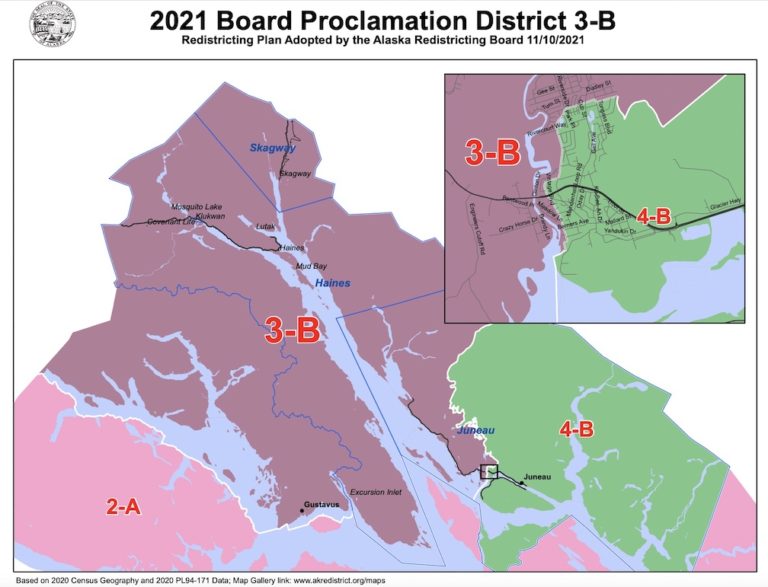
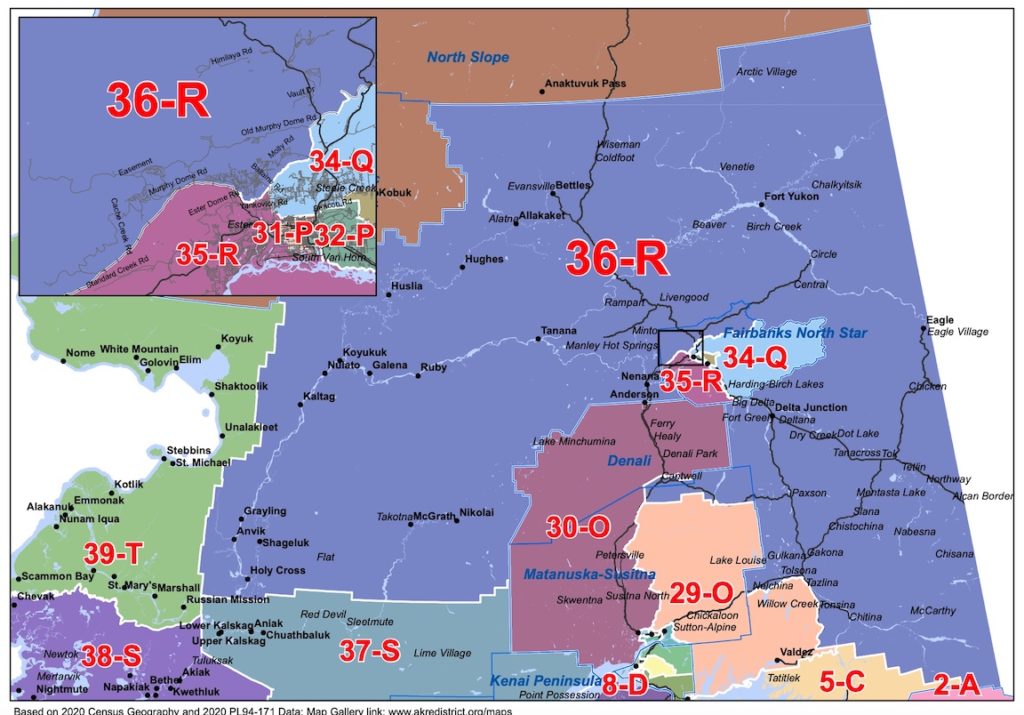
Those boundaries, as set forth by the Alaska Redistricting Board, disadvantage Guttenberg’s nephew, Democrat Rep. Grier Hopkins, whose new district trends conservative and will be difficult for him to win in 2022.

Guttenberg is complaining that a portion of the Goldstream Road area has been districted into the new District 36, which is a sprawling Interior Alaska District, a shape that is favored by Doyon Native Corporation. Guttenberg wants the borough to file an amicus brief in regard to the new lines, and so the matter is the subject of the special meeting.

But Guttenberg is only complaining about Goldstream, and mentions nothing about the Elliott Highway, much of which is also in the new D-36, and parts of the Steese Highway. He’s only concerned about the redistricted portion that impacts his nephew.

The Borough Assembly had, during the draft mapping process, asked the redistricting board to fix overpopulated districts in the region, and the board complied. The Assembly asked the board to take any the excess population and put it in a single district. The board did that, too. Now Guttenberg is worried about the result, perhaps because it impacts the Guttenberg-Hopkins political legacy.

Guttenberg is a former Fairbanks state representative, who served eight terms representing that part of Fairbanks before retiring from the State Legislature. Hopkins ran for the seat vacated by his uncle in 2018 and won it handily.

The filing deadline to oppose the new districts has already passed, but the amicus brief, something that would be drawn up by the borough’s lawyers, would support an existing lawsuit by the City of Valdez and the Matanuska-Susitna Borough.

Oral arguments for the challenges to the redistricting map are set for January.

The agenda for the meeting has the resolution on it and nothing more. The draft of the resolution is here:

Fairbanks woman finds newborn baby abandoned in cold on New Years Eve

A prematurely born newborn baby was abandoned in a cardboard box along a Fairbanks street on New Year’s Eve, according to Alaska State Troopers and the woman who found the child early Friday afternoon.

The baby, who was alive, was wrapped in baby blankets and left at the corner of Dolphin Way and Chena Point Avenue, not far from Chena Pump Road, according to Alaska State Troopers, who were notified at about 2 pm on Friday. The outside temperature was 1 degree with wind chill of -12.

A woman who said she found the baby, Roxy Lane, wrote on Facebook on Friday night that the child had been left near mailboxes near her home. She posted a short video of the child, and showed the note that was apparently written by the child’s mother, who said neither she nor her family have the resources to care for the baby.

“Today I found an abondaned newborn in a cardboard at the row of mailboxes by my house. I’ve been processing my feelings all day and running through all the different scenarios and reasons, with my bf and family, as to why something like this could have happened.I wanted to share some thoughts. First, the safe haven law is relatively new in Alaska (adopted in 2008) and it’s possible that many people, particularly young people, might not know what it is. There is always a safer, humane choice to surrender a baby and you will not get in trouble or even have to answer any difficult questions. Take the baby to a fire station, or church, or hospital and they will take care of them. I hope the mother gets the help she might need. I doubt they could have afforded to take her to the hospital and she may be in need of medical attention. Please, someone knows this new mom, check on her! She might be in a desperate situation, feeling abandoned herself. We don’t know, there could be a whole backstory here behind closed doors. Our community has been having an incredibly difficult time this year. I’ve been listening to sad story after sad story this week at work as I’ve been trying to do my part to provide our community with power and access to water or groceries. I’ve worked 9-11 hour days to provide good samaritans the ability to dig their neighbors out or pull out stranded strangers. I’ve been thanked and called an angel more times this week than ever before at my job. So let’s keep this feeling of community going into this new year. Clearly, someone in our community felt so lost and hopeless that they made probably the hardest choice of their lives to leave that innocent life on the side of the road with nothing but some blankets and a name. But she named him! There’s some love there, even if she made a terrible decision. I know we’re all struggling, I see it. I see you. I love you all and I’m here. Today I saved a baby and I’ll probably think about Teshawn for the rest of my life,” Lane wrote on Facebook.

The note from the apparent mom, who says she lived on Cormorant Street, a sparsely populated five-block street, described her anguished decision:

Troopers said that emergency medical workers took the child to the hospital where he was found to be in good health and is being cared for.

Matanuska delayed in Ketchikan Shipyard, will be out of service until Jan. 31

Unfortunately, due to the extent of additional repairs and vendor delays on the Alaska state ferry M/V Matanuska, the ship’s expected returned to service is now Monday, Jan. 31.

Welders in the Ketchikan Shipyard worked extended hours to replace and repair damaged steel on the M/V Matanuska, a critical component in the Alaska Marine Highway System. The ship serves Bellingham, Juneau, Haines and Skagway, among other communities.

The delay means that Skagway will not have ferry service from Jan. 8 through about Feb. 5. Haines is served by the Kennicott on Jan. 12, but the ship is not scheduled to call on Skagway at this time.

The delay has caused a Jan. 24 cancellation to the Matanuska sailing to Bellingham, as well. Passengers may rebook on a later sailing or seek alternative arrangements to reach their destination. AMHS reservation staff is reaching out to affected passengers to provide assistance.

AMHS is seeking alternatives for the missed sailings, including crewing the Tazlina to provide service to Northern Lynn Canal and other communities. The department will share more information on these alternative sailings as soon as possible, it said in a press release.

The M/V Matanuska is 58 years old, among the oldest vessels in the marine highway system. Steel damage is not uncommon on older ships, and must be repaired, the Alaska Marine Highway System said. Additional repairs of control systems, the waste heat boiler system, and a generator repair are needed, and vendor delays are impacting the ship’s schedule.

Yes, December was cold in Southeast, even while it was warm in Western Alaska

In Ketchikan, December 2021 was especially cold — a full 10.5 degrees colder than normal. The First City had an average temperature of 25.7F, the coldest month in the calendar year since January of 1972, which averaged 25F.

On Christmas, Ketchikan set a record low temperature of zero. The old record was 6 degrees in 1964 on Christmas Day. Ketchikan is the largest city in southern Southeast Alaska, at about the same latitude as Copenhagen, Denmark.

Juneau also had a bitter cold December, and is starting 2022 with a blizzard, with snow and a high wind warning for Downtown Juneau, Douglas, Thane, Skagway, and the Klondike Highway beginning midnight Saturday and going through 6 am Monday, the National Weather Service said.

Other parts of the state had weather events in December. Fairbanks had the fourth snowiest month in a century, with nearly 50 inches of snow, as measured by the National Weather Service Fairbanks.

In Cordova, snow was scarce in December, tying a record with 1965 for having the lowest amount of snow — 1.87 inches, which is about 24 percent of of the normal snowfall for the month in the past two decades.

In Bethel, December was markedly warmer, with temperatures nearly 18 degrees higher than they were in November. Aniak was nearly 20 degrees higher in December than November. Rain and ice made conditions difficult for Western Alaska all month.

Unalaska’s average December temperature was 41.5F, about 6.5 degrees above normal and setting a high for the month. The Aleutian Chain city had 11 days in December when temperatures reached at least 50 degrees.

December in Nome set records for the greatest amount of precipitation. The Norton Sound city ended December with gale force winds on Dec. 28, which took out the power for most of the city overnight. Earlier rain had caused icing on the power lines, and the wind actually broke some of the crossbars on the poles. Crews worked throughout the night to restore power.

Fairbanks is starting the New Year with snow and wind, with wind chill temperatures as low as -45.

In Whitehorse, Yukon Territory, it was the snowiest December since 1980, according to Environment Canada.