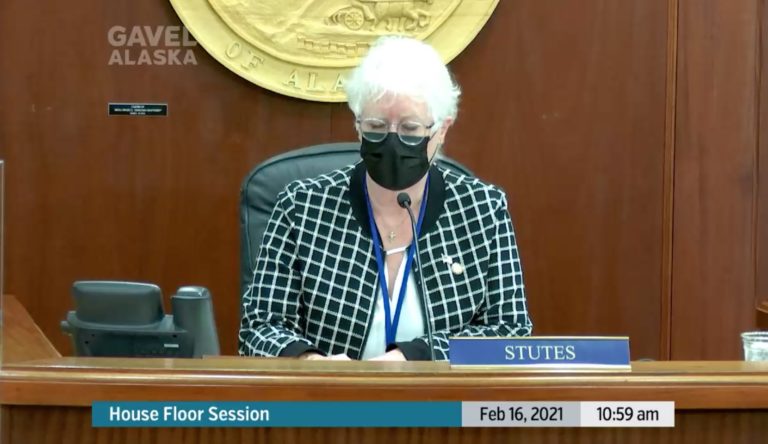
Numerous Democratic legislative staffers attended a Sham Jam fundraiser for an LGBTQ cause at the Red Dog Saloon on March 26, and have now “popped hot” for Covid. Thus, the House of Representatives has reinstated its mask requirement for the House Chambers. All members and staff must wear face masks, including when members rise to speak, Must Read Alaska has learned.
Sham Jam is an annual legislative fundraiser started by the late Sen. Johnny Ellis. It supports a different nonprofit each year. This year it is supporting the Southeast Alaska Gay and Lesbian Alliance. Beacon, the company that has the testing contract for the Legislature, has identified that as the super-spreader event.
The Chicago City Council has voted to ban city investments in coal, oil, and even gas companies. Chicago Mayor Lori Lightfoot and the city’s treasurer support the move. The city will develop a list of companies that the treasurer will be banned from investing in, and she will also divest in companies that are added to the list of blacklisted businesses. The city has about $9 billion in invested assets, including pension funds.
The measure to ban and divest was introduced in late February and approved Wednesday. The ordinance said, “The consequences of climate change stand to make Chicago a less desirable place to live and work, negatively affecting the fiscal and social health of the city. Divestment is to take place as soon as practicable and in line with the underlying investment policy.
Chicago is among 38 U.S. cities that have dropped their investments in fossil fuel companies, the ordinance stated. One state — Maine — has passed a law to make it the first state to divest from oil, gas, and coal.
This week, the Chicago City Council will take up another ordinance — to temporarily suspend the new 3-cent city tax on fuel, in order to help consumers deal with high prices at the gas pump. Mayor Lightfoot increased the city’s gas tax by 3 cents per gallon at the start of 2021 and is now asking the council to reverse the tax.
Mitigation efforts for the Hiland Road avalanche are complete and were successful, the Anchorage Mayor’s Office reported late Sunday afternoon. Those who were evacuated from the area will be allowed back to their homes, but officials urge caution and advised people to stay away until more work is done.
Although no more avalanche snow has reached Hiland Road or the homes along it, the road is still buried in snow and it will take as long as two weeks to remove the snow and debris to make the road passable.
Significant risks remain in place until snow clearing operations are complete, the Mayor’s Office said.
People are still needing to access their homes via a snow machine and foot trail that is being used, as well as an historic road that has been somewhat overgrown with alders in recent years. One four-wheel road was rough cut through an area on Saturday to provide another access point. Some people have been walking to and from their homes using established trails in the ravine below the avalanche.
Among those trapped behind the avalanche were a group visiting from Indiana, who had been staying at a rented vacation home past the avalanche area. They hiked out through the ravine in tennis shoes, according to officials who were on the scene. “It was quite a scene,” one said.
Maintenance crews will begin work to remove snow starting Monday, contingent on safety assessments, which will be made daily.
The Salvation Army set up a food truck near to the point where people were being evacuated, offering hot chili, coffee, and other snacks. Some elderly residents came out on sleds pulled by snow machines and were greeted with a hot cup of coffee by Salvation Army volunteers.
Roughly 100 city employees, including police, fire and rescue, and maintenance and operations personnel, as well as volunteers from Alaska Mountain Rescue were at the site today working through the problem of how to evacuate people and how to safely bring down the remaining snow slab. At this time, no lives are believed to have been lost in the avalanche, which occurred late Thursday night.
Assemblywoman Jamie Allard went by snow machine to talk to residents whose homes were isolated by the slide and she and other volunteers helped them load up some of their possessions and convinced others to leave the area for the afternoon.
After the cornice released above the avalanche, no major slide occurred on Sunday and no homes have been destroyed, a risk that had been explained by officials before the blasting occurred.
Assemblywoman Crystal Kennedy also visited with some of the neighbors but was not able to assist them in leaving as she is recovering from shoulder surgery.
Allard and Kennedy, who represent Eagle River on the Assembly, released a statement thanking the community and the city for its cooperation.
“[Jamie] Allard and [Crystal] Kennedy would like to thank the Bronson Administration, the Municipality of Anchorage including Municipal Manager Amy Demboski, the Anchorage Fire Department, the Anchorage Police Department, Office of Emergency Management, Building Services, Department of Law, Parks & Rec, and the Chugiak Birchwood Eagle River Rural Road Service. From the State of Alaska and other local partners, we thank Governor Dunleavy, the Department of Transportation, the Department of Public Safety, Alaska Railroad, Alaska Mountain Rescue, Salvation Army, American Red Cross, the National Weather Service and a myriad of volunteers,” their statement said.
“The amount of caring concern for neighbors and the constant vigilance over each other was truly inspiring. The residents went above and beyond to make the best of a stressful and dangerous situation,” the statement from Allard and Kennedy said.
“The number of agencies and people engaged in handling the challenges of a very large and unprecedented event in our community was impressive,” Kennedy said.
“The Hiland residents supported each other through what started as an incredibly scary event that could have turned to a very tragic event but now has turned into a happy ending and they should be proud of how they handled it all,” Allard said.
Another weather system is expected late Sunday night and will bring more snow to the Eagle River area, according to Municipal Manager Amy Demboski.
Four board members of the Palmer Chamber of Commerce were said to have quit the board, and by Sunday morning the chamber board — what was left of it — had reversed the decision to rename Colony Days as the “Braided River Festival.”
The backlash had only grown since the announcement was made late last week.
“Today, the Greater Palmer Chamber of Commerce announces the planned Colony Days rebrand will not move forward, following the GPCC Board’s unanimous vote over the weekend to revisit the decision.
“The board made an initial decision to rebrand the event based on assumptions that the feedback from a small segment of our membership was enough to make a decision internally,” said Ailis Vann, GPCC executive director. “That was a mistake, and we heard it loud and clear. Our attempt to present a full package to everyone at once came across as not being transparent and honest, and that was never the intent. We regret the hurt this controversy has caused our community, and our members.”
The name Colony Days will remain, including for the festival scheduled this year on June 10-12.
“We’ve learned a lot from this process and look forward to moving on and planning a Colony Days celebration the entire community can be proud of,” said Vann. “To the hundreds of people who spoke up: we heard you and are sorry. We will do better. The pushback has reminded us of the important role in our community that we and our decisions play and we don’t take that lightly.”
The GPCC plans to engage with its membership in greater depth on this issue in the coming weeks. Anyone interested in learning more about the chamber, its committees, board, and events is encouraged to visit www.palmerchamber.org.
The organization made no reference as to whether it would change the “Colony Christmas” celebration to “Hometown Holidays,” as announced in its rebranding last week. Update: The chamber has said Colony Christmas’ name will not be changed either.
Business owners in Palmer and leaders around Alaska responded with shock and dismay when the Palmer Chamber of Commerce announced its decision last week to ditch the name of the community’s iconic festival, “Colony Days,” and rebrand it the “Braided River Festival.” The chamber also rebranded the Christmas festival from “Colony Christmas” to “Hometown Holidays.”
While the chamber owns the festival, the community also takes ownership of it, as it has been a tradition for over 80 years. The only time the festival hasn’t taken place since 1936 was in 2020, when it was canceled due to the Covid-19 pandemic.
Now, a fight is underway in the peaceful farming town over the re-naming of two of its biggest yearly celebrations.
The Palmer Chamber of Commerce has taken a turn toward political correctness, and even opened last year’s Colony Days Festival with a “land acknowledgement.” During that acknowledgement, the president-elect of the chamber, Sam Dingas, acknowledged that the white settlers in the area are an issue with some people, that the name “Colony Days” doesn’t make everyone feel good, and that the land is “unceded territory” of the Ahtna Athabaskan people.
“And we recognize that the word ‘colony’ has hurtful connotations,” Dingas said in 2021, and he then mentioned “braided river,” hinting of the new name to come.
“Not everyone’s experience of the Palmer story is the same,” he said.
In order to create a sameness of experience, the new brand “Braided River Festival” was rolled out last week, surprising the entire community.
The chamber’s first public communication about the negative reaction it received was Friday on Facebook. The message indicated the chamber had been prepared and had budgeted for dissent, but the decision would stand and volunteers are needed to produce the newly named event:
“Yesterday, we made news. Today, we hear you. Tomorrow and beyond, we look forward to your continued engagement with the Greater Palmer Chamber of Commerce. To everyone who has called, emailed, posted to social or otherwise reached out, thank you. We appreciate the feedback. Let us clarify a few things to make sure we’re all on the same page. A few things to know: The decision to change the name from Colony Days to The Braided River Festival was voted on and approved by our Board of Directors. It was not an overnight decision. It was thoughtful, and deliberate. Our board is made up of a diverse group of community and chamber members throughout the Palmer area. This event has been managed and coordinated by the GPCC for more than 40 years; it is powered by chamber staff and volunteers. While the event name will change, the many proud traditions that generations of Palmer residents (and beyond) have grown to love will remain the same. We always need many volunteers to pull off this event. Want to get involved? Join the chamber! You would be hard pressed to find a more hardworking, welcoming group of people. The GPCC works to promote a business-friendly environment for our members and the entire Palmer business community. Join us. For more information on the decision to rebrand the event to The Braided River Festival, visit our website,” the Palmer Chamber wrote on Facebook.
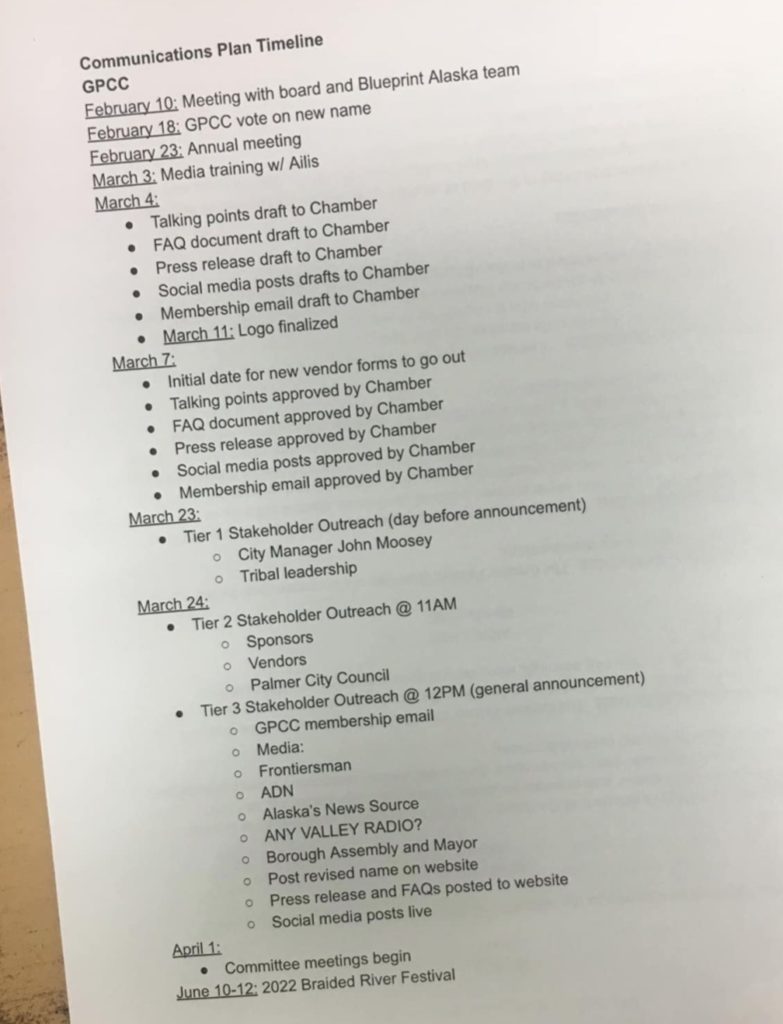
Documents showed up online indicating that the Palmer Chamber had set aside $10,000 to help manage the public relations for the name change through June. The talking points were prepared well in advance.
The mitigation plan for the rebranding of Colony Days.
The Chamber took a different tone on Saturday, asking for people to refrain from attacks, which had, by then, gotten ugly:
“Greetings community members, Over the last several days, we have learned just how important the name Colony Days is to this community. I write today to provide an update on what the Chamber is doing, considering the incredible amount of feedback we’ve received on the decision to rebrand the Colony Days event. Please know the board is listening to everyone. We apologize for not returning calls, texts, and emails as promptly as we would like, but the amount of correspondence has been overwhelming. Regardless, we are collecting all feedback and will review it as a group on Monday and discuss next steps. We appreciate your passion and dedication to this community. I am confident that all of us, board members included, only want what is best for the community of Palmer. I would ask that as we work to resolve this situation that we do so with compassion and empathy for each other. Some of the comments directed at our members have devolved into ugly personal attacks that are unfair and uncivil, even threatening. Whatever differences we have on this issue, I know we can discuss them in a calm, professional manner that highlights us being friends and neighbors first. Please stay tuned. An update following our Monday meeting will be sent to our members and sponsors, and then we will post that same update here. Thank you for your patience and understanding, Ailis Vann, Executive Director.”
Whimsy, a store in downtown Palmer, started a thread on Facebook:
“The rebranding of Colony Days struck a deep chord in the community. As business owners and chamber members, the news we heard today was a punch to the gut. “We completely understand why the community is so upset over this decision by the chamber board. We found out the chamber secretly and unilaterally made this decision at the same time the community learned of it.
“As business owners, we avoid mixing business with divisive social and political issues. We are very disappointed in the actions taken by the board of the Greater Palmer Chamber of Commerce, because it put us in the position of being scapegoated for a poor decision that impacts the economic viability of the Palmer business community.
“The Palmer business community is dedicated to working together to make the special events in Palmer a success, because we love this community.
“We will be responding as chamber members and will also be letting the chamber board know how exactly we feel about this divisive decision,” the store owners wrote.
That post received more than 350 positive reactions from Facebook users, and was shared over 200 times to other accounts. All of the comments supported retaining the name Colony Days in honor of farming settlers.
Peak Boutique was also outspoken in its disapproval:
“Peak Boutique learned about the rebranding of Colony Days at the same time the community did. As a member of the Palmer Chamber of Commerce, I was disheartened to learn the chamber board acted in secrecy with little to no input from the business community and membership. I am dumbfounded the chamber board would make a decision without having the foresight to recognize the political backlash that would fall on the shoulders of a business community with no involvement in the decision. I do not like my politics to be a part of my business. There is a time and a place to be respectful for both. However, the decision by this chamber board backed many of us into a corner. We are now forced to pick up the pieces of a poorly delivered and politically insensitive decision. I feel it necessary to make a statement, because now our businesses are in the crosshairs of the public wrath caused by the board. The social media outrage calling for the boycott of our businesses is concerning. Clearly, this chamber board has little regard for the potentially devastating economic outcomes of this decision.The business community in Palmer is made up of some of the most creative, friendly, supportive and giving people I have ever met. They are not ‘my competition,’ they are my FRIENDS. As we navigate through this, please know that we do not support this rebranding of Palmer’s Colony Days. Many of us will not be silent as we move forward toward a solution.”
And so it went, with no one defending the Palmer Chamber of Commerce, and many making vows to never go to Palmer again and to boycott the businesses there, which then upset the business owners who say they are not at fault for the chamber’s decision, which they didn’t know about.
By Saturday, a Change.org petition was started to pressure the chamber to reverse the decision. More than 6,000 people had signed the petition by Saturday night.
Then, a protest was in the works: On March 28, a “peaceful demonstration” in Palmer is scheduled from 4-6 pm at 550 S. Alaska Street — in the heart of the Palmer business district. Those who have Colony Days branded items are encouraged to bring them and to also make signs.
Meanwhile, people across Alaska started posting criticism of the the public relations roll-out plan, which shows that the chamber has been busy with the decision for many weeks, and budgeted $10,000 for public relations, because it expected fallout.
Sen. Shelley Hughes issued a statement on Saturday, saying she was hearing from constituents that they were angry and felt disrespected by the Palmer Chamber of Commerce, which had not included the public in the rebranding of the festival that honors the farming settlers who came to Palmer in the 1930s and 1040s to try their hand at farming in Alaska.
“My initial reaction when I heard the news of the name change was concern for our community elders who were children of Colonists in the ’30’s and ‘40’s and deserve honor and respect in this stage in their lives. I immediately knew in my gut that local residents would not be happy and that the Palmer Chamber Board would take heat. That seems to have come to pass. The consternation has been quite palpable! I’ve been hearing steady outcries from constituents all the way from Juneau. The most interesting contacts have been from Alaska Native residents and from descendants of the Colonists, all who were furious about the name change. I personally am tired of the “woke” and “cancel” culture and attempts to rewrite history. Since time on earth began, land around the globe has been home to changing people groups. What is important and beautiful about Alaska now is that we are constantly working together to be better at being communities. Let’s stop the guilt game and move forward. Palmer was a trading station in the late 1800’s but it was the agricultural settlement, the Matanuska Colony Project, that made it a vibrant community, the foundation for our charming town today. That Colony history should not and cannot beerased. It is part of who we are. It is part of what makes Palmer, Palmer. Colony Days and Colony Christmas are Palmer through and through. The replacements names, Braided River Festival and Hometown Holidays are homogenous, nonidentifiable titles for events in Anytown, USA. Let’s hope the Palmer Chamber Board* reconsiders its decision**. Whatever happens, my family and I will proudly continue to call them by their proper Colony names as we also continue to value, respect, and love our Alaska Native friends and neighbors,”Hughes wrote.
Alaska gubernatorial candidate Charlie Pierce and his running mate Edie Grunwald issued a statement that criticized the change. They were among the hundreds who wrote on numerous pages on Facebook about their displeasure with the decision to erase a piece of Alaska history.
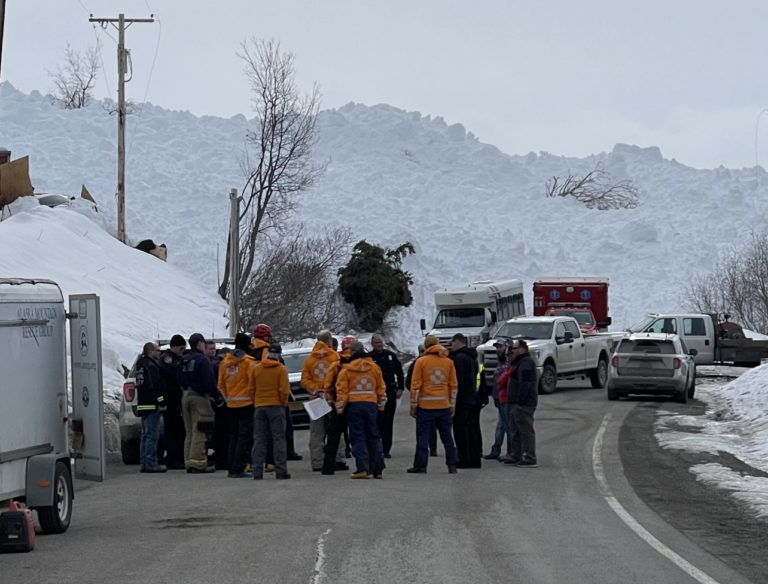
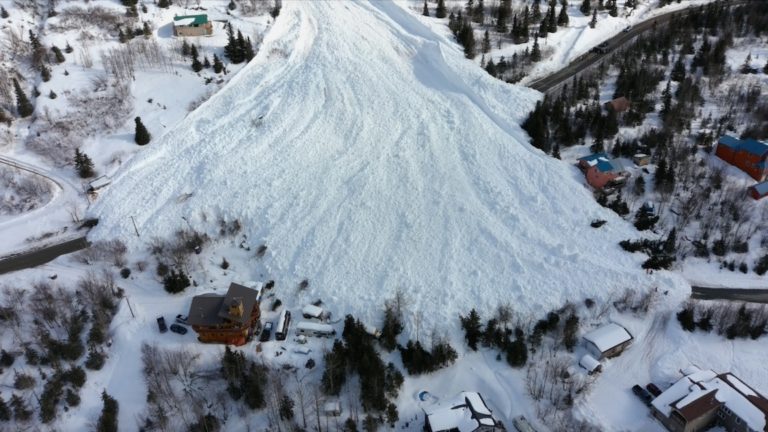
Anchorage officials continue to coordinate operations at an avalanche the area of the Hiland Road in Eagle River. Mayor Dave Bronson, City Manager Amy Demboski, Assemblywoman Jamie Allard, and Gov. Mike Dunleavy visited parts of the area, and the mayor has declared a disaster for the area of the slide, which occurred Thursday at about 11:30 pm in the 2400 block of Hiland Road.
Parts of the slide debris field are as deep as 80 feet. While narrowly missing homes, the avalanche was about 300-400 feet wide at the base and caused power outages at over 100 residences. Many residences remain cut off from road access, and it is estimated that it will take several days to clear the road.
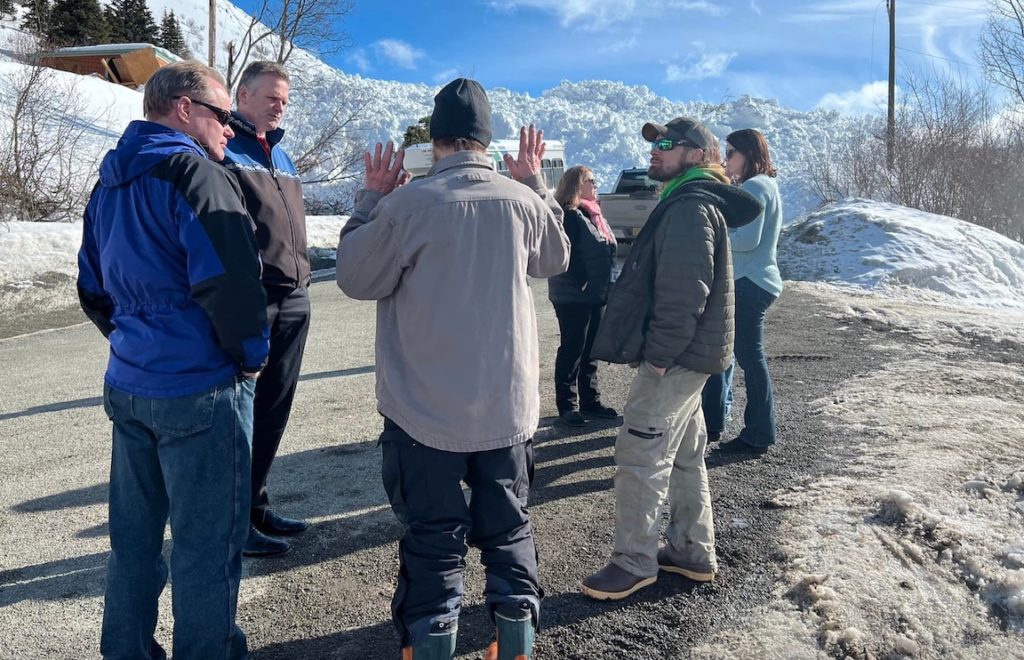
Mayor Dave Bronson, Gov. Mike Dunleavy and other officials discuss the avalanche situation across Hiland Road on Saturday.
100 houses, some with medically fragile people, are trapped on the far side of the avalanche. There is now a firefighter placed on that side of the avalanche.
Officials say there is no sign that anyone was buried by the avalanche. On Friday, several households in the area were advised to shelter in place. By Saturday, a couple of dozen households were asked to evacuate, as more slides are possible, and slide warnings have been issued.
On Saturday, Anchorage Mayor Dave Bronson left the Governor’s Prayer Breakfast and headed to Eagle River. He issued an emergency disaster declaration and asked the state for help with the response and recovery.
On Friday, a Red Cross evacuation shelter was established at the Harry J. McDonald Memorial Center in Eagle River, to receive evacuated residents who needed a place to stay.
Residents were asked to stay clear of the slide area, and to not walk on the main slide.
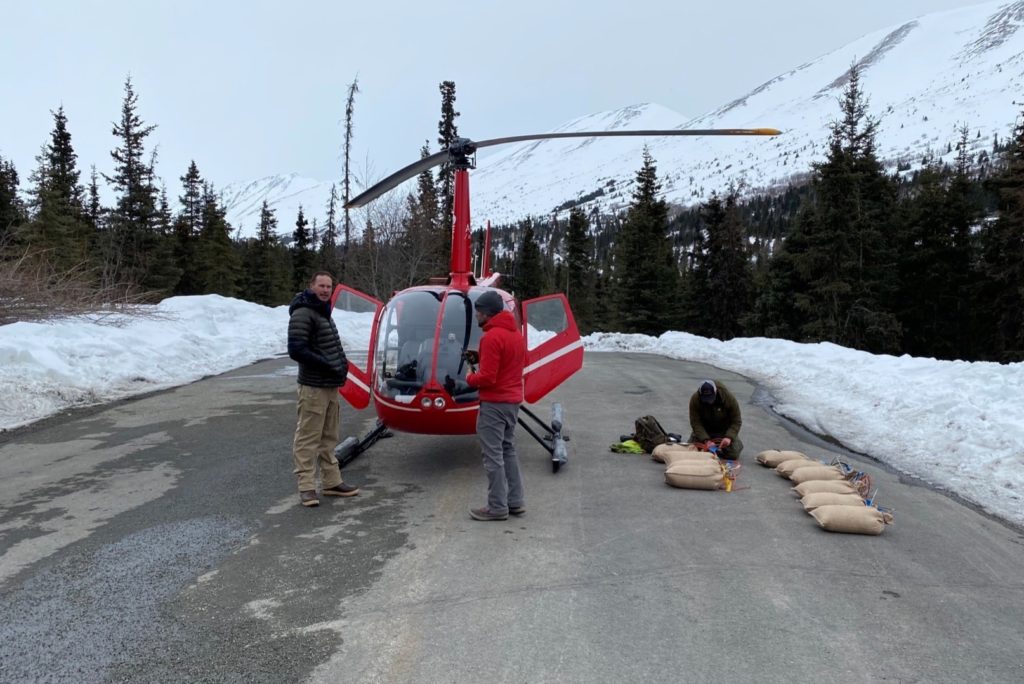
Update: The city has two choices: Bring the rest of the avalanche down with explosives, or let it slide on its own. Both options have risks, including which entity would take the risk for homes that could be destroyed if explosives are used and who would be responsible for replacing those homes. And the explosive route cannot be used if some people refuse to leave their homes, which is currently the case. Another storm is expected tomorrow, which could add more snow onto the already fragile snow load that is bound to come down and follow roughly the same route as the first one.
Responders are now using a snow machine trail to access the people who are cut off.
A member of the Kenai Borough Assembly has filed for Alaska Senate for Senate Seat D, previously known as Senate Seat O.
Jesse Bjorkman, a personal friend to Senate President Peter Micciche of Kenai, has put his name on the list at the Alaska Public Offices Commission and has publicly stated he wants to give Kenai Peninsula voters someone else to vote for other than Tuckerman Babcock, who has already filed for the seat.
Babcock is from the Soldotna area and has statewide name recognition, having served as the former chairman of the Alaska Republican Party. Bjorkman is a teacher from Nikiski, with less name recognition but union backing.
Senate President Peter Micciche has not said whether he is going to stay in the race, but he has filed. Micciche assumed office in 2013. His current term ends in January 2023.
Bjorkman was a proponent of Ballot Measure 2, the initiative that brought in ranked choice voting to Alaska, and which has now created a challenging election cycle, since the death of Congressman Don Young.
Last year, Bjorkman said that he felt a “large increase in male energy” from having taken a Covid vaccine and so encouraged everyone to get vaccinated, as seen in this video from a Kenai Assembly meeting:
A National Education Association member, he was also featured in the New York Times for his work teaching his students how to butcher wild game such as moose.
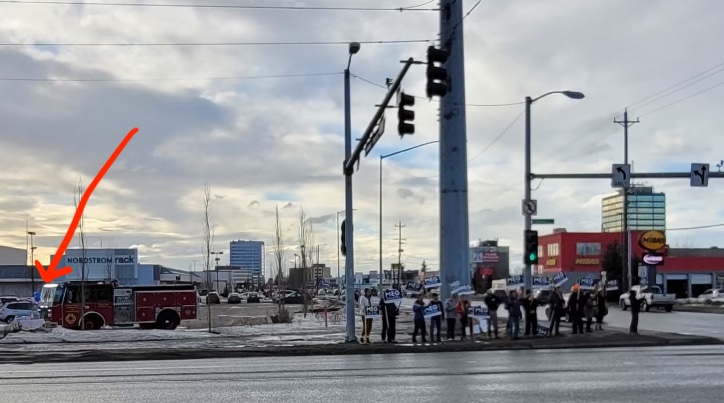
Assemblywoman Meg Zaletel managed to get a fire truck parked right behind her at her sign-waving event on Friday evening at the corner of Northern Lights Blvd. and Seward Highway. The campaign appeared to have tied balloons to the front of the fire truck.
If city equipment has been positioned to give an appearance of support to a campaign, it would be misuse of taxpayer-funded assets.
Zaletel has the backing of the unions. She is being challenged by Kathy Henslee for a midtown seat on the Assembly.
It’s not a direct endorsement, but it’s a shady look for the fire department and for Zaletel to have a fire truck parked at the end of a parking lot, with no particular purpose other than to give her campaign gaggle some nice color in the background.
The Anchorage School Board has narrowed its search for a replacement for Superintendent Deena Bishop, who announced in November that she will retire in June.
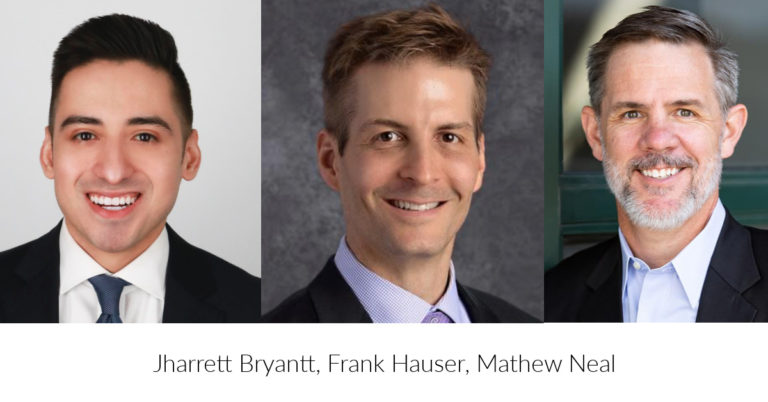
The three finalists hail from Texas, Sitka, and Colorado.
Texan Jharrett Bryantt is an executive in the Office of Talent at the Houston Independent School District in Texas, which is described as one of the largest school districts in the nation. Bryantt has been an assistant superintendent and served in other capacities since 2013. A Teach for America alumnus who taught math and science in Houston before moving into administration, he has a doctorate in education leadership and policy from University of Texas.
Alaskan Frank Hauser has been the superintendent of the Sitka School District since 2021. He served as principal of Robert Service High School in Anchorage and as assistant principal of curriculum for Dimond High School. He was named 2019 Alaska Principal of the year by the Alaska Association of Secondary School Principals. He is a graduate of the University of Alaska and received his Masters from UAF; he has been in Alaska education for his entire school career.
Coloradan Mathew Neal is the current superintendent of Woodland Park School District, a position he has held since 2021. Neal worked in Kuwait as superintendent of American Creativity Academy and has worked in other leadership capacities in Colorado and Wyoming.
Some 23 people applied for the position of Anchorage superintendent. A search firm, Ray and Associates, managed the nationwide search on behalf of the board.
Complete information about the candidates and the interview process is at this link.
A virtual community town hall with the three finalists is planned for March 29, 5-6:30 pm. Details:
Webinar ID: 974 4618 5123
Tue, Mar 29 5-6:30 pm Superintendent Candidate Search: Community Town Hall