Monday, May 11, 2026
Home Blog Page 885

Supreme Court intervenes: Puts hold on judge’s activist decision on district maps for Eagle River, Girdwood

The Alaska Supreme Court has stayed the Superior Court order by Judge Thomas Matthews that directed the Alaska Redistricting Board to adopt Map 2 for Senate pairings for East Anchorage, Eagle River, and Girdwood. Judge Matthews earlier this week ordered the board to adopt the map, after he said he did not like the second map the board drew for Senate districts in East and South Anchorage. Matthews had ordered the Democrats’ preferred map be used for the 2022 election cycle, rather than the one the redistricting board had decided on.

The Alaska Redistricting Board has petitioned the Supreme Court for review of the Superior Court decision. The Supreme Court is reviewing petitions over the next few days. A date for oral arguments, if any, has not been set. 

The litigation page at the Alaska Redistricting Board’s website has been updated with the Board’s Petition to Review filed with the Alaska Supreme Court last night. More about the ongoing litigation over the Anchorage Senate districts can be found at the Alaska Redistricting Board’s homepage.

Related story and background from May 17:

Biden’s ‘Ministry of Truth’ put on hold due to controversy

By CASEY HARPER, THE CENTER SQUARE

President Joe Biden’s Department of Homeland Security “Disinformation Governance Board” has been put on hold after quickly falling into controversy, according to media reports. Critics have dubbed it the “Ministry of Truth,” and described it as Orwellian and communist.

The Washington Post on Wednesday reported a pause for the board, which DHS head Alejandro Mayorkas announced at a Congressional hearing last month. 

Mayorkas told lawmakers the board would use federal law enforcement power to address disinformation. He gave the examples of bad information given to migrants as well as Russian disinformation.

“The goal is to bring the resources of (DHS) together to address this threat,” he said before Congress in April.

Soon after, videos emerged online showing the woman tapped to lead the board, Nina Jankowicz, making a series of controversial comments. News outlets reported her resignation Wednesday.

Critics also raised concerns about how such a board could be used to silence free speech. Several lawmakers took issue with the board.

U.S. Sen. Marco Rubio, R-Fla., posted a video on Twitter saying the “Soviet-style censorship agency” is evidence “the Marxist left are coming after your most basic constitutional rights.

“A lot of people don’t know this, but the Department of Homeland Security just set up a new office that’s going to be a speech police,” Rubio said after the board was announced. “They’re basically going to be focused on misinformation … so instead of the Department of Homeland Security focused on stopping drugs from coming into America or securing the border, stopping illegal immigration, they’re not going to be focused on that. They’re focused on policing speech, on making sure that people cannot share information or say things that they decide is misinformation.”

WalletHub: Where does Alaska rank in job resignations?

WalletHub ranks Alaska as first in the nation for how frequently people leave their places of employment. For April, 3.90% of Alaska workers resigned. The average resignation from Alaska jobs over the past 12 months was 4.15%.

Florida comes in at second place, and Arizona at third, on an annual basis.

New York State had the lowest number of job resignations last year, at 1.95%.

Alaska has one of the most transient workforces in the nation, with an emphasis on seasonal jobs such as construction and fishing, which boosts the number of resignations up, perhaps somewhat artificially. It also has a high number of government jobs, where the workforce is especially stable.

The top ten:

To view the full report and other state rankings, click on this link.

Defined pension HB55, for public safety, dies in Senate after Alaskans make their voices heard

A bill that would have reinstated a defined benefits plan for some public employees has failed to make it through the Alaska Senate before the Legislature gaveled out for the year.

The bill, HB 55, would have restarted a plan for firefighters and peace officers, which was introduced as a method to recruit and retain public safety officers and replace the current defined contribution plan with a set pension, similar to the one that existed before 2006 in Alaska.

Americans for Prosperity Alaska State Director Bernadette Wilson said the bill dying was a victory for fiscal responsibility. Her group had raised the alarm over the likely costs for returning to a pension plan, when the previous plan has not yet been paid down. Her group counts this as a win, after volunteers made hundreds of calls to lawmakers asking them to vote no.

The bill, pushed by public sector unions, was flawed by many accounts. According to the Equable Institute, the plan provided slightly worse retirement benefits for most Alaska peace officers and firefighters, compared to the current defined contribution plan.

More about the score the Equable Institute gave HB 55 here.

The Equable Institute also said:

  • Short-term workers would likely be worse off under the proposed retirement plan. 
  • Medium-term workers could be slightly better off under the proposed plan than the current plan depending on personal factors in their career; but even if they are the proposed plan’s value is below common standards for adequate retirement income. The proposed plan does not meaningfully improve retirement security prospects for medium-term workers.

“Because the proposed pension plan does not provide meaningfully better benefits, it is unclear whether adopting HB55 would achieve the stated goal of its proponents to improve retention,” Equable said. “Most academic literature suggests that few individuals join public service because of the retirement benefits, and other factors like salary, health benefits, and working conditions are stronger factors for retention than retirement benefits (no matter the plan design).

If the public employee unions want to push the effort to return to defined pensions, they’ll need to reintroduce legislation next year, as HB 55 is now dead.

Permanent Fund dividend whittled down by Bill Walker allies in House, but is still largest in history at $3,200

A Permanent Fund dividend and energy assistance check that started at $5,500 in the Senate two weeks ago was whittled down to $3,200 late Wednesday night at the close of the Legislative session.

Lawmakers needed a three-quarters vote to access some funds from the Constitutional Budget Reserve to pay for the compromise that came out of the conference committee, which was $3,850.

Sen. Bert Stedman, co-chair of the Conference Committee, put a poison pill in the compromise. An opponent of the statutory dividend, Stedman counted on the House not being able to come up with the three-quarters vote to access the CBR, and he was right.

Late at night, just before the House was required to adjourn for the year, the political knives came out by the Democrats who oppose the reelection of Gov. Mike Dunleavy and wanted to try to take away a win from him. Of the 11 Democrat House members who voted against the $3,850 dividend (by voting against the CBR), six of them are deeply aligned with the campaign for governor of former Gov. Bill Walker, who started the tradition of cutting the dividend in 2016 and who was booted from office in 2018.

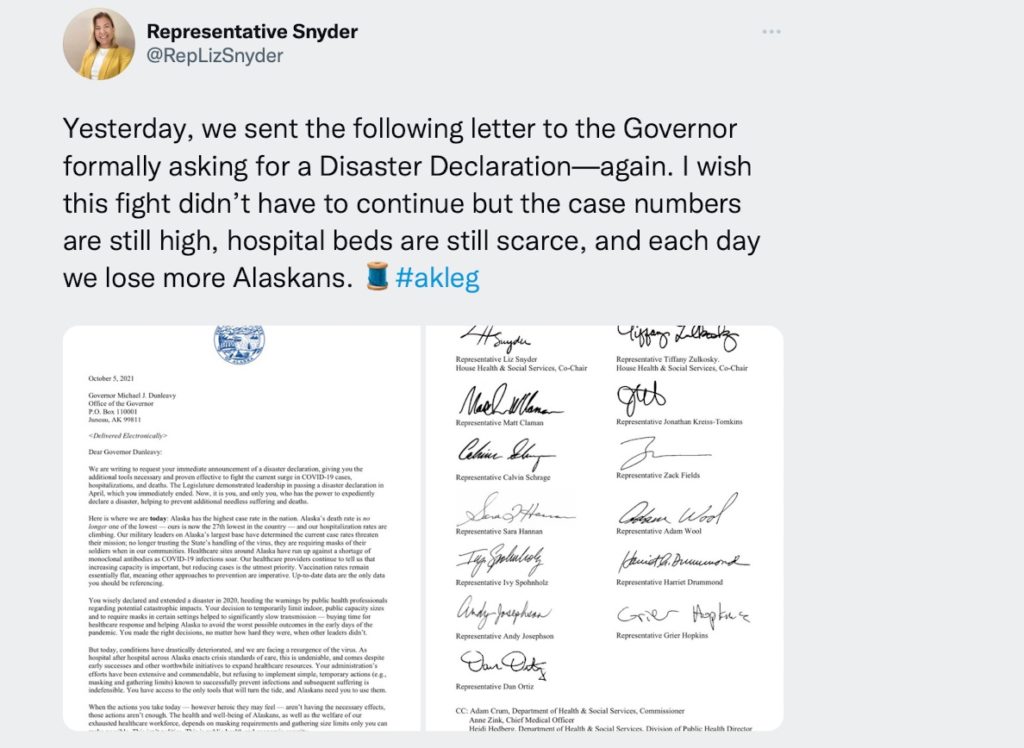
Those House members are Reps. Brice Edgmon, Tiffany Zulkosky, Andy Josephson, Adam Wool, and Daniel Ortiz — all who have signed on as co-chairs of the Walker-Drygas campaign.

The sixth, Rep. Grier Hopkins, is a defacto Walker surrogate, with close family ties to the former governor: He is related by marriage to Scott Kendall, Walker’s former chief of staff and who has been deeply involved in his current campaign for governor. Kendall also led the failed push to try to recall Gov. Mike Dunleavy.

Even though it is smaller than proposed in the compromise by the conference committee, the dividend is the largest in history, and it’s unlikely the governor will veto it and hold out for the extra $650 for every Alaskan. He has won most of what he set out to get, which was a full statutory dividend for Alaskans and an even-up for what was taken from them last year by the Legislature. He’ll likely turn his political sights on getting new legislators elected who will support using the statutory formula, rather than keeping Alaskans entrenched in PFD warfare year after year.

What was practically unthinkable in January has somehow made it through the legislative process in what is an election year for nearly all of the members of the Legislature. The final number is: $2,550 Permanent Fund dividend and a $650 relief assistance bonus on that dividend for every eligible Alaskan.

Michael Tavoliero: Education must create citizens

By MICHAEL TAVOLIERO

I would like to offer a thought or two regarding Jodi Taylor’s May 16, 2022, Must Read Alaska column.

First and foremost. Thank you, Jodi. 

My hope is the direction we take as a state, as a community, and as individuals, is to understand that it is the parents who must be the ultimate determiner of their childrens’ education. When parents are given this control and held accountable and responsible, that can create an environment where government education will have to compete with the private sector.

We must do this now and not tomorrow. Thomas Sowell points out, “The big problem in the long process of dumbing down the schools is that you can reach a point of no return. How are parents who never received a decent education themselves to recognize that their children are not getting a decent education?”

First and most important, Alaska education is about our children’s future. It is not about anything else. It is not a platform for social justice, it is not an echo chamber for situational morality, and it is not a foundation for political demonstration and insurrection.

Education must create literate citizens.

Perhaps the unintended consequences of the Correspondence School Allotment Program are that parents may realize they’ve been duped by their own government. 

Using Jodi’s example, parents receive up to a $4,000 reimbursement per student from the Anchorage School District and personally spend an additional $2,000 for one year tuition at St. Elizabeth Ann Seton private school. They attend full time and are also enrolled in the Anchorage School District’s Family Partnership Charter School. 

I read the internet reviews of St. Elizabeth Ann Seton private school by parents. They were impressive.

Parents living in Anchorage who own their home pay 8.47 mills in property tax for education in Anchorage for 2022.  According to Alaska’s News Source, the beginning of 2022 set the average single-family home in the municipality as property tax assessed at $400,949. That’s an additional cost to the parents of $3,396.04 for education for 2022 without any benefit since the student allotment is based on the Base Student Allocation, which is state money and not MOA property tax money.

Sure, the argument can be flimsily made that this pays for the Anchorage School District’s overhead in administering the Anchorage School District’s Family Partnership Charter School, but couldn’t this be bypassed with a direct allocation to the parents from the state?  After all, depending on how you read the Alaska Department of Education and Early Development’s budget, some 18% to 25% of its 2021 $1.66 Billion budget went to administration. Why do we have another layer of administration designed to financially damage its constituents?

Jodi states, “Alaska spent $20,553 per student in average daily attendance in 2019-2020, yet correspondence homeschool students currently receive only the Base Student Allocation, or $5,930 each as a base, depending on district (the Base Student Allocation is only part of the cost per student).” She is pointing out a systematic theft by government with no reward.

Are parents who are guilty of the only crime of seeking an exemplary education for their children being punished by this additional financial burden? 

In a school district that flaunts the superior features and benefits of equity, do any of you see this as a demonstrable inequity?

Michael Tavoliero is a realtor in Eagle River, is active in the Alaska Republican Party and chaired Eaglexit.

Notes from the trail: Mark Begich endorses Chris Constant for Congress, Les Gara has a barbecue with Vic Fischer

As of Tuesday, about 58,000 of the ballots in the special election primary for Congress had been voted and turned into the Division of Elections. That’s about 40% of the high end of the “expected vote” in this election, but with a mail-in election and a short campaign season, it’s still anyone’s guess, as Alaskans begin the process of replacing their congressional representative.

Political family splits: Mark Begich, former mayor of Anchorage, former U.S. senator, and now businessman, has endorsed Chris Constant for Congress, even though his nephew, Nick Begich, is running for the same seat. Constant is a Democrat, like Mark. Some thanks Nick gets for having provided capital for his business ventures. (Corrected).

On the air: Tara Sweeney, running for Congress is making her move in media. Her campaign and the independent expenditure group supporting her just bought over $80,000 in broadcast ad buys for messaging from May 17 through May 26, which means it will be the Tara show on the airwaves. Carpet bombing.

Halcro on Twitter: Andrew Halcro, running for Congress, is running a series of ads on social media that look like they were done by Fivrr, the overseas design shop that lets you have graphics built on the cheap offshore. His latest is a cartoon video showing he supports Lisa Murkowski, LGBTQ, Abortion, and that he believes climate change is real and supports gun rights. It’s the kind of production that might cost him $200 to have produced. The whole campaign is beginning to look like a marketing venture for something else Halcro is doing in the future. He doesn’t use legal disclaimers on his ad, per FEC.

Sealaska pulls the race card: Vote for a Native, Sealaska says in its recent message to Alaska Natives. “Let’s send one of our own,” is how the corporation puts it. Imagine if the Daughters of the American Revolution or garden variety “white person” wrote such a thing.

The known Alaska Natives running for Congress are Mary Peltola, Emil Notti, and Tara Sweeney — none are Sealaska shareholders.

Palin fundraisers in Florida, Georgia: Sarah Palin is raising funds in Ponte Vedra Beach, Florida and Savannah, Georgia this week, with former Gov. David Perdue.

Les Gara barbecue: Running for governor, Les Gara says he is the only pro-choice candidate. Special guests Vic Fischer and Jane Angvik and music by Hannah Yoter are notable for this downtown Anchorage event. Downtown Anchorage is Gara Country. No word on what they are barbecuing but surely it will be a carbon neutral event. Maybe Les is going to clean out his freezer full of last summer’s salmon.


Follow up: Palin files federal financial disclosures, but Revak, Halcro, Wool still missing

Following a Must Read Alaska story Tuesday on the financial disclosures by congressional candidates that were due Monday, former Gov. Sarah Palin filed her disclosure with the Clerk of the Congress, as required by the Congressional Ethics Act.

The disclosure shows her financial investments and where she has made her money from in recent years. There is nothing remarkable in the filings except that much of her income has been generate through an online program called Cameo, in which celebrities get paid to give shout-outs to people for their birthdays, anniversaries and more. Palin reported $200,000 in income from making these short videos.

One of these Cameo videos was contracted by some friends of congressional candidate Tara Sweeney last year, who evidently paid Palin for it, as Sweeney was retiring from the Department of Interior, with the election of Joe Biden for president. It can be seen at this link.

A screenshot from one of the Sarah Palin “Cameo” videos that she has done to earn income over the past year. This was the Cameo for Tara Sweeney.

Palin reported her assets as between $950,000 and $2.4 million. Her Wells Fargo savings account has between $500,000 and $1 million. The financial report shows that she has had a successful career as a political figure since being governor of Alaska.

View the financial disclosure forms for all the congressional candidates who filed them at this link. Use the search function and be sure to click on the “candidate” tab.

Candidates who raise more than $5,000 are required to file these disclosures for the special election now underway to fill the Alaska seat in the U.S. House of Representatives. Still not filed are congressional candidates Josh Revak, Andrew Halcro, Adam Wool, and dozens of others who have not mounted strong campaigns.

Biden visit to Korea includes Alaska fueling stop on Thursday, closing air space around Southcentral

President Joe Biden’s expected trip to Korea on Thursday will mean a stopover at Joint Base Elmendorf Richardson, where Air Force One will refuel before making the last leg of its journey over the Pacific.

The Federal Aviation Administration and Transportation Security Administration has issued a Temporary Flight Restriction for areas around Southcentral Alaska on Thursday.

White House press secretary Karine Jean-Pierre and national security adviser Jake Sullivan said on Wednesday that Biden will not be visiting the Demilitarized Zone between North and South Korea on this trip because he has visited it before.

“Just to reiterate here is that as vice president, he has been there before,” Jean-Pierre said. “He is just not going to go on this trip. He is going to go to South Korea. He is going to show his support for the region.”

The FAA said that previous Temporary Flight Restrictions in this area resulted in numerous violations and reiterated the agency needs support from the aviation community to get the word out and stay clear of the affected area.