Monday, May 11, 2026
Home Blog Page 878

Anchorage ballots arrive for downtown Assembly seat

The Municipal Clerk’s Office mailed approximately 37,000 ballot packages on Tuesday to qualified registered voters in District 1, North Anchorage, also referred to as Downtown Anchorage.

Downtown voters can anticipate receiving their ballot package in the mail by Tuesday, June 7, the Clerks’ Office said. The final day of the mail-in election ends June 21.

Voters in the downtown district are getting a second seat on the Assembly, almost ensuring that the Anchorage Assembly will remain controlled by liberals for years and decades ahead.

The change came about when the Assembly placed the question on the ballot, and Anchorage voters approved the measure last year. Candidates who filed to run for the seat include Cliff Baker, Rob Forbes, Tasha Hotch, Robin Phillips, Stephanie Taylor and Daniel Volland.

Additional Election Information

For additional Municipal Election information, visit muni.org/elections, call 907-243-VOTE (8683), or email [email protected]. 

Anchorage ending Sullivan Arena shelter availability on June 30

Anchorage Mayor Dave Bronson announced that the Municipality of Anchorage will end its pandemic-era mass shelter operations at the Sullivan Arena effective June 30, 2022.

The onset of the Covid-19 pandemic thrust the Muni into providing adequate shelter options for those affected by the virus, the mayor’s office said. When Covid-19 arrived in Anchorage, local nonprofit shelters did not have the capacity to meet physical distancing requirements, and thus the Sullivan Arena was reassigned to fill the gap. Since March 2020, the Sullivan Arena has been operating as a temporary mass shelter site, housing many homeless men.

Given the significantly diminished impact the virus is having on the community, lack of emergency declarations at the local and state level, and FEMA’s reimbursement of Covid-related expenses ending on July 1, 2022, the Muni is moving forward with a comprehensive plan to transition those at the Sullivan Arena into viable housing options.

“It is time to close this chapter in our city’s history and move forward with a bold plan that both treats those experiencing homelessness with dignity and restores the Sullivan Arena to its intended purpose as a place for memorable community gatherings and events,” said Bronson. “Our transition plan is a robust bi-partisan public-private partnership that has been in the works for nearly a year, and represents the largest investment ever made by the Muni to address homelessness in our community.”

The Administration has begun the process of notifying residents at the Sullivan Arena, and the Municipality is working with local non-profits and providers to transition individuals into housing options that meet their specific needs. Roughly 320 individuals currently reside at the Sullivan Arena.

The transition plan relies on planks established by the facilitated workgroup, made up of the Administration and Assembly, and will involve moving individuals into permanent supportive housing, workforce supportive housing, drug and alcohol treatment facilities, and other temporary housing options. Additionally, with the Muni-backed Navigation Center expected to open this fall, an additional 150 beds will be available for temporary sheltering needs.

For more information on the Municipality’s comprehensive response to homelessness, click here.  

Notes from the trail: Over 92,000 Alaskans have voted; Palin loses bid for New York Times court retrial

As of Tuesday, 92,845 ballots have been cast in the special primary election for the temporary U.S. Congress seat being contested by 48 candidates. That is an average of 1,240 votes per day coming into the Division of Elections over the past four days. Republican ballots are outpacing Democrat ballots 2.14-to-1. There are 11 days left before the election deadline. Rural turnout remains low.

Memorial Day observances: At the Anchorage Memorial Day event, we noted that U.S. House candidates Sarah Palin, Nick Begich, and Chris Constant were in attendance. Also we spotted U.S. Senate candidate Kelly Tshibaka and her family. Above, Rep. Cathy Tilton, Kelly Tshibaka and Mayor Edna DeVries of the Mat-Su Borough and Mayor Glenda Ledford of Wasilla take part in the Memorial Day ceremony in the Valley.

In town, but missing: Al Gross for Congress was not spotted at any of the official events, but did have a private barbecue with some of his friends, including Alaska House candidate Andrew Gray and Alyse Galvin, both who are Democrats who are running for Alaska House seats.

At the Valley memorial event, there were many legislators in attendance, and Sen. Dan Sullivan spoke at that event, as well as at the Anchorage memorial event. Nick Begich was the only U.S. House candidate spotted.

Chesbro wants gun control: In the Anchorage Daily News, U.S. Senate candidate Pat Chesbro is preaching gun control: “In this month alone, we have seen two teens, barely old enough to vote, shoot more than 30 people, including children. I am outraged that, once again, elected leaders from the GOP are offering only thoughts and prayers while extolling the rights of gun owners to own any weapon they choose, even those whose sole purpose is to kill humans.”

This, she wrote, just before further condemning thoughts are prayers: “Thus far, thoughts and prayers have not ended school or grocery store or night club or movie theater shootings in this country. The United States has more mass shootings than any other country. There is no magic wand we can wave that would address these atrocities but doing nothing has certainly not worked. Defunding research around gun violence has not helped to inform us about ways to address both the violence and the reasons 18-year-old teenagers would commit these crimes.” Her op-ed continued the talking points of Democrats.

Note: The AR-15 is used by Alaska Natives in hunting seal and sea otter.

Filing photos: Forrest Dunbar, above, took a selfie as he filed for Alaska Senate, and Andrew Gray invited his family to join him as he filed to run for House District 20, Anchorage University district. So far, Dunbar is unopposed, as is Gray.

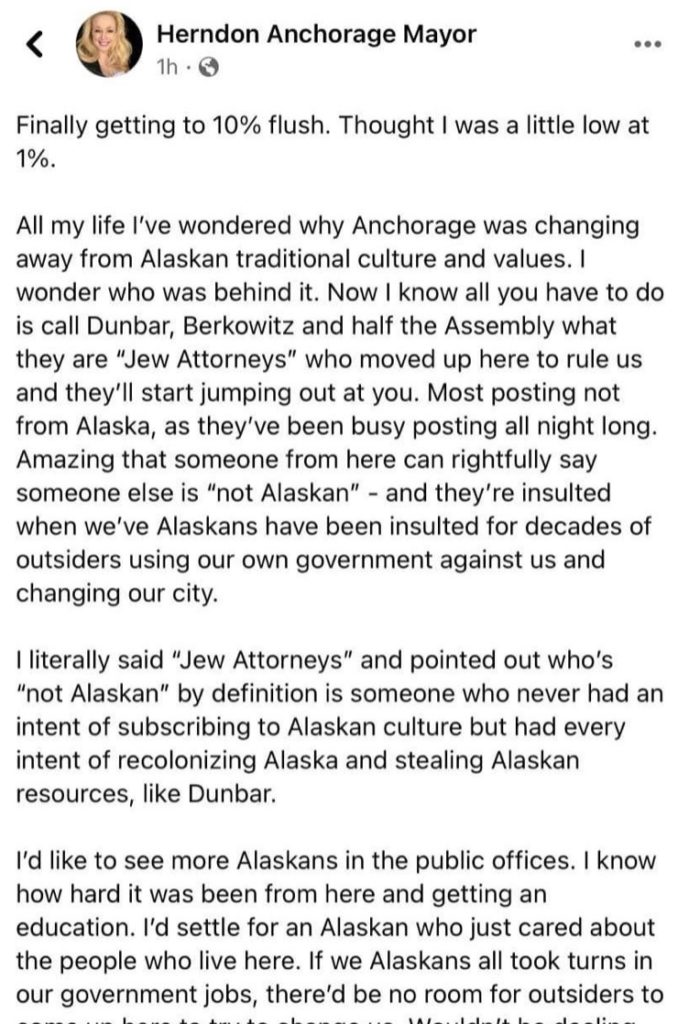
Also filing: Heather Herndon, who recently ran for mayor of Anchorage, has filed against State Sen. Tom Begich for Senate Seat I. Anchorage, Fairview, Government Hill, JBER, and Tikahtnu.

Palin loses in court: The judge in Sarah Palin’s libel case against The New York Times denied her request for a new trial, saying she had shown not “a speck” of evidence to indicate the newspaper acted in actual malice when it blamed her for mass shootings.

Palin also lost her bid to have the judge disqualify himself.

Door-knocking: Over 20 door knockers spent their weekend canvassing for Nick Begich in Anchorage, and over 50 are lining up to work the neighborhoods on Saturday on behalf of the group promoting Begich for Congress.

Revak wounded but fights on: All of Josh Revak’s ads for his House race involve his war injuries. Some of his digital ads show that the ad is sponsored by USO.org, which would be awkward and illegal. The sponsor message links to an article about Revak from 2016 at USO.org. Many of his fundraising emails begin with “Purple Heart recipient Josh Revak…”

He’s still in the race, but evidently Revak making other plans.

Big event for Nick: Over 100 co-hosts are hosting a fundraiser for Nick Begich, the biggest one in Anchorage yet. The event is June 9, and curiously, Art Hackney is noted as one of the co-hosts. He was formerly with the Revak campaign.

Smith and Jones take on Sen. Gary Stevens for Kodiak-Cordova-Clam Gulch Senate seat

Senate Seat C, which stretches from Cordova to Clam Gulch to Kodiak Island, is a race to watch this election season. All three candidates for the seat are Republicans, and one of those Republicans is Sen Gary Stevens, the grand old man of the Alaska Legislature.

Sen. Stevens, of Kodiak, began serving in the Legislature after winning a House seat in 2000; joined the Senate in 2003. He’s risen to become Senate president, served on the Legislative Council for several years, as majority leader and as Rules Chairman, a position he now holds.

Two credible conservatives from the Homer-Kodiak Senate district are taking on Stevens. If only three are in the race by the close of business on June 1, all three will proceed from the primary election ballot on Aug. 16 to the general election ballot, which is the ranked choice ballot. This poses a real challenge for Stevens in this fairly conservative part of the state.

Walter Jones is from Anchor Point. He’s a truck driver, and also an Army veteran who served for 18 years in the military. Jones’ website is at this link.

“In my 32 years in Alaska, I as many of you have watched at once prosperous State turn into a vacuum for nonprofits, a haven of domestic and foreign interference into the heart of Alaska’s political being, destroying the Alaska spirit, destroying Alaskan jobs, Alaskan small businesses, our resource development, restricting subsistence rights of Alaskan residents while feeding industries that are destroying our oceans by depleting fish stock for future generations of Alaskans,” Jones writes on his website.

Heath Smith is a born-and-raised Alaskan from Homer. He has served on the Homer City Council, is a family man, and is in the trucking business, running a local UPS operation in Homer. Smith’s website is at this link.

“I had the great honor of serving on the Homer City Council for six years. Through that experience I learned that public service is highly rewarding when you get results. It’s time for new energy and a new perspective to lead our district in Juneau. I commit to representing each of our communities interests in the legislature, and will work hard to improve the quality of life for all Alaskans,” Smith writes on his website.

Stevens, also an Army veteran, has a massive resume, including a Ph.D. from the University of Oregon. He was elected mayor of Kodiak, was president of the school board, presiding officer of the borough Assembly, on the board of directors for the Alaska Municipal League and Alaska Conference of Mayors, chaired the Kodiak Mayor’s Conference, was ex-officio member of Alaska Aerospace Development Corporation, and is a retired university professor, having taught at the University of Alaska for 25 years.

In the Senate, Stevens is considered a gentleman and a left-leaning moderate, who has voted against a full Permanent Fund dividend over the past six years, since the Legislature started cutting the dividend. He is one of the only incumbent republicans who has endorsed Sen. Lisa Murkowski for Senate.

How we got here: The Bill Walker Caucus created chaos that led to this year’s one-third turnover in Legislature

For the first time in four years, Alaska’s Legislature came out of the Memorial Day holiday without a special session.

There were several factors for the Alaska Capitol emptying out after May 18, the last day under the state Constitution allowed the legislative session.

Alaska’s public finances, buoyed by high oil prices thanks to the Biden Administration destroying exploration in the United States and a war in Ukraine, are in surplus for the first time in nearly a decade. More money going around makes political deal-making much easier. 

But another reason is this: Lawmakers, particularly in the Alaska House of Representatives, were exhausted from the combination of external pressure and internal squabbling that has marked the chamber since 2017. To most representatives, it was time to get out, both of session and, as the filing deadline looms, out of politics altogether. 

Turnover is normal every two years and is a healthy component for cycling in new people with new ideas reflecting the views of voters. But 2022 is shaping up to be a real washout before the Alaskan public has had its say, with over a third of the Legislature looking at being gone before November’s elections.

The turmoil in the Legislature has been corrosive to many, but the past six years have been exceptionally brutal on the public and lawmakers, with the longest special sessions in history recorded, and record-level litigation between the branches of government. This is not a normal work environment, even for politics. 

One factor has driven this dynamic more than any other: the rise and rule of what could be called the “Bill Walker Caucus.” It is not a formal caucus like that associated with a majority or minority group of lawmakers organized with leadership and committee assignments. It is not a longstanding regional group like the Bush Caucus or the Anchorage Caucus. It is not publicly centered around a policy, like the Agriculture Caucus, which was formed this year.

The Walker Caucus is an ad hoc group of lawmakers that have, for almost 10 years, served as a bulwark for the former and once again aspiring governor to maintain control of the levers of power in Juneau, and to stop any attempts to unwind the agenda of the Walker administration, which ended in scandal in 2018. 

This is the chronicle of how this caucus came to be and, perhaps, how it looks to end.

The Walker Caucus has changed slightly since it first came out of the shadows in November of 2016, but it is characterized by the same flavors: a mostly Democratic base of legislators, long out of power and hungry for the clout that comes with being in the majority, combined with a few key crossover Republican lawmakers who get, in return for their turncoat action, the choicest positions of power.

Republicans who join the Walker Caucus Democrats have been called by members of their own caucus the “Big Office Caucus.” These two groups have held a glue that kept Republicans, despite outright majorities in the Legislature and Governor’s office since 2018, hamstrung from enacting their agenda. 

When Bill Walker was elected in 2014, he faced daunting opposition from what appeared to be a united and unassailable front in both the Senate, under President Kevin Meyer, and in the House, under legendary Speaker Mike Chenault. That front was invigorated by a combination of Republicans feeling robbed by the manner in which Walker entered office, supported hand in hand with the Alice Rogoff-funded Anchorage (Dispatch) Daily News printing breathless headlines scandalizing Walker’s opponent, Gov. Sean Parnell. The mainstream media dropped the so-called scandal the very week after the election.

Most of the 2015 session was a bruising experience for the Walker Administration. After gutting much of the state government set up by the Parnell Administration, the new governor faced withering committee fire in both houses for three bruising months. A near record of Walker’s appointees went down in confirmation, and his cabinet had several close escapes, including his Attorney General.

The gasline, the key obsession of Walker’s, consumed the 2015 session and ended in a stalemate with Walker vetoing bills that would constrain his power over the state corporation overseeing gas projects, but losing key funding for his plans. 

By 2016, the Walker administration was now pushing a decidedly Democratic fiscal agenda, proposing a record number of taxes including attempting to rewrite the newly establishes oil tax system that voters had just upheld. Every single proposal, including rewriting the Permanent Fund dividend formula, went down to defeat by a single vote in the House of Representatives. The effort to rewrite the dividend formula enjoyed large, unconventional support from some of the state’s most powerful interest groups across the political spectrum, from the largest labor unions to several large private sector trade associations.

In response, Walker instigated the defining act of his gubernatorial administration: He vetoed the 2016 Dividend down to a number he considered “reasonable.” Overnight, candidates for office were defined about where they stood with Walker’s budgetary action, and where the lines broke on that response did not follow conventional party affiliation.

That break was made clear in November of 2016, when a majority of the House of Representatives announced they had enough members to have a ruling caucus. For the first time in a generation, Democrats would comprise the majority. But it was the Republicans who came into the fold that made this shift possible.

Rep. Gabrielle LeDoux, the former Democratish Republican who once represented Kodiak and then East Anchorage, orchestrated a coup that placed her in the powerful Rules Committee chair, allowing her to, literally, write the rules of House procedure and how bills became law. (LeDoux is now under indictment for election fraud). 

Joining Rep. LeDoux in power was Homer Democratish Republican Rep. Paul Seaton, who finally had the chance to write the state’s budget in the manner he saw fit and was constantly stopped from doing. Rep. Louise Stutes, a Kodiak Democratish Republican, also joined. These votes allowed Bryce Edgmon, at that point a lifelong Democrat, to become the first Democrat Speaker of the House since Rep. Ben Grussendorf of Sitka — back when the Soviet Union still existed. 

The agenda of this rail-thin majority became apparent: Sync up with the Bill Walker administration and pressure the Senate, then under the presidency of Pete Kelly of Fairbanks, to capitulate to taxes, enact whimsy-driven Permanent Fund dividend reductions, budgetary pressure, and other types of bills. Although the Kelly-led Senate did have a sizable portion of its members who supported rewriting the dividend formula, it was vehemently opposed to doing so under threat of taxes, and without a spending cap. An income tax passed the House and was pushed by the Walker Administration, only to die ignominiously on the Senate floor in 2017. 

At the 11th hour of 2018, the Legislature passed a law setting a limit on the total amount of money that could be expended from the Permanent Fund’s earnings.

Crucially and unfortunately, the dividend formula itself was left unchanged as the Legislature, and Walker, went to the ballot box in November seeking another term. Walker, and several members of the coalition including Rep. Seaton, were either unseated or withdrew before the voters could reject them (the coalition also lost three of its newest members of its caucus for sexual misconduct).

The election of Mike Dunleavy as governor, with several Republican lawmakers in the House and Senate cementing a solid majority in the Legislature, promised an opportunity to expunge the Walker Caucus from its perch in the Capitol, and to undo the damage from the previous four years. 

Reps. Chuck Kopp and Jennifer Johnston of Anchorage, and the late Rep. Gary Knopp of Soldotna had other ideas. With Knopp holding out to support a Republican Speaker of the House, the chamber remained deadlocked for the longest time in state history as the embattled Walker Caucus fought to retain its rule of the chamber. The impasse was broken by Knopp, Kopp, and Johnston, who all voted to make Edgmon, who registered as a no-party candidate, once more Speaker. Rep. Tammie Wilson of Fairbanks also temporarily joined the majority in exchange for the gavel on the Finance Committee. 

The Walker Caucus was firmly established in the House once more, with powerful allies and newcomer surrogates such as Zack Fields, an Anchorage downtown Democrat who also worked in the Walker administration under Heidi Drygas, the then Labor Commissioner (Drygas is Walker’s current running mate). Under the gavels of furious Democrats and scorned Republicans, the Dunleavy administration was savaged in committees at every turn. 

This climate of hostility peaked at several moments, including the character assassination on the floor of a joint session of several of Dunleavy’s appointments, such as Karl Johnstone to the Alaska Board of Fisheries, and Bob Griffin to the Alaska Board of Education.

Former Walker administration officials, such as Chief of Staff Scott Kendall, began testifying in committees against Dunleavy officials, an unprecedented action for senior personnel.

Then the lawsuits began, first on from the legislature trying to get court approval for its previous forward funding of education. This would kick off a record number of lawsuits between the three branches of government that continues to this day. 

Opposition to Dunleavy’s budget vetoes triggered a recall effort enflamed by among others, prominent members of the Walker Caucus at rallies in 2019. The political brushfire was only extinguished by a plane arriving from Wuhan, China, in January of 2020, plunging Alaska and the rest of the world into a Covid-induced convulsion. 

When voters went to the polls in August and November of 2020, the recipients of the greatest rebukes were members of the Walker Caucus. Kopp, Johnston, LeDoux, and several others were trounced out (Gary Knopp passed in an airplane collision before his election, and Tammie Wilson resigned from office). Perhaps, finally, the Walker Caucus members would be in them minority as, once again, a majority of legislators in both bodies were Republicans. 

By February 2021, the House was once again deadlocked and unable to organize. The dam broke when Rep. Kelly Merrick, an Eagle River Republican, crossed in exchange for becoming co-chair of the Finance Committee. What was different this time was who was in the Speaker’s chair. Instead of Edgmon, who by accounts was seeking a third consecutive term, Stutes of Kodiak was thrust into the key leadership post by Merrick’s decisive vote.

The Merrick move placed a Republican over a caucus of mostly Democrats. 

It also was the first split of members of the Walker Caucus. Edgmon, a fervent Walker supporter, had apparently been outmaneuvered by Fields, who by several accounts orchestrated the deal. The placement of Stutes over Edgmon touched off a rivalry between the two that resulted in the majority being called the “Caucus of Two Speakers” with Edgmon, now rules chair and sitting on finance, harrying Stutes’ governing for two years. At times, the two didn’t speak to each other for weeks.

One of the key characteristics of all the Walker Caucuses was its thinness. None of the majorities enjoyed mandates with comfortable majorities in any of the years it was in power. Chenault, at the height of his power as speaker, could boast a caucus with 30 out of the chamber’s 40 members. This edginess led to a rough dynamic of progressive Democrats in the majority but a sliver of Republicans in leadership. 

The result was that nothing of substance passed for most of those years. When Walker was out of power, this defensive shield against Dunleavy was useful, as useful as the shield initially was against Walker in his administration’s first two years. But after three years and endless special sessions, the cracks of inaction showed in the wall of a caucus whose only reason for existence was opposition to the current Governor. 

Those cracks opened up this year, as the worn Walker talking points of “unaffordable dividends” evaporated under record oil prices and revenues that swelled the public coffers. When the Legislature gaveled out this year, voting for the largest dividend in history along with part of an energy rebate, it was the core of the Walker Caucus who voted down the second half of that payment, managing to kill it by a single vote. 

It is impossible to tell what will occur this year during the massive election cycle ahead. But Bill Walker benefitted from a House that for the last six years defied political gravity in pursuit of an agenda he crafted. The majority of key lawmakers who instigated the Walker Caucus have either been thrown out of office or retired. Whatever comes this year, one thing is clear: Voters have their eyes clearly on Bill Walker and his surrogates, and the caucus they fashioned in the Legislature to subvert the will of the majority of Alaskans. 

Business Insider: Palin short on cash going into last days of special primary election

By GRACE PANETTA | BUSINESS INSIDER

Former Alaska Gov. Sarah Palin is short on cash compared to her some of her main Republican rivals for an open US House seat, new campaign finance filings reveal. 

Palin is one of 48 candidates of all parties running in a special primary election to replace the late Rep. Don Young under Alaska’s new top-four primary system. The election is being held all by mail, with ballots due on June 11, and the top four candidates will advance to a ranked-choice special general election to be held on August 16. 

Despite the number of candidates in the race, only a handful of them are on the airwaves and spending money.

Palin has raked in over $630,000, spent over $530,000, and has just over $105,769 in cash on hand, according to a new filing from her campaign.

Nick Begich III, a wealthy software entrepreneur, has lent his campaign $650,000, the filings show, in addition to some $135,000 raised from donors. He’s spent a little over $304,000 so far and has over $716,000 in cash on hand.

Americans for Prosperity Action, a Koch-aligned conservative political group, has also spent over $83,000 supporting Begich in the special election, records show

Tara Sweeney, a businesswoman who served as assistant secretary for Indian Affairs for the Interior Department under the Trump administration, has raised over $230,000, spent $82,145, and has $149,000 in cash on hand, also more than Palin has.

Read this story at Business Insider.

Kelly Tshibaka: Murkowski handed us Haaland, and the two have been a disaster for Alaska

By KELLY TSHIBAKA

There is perhaps no other state for which the identity of the Secretary of the Interior is as important as it is for Alaska.

Most people in the Lower 48 can live their whole lives never being aware of who occupies that office, but in Alaska, we are deeply affected by who holds it, and we especially are today.

Our Interior Secretary is the radical environmentalist Deb Haaland, and we have Sen. Lisa Murkowski to thank for that.

Murkowski cast the tiebreaking vote in committee to advance Haaland’s nomination to final approval. And after her confirmation, Haaland wasted no time in confirming our fears that she would be an environmental radical in the job. She is spearheading Biden’s 30×30 plan, to convert 30% of America into untouchable federal lands by 2030. Her main target: Alaska.

President Joe Biden has aimed 24 executive actions directly at us, with many of them coming from Haaland’s department. On top of cutting off oil and natural gas exploration in ANWR, Biden and Haaland have been busy attacking Alaska’s energy workers just in recent weeks.

Near the end of April, Biden dispatched Haaland to Alaska to be escorted around the state by Murkowski, who has been enabling the Biden radical agenda with her votes. But once Haaland returned to D.C., she blocked energy production in the National Petroleum Reserve-Alaska, killing more energy jobs and taking billions of barrels of our own oil completely off the table.

In mid-May, Haaland also decided to cancel a lease sale covering over a million acres in Cook Inlet, which could have led to decades of production, thousands of jobs, and billions of dollars of investment in Alaska.

Haaland later appeared before the Senate Committee on Energy and Natural Resources, where it was revealed that she has effectively halted new oil drilling and exploration in Alaska. Even more incredibly, Haaland was unable to admit that gasoline prices are too high, despite new all-time records being set nearly every day.

If Biden truly wanted to reduce domestic energy costs, he would fire Haaland and reverse all these decisions. But he has not done that, and he won’t, because reduced domestic energy production, and the resulting increased costs of fossil fuels, are part of the plan hatched by the environmental extremists who are leading his administration.

And all of this can be laid at Lisa Murkowski’s feet.

Sure, there are some who say that Democrats would have found a way to confirm Haaland even without Murkowski’s vote, but that’s merely a weak justification for our senator’s failure to stand up for Alaska.

Instead of fighting for the best interests of Alaska, Murkowski gave Haaland her full support, even after admitting that Haaland would likely be harmful to our state.

And Murkowski didn’t stop there. She also championed the appointment of Haaland’s Deputy Secretary and was once again the tie-breaking vote to advance the confirmation of Haaland’s Solicitor, another radical Biden nominee. Our senator stacked the leadership of the Department of the Interior against us.

Murkowski calls herself a strong leader, but U.S. senators should never dodge accountability, as she has done, by claiming that her tie-breaking vote for Haaland didn’t actually matter. And Murkowski’s vote for Haaland was not simply a one-time mistake; rather, it was a colossal error in judgment that is hammering Alaska over and over again.

Everyone with a pulse saw this coming, but Murkowski feigns shock and dismay every time Haaland does exactly what we all knew she would do.

Of course, Murkowski has voted for more than 90% of Biden’s radical cabinet appointments, so none of this should surprise anyone in Alaska.

For progressives, there is a clear choice in the Senate race now that Democrat Pat Chesbro has announced her campaign. She would cast many of the same votes as Murkowski and then cheer the outcomes.

By contrast, Murkowski puts the leftist bureaucrats in place and then acts bewildered when they behave like leftist bureaucrats. It’s this tired, two-faced act that frustrates Alaskans because it reveals that no one can trust or rely on Lisa Murkowski.

We deserve a senator who will stand up for Alaska and fight for what’s important to us, and when I’m in the Senate, I can promise you there will be no doubt about where I stand. I’m For Alaska, not the radical D.C. insiders.

Kelly Tshibaka is a candidate for U.S. Senate running against Sen. Lisa Murkowski.

Candidates file FEC campaign reports: Palin raised over $600K, spent $500K, has $105K left in campaign account

The required campaign finance reports, due this weekend, are beginning to show up at the Federal Election Commission website, shedding light on which candidates for the special U.S. House of Representatives primary race have raised the money needed to get their messages out to voters.

With just 12 days left before ballots are due, it appears Sarah Palin is still a fundraising machine. Palin, who filed on April 1 to fill the seat of the late Congressman Don Young, raised the bulk of her money nationally through fundraising mills. Palin logged over 1,000 individual donations totaling more than $600,000 from places like Tennessee, Florida, Texas, Nevada, California, Georgia, Minnesota, Virginia, Maryland, and a handful from Alaska.

She has raised more money from each of the states of Texas, Florida, and California than she has raised in her home state. Read the list of Palin donors at this FEC link.

Palin received more than $30,000 from political action committees. Read the political action committees at this link.

Much of Palin’s $500,000 in expenditures are related to fundraising for things like list rental fees. Palin has not spent that much on advertising to Alaskans, possibly because with her name recognition, she doesn’t need to spent the money to get noticed. Her expenditures are at this link.

Republican candidate Nick Begich has raised over $530,000 and has loaned some extra money to his campaign. The businessman, who filed back in October, has over $716,000 in his campaign account. Nearly all of his donors are Alaskans. His donation report is at this link.

Begich has spent $302,414 on his campaign so far, much of it for travel to communities. Alaska Airlines has been one of his biggest expenditures as he has crisscrossed the state. His expenditure list is at this link.

Republican candidate Tara Sweeney raised $231,000, ended the reporting period with $149,000 cash on hand, and $53,000 in debt, so a net position of $96,000. Most of her donations are large checks from heavy-hitting business leaders inside Alaska. Her list of donors is at this link.

Republican candidate Josh Revak raised $110,800 and has $27,800 cash on hand. He has paid $9,500 to a compliance company in Virginia. Most of his checks are coming from Alaskans, many of them lobbyists and business leaders. His report is at this link.

No-party candidate Al Gross raised $545,744 and has $113,478 cash on hand. His campaign funds are a mixture of in-state and out-of-state. Gross’ donor list is here. Gross appears to be using his former Senate race list of donors to get one more drink at the well for his bid for U.S. House. Some of Gross’ fundraising came from his own political action committee, Northern Leadership Fund. That report link here.

Gross is spending a lot on newspapers. He spent nearly $3,000 with the Nome Nugget newspaper for advertising and $1,800 on Homer News and $3,000 for the Juneau Empire ads. He logged $1,650 with KTOO public broadcasting for radio ads and $1,275 for an ad in the Chilkat Valley News. The disbursement list is here.

Democrat Chris Constant has raised $150,790. His cash on hand is $82,248. His donor report is at this link.

Democrat Mary Peltola raised $81,000 and spent $48,000.

Justin Trudeau goes for handguns in Canada

Canadian Prime Minister Justin Trudeau today announced he will file a bill that will freeze the sales of handguns in Canada.

“We are capping the number of handguns in this country,” Trudeau said in his announcement.

Laws in Canada already include expanded background checks, and a mandatory buy-back program beginning later this year. For AR-15 style rifles, they must be made inoperable to be legal in Canada.

Trudeau ran on stricter gun laws, but introduced the new ban on handguns after the mass shootings in Buffalo, N.Y. and Uvalde, Texas earlier this month.

“One Canadian killed by gun violence is one too many. That’s why we’ve banned 1,500 types of military-style assault firearms. And that’s why, today, we’ve introduced legislation to further strengthen gun control in Canada,” Trudeau said. “Through this legislation, we’ll move forward with a national freeze on handgun ownership. In other words, it will no longer be possible to buy, sell, transfer, or import handguns anywhere in Canada once this Bill becomes law.”

Trudeau’s news release with details about his bill are at this link.

View Trudeau’s remarks on his handgun ban at this link.

Earlier this year, Trudeau condemned the nation’s commercial truckers as they engaged in civil disobedience over the prime minister’s oppressive Covid-19 measures that forced Covid-19 vaccines on them. He called the protesters a fringe extremist group.

Last summer, in the middle of Covid-19 pandemic lockdowns, Trudeau announced the ban on sales of new gas-powered cars after 2035.