In Eagle River’s State Senate Seat L, Kelly Merrick and Ken McCarty are all that remain on the November ballot, after candidates Clayton Trotter and Joe Wright dropped out of the race, leaving a head-to-head race between conservative McCarty and Merrick, who caucused with the Democrats during the past two years.
There will be no ranked-choice mess in the Eagle River Senate race — it’s a back to a binary choice between McCarty or Merrick.
In House races, a total of 26 of the 40 seats have either just one or two candidates on the ballot. There is no ranking involved when there are one or two candidates. Add in the races with three names on the ballot, and fully 35 races out of 40 that three or fewer choices.
Only five House races will have a candidate in all four slots on the ranked choice ballot.
That means just 12.5% of legislative House seats will actually be chosen through a ranked choice method with four candidates. 15% of the seats have only one candidate, and half of the seats being contested are binary from the get-go, with two candidates.
In the Senate, 11 of the 19 seats have two or fewer candidates: 58% of the seats. Another 8 of the 19 have three candidates — 42%.
Others who dropped out by the Sept. 5 Division of Elections deadline include:
Senate Seat J: East Anchorage Democrat Drew Cason withdrew, leaving Democrats Forrest Dunbar and Geran Tarr to battle it out for the liberal vote, while Andrew Satterfield, the Republican, makes his first attempt at elected office. This race has three candidates.
House District 1: Shevaun Meggitt, a Wrangell nonpartisan, dropped out. Left in the race are Democrat-caucusing Rep. Dan Ortiz and Republican Jeremy Bynum. Both are of Ketchikan. This race has two candidates.
House District 10: For South Anchorage, Democrat Sue Levi, a regular on the ballot, dropped out. Remaining on the ballot are Libertarian Mikel Insalco, Democrat Caroline Storm, and Republican former Rep. Craig Johnson. This race has three candidates.
House District 13: Alaskan Independence Party Tim Huit dropped out, so that Republican Kathy Henslee has a clear shot to take on Rep. Andy Josephson for this mid-Anchorage seat. This race has two candidates.
House District 16: Alaska Constitution Party Richard Beckes dropped out, along with Republican Joel McKinney. That leaves Republican Liz Vazquez to face off against Democrat Jennifer Armstrong for west Anchorage. This race has two candidates.
House District 21: Patrick Sharrock, a nonpartisan, dropped from the ballot, leaving Democrat Donna Mears and Republican Forrest Wolfe to duke it out in East Anchorage. This race has two candidates.
House District 22: Republican Lisa Simpson has dropped, and Ted Eischeid, a Democrat, will face off against Republican Stanley Wright. This race has two candidates.
House District 35: Nonpartisan Tim Parker withdrew, and this race is unusual in that it has four candidates left: Republican Kevin McKinley, Republican Ruben McNeill, Alaska Constitution Party Kieran Brown, and Democrat Ashley Carrick. This race has four candidates.
The general election is on Nov. 8, when all candidates on Alaska’s ballots are in ranked choice races — except for the vast majority of them, which are not in races where ranked choice voting can actually be done.
Anchorage Mayor Dave Bronson last week unveiled the Municipality’s Emergency Cold Weather Sheltering plan for the 2022-23 winter. As required by Anchorage Municipal Code, the administration developed the plan to address emergency sheltering as temperatures drop. The plan includes four main components:
Use up to 20 portable self-contained buildings provided to the Municipality, at no-cost by a community partner, as cold weather shelters. These 900-1000 square foot buildings will be placed at selected site(s) and have the potential to shelter 200-240 individuals.
Develop a program to provide micro-grants to churches, non-profits, and organizations throughout Anchorage who elect to become emergency shelter sites. These micro-grants will be funded by the Municipality.
Provide funding to extend operations at the Aviator Hotel as a non-congregate site through the end of December, with the option to extend through April.
Use Municipality buildings as emergency shelter sites. The Spenard Recreation Center and Fairview Recreation Center have been selected as MOA emergency shelter sites. Using these buildings is the least preferred option identified by the Municipality. If portable self-contained buildings do not become available through necessary code changes, these sites will be activated from October – April.
The Bronson Administration will need the cooperation of the Anchorage Assembly, whose leftist leadership has a history of blocking everything and anything it can in order to hamstring the mayor. Leftists on the Assembly worked hard, but failed to get Assemblyman Forrest Dunbar elected mayor, and now find many ways to block the person who voters chose to lead the city. The code change needed will allow portable, self-contained buildings to be used as emergency shelters, and that requires Assembly approval.
Bronson said he also needs help from the Assembly to identify funding sources to continue housing the 200 people staying at the Aviator Hotel.
Additionally, with the city-funded Navigation Center expected to come online soon, another 150 beds, with the potential to surge up to 200 beds, will be available this winter. This purpose-built facility will play a key role in connecting individuals to services, treatment, job training, and permanent housing.
The Municipality will place individuals in municipal-owned buildings as a last resort if enough shelter space is not available in the community. The municipality has room for up to 100 women and children at the Spenard Recreation Center, and up to 100 single adults at the Fairview Recreation Center.
The entire Emergency Cold Weather Sheltering Plan can be found at this link. An application process will open soon for the micro-grant program. Churches, agencies, non-profits, and entities seeking to become an emergency shelter this winter can apply and learn more about their potential role in providing shelter at this link.
The Assembly leadership is developing its own competing plan, which signals it is reluctant to work in good faith with the mayor. The Assembly refused to work with the mayor on his plan in 2021, which included a navigation center that the Assembly opposed. The navigation center is a one-stop place for homeless to get many different services, including referrals to drug and alcohol treatment, shelters, jobs, job training, and reuniting with family.
The Mayor’s team will meet with the homelessness committee on Wednesday, but the Assembly does not meet as a decision-making body until Sept. 13. The normal date for temperatures getting into the 30s (39º or less) in Anchorage is Sept. 5. At this point, the nighttime temperatures are still in the high 40s.
Californians were asked to set their thermostats at 78 or higher over the weekend, and also to not charge up their electric cars. All this on the heels of a state plan approved last week to end the sale of new gas-powered cars in just 13 years.
With temperatures in California hovering between highs of 105 and 110 degrees in Southern California, the power grid is being put to the test, leading the California Independent System Operator, which runs the state’s electrical grid, to ask electric car owners to avoid charging vehicles between 4-9 pm, when the power grid was expected to be at its highest demand. Residents were also asked to avoid using major appliances.
“California and the West are expecting extreme heat that is likely to strain the grid with increased energy demands, especially over the holiday weekend,” the operator said in a statement. Since that statement, forecasters are saying the heat wave will continue into the midweek.
State energy officials said the electrical load on Tuesday potentially could hit 51,000 megawatts, the highest demand ever seen in California, the San Francisco Chronicle reported. California Independent System Operator on Monday requested the use of four temporary emergency power generators by the Department of Water Resources in Roseville and Yuba City. The generators, activated for the first time since they were installed last year, can provide up to 120 megawatts of electricity, enough to power up to 120,000 homes, the Chronicle wrote.
Also last week, the California State Assembly (legislature) voted to not shut down the nuclear power plant called Diablo Canyon in 2025, but to keep it open for another five years; the plant provides 9% of the state’s electricity.
Rent increases, fewer available rentals, and average single-family home prices up nearly 17% demonstrate Alaska’s tight housing market, according to a new report.
Alaska saw rents up more than usual in three of its largest markets, including Anchorage recording its largest single-year increase in two decades, the Annual Renter Survey by the Alaska Department of Labor and Workforce Development shows.
In general, rent changes in urban Alaska have followed the national trend since last year, the report showed. In Alaska, the median adjusted rent was $1,276 at the time of the survey in March, up 8% from the previous year.
It’s possible recent cost increases since the survey was conducted will drive rents even higher than that, the report said. However, it went on to say rent is still affordable on average. The U.S. Department of Housing and Urban Development considers housing affordable if the occupants spend no more than 30% of their income on housing costs, the report said.
“While rents have risen everywhere since 2020, rising wages have made renting more affordable in all surveyed areas except Anchorage, where rent increases have outpaced average wage growth,” the report said.
Declining vacancy rates were attributed to several factors. The increase in home prices and interest rate hikes likely prevented renters from making the leap to becoming homeowners.
“Normally, the flow of renters buying homes each year steadily frees up rental units, but house prices jumped during the pandemic, pushing some prospective first-time buyers to keep renting longer,” the report said.
The price for a single-family house averaged over $388,000 in 2021, up almost 17% from 2019, according to the report.
“Interest rates increased sharply in early 2022 while home prices remained high, pushing the average monthly mortgage payment up and putting home buying even further out of reach for some,” the authors wrote.
Another likely factor contributing to low vacancies was emergency rental assistance, leading to fewer evictions and thus fewer available rentals.
The report also listed an increase in short-term rentals as a possible contributor.
“It’s not clear how many units in Alaska are moving from long-term to short-term, but national studies have found that in other parts of the country, short-term rentals can deplete long-term rental stocks. Anecdotally, our survey did suggest some Alaska units are transitioning to short-term rentals,” said the authors.
Meanwhile, there are more people moving out of Alaska than there are people moving in. Alaska’s gross migration rate has topped the list for the last 14 years in a row, according to Internal Revenue Service data. The gross migration rate represents the total number of people moving both in and out of the state.
Kim Jarrett’s career spans over 30 years with stops in radio, print and television. She has won awards from both the Georgia Press Association and the Georgia Association of Broadcasters.
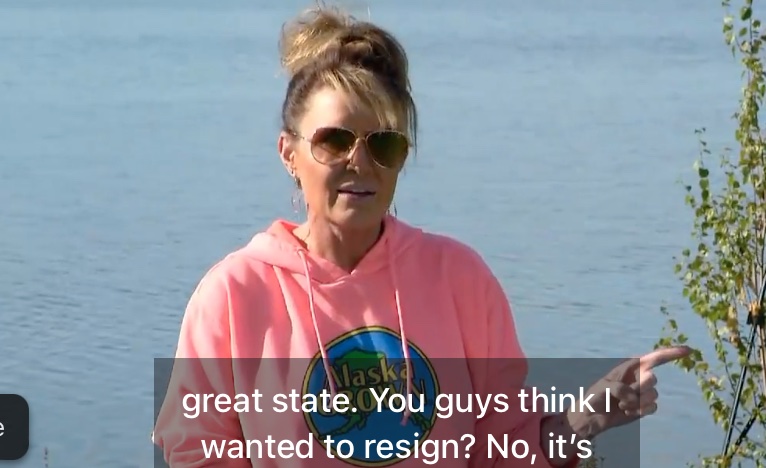
In a tense press conference on the lawn of her Wasilla waterfront home on Monday, congressional candidate Sarah Palin lashed out, casting blame for why she failed to get enough voters to win the temporary seat for Congress, and calling her Republican opponent names, such as “Baggage” and “Negative Nick.”
For a half hour, she lashed out at Nick Begich, who is also running for Congress. And it was Suzanne Downing of Must Read Alaska who is especially a “problem,” she said.
She lectured the media and told them if they don’t respect her property they won’t be invited back, and scolded them to stop hiding out in the woods by her home. If they want to get pictures, she said, contact Kris Perry, her campaign manager, and Perry will help them with pictures.
Then she called for Nick Begich to drop out of the congressional race because “conservative votes are obviously being split and ranked choice voting is obviously a scheme,” she said. “It’s a racket.”
“And I want to clear up some lies that some of you reporters have actually helped perpetuate,” she said. “And that’s not fair, and that’s not right. Those who have, Suzanne Downing, you particularly perpetuating the problem. You give journalists a bad name. Like that this isn’t really my home, that I don’t really live in Alaska, which cracks us up…” She went on to explain she had lived in the home since her children were small.
Must Read Alaska did report on Sarah and Todd Palin purchasing a lot in Arizona and getting ready to leave Alaska. Those plans were dashed when Todd divorced her.
Palin did not call on Libertarian candidate Chris Bye to drop out, nor did she attack Democrat Mary Peltola, who won the temporary seat for Congress. She and Peltola have become something of political allies.
Source: Sarah Palin Instagram.
Palin had special ire toward Nick Begich, who she pronounced “Nick Baggage.” After insulting him, she said he has until 5 pm Monday to resign from the race. The Division of Elections cutoff is 5 pm for the Nov. 8 ballot.
“I’m calling on negative Nick Begich to get out of this race,” Palin told reporters and supporters gathered on the lawn outside her Lake Lucille home. “He does not represent the best of Alaska. He represents the good old boys network, the establishment and yes, the liberals, the liberals in the Democrat Party. Only a Democrat sympathizer would selfishly stay in this race after getting thumped three times, three times in a row by his GOP opponent, just to enable a Democrat to hold the Alaskan people’s seat in the United States House of Representatives.”
While others have called on Palin to drop out, she said she will not.
Begich took the high road, and said he will not be withdrawing from the race and said that mathematically he has the best shot at beating Democrat Mary Peltola in November, since Palin’s negatives are so high, with over 60% of Alaskans viewing her unfavorably. He spent the day at the Alaska State Fair meeting as many Alaskans as he could on the fair’s final day.
“We are confident that we are on a positive trajectory to win in November,” Begich said. “Ranked choice voting showed that Palin simply doesn’t have enough support from Alaskans to win an election and her performance in the Special was embarrassing as a former Governor and Vice Presidential candidate. Pollsters have been telling us for months that Sarah Palin cannot win a statewide race because her unfavorable rating is so high. These same polls have consistently shown that Alaskans are looking for a less polarizing alternative.”
“I have introduced myself to Alaskans, I have steadily increased my percentage of the vote since the June 11 Special Primary election. I will continue traveling the state, making the case that this election is about a choice between Mary Peltola and Nick Begich,” he said in a statement.
At present, 41% of Alaska voters lean Republican, while 31% lean Democrat, and 28% have no particular preference, but are swing voters.
Alaska conservatives are doing what they always do. Less than a week after our eye-popping defeat in the special election, Alaska conservatives are still squabbling over “Who-is-more-conservative-than-whom?”
Instead, they should be strategizing for a win in November’s general election.
In my last column, I introduced you to the “Never Paliners” and I proposed that these people are in control of our election. The election results prove the point that Sarah Palin is destined to lose because a small fraction of Alaskan voters would rank a bag of Pilot Bread before they’d rank Sarah. And the actual number of “Never Palin” voters is larger than I previously stated.
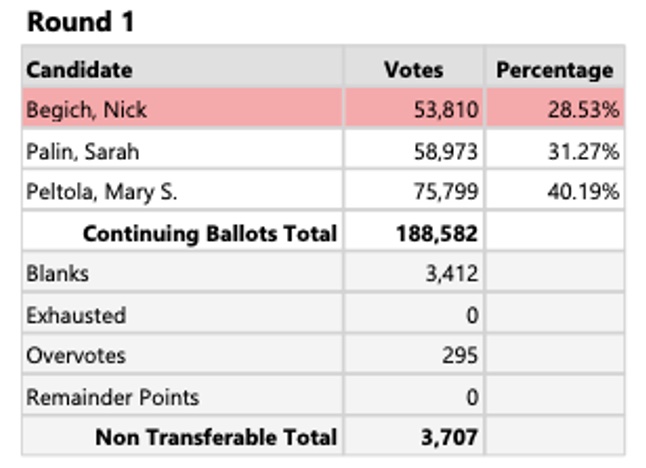
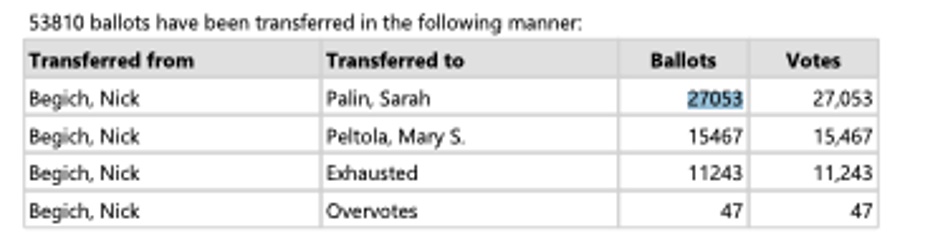
In Round 1, Sarah Palin received 58,973 votes. Nick Begich lost Round 1 and his votes were redistributed as follows: 27,053 votes went to Palin, and 15,467 went to Mary Peltola. The latter group is what I call “Never Palin” voters. But there are more voters to account for: 11,243 votes were “exhausted” meaning these voters only voted one candidate in one place: Begich. These people could be “Never Paliners,” or they could be “Anti-RCV” voters. Either way, their votes were dropped from the final totals. 47 “over votes” are attributable to voting for Begich in all four slots. I think these people are also “Never Palin” voters or “Anti-RCV” voters.
Either way, both categories did not rank Palin. Let’s assume, for this exercise that they will refuse to rank Palin in the coming general election.
In a showdown between Peltola and Palin, Palin would garner the following tally:
Original First Place Votes for Sarah: 58,073
Redistributed votes from Begich to Sarah: 27,053
Total: 85,126
Now, compare this to Peltola’s outcome, and assume that Begich’s remaining votes go to her. This would be the outcome of the race if we assume that all of Begich’s exhausted votes and overvotes are entirely “Never Palin” voters:
Original First Place Votes for Peltola: 75,799
Redistributed votes from Begich to Peltola: 15,467
Begich’s exhausted votes: 11,243
Begich’s overvotes: 47
Total: 102,556
In a scenario where all of Begich’s exhausted votes and over votes to go Peltola, Peltola wins.
Now, let’s see what happens if we apply Begich’s exhausted votes and overvotes to Palin. This would be the outcome if we assume that all of Begich’s exhausted votes and overvotes are “Anti-RCV” voters who would compromise with Palin:
Original First Place Votes for Sarah: 58,073
Redistributed votes from Begich to Sarah: 27,053
Begich’s exhausted votes: 11,243
Begich’s overvotes: 47
Total: 96,416
Compare this to Peltola’s would-be outcome:
Original First Place Peltola Votes: 75,799
Redistributed votes from Begich to Peltola: 15,467
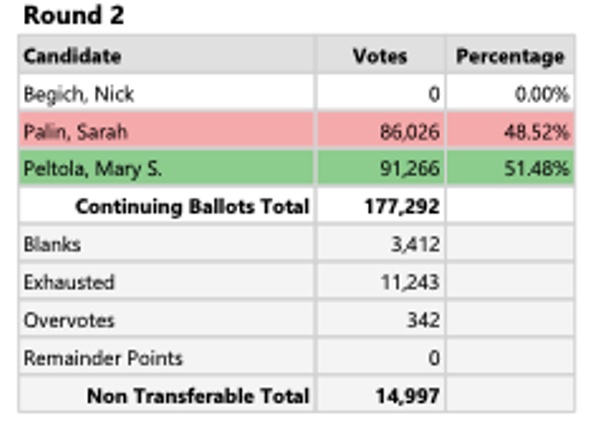
Total: 91,266
This is the best Sarah can hope for: a margin of 5,150 votes for a win. Is that margin big enough to stake the lives of unborn children on? That sounds like hyperbole, but pro-life voters must ask themselves this question, and answer honestly when they cast their votes in November.
Strategizing your vote will matter in November for other reasons, too.
As implied strongly by Project Veritas, ranked choice voting was created and promoted by operatives now working for the Murkowski campaign. This scheme was designed with the purpose of getting one of Washington’s most outrageous RINOs re-elected. The outcome of our special election is the wind in Murkowski’s proverbial sails. You, Alaska conservatives, need to consider the ramifications for the future of the pro-life movement.
The governor’s position is up for grabs. Have you pondered how important this election will be to the future of Alaskan elections? If Les Gara or Bill Walker get into the governor’s seat in November, your hopes of dumping ranked choice voting will be dashed. This system is their dream come true. They’ll never agree to eliminate it. So, for those conservatives who want to see RCV disappear, strategizing your vote will be the penultimate necessity in November. Do not squander it on petty squabbles, such as, “Yeah but Charlie Pierce is more MAGA than Mike Dunleavy.”
Instead, think: “Which one is the most likely to win?” Cast your vote for this person as #1 and the less likely as #2. In the case of the governor’s race (my apologies to Charlie Pierce), it’s got to be Dunleavy #1 and Pierce #2. Do not rank Les Gara or Bill Walker.
If you get it wrong in November on the governor’s race, you’ll never see RCV go away.
And of course, as I illustrated above, Alaska is realistically flipping to a blue state with our one and only vote in Congress going to Mary Peltola. Do you want to let her sit there for the next two years representing you? Stupid squabbles between conservatives who said, “Well, Sarah is more pro-life than that RINO Nick Begich” are exactly the arguments that put the pro-choice candidate in the temporary seat. At the end of the day, you could have a pro-life win if you’d vote strategically, and leave behind that nonsense in-fighting.
Given that we have to confront the ”Never Palin” cohort, my best advise is to rank Begich #1 and Palin #2. Do not rank Peltola. This maximizes the chance, no matter how the chips fall, that a conservative candidate will beat Peltola once and for all.
The choice is yours, Alaskan conservatives. Alaska’s election is now a Chess Game. Start playing to win.
Donna Celia is a mother of two children who lives in Anchorage.
John A. Sandor, born in Buckley, Washington on Dec. 22, 1926, passed away on Aug. 23, 2022 at 95 years old in Sitka. John was the youngest son of John and Mary Sandor, whose family of five sons and three daughters were all raised on a small ranch in Buckley.
Professionally, John was an Army medic in World War II; received a Bachelor’s in Forestry degree from Washington State University in 1950 and a Master’s of Public Administration degree from Harvard in 1959. Sandor’s Forest Service career began in 1953 when he came to Alaska to work on forest surveys of the Tongass National Forest. He held a succession of other posts with the Forest Service, including Assistant Regional Forester in personnel management for the Southern Region in Atlanta from 1965 to 1968; Assistant to Chief Ed Cliff in the Washington Office from 1968 to 1971; and Deputy Regional Forester in the Eastern Region from 1971 to 1976. In 1976, Sandor returned to Juneau as Regional Forester.
Sandor was active in forming the Society of American Foresters Alaska Chapter and Section; and was also active in the American Society for Public Administration. Sandor retired from the Forest Service in 1984. He was appointed Commissioner of the Alaska Dept. of Environmental Conservation during the Hickel administration from 1990 to 1994. During this time he was also a member of the Exxon Valdez Oil Spill Trustee Council.
One of his favorite quotations was, “If a task you’ve once begun, do not leave until it’s done. Be the labor great or small, do it well, or not at all.”
It is challenging to list the many accolades, awards and distinctions John earned in his service to the community, state and country. However, here are a few notable items to mention:
Sandor received the Alaska Federation of Native’s 1994 Denali Award for efforts to preserve Native values. He also received the Alaska Public Health Association’s Health Achievement Award for water-sanitation and clean air act initiatives. He also worked cooperatively with Canadian officials in British Columbia and Yukon Territory on conservation, water-sanitation, and hydro-electric issues.
In 2007, Sandor received the Gifford Pinchot Medal from the Society of American Foresters. This award recognizes an SAF member who has made outstanding contributions in the administration, practice, and professional development of North American Forestry. He is named as “Director Emeritus” of the First Things First – Alaska Foundation and was a founding member of Juneau’s Gold Rush Days. He is also a past recipient of a “Lifetime Achievement Award” from the Juneau Chamber of Commerce.
Personally, John was married to the love of his life, Lenore Barbat, on May 18, 1956 in Juneau. John was an avid fan of Mozart, travel, rare books and maps, and his two grandsons, Benjamin and Jacob Freiman. John thrived on staying active in the community and was often seen attending Rotary, Masonic Lodge, Miners, Chamber of Commerce and was an active member of the Douglas Community United Methodist Church. After residing in Juneau for 40 years, John moved to the Sitka Pioneer Home with his wife, Lee, in 2017.
John was preceded in death by his parents, four older brothers (Charles, William, Henry, and Frank), and three sisters (Helen Carden, Pat Hoyle and Margaret Bryant) and his dear wife, Lenore. He is survived by his oldest daughter (Mary Helen of Anchorage, Alaska) and youngest daughter (Janet Freiman of Danville, California), his son-in-law, Harold Freiman, and the two grandsons he adored, (Ben and Jacob Freiman). He is also survived by many beloved nieces and nephews and other relatives, most specifically in Washington State and Ohio. Family meant everything to John and he holds each and every one of them dearly.
The family would welcome donations in John’s memory to the National Museum of Forest Service History, or simply plant a tree in his name.
Three of five congressional vacancies will be filled later this month when Democrat Reps.-Elect Pat Ryan, NY; Mary Peltola, Alaska; and Republican Rep.-Elect Joe Sempolinski, NY, are sworn in the House. Each won their special elections in August.
With Democrat Congressman Charlie Crist of Florida resigning to focus on his run for governor this fall, there are 430 House voting members at present — 219 Democrats and 211 Republicans.
It appears the Congresswoman-Elect Peltola swearing in ceremony will be Sept. 13, subject to change.
While we wait for the complete voter file to be released on the congressional race (how Palin voters ranked and how Peltola voters ranked), a roundup of writers who are offering their analyses about our recent special congressional race:
Newsweek did the math and said Nick Begich is the only one who can save Alaska’s red congressional seat. Read more here.
National Review: Palin instructed her voters not to rank anyone else. Did her voters comply? Some Nick Begich voters didn’t rank her.
Cook Political Report: House rating changes for Alaska turned it into a toss up. A quote from the story behind the paywall:
“Peltola’s triumph was a perfect storm. By far the biggest factor: Palin’s deep unpopularity in the state, registering over 60% in several polls. The Trump-endorsed Palin and the Alaska GOP-endorsed Begich mutually self-destructed while Peltola, a moderate tribal fisheries official, stayed above the fray. She ran on a positive pro-oil, pro-choice, “pro-fish” message and rolled up huge margins in the rural Bush, where Young had been highly popular.”
“The second biggest factor: Alaska’s brand new ranked-choice voting system. Peltola finished with 40% of first choice votes to 31% for Palin and 28% for Begich. In the end, 21% of Begich first-choice voters didn’t rank a second choice, “exhausting” those ballots. Palin only won the remaining Begich ballots 50%-29%, not enough to overcome Peltola. Alaska voters’ unfamiliarity with this new system likely played to Peltola’s advantage.”
Wall Street Journal wrote, “Imagine you’re an Alaska Democrat. The best scenario for your candidate, Ms. Peltola, might be a final showdown against Ms. Palin, meaning you want Mr. Begich to be eliminated.” Some quotes from behind the paywall:
“Alaska’s next Member of Congress will be a Democrat, Mary Peltola. She beat two Republicans in a special election held Aug. 16 under the state’s new ranked-choice voting system. Congratulations to Ms. Peltola, and no disrespect intended . . . but what in the heck? Alaska voted for President Trump in 2020 by 10 points. Is this now the true will of the electorate?
“The second-place finisher was Sarah Palin, and part of the story seems to be that Republicans were polarized by her history. Yet parsing the results is tricky given how these ranked-choice elections operate. The ballot lets voters choose multiple names in order of preference. If no candidate wins a majority, the bottom contender is eliminated, and that person’s voters are reassigned to their second choices (or third or fourth, as the process goes on).
“In Alaska, the first-choice votes show the GOP divide: Ms. Peltola led with 40.2%. Ms. Palin held 31.3%. Another Republican, Nick Begich, took 28.5%. That meant Mr. Begich was eliminated and then his supporters were reshuffled. Where did they go? Half ranked Ms. Palin second. Slightly more than a quarter migrated to Ms. Peltola, perhaps including some of the Republicans who couldn’t stand Ms. Palin.
“Imagine you’re an Alaska Democrat. The best scenario for your candidate, Ms. Peltola, might be a final showdown against Ms. Palin, meaning you want Mr. Begich to be eliminated. You might therefore conclude that the best use for your own ballot is to rank Ms. Palin first, ahead of the Democrat you actually want to win. Helping to knock out Mr. Begich early might improve Ms. Peltola’s overall odds.
“At this point our head starts to hurt. Ranked-choice elections are sometimes referred to as instant-runoff voting. What was the problem with regular, old-fashioned runoffs? No election method is perfect, and choosing candidates in partisan primaries has produced its share of turkeys and loons. But there’s something clarifying about a head-to-head argument between two candidates with different visions. Whoever wins has a mandate that isn’t cobbled together from second or third rankings.”
Washington Examiner wrote that Palin has stalled out:
“Sarah Palin’s political comeback bid stalled on Wednesday when Democrat Mary Peltola was declared the winner of a special election for Alaska’s at-large House seat.
“Palin, who stepped down as governor of Alaska in 2009 after a failed run for vice president, competed against Peltola and Republican businessman Nick Begich III to finish out the term of longtime Rep. Don Young (R) following his death in March.
“That bid faltered this week, and election analysts expect a tough fight for Palin in the fall when she will face off again, this time for a full two-year term starting in January.
“Peltola’s win is the latest example of Democrats outperforming in special elections this cycle and suggests political headwinds won’t benefit Republicans as much as expected in the midterm elections.
“But Palin also suffered from low approval ratings in the state as well as the rollout of a ranked choice voting system that favors centrists.
“Despite earning the endorsement of former President Donald Trump, who carried Alaska by 10 points in 2020, Palin lost to Peltola 48.5% to 51.5%.”
Five Thirty Eight Podcast: Why Sarah Palin lost. It’s difficult to extrapolate from any race that has Palin in it because she’s famous and her negatives are so high. Senior elections analyst Nathaniel Rakich analyzes. Listen to the podcast here.
Palin is super friendly with Peltola: Sarah Palin called Mary Peltola a “real Alaskan chick” and indicated she will not take her on during the general election, and in fact is making big overtures to Peltola voters. Peltola, in turn, said the two women are “in this together”:
Nick Begich: The Republican candidate was on social media with a video clip of Palin saying, ““I was telling people all along, don’t comply!” with ranked choice voting. It’s at this link. Evidently he is not backing down. He said he’s going to D.C. to fight for Alaska, not to make nice with Democrats determined to crush our economy.
Tara Sweeney: Sweeney has completed her official withdrawal paperwork with the Division of Elections, which means it’s official that Chris Bye, the Libertarian, moves into the fourth spot on the congressional section of the ballot.
Charlie Pierce: Charlie Pierce, a Republican, has been pressured by social media posts from candidate Chris Kurka to withdraw from the governor’s race, but it appears he has no intention of doing so. Scott Kendall, the liberal lawyer who engineered the open primary and ranked choice voting, said he agreed with Kurka, that Pierce should get out. Kendall wants Kurka on the ballot, because Kurka will savage Gov. Mike Dunleavy and make it more possible that Kendall’s chosen candidate Bill Walker would win. Sept. 5 is the deadline for withdrawing.
Bill Walker: The Anchorage Daily News has been printing a steady stream of endorsement op-eds for Bill Walker for governor. As for Walker, he got his feelings hurt when Gov. Mike Dunleavy pointed out that the Dunleavy Administration had cleared all the rape kits that Walker had not dealt with. Walker wrote, “Unfortunately Mike Dunleavy has a lot to say lately about my track record on rape kits. So here are the facts: 1) Politicizing the suffering of rape victims is unacceptable. 2) It is well-documented that I made the rape kit backlog a top priority of my time as governor. 3) The record is also crystal clear that Dunleavy has fallen short repeatedly in supporting rape victims. Trying to pass the blame of his own failures and use this issue as a political ploy is disgraceful. Alaskans deserve better than Dunleavy.”
Mike Dunleavy: Usually in the fall, Dunleavy and can be found out in the Aleutians or in Kodiak, hunting or packing meat out from a wounded warrior hunt. But this year, no hunting for the governor, who will be focused on his campaign. He spent Saturday at the Alaska State Fair at the 4-H auction. This week, expect the exact amount of the Permanent Fund dividend to be announced by the governor from this official side, not campaign side, but it cannot help but give him a boost with Alaskans.
Tuckerman Babcock vs. Jesse Bjorkman: Kenai Senate race is getting some contrast going between the candidates on whether the candidates support ranked choice voting. For years, teacher Jesse Bjorkman has supported RCV quite publicly, but now has switched his position and says he will oppose it. Babcock has remained steadfastly firm against the scheme set up by Ballot Measure 2.
Kelly Tshibaka: Running for U.S. Senate, she’s been at the Alaska State Fair meeting people this weekend and celebrates her birthday on Monday.
Lisa Murkowski: A breakfast with Sen. Lisa Murkowski and Jason Liberty, the CEO of Royal Caribbean, is on the schedule for Wednesday, Sept. 7, 8 am at the Egan Center in Anchorage. Suggested donation is $1,000. RSVP to [email protected].
Pat Chesbro: A fundraiser for the Democrat on the ballot for the U.S. Senate is set for Wednesday, Sept. 7 at 6 pm at the Susan Wingrove-Richard Reed home in Rogers Park in Anchorage, with co-hosts Les Gara, Tom Begich, Elvi Gray-Jackson, Chris Tuck, Harriet Drummond, Will Hurr, Michelle Turner, Carl Johnson, Jeremy Houston, Diane DiSanto, Anita Thorn, Erik Gunderson, Deborah Bonito, Kay Brown, Robin Smith, Linda Sharp, Betty Hertz, Anita Thorne, Genevieve Mina, Susan Soule, Christy Willer, Charity Kadow, and Caroline Storm .
We have just experienced the fruits of our first ranked choice vote and it is proof positive that Republicans can, and will, steal defeat from the jaws of victory every time.
There are some die-hard Sarah Palin fans in this state. I am not one of them, but I wasn’t foolish enough to rank Mary Peltola behind Nick Begich, which is what 15,467 Alaskan did. I will call these Alaskans “Never Paliners.” These people aren’t voting pro-life, pro-Trump, or pro-conservative. These people are voting anti-Palin. We need to take this message seriously.
According to Jazmine Ulloa of the New York Times, Palin ranked Peltola #2 on her own ballot. It’s unclear what she actually did but this ought to send a clear message to Alaska Right to Life and any die-hard pro-life voters in Alaska: Palin is not voting pro-life in her own election. Get a clue, folks! She is pro-life in name only. If she meant it when she claimed to be the most pro-life candidate, she wouldn’t have ranked Peltola.
I’m reading the tea leaves here. I don’t think Palin believed she would win. So, why did she subject herself to this humiliation? I propose that it was so that she could ensure Peltola’s victory and boost to her dwindling TV career while she’s at it. If I’m wrong, Palin will step down before the general election in November, and I will write her a personal apology. But if I’m right, then Palin will remain on the ticket and secure Peltola’s long-term placement into Don Young’s seat. If that happens, you’ll hear me crowing from 10 miles away. “Hate to say I told you so!”
Conservative Alaskan voters need to wake up to the reality of that scenario: If Palin remains on the ticket in November, she will guarantee the same turnout that we’ve just experienced here. Let me illustrate for you what would have happened if Palin wasn’t on the special election ticket.
Based on the newly certified election results, let us look first at what happened in Round 1:
Begich lost Round 1, so his votes were redistributed. 27,053 votes went to Palin, and 15,467 votes went to Peltola. The latter group is our “Never Paliners.” These people would have taken Begich, if they could get him, but they would rue the day Palin wins a congressional seat. These people decided our election.
In Round 2, Palin received 86,026 votes. That’s the sum of her original votes, plus the ones she picked up from Begich’s redistributed votes.
In a hypothetical showdown between Begich and Peltola, only, you can assume that all of Begich’s voters will vote for Begich again. And most (if not all) of the people who voted for Palin will vote for Begich. This would mean Begich will end up with:
Palin’s Round 2 votes: 86,026
Begich’s votes that transferred to Peltola: +15,467
Total: 101,493
This compares to the total Round 1 votes that Peltola received: 75,799. Therefore, in a hypothetical showdown between Begich and Peltola, Peltola will be sent packing. There are two ways we can accomplish this outcome:
If Sarah Palin steps down.
If conservative voters treat the November election as if Sarah Palin doesn’t exist.
I believe Palin is both too prideful and too disdainful to her supposed “beloved” Alaska to do right by us. I am betting we will NOT see her step down. After the low point in her TV career, the Pink Bear costume and rapping on The Masked Singer, she needed a boost. Alaska gave her that leg up. She has no real interest in us, our politics, our prosperity, or our livelihoods. She is acting, as always, in her own best interests. After she ensures Peltola’s win in Congress, she’ll add to her family’s coffers with the continuation of her reality TV career—a career that is substantially more lucrative, however humiliating (Pink Bear), than representing Alaskans in Washington.
That leaves us with Option #2 as our only exercisable choice. From this day forth, we conservative voters need to cooperatively coordinate our strategy. We need to unanimously demand that Sarah step down from the General Election ticket (which I predict she won’t do). And then we need to vote only for Nick Begich in the #1 slot. Do whatever you want with your second, third, and fourth place votes, provided you do not rank Peltola.
In essence: Treat our next election as if there are only two candidates. If we can agree to do this, we’ll send Palin’s politically disastrous failures, and Peltola’s brief political success straight into the dustbin of history.
Donna Celia is a mother of two children who lives in Anchorage.