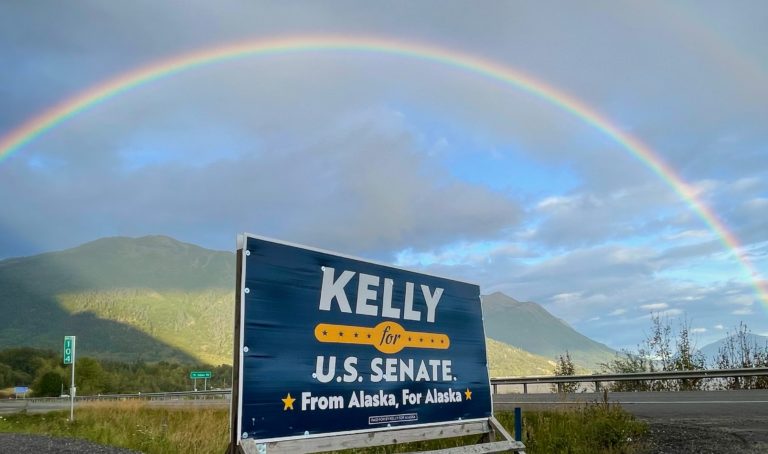
We may never be able to quantify how much Kelly Tshibaka’s first-name campaign has benefitted Buzz Kelley and Kelly Merrick. However, the difference in ideology between the Kelly running for US Senate and the one running for State Senate from Chugiak/Eagle River is verifiable.
Kelly Tshibaka is a true conservative, supporting limited government, personal liberties, Christian values, and Alaska- and America-first principles.
Kelly Merrick, on the other hand, has been censured twice by the Republican Party as her most noticeable accomplishment in the Alaska House was earning co-chair of the finance committee by joining the Democrat Caucus and betraying her Republican base.
As candidates for the State Senate, District L primary against Kelly Merrick, Joe Wright and I have subsequently dropped out of the race in part because we want to give Alaska Rep. Ken McCarty a greater chance to beat the “Other Kelly” — Kelly Merrick.
The “Other Kelly” single-handedly gave the leadership of the Alaska House to the Democrats in exchange for a chairmanship. She caucused with the Democrats and honestly should have a D after her name.
She voted against the full PFD, but took credit for the $3300 PFD this year.
Kelly Merrick has been censured by the Republican Party because she sold out. She went against her campaign promise and joined the Democrat caucus, and thereby handed the control of the state house of representatives to the Democrats when there existed a Republican majority.
Kelly Merrick is funded by unions who are gaining access to the legislature though her. Free-enterprise is a Chugiak/Eagle river ethic! “The Other Kelly” with her union boss husband represents union control.
Kelly Merrick needs to be defeated because she betrayed our trust and does not reflect the conservative values of Chugiak/Eagle River.
The “Other Kelly,” Kelly Merrick, should not be confused with the dedicated conservative Kelly Tshibaka who is focused on doing what is right for the nation.
Vote and support Ken McCarty for State Senate District L, and Kelly Tshibaka for US Senate, but say “no” to the “Other Kelly’s” liberal values.
Voters have a real opportunity to change the future of Alaska by electing Kelly Tshibaka as US Senator and Ken McCarty as State Senator. They will bring the values of faith, family, and freedom to our government for Alaska’s future.
Clayton Trotter is a former candidate for Alaska Senate.
U.S. Senators Lisa Murkowski and Dan Sullivan, both R-Alaska, recently sent a letter to Interior Secretary Deb Haaland reiterating their strong support for the Ambler Access Project (Ambler Road).
But Alaska’s Congresswoman Mary Peltola would not sign the letter, even though when she was running for office earlier this year, she said in a media survey that she would support the road, stating “Yes, pending local support, usage restrictions, and environmental standards are met.”
Peltola, who is finishing out the term of the late Congressman Don Young, is now running for the two-year seat and her name will be on the Nov. 8 ballot, along with Nick Begich, Sarah Palin, and Chris Bye.
The senators called on the Department of the Interior to promptly complete its work to re-approve the Ambler Road following DOI’s request for a voluntary remand of the project’s Record of Decision. Murkowski and Sullivan specifically urged Interior to commit to a concrete timeline, allow the project proponent to continue important baseline scientific work, and allow geotechnical drilling to proceed.
The senators also reiterated that failure to satisfy the court’s remand order in a timely and narrow manner would defy federal law, prevent hardworking Alaskans from accessing jobs that support their families at a time of painfully high inflation, and worsen projected shortfalls of strategic minerals and metals that are crucial to clean energy and many other technologies.
“This Congressionally-mandated access is essential to ensuring the economic stability of both Alaska and the nation. In Alaska alone, the Project has the potential to facilitate over 8,700 direct, indirect, and induced construction and operation jobs and nearly $700 million in annual wages. That would be top of an annual average of 360 direct jobs over the road’s construction period, and up to 81 direct annual jobs for road operations and maintenance over the life of the road.”
“Given assurances that the remand would be “timely” and given the importance of the Project to Alaska and national security, we are concerned that DOI’s first status report, filed with the Court on July 18, 2022, indicated the Department was “not yet able to identify a timeframe for completion of a draft and final supplemental environmental impact statement.” We anecdotally understand that the timeframe could be up to three years, which is categorically unacceptable and deeply contrary to every reasonable expectation for how the voluntary remand would proceed.
“Given the seven years of cooperation between all applicable federal agencies, the comprehensive [Joint Record of Decision], and the Congressionally-recognized importance of completing the Project on an expedited basis, we urge you to take the necessary steps to move the Project forward and complete the voluntary remand in a timely, workable, and definitive timeframe. Otherwise, DOI will jeopardize economic and national security by increasing our reliance on adversaries like China for those strategic minerals necessary for our defense, competitiveness, and future prosperity.”
The Ambler Road would provide access to mining district and facilitate the responsible development of high-grade mineral deposits—including copper, cobalt, zinc, silver, gold, and other metals—in northwest Alaska. A right-of-way across federal land is guaranteed by the Alaska National Interest Lands Conservation Act (ANILCA). These critical minerals are crucial to all aspects of modern technology and national security and will help prevent the shortfalls that S&P Global, Bloomberg New Energy Finance, and others have forecast in recent months.
The Alaska Industrial Development and Export Authority initially submitted its application to develop the 211-mile Ambler Road project in November 2015, making this the seventh full year of federal regulatory review. The Bureau of Land Management published a draft EIS on August 30, 2019 and held 22 public meetings in local communities, Anchorage, Fairbanks, and Washington, DC prior to issuing a favorable ROD in July 2020.
Despite that, the Biden administration sought and won approval to voluntarily remand the ROD on February 22, 2022. With no apparent sense of irony, President Biden held a roundtable on “Securing Critical Minerals for a Future Made in America” that very same day—failing to recognize that the Ambler Mining District is one of the nation’s best options to produce them.
On Sept. 20, 2022, BLM initiated a 45-day public scoping process for a Supplemental Environmental Impact Statement (SEIS) for the Ambler Road project. BLM’s notice of intent states that the agency will evaluate a “range of alternatives” related to a range of topics but provides no timeframe for the completion of this additional review.
Senate Republican Minority Leader Mitch McConnell’s political action committee has put Republican Senate candidate Kelly Tshibaka in its crosshairs, with a vicious radio ad in Alaska that all but accuses Tshibaka of committing fraud.
Tshibaka has, in the past, said that if elected she will not support McConnell, now in his seventh term in office, for Republican majority leader. The Kentucky lawmaker is returning the favor: His ad, which is carefully worded, refers to an audit done when Tshibaka was a federal employee that related to the accounting of her hours and the hours of others. Tshibaka was never accused of any wrongdoing then, but listeners would not know it from the ad running on many radio stations across the state.
“Kelly was fully exonerated after an investigation, and in fact was shortly thereafter named acting inspector general for the federal trade commission. The ad is full of lies,” said Tshibaka’s campaign.
One radio station owner turned the ad down, saying it was over the line in terms of decency, according to what the owner told Must Read Alaska. The station sacrificed several thousands of dollars by turning down the ad.
The Senate Leadership Fund, controlled by McConnell, supports Alaska Sen. Lisa Murkowski in her reelection campaign, while former President Donald Trump and his political action committee support Tshibaka. Earlier this year, McConnell’s fund postponed running its ads in Alaska in order to focus on more high-stakes races. But just two weeks after an AARP poll shows Murkowski and Tshibaka virtually tied, the ads against Tshibaka are on the airwaves.
Tshibaka and Murkowski’s campaigns have been running attack ads on each other for months, but the McConnell ad caught the attention of many Alaskans, who said it went too far.
Murkowski and McConnell are usually aligned, but not always, especially when it comes to Donald Trump. In 2021, Murkowski publicly said she was upset with McConnell over his decision to block a commission to look into what she considers a the violent attack on the U.S. Capitol by hundreds of Donald Trump supporters on Jan. 6, 2021.
“In an extraordinary meeting with reporters on Capitol Hill before an expected vote on the Jan. 6 commission, Murkowski took direct aim at the Kentucky Republican over his stated rationale for opposing the investigatory panel: that he would rather focus his party’s energy on President Joe Biden’s misdeeds to gain fodder for the 2022 midterm elections rather than risk alienating former President Trump and his supporters,” according to the Huffington Post, which reported that she was accusing him of trying to make political gains.
“To be making a decision for the short-term political gain at the expense of understanding and acknowledging what was in front of us on Jan. 6, I think we need to look at that critically. Is that really what this is about, one election cycle after another?” Murkowski said to reporters then. “Or are we going to acknowledge that as a country that is based on these principles of democracy that we hold so dear. And one of those is that we have free and fair elections… I kind of want that to endure beyond just one election cycle.”
In a day when professional athletes are encouraged not to stand for the national anthem, and pundits declare that Americans everywhere should feel ashamed of America and her founding, I suppose it is but a small step to next attack the U.S. Constitution itself.
In Alaska, I find myself at the tip of the spear as this latest assault on the Constitution unfolds. Using the Constitution to attack those who support the Constitution — when did that even become a thing?
For me, that became a thing on Aug. 1, when I learned that a well-financed law firm was filing suit to overturn my 2020 election and give my district’s seat in the legislature to someone that voters in my part of the state never elected. A second part of the lawsuit also would overturn the results of this year’s primary election and legally bar voters in my district from being able to vote for me in November—and all in the name of protecting the Constitution.
This is where the front lines have moved to today.
By the way, in Alaska, there is no government agency to defend the results of an election against these kinds of attacks. Our Division of Elections has balked at having to assess every political candidate’s loyalty to the Constitution, which they should never, ever be asked to do, but they have stopped far short of defending the rights of the voters in my district to continue to be represented by a legislator they actually elected.
At present, the legal responsibility for defending the right of my constituents to choose their own elected representatives falls on me alone, with the help of my attorney and those willing to financially support that effort.
To turn away from this latest attack means forfeiting that right, and inviting a future in which the voters in my state will only be permitted to vote for those candidates whom the state has first deemed appropriately “loyal” to the Constitution; from state governor to the city dogcatcher.
Let that sink in.
What the attorneys against me are arguing is that the Constitution not only allows, but in fact requires, the state to subject political candidates to a loyalty test where the state will subjectively determine whether someone is sufficiently loyal to the government—prior to allowing that individual to serve in a government position or even allow that candidate’s name to appear on the ballot.
What the attorneys against me are arguing is that the Constitution not only allows, but in fact requires, the state to subject political candidates to a loyalty test where the state will subjectively determine whether someone is sufficiently loyal to the government—prior to allowing that individual to serve in a government position or even allow that candidate’s name to appear on the ballot.
This manner of conducting elections would flip the Constitution on its head. In the future, instead of candidates seeking to obtain the consent of the governed (voters) before serving in office, they would first have to seek and obtain the consent of the government.
What this also means practically, is that a well-financed law firm will be able to unilaterally double or triple the cost of running for office for any candidates they decide to target. Not only will conservative candidates have to win a primary and a general election, but before even competing in an election, they will face the prospect of an expensive legal battle in the courts over whether or not the state has accurately assessed their loyalty.
In my case, the other side has already indicated that they plan to appeal to the supreme court and pursue the lawsuit into next year, assuming they are not successful in the lower court. As a candidate, just defending my candidacy in court, even if we win the case at every level, will almost certainly cost more than my election campaign.
How many conservative candidates have an extra $50K or $100K to spend on an election lawsuit, the results of which are never certain? And perhaps that’s the point: getting conservative candidates to think twice about ever running for office.
To add insult to further insult, in my case, the other side is trying to make the case that my unwavering support for the Constitution is actually further proof that I am unfit for office, and that I am violating the constitution today just by the mere act of serving in the legislature.
Like every other state legislator, on January 19, 2021 I took the oath of loyalty to the Constitution immediately before assuming office. But while that oath was sufficient to establish the loyalty of every other legislator, those behind the lawsuit argue that it wasn’t sufficient to establish my loyalty.
They point back to thirteen years ago when I became a Lifetime Member of an organization that requires members to take an oath of loyalty to the United States Constitution before joining and, consequently, forbids any member from being disloyal to the Constitution or advocating for its overthrow.
They point back to January 6th, 2021, before I was sworn in as a legislator, and the fact that I willingly attended the speech that President Donald Trump gave that day, in person. It was in Washington, D.C.—more proof that I am disloyal to the Constitution, that my election should be overturned, and that the voters in my district should lose their elected representative.
This is what the front line of the battle for the Constitution looks like today. It is crucial that we hold the line at this point. With your help, that is exactly what we intend to do. Please visit: www.davidlegal.org.
David Eastman is a state representative who lives in Wasilla, Alaska.
The Biden Administration and federal agencies overstepped their authority when they mandated a Covid-19 vaccine for Head Start workers and masks for children participating in Head Start programs, according to a ruling from a U.S. District Court judge on Wednesday.
Under a federal rule announced almost a year ago, Head Start centers must require vaccines for staff and masks for anyone 2 years or older, according to the Department of Health and Human Services, which oversees the program
“The Court finds the Agency Defendants have exceeded their authority by implementing the Head Start Mandate because Congress only gave Agency Defendants the power to “modify” Head Start performance standards. The Head Start Mandate is not a modification,” states the 27-page ruling by U.S. District Court Judge Terry A. Doughty for the Western District of Louisiana.
Today’s ruling orders a permanent injunction against the Head Start mandate in Alaska and in 23 other states.
In December 2021, Alaska Attorney General Treg Taylor signed onto the lawsuit. “This is a pivotal decision in the pandemic’s legal disagreements over vaccines and masks for nearly half the nation,” said Taylor. “The District Court lays out that the liberty interests of individuals who would be forced to take the COVID-19 vaccine outweigh any interest generated by the mandatory administration of vaccines. And the court protects the rights of States to protect their citizens from such overreach, as Alaska has been insisting on doing.”
On page 21 ofthe ruling, it states, “The Court finds that the Head Start Mandate, which imposes its requirements upon 273,600 Head Start staff, 864,000 children and approximately 1,000,000 volunteers, involves an agency decision of vast economic and political significance. Congress has not clearly spoken to grant Agency Defendants the authority to impose the Head Start Mandate. Therefore, the Head Start Mandate violates the major questions doctrine.”
Other court cases also challenge the mandate. The District Court ruled, “This Permanent Injunction order shall remain in effect pending the final resolution of this case, or until further orders from this Court, the United States Court of Appeals for the Fifth Circuit, or the Supreme Court of the United States.
Until today’s ruling, the school year started with the Covid restrictions for Head Start, as mandated by the Biden Administration. Children older than 2 who were part of the program were required to wear masks, even while people in the rest of society are no longer wearing them.
For much of the country, this school year started with Covid restrictions in the past: No more masking, vaccine mandates, social distancing requirements or testing regulations. The federally funded preschool program serves low-income families, and the ruling that governed these children were much harsher than the general CDC recommendation to wear masks in areas of high transmission of the Covid-29 virus.
The Biden Administration introduced it as an interim final rule in 2021, drawing immediate condemnation from Alaska and several states. Twenty-four states, including Alaska, sued the federal government for the lawless mandates.
Rosemary Ahtuangaruak, mayor of Nuiqsut, Alaska, compared a small subsurface gas leak at Alpine CD1 this past winter to Deepwater Horizon, the drilling rig blowout in 2010 in the Gulf of Mexico, which led to the largest marine oil spill in history.
After being introduced to the subcommittee by Alaska Congresswoman Mary Peltola, Ahtuangaruak talked about how the air in Nuiqsut was so bad during the CD1 subsurface leak in March that people in the village could not breathe and feared for their lives.
That was a whopper, since the air around the site is some of the most heavily monitored air on earth and never went out of normal range.
But the real whopper she told was when the ranking member of the Subcommittee on Energy and Mineral Resources asked her who wrote her testimony.
Minnesota Congressman Pete Stauber asked Ahtuangaruak she had written her own testimony. She said yes.
Stauber then pointed out that the document’s information panel showed it was authored by Trustees for Alaska’s Bridget Psarianos, a lawyer for the environmental litigation firm.
Ahtuangaruak said no, she had no connection with Psarianos or Trustees of Alaska. Yet, the PDF file clearly shows Psarianos as the author.
The mayor of Nuiqsut was caught in a lie to Congress on the simplest of questions — did she write her own testimony or was it authored by a group that has an active lawsuit against the Willow Project.
The subcommittee hearing was convened to discuss H.R. 8802, offered by Rep. Raúl M. Grijalva, the Arizona Democrat who chairs the House Natural Resources Committee. The bill would require the secretary of the Interior and the chief of the Forest Service to align management of public lands and waters with the president’s greenhouse gas emission reduction goals. It’ a climate change bill, and it’s a Green New Deal bill, but had no mention of specific projects, such as Willow.
The Willow project was announced in January 2017 is in the Bear Tooth Unit in the northeast portion of the National Petroleum Reserve-Alaska (NPR-A). Estimated to produce 180,000 barrels of oil per day at its peak, the project will strengthen America’s energy security and stimulate economic growth for the entire region and Alaska. It is supported by Alaska’s entire congressional delegation and awaits a decision by the Bureau of Land Management and federal judges.
In addition to lying to Congress, Ahtuangaruak also hijacked the topic of the hearing and used her time to talk about the minor natural gas leak at CD 1, and her strong objection to the Willow oil project — both topics that were completely off-subject for the bill at hand.
One Juneau grandparent is up in arms after discovering that his 9-year-old granddaughter, while using the dressing room at the Dimond Swimming Pool in the Mendenhall Valley, was being watched by a fellow classmate.
And by fellow, the grandparent means the granddaughter was being watched by a boy who was in the girls’ dressing room.
“The boy changed his clothes in a stall, but then came out and watched the girls undress,” the grandparent of the girl said. “She saw the bra drop in the stall, which was very confusing to her. No school official gave the parents a heads up on this possibility. This is unacceptable.”
While the Mat-Su Borough School District has put such gender-bending policies on ice until further review, it’s apparent the Juneau School District has bent to pressure from parents and students who say they are more comfortable appearing to be the opposite gender. Unlike the Mat-Su, the district has made no effort to put its policy into “review” status.
The parents of the girl wrote to the school district superintendent last week, saying their daughter was very uncomfortable having to change in and out of her swimsuit in front of a boy. On Wednesday, a week after this happened, the parents got a response from Elizabeth Siddon, the president of the Juneau School Board:
“The district strives to foster inclusive and welcoming learning environments that are free from discrimination, harassment, and bullying regardless of sex, sexual orientation, gender identity, or gender expression and to make sure that all programs and activities are free from discrimination. The district complies with local, state and federal laws that prohibit discrimination, harassment and bullying.
“Our Administrative Regulation states that access should be allowed to restrooms and locker rooms based on the gender identity consistently expressed by the student. Transgender individuals should not be required to use facilities that are inconsistent with their gender identity, nor should they be required to use single-user facilities. If any student, regardless of gender identity, is uncomfortable using a shared restroom or locker room, considerations can include safe and non-stigmatizing alternatives such as the addition of a privacy partition or curtain, use of a nearby private restroom or office, or a separate changing schedule.
“Protecting individual privacy rights and disclosure rules must be taken into consideration throughout the process. Families are encouraged to work together with teachers and school administrators to develop solutions if questions or concerns arise. The privacy of all students is important and creative alternatives can be used to make everyone feel safe and comfortable during school activities. The use of parent volunteers can help increase the amount of supervision available during school activities such as sporting events or swim lessons.
“You are encouraged to bring any fears or concerns about specific situations to the attention of your child’s teacher and/or principal.”
The parents have been told by district personnel that their daughter can simply use the family dressing room, which has a door on it. But the parents also said their daughter was told to be discrete about using the family changing room and not make a big deal about it. The district doesn’t want other parents to find out what is going on, the parents suggested.
Now, girls are lining up to use the changing stalls so they don’t have to undress in the open in front of the boy, a parent told Must Read Alaska.
“I don’t understand. Why are they making my daughter’s feelings not matter? The other girls are now so uncomfortable they are lining up to use the stalls, instead of the boy using the family facility. She [the daughter] didn’t do anything wrong and she is the one who has to change in the family locker room.”
A parent told Must Read Alaska that her daughter is now putting on her swimsuit before she dresses in the morning so she won’t have to change in front of the boy. Another parent has moved her child to a home school pod.
For a while, the matter was brought up on the Juneau Community Collective Facebook page, but that discussion has since disappeared.
By ranking the “red,” perhaps former Gov. Bill Walker didn’t understand that it means rank the Republican. Perhaps he thought it meant a different kind of red — the Marxist type.
Walker, who was once a Republican, wants voters to rank him first for governor, and to rank Democrat Les Gara second.
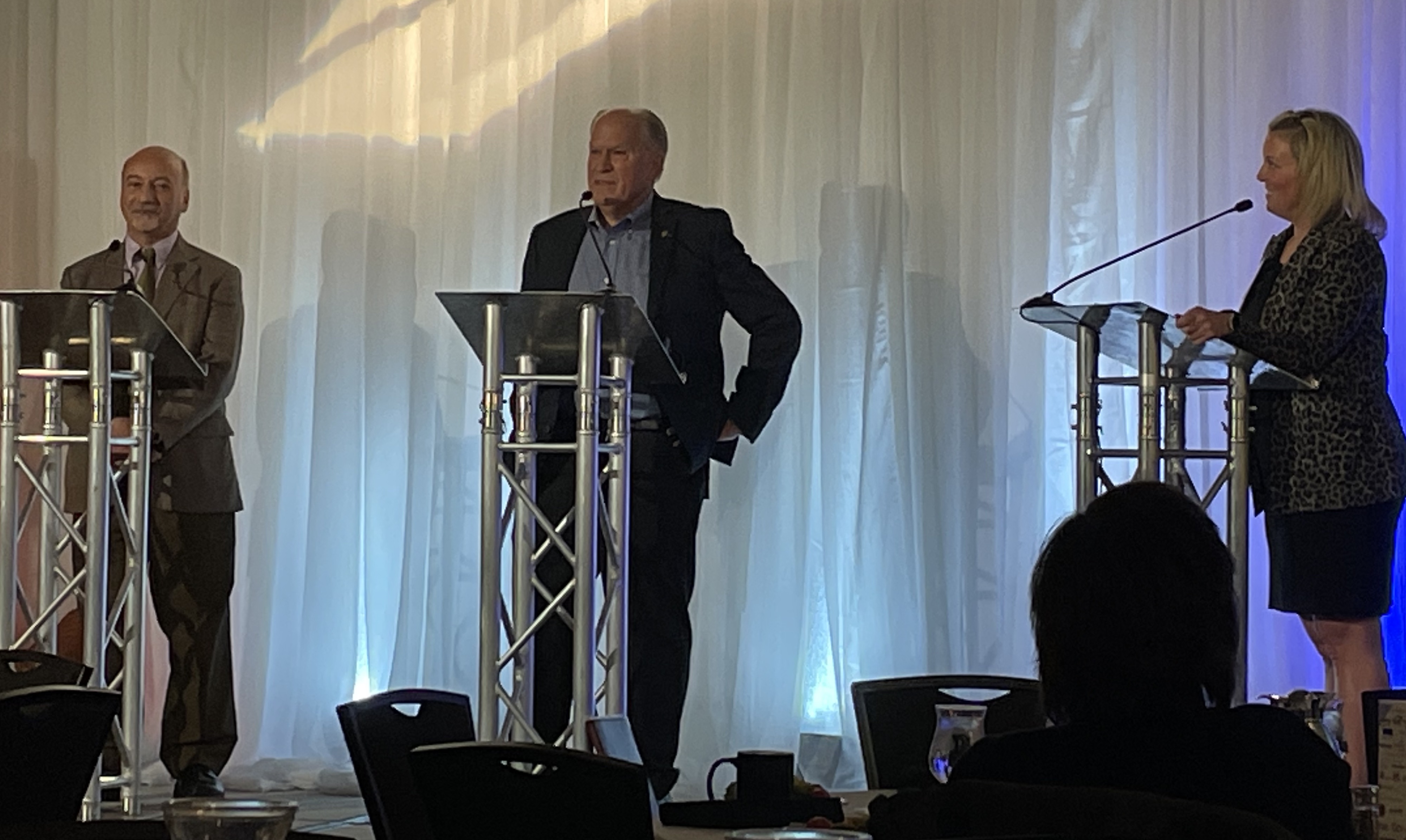
Walker started running as a no-party candidate in 2014, and then merged his campaign with Democrat Byron Mallott, who became his running mate. He served as governor for four years, but voters booted him out of office in 2018. Now, he is running again, still an undeclared candidate, but with radical-progressive leanings. At the Fairbanks Chamber of Commerce debate on Wednesday, Walker said voters should rank him first, and rank Gara, the hardest of the hard-left Democrats, second.
Alaskans will, for the first time in state history, rank their choices for governor on Nov. 8, rather than choosing just one. Walker, during the open primary, only received 22.8% of the vote, slightly behind Gara and far behind Gov. Mike Dunleavy, the incumbent, who got 40.4% of the vote. Charlie Pierce, another Republican, received 6.6% and Chris Kurka, yet another Republican, received nearly 4%.
Dunleavy was not at the forum, as he was on site in Western Alaska, where there is a major disaster occurring with coastal flooding.
During the debate, Walker also said the state needs to return to the Coastal Zone Management Program, a program that the state disconnected from in 2011. The issue boils down to who gets to control the outcome of permitting decisions on state land. The Alaska program had had a twisted history with a jumble of plans that led to uncertainty, and the program was another layer of review that did not add any value other than being regulatory netting.
During the debate, Gara said that Dunleavy is anti-gay. It’s the second time he has made the assertion about the governor who, during his first run for governor in 2018, suffered from a Democrat-led smear campaign that alleged Dunleavy was secretly gay.
An Anchorage grand jury indicted former Acting Alaska Attorney General Clyde Edward Sniffen, Jr. on three counts of sexual abuse of a minor in the third degree for conduct alleged to have occurred with a West High School Student while he was in a position of authority in 1991. Sniffen’s Superior Court arraignment is set for Sept. 26, 2022 at 1:45 pm.
The charges in the indictment are only allegations and are not evidence of guilt. Sniffen is presumed innocent and is entitled to a fair trial at which the prosecution must prove his guilt beyond a reasonable doubt, the Department of Law said.
The woman he allegedly sexually abused was 17 at the time, and is now in her late 40s. She came forward after the long-time assistant attorney general had been appointed acting attorney general after the resignation of former AG Kevin Clarkson. Sniffen quickly resigned after the allegations were brought to the mainstream media.