Saturday, August 15, 2026
Home Blog Page 676

Rubio leads fight against social scoring programs in education

BY CASEY HARPER | THE CENTER SQUARE

The legislative fight against Diversity, Equity and Inclusion programs in education is picking up steam nationwide.

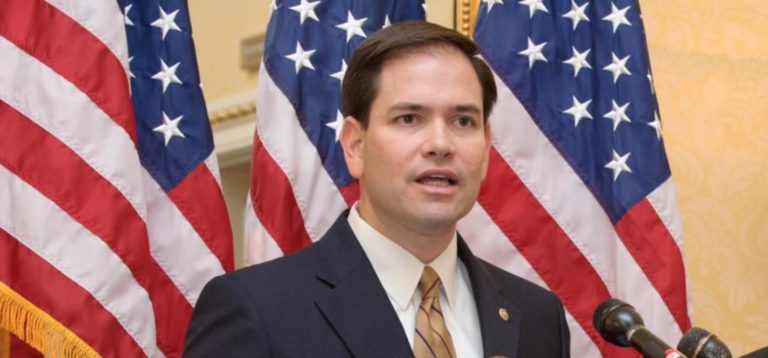
U.S. Sen. Marco Rubio, R-Fla. introduced the Fairness in Higher Education Accreditation Act,  which would ban accreditation officials from considering an educational institution’s DEI or affirmative action policies when determining accreditation.

DEI departments have exploded at universities in recent hears with a spike in new administrators who enforce liberal equity and racial policies at the educational institution. These programs usually embrace the idea of systemic racism, speak of the U.S. as a deeply racist nation, and push for the most aggressive side of the LGBTQ agenda.

In recent years, more and more federally recognized accreditation agencies have implemented DEI requirements for applicants, forcing schools to embrace progressive ideas on race and gender or risk losing their accreditation.

“Wokeness should not be mandatory,” Rubio said in a statement after introducing the bill, which the Florida senator argues “seeks to prevent a politicized Department of Education from further forcing diversity, equity, and inclusion policies into higher education.”

Practically, DEI enforcement manifests in various ways.

In a fact sheet published by the Department of Education, the agency touts President Joe Biden’s emphasis on DEI and lays out several examples of potential DEI activities.

From the DOE:

• diversity, equity, and inclusion training;

• instruction in or training on the impact of racism or systemic racism;

• cultural competency training or other nondiscrimination trainings;

• efforts to assess or improve school climate, including through creation of student, staff, and/or parent teams, use of community focus groups, or use of climate surveys;

• student assemblies or programs focused on antiharassment or antibullying;

• investigations of, and issuance of reports concerning the causes of, racial disparities within a school; or

• use of specific words in school policies, programs, or activities, such as equity, discrimination, inclusion, diversity, systemic racism, or similar terms

The federal agency goes out of its way to argue that these activities do not “create a hostile environment on the basis of race.”

U.S. Sens. Rick Scott, R-Fla., and Mike Lee, R-Utah, are helping lead the effort to undo these federally backed requirements for accreditation.

“We need to make sure that no school is judged based on whether a DEI agenda is used,” Scott said.

Lee said the effort “safeguards against manipulating the accreditation process to advance ideological agendas.”

The Senate effort is the latest pushback against DEI. State lawmakers and governors have already begun taking on DEI policies, as The Center Square previously reported.

Texas Gov. Greg Abbott signed a bill last week that will end taxpayer funding for DEI programs at public colleges and universities.

Meanwhile, the U.S. Supreme Court is taking on the affirmative action issue and may prohibit the policy. The high court is expected to issue a ruling in the coming weeks on the case, which considers the race-based admissions policies at Harvard and the University of North Carolina at Chapel Hill

Specifically, the ruling in this case could have a major impact on schools’ affirmative action policies and how they discriminate based on race, especially whether schools receiving federal funding can continue to do so.

Students for Fair Admissions, a nonprofit group boasting 20,000 members, filed the relevant lawsuit against Harvard and the University of North Carolina in 2014. The lawsuit alleges that the policies discriminate against white and Asian-American applicants. Both SFFA cases have been defeated in lower courts, but now the Supreme Court will have its ruling out imminently.

Bud Light grants $200,000 to National LGBT Chamber of Commerce

Bud Light and the National LGBT Chamber of Commerce, the “exclusive certifying body for LGBT-owned businesses,” announced they are extending their partnership to support economic opportunities and advancements for LGBTQ+ Americans and business owners across the country.

“Bud Light was brewed to be an ‘Easy to Drink, Easy to Enjoy’ beer for everyone 21+ and that still holds true today,” said Anheuser-Busch in a May 30 press release. “We look forward to extending our work with the NGLCC to continue making a positive impact on the LGBTQ+ businesses that play a critical role in bringing people everywhere, together.”

This year, Bud Light will donate $200,000 to the LGBT Chamber in support of its Communities of Color Initiative, designed to support the growth and success of minority LGBTQ+-owned businesses through certification, scholarships and business development.

Bud Light also donated $200,000 to the LGBT Chamber in 2022.

Bud Light has had stormy weeks since it decided to partner with transgender Dylan Mulvaney, who on TikTok play acts as a teen or pre-teen girl. The partnership ended up costing the company in sales and stock value, as consumers walked away from the brand that had been seen as American as apple pie.

Bud Light maker Anheuser-Busch InBev lost $27 billion in market value after it came out with the Mulvaney partnership. Last week, its stock dropped another 4% and May was the third-worst month for company stock prices, which have suffered a 20% fall since Americans began boycotting the brand.

Aug. 23 is first primary debate for GOP presidential candidates, but who will be on the stage?


To kick off the upcoming 2024 presidential election cycle, the Republican National Committee unveiled requirements for candidates to participate in the first debate, scheduled to take place on Aug. 23, and hosted by Fox News.

The RNC’s announcement comes as several well-known Republican figures have already thrown their hats into the ring, including former President Donald Trump, former U.N. Ambassador Nikki Haley, former Arkansas Gov. Asa Hutchinson, South Carolina Sen. Tim Scott, Florida Gov. Ron DeSantis, media personality Larry Elder, and tech mogul Vivek Ramaswamy.

Former Vice President Mike Pence, former New Jersey Gov. Chris Christie, and North Dakota Gov. Doug Burgum are expected to join the race soon.

The RNC set specific criteria that candidates must meet in order to secure a spot on the debate stage. According to a report from The Hill, candidates must attain at least 1% support in three different national polls,

Alternatively, they can reach 1% in two national polls and one poll from an early primary state, which could be Iowa, New Hampshire, South Carolina, or Nevada.

The polls must survey a minimum of 800 registered likely Republican voters on or after July 1 and cannot be conducted by an entity associated with any of the candidates.

Candidates who meet the requirements will be arranged on the debate stage based on the polling, with the candidate with the highest polling getting center stage. 

In addition, the RNC has set fundraising benchmarks for candidates. To be considered qualified for the debate, candidates must have at least 40,000 unique donors, with a minimum of 200 unique donors from at least 20 states and territories. The requirements are meant to ensure candidates have a broad enough base of support.

The RNC has also introduced two provisions: All participants in the debate will be required to sign a pledge to support the eventual nominee of the party. Candidates must also agree not to participate in any debates that are not officially sanctioned by the RNC.

These rules may be challenging for former Trump, who has hinted he may skip the first debate.

The second GOP debate is tentatively set for the next day, Aug. 24, at the Ronald Reagan Presidential Library in California.

Creepy: Three deaths in three days on one boat anchored near Juneau

The vessel Dusky Rock, anchored offshore at Sandy Beach on Douglas Island has become the scene of three deaths within the span of three days.

Sandy Beach is a popular recreation area in the heart of the Douglas town center, right across Gastineau Channel from Juneau.

On May 31, a 34-year-old female reported the discovery of her friend, 51-year-old Curtis Edwin Anderson, deceased on board the vessel.

Investigations revealed no indications of foul play surrounding Anderson’s death. His body will undergo an autopsy at the Alaska Medical Examiner’s Office in Anchorage, and his relatives were notified.

On June 2, at approximately 6:19 p.m., Juneau police received another report related to the Dusky Rock.

This time, a concerned individual informed authorities that he had heard a dog howling on the Dusky Rock and ventured out to investigate. He stumbled upon the lifeless body of a female on board.

Police and response workers confirmed the presence of two deceased females on board the boat. No other individuals were on the vessel, nor is it clear why the dog was there.

Authorities towed the vessel from Sandy Beach to Aurora Harbor, where Capital City Fire and Rescue conducted a thorough examination for the presence of harmful fumes and concluded that none were detected.

The deceased individuals have been identified as a 34-year-old Juneau woman and a 28-year-old Juneau woman.

Notably, the 34-year-old woman was the original complainant who reported Curtis Edwin Anderson’s death on 31st May. The next of kin for the 34-year-old have been informed, while police are still in the process of notifying the family for the 28-year-old female.

Although foul play has not been discovered during the preliminary investigations, police said that the use of controlled substances might have played a role in these fatalities. Both bodies will be transported to the Alaska Medical Examiner’s Office in Anchorage for autopsies to determine the cause of death.

Anderson had many prior run-ins with the law, including criminal offenses such as assault, driving under the influence, trespassing, and violating conditions of release, all going back to at least 2011.

The Dusky Rock is listed as a 35-foot fishing vessel that according to databases was originally built for William T. Council, the late husband of former Lt. Gov. Fran Ulmer, who had also served as the mayor of Juneau and a state representative.

As long ago as 2012, it was used in halibut fishing. It’s unclear who the owner of the vessel is today, but the deck is littered with crab pots.

Red state, blue state: Birth rates during Covid pandemic show fear-factor and political leanings

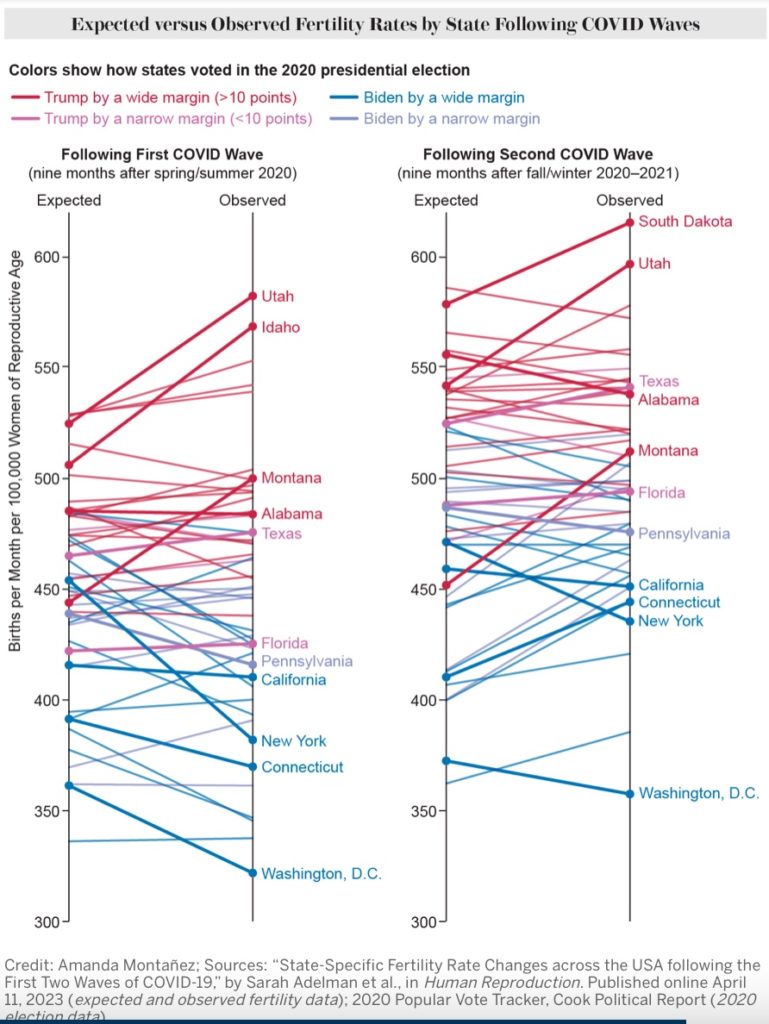
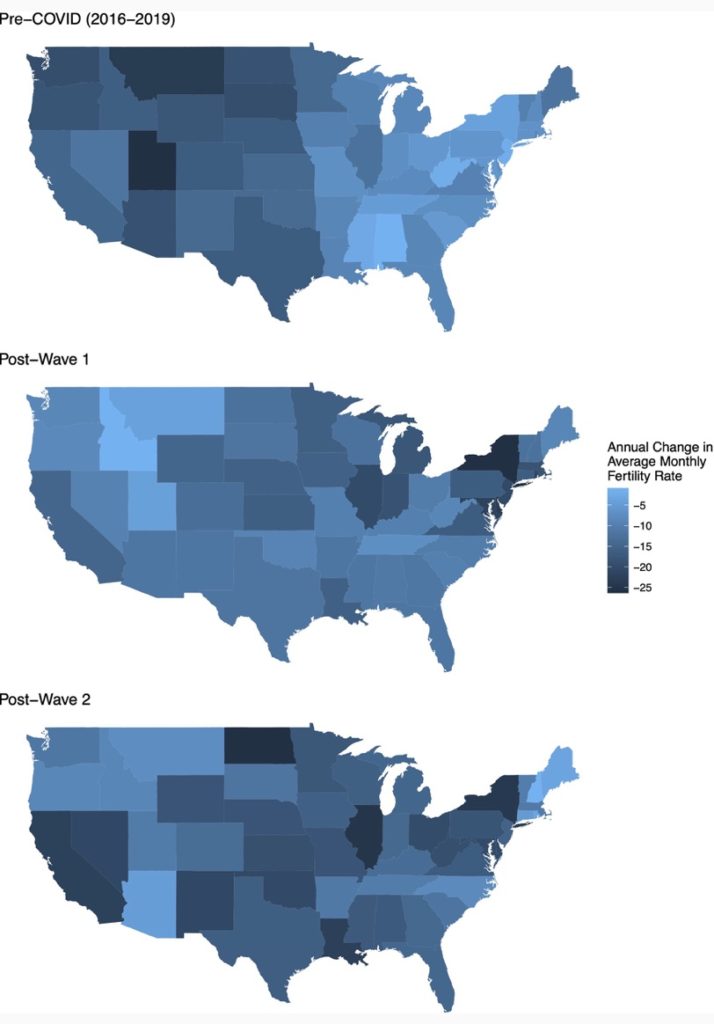
A study in the scientific journal Human Reproduction compared the birth rates of states during the Covid pandemic years of 2020 and 2021.

The red (Republican-leaning) states trended toward higher live birth rates, while blue (Democrat-leaning) states saw their live birthrates decline, the study reported in April.

The researchers explored the impact of public perception of the Covid-19 pandemic on fertility rates, researchers found a significant correlation between the degree to which states or regions took the virus seriously, feared the virus, had a lot of anxiety about the future, and subsequent fluctuations in their fertility rates.

The study suggests that political leanings played a role in shaping the perceived threat of the virus, with Democratic-leaning states and Washington, D.C. exhibiting a higher level of concern compared to their Republican-leaning counterparts.

For example, Utah, South Dakota, and Idaho birth rates went up, while New York, Connecticut, and Washington, D.C. went down.

San Francisco mirrored the liberal drop in childbearing during the recent pandemic. The Bay Area had an 18% decline in births in early 2021, right when early pandemic babies might have been born, compared to a 15% decline in California in general for the pandemic year of 2021.

Alaska and Hawaii are not found in the study, but a separate look at Alaska’s birth rates show a continuous drop for many years, one that continued through the Covid pandemic years of 2020-2022.

Since 2015, Alaska’s live births have dropped by over 17%. Unlike red states of South Dakota, Utah and Idaho, the downward trend was unchanged during the waves of pandemic lockdowns and mandates. Alaska is currently in the longest stretch of declining birth rates since the state began keeping records in 1945.

Year | Live Births in Alaska
—————————–
2015 | 11,325
2016 | 11,247
2017 | 10,496
2018 | 10,120
2019 | 9,862
2020 | 9,469
2021 | 9,410
2022 | 9,364

In general, liberals are not having nearly enough children to keep up with conservatives. This makes it no surprise that San Francisco has a birthrate of 3.6 per 1,000 compared with Anchorage at nearly 12.66 live births per 1,000, and Fairbanks at 13.35, according to Statista.

“The political right is having a lot more kids than the political left,” observed Syracuse University social scientist Arthur Brooks, in 2006. “The gap is actually 41 percent.”

The U.S. birth rate shows that 100 conservative adults will have 208 children, while 100 liberal adults will have 147.

If birth rates during Covid pandemic years of 2020 and 2021 are any indication, then Alaska is an anomaly among the red states.

Alaska, where the birth rate keeps dropping, voted for President Donald Trump in 2020 by a margin of 53%. Adding Trump votes together the other conservative candidates on the General Election ballot in 2020 (Libertarian Jo Jorgensen, and Constitution Party Don Blankenship), the conservatives won 55.5% of the presidential votes in Alaska. But the babies are just not showing up in the 49th state, like they are in other conservative states.

Spoiled concrete: Supreme Court weighs in on right to strike definitions in Washington Teamster case

In a landmark decision on Thursday, the United States Supreme Court established a new definition concerning limits on the right to strike under federal labor law.

The case, Glacier Northwest v. International Brotherhood of Teamsters, Local Union 174, focused on whether an employer could legally sue its employees’ union under state law for demonstrable damages resulting from a strike.

The court’s ruling departs from the traditional application of federal labor law, which the Teamsters said was “settled law.”

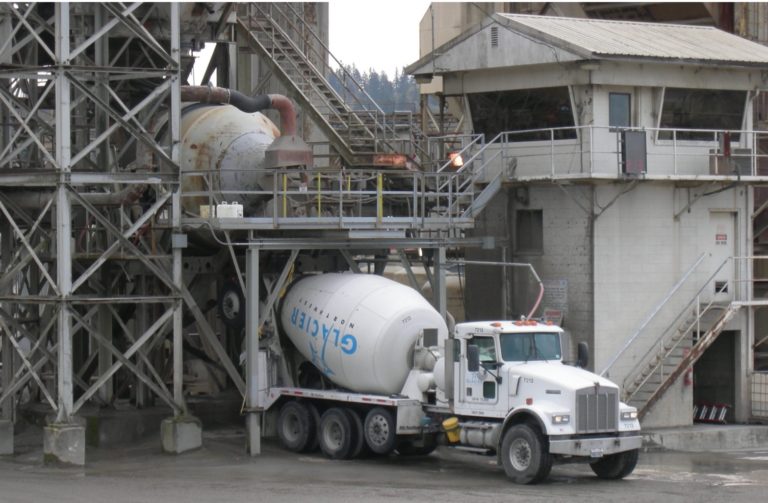
The case involved a group of concrete mixer drivers employed by Glacier Northwest, which operates in South Seattle and other places in Washington state. On the day of the strike, several drivers showed up for work and allowed the company to load the trucks they were driving with concrete. However, the drivers then returned their trucks to Glacier’s headquarters and walked off the job, leaving the concrete to set into stone in the trucks. It cost Glacier Northwest an enormous sum to safely and legally dispose of it.

Glacier Northwest then filed a lawsuit against the Teamsters for what it claimed was the “tortious destruction” of its property—the spoiled concrete—during a strike.

The Washington Supreme Court had dismissed the case, citing the principle of “Garmon preemption,” which generally prohibits the application of state law to labor disputes covered by the National Labor Relations Act.

However, the Supreme Court’s decision in Glacier Northwest v. International Brotherhood of Teamsters introduced a new interpretation of the Garmon preemption doctrine.

Writing for the majority, Justice Amy Coney Barrett, joined by Chief Justice John Roberts and Justices Sonia Sotomayor, Elena Kagan, and Brett Kavanaugh, argued that the Teamsters’ strike was not protected by the National Labor Relations Act and, therefore, Glacier had the right to sue the union for damages in state court.

The decision was 8 to 1, with Justice Ketanji Brown Jackson dissenting. Jackson’s dissenting opinion voiced concern that the court’s ruling had expanded the scope of Garmon preemption beyond its intended purpose, potentially undermining the protections afforded to workers under federal labor law. This was Brown Jackson’s first solo dissent with the court.

As a result of the Supreme Court decision, the case will be sent b ack to the state court for further proceedings. The ruling could have significant implications for future labor disputes, as it establishes a broader framework for determining the limits on the right to strike under federal labor law.

Lawyers for the Teamsters said this changes nothing:

“Although we’re disappointed in today’s result, the Court’s opinion leaves intact both the federally protected right to strike and the basic framework for determining when labor disputes should be decided by the National Labor Relations Board instead of state courts. First, the Court rejected Glacier’s attempt to effectively overturn the 1959 decision in Garmon, which says that federal labor law preempts state lawsuits that challenge conduct even arguably protected by the NLRA. Second, the Court rejected Glacier’s attempt to adopt a novel subjective test that would have stripped strikes of protections whenever strikers intend to cause employers economic harm; it instead maintained current law, which strips federal protections for strikers only when they stop work without taking objectively reasonable precautions to avoid foreseeable, aggravated, and imminent harm to employer property. Third, the National Labor Relations Board maintains its primary role in deciding the actual facts of labor disputes and whether, under the actual facts, federal labor law protects strikers and their strikes.

“At the end of the day, nothing in this decision will stop workers from exercising their federally protected rights to strike when necessary to achieve better wages, benefits, and working conditions. In this particular case, Glacier has found a way to prolong its meritless lawsuit by artfully pleading allegations the Court today found sufficient to get past a motion to dismiss. But we’re confident, based on the extensive record developed in this case by the Labor Board from January through March 2023, that the Board will find Teamsters Local 174’s strike in this case was protected based on the actual facts, not just Glacier’s allegations.”

Photo credit: Joe Mabel, Wikimedia Commons

R-rated drag queen shows return to Soldotna Creek Park on Saturday

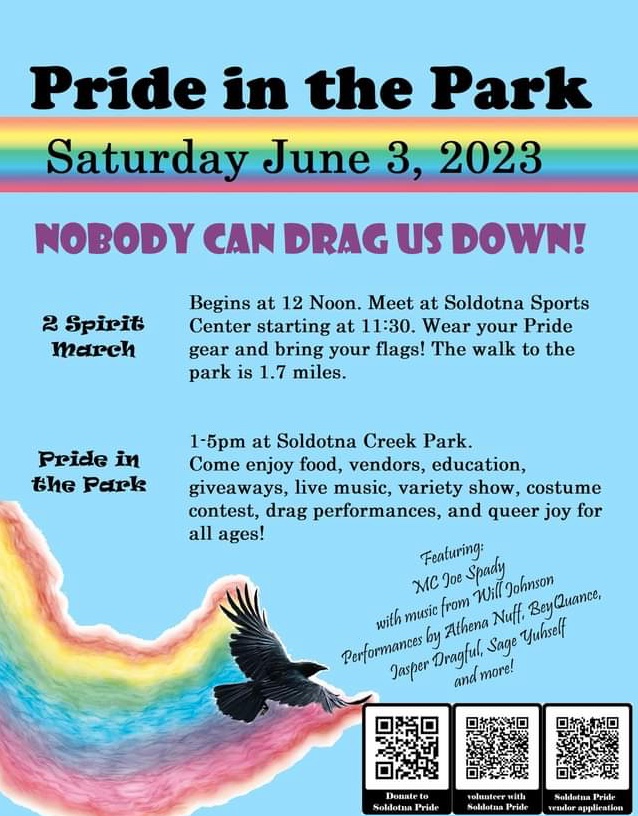
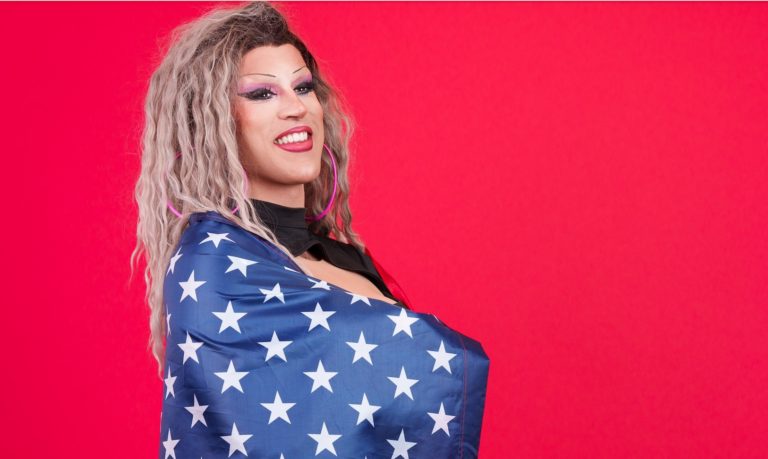
Pride Month is in full swing across the state. After a burlesque performance for children in Soldotna last year upset many in the community, the Pride in the Park event returns on June 3, for another year of queer expression, including drag queen performances “for all ages.”

Last year’s performance drew outrage from those who felt it was inappropriate to have burlesque shows that targeted children, which the event did, according to video and photos taken by residents. Parents tried to have the Soldotna City Council set up some guidelines, but the council refused to take action, in spite of an overwhelming number of people who pleaded with the city to establish standards for public park performances.

During last year’s event, one drag queen performer was dressed in a nude-colored pair of leggings, with a thong over it, and a skirt that barely covered his bottom, giving him the appearance of near nudity. Dressed as a woman or pre-teen, he bent over suggestively and shook his thonged bottom at the audience. The drag queen performers drew the children closer to the state.

Watch the segment of the drag queen show on our Facebook link.

The June 3 event appears to be doubling down on drag and other festivities celebrating gay, lesbian, bisexuals, and other forms of sexuality and gender expression. The events start at 11 am.

Department of Defense bans drag shows on military bases

At the start of Pride Month, the Department of Defense has canceled drag queen shows on bases across the world.

Shows that had been previously scheduled at Nellis Air Force Base in Nevada and Ramstein Air Base in Germany are now canceled, according to military officials who spoke to various members of the media. The directions came down from Defense Secretary Lloyd Austin,

The show at Nellis Air Force Base was first reported by NBC News.

Austin was grilled by the House Armed Services Committee earlier this year, when news of the drag queen shows became known.

On Thursday, Austin issued a statement in support of Pride Month: “As secretary of defense, I remain dedicated to making sure that our LGBTQ+ personnel across the joint force can continue to serve the country that we all love with dignity and pride — this month and every other one.”

Federal government stakes claim on emerging lands near Mendenhall Glacier in Juneau

The Bureau of Land Management announced Friday that it is claiming another 4,500 acres inside the 17-million-acre Tongass National Forest.

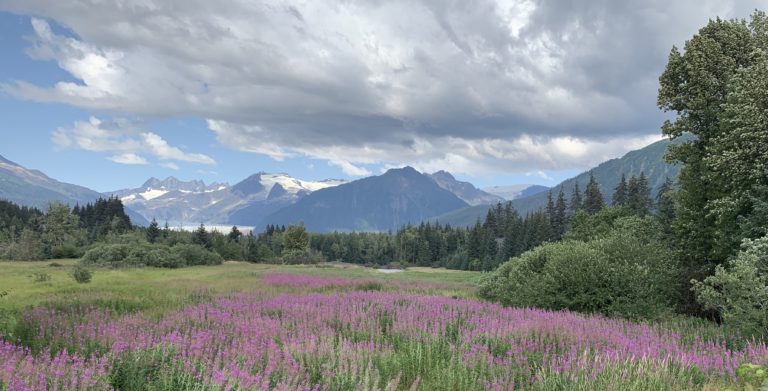
Public Land Order No. 7922 will take land that is being exposed with the receding of the Mendenhall Glacier, and ensure that it belongs to the federal government. Without the land order, the ownership of the land might be ambiguous.

The agency said it’s part of the Biden Administration’s America the Beautiful initiative, which seeks to lock up 30% of American land by the year 2030.

The Mendenhall Glacier, one of Alaska’s most accessible glaciers, draws hundreds of thousands of visitors each year. The glacier is located in the Mendenhall Glacier Recreation Area, which is home to a seasonally bustling visitor center, scenic hiking trails, and breathtaking viewpoints.

The U.S. Forest Service requested the 20-year withdrawal to ensure the long-term viability of the Mendenhall Glacier Recreation Area and to facilitate future Forest Service facility development, but no other development.

Staking a federal claim may also prevent a local tribe from declaring ownership of the land, which would cause complications for the Forest Service, as it will want to build a new visitor center. The current one doesn’t have a good view of the glacier, as it has receded so much. The action also prevents the State of Alaska from laying claim to the emerging lands.

“The withdrawal of these lands reflects our commitment to protecting our natural treasures and ensuring that future generations can continue to enjoy the splendor of the Mendenhall Glacier,” said the Bureau of Land Management. “This action is consistent with the America the Beautiful initiative, which aims to conserve 30 percent of America’s lands and waters by 2030.”

The boundaries of the withdrawn area include parts that were previously covered by the Mendenhall Glacier, which has been steadily receding since the end of the last mini-ice age in the 1700s.

According to the State of Alaska, the state’s glaciers are among the fastest melting glaciers in the world, with Alaska experiencing twice the rate of warming compared to the rest of the country over the past several decades.

Officials predict that the Mendenhall Glacier will retreat from the existing visitor center’s view by 2050.

The newly established withdrawal aims to protect areas that are becoming accessible as the glacier recedes.

As the glacier retreats, it opens up new ecosystems, leading to increased sightings of salmon, bears, and other wildlife. The withdrawal of the newly exposed lands will help preserve these unique habitats, natural resources, and the area’s pristine setting.

The decision to withdraw the lands is in line with the Mendenhall Glacier Recreation Area 2019 Master Plan, which was specifically developed to address the ongoing changes caused by the glacier’s retreat. The plan not only capitalizes on new opportunities but also addresses the anticipated increase in visitation over the next 20 years while providing a long-term vision for the next 50 years.

The withdrawal, which went into effect with the publication of the Public Land Order, will remain in place until June 2, 2043.