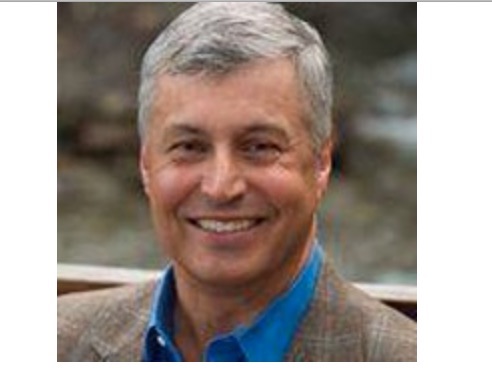
Fairbanks Republican Leslie Hajdukovich has filed to run against Sen. Scott Kawasaki for the Alaska State Senate Seat P, which Kawasaki has held since 2018. Hajdukovich filed her letter of intent with the Alaska Public Offices Commission on Tuesday morning.
Hajdukovich served for six years on the Fairbanks North Star School Board, including three years as president. She was the Fairbanks-Interior regional director for Sen. Dan Sullivan, and has remained active in the political life of Fairbanks. In 2014, she was part of the “Vote No on [Ballot Measure] 1” group that fought and defeated Senate Bill 21, the bill that had raised taxes on oil in Alaska.
Hajdukovich comes from the storied Wien aviation family and is a lifelong Fairbanks resident who graduated from West Valley High School. She is married to aviation executive Bob Hajdukovich.
Kawasaki is a Democrat who served on the Fairbanks City Council for two terms and then was elected to the State House. From there, he rose to the Senate in 2018, defeating incumbent Sen. Pete Kelly, a Republican.
On Good Friday, 1966, my Mom and three siblings and I boarded an airplane out of Chicago to fly to California, where Dad had gone to set us up for a new life on the WestCoast. I was three years old; Mom was 33, and it was the first airplane ride for all of us. My brother and I wore suits and ties. Mom and my two sisters wore pretty dresses and white gloves.
We weren’t all gussied up just because it was a holy day, but because we were going on an airline flight, a special and personally historical event. The stewardesses (a sexist and outdated term – so stipulated), seeing Mom traveling with four children between three and 10 years of age, directed us to a table – a table! – in the back of the airplane, so we could color, play games, and give Mom the ability to better corral us.
Flashforward to a couple years ago. I wore a suit and tie while flying from Anchorage to California, and while making her beverage run, the stewardess (there it is again) asked if I would like a free drink, as in one with alcohol. I reminded her I was sitting in coach where one has to pay for such indulgence, and I did not have the necessary but unbudgeted funds to cover a $6 bottle of beer.
“It’s on the house,” she said. “No one wears suits on airplanes any longer. Thank you.” She smiled, handed me the overpriced beer, and patted my arm.
My, how times have changed.
I never expected to hear myself utter the words, “Back in my day,” but . . . back in my day, church services required nice clothes; as did school picture day, my sister’s boring ballet recital, going out to dinner at a sit down restaurant, and the neighbors’ annual Christmas party.
Heck, I remember Mom and Dad dressing up to go to the movie theater on a far-too-infrequent date.
A few years ago, when the great ballplayer Stan Musial died, Sports Illustrated put his photo on the cover. The responses to that issue had more to do with the clothes the fans in the background were wearing than what Stan The Man was doing. The ladies (a sexist and outdated term – so stipulated) had on dresses and stylish hats, and the gentlemen wore suit jackets and fedoras.
As Alaskans, we are used to flying. I haven’t seen the statistics, but I am willing to bet a pair of cufflinks that we fly more miles and more often than those from the Lower 48. We are all too familiar with all that goes with traveling by air, and if you’re like me you find what used to be an enjoyable, sometimes exciting, experience to be a loathsome travail and a lesson in the bad habits and poor hygiene of North Americans.
Airports and airliners bring out awful human behavior, but then, so do many activities, such as grocery shopping, attending sporting events, and simply standing in line. Have you held a door open for someone lately? Go to a business office or store and time it so you have the opportunity to open the door for someone. More often than not, you will be greeted with nothing: No eye contact, no smile, and certainly no “thank you.” Sure, there’s the occasional person who will respond nicely, but that is the exception. Decency is not only uncommon, but also becoming increasingly rare.
What happened? Why have good manners disappeared? Is it because they’re not taught in the home and schools? Yes and yes. And I have a theory – completely untested and entirely void of scientific research – that many of the social ills we face today are due to a lack of manners. Manners teach children to be kind to other people and respect their opinions. They are based on basic kindness and treating people the way in which we would like to be treated.
Prior to our children beginning school, my wife and I kept meeting well-mannered children that stood out among their peers. They uttered phrased such as “please” and “thank you.” If they needed to speak with an adult who was already engaged in conversation, they politely said “excuse me” before conveying their thoughts. It was refreshing and encouraging, and we wanted our children to be like that. What we found was nearly all those well-mannered children were homeschooled. So, we decided to homeschool our kids.
The result? People continually asked us how we raised such polite children. “We teach them manners,” was our standard reply.
“Oh,” was the typical response, usually accompanied by a grimace or, occasionally, an enlightenment – a moment of Eureka. It was as if people had not thought about teaching their children manners . . . and I think that’s because people had not, well, thought about teaching their children manners.
The insufferable brats that block traffic for environmentalism, throw rocks at police officers, kneel during the National Anthem, shout down speeches given by the un-woke, and loot and burn in the name of social justice, do so with self-righteous indignation and the complete and utter disregard for the opinions or safety of others. They are convinced their actions are justified because they have been encouraged and empowered to feel they are in the right.
It may be a gross oversimplification, but in short, they are void of good manners.
Too much of a stretch? Well, there are college professors and other adherents to the Black Lives Matter movement, that actually argue that good manners are racist. Proper English grammar falls into that category as well.
But back to adventures in the less than friendly skies. I am willing to admit that the following behaviors during my travels last week are irritating to me because I’m getting old, but I honestly don’t remember people (adults, that is) cutting into the middle of a log line of would-be passengers waiting to board an aircraft, and talking very loudly on their ever-present cell phones while waiting to board, boarding, and even while seated on the airplane.
Speaking of boarding the airplane, there is, I hope, a special place in the underworld for those folks who make their way to the boarding area long before their boarding section is called. It kind of makes sense if they’re disabled, traveling with small children, or can afford First Class fares, but we encountered a family that approached the gate agent and when they were told their group was not yet boarding, they stood there. They didn’t argue or protest, but neither did they move out of the way. As no one was now entering the tunnel, other people started going around them. Being curious as to what they were doing, I asked them what they were doing. “We gotta’ wait,” was the answer.
“Could you move to the side, please, so the rest of us can board?” I asked. No answer this time. The two adults and two children continued to stand there and make everyone else go around them. Those kids are going to perpetuate their parents’ behavior and the rest of society is going to suffer for it.
And I didn’t even get to the drunks, seat recliners, and passengers from row 24 who stand up and try to exit the plane as soon as it comes to a stop.
Enjoy your holiday travels.
Tim Barto is vice president of Alaska Family Council and a regular contributor to Must Read Alaska.
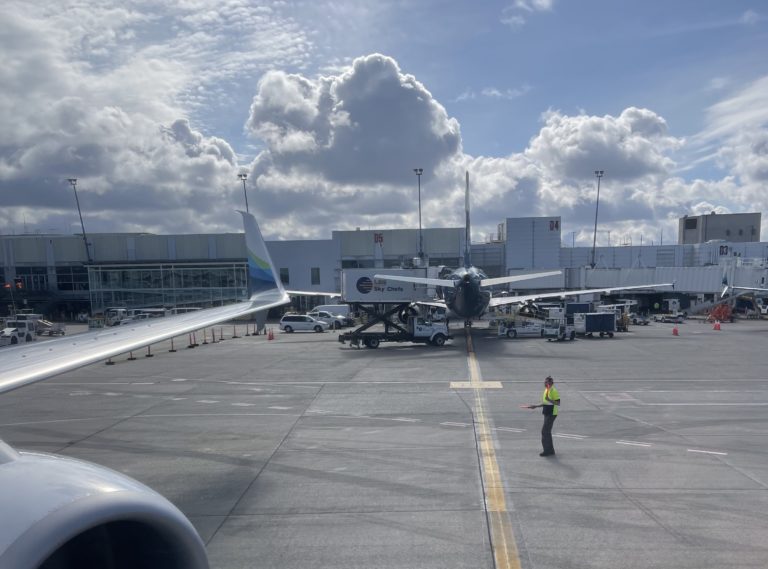
Travelers going through Ted Stevens Anchorage International Airport or heading through Seattle-Tacoma Airport may see Alaska Airlines flight attendants picketing outside the airports on Tuesday, as the Association of Flight Attendants has called for a nationwide “day of action.”
The flight attendants are demanding significant pay increases and say they were motivated to strike after Alaska Airlines management told them their contract proposals were not economically feasible, leading to stalled contract negotiations n October, but then the airline announced it was buying Hawaiian Airlines for $1.9 billion.
The pickets are scheduled for seven airports, including Anchorage, Seattle, Portland, Los Angeles, San Francisco, San Diego, and Washington D.C.
The union announced on Tuesday that ballots will be sent to 6,800 Alaska Airlines flight attendants after Jan. 1, with the strike vote taking place Jan. 8 through Feb. 13.
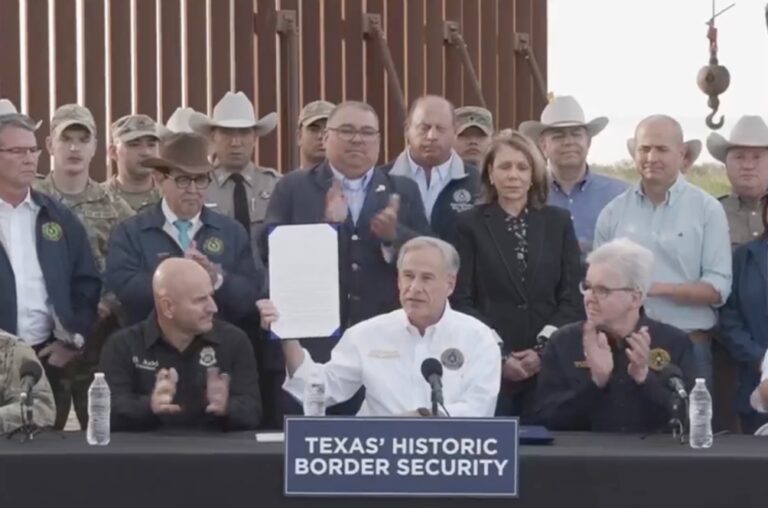
Gov. Greg Abbott signed historic border security bills into law on Monday, including making illegal entry from a foreign country a state crime. The Texas law is the first of its kind in the country and is expected to be challenged in court, with many arguing it’s unconstitutional.
He signed three border bills in front of the first wall Texas has ever built on state soil, south of Brownsville in the Rio Grande Valley. Gov. Abbott is the first governor in the country to direct, and allocate funding for, the construction of a border wall on state soil.
“Four years ago, the United States had the fewest illegal border crossings in about 40 years” because of four policies implemented by the Trump administration, he said. After President Joe Biden eliminated them, the U.S. has seen the highest number of illegal border crossings in the country’s history.
“Last year, there was more than 2.4 million apprehended crossing the border illegally,” Abbott said, which is “larger than the size of Houston,” the largest city in Texas.
While Democrats in New York City and Chicago complain about a “migrant crisis,” Abbott said, “I don’t think they truly know the magnitude of the damage caused to the United States by [President] Joe Biden because three times the number of residents of Chicago have entered illegally under Joe Biden and about equal the amount of total population in New York City have entered the country illegally under Joe Biden,” he said, excluding gotaways.
“Gotaways” is the official CBP term defining those who illegally enter the U.S. primarily between ports of entry, intentionally seeking to evade capture by law enforcement, and don’t turn back to Mexico or Canada. An estimated 1.7 million gotaways have illegally entered nationwide since January 2021, The Center Square reported. The total number of illegal entries are estimated to be significantly higher than the numbers Abbott cited.
Including gotaways, since January 2021, Texas has seen over 1.9 million people pour through its border, The Center Square first reported.
Abbott also pointed to the national security threats posed by the volume of illegal border crossers, citing FBI Director Wray’s warning about a likely terrorist attack. President Biden’s “deliberate inaction has left Texas to fend for itself,” Abbott said, pointing to Article 1 Section 10 of the U.S. Constitution, which empowers states “to take action to defend themselves and that is exactly what Texas is doing.”
While not describing the situation at the border as an invasion, Abbott referred to the invasion clause of the Constitution, which the judges and commissioners of roughly 50 Texas counties have invoked. More have issued disaster declarations and states of emergency, which have been renewed every month since April 2021.
The three bills Abbott signed into law passed the state legislature in the third and fourth special legislative sessions. In addition to the regular legislative session convened at the beginning of the year, Abbott called legislators back to Austin to pass bills in four special sessions.
Abbott signed S.B. 3 and S.B. 4 into law, which passed in the 4th special session. S.B. 4’s goal is to “stop the tidal wave of illegal entry into Texas” by creating a criminal offense for illegal entry into Texas from a foreign nation. Repeat offenders who illegally reenter Texas can face a prison sentence of up to 20 years, according to the new law.
S.B. 3 allocates another $1.54 billion to build more border barriers and continue building Texas’ border wall. Texas has already completed more than 16 miles of wall, Abbott said, with another 33 miles slated to be built. Over 110 miles of razor wire barriers have been laid, he said.
He also signed S.B. 4, which passed in the third special session, to increase the penalties for human smuggling and operating stash houses. He said the situation “has gotten out of control” in Texas. In 2017, there were 370 human smuggling arrests in Texas. There were 7,700 smuggling arrests in 2023, a more than 2,000% increase. The new law creates a mandatory 10-year minimum prison sentence for smuggling and a five-year mandatory prison sentence for operating a stash house.
These laws will enable law enforcement officers to continue their efforts through Abbott’s border security mission, Operation Lone Star. Since it launched in April 2021, OLS officers have apprehended over 489,500 illegal foreign nationals, according to state data. They’ve also made more than 37,500 criminal arrests, with more than 34,100 felony charges reported. They’ve also seized over 450 million lethal doses of fentanyl, enough to kill more than everyone living in the U.S. and Canada.
Abbott also launched the state’s busing strategy in April 2022 and has since sent over 80,000 people who illegally entered the country and were released into Texas by the Biden administration to so-called sanctuary cities. The first destination was Washington, D.C., followed by five more Democratic cities. Since April 2022, over 12,500 were bused to Washington, D.C.; since August 2022, over 29,300 to New York City and over 23,800 to Chicago; since November 2022, over 3,300 to Philadelphia. In 2023, two more cities were added, with 10,300 being sent to Denver and over 1,200 to Los Angeles so far.
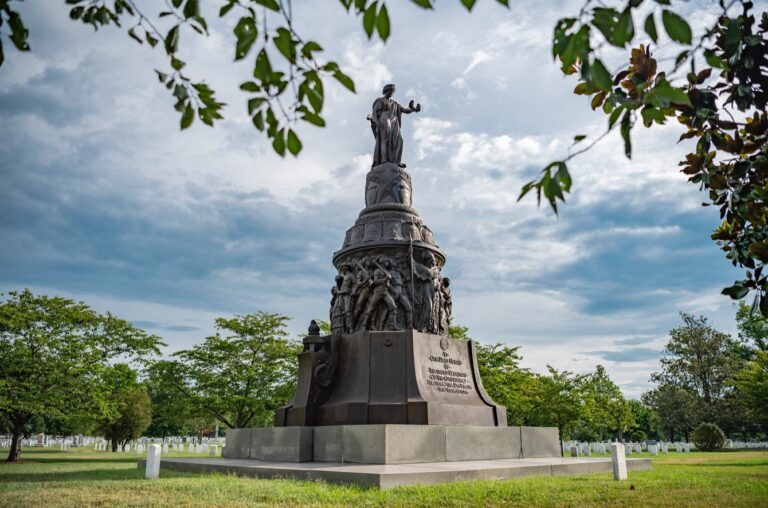
A federal judge on Monday issued a temporary restraining order to halt removal of a “Reconciliation Memorial,” built as a gesture of unity for the nation and to memorialize Confederate soldiers at Arlington National Cemetery. The order was made on Monday, the very day that workers brought in scaffolding and equipment to begin to dismantle the monument.
The Reconciliation Memorial removal order came after the 2020’s Black Lives Matter riots, and was part of a larger order to remove all references to the Confederate South in military sites around the country.
“The removal will desecrate, damage, and likely destroy the Memorial longstanding at ANC as a grave marker and impede the Memorial’s eligibility for listing on the National Register of Historic Places,” the lawsuit against Arlington states.
The temporary restraining order issued by U.S. District Judge Rossie Alston said a lawyer for the plaintiffs alleged that the work involves disturbance of gravesites. The memorial is, in fact a gravesite of its designer, a Jewish man who served in the army of Gen. Robert E. Lee.
“This monument was erected in the spirit of reconciliation and was the brainchild of US President McKinley, himself a Union veteran, after the Spanish-American War,” the group says on its website. “The monument was designed by Sir Moses Ezekiel, a Jewish VMI Cadet who served in Gen. Robert E. Lee’s Army. It is literally the grave of Ezekiel, who died in WWI and was buried at the base.”
Defend Arlington says that removing the memorial monument does nothing to advance civil rights.
“In 1898, following the Spanish-American War, where Union and Confederate veterans fought side-by-side under one flag, President William McKinley declared in the heart of the South, Atlanta, Georgia, that the U.S. government would commit to sharing in the burden of honoring and properly burying the Confederate dead, stating, ‘sectional feelings no longer holds back the love we feel for each other. The old flag waves over us in peace with new glories.’ In 1900, Congress authorized Confederate remains to be buried at Arlington National Cemetery, and in 1906, Secretary of War, William Howard Taft, permitted construction of a monument honoring our country’s new shared reconciliation from its troubled divisions,” wrote Rep. Andrew Clyde of Georgia, who opposes the desecration of the monument.
“Finally, in 1914, President Woodrow Wilson unveiled this new memorial to national unity – designed by a Jewish-American sculptor, the memorial is topped with a woman crowned by an olive wreath to symbolize peace,” Clyde and 43 other lawmakers wrote.
The monument has such significance that presidents traditionally send wreaths to be placed at its base. Even President Barack Obama carried on the tradition because of the unifying message of the monument.
“This tradition, which demonstrates tremendous national unity and respect, has been carried on regardless of the party or politics of the sitting President. Even President Barack Obama understood the importance of the Reconciliation Monument in the context of what it stands for, unity not division, when he continued the presidential tradition of sending a wreath to the monument in 2009.”
Rep. Clyde also wrote, “As its removal does not align with the original intent of Congress, the House of Representatives took action to prevent the removal of the Reconciliation Monument in the Fiscal Year 2024 Department of Defense Appropriations Act. The Department of Defense must comply with this request or risk denigrating the delicate balance of the principles of separation of powers between Congress and the Executive, outlined in the Constitution.” The full letter and its signers, all Republicans from the party that fought to end slavery, are available at this link.
The judge says he will take any exaggeration by lawyers representing Defend Arlington seriously “and should the representations in this case be untrue or exaggerated the Court may take appropriate sanctions.”
The opposition to the monument’s removal goes beyond grave desecration for many. It’s about “woke” politics erasing American history, with all its flaws.
“A Presidential Document by the Executive Office of the President filed on 07/02/2020 reveals the government is perfectly aware that a trend of indiscriminate attacks on historical sites and figures is gaining steam across the country while city and state officials are unable to properly contain or counter the crimes. The government knows the tone of our country is worsening, yet the U.S. Military continues to bend a knee to the trend of whitewashing history and now has slated for the removal of an Arlington Cemetery monument. Tell our U.S. Military that enough is enough, quit the cancel culture, defend our American heritage, stop the destruction!” wrote the group at Change.org.
Army National Military Cemeteries is complying with a Congress-created “Naming Commission” requirement to remove the Confederate Memorial by Jan. 1, 2024. The naming commission has also been responsible for removing historic names from various military bases, primarily in the South.
A perimeter of safety fencing has been installed around the Reconciliation Memorial, with the removal date set for Dec. 22.
New polling data obtained by Must Read Alaska shows Nick Begich has gained four points and Rep. Mary Peltola has lost 7 points among likely voters since the 2022 General Election. Both are running for Congress in 2024 in what is still an uncrowded field.
Begich, who got 24% of the first-ballot vote in the 2022 General Election, has inched up in the last year and now polls at 28% with likely voters.
Peltola, who got 49% of the first ballot in the ranked-choice election in 2022, has seen her approval slide to 42% since she took office.
She is now just slightly above President Joe Biden’s approval rating, according to aggregated polls at FiveThirtyEight.com, which show 55.4% of voters are disapproving of Biden performance.
Other Alaska congressional candidate rankings in the latest poll include Republican Lt. Gov. Nancy Dahlstrom at 9% and potential Libertarian candidate Chris Bye at 7%. Dahlstrom announced last month, and Libertarians almost always field a candidate.
Arizonan Richard Grayson of the No Labels Party, got 2% in this poll by Remington Research Group, a national polling firm, which asked questions of 672 Alaska likely primary voters.
The news is good for Begich, as nearly 70% of Alaska Primary voters believe the country is headed in the wrong direction, the poll shows. Peltola has tied her fortunes to President Biden, and hardliners like Rep. Nancy Pelosi, Rep. Hakeem Jeffries, and socialist Rep. Pramila Jayapal. Peltola votes in line with President Biden 96% of the time.
Here are some of the questions and answers from the poll obtained by MRAK:
Q: Do you believe our country is headed on the right track, or going off in the wrong direction? Right track: 20% Wrong direction: 69% Not sure: 10% Voters were read one hypothetical ballot matchup for the 2024 Primary Election. In the matchup, Republican Nick Begich is in a solid second place, with no other Republican candidate garnering double digits.
Q: Possible candidates in the 2024 Primary Election for United States Congress are Mary Peltola: Democrat, Nick Begich: Republican, Nancy Dahlstrom: Republican, Richard Grayson: No Labels and Chris Bye: Libertarian. If the election were held today, for whom would you vote? Mary Peltola: 42% Nick Begich: 28% Nancy Dahlstrom: 9% Richard Grayson: 2% Chris Bye: 7% Undecided: 11%
The poll shows that years in government is not necessarily an advantage to a candidate in Alaska. This question on the poll, while not mentioning Begich, is going to be important to his campaign strategy as he fends off a Republican challenge from Dahlstrom, who has years of government service.
Q: When thinking about your candidate preference in a race for United States Congress, would you prefer a candidate who has decades worth of experience in government, or a candidate who has decades of private sector experience and started several successful small businesses? Government experience: 32% Private sector experience: 42% Not sure/don’t care: 26%
Q: Do you believe candidates should step down from their current position in government when seeking a higher political office? Yes: 47% No: 19% Not sure: 33%
The top-line data as obtained by MRAK is in this document:
Satanic doxologies were recited for what may be the last “official” time during an invocation moment at Kenai Peninsula Borough Assembly meetings.
After the pre-meeting invocations were taken advantage of by atheists and satanists who got themselves on the invocation list, the Assembly voted that future invocations will be given by either chaplains from the fire department as designated by the Assembly president, a policy that goes into effect Jan. 1, 2024.
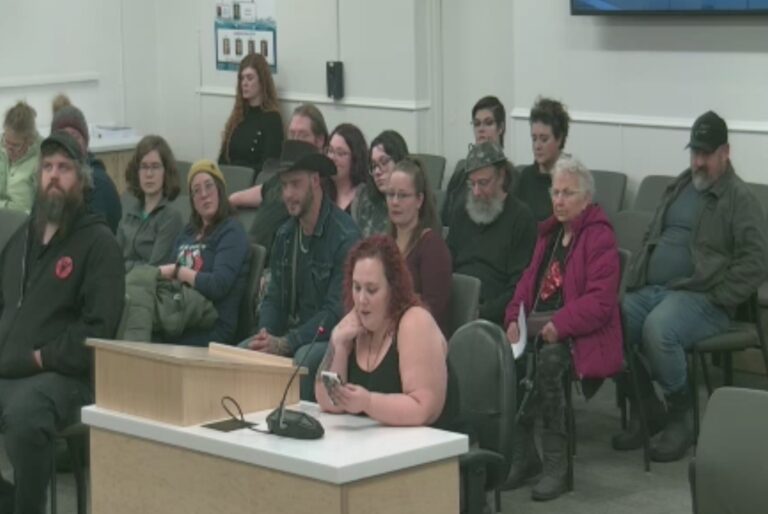
“Hail Satan,” was recited again on Dec. 12 by Iris Fontana of the Satanic Temple, who had also read from her smart phone a message in support of her beliefs, “Let us embrace the Luciferian impulse to eat at the tree of knowledge and dissipate our blissful and comforting delusions of old. Let us demand that individuals be judged for their concrete actions, not their fealty to arbitrary social norms and illusory categorizations.”
The change to the new invocation procedure was initiated earlier this year by Borough Mayor Peter Micciche, Assembly Vice President Tyson Cox, and Assemblywoman Kelly Cooper. It was voted on last month.
Fritz Creek community member Barrett Fletcher, wearing a steel colander on his head and representing the “Pastafarians” or Church of the Flying Spaghetti Monster, told the Assembly he will probably file a lawsuit over the new invocation procedure. He said the only way to get rid of unwanted invocations was to ban them altogether.
“I’ll be listening very closely to the chaplains that will be giving the invocation from now on, and if I happen to hear them invoke any specific deity while failing to acknowledge the true creator of the universe, the great Flying Spaghetti Monster, I’ll be suing,” he said.
During last month’s meeting when the change was made, Mayor Micciche said that the invocations had become more like lectures and less like inspiration, “more and more, sort of, politically motivated speeches that seldom ask for any help or support for the Assembly. This is a standardized way for a volunteer who is trained in exactly what an invocation represents to deliver a two-minute, or under, opening to our meeting.”
In other communities in Alaska, the invocation has been dropped entirely and replaced with a “land acknowledgement” statement that declares that the land belongs to one Native group or another, and that people who are not native are colonizers.
In the 2018 Alaska gubernatorial race, Michael Dunleavy emerged as the guardian, vowing to shield Alaska’s Permanent Fund Dividend from encroaching threats. His campaign resonated with resolute promises: “Only one candidate has proven he will protect the PFD: Mike Dunleavy.” The slogans emphasized trust in the democratic process with “No change to the PFD without a vote of the people: Mike Dunleavy.”
I was there. I remember. Do you?
In the silence that followed the storm of the Left’s fervent pursuit to recall Gov. Dunleavy during his initial term, a subtle corrosion took hold. The echoes of discontent lingered, especially after the departure of his first chief of staff. Now, in his second term, the clamor for recall has subsided, replaced by a new tempest as the governor endeavors to fulfill the promise of disbursing the full PFD to eligible recipients.
The PFD remains a political football, carried downfield toward the goal since 2016 but stopped by opposition that believes the state bureaucracy is more important than the people.
For every political season since Gov. Walker, the PFD has been the central topic of legislative debate, with the money team funded to ensure the state bureaucracy is not cut, as well as the full dividend not paid.
And with every crisis, real or faked, comes an opportunity.
Against the backdrop of the winter of 2022, Alaska faced an economic frost, with fuel oil prices soaring to $5.03 per gallon in 85 unsubsidized communities, well above the national average of $3.60 per gallon. In the isolated expanses of Arctic Village, Hughes, and Alatna, where air cargo is the lifeline for fuel delivery, the cost reached alarming heights. Arctic Village, adapting to biomass for heating, signaled a community in transition.
In the annals of Alaskan tradition, the PFD served as a financial bulwark for families in these frigid landscapes, especially when economic pillars like subsistence, commercial fishing, and natural resource industries weathered the storm of pandemic realities.
Unbeknownst to many, the State of Alaska carries a debt to its citizens — every eligible PFD recipient from 2016 to the present is owed $13,820, totaling $55,280 for a family of four. In a state where the specter of government growth looms large, eroding the prospects of natural resource development, this owed income could suture the gaping wounds of financial distress.
Within the corridors of Alaska governance, the governor wields a constitutional tapestry of authority, as articulated in Article III, section 23. This executive authority weaves a narrative where the governor:
– Exercises the Governor’s Authority: Initiates changes deemed indispensable for efficient administration.
– Issues Executive Orders: Enunciates changes necessitating the force of law.
– Allows Legislative Oversight: Affords the legislature a prescribed timeframe (sixty days) during sessions to challenge and disapprove these executive orders.
– Determines the Effective Date: Mandates that, absent legislative disapproval through a majority resolution in joint session, the executive orders become effective at a later date designated by the governor.
This gubernatorial prerogative is both a shield and a sword, providing the flexibility for administrative course corrections while maintaining a crucial check by the legislative branch.
As the 2024 presidential election looms on the horizon, the political tapestry of Alaska reveals a mosaic — a symphony of 13 Democrats, 22 Republicans, 4 no-party independents, and 1 nonpartisan in the Alaska House of Representatives. All 40 seats are up for grabs. Meanwhile, in the Alaska Senate, the composition comprises 9 Democrats and 11 Republicans, with 9 Senate seats in contention.
Is it politically naive to consider any of the 40 of these House Candidates and any of the 9 of these Senate candidates disapproving through a majority resolution in the next joint session of the legislature during perhaps the most major election in the history of Alaska and the United States?
Timing is everything.
Gov. Dunleavy, entrenched in his second term and ineligible for re-election, stands at a juncture where the legacy he leaves hinges on the deployment of his constitutional authority. The adage holds true: when good men do nothing, evil flourishes.
The Governor has the singular reality of being in the best position to exercise the bully pulpit and spread the news across the state. The past due PFD amount of $13,820 is owed to eligible Alaskans.
In 2023, 61,000 Alaska’s children’s parents lack secure employment while in 2021 the Alaska Legislature’s Capitol complex is now spread over five blocks in Juneau, rather than move the Legislature out of Juneau to the road system allowing greater operational saving for the state.
In a past interview between Joe Rogan and Jordan Peterson, Peterson said, “Things get to terrible places one tiny step at a time. If I encroach on you and I’m sophisticated about it, I’m going to encroach two millimeters. I’m going to encroach right to the point where you start to protest, then I’m going to stop. I’m going to wait, then you’re going to calm down, then I’m going to encroach again. Right to the point where you protest, then I’m going to stop. I’m just going to do that forever, and before you know it, you’re going to be back three miles from where you started.”
This is the Left side of the Alaska Legislature’s strategy to subdue Alaska into its existing bureaucratic hegemony. We have one champion left.
Is it time for the governor to marshal his constitutional powers, ensuring the fulfillment of promises and the restoration of Alaska’s oil wealth to its deserving citizens? The answer to this question will sculpt the narrative of Alaska’s future, echoing through the corridors of governance and resonating in the hearts of its people.
Michael Tavoliero is a senior contributor to Must Read Alaska.
According to video obtained by The Daily Mail, Russian military cadets, some who are young children, vow to grab Alaska from the United States and sing that they are “ready to die” for Russia President Vladimir Putin.
The young Russians are also seen pledging never to surrender Crimea, “as they sing from a military college against a backdrop of Second World War monuments in Volgograd, formerly Stalingrad.” The video is interspersed with images of Russian military might.
The film actually uses a section of video from a Brexit rally to justify Vladimir Putin’s bid to restore Russian might, the newspaper reported. The video can be seen at this link or below: