Tuesday, August 4, 2026
Home Blog Page 363

Michael Tavoliero: Wherever ranked-choice voting is used, Democrats dominate. Here’s why

By MICHAEL TAVOLIERO

Ranked-choice voting (RCV) is an electoral system where voters rank candidates by preference instead of choosing just one. 

While choice is the personal judgment in favor of merit or value, preference determines favor by any methods available, often sacrificing the evidence of merit or value. A choice is a context-driven decision. A preference emerges when a person assesses different options, hence ranking one’s options. 

RCV promotes a bromide which insists if no candidate receives a majority of first-choice votes, the candidate with the fewest votes is eliminated, and their votes are redistributed according to the voters’ next preferences. This process continues until a candidate achieves a majority. 

Two states, Alaska and Maine, have adopted RCV for statewide purposes. 

It is noteworthy that Maine has six active political parties as opposed to Alaska’s 17 active political parties.

Maine has a population of about 1.35 million people with about 950,000 voters. Maine’s voter population represents almost 70.4 % of the state’s population. Maine’s population is increasing. Maine adopted RCV in 2016 and started to use it in 2018. It is used in all federal elections, including U.S. Senate and U.S. House races and its state elections.

Alaska has a population of about 734,000. The Alaska Division of Elections reported for Aug. 5, a 605,892-voter population. Alaska’s voter population represents almost 82.6 % of the state’s population. Alaska’s population is on the decline. Alaska adopted RCV in 2020 and started to use it in 2022. It is used in all federal elections, including US Senate and US House races and its state elections.

The Maine RCV maintains the Democratic Party’s majority support of its elected officials. Maine is a predominantly Democrat state where the Democrats include over 36% of the voters while Republicans include over 29.5% of the voters. The balance of voters is what Maine’s Office of the Secretary of State calls “unenrolled voters” which are independents, almost 29%. As the voting preference for independents is Democrat and with the inclusion of the Green Independent Party of 3.9%, Maine’s Democratic voter population is about 69%.

The Alaska RCV also maintains the Democratic Party’s majority support of its elected officials. 

Using the voter roll report from Aug. 5, the Democrats include over 12% of the voters while Republicans include almost 24% of the voters. The balance of voters who share Democrat ideological perspectives includes the Moderate Party of Alaska, .065%, the Green Party of Alaska, .25%, Nonpartisan, 13.9%, the Progressive Party of Alaska, .042%, and Undeclared, almost 45%. With the inclusion of the Democratic Party voter population, this total of over 59% of Alaska’s voting population.  

Ranked choice voting is a progressive reform. Denying its connection to politics would be both misleading and academically unsound.

Although RCV itself is not inherently partisan, clear political trends can be observed in its adoption. To account for the political culture and ideology within the states of Alaska and Maine, the adoption of RCV in these states reflects a broader movement of how the system dehumanizes the voting process, especially when compared to the traditional “one person, one vote” method. 

This process of the ranking of voter preferences leads to depersonalization. This is central to understanding how RCV is dehumanizing.

In the 1960’s, a series of social psychology experiments were conducted by Yale University psychologist Stanley Milgram, who intended to measure the willingness of study participants to obey an authority figure who instructed them to perform acts conflicting with their personal conscience

Milgram’s experiment was designed to explore the extent to which individuals would obey authority figures, even when asked to perform actions that conflicted with their personal morals. The experiment exposed a disturbing inclination for individuals to follow authority figures’ orders.

RCV instructions require voters to rank candidates in order of preference, introducing a level of complexity that differs significantly from the simplicity of casting a single vote for a single candidate. This complexity creates by design a sense of distance between the voter and the impact of their ranked preferences. 

Just as Milgram’s experiments demonstrated that its subjects become detached from the consequences of their actions through the structured nature of the experiments, voters in an RCV system become detached from the immediate impact of their vote. The need to trust a complex, algorithmic process leads to a sense of incremental powerlessness as often, voters do not fully understand how their ranked preferences translate into the final outcome.

In contrast, the traditional “one person, one vote” system is straightforward and transparent. Each voter casts one vote for their preferred candidate, and that vote directly influences the election result. This simplicity reinforces the connection between the voter and the outcome, allowing individuals to feel that their participation has a clear and direct impact. 

Does Alaska want an electoral system which upholds the democratic ideal of individual empowerment, where each person’s vote carries equal weight and significance?

Moreover, the reliance on complex algorithms in RCV can mirror the way Milgram’s participants placed trust in an authority figure, even when it conflicted with their personal judgment. Voters in an RCV system are compelled to trust an impersonal process, which leads to a sense of alienation. The transparency and directness of the “one person, one vote” system, on the other hand, allows voters to see the results of their collective decision-making more clearly, fostering trust and reinforcing their role as active participants in the democratic process.

In essence, Milgram’s model of obedience and depersonalization provides a framework for understanding how RCV, despite its intentions to create a more inclusive and representative system, risks creating a sense of detachment and dehumanization. 

Through the deceptive semantics of “choice” versus “preference”, RCV falsely aims to broaden voter choice, improve election outcomes and eliminate “dark money”. The complexity of the process leads to a feeling of alienation among voters as their personal impact seems diminished by the intricacies of the system. The traditional “one person, one vote” method, by contrast, maintains a stronger connection between the individual voter and the democratic process, ensuring that each vote is both meaningful and direct.

As further evidence of RCV dictating political outcomes, it is also used in New York City, New York, San Francisco, California, Minneapolis and St. Paul, Minnesota, Santa Fe, New Mexico, and Burlington, Vermont. The Democrats are the dominate political party in all these cities.

Ranked-choice voting (RCV) presents itself as a progressive reform aimed at enhancing democracy, but upon closer examination, it reveals significant flaws that undermine the very principles it seeks to uphold. The complexity of the RCV system, which requires voters to rank candidates by preference, introduces a layer of detachment between the voter and their individual impact on the election outcome. 

This detachment mirrors the disturbing findings of Milgram’s experiments, where participants became increasingly disconnected from the consequences of their actions as they obeyed an authority figure. Just as Milgram’s subjects were led to act against their moral judgment, voters in an RCV system are compelled to trust a complex, impersonal process, which can lead to a sense of alienation and powerlessness.

The traditional “one person, one vote” system, in contrast, is straightforward, transparent, and reinforces the direct connection between the voter and the election result. It upholds the democratic ideal of individual empowerment, where each person’s vote carries equal weight and significance. The deceptive promise of “choice” in RCV, when in reality it often amounts to a mere ranking of preferences, dilutes the strength of personal judgment and leads to a depersonalized voting process.

As Alaska faces the implications of RCV, the state must consider whether it wants to continue down a path that risks concentrating political power in a single dominant party, as has been observed in the above RCV-implemented entities, or whether it will uphold a system that ensures every vote is meaningful and directly impactful.

The decision Alaska makes will determine whether its electoral process remains a true reflection of the people’s will or becomes another victim of dehumanizing political engineering.

Michael Tavoliero is a resident of Eagle River and writes for Must Read Alaska.

Bob Bird: Reshuffling the American and Alaskan deck

By BOB BIRD

The proud American union is a union by force — as was feared with Patrick Henry’s warning in 1788, and later proved by President Abraham Lincoln in 1861.

That’s what we have, and we have made the best of it, despite our history that spilled much American and native blood to achieve it. Each state is uniquely different, and the circumstances of admission changed as the frontier moved westward. 

Look at the 1785 map of the U.S. shortly after we won our independence. Because of western land claims, we might have had “Chicago, Connecticut”, “Milwaukee, Massachusetts,” or “Memphis, North Carolina”. 

The American states have operated under three different authorities, beginning with an unwritten provisional government in 1776. After the Treaty of Paris yielded British territory as far as the Mississippi River, the supposedly weak and ineffective Articles of Confederation — our first written constitution — convinced states that their land claims west of the Appalachians were unrealistic. As settlers moved west, Congress drew up new states, matching equal sovereignty with the Original Thirteen, and a harmonious union emerged … for a time.

As land was acquired through treaties, wars and purchases, the size of the U.S. became increasingly unwieldy, and the federal government assumed more centralized powers. The 14th state, Vermont, denying the claims of both New Hampshire and New York, declared its own sovereignty and then applied for admission to the union, but this was not a good template for the future.

Congress designed unorganized territories, organized territories and states based on the whims of committees and their chairmen. They were as wise as they were foolish, depending on the geography, native considerations and emerging economies and culture. Slavery created tensions that mandated compromises, which although were creative, merely swept the dirt under the rug, leading to the great war and federal power grab of the 1860s – 70s.

Our third constitution, which we call The Constitution with a capital “C”, likely anticipating that committees often make grotesque and misshapen mistakes, permitted the re-drawing of state boundaries with the following proviso in Article IV, Sec. 3:

New States may be admitted by the Congress into this Union; but no new State shall be formed or erected within the Jurisdiction of any other State; nor any State be formed by the Junction of two or more States, or Parts of States, without the Consent of the Legislatures of the States concerned as well as of the Congress.

Tennessee was fractured off from North Carolina in 1796 and Maine from Massachusetts in 1820. Then we tread into dangerous waters, because the state of West Virginia was illegally created in 1863, just one of the many drastic and dangerous constitutional overthrows under Lincoln’s supposedly avuncular and wise hand. Indeed, it was a good move for the people of those western counties of Virginia. But “good” does not necessarily mean “constitutional”, and by paying indemnity to Virginia well into the 20th century, a de facto apology was made.

Now we live in an era of ideological separation, and it is becoming intolerable. It is a “rural” versus “urban” divide, and with it comes warped perceptions of reality from the poor souls who live in the asphalt jungles of our decaying urban zones. They have never seen a farm, sat in a small town café, smelled manure, or inhaled the delicious fragrance of the forests that are only a few miles away, even in New York. 

Chicago continues to sprawl from its dark and filthy slums into the flatlands of Illinois, as people escape from crime and ugliness, yet bring with them the untenable ideas of socialism to pollute new areas. The same has occurred in New Hampshire and southern Maine from the Boston area. Then ask anyone in Montana, Nevada, Idaho or Arizona if they fear the same problem from Californians who bring their socialist baggage with them, even as they escape the results of those policies.

Eastern Washington and Oregon, northern California, Wisconsin, Michigan, New York and Minnesota, and downstate Illinois are locked in the tyrannical bear hug of socialism that their population centers force upon them. It translates into government corruption, high taxes, public school indoctrination, atheistic political correctness and the loss of freedom and evils of the fake Climate Change Cult.

Alaska is not immune to this. Southeast Alaska has little in common with the road system (which includes Prudhoe Bay), and the road system has little in common with Southeast or the Arctic and western villages. It is political suicide to say this, but I am not an elected official, so I will do it: Southeast lives off of the productivity of the road system, is a two-day drive through a foreign country to reach, and demands that the road system pay for the sustenance of its economic livelihood.

It doesn’t have to be this way. Southeast has an untapped mining and logging economy, but it is locked up by the federal Green Lobby that it seems to worship. While its cultural focus is on Seattle, Southeast demands that the state capital remain with them, defying the will of the people that has never been changed since 1974. It would seem that if they like their lifestyle of tourism and a stagnant economy, they ought to apply for admission to Washington state — if Washington would want to assume this albatross around their necks.

This cannot last much longer. America and Alaska are going broke, and must undergo an authentic re-shuffling, whether it be a geographic or an ideological one. It will hopefully be one of our own making, uncontrolled by the evil forces of communism that exist in Pacific Rim foreign governments, with their bought and willing enemies of freedom within our own ranks.

Bob Bird is former chair of the Alaskan Independence Party and the host of a talk show on KSRM radio, Kenai.

Seward man arrested for threatening governor

5

A Seward man was taken into custody in Seward on Wednesday after a federal grand jury returned an indictment charging him with stealing someone’s identity to issue a threat to “bomb and shoot” Alaska’s governor.

According to court documents, on April 12, 2024, Matthew Edward Stanley, 22, used an account with a virtual private network service to access the State of Alaska website and send a message to the governor.

Stanley allegedly used a different individual’s personal information when addressing the letter, falsely representing that that individual was the one who had sent the threats.

The indictment states the message requested pay rates be raised for “me and my son. Or else everyone at [Victim Labor Union] and my son will take a stand here at seward.”

The message continues with a threat to “bomb and shoot you with my son.”

Stanley is charged with one count of issuing a threat involving explosives, one count of false information and hoaxes and one count of aggravated identity theft. The defendant is scheduled for his initial court appearance today before U.S. Magistrate Judge Matthew M. Scoble of the U.S. District Court for the District of Alaska. If convicted, he faces a mandatory sentence of two years in prison for aggravated identity theft, in addition to up to 10 years in prison for his other alleged crimes. A federal district court judge will determine any sentence after considering the U.S. Sentencing Guidelines and other statutory factors.

U.S. Attorney S. Lane Tucker of the District of Alaska, Special Agent in Charge Robert Hammer of Homeland Security Investigations (HSI) Pacific Northwest operations and Alaska State Trooper Colonel Maurice Hughes made the announcement.

HSI and the Alaska State Troopers are investigating the case.

Assistant U.S. Attorney James Klugman is prosecuting the case.

Lucy Bauer gets prized endorsement of Rep. Laddie Shaw for his District 9 seat

5

Although Rep. Laddie Shaw, already a retired U.S. Navy SEAL is retiring in January, he still has one of the most valuable assets in the Republican Party — his endorsement.

Lucy Bauer, a Republican running to replace him in House District 9, just won that endorsement. She is running against Democrat-endorsed Ky Holland for the South Anchorage seat.

Bauer is an American by choice. She immigrated from China at a young age to escape communism and became an American success story in business in Anchorage, where she settled.

In addition to Shaw, who was first elected in 2018, Bauer has the endorsements of Duby and Loran Baxter, Judy and Randy Eledge, Sarah Erkmann-Ward, Beth Farnstrom, Pal and Suzanne Gionet, Sami and Bruce Graham, John Hendrix, Christine and Duane Hill, Sen. James Kaufman, Dawn and Thad Phillips Al Smay, Rep. Cathy Tilton, Michael and Lindsay Williams, Roberta and Dan Zipay, and Gretchen and Mike Stoddard, to name a few. Gov. Mike Dunleavy also endorses her.

You can meet Bauer and hear more about her life story and why she is a conservative at an event coning up at Bell’s Nursery, 13700 Specking Ave., Anchorage, on Sept. 16, from 5:30-7:30 p.m., when her campaign is hosting a fundraiser for her first run for public office.

Breaking: Gov. Mike Dunleavy picks a side, endorses Jared Goecker for AK Senate, Chugiak-Eagle River

Republican Jared Goecker, running against Sen. Kelly Merrick for Chugiak-Eagle River’s state Senate Seat L, has just gotten a big-name endorsement from the sitting governor — Mike Dunleavy.

Although Merrick is also a Republican, Dunleavy did not ask voters in Chugiak-Eagle River to “rank” Merrick in the general election. He only mentioned Goecker. In addition to Goecker and Merrick, Democrat Lee Hammermeister is running for the seat.

Dunleavy took the rare step of cutting a YouTube video endorsement for Goecker, whom he described as a “common-sense conservative.” The ad is here:

Merrick may be in deep trouble. Even though she is Republican and married to a Big Labor boss who brings a lot of money to support her campaign, she has been an unreliable vote for conservatives in the Senate and is seen by many as being a false-flag Republican, voting against the governor on several occasions.

Alaska’s U.S. House race shifts to ‘toss up’

Cook Political Report, which analyzes races across the country, has shifted the Alaska U.S. House race from the “Lean Democrat” category to “Toss Up,” in the latest ranking.

The change explains why Democrats, who have their own polling, are now suing the state Division of Elections to save the Rep. Mary Peltola, who is facing Republican Nick Begich in the general election, in her reelection bid.

Along with Peltola now being at risk in the general election, Cook Political Report says that Peltola’s “rural Antifa” colleagues in the House Blue Dog Democrats — Rep. Jared Golden of Maine and Rep. Marie Glusenkamp-Perez of Washington — are also facing tough elections. The new toss-up list for Democrats, per Cook Political Report, is here:

  • AK-AL Peltola
  • CO-08 Caraveo
  • ME-02 Golden
  • MI-07 OPEN (Slotkin)
  • MI-08 OPEN (Kildee)
  • NC-01 Davis
  • NM-02 Vasquez
  • OH-13 Sykes
  • PA-07 Wild
  • PA-08 Cartwright
  • WA-03 Perez

Cook Political Report has seemed reluctant to move Alaska into the toss-up category due to Alaska’s weird open primary and ranked-choice general election scheme. But a recent poll by Cygnal shows that Begich is now even with Peltola. Alaska’s is the most Republican seat in the House that has a Democrat in it and is seen as a strong likelihood to flip back to Republican in November.

Working against Peltola is her own party, which has decided to sue to keep another Democrat, Eric Hafner, off of the November ballot. The Alaska Democrats have hired the nation’s top Democrat election lawyer, Marc Elias, known for sowing chaos in elections.

The lawsuit drains enthusiasm from the party and embarrasses its Alaska voting membership, since it makes Peltola look desperate and conniving. Peltola would have most certainly approved the party going forward with the lawsuit that is intended to be her life ring.

Also working against Peltola is that the National Republican Congressional Committee is now showing Alaskans Peltola’s actual record in Congress, which has her in the same radical category as Rep. Nancy Pelosi, voting against the interests of Alaskans time and again. Peltola has never had to run against her own immediate voting record and political judgment in the past, but has been able to rely on her personality, personal story, and looks.

Peltola demands more foreign workers in Alaska, while blasting Nick Begich for his international businesses

Ads running for Mary Peltola’s campaign harp constantly about how Republican candidate Nick Begich, who has specialized in start-up businesses in the private sector, owns a company that hired IT workers in India.

But Peltola is now on record stating that Alaska needs more foreign workers pumped into in the state because there are not enough people in Alaska to do the work.

Alaska has seen its population drop in recent years by thousands, and its unemployment rate is currently 4.5%, with about 16,700 people considered unemployed.

Speaking to a “summit” of Alaska Natives convened by Peltola on the outmigration problem in Alaska, Peltola said, “Our challenge has been outmigration for over 10 years. In fact, we need J-1 visas like nobody’s business, because we need foreign people to come and help us fill our sectors.”

Her campaign criticizes Begich for finding highly skilled IT workers to perform extremely specialized application development tasks, but she wants low-skilled jobs in the fishing industry, which could be performed by residents without so much as a graduation equivalency diploma and the homeless population, to go to foreigners.

According to the Alaska Department of Labor, Alaska doesn’t need to import foreigners. “Every year thousands of people inquire about working and living in Alaska. Alaska has adequate numbers of qualified people to fill most jobs,” the department says on its website.

Nick Begich no longer employs any international workers. In the information technology sector, many jobs and tasks are now being replaced by artificial intelligence in what is a rapidly changing field.

The companies he has worked with and invested in in the United States were early-stage start ups, many of which went on to create hundreds, or in some cases thousands of U.S. jobs that would not have existed without a unique model developed by Begich, in which his team coached and mentored start up companies as they developed their technology. Two Harvard University case studies have been written about Begich’s unique business model and his model has been covered by the Wall Street Journal.

Peltola’s attack on Begich is message-tested by her campaign team. But she has now stepped in her own mess, by advocating to replace Alaska’s jobs with foreigners.

Earlier, Peltola stated that only those who have had a career in government should run for public office.

Alex Gimarc: Those ranked-choice voting ads are all bought and delivered by Outside dark money

The second round of pro-ranked choice voting ads rolled out last week. The ads exhort the listener to vote against the repeal or ranked-choice voting in November.  They trot out three arguments in support of their “no” vote:

  • RCV outlawed dark money
  • Repealing RCV removes the freedom of an open primary
  • The repeal effort is entirely the creation of party insiders and political elites

Let’s take a closer look:

The ad is backed by three entities: Unite America, Final Five Fund, and the Action Now Initiative. 

A look into the most recent IRS Form 990 submittals for the people funding the ads find that Unite America is located Denver.  It had revenues of $8.2 million in 2022.  None of the contributors are listed.  Final Five Fund is headquartered in Chicago.  It had revenues of just over $12 million in 2022.  None of its contributors are reported either.  Our final participant is the Action Now Institute, also from Chicago.  It had $388,000 revenue in 2021.  Like the others, no individual contributors were listed.

We see that all three non-profits backing RCV here in Alaska are Outside non-profits. They do not report their contributors, while piously running an ad claiming RCV outlawed dark money. 

If RCV outlawed dark money in Alaskan elections, why are these guys able to run their dark-money-funded ads defending RCV?

The second claim is that repealing RCV removes the freedom of an open primary. This is a return to the original pro-RCV campaign in 2020. There have always been a group of our neighbors who believe they have the right to select candidates for other political parties. But do they? A political party is a voluntary group of like-minded people who select their own representation. Once that process is complete, the parties attempt to get their choices approved by the larger electorate on election day (primary, general, run-off).

The original campaign to pass RCV concentrated on this point, and didn’t go so well, so the backers focus-grouped their argument and pivoted to the promised ban on dark money in Alaskan elections, something I just demonstrated is a complete lie.

Finaly, the ad pounds the notion that all of this is something out of party insiders, the political elites. The fact of the matter is that the repeal was entirely a grassroots effort, fought at every turn by Team Lisa Murkowski and her lawfare proxies. 

In this case, it is the political elite, Team Lisa that is in full-throated support of RCV. They wrote it. They figured out how to pass it. And they want to retain it at all costs because it benefits their political future.

If RCV is such a good thing, why do its supporters believe they need to continue to lie about it and hide their funding from the general public?  We are fast approaching the point with this crowd that the only thing we need to know that proves they are lying is that their lips are moving.  

Rather than damaging the repeal effort, every time the pro-RCV side runs an ad like this, they strengthen the case in support of a repeal.  

Alex Gimarc lives in Anchorage since retiring from the military in 1997. His interests include science and technology, environment, energy, economics, military affairs, fishing and disabilities policies. His weekly column “Interesting Items” is a summary of news stories with substantive Alaska-themed topics. He was a small business owner and Information Technology professional.

Alaska Democrats’ conspiracy-theory lawsuit in elections case reassigned to new judge

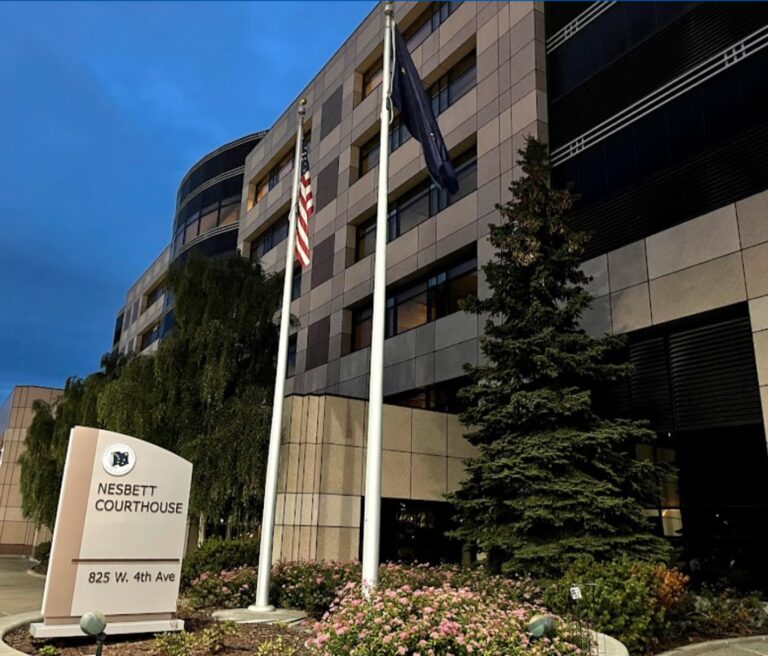
A lawsuit brought by the Alaska Democratic Party against the Division of Elections to stop the general election ballot from being printed until it conforms to the party’s demands has been reassigned to a new judge and oral arguments are set for Monday at 9 a.m.

Originally, the case was assigned to Superior Court Judge Adolf Zeman, but on Thursday it was administratively reassigned to Judge Ian Wheeles.

It appears that Zeman, who is on the ballot for judicial retention in November, wanted off the case, since he is already in hot water with Republicans over his ruling earlier this year that said that the state’s correspondence schools were unconstitutional, a ruling that was overturned by the Alaska Supreme Court.

Many Republicans plan to vote against Zeman’s retention, and no matter which way he would rule on this lawsuit from the Democrats, it could cost him his job by either further infuriating Republicans or giving Democrats a reason to not retain him.

Judge Wheeles also serves in the Third Judicial District in Anchorage, where he has lived his whole life. Wheeles graduated from Dimond High School, played baseball at Illinois Tech, completed his undergraduate degree at the University of Alaska Anchorage and earned his law degree at the University of Idaho. He practiced criminal defense, family law, and was appointed by Gov. Mike Dunleavy in 2022 to serve on the court.

The case against the Division of Elections’ certification of the ballot is on a fast-track in the courts since the election is in just 60 days and ballots need to be mailed to overseas voters within two weeks. The State has submitted its brief on Friday morning, and the Democrats will file their brief later Friday.

The original lawsuit by the Democrats can be seen here:

The gist of the case is that the Alaska Democratic Party is demanding that the name of Democrat candidate Eric Hafner be removed from the congressional portion of the November ballot. The Democrats claim that since he finished in the open primary in sixth place, he cannot be moved up, even after the third and fourth-place finishers dropped out after the primary. They also claim that since he is a felon serving time in prison, he can’t possibly be an Alaska resident. They claim people might be confused and vote for Hafner and not rank Rep. Mary Peltola, the party’s endorsed candidate.

Hafner got onto the certified general election ballot because two who finished before him declined to continue and dropped before the Sept. 2 deadline. Nancy Dahlstrom and Matthew Salisbury, both Republicans, withdrew from contention to give Republican Nick Begich a better shot at winning the congressional seat in November.

The Democratic Party, in its lawsuit, claims it was a Republican conspiracy to move Hafner up into the fourth slot for the November ballot. Also moving up was John Wayne Howe of the Alaskan Independence Party.

The Democrats’ claim that since Hafner cannot live in Alaska if he wins election, he is ineligible to serve would be a post-election challenge, not something that could be challenged in advance of Nov. 5. Clearly, the Democrats are afraid that even a few hundred votes for Hafner could cost them the seat in Congress.

It’s a difficult set of arguments, since on the one hand, predicts that Hafner would not be granted a pardon by Joe Biden in order to help flip the U.S. House to Democrat control. Also, there are many who are serving in federal prisons around the country who are Alaska residents. Alaska voter registration laws allow those who “intend to return” to Alaska to maintain their voting rights if they don’t register in another state. Hafner could claim he intends to reside in Alaska.

Intention in residency is something the courts have recently considered in a similar Alaska lawsuit filed by Republican candidate Liz Vazquez against Democrat state Rep. Jennie Armstrong in 2022. Vazquez wanted to kick Armstrong off the ballot since, as a recent transplant to the state, Armstrong had clearly not lived in Alaska and or her district long enough to qualify to serve. The courts held the challenge for candidate eligibility expires 10 days after the filing deadline in June. The challenge was not timely in 2022 and Armstrong went on to win a seat representing the Turnagain neighborhood in West Anchorage.

Defending the Division of Elections and Director Carol Beecher in the current case are state attorneys Katherine Demarest and Thomas Flynn. Alaska Democrat election attorney Thomas Amodio and the Democrat law firm of Marc Elias in Washington D.C. are representing the Alaska Democratic Party.