Tuesday, August 4, 2026
Home Blog Page 362

Michael Tavoliero: How the Supreme Court paved the way for unchecked expansion of government

By MICHAEL TAVOLIERO

For more than 80 years, the rulings in NLRB v. Jones & Laughlin Steel Corp (1937) and Wickard v. Filburn (1942) have cast a dark shadow over this nation, twisting the meaning of our Constitution and betraying the very foundation of our history and traditions. These decisions tore apart the democratic process, corroding our legal system and eroding the rights of both individuals and states. They paved the way for the unchecked expansion of the federal government, feeding the monstrous bureaucracy we now call “The Swamp.”

The tyranny that followed suffocated any chance for true compromise between the people and their government.

These rulings have chained the Court to a political battle it was never designed to fight, a conflict it will never resolve.

Eight decades later, the Court stands isolated. These decisions claim a right so destructive, so vast, that they have altered the very fabric of human life in ways for which the Court was never designed.

NLRB upheld the constitutionality of the National Labor Relations Act of 1935, also known as the Wagner Act, which was a center piece for the FDR New Deal centralization of the control and power by the federal government. NLRB marked a major shift in the federal government’s regulatory power over labor relations and interstate commerce.

The case arose when the National Labor Relations Board accused Jones & Laughlin Steel Corporation, one of the nation’s largest steel producers, of discriminating against workers involved in union activities. The company argued that the Act, which protected workers’ rights to unionize and bargain collectively, exceeded Congress’s power under the Commerce Clause, since labor relations were a local matter and not subject to federal regulation.

Less than 20 years earlier, the US Supreme Court ruled in Hammer v Dagenhart (1918) that local labor conditions did not fall under federal authority, even if they influenced commerce. The Court also relied on the 10th Amendment and states’ rights to regulate local matters like labor. Thus, this decision reflected the Court’s earlier philosophy of limiting federal intervention in local affairs.

Our nation’s jurisprudence up to National Labor Relations Board has been clear as well as supported by both Madison in Federalist No. 42 and Hamilton in Federalist No. 11. The federal government had the authority to regulate interstate commerce, and the states had authority to regulate intrastate commerce. 

At the time of NLRB, the Court adopted a view of federal power which perverted the Commerce Clause, aligning with the New Deal era’s goals of regulating the economy and labor relations on a national scale.

NLRB opened the door to tyranny in the United States. The New Deal Era Supreme Court case fundamentally reshaped American jurisprudence, increased Congress’ power and control over the states and US citizens exponentially and vastly expanded the federal government’s budget simply by the Court’s expansion of its definition of the Commerce Clause. 

This decision was a key moment in expanding the federal government’s ability to regulate economic activity, particularly in areas related to labor and business practices, and played a crucial role in shaping modern labor law in the U.S.

Compared to amending the US Constitution which usually takes a period of several years to accomplish if at all as there are hundreds of amendments introduced regularly, NLRB was argued Feb. 9 through Feb. 11, 1937, and decided April 12, 1937. 

In other words, the U.S. Supreme Court permanently amended Article 1, Section 8, of the United States Constitution in 62 days. 

The FDR Administration, unlike the more traditional efforts of the Wilson Administration, found a way to reshape the U.S. Constitution with astonishing speed and with the influence of just five individuals—the Supreme Court justices. In a matter of years, they achieved what should have required the will of the people and a rigorous amendment process, instead bypassing it with judicial rulings that altered the very foundation of our nation.

What was meant to be a careful and deliberate process, with checks, balances, and broad public consensus, was reduced to the decisions of a handful of people. This quiet yet monumental shift didn’t just undermine the Constitution; it subverted the democratic process itself, stripping away the people’s right to shape their own government. This swift and subtle change has left us grappling with a government that wields powers never intended by the Framers, powers we must now decide whether to accept or reject. 

The question before us is clear: will we reclaim the Constitution, or let it continue to be rewritten by a few?

Then in 1942, the Wickard v Filburn decision drove the nails of tyranny into the heart and the four corners of constitution and buried liberty in a hell some believe not even Charon can access.

Wickard v. Filburn (1942) is a landmark U.S. Supreme Court case that further expanded the federal government’s power under the Commerce Clause of the Constitution.

The case involved an Ohio farmer, Roscoe Filburn, who grew more wheat than was allowed under the Agricultural Adjustment Act of 1938, a law designed to stabilize wheat prices by limiting production. Filburn argued that the wheat he grew in excess was for personal use on his farm and not for sale, so it should not be subject to federal regulation.

The Supreme Court unanimously ruled against Filburn, holding that even wheat grown for personal consumption could be regulated by the federal government if it had a “substantial effect” on interstate commerce. The reasoning was that if many farmers grew excess wheat for personal use, it could affect the overall supply and demand in the national market, indirectly influencing interstate commerce.

This ruling broadened the scope of federal power under the Commerce Clause, allowing Congress to regulate even local, non-commercial activities when it is imagined by federal authorities to have a cumulative impact on interstate commerce. 

These two decisions underscore a troubling reality: government spending and expansion have far outstripped the growth of individual earnings and the prosperity of states, as Washington, D.C. seizes more power and control. This shift marks a dangerous trend of centralizing authority, where the government’s reach takes precedence over the dignity and freedom of American citizens. Instead of respecting the diversity and autonomy of states to shape their own futures, we are witnessing a forced transformation of national norms, with the heavy hand of federal control suffocating the self-determination that once defined our country.

From $4.4 billion in 1937 to an astounding $6.3 trillion in 2024, the U.S. budget has skyrocketed by an unimaginable 142,731%. In stark contrast, the median annual income has risen by just 6,114%, reaching roughly $59,228 in 2024. At first glance, we might chalk this disparity up to inflation, but that explanation falls short. Inflation from 1937 to 2024 has only caused a cumulative price increase of 2,084.31%—nowhere near enough to account for the vast chasm between government growth and individual income.

So, what is truly driving this economic distortion? The answer is clear: it’s our federal government. By inflating its own power and expanding its spending to unsustainable levels, Washington, D.C. has eroded the value of our hard-earned dollars. This unchecked federal bloat is not merely a symptom—it is the cause, choking off prosperity and placing the burden of its reckless growth squarely on the backs of the American people.

The expansion of the Commerce Clause through NLRB and Wickard gave Congress sweeping control over every facet of human life, from conception to the grave. This redefinition didn’t just mark an unprecedented rise in federal power—it unleashed a tyranny that contemporary Americans had never known. It allowed Congress to hand off its legislative authority to sprawling bureaucracies, run by unelected administrators with little accountability to the people.

This shift in power has done more than just reshape government. It has transformed our very way of life, dictating behaviors and norms from a distant capital. And now, as Americans and Alaskans, we stand at a crossroads, facing critical election decisions amidst the distracting noise of those who seek to preserve this system. The time has come to reclaim our voice, our autonomy, and our future.

Michael Tavoliero is a senior writer at Must Read Alaska.

Congress back in session this week, but Peltola takes week off for celebration of life of late husband

Rep. Mary Peltola has been campaigning in Alaska for a month, and now that Congress is back in session, she put out a notice on Monday saying she will be in Bethel this week to celebrate the life of her late husband, who died a year ago this coming Thursday. She explains this week off is part of Yup’ik culture.

The U.S. House of Representatives meets Monday through Thursday this week and Monday through Friday next week. Among items to be considered are measures to pass stop-gap funding to prevent a government shutdown.

Gene “Buzzy” Peltola was piloting a small plane when it crashed last Sept. 12 upon takeoff from a hunting site near St. Mary’s. He was the only person on board, ferrying more than 500 pounds of moose meat and a set of antlers.

The NTSB has issued a preliminary report on the accident but as of Sept. 9, 2024 has not issued its final report.

An evening in Goldhill neighborhood of Fairbanks with a bonfire, hot dogs, and political problem-solving

About 60 residents of the Goldhill area of Fairbanks, sometimes called the Ester Lump, gathered Saturday for a bonfire and a meet-and-greet with Republican candidates for the Legislature, mayor, assembly, and school board.

The event, organized by Assembly member Barbara Haney at the home of Karla Secor, included state Senate candidate Mike Cronk, House of Representative candidate Ruben McNeil, mayoral candidate John Coghill, Assembly candidates Miguel Ramirez, Tammie Wilson, and Jimi Cash, and school board candidates Loa Hubbard and April Smith.

Ester has a growing number of Republicans and conservative-leaning voters in the district, but a Republican event in Ester is still a rare thing. This one came shortly after two heavily attended fundraisers hosted by Gov. Mike Dunleavy in Fairbanks for Rep. Frank Tomaszewski and mayoral candidate John Coghill.

For Rep. Mike Cronk, now running for the Senate seat being vacated by Sen. Click Bishop, this event was like a homecoming of sorts. Cronk has several family members who are long-time residents of the neighborhood, where the Cronk kids were well known and popular. Even though Mike Cronk moved from Ester to Northway while he was young, he’s maintained ties to the area through his aunt and uncle and extended family.

Residents had one-on-one conversations with the candidates about issues that mattered to them, while a bonfire was the center of activity for hotdogs and marshmallows.

The Goldhill area is one that has been hard hit by homeless people squatting on private property, sometimes even inside people’s houses, sheds, or garages, while owners are away. Ester also has a mining community, and some members expressed concern with the “anti-mining” mindset of the current borough Assembly under the leadership of Savannah Fletcher. 

Other area residents discussed the challenges in meeting the documentation requirements by the borough assessor for the agriculture exemption, and other assessment issues. Overly aggressive assessments, excessive document requirements, and unreasonable timelines under the new appeal process have been an on-going area of concern by residents throughout the FNSB borough, and Ester residents were no exception.

Under the new appeal process passed under Fletcher’s leadership, it is practically impossible to file an appeal under the 10-day timeline. As one attendee noted, “By the time a person receives the letter to allow the appeal, the 10-day deadline to appeal is passed. It doesn’t seem fair.”

Saturday was an opportunity for candidates to listen to the concerns of Ester residents. Rather than coming in with a platform of ideas, the candidates came to listen to what mattered most to residents.

New documentary reveals the vagrant problem in Anchorage is here to stay

69

A new documentary by Jeff Landfield and Scott Jensen of the Alaska Landmine shows the underbelly of Anchorage in all its wasted glory. Landfield takes viewers through the encampments around Alaska’s largest city on foot and by drone, going into places where many citizens would not feel safe treading.

It’s the third documentary on the topic he had done in five years. In those years, the problem has only gotten worse.

The hobo encampments have spread from the greenbelts and parks to encampments on streets and sidewalks. Since his latest documentary, released in late August, Landfield says he has been contacted by Anchorage business owners who say they’re dealing with vagrants’ vandalism at their businesses, with everything from broken windows to abandoned items.

But the big message from the permanent campers featured in the video is that they want to live that way. They don’t want to be in shelters. These are people who can’t easily be housed because they are dealing with serious mental illness, drug or alcohol addiction, or a strong need to be outside of society in general.

Over 22,000 people have now viewed the video on YouTube, and more on Facebook and Twitter, Landfield said.

Watch the video at here:

As fall closes in on Alaska, the temperatures will drop and Anchorage will again open mass shelters and use taxpayer money to pay for hotel rooms for those who can’t camp all winter in the outdoors.

Although the filmmaker offers no solutions for the problem that plagues Anchorage and other major cities, recent rulings at the U.S. Supreme Court now give local communities more authority to deal with the growing problem of vagrancy — if they have the political will to do so.

Here we go again: What Trump said about what he’ll do to corrupt officials vs. what reporters said he said

“WHEN I WIN, those people that CHEATED will be prosecuted to the fullest extent of the Law, which will include long term prison sentences so that this Depravity of Justice does not happen again,” Trump wrote late Saturday at Truth Social and on X/Twitter.

The media pounced: Trump was “sowing doubt once more about the integrity of the election, even though cheating is incredibly rare,” said the AP.

The AP has decided that election fraud just is not a thing.

“Please beware,” Trump continued in his post, “that this legal exposure extends to Lawyers, Political Operatives, Donors, Illegal Voters, & Corrupt Election Officials. Those involved in unscrupulous behavior will be sought out, caught, and prosecuted at levels, unfortunately, never seen before in our Country.”

In other words, election fraud will be prosecuted by the Department of Justice.

The headline on the AP story, carried around the world is this: “Trump threatens to jail adversaries in escalating rhetoric ahead of pivotal debate.”

Even in the Anchorage Daily News on Sunday, the AP headline ran verbatim as news, not commentary:

“Trump’s message represents his latest threat to use the office of the presidency to exact retribution if he wins a second term. There is no evidence of the kind of fraud he continues to insist marred the 2020 election; in fact, dozens of courts, Republican state officials and his own administration have said he lost fairly,” the AP story continued.

The AP was once considered to be a neutral news source. In recent years, however, it has drifted toward a point-of-view style of journalism.

Over on PBS, the news team is already pre-spinning how Trump might deny a 2024 loss:

“Beware when PBS brings on a ‘nonpartisan’ expert on election integrity, and no one mentions Kamala Harris at all. On the September 3 PBS News Hour, deeply biased White House reporter Laura Barron-Lopez brought on David Becker for a segment titled “How Trump has made election lies a key feature of his campaign.” But this wasn’t just about Trump denying he lost the election in 2020. Most of it was about ‘pre-denial,’ or how Trump would spin a loss in the 2024 election,” explained writer Tim Graham at Media Research Centers’ Newsbuster website, which holds mainstream media accountable.

Becker co-authored an anti-Trump book with CBS reporter Major Garrett, titled “The Big Truth: Upholding Democracy in the Age of ‘The Big Lie,'” touted as an “overwhelming counterattack” on Trump’s election denial. The “Big Truth” authors imagined the outbreak of civil war in 2023, according to Graham.

At Amazon, the new book by conservative Jack Posobiec, titled “Bulletproof: How a Shot Meant for Donald Trump Took Out Joe Biden,” was given a thumbnail book cover that advertised a completely different book: “Kinfolk.” After over 24 hours of the wrong image being attributed to the conservative writer’s new book, Amazon had still not fixed the error. It was showing a photo of a publication that is a guide to Seoul, Korea.

Posobiec wrote, “They are sabotaging the FIRST book ever written about the Trump assassination.”

The mainstream media and companies like Amazon appear determined to take sides during the election cycle, repeating habits they perfected and locked in during the 2016 and 2020 general elections when Trump was also on the ballot.

Must Read Alaska will continue to hold them accountable, even from our outpost here in the Great Land, where we work to preserve free speech and free people.

Commentary: It’s time to sting the L.A. Dodgers over their caving to anti-faith transgender ideology

By BRENDA LEBSACK and REBECCA FRIEDRICHS

The “Sisters of Perpetual Indulgence,” according to Catholic Vote, is “a vile anti-Catholic organization.” Their motto is “Go and sin some more” and they use the cross for pole dances. The group satirizes Catholic beliefs for the sake of activism. They mock Easter Sunday with a Hunky Jesus/Foxy Mary contest. According to the Catholic League, they hold “Midnight Confessional Contests” awarding the “hottest confessions.”

So it makes sense that Dodgers fans came unglued when they heard their team would be rewarding the anti-Catholic, anti-Christian group. The Dodgers withdrew their award in response to customer outrage and disinvited the “Sisters.”

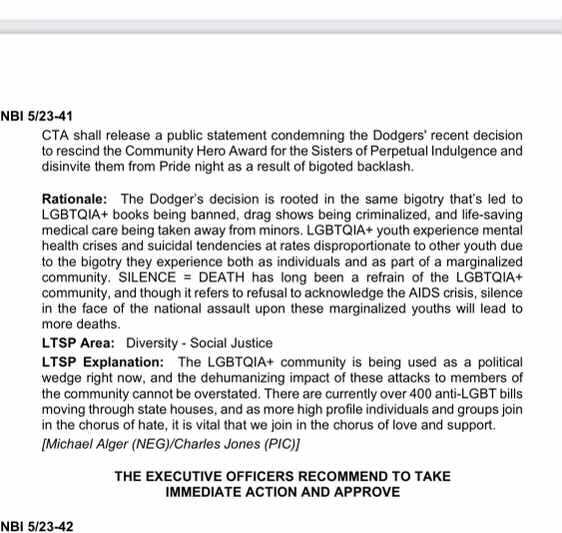
But the California Teachers Association stepped in and strong-armed the Dodgers into standing with perverts against the will of their paying customers.

California Teachers Association’s May 2023 New Business Item states, “CTA shall release a public statement condemning the Dodgers’ recent decision to rescind the Community Hero Award for the Sisters of Perpetual Indulgence.”

As veteran California teachers who’ve served within the unions and personally witnessed the radical agenda CTA imposes upon teachers, we find it suspicious that while the Dodgers are taking so much rightful heat for their June 16 celebration of the offensive “Sisters,” the teachers union is getting away scot-free. CTA’s offensive intrusion into America’s national pastime and its endorsement of drag queens mocking nuns is scandalous. That’s why discerning Americans have had enough and are rising up in protest against teachers unions.

“The statement of the CTA should alarm every Catholic parent who sends their children to California public schools. No school should be a place where children are sexualized or taught anti-Catholic prejudice,” said Father Sebastian Walshe of St. Michael’s Abbey in the Diocese of Orange.

The CTA rationalizes its stance with: “The Dodgers decision is rooted in the same bigotry that’s led to the LGBTQIA+ books being banned, drag shows being criminalized, and life-saving medical care being taken away from minors.” But this is a deceptive statement. Americans are pushing back on pornographic books, drag queen events, and sex transition surgeries on children because these things are destructive to children and an affront to families and American values.

Catholics are not the only Americans offended by the CTA’s endorsement. Jews, Muslims, Protestants and teachers like us are outraged as well.

Rabbi Dov Fischer, a senior congregational rabbi and law professor in California comments in his EdSource article, “The state’s school system, established to provide a safe learning climate for all students regardless of their ethnicity, race, language or religious affiliation, is now [thanks to unions] a social laboratory where students and families from devout faiths feel ostracized.”

Dr. Ahmed Soboh, the Chairman of the Islamic Shura Council of Southern California, an umbrella organization of 67 mosques throughout California, agreed with the rabbi: “Making fun of religious symbols or mocking religious figures should not be celebrated, especially by those who have the honorable job of educating our children.”

Most teachers would agree with the reasonable statements of Father Walshe, Rabbi Fischer, and Imam Soboh. However, the CTA does not represent the majority of teachers. CTA’s endorsement of the “Sisters” is offensive to most teachers, and it demonstrates the radical, out-of-touch views of CTA leadership.

Families of faith have good reason to be appalled since CTA – and its national arm NEA – misrepresent most teachers while controlling the trajectory of public education. Sahara Medrano, a dedicated veteran teacher and a minority representative of the California Teachers’ Union State Council, sees the red flags: “It’s becoming increasingly clear that a politically charged anti-Christian culture of religious intolerance is spreading throughout public school districts across our nation. If this trend continues, our public school system will break confidence with the religious community they are entrusted to serve. Students of faith are starting to boldly speak out saying they don’t feel safe in public schools.”

Teachers don’t feel safe either. And we have to ask, what does forcing the Dodgers into submission to a political agenda that harms children have to do with representing us as educators?

As public school teachers who’ve also served in Christian ministry for years, we commend Muslims, Jews, Catholics, and Protestants for collectively taking a stand for true religious tolerance, by standing against the religious intolerance of CTA. And we’re calling on teachers to join in protest too.

Let’s follow the lead of fed-up Americans who are using their enormous power of the purse to deliver a financial sting to the Dodgers and companies like Bud Light and Target who cave to pressure from special interest groups instead of serving their customers.

Teachers can stop the power of the intolerant CTA by refusing to pay union dues, but we need your help educating teachers that they no longer have to pay unions as a condition of employment. If we help teachers empty the purses of union overlords, Americans can restore childhood innocence and freedom of speech and religion, and get back to enjoying baseball.

Brenda Lebsack is a veteran teacher, former school board member, and founder of Interfaith Statewide Coalition.

Rebecca Friedrichs is founder of For Kids and Country, author of “Standing Up to Goliath: Battling State and National Teachers’ Unions for the Heart and Soul of our Kids and Country,” and a 28-year public school teacher who was lead plaintiff in Friedrichs v. CTA. This article was originally published by RealClearPolitics and made available via RealClearWire.

Helicopter with five aboard crashes into Naknek River, one dies

2

The National Transportation and Safety Board is investigating the crash of a Bell 206B helicopter near King Salmon.

On Saturday morning, Alaska State Troopers were notified that the helicopter carrying five peopled crashed into the Naknek River. The crash occurred between 9:15 a.m. and 9:30 a.m., not long after the helicopter departed the King Salmon Airport. Emergency personnel and good Samaritans were able to get all the occupants of the aircraft out of the water prior to Troopers and Alaska Wildlife Troopers arriving on the scene.

One passenger, Martin Delaureal, 73, of Metairie, Louisiana was killed in the accident. Next-of-kin has been notified. NTSB was alerted and is responding. The helicopter remains in the river as of Saturday night, pending getting equipment to the site so it can be removed, at which point the NTSB will continue its investigation into the crash.

Footage from the Naknek River camera operated by the U.S. Park Service shows that conditions may have been foggy in the morning.

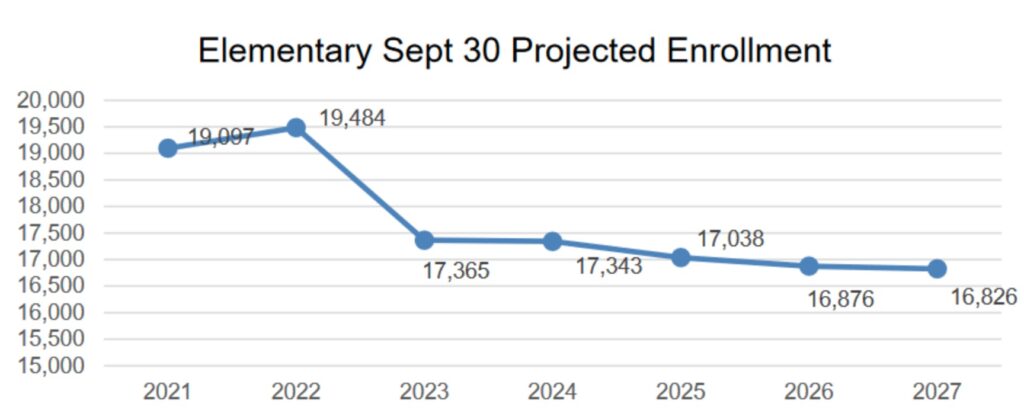
Anchorage school enrollment falls, but at least one city leader is in denial about population collapse

30

The number of students enrolled in Anchorage School District schools has decreased, according to the district’s updated enrollment figures as of Sept. 5. That includes correspondence school students who don’t use school buildings.

Superintendent Jharrett Bryantt announced in April that it’s past time to close some campuses and consolidate, as the working-age population of the city has declined by more than 17,000 residents, or 8.5% over the last decade, and the student enrollment has declined by nearly 10%. He said in the spring that he would gather community input and that decisions would have to be made this fall.

In 2002, 50,055 students attended Anchorage public schools. By 2010, the district had just under 50,000 students. Last year during the official count released in October, the enrollment had fallen to about 43,370 students.

So far this year, the shrinkage appears to be continuing at to 42,353, with a further drop to 37,000 predicted by 2027.

This year’s enrollment number will not be official until October’s annual formal count.

On top of an outmigration problem balanced somewhat by an increase in the homeless population, birth rates in Anchorage have sagged.

In 2004, some 10,336 babies were born in Anchorage. In 2022, that dropped to 9,410 babies born. Granted, births in Anchorage may be from moms and dads in other parts of the state, but a drop is still relevant to school management and forecasting.

The disappearance of babies, while not appearing dramatic on the surface, is already the equivalent of three elementary schools.

The State of Alaska says the overall fertility rate in Anchorage has gone from 72.4 per 1,000 women in 2004 to 64.3 in 2021, the last year the state has published its estimates. That is more than an 11% drop in fertility.

However, in the discussion of population outmigration and student enrollment’s falling numbers, there are population collapse deniers.

The chairman of the Anchorage Assembly says “marginal loss of population in Anchorage is wholly driven by JBER personnel decisions. Otherwise, Anchorage is growing.”

Denial by city leaders doesn’t negate the fact that 70% of Alaska’s 30 boroughs and census areas lost population over recent years. Meanwhile, unlike what Constant supposes, Joint Base Elmendorf-Richardson has seen no significant force reductions, although the Obama Administration had planned for such reductions in 2014. The Obama military slashing plan for JBER was halted in large part by efforts of Sen. Dan Sullivan in 2016; he was elected to the U.S. Senate two years earlier and made protection of military strength in Alaska a priority.

Anchorage had nearly 294,000 people in 2010, and the latest estimate is 289,653. Current population estimates can be found at the State of Alaska website here.

Since Bryantt took over the schools in 2022, he has been trying to right-size the footprint of the campuses, but has been met with resistance. While in 2022 he said six elementary schools need to be closed, the board caved to complaints from the public and only agreed to close Abbott Elementary School. But in reality, Abbott Elementary is still a school district facility serving as Alaska Native Cultural Charter School.

Meanwhile, the MatSu School District to the immediate north of Anchorage has grown to 19,705 students.

Fairbanks has 12,331 enrolled, having lost 1,300 students since 2015.

Gov. Dunleavy to weigh legal arguments before his upcoming decision on reauthorizing Eklutna Hydro

17

On Monday, Gov. Mike Dunleavy’s staff will hear from all sides about whether the Eklutna Hydroelectric Project and associated dam should be reauthorized. His decision is due no later than Oct. 2.

The Anchorage Assembly last week passed a resolution demanding that Dunleavy delay the decision for two years. On Monday, he’ll hear legal points for why a delay of his decision might be legal or not legal, according to agreements made in the 1990s.

The Assembly wants the delay because it doesn’t want the reauthorization of the dam. The Assembly majority wants to wait until there’s a different governor in office — preferably one that will cave to the demands of the Assembly to take down the dam that holds nearly all of Anchorage’s drinking water and a significant portion of its electric capacity for homes and businesses. The Assembly has gone on record wanting full restoration of the Eklutna River, something that was never envisioned under the terms of the U.S. Fish and Wildlife agreement.

The project was sold in 1997 to the Municipality of Anchorage, Chugach Electric Association, and Matanuska Electric Association. As part of the sale of the project, the three utilities entered into a Fish & Wildlife Agreement in 1991. The agreement requires the project owners to develop and propose to the governor a program to protect, mitigate damages to, and enhance fish and wildlife impacted by the development of the hydroelectric project.

But now in 2024, after selling off Municipal Light & Power to Chugach Electric under Mayor Ethan Berkowitz, the Assembly has no voting role in the matter. The municipality is not an ownership member without ML&P.

The Assembly has been, however, holding government-to-government meetings with the Eklutna Village, which has about 70 people enrolled, and the Assembly has been threatening to sue the governor if he reauthorizes the dam, which was first built in the 1920s and rebuilt in the decades that followed.

The governor has the authority to reauthorize the dam as it is or with a plan developed over a five-year process by the voting members of its ownership group, which is now Chugach Electric Association and Matanuska Electric Association.

“They would threaten the water supply and cost hundreds of millions of taxpayer and ratepayer dollars,” said Power the Future in July. “They believe that other energy solutions (i.e., wind and solar) can more than make up the power produced by the Eklutna system.  Ask Anchorage residents what that might have looked like this past January, when the current wind solution would have powered less than 700 homes on the coldest day of the year, while the Eklutna supply powered over 28,000 between Anchorage and the Mat-Su Valley.”

According to the description by Eklutna Hydro, the 1991 Agreement says the governor will review the proposal and issue a final Fish and Wildlife Program giving equal consideration to:

  • the purposes of efficient and economical power production
  • energy conservation
  • the protection, mitigation of damage to, and enhancement of fish and wildlife
  • the protection of recreation opportunities,
  • municipal water supplies
  • the preservation of other aspects of environmental quality
  • other beneficial public uses
  • requirements of State law

Throughout the process, the owners are required to consult with the U.S. Fish and Wildlife Service, the National Marine Fisheries Service, state resource agencies, including the Alaska Department of Fish and Game, the Alaska Department of Environmental Conservation, and the Alaska Department of Natural Resources, and any other interested parties.

Read more about Eklutna Hydro at this link.