An energy worker advocacy group is calling on the Trump administration to refill the Strategic Petroleum Reserve now that oil prices have fallen to four-year lows.
Former President Joe Biden drained the reserve of more than 40% of its capacity when gas prices reached record highs, averaging more than $5 a gallon across the U.S. in June 2022.
With the price of a barrel of crude oil at about $61, Power The Future says it’s the right time to restock the reserve.
“This drop in oil prices is not only potential good news for Americans at the pump, it also provides a window to strengthen our national energy security,” Daniel Turner, founder and executive director of Power The Future, said Monday.
he Strategic Petroleum Reserve was created in 1975 after member countries of the Organization of Arab Petroleum Exporting Countries placed an embargo on oil production and distribution, leading to oil shortages and higher costs. The stock pile of oil in the reserve is meant to protect the U.S. from similar supply disruptions.
“Joe Biden left America weaker by not refilling the SPR, but today’s prices provide an opportunity to fix yet another one of his failure,” Turner said. “The SPR can now be refilled while giving taxpayers a break and it can be purchased tariff-free because we’ll use all American-made energy.”
Dan McCaleb is the executive editor of The Center Square.
An agreement has been reached between Oil Search (Alaska), a subsidiary of Santos, and ConocoPhillips Alaska for the use and maintenance of the Kuparuk River Unit Road. The agreement resolves a years-long dispute over the gravel road access within the Kuparuk River Unit to fields like Pikka, Quokka, and Horseshoe.
Located 40 miles west of Prudhoe Bay, Kuparuk River Unit is the second-largest oil filed in America, built by Arco Alaska on state-owned land and operated by ConocoPhillips.
The roads are critical for accessing the projects on the North Slope.
Pikka, a project of Oil Search, is to the west of Kpaus, and to get to it, the company needs to use the Kuparuk Road System, as building a new road network is impractical and costly.
But ConocoPhillips has been spending $10-20 million annually to maintain the roads, which would cost over $1 billion to build in today’s dollars. ConocoPhillips offered the use of the roads for $95 million over 20 years, but Santos argued that $60 million was a fair amount, and said that state ownership of the land entitled the company to use the roads without high fees.
The conflict arose after the informal arrangement had been used from 2019 to 2022. As Pikka moved toward full-scale development, ConocoPhillips sought more formal compensation, with an anticipation that use of the roads would increase.
Oil Search (Santos) sought a permit from the Alaska Department of Natural Resources to use the road without paying ConocoPhillips, and DNR granted the permit, based on an assertion that it has authority over the land and that the public interest would be served by granting access. ConocoPhillips appealed the decision, arguing that it was, in essence, underwriting the expenses of another company.
Santos and ConocoPhillips have now settled the dispute by signing a Kuparuk River Unit Road Use and Maintenance Agreement, retroactive to Jan. 2. Santos will withdraw its legal appeal.
The agreement ensures that Oil Search can proceed with Pikka, which could add 120,000 barrels a day to the Trans Alaska Pipeline System, at peak production.
ConocoPhillips issued a statement: “ConocoPhillips Alaska is pleased to have signed a commercial agreement with Santos for the use of the Kuparuk River Unit (KRU) road system. The long-term road use agreement follows precedent and recognizes the long-standing custom and practice on the North Slope for operators to enter into commercial agreements governing third-party use of private improvements and facilities, including the KRU road system.”
Due to the unfair treatment I had witnessed toward my children’s charter school by the Anchorage School Board and my recent job displacement that seemed entirely like a publicity stunt, I resolved to attend Saturday’s legislative town hall at University of Alaska . As I turned the corner to enter the Cuddy Center, I encountered a barricade.
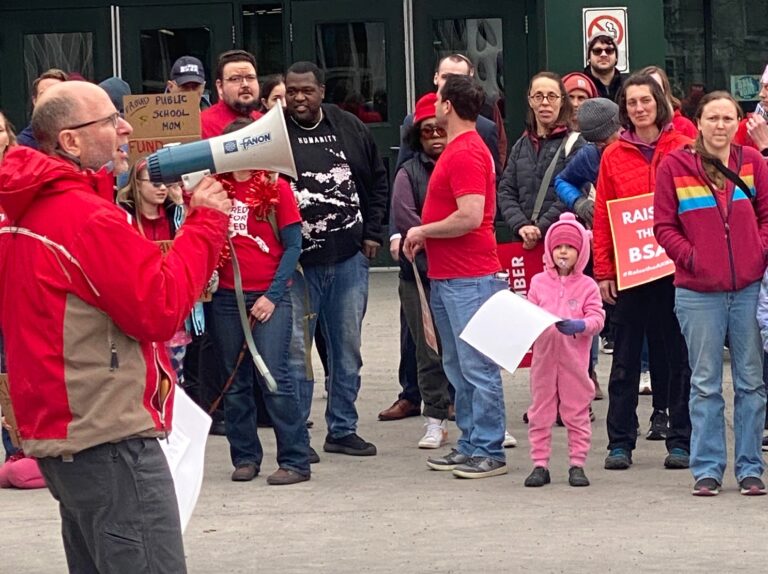
The Anchorage Education Association, an affiliate of the NEA, had organized a protest group that made entry to the town hall impossible unless you crossed far behind their red-shirted, borg-like lineup or directly in front of their barricade. I asked ASD School Board members Kelly Lessens and Carl Jacobs, who were part of the protest, to move aside so we could pass through.
I somehow made it past the megaphone that Region VI Director AEA President Corey Aist was blasting and went to sign up to testify. A few conservative teachers had taken time out of their Saturday to show up, and we sat together in a sea of NEA-compliant red shirts. We had all personally experienced ASD making unwise and financially unsound decisions with the district’s nearly $1 billion budget, to the detriment of our students and the disbelief of our colleagues. We discovered the following:
ASD needs accountability in its spending choices. Did you receive the slew of “rightsizing” or “Academies of Anchorage” emails, only to see the ASD Board vote against their own rightsizing recommendations and Academies planning? We did, and it left us dumbfounded. Did they just waste a $5 million grant? What was their Plan B? Regarding school closures, had they no other source of income on the books to support keeping schools with low enrollment open? I’ve attended the last four months of School Board meetings and work sessions, which showed me they had no plans for improving dismal student test scores and absenteeism or for expanding career choices for students.
The Permanent Fund dividend should not be the piggy bank for unaccountable spending. Many of our students’ families depend on these funds to pay for things they cannot otherwise afford. I personally could not have attended college without a statutory PFD. There is no specific fiscal note on HB 69; they haven’t explicitly stated how they are paying for it. Trust me, they are coming after poor families’ PFDs.
NEA is in charge of Anchorage education and acts like a bully. I’m not saying individuals within the group are bullies; I’m saying the way they act as a whole is bullying. As a fellow teacher testified, I felt a disconnect in people’s thinking. NEA rally folks called for more education funding but did not demand accountability in its spending. They couldn’t see that they were just being used as puppets for a district and union that was lousy at budgeting.
The majority of people testifying parroted back union propaganda.
I receive emails in my work email asking me to attend their union events. At new hire orientation, we are not presented with alternatives. Since de-enrolling from the union and joining another advocacy group, I’ve saved thousands of dollars, gained support, and cleared my conscience.
We were shocked to see so many people testify exactly according to NEA Alaska’s talking points, as if all reason had flown out the window. One man kept repeating how he longed to have himself and everyone taxed. Government does some things well, like arresting mass murderers, but it is pretty lousy at addressing issues like homelessness or education without accountability. Have you driven by the Inlet View School construction site? At the very moment when ASD needs to be refining its spending and building use, they are constructing a huge school downtown next to a usable old school that voters rejected rebuilding several times. How many homeless villages in our beloved parks can you point out?
I was also surprised to see so many fellow displaced colleagues I recognized who were wearing NEA red. They didn’t seem to make the connection that the union they pay $1,200+ per year to actually worsens their plight. NEA roars for a 15% pay raise across the board for one year. Where is that money coming from? ASD has already announced that elementary classes will have over 30-40 students per classroom at some schools. They have to increase class sizes if the union secures a pay raise. They guilt-trip legislators, like an abusive boyfriend guilt-tripping his girlfriend’s family. Unions demand things that aren’t funded and then rally folks to come enmasse to decry their self-proclaimed budget. I can’t budget like this as a single mom; I have to count my incoming income first.
For everyone who stayed home this April election just because Trump wasn’t on the ballot or felt hopeless, I ask you to consider writing your Republican legislators (look them up at Akleg.gov). Tell them that you support accountability in education and oppose using our PFDs to fund it.
This recent school board election is lost, but we still have legislators who can stand firm with the governor’s initiatives for accountability in school funding. It’s up to you to act.
The Texas Senate passed a bill to prohibit individuals in Texas from changing their biological sex on their birth certificates in most cases. It was filed after some judges and school officials appear to be circumventing state law that bans biological men and boys from participating in women’s and girls’ sports.
The Texas Senate passed SB 406 filed by state Sen. Mayes Middleton, R-Galveston, who also authored bills to protect women and girls in sports, bathrooms, locker rooms and other spaces.
Alaska has no such law protecting the accuracy of birth certificates and has not passed legislation protecting girls’ athletics from transgender intrusion.
In fact, Alaska allows individuals to amend the gender marker on their birth certificates. The Alaska Department of Vital Records will update the sex designation upon receiving documentation, such as a letter from a licensed medical provider, such as a physician, social worker, or psychologist, attesting to the individual’s gender transition or identity, or a court order certifying the change. The amended birth certificate will note that the sex designation has been changed, but the state does not issue an entirely new certificate replacing the original. This means Alaska’s vital records align with an individual’s gender preference, even if there is no surgical intervention.
The Texas legislation, SB 406, would amend the state Health and Safety Code to require birth certificates to state an individual’s biological sex at birth, “as determined by their sex organs, chromosomes, or endogenous profile.” It would prohibit birth certificates from being issued that change the biological sex of an individual unless there is a clerical error, the original birth certificate doesn’t list the person’s biological sex at birth, or for a few other reasons.
The bill “ensures Texas birth certificates remain accurate, consistent, and reflective of biological reality,” Middleton said after the bill passed. “A birth certificate, like a death certificate, is a snapshot in time that records accurate vital statistics existing at birth. A birth certificate states God given sex, either XX or XY.”
He also pointed to President Donald Trump’s executive order stating there are only two biological sexes, male and female, “which expressly excludes gender identity,” he said. He also pointed to Gov. Greg Abbott’s directive to state agencies to follow Trump’s executive order and disregard court orders to change an individual’s biological sex on their birth certificates and driver’s licenses.
Last month, Attorney General Ken Paxton issued a legal opinion arguing that state district courts don’t have the constitutional authority to direct government agencies to change a person’s biological sex on government-issued identification documents, including driver’s licenses, birth certificates, and ID cards that is contrary to their biology. He also directed state agencies to correct and reverse any documents they may have altered related to gender, The Center Square reported.
The Senate also passed Middleton’s bill after Paxton sued Dallas ISD after finding “alarming evidence” that its administrators “had implemented an unwritten policy of encouraging students to alter their birth certificates to play sports” in violation of state law, The Center Square reported.
They reportedly did so after Abbott in 2021 signed a bill into law to prohibit K-12 students from competing in interscholastic athletic competitions designated for the opposite biological sex. In 2023, he also signed another bill into law prohibiting biological men from competing on a team or as an individual against women in college sports, authored by Middleton, The Center Square reported.
SB 406 “closes a loophole courts created with no authority to try and change vital statistics from the time of birth,” Middleton said.
He also said that judges changing biological sex on birth certificates “could potentially undermine the integrity of sex-specific sports categories. After passing the Save Women’s Sports Act in the 88th legislature to ensure fairness and opportunity for all Texan women, there are concerns that individuals may attempt to circumvent these laws by amending their birth certificates to reflect a gender ideology and not biological sex.”
SB 406 isn’t about “restricting anyone’s personal expression,” Middleton said, but is “about ensuring that legal documents reflect accurate statistics and that our laws can be effectively enforced. By keeping birth certificates fact-based, we are taking another step to preserve the fairness and integrity of women’s sports and other sex-based protections, as well as safety for women in private spaces.”
The bill passed along party lines and was sent to the Texas House.
In the Texas House, a bill was also filed that would make it a felony for individuals who knowingly make a false or misleading verbal or written statement to a governmental entity or their employer by claiming to be a gender that is contrary to their biological sex.
Middleton also authored one of two companion bills filed in the Texas Senate and House to prohibit individuals from using state-funded facilities that are designated for use by the opposite sex. It bans biological males from using state-funded women’s facilities like in jail or prison cells, domestic violence shelters, public bathrooms, locker rooms or other facilities, The Center Square reported.
In the Alaska legislative bill process, fiscal notes aren’t just paperwork, they are foundational to the legislative process. They tell us, in dollars and cents, what a proposed bill is going to cost the state. That’s not an optional requirement, its the law, laid out clearly in AS 24.08.035.
These fiscal notes are supposed to be drafted by the state agency most impacted by the bill, giving legislators the facts they need to make informed decisions. But recent developments surrounding HB78 (defined benefits for state employees) and last year’s HB173 have me questioning whether that law is being followed; and whether the process is being compromised.
Let’s be clear. Fiscal notes are meant to protect us from budgetary surprises down the road. They’re there to highlight what a bill will really do to our budget and whether it’s going to save money or cost us more. That only works if the notes are written by professionals who have the right data and the right experience. When that process gets usurped or twisted, and the wrong people are involved, or there’s bias at play, it undermines the whole point.
The buzz at the Capitol is that the fiscal note for HB78 (the defined benefits bill) didn’t come from the proper agency, but from a legislative staffer.
If true, that’s a blatant violation of AS 24.08.035. Staffers aren’t impartial experts. They’re often tied to the bill sponsor or the committee, and while they’re hard-working folks, they don’t have the authority or the objectivity to do this job. What we then end up with is something that’s been referred to as a “deep fake” fiscal note. And in this day and age, where misinformation runs rampant, that should concern all of us.
If a staffer generated fiscal note hides the real cost of a bill like HB78, we could end up blindsided, and future legislators could end up dealing with a programmed increase that the state coffers are ill equipped to handle. That’s a threat to responsible government, and it erodes the trust people have in the legislative process.
Now let’s talk about last years HB173 – the so-called “little Davis-Bacon Act.” This one raised the threshold for public construction projects under wage regulation from $25,000 to $150,000. That change makes a lot of sense for our small towns and villages as it reduces red tape and helps projects move forward more affordably. For small villages and cities that bill would have been a game changer. But here’s the issue: I’ve heard that the fiscal note for HB173 may have been drafted or influenced by current or former union members within the Department of Labor.
Technically, the agency involved was the right one. But if the folks writing the fiscal note have a union background – and the bill directly affects union interests – that’s a serious conflict of interest. Even if the numbers are accurate, the perception of bias alone damages credibility. And when you slap a big, inflated fiscal note on a bill that’s supposed to be fiscally conservative, it muddies the waters and discourages smart policy. We cannot afford that kind of manipulation by state agencies. We have got to get serious about protecting the integrity of this process. When fiscal notes are compromised, we face real risks such as:
They can lead us down a very wrong path.
They can reflect personal or political bias, rather than cold hard facts.
They can leverage a vote from a fiscal conservative not to vote for a bill simply because of the expense.
And most dangerous of all, they chip away at the public’s trust.
If HB78’s defined benefits fiscal note were actually staff generated, it might have huge hidden costs left out to help the bill pass. If HB173’s fiscal note was influenced by union ties, it might’ve exaggerated the costs to make it seem more expensive to get conservatives to vote against it. Either way, legislators are left flying blind when the bill comes for a vote.
Here’s what we need to do:
Enforce the law. AS 24.08.035 says fiscal notes must come from state agencies. Period. No shortcuts, no loopholes.
Consider establishing an independent legislative budget office – something neutral and professional, to review or even draft fiscal notes.
Increase transparency. If someone working on a fiscal note has ties that might affect their objectivity, those affiliations should be disclosed.
Create strong guidelines to prevent conflicts of interest. Anyone with a direct stake in a bill’s outcome should be nowhere near its fiscal note.
The bottom line is this: Fiscal notes aren’t just technical documents. They’re a cornerstone of honest government. And if our actions let rumors and bias creep into this process, we’re failing the Alaskans who trust us to be good stewards of their money. We owe it to Alaskans to fix this, and we owe it to the institution we serve to demand better.
Rep. Kevin McCabe is a legislator from Big Lake, Alaska.
The Anchorage Assembly has a government-to-government meeting scheduled for Thursday with the Native Village of Eklutna, as it does twice a year since 2021, when it formally acknowledged the 70-member tribe as a co-equal government in Anchorage.
On the agenda is a briefing on the makeshift casino now operating in the Birchwood neighborhood, which is a significant issue for the community.
Last month, Debbie Ossiander of the Chugiak Eagle River Advisory Board, which is established by municipal code to advise the city on planning relating to the area, sent a resolution to the Assembly complaining that it was never consulted about the Chin’an Gaming Project, a casino that is being built in a quiet residential area near the Birchwood Airport in Birchwood, approximately 20 miles northeast of downtown Anchorage.
The site, owned by the village through Native allotments, is situated off Birchwood Spur Road, close to the Alaska Railroad tracks and Peters Creek, within the Municipality of Anchorage. Currently, it’s a doublewide trailer casino being operated by the Native Village of Eklutna on an 8-acre Native allotment owned by tribal members.
The Mayor’s Office is acting as though it has no planning or zoning control over the site, and has allowed the massive project to go forward with no planning or environmental oversight.
The advisory board says that the project has had multiple violation of land use code and policies, a lack of community involvement, and potential negative effects on the community. Residents report excessive dust coming from the construction onto the road to their homes. The Mayor’s Office is taking a “not my problem” approach to the massive change to the community.
Per code, the Municipality of Anchorage must give the community councils and advisory boards notice about issues impacting their neighborhoods.
No such notice was ever given to the community council or the planning advisory board for the area.
The resolution by the community advisory board is demanding the municipality adhere to municipal code and give the relevant councils notice about what is happening in their neighborhoods, and listen to the council and board input:
A second resolution was also passed, challenging the exemptions that the gaming hall claims it has from state and local regulatory law, including the payment of local taxes. It says residents are getting no response from code enforcement over noise, dust, and traffic complaints. The resolution asks for clarity over jurisdiction. It was also ignored by the municipality.
Neither of these resolutions from legal entities established by the Assembly in municipal code were included on the agenda for Thursday’s meeting with the Village of Eklutna.
However, the joint meeting of the Assembly and the village has agenda items such as the Eklutna River restoration, renaming local places in the area, public safety, boarding school investigation, use of alcohol tax funds for “culturally relevant programming,” and municipal employee training.
Although Debbie Ossiander, with the Chugiak Eagle River Advisory Board, said she asked if she could be part of Thursday’s meeting, she was told that while she could attend, she could not speak, except during the public comment section of the meeting.
The advisory board continues to voice its concerns not only with noise, traffic, and environmental impacts to Peters Creek, which is 50 yards from the unregulated building project, but also jurisdictional questions.
Meanwhile, the State of Alaska has filed a lawsuit to clarify these jurisdictional issues and the federal decision on the casino, the first in Alaska.
The state’s lawsuit, filed on Feb. 4, challenges federal decisions by the U.S. Department of the Interior and the National Indian Gaming Commission that authorized the Native Village of Eklutna to conduct gaming on what is known as the Ondola Allotment, a Native-owned parcel of land. The State argues that these decisions, particularly the DOI’s 2024 Anderson Opinion, unlawfully reversed decades of precedent — specifically the 1993 Sansonetti Opinion and a 2021 federal court ruling — by granting the tribe jurisdiction over the allotment for gaming purposes.
The Chin’an Gaming Hall temporarily opened in doublewide trailers to the public on Feb. 3, just one day before the lawsuit was filed, and has since reported brisk business.
The State seeks declaratory and injunctive relief to overturn the federal approvals and halt gaming operations, asserting that the Alaska Native Claims Settlement Act (ANCSA) of 1971 intended for the State to maintain primary jurisdiction over such lands, not tribes.
No court ruling has been issued, but the case could have significant implications for tribal sovereignty and gaming in Alaska, where Indian Country was extinguished by the ANCSA.
Legal proceedings of this nature typically take months to progress, but while gaming goes on in trailers, the construction of the main commercial facility has been under way, all guided by a Las Vegas developer. The developer’s strategy is to establish gaming before the decision comes down, setting up a case for a challenge to a higher court over whether the federal government has ultimate jurisdiction over the six-acre parcel, as it does in Indian Country.
Another lawsuit was filed by Birchwood residents in the U.S. District Court for Alaska, a case that also remains unresolved.
A man once convicted of murder and released on parole was tracked down and arrested after a dramatic multi-agency manhunt involving SWAT teams, high-tech surveillance, and a helicopter pursuit through Alaska’s rugged terrain.
A federal jury convicted George Moises Romero Jr., 37, on Wednesday of being a felon in possession of a firearm and a violent felon in possession of body armor.
Romero, a name long known to Alaska law enforcement, was originally sentenced to 24 years in prison after a 2006 conviction in Anchorage Superior Court for Second-Degree Murder, Second-Degree Robbery, and Third-Degree Assault.
Despite the gravity of his crimes, Romero was granted discretionary parole and released in 2019 — a decision now under renewed scrutiny.
But his freedom was short-lived. On June 4, 2024, a parole violation warrant was issued for his arrest. The Fairbanks Area Criminal Suppression Unit launched a manhunt to apprehend the convicted killer, knowing he posed a serious risk to public safety.
Law enforcement officials used real-time cell phone tracking to try to locate Romero, only for him to slip through their fingers at the last moment. As the SWAT team prepared to execute a search warrant at his suspected location, Romero vanished, fleeing surveillance and relocating to Alaska’s remote Goldstream Valley.
Undeterred, the Alaska State Troopers deployed a helicopter equipped with high-powered cameras on June 6, 2024. They located a vehicle associated with Romero and tracked its movements from the sky.
Then came the moment that played out like something from a Hollywood thriller: The helicopter team watched as Romero was dropped off at the edge of the woods, carrying camping equipment and preparing to disappear into the wilderness.
But the woods would not be his escape. Ground teams moved in, and Troopers intercepted Romero before he could vanish. He was wearing body armor and carrying two loaded firearms, with extra magazines and ammunition strapped to his person. A third firearm and more ammunition were found in a duffle bag he carried.
The case was a joint effort by the Alaska State Troopers, the Fairbanks Area Narcotics Team (FANT), the FBI Anchorage Field Office, the Fairbanks Resident Agency, and the ATF Anchorage Field Office.
Romero’s conviction followed a three-day federal trial in Fairbanks. Prosecutors Assistant U.S. Attorney Carly Vosacek and Antitrust Division Trial Attorneys David Bernhardt and Lauren Weed led the case.
Now back in custody and facing a likely lengthy federal sentence, Romero’s case is prompting new conversations about parole and public safety in Alaska.
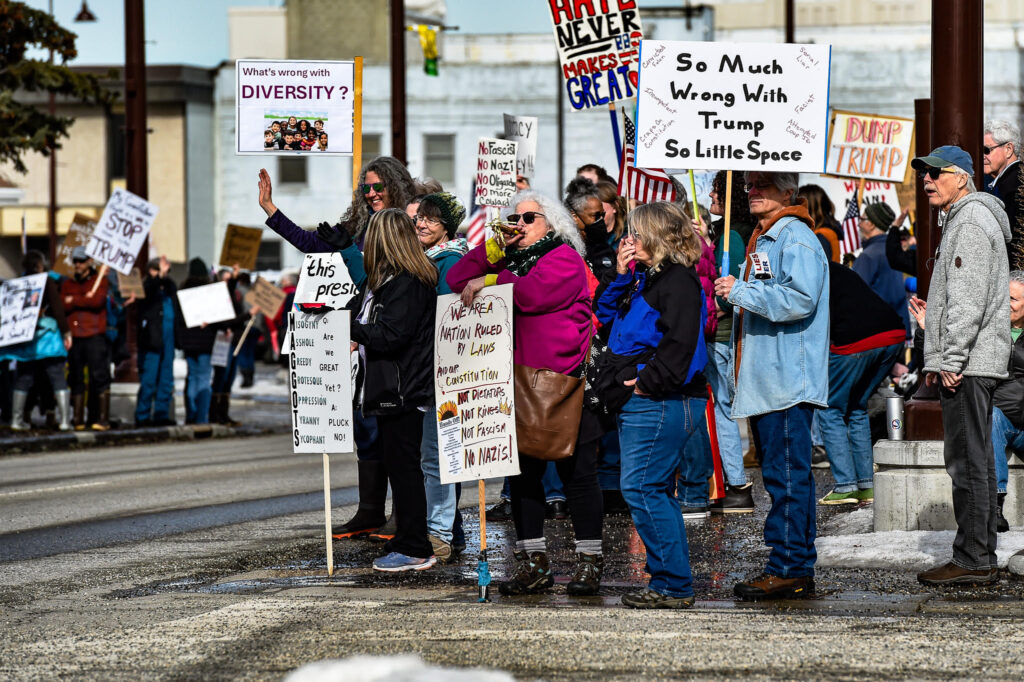
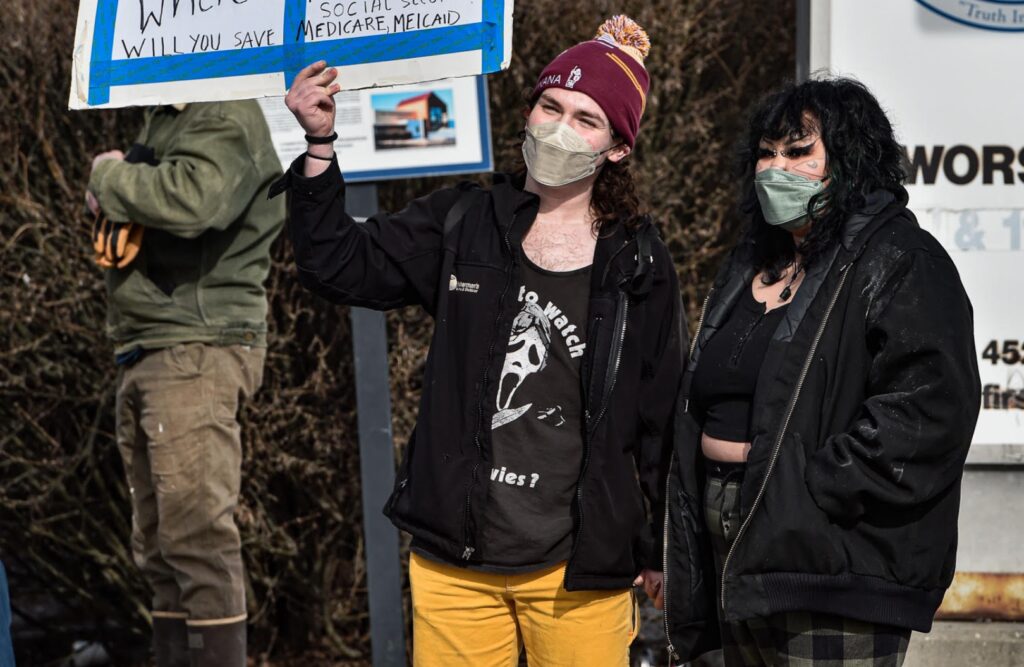
Across Alaska, in communities large and small, people who voted for Kamala Harris for president in 2024 took to the streets as protesters on Saturday. There have been numerous protests like this since Trump was elected.
President Donald Trump has given them lots to protest, including tariffs on countries like China that practice slavery, and countries like Canada and Mexico, which allow and even encourage imports of illegal drugs and immigrants into Alaska. He’s been ejecting illegal immigrant gangsters and returning the rights of girls to compete in sports without boys taking their trophies. Trump has done all that he was elected to do, and in a very short period of time.
The protesters object to Trump trying to stop waste, fraud, and abuse in government.
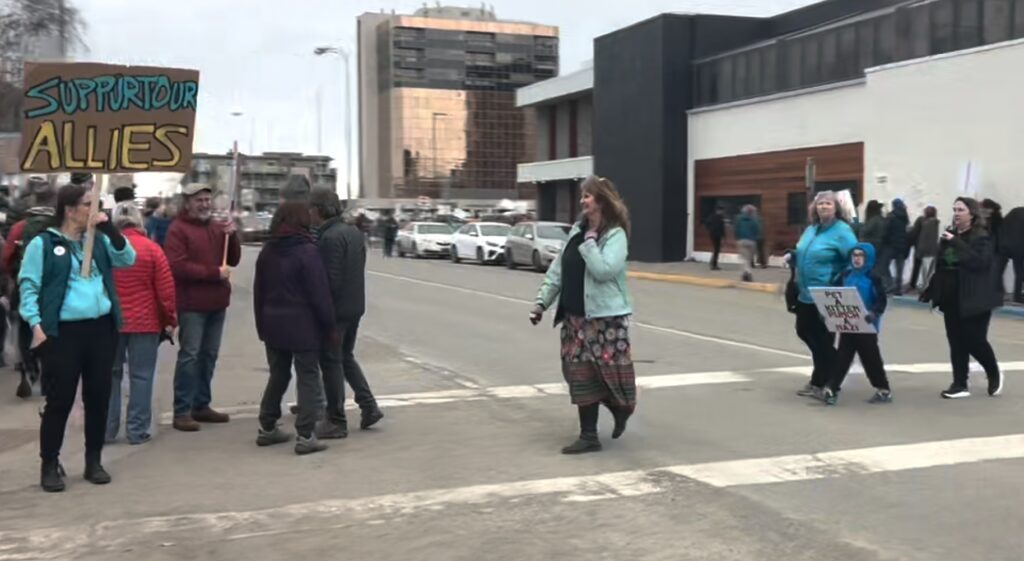
Some protesters held signs that called Trump a fascist. One child held a sign that said, “Pet kittens, punch Nazis.”
Here’s Anchorage:
Protesters in Anchorage on April 5, 2025.Teaching the young to hate.
Observers told Must Read Alaska that when the protesters got to Town Square in downtown Anchorage, they were faced with a group of vagrant Native individuals who told them to leave because they own the land. A fight ensued. One vagrant was taken into custody for spitting on a protester. By “arrest,” that likely means handcuffs and a piece of paper telling the person when to report to court, and a release.
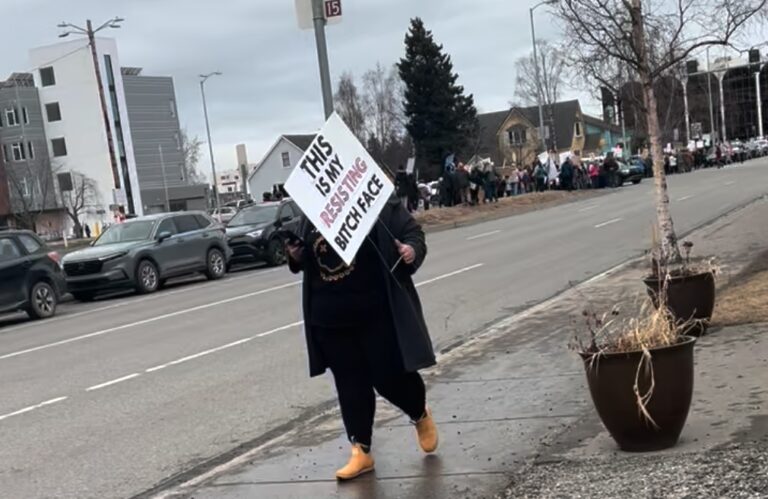
About 3,000 persons took part in Anchorage, including the one sign-holder who advertised on her sign that this was her “resisting bitch face.” Another person was seen stashing an AR-15 firearm in a tent. Later he got a gas can and lit a bunch of wood and pallets on fire at Barrow Street and 2nd Ave.
One observer noted he was “glad these people are out on the streets protesting and not in the halls of government making decisions.”
Here’s more of Anchorage’s protest, in video:
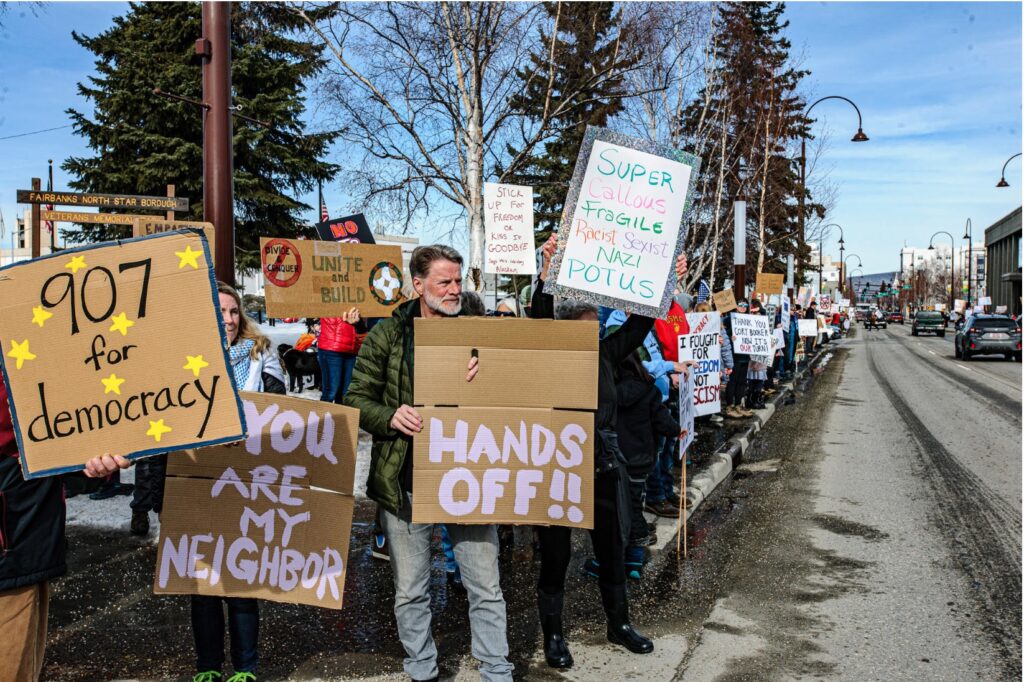
In Fairbanks, the scene was basically the same, but festive. It was more a social gathering than a protest. Mayor David Pruhs was sitting on the City Hall steps watching the whole thing unfold and even had a cookout going.
Photo courtesy of Robert LypePhoto courtesy of Robert LypeProtesters in Fairbanks. Courtesy of Robert Lype.
Juneau protesters numbered over 1,000 in front of the state Capitol. One man carried an American flag upside down and defaced with black spray paint that said: “Fight fascism!”
Photo credit: Jeff Landfield, Alaska Landmine.
In Washington, D.C. Must Read Alaska sources said that protesters included some “furries,” people who identify as animals.
The protests were impressive in numbers in all the major cities, such as Boston, where 20,000 people reportedly took part in a city that voted heavily for Kamala Harris.
NEW: Thousands of protesters take to the streets to protest against Trump & Musk in Boston.
Protesters are demanding that the admin stop all efforts of eliminating government waste and fraud.
A proposed ordinance for the Anchorage Assembly to consider during its April 8 meeting would make the recreational use of nitrous oxide (laughing gas) illegal in the municipality.
Ordinance No. AO 2025-50 is being introduced by Assemblyman Randy Sulte. It would prohibit the recreational use, possession, sale, and offering to another of nitrous oxide (“laughing gas”), amyl or butyl nitrite (“poppers”), and Kratom, by amending Anchorage Municipal Code list the new offenses in the misdemeanor table.
Recreational use of nitrous oxide is not explicitly illegal under federal law in the United States, and is not classified as a controlled substance by the Drug Enforcement Administration. However, its sale or distribution for human consumption (i.e., recreational inhalation) is regulated by the FDA under the Food, Drug, and Cosmetic Act, and misuse can lead to federal penalties if prosecuted as “misbranding.”
At the state level, recreational use of laughing gas for the purpose of causing euphoria is illegal in California, New York, Michigan, Florida, North Carolina, Texas, Pennsylvania, and Illinois. It is not illegal in Alaska.
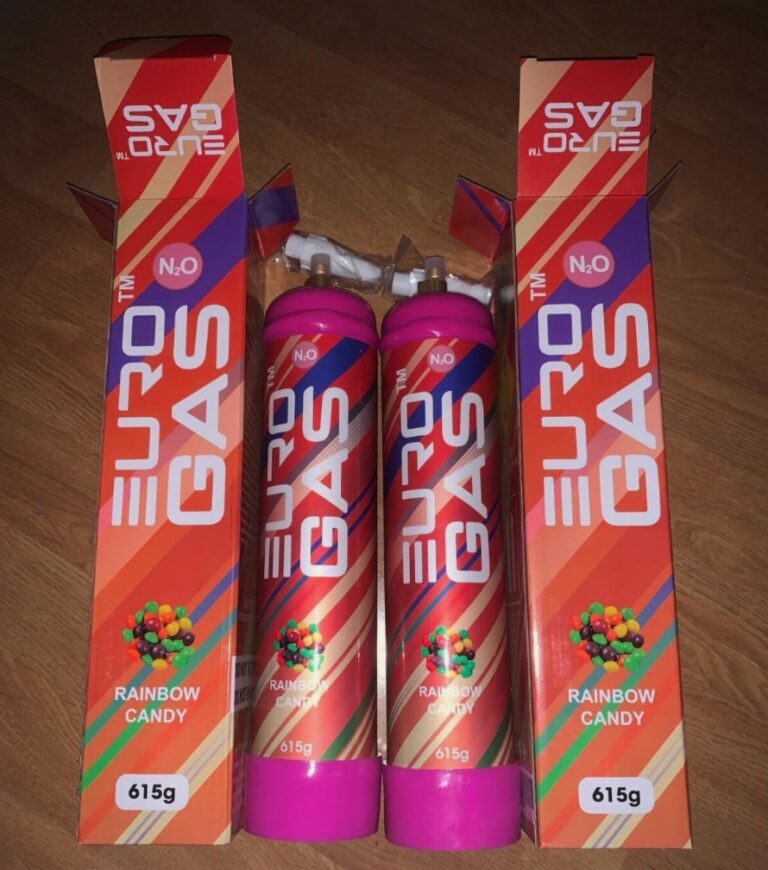
Nitrous oxide itself has a functional use in canned whipping cream, where it is used as a propellant to dispense the cream from the canister and aerate the cream. But some people looking for a quick rush use the cans as “whippets,” where they release just enough gas from the canister (usually using a balloon to capture the gas) and inhale it for a buzz that will last up to a couple of minutes. Repeat use of whippets may have adverse health effects. People also sell and buy nitrous oxide canisters for recreational highs.
Butyl nitrite poppers are a type of recreational inhalant drug consisting of a volatile liquid — butyl nitrite — which is inhaled for its psychoactive effects. Poppers are routinely sold under various brand names like “Rush,” and “Bolt,” and they skirt federal regulations by being advertised as “room odorizer,” “video head cleaners,” or “leather cleaners.” Like nitrous oxide, when inhaled, the vapors produce a rapid, short-lived high, lasting 30 seconds to a few minutes, characterized by euphoria, a “head rush,” and muscle relaxation, especially smooth muscles like those in the anus or blood vessels. Misuse can lead to coma or death.
Kratom is a from a tropical tree native to Southeast Asia. Various products containing it are sold in both retail stores and online. Kratom leaves are often used to self-treat conditions such as pain, coughing, diarrhea, anxiety and depression, opioid use disorder, and opioid withdrawal, according to the Food and Drug Administration. An estimated 1.7 million Americans aged 12 and older used kratom in 2021, according to the Substance Abuse and Mental Health Services Administration’s National Survey on Drug Use and Health. It is not a controlled substance.
Sulte says the the proposed ordinance fills a gap in criminal law by identifying the chemical compounds in whippets and poppers and prohibiting their use or sale for recreational purposes, as a Class B misdemeanor. Sell or providing them to a minor is classified higher as a Class A misdemeanor.