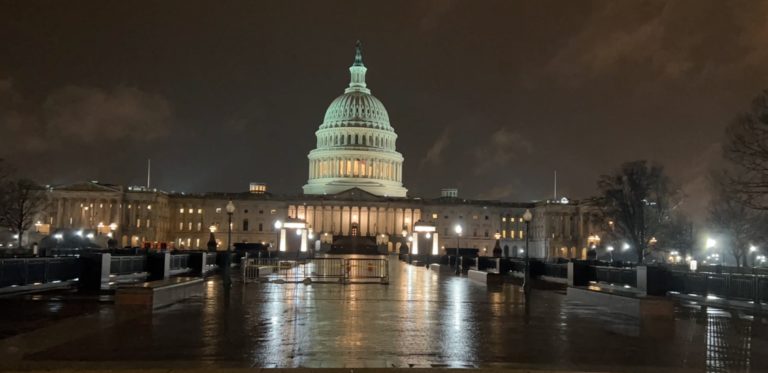
The US Senate voted in the wee hours of Saturday morning to pass a wide-ranging budget resolution paving the way for making Trump’s first-term tax cuts permanent, increasing border security, and restoring defense spending. It was a big step, and the resolution heads to the US House in what is still a long process.
The “blueprint,” as it is being called, lays the foundation for a yet-to-be-written bill to make permanent the tax relief implemented under President Donald Trump’s 2017 Tax Cuts and Jobs Act. It also authorizes an additional $1.5 trillion in new tax reductions to stimulate economic growth.
In a surprise development, Sen. Lisa Murkowski of Alaska voted in favor of the resolution on final passage, in an increasingly rare moment of aligning with her Republican colleagues. That left only two GOP senators — Rand Paul of Kentucky and Susan Collins of Maine — breaking ranks to vote against the measure, although they did for differing reasons.
The final vote came after a long night of debate, as Democrats launched a delaying tactic of offering amendment after amendment to stall passage of the resolution and inflict as much pain as possible on the Republican majority. Despite their efforts, Republicans remained united past midnight in pushing forward a plan that would deliver on key Trump promises.
Among the amendments rejected during the session was a Democrat measure to bar Pentagon officials from using commercial messaging apps like Signal to discuss classified operations. That amendment was directed at Defense Secretary Pete Hegseth, who recently came under fire by Democrats and their media allies for using the encrypted Signal app to discuss sensitive military planning.
Republicans also rejected Democrat proposals that would have blocked tax breaks for top earners and large corporations.
Some nonbinding Democrat amendments were voted down, such as one that condemned the Trump Administration’s idea of closing the Federal Emergency Management Agency, which had become politicized under the Biden Administration, and his temporary freeze on military aid to Ukraine.
The resolution as passed raises the federal debt ceiling by $5 trillion, a move aimed at avoiding a catastrophic default this summer. The current debt ceiling is $36.1 trillion; without an increase, the government can no longer borrow, which would threaten payments on interest payments to bondholders.
The Republican-led plan also has $521 billion in new spending, including $175 billion earmarked for border enforcement and $150 billion for the military.
The vote is another step in the budget reconciliation process, having cleared the hurdle of the Democrats’ objections. The passage means the Senate can now pass budget-related bills with a simple majority, without having to endure filibusters by the Democrats and without needing 60 votes, but just a simple majority, which will sideline some of the Republicans who normally vote with Democrats, such as Murkowski and Collins.
But the challenge is that the House and Senate must approve identical budget resolutions directing congressional committees to draft the actual legislation, which will take several months.
It’s a momentary victory for Republicans and Trump in a complicated budget reconciliation process that few Americans understand.
A national movement is afoot to defund Planned Parenthood. On Wednesday, while the US Supreme Court heard oral arguments in Medina v. Planned Parenthood South Atlantic, a case testing whether a state can withhold Medicaid funding from organizations that conduct abortions, pro-life people across the country rallied to stop taxpayer money from going to Planned Parenthood, the organization that conducts 42 percent of the nation’s abortions.
Alaskans are a part of that movement, as evidenced by a Defund Planned Parenthood event in front of the Anchorage Planned Parenthood office on Lake Otis Boulevard. Mary Kemper of Pro-Life Alaska organized the event, with help from Students for Life and Alaska Family Council.
Kemper has an ever-present smile and is one of the kindest human beings a person could meet. A devout Catholic, Kemper has committed her heart to save pre-born children. She spoke at the event, as did Student for Life leader Francis Bird, Alaska Family Council president Jim Minnery, and longtime sidewalk advocate and pro-life activist Windy Perkins.
The crowd of approximately 55 supporters listened on, waved signs, sang hymns, and prayed.
Across the street, a group of a half dozen counter protesters showed up with signs reading, among other things, “No Forced Pregnancies” and “Find a New Hobby,” the latter presumably directed at the folks attending the much larger Defund gathering. Saving babies is apparently not an effective use of one’s leisure time.
Other than a few motorists flipping the bird or yelling unintelligible or obscene comments at the group, it was a calm gathering. Honking horns and thumbs up greatly outnumbered the naysayers.
During her talk, Kemper mentioned the Medina case as well as the fact that Alaska is among several states to which President Trump has cut Planned Parenthood funding. At issue is the abortion mill’s failure to abide by the new restrictions placed on organizations that fail to follow the administration’s DEI guidelines. The combined money being withheld from the states totals “only” about $27.5 million, but every dollar counts.
Minnery told a story about questioning a pro-abortion activist about the definition of the term elective abortion. The activist’s response, after a long pause, was that they do not know what that means. The implication being that all abortions in their eyes are not elective; rather, they are considered medically necessary.
Labeling all abortions as medically necessary is, besides being untruthful, a convenient way to get funds into the hands of the abortion providers. After all, if the procedure is medically necessary, it is less controversial, even among many pro-life supporters who are willing to make exceptions in the cases of rape, incest, or the life of the mother.
Labeling all abortions medically necessary clearly shows how fundamentally important abortion is to those who support it. The Clinton doctrine of “safe, legal, and rare” has been replaced with “shout my abortion” . . . and shout down anyone who dares to put value on the lives of the pre-born.
In response to an email sent out by Alaska Family Council to announce the event, one recipient wrote back to inform us that Planned Parenthood is evil, so it is encouraging to see so many people, especially teenagers and young adults, gather together in Alaska, and across the country, to stand up for this noble cause.
Tim Barto is vice president of Alaska Family Council and a regular contributor to Must Read Alaska.
The Alaska House Finance Committee advanced a proposed state operating budget for the next fiscal year, which begins July 1. It contains $14 billion and includes a full statutory Permanent Fund dividend, estimated at around $3,800 per eligible Alaskan.
The full PFD was an apparent mistake that Democrat Rep. Andy Josephson of Anchorage made when he proposed the budget. He is not one to promote a full PFD, but it was an oversight he made as chair of House Finance. He was then stuck with it, as , rural Democrats on the Finance Committee were too fearful of their reelection chances to take it out. The Democrat majority, with rural Reps. Neal Foster and Nellie Jimmie showing reluctance to take money from their constituents, just didn’t have the votes to reduce the dividend.
Thus, the budget is nearly $2 billion in the hole, with no apparent easy way to fund it.
The proposal has been sent to the House floor for a vote, where skepticism remains about being passed in its current state. The House is supposed to pass a funded budget, but Josephson’s budget has no funding.
Josephson admitted in a Finance Committee meeting that he had had secret talks with the Senate, so he may have something up his sleeve.
To fund the deficit, there is still the Constitutional Budget Reserve, which has about $2.8 billion in it. But that requires a three-quarters vote of both House and Senate to tap into.
The CBR was established by voters in 1990 as an article of the Alaska Constitution. Its stated purpose is to serve as a savings account to help stabilize the state’s finances by providing a reserve of funds to cover budget deficits during times of low revenue, particularly when oil prices or production decline. The CBR is meant to store excess revenue from certain one-time sources, such as settlements or legal judgments related to mineral revenues (primarily oil), and to protect the state against fiscal volatility due to its heavy reliance on resource-based income.
The state government has used the CBR to balance its budget for 10 years in a row, starting around fiscal year 2015.
Meanwhile, the supplemental budget to pay for items in this fiscal year passed the House on Thursday, also unfunded. On a vote of 21-19, the House Democrats may be thinking there will be enough money in the CBR to also pay for this year’s supplemental needs. But there’s not enough in the CBR for the supplemental and next year’s deficit.
The end-game is upon the Legislature, which has a final date of April 20. Negotiations will continue and those who frequent the Capitol are predicting that a special session will be called, which could extend the power plays until May 21. The new fiscal year begins July 1.
Alaska must critically reform and streamline its state agencies to maximize local autonomy and eliminate counterproductive collaborations with federal agencies that restrict land use, hunting, and responsible resource development.
The Alaska Department of Natural Resources needs continued restructuring to simplify permitting processes, reduce bureaucratic hurdles, and efficiently promote balanced land development for Alaskans.
Similarly, the Alaska Department of Fish and Game must refocus its mandate on managing fish and wildlife sustainably, prioritizing local needs over federal constraints.
Additionally, comprehensive evaluations and targeted reforms of state agencies in Alaska are critical to achieving Alaska’s goal of self-determination, economic vitality, and responsive governance. Self-examination by the state of its bureaucracy is timely and necessary.
But the unspoken reality for Alaskans is the settlement of all federal lands in Alaska. This has been languishing for decades due to political, environmental and market concerns. Alaska stands unmatched as America’s greatest untapped frontier, holding within its borders an extraordinary abundance of natural resources essential to our nation’s continued prosperity, economic security, and global competitiveness.
The following information outlines a hypothetical framework addressing historical challenges, abundant natural resources, and fostering a strong and collaborative relationship between the State of Alaska and over 200 Alaska Native Tribes. This approach honors the promises made through critical historical compacts, including the Alaska Statehood Act, ANCSA, and ANILCA, while proposing innovative solutions for managing Alaska’s vast natural wealth for the benefit of all Alaskans.
II. Historical Challenges and Context
Alaska has historically faced systemic challenges due to federal land management practices, significantly affecting resource development, economic opportunities, and local autonomy. Despite explicit statutory commitments established through the Statehood Act, ANCSA, and ANILCA, repeated federal breaches have hindered Alaska from fully benefiting from its natural resource wealth.
Critical Issues:
Limited Access: Federal restrictions blocking access to resource-rich lands.
Alaska has endured decades of exhaustive studies, prolonged analyses, repeated approvals and denials, bureaucratic stalling, and political inaction regarding its land and resource management. This chronic cycle of “analysis paralysis” has severely hampered the state’s economic and social progress. Alaskans have patiently awaited fulfillment of federal promises, only to face continual delays and broken commitments. The time for perpetual evaluation has passed; decisive action is now urgently needed. Alaska must finally be provided with the tools and authority necessary to fully realize its vast potential and take its rightful place as one of America’s most productive, prosperous, and strategically vital states.
III. Natural Resource Wealth
Alaska boasts extensive natural resources:
A. Oil and Gas
National Petroleum Reserve of Alaska (NPR-A): Holds approximately 900 million barrels of conventional oil and over 53 trillion cubic feet of natural gas.
Arctic National Wildlife Refuge (ANWR): Potential for billions of barrels of untapped oil.
Non-North Slope Federal Lands: Mandated development under ANILCA Title X remains largely unrealized.
B. Timber and Agricultural Resources
Tongass National Forest: Historically yielded over 520 million board feet annually. Current management strategies severely limit output and employment.
Chugach National Forest: Approximately 5.4 million acres, with timber potential and historically sustainable forestry practices.
State and Native Corporation Forests: Vast lands managed by the state and Native corporations provide additional commercial forestry opportunities.
Traditional Farming: Limited but growing potential for cold-tolerant crops like potatoes, carrots, barley, oats, and greens, primarily in the Mat-Su Valley, Kenai Peninsula, and Delta Junction regions.
Livestock and Ranching: Raising cattle, reindeer, goats, sheep, and poultry adapted to Alaskan conditions.
Specialty Agriculture: Berry production, greenhouses, controlled-environment agriculture, and niche markets (e.g., peonies, herbs) are emerging opportunities.
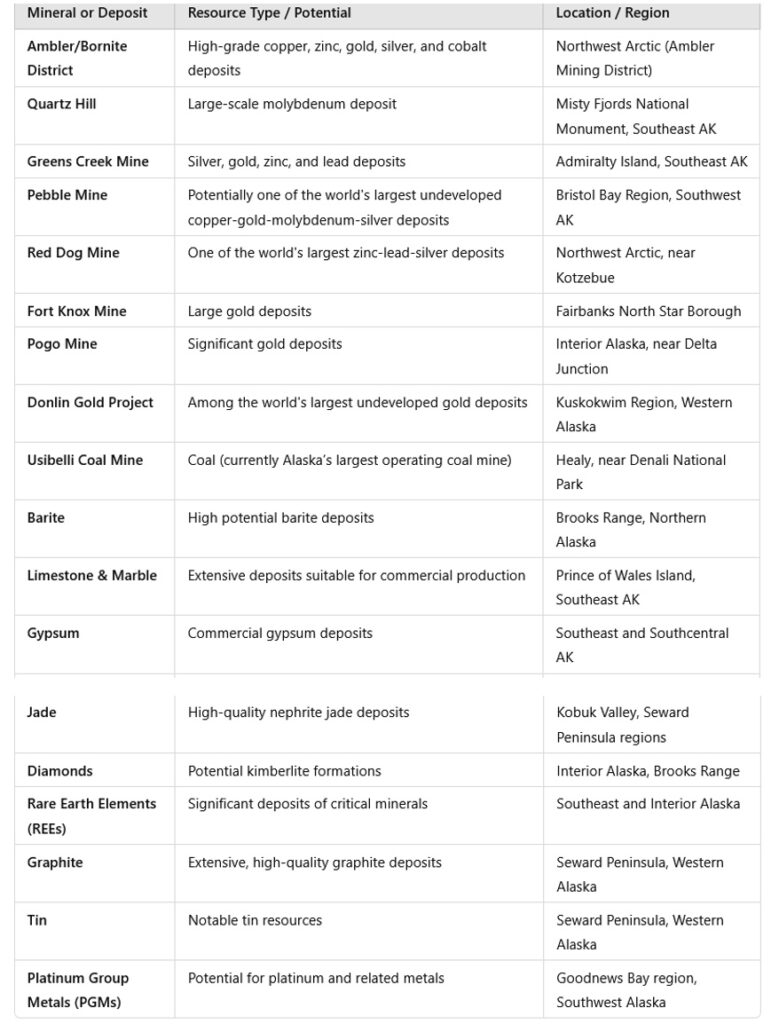
C. Known Mineral Resources
The above table provides an overview of Alaska’s abundant and diverse mineral resources, including strategically important metals and industrial minerals. Alaska hosts world-class deposits of gold, copper, silver, molybdenum, zinc, rare earth elements, and strategic industrial materials such as barite, limestone, gypsum, jade, and diamonds.
C. Alaska’s fish, marine life, and related activities
Commercial Fishing: Alaska produces over 60% of the nation’s commercial seafood, including salmon, halibut, crab, pollock, and cod. This sector generates billions of dollars annually, supports thousands of jobs, and fuels local economies.
Subsistence Fishing & Marine Harvesting: Vital to Alaska Native communities, subsistence fishing and harvesting of marine life are deeply embedded in cultural traditions and provide food security across rural areas.
Recreational & Sport Fishing: Significant drivers of tourism, attracting visitors for salmon runs, halibut fishing, and other marine experiences, adding millions to the state’s economy each year.
Marine Ecosystem Services: Healthy marine habitats support biodiversity, carbon sequestration, coastal protection, and other environmental benefits.
D. Resources Yet to be Discovered or Fully Developed
Alaska’s geology suggests vast undiscovered mineral and energy resources, including critical minerals essential for technological advancements.
Offshore oil, gas reserves, and renewable energy opportunities (wind, geothermal, tidal) remain significantly unexplored.
The state’s geothermal potential offers opportunities for renewable energy development, particularly in regions with volcanic activity. Certain areas in Alaska have favorable conditions for wind and solar energy projects, contributing to the state’s renewable energy portfolio.
IV. Strategic Objectives
A. Natural Resource Development
Fully realize ANILCA mandates to responsibly develop oil, gas, timber, and minerals.
Reinstate original intent behind NPR-A, ANWR, and Title X of ANILCA, ensuring expeditious resource exploration and development.
Reactivate forestry operations in Tongass and other parts of the state to restore sustainable harvest levels and employment opportunities.
Clear regulatory barriers to mineral development to promote investment and economic diversification.
B. Protection and Enhancement of Traditional Uses
Guarantee traditional access and use of conservation system units for subsistence, recreation, and economic activities.
Ensure agency adherence to Section 1110(a) access rights under ANILCA without imposing unauthorized restrictions or permit requirements.
C. Recognition and Protection of Valid Existing Rights
Honor and guarantee access to private inholdings, Alaska Native lands, mining claims, and state-owned lands through simplified and streamlined processes.
Reassert R.S. 2477 rights-of-way to facilitate efficient transportation and access infrastructure essential for rural and resource-dependent communities.
V. State and Tribal Partnership
For the first time in American history, Alaska, in collaboration with its unparalleled number of federally recognized sovereign tribal governments, is positioned to create a unified strategic partnership to fundamentally redefine state and tribal land management through the direct transfer of federal land titles. By building a powerful alliance grounded in mutual respect, shared economic goals, and recognition of tribal sovereignty, Alaska and its tribes can leverage unprecedented political and legal influence to negotiate the full transfer of federally promised lands, including parks, national monuments, preserves, and other federally controlled areas, directly into state and tribal ownership. This coordinated approach emphasizes a collective vision where both state and tribal governments hold clear, legally secured titles, cooperatively managing and operating lands to realize commitments made at statehood and reaffirmed through ANCSA and ANILCA. This historic strategy prioritizes local autonomy, economic prosperity, and sustainable management practices, positioning Alaska as a national model for state-tribal partnership, sovereign land stewardship, and genuine self-determination.
The continued federal retention of approximately 220.3 million acres in Alaska, without any explicit constitutional justification relating to national defense, transportation, or critical infrastructure, raises serious constitutional, legal, and equity concerns. Moreover, it has resulted in decades of underutilization and outright waste of abundant natural resources, depriving both Alaska and the nation of vital economic development, strategic resource independence, and sustainable prosperity.
Alaska with its tribal governments have strong grounds to argue for a timely transfer of these federally held lands into state and tribal hands.
In order to accomplish this, a robust and well-defined partnership between the State of Alaska and the 200+ Alaska Native Tribes is fundamental:
Strengthen state-tribal collaboration frameworks, prioritizing joint decision-making in natural resource management and economic development.
Respect tribal sovereignty and support tribal self-determination in managing tribal lands and resources.
Foster cooperative agreements and joint ventures to ensure shared economic benefits and sustainable development practices.
Prioritize infrastructure and economic support for rural and tribal communities disproportionately impacted by historical federal mismanagement.
VI. Proposed Remedy: Land and Resource Management Transfer
Given systemic federal failures, the plan advocates for:
Transferring significant federal lands to State control under conditions that honor original federal mandates and promises.
Enhanced role and explicit consent authority of Alaska and Alaska Native Tribes in future federal land-use decisions.
Leveraging state and tribal expertise for more responsive, efficient, and locally-informed land management and economic development.
Utilizing Alaska’s proven capacity and extensive expertise in natural resource management to immediately improve stewardship, economic outcomes, and environmental protection.
Empowering Alaska Native Tribes to apply their considerable knowledge, cultural expertise, and management capabilities for sustainable, culturally-informed resource development and land management.
VII. Implementation and Governance
Reinstate and empower the Alaska Land Use Council as a joint state-federal-tribal governance body, with state consent as a mandatory condition for federal land-use decisions.
Transparent tracking, accountability, and regular reviews to ensure adherence to statutory and policy commitments.
Strategic state investment in rural and tribal capacity-building, infrastructure, and workforce development to optimize resource-driven economic opportunities.
VIII. Conclusion
This approach marks a transformative step toward empowering Alaskans and Alaska Native Tribes with rightful stewardship over their natural resources. By rectifying historical wrongs, this settlement lays the foundation for sustainable economic prosperity, cultural preservation, and environmental stewardship—fulfilling the original promise of Alaska’s statehood compact for present and future generations.
The Alaska Legislature, in a faux embrace of small government voted Senate Bill 15, legislation to allow 18-year-olds to sell alcohol. The bill was passed out of both houses with veto-proof majorities. It is headed to the governor’s desk for action.
From the outside, it would appear that the majority is telling those that installed them to “Here, hold my beer.” A cynic might wonder how bad the service at Juneau bars has been this session. A happy thought would be that they have finally solved the substance abuse problem in Bush Alaska, and introducing youngsters to alcohol at a younger age is no longer a problem.
Of course, such thinking would completely ignore the disaster of changing the legal age for purchasing alcohol to 18 following passage of the 26thAmendment(right to vote at 18) in 1971. The fallout among the newly emancipated young was sufficiently awful that it only took states a couple years to return the legal age to 21. The legal whiplash of those of who rode that wave was awesome.
When you get a lemming stampede like this out of the Legislature, actual issues and fallout is often never considered.
For example, we here in Anchorage are treated to universal ID checks regardless of age when we purchase alcohol. If it is safe enough for 18-year-olds to sell, why are we still carding? This was recently extended to bars and restaurants, where patrons are universally carded.
According to this legislature, alcohol remains sufficiently dangerous that it isn’t legal to purchase until you are 21, but safe enough for 18-year-olds to sell. One or the other could be true, but not both.
Extend this logic a bit to other substances illegal to purchase between ages 18 – 21 – tobacco, vaping and pot.
Are these substances more or less dangerous than alcohol? Most of us would think less, though society via its laws treat them as the functional equivalent of heroin, fentanyl, or worse. If 18-year-olds can sell alcohol, why then can they not sell tobacco, vaping products or pot?
Why indeed.
Finally, we have the ongoing substance abuse destruction of people in the Bush. Allowing 18-year-olds to sell alcohol out there will only introduce more of them to alcohol at an earlier age. Does anyone in the legislature think this is a positive lifestyle choice?
Maybe it is time to have another public discussion over the Age of Majority, something pointedly ignored by the legislature in their rush to speed up bar service in Juneau. We as a nation tried this half a century ago. It didn’t go all that well, and that was a society with more intact families and more people going to church on a regular basis. Anyone out there think it will work better this time around?
If this is an example of thoughtful legislation out of this legislature, I shudder to think what they are about to do to public employee pensions, the BSA and the PFD.
While I don’t expect the governor to veto this, I think he should, although it might be overridden.
Alex Gimarc lives in Anchorage since retiring from the military in 1997. His interests include science and technology, environment, energy, economics, military affairs, fishing and disabilities policies. His weekly column “Interesting Items” is a summary of news stories with substantive Alaska-themed topics. He was a small business owner and Information Technology professional.
The new reciprocal 34% tariffs announced by the United States and China could especially impact Alaska seafood prices, due to the state’s heavy reliance on exports and Chinese labor.
The tariffs have been a moving target. On March 4, President Donald Trump imposed an additional 10% tariff on Chinese imports, which brought the cumulative tariff’s to 20% on top of existing tariffs from Trump’s first term, which were basically left in place by President Joe Biden.
Then there is the new 34% tariff on top of that. China immediately reciprocated by imposing a 34% tariff.
The tariffs will affect Alaska seafood sent over and processed in China and re-exported to the US, a common practice for Alaska products like pollock and salmon. Over half of Alaska’s fish is sent to China, where pin bones are removed by cheap labor, then is re-imported as packaged for retail to the US.
While Alaska salmon is headed and gutted on this side of the Pacific Ocean, to process fillets and remove pin bones is very labor intensive, so companies like Trident Seafoods and others use the massive processing centers in cities like Qingdao, Dalian, and Yantai in Shandong and Liaoning provinces, which are global seafood processing centers.
China uses forced labor, including conditions that Americans would view as slave labor, in Qingdao and other parts of Shandong Province to process fish. Qingdao has a reputation for using and abusing minorities, particularly Uyghurs and North Koreans, in its seafood processing plants.
The “dual tariffs” now in place as Alaska moves into fishing season will increase cost of processing, which will be passed along to consumers and could soften the demand for wild Alaska salmon.
Meanwhile, farmed salmon from Scotland, Norway, and Chile, are also processed in these same facilities. Those farmed salmon products have very low tariffs — in the teens — between the respective countries. Alaska wild salmon is already significantly more expensive than the farmed salmon that is ubiquitous in the Lower 48.
With China as Alaska’s largest seafood export market, there could be a surplus of seafood in the US market in the coming salmon harvesting season, potentially depressing wholesale prices paid to Alaska fishermen and processors, at least in the short term.
One of the outcomes might be that processors in Alaska turn to domestic processing, which has higher labor costs associated with it than the near forced-labor in China.
As for Chinese consumers, they may turn to competitors like Russia or Norway, as happened in 2018 during a trade war, when Russian pollock imports to the US surged as a result of Chinese tariffs on the US, which led to a 20% drop in seafood sales to China, impacting 65% of Alaska seafood businesses.
Now, if American consumers shift to domestic seafood to avoid tariffed imports (mainly Chinese tilapia, prawns, or shrimp), demand for Alaskan products could rise, which might offset some price drops.
Alaska’s seafood industry employs nearly 70,000 people and generates over $5 billion annually. It’s big business, although less than 10% of Alaska’s GDP.
The US-China reciprocal tariffs will be a dynamic condition that may reduce demand and increase costs in the short-term, and may boost domestic jobs that require the use of more workers coming to the US on the H-2B visa, a non-immigrant visa that allows US employers to bring foreign workers in seasonally for temporary seafood processing jobs when there are not enough US workers available. These H-2B visa workers are especially critical for Bristol Bay salmon runs.
As labor markets and supply chains adjust, Alaska fishing companies and US consumers will likely feel the pinch — at least in the short-term.
The Alaska Railroad’s proposed $274 million estimate to complete the Point MacKenzie Rail Spur is an inflated price tag that doesn’t hold up. With $184 million already spent, the total for 32 miles is $458 million – or $14.31 million per mile.
This is excessive when you look at the scope of the project. With 25.6 miles of embankment already completed, all bridges in place, and 7.2 miles of embankment left (on flat farmland), and 32 miles of track to lay, the final tranche should be closer to $100 million to $150 million, not nearly $274 million.
Rural freight rail construction typically costs between $2 million and $5 million per mile. Due to higher logistics and labor costs, it’s reasonable to expect Alaskan costs to be closer to $5 million to $10 million per mile for more complex projects. However, this project’s terrain and available materials shipping from Port MacKenzie suggest that the remaining work should cost significantly less than the inflated $274 million estimate. A realistic breakdown for the final stretch of the project would be $50 million to $135 million—not $274 million.
To break it down further, the embankment work on the remaining 7.2 miles of flat farmland would typically cost $500,000 to $1 million per mile—adding up to $3.6 million to $7.2 million in total. Given Alaska’s premium costs, we could expect this to go up to $10 million to $15 million at the high end.
For the track-laying portion, which spans 32 miles, the typical cost for rural freight rail would be $1 million to $2 million per mile, putting the total at between $32 million and $64 million. Even with Alaska-specific costs, we can expect that figure to rise to between $80 million and $100 million. Add another $10 million to $20 million for basic signaling and contingency costs, and we get a reasonable estimate of between $50 million and $135 million for the remaining work.
That makes the $274 million estimate look not just high but completely disproportionate. The $184 million already spent on the first part of the project ($7.19 million per mile) is already on the high side, but adding another $274 million ($8.56 million per mile) for a relatively simple stretch of track is excessive. In fact, this estimate suggests more than just inefficiency—it smells of political maneuvering.
Politics plays a significant role here. The Point MacKenzie Rail Spur is seen by many in the Mat-Su region as a key to unlocking the potential of Port MacKenzie, which has long been underutilized due to the lack of rail access. If the rail spur is completed, Port MacKenzie could become a serious competitor to Anchorage’s Port of Alaska, which has faced its own set of challenges with modernization and expansion.
It’s important to note that Port MacKenzie isn’t trying to outcompete Anchorage; rather, they want to complement it. Their goal is to offer services that the Port of Alaska can’t or doesn’t want to handle, filling gaps in the market and providing additional capacity.
However, the Alaska Railroad, whose headquarters are located at the Port of Anchorage, has clear ties to Anchorage’s port and has a vested interest in maintaining its primacy. So, there’s a potential conflict of interest in how the project is being handled. The inflated price tag could be a way to keep Port MacKenzie from growing too quickly, or to secure additional funding from the federal government or state coffers under the guise of an urgent and costly project.
If you step back and look at the numbers, the $274 million estimate just doesn’t add up. To put it in perspective, the Tanana River Bridge, a massive engineering feat, cost $187 million in total. So how can we justify $274 million for 32 miles of flat terrain, with all bridges already completed?
The answer is simple: we can’t. The figures don’t support it unless there are significant undisclosed features – like electrification or hidden terminals – that are somehow driving up the cost. But no such features have been mentioned.
The truth is ~ the estimate could easily be padded for political reasons. A $150 million estimate could be bumped up to $274 million by adding a ‘strategic buffer’ to make the project seem more urgent or to secure more federal and state funding. However, padding it by over $100 million isn’t just strategic; it’s excessive and irresponsible. Ultimately, Alaskans will bear the burden of this overinflated cost.
At $458 million total, this project is on track to become a fiscal albatross, not the economic engine it’s supposed to be. An inflated estimate undermines trust in the Alaska Railroad and state leadership, especially when that money could be better spent elsewhere, like in Anchorage’s port modernization efforts. A more realistic estimate of $100 million to $150 million for the remaining work would bring the total project cost to somewhere between $284 million and $334 million – still ambitious, but more in line with what makes sense for Alaskans.
In the end, the Alaska Railroad’s $274 million estimate is unreasonable and inflated. While I understand that construction costs in Alaska are higher than the national average, the scope of this project simply doesn’t justify this kind of pricing. The high cost appears to be driven by political gamesmanship, not by the needs of the rail project itself. At $458 million, the rail spur becomes more of a political tool than a legitimate infrastructure investment. Alaskans deserve a transparent breakdown of costs, free from political agendas.
Port MacKenzie should complement Anchorage, not compete with it, and we need to make sure this project is finished in a way that benefits all Alaskans, not just a few political players.
Rep. Kevin McCabe is a legislator from Big Lake, Alaska.
Bernadette Wilson, a dynamic Alaskan who has tirelessly worked in Alaska’s political realm for 20 years, was the far-and-away winner of the Must Read Alaska NewsletterQuestion of the Week:
Who should run for governor?
The nonscientific survey only had space for five names. The names that MRAK chose for the five were some possible contenders: Mary Peltola, Adam Crum, Treg Taylor, Nancy Dahlstrom, and Bernadette Wilson.
With the exception of Wilson, all four others have campaigned for office and held high positions in government. Mary Peltola is the former House member for Alaska, Adam Crum is commissioner of Revenue and former commissioner of Health and Social Services, Treg Taylor is attorney general, and Nancy Dahlstrom is lieutenant governor.
Wilson is the only one who has never run for office.
Here are the final result of the three-day poll:
None of the names on the poll has actually filed for the 2026 race for Alaska governor, but all are known to be “kicking the tires” to see if they can mount a credible campaign. All on the poll are Republicans except for Peltola.
The question was sent to the 33,000 people who subscribe to the three-times-a-week newsletter, which generally is opened by about 14,000 recipients for each edition. The question ran in the March 31 and April 2 editions of the newsletter (subscribe here.) The newsletter subscribers are generally conservative, although there is a small but loyal readership among Democrat politicos, as seen in the results above, where Peltola received 4%.
Must Read Alaska newsletter readers might be described as the conservative super-voters of the state, and many are politically active in their communities.
Thus, it’s an interesting result to see that Wilson got more than double the support of the next contender — Lt. Gov. Nancy Dahlstrom, who ran for Congress last year but withdrew after the primary.
Who is Bernadette Wilson? She owns a garbage disposal company, is a single mother, and got her political start managing the 2010 Parental Notification Initiative, which won statewide with 56% of the vote. She has worked on several campaigns ever since, most recently as a senior advisor to the Nick Begich congressional race. In addition, she was the state director for Americans for Prosperity, and hosted a television show and a radio talk show (coincidentally, the co-host was Democrat Ethan Berkowitz.)
Wilson is known for organizing the People’s Memorial Day in 2020, when then-Mayor Ethan Berkowitz cancelled the Memorial Observance at the Veterans’ Memorial in Anchorage.
And she organized community action against the shut down of the Anchorage economy during Covid, and even held a “dance off” protest in front of the Loussac Library, as a protest to the Berkowitz ban on dancing in 2020, and later a convoy of trucks that rolled through downtown.
Bernadette Wilson, front left, organized a dance protest to show public disapproval of Mayor Ethan Berkowitz’ ban on dancing in 2020, while the Anchorage Assembly met inside the building.
Is this Wilson’s time to run for office? Readers seem to think so.
There are other possible contenders for governor besides those five names. Must Read Alaska will have another Question of the Week with some of the other possibilities. You can vote in that poll in the Monday, April 7 and Wednesday, April 9 newsletter.
The Trump Administration has issued a stern directive requiring K-12 schools to certify their adherence to the executive order issued by President Donald Trump that eliminates racist programs known as DEI.
The Education Department sent notices on Thursday, giving states and schools a 10-day deadline to return signed certifications confirming compliance.
The administration’s action represents an escalation in its broader crackdown on so-called Diversity, Equity, Inclusion policies, leveraging federal financial assistance as a means to enforce compliance.
Meanwhile, in Anchorage, the school district has taken a different stance. The Anchorage Assembly on Tuesday night approved the school district’s budget for the 2025-26 fiscal year, which includes funding for DEI programming, including three personnel positions. The budget, totaling $866,250,188, includes local contributions of $267,342,224 from property taxes and other sources.
Despite a $27,990,396 reduction in the district’s upper spending limit—primarily due to a loss in state revenue—the budget maintains funding for DEI. The move appears to challenge the Trump administration’s position, raising questions about potential consequences for federal funding eligibility.
Trump declared DEI expenditures are an illegal use of US taxpayer dollars, as many schools have failed to meet their legal obligations by using DEI programs in ways that discriminate against certain groups.
“Federal financial assistance is a privilege, not a right,” said Craig Trainor, acting assistant secretary for civil rights. “Many schools have flouted their legal obligations, including by using DEI programs to discriminate against one group of Americans to favor another.”
The certification notice requires state and school leaders to sign a “reminder of legal obligations,” to acknowledge their understanding that federal money is conditional upon compliance with the executive order.
With the 10-day deadline looming, the directive will mean either school districts like Anchorage comply or risk federal funding.