A bill rider introduced by a California Congressman is aimed squarely at the Pebble Project — and stopping it from moving forward.
Rep. Jared Huffman, a Democrat from Marin County, introduced an amendment to a $1 trillion spending bill that will go to the House floor next week.
Huffman’s amendment, which is all of 23-words long, prohibits the U.S. Army Corps of Engineers from using any funds in the appropriation for completion of the environmental impact statement for the proposed gold and copper mine in Western Alaska. The EIS process is under way right now, with a public comment period that ends July 1 with the Army Corps of Engineers.
The amendment is a form of reverse earmark, whereby Congress can direct or redirect funds to or from specific projects.
Huffman is an environmental lawyer who was employed by the National Resources Defense Council for six years. The NRDC is one of the most well-funded of the anti-Pebble environmental groups in the country and raises significant cash through fighting the Pebble Project.
“As Rep. Huffman formerly worked for the NRDC, we find it surprising that Rep. Huffman wants to circumvent the very NEPA process the NRDC calls the Magna Carta of environmental law. This is bad public policy and it should be summarily rejected,” Pebble Project said in a statement.
Huffman is the same congressman who sponsored legislation to put a padlock back on the Arctic, through his H.R. 1146, the Arctic Cultural and Coastal Plain Protection Act, which would repeal President Trump’s 2017 tax law that finally allowed drilling in ANWR, the Arctic National Wildlife Refuge’s Coastal Plain, sometimes called the 1002 Area.
The House Rules Committee took up the appropriation package,H.R. 2740, on Monday and continues its consideration of it at 3 pm on Tuesday, June 11 with testimony from amendment witnesses.
Anchorage police stopped a red Chevy Malibu in a parking to at 18th and Gambell Streets on Sunday morning at 12:46 am. The car had been weaving across all four lanes of the street going southbound.
The driver, 32-year-old Jarel M Paulk, had no proof of insurance and his driver’s license was revoked.
Paulk was issued citations for both violations; he was then advised that his vehicle was going to be impounded. Paulk and the adult female passenger began walking away from the scene while verbally expressing their displeasure with the situation. An unrelated vehicle pulled into the bank parking lot which caused both officers to look over at it.
At that moment, at 1:29 am, a shot was fired at the officers from the direction of Paulk and his passenger. The bullet struck a tree. Officers took cover and brought in backup police officers. Paulk and his companion ran off.
No one was injured and officers did not return fire because they didn’t have a clear target.
At 5:14 pm on Sunday, officers received a tip that Paulk and the woman were in the Mountain View area. Officers saw the two outside on the 300-block of N Bunn Street.
Paulk refused to comply with officer commands; several officers took Paulk to the ground where they were able to both handcuff him and put him into full restraints. Paulk continued to be physically combative, and was in custody by 5:24 pm. A weapon, believed to belong to Paulk, was found discarded under a car he was standing next to.
The woman was also taken into custody.
Paulk was remanded at the Anchorage Jail on two counts of Assault III, Misconduct Involving a Weapon II, Misconduct Involving a Weapon III – Felon in Possession, and Resisting Arrest. The passenger was not charged.
It strikes us Alaska and Alaskans are missing a great opportunity to invest in, well, Alaska – for everybody’s benefit.
Instead of using the Permanent Fund as simply a way to partially underwrite government and pay Alaskans an annual dividend, why not set up a system allowing, on a voluntary basis, those eligible to receive the fund’s annual payout to invest in the fund.
Their dividends, and perhaps even other cash, then would be managed along with the fund’s corpus by the fund’s managers, who have done a superb job in growing the fund to a $65 billion powerhouse.
Such a change would put money back into the fund and allow ordinary Alaskans, who likely cannot afford the services of a professional money manager or stock broker, to get the benefit of having their investments mirror the fund, whose returns generally far outpace bank savings accounts.
The fund has had high points and low points over the years – the 25.6 percent return in 1985 to the 18 percent drop in market value in 2009 – but the fund has grown from $494 million in 1980 to today’s $65 billion.
Alice “Debbie” Fullenwider is the new chair of the Alaska Human Rights Commission, elected unanimously by the commission this morning during the first meeting of the reorganized body.
Fullenwider, of Anchorage, has an extensive background in serving the Alaska Native community, including leadership positions with Eklutna Inc., where she served as President. She was a director of Cook Inlet Region Inc. for more than 13 years. She also served as a former Director of Cook Inlet Tribal Council and was associated with the Council for over 25 years. Additionally, she served on a number of State commissions, including the Alaska Post-Secondary Commission and the Alaska Equal Rights Commission.
Marcus Sanders remains the vice chair. The commission also acted to retain the acting executive director Nanette Gay, while the process proceeds to hire a new executive director for the agency.
The hiring committee for the new executive director includes Commissioners David Barton, Marcus Sanders and Debbie Fullenwider. The committee will meet on June 17 at 9 am to review the applications received.
The agency’s governing body has been nearly completely made over by the Dunleavy Administration after the former executive director, Marti Buscaglia, resigned upon being sanctioned by the commission for her role in abridging the free speech rights of a building contractor, who had parked his truck in the commission’s parking lot. The truck had a “Black Rifles Matter” decal on it.
Buscaglia, using her official state business card, posted a note on the truck telling the owner to remove it from the parking lot due to the offensive decal. She then mocked the truck owner by posting a picture of the truck on the agency’s official Facebook page, with the comment, “In what world is this OK?” Buscaglia believed the sticker was racist.
Many gun rights owners took exception and Buscaglia took down the Facebook post, but the owner of the truck had already taken his cause to social media and the agency soon fell into disrepute due to the negative publicity. That led to the removal and reappointment of nearly all of the commissioners, and the resignation of the executive director and the chief enforcement officer.
The MRAK Almanac is your place for political, cultural, and civic events, events where you’ll meet political leaders or, if you are interested in getting to know your state, these are great places to meet conservative- and moderate-leaning Alaskans.
6/7-9/15: Alyeska Resort’s bike park is up and running for the summer. The downhill biking facilities are open every Friday, Saturday, and Sunday from noon to 6 pm until September. Instead of the ski lifts transporting skis, they will now be transporting mountain bikes up the hill for riders. Alyeska will also host various downhill biking races throughout the summer for riders of all skill levels.
6/10: The Alaska State Commission for Human Rights meetin their Anchorage office at 9 am. There will be an opportunity for public participation, as well as discussion of the commission’s new executive director. Read the full agenda here.
6/10: Monday Markets at Pioneer Park in Fairbanks. Visit between noon and 8 pm for an array of handmade local crafts, delicious food, and even live music at 7 pm.
6/10: First race of the summer for the Beaver Sports Paddle Race Series. The race begins at 7 pm in downtown Fairbanks and it’s free to enter with your kayak, canoe, or paddleboard. Facebook event here.
6/10: The Fairbanks City Council will hold a regular meeting at 6:30 pm. The council will consider an increase to hotel bed taxes as well as vote on new contracts for the electrician’s union and firefighter’s union. There will also be a period for public testimony. Read the agendahere.
6/10: The Homer City Council will hold a regular meeting at 6 pm. The council is set to hear public testimony on their new water service and public utility ordinances. Agenda at thislink.
6/10: The Kenai Harbor Commission will meet in the Kenai City Council chambers at 6 pm. The commission is set to discuss capital improvement projects as well as hear public testimony. More information here.
6/10: The Seward City Council will hold a regular meeting beginning at 7 pm. There will be an opportunity for public testimony on agenda and non-agenda items. Full agenda here.
6/10: Regular meeting of the Wasilla City Council, will gavel in at 6:00 pm. There will be a period for public comments, meeting agenda here.
6/10: UAF Down Memory Lane lecture with retired UAF dean Joan Braddock, who will speak about her time at the university and her research. Begins at 7 pm in the Murie Building auditorium.
6/10:Goldpanners baseball team meet and greet in Fairbanks. Big Daddy’s will be providing free hot dogs, popcorn, and soda for all attending this fun event. This is a great opportunity to meet Fairbanks’ favorite local baseball team.
6/10-6/13: The U.S. Department of Veterans Affairs will be holding Benefits and Claims Clinics throughout the state. These clinics will take place in various locations at different times, so be sure to check outthis link for further details.
6/11: The Bethel City Council will hold a regular meeting beginning at 6:30 pm in the council chambers. The council is set to discuss, among other things, the city budget for FY20. Click herefor more details.
6/11: The Regulatory Commission of Alaska will be meeting in Anchorage to adopt new regulatory cost charges for public utilities in Alaska. More details here.
6/11: Bearwareness bear safety class at JBER. This free class will teach Alaskans how to live in harmony with Alaska’s many resident bears. Visit the Facebook link here.
6/11:Alaska Fly Fishers board meeting at the BP Energy Center in Anchorage. This meeting is open to all current members of the Alaska Fly Fishers. Those who are not members but are interested in fly fishing can learn more about the organization here.
6/11: The Haines Borough Assembly will be meeting at 6:30 pm in assembly chambers. The assembly will be voting on the final budget for FY20 as well as considering a new ordinance relating to required permitting for grading and filling vacant land. Read more here.
6/11: Fifty Years in Photos presentation at the Alaska Zoo in celebration of their 50th anniversary. The talk will commence at 7 pm and is included in regular zoo admission. Visit the Facebook event for more details here.
6/11: The Wasilla Chamber of Commerce’s HYPE (Harnessing Young Professional Energy) Committee will be meeting at 5 pm. Read more here.
6/11: The Wrangell Borough Assembly will hold a regular meeting at 7 pm. Click here to read the full agenda packet.
Alaska History Archive:
June 9, 1933: Happy 86th birthday to Congressmen Don Young, representing all of Alaska in the U.S. House of Representatives. Don Young is currently the longest serving member of Congress and the only remaining member to have been in office during the presidency of Richard M. Nixon. Congressman Young first came to Alaska in 1959 and made the small city of Fort Yukon his home, eventually winning a special election for U.S. Congress in March of 1973.
June 10, 1996: Authorities announced that the Miller’s Reach Fire in Big Lake, Alaska had been successfully contained after burning for just over a week. The fire burned over 37,000 acres of land and resulted in the complete loss of nearly 350 man-made structures—this made it the most destructive fire in Alaska history, destroying more structures than all other fires combined. It was later estimated that the damage to property exceeded $10 million.
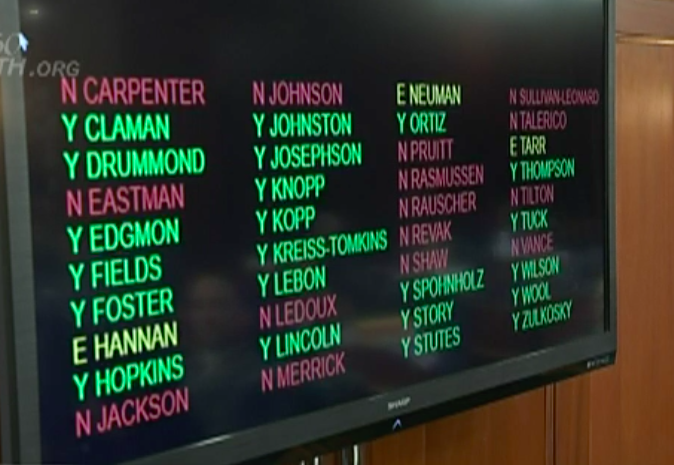
The Alaska House of Representatives, over the objections of the Republican Minority, agreed to a resolution to form up a task force that will look at restructuring the formula for how the Permanent Fund dividend is paid in future years. The vote went along caucus lines, with Rep. Gabrielle LeDoux voting with the minority Republicans.
Although the Democrat-led majority clearly had the votes, its leaders still made passionate arguments for the task force. At one point, Rep. Tammie Wilson, who joined with the Democrats in February, told the Republican minority to get over their “paranoia” and get on board with the task force concept, like she had. “Come on, guys,” she prodded them.
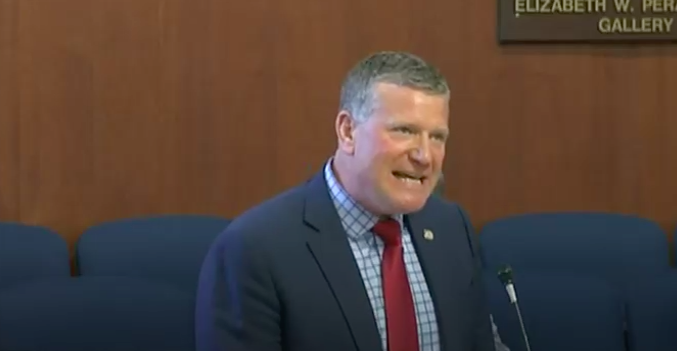
Rules Chair Chuck Kopp let his emotions get the better of him when he upbraided the minority, saying that if there is no change to the Permanent Fund dividend payout formula, there will be no dividend at all by 2025. He called for his fellow lawmakers to lead their constituents. His speech reflected the passionate opinions that the dividend program brings out in Alaskans.
“You don’t follow out of fear of people who are screaming who don’t have accurate information. Mr. Speaker, I’m all about leading, and I will give my constituents the truth and I invite them to not support me if they want to believe something else,” Kopp boomed.
The task force would be controlled through appointments by the House Speaker and Senate President. Minority members argued that giving two people in the entire the Legislature the power to form up a task force for the purpose of recommending a new dividend structure to the Legislature was blatant attempt to predetermine the outcome.
Rep. Laddie Shaw noted that the House already has a task force — it’s called the Finance Committee, and that’s where the work was supposed to be done over the past 145 days that the Legislature has been in session, extended session, and special session.
But there’s likely another reason the House didn’t take up the Permanent Fund dividend bill today, but just voted on a resolution to form a task force to study the dividend.
Those in the Legislature who see the need to trim back the statutory formula are also those who want to be in a position to override the vetoes the governor will certainly make to the operating budget, which passed the House today and will likely pass the Senate on Monday.
The next couple of weeks will be a game of three-dimensional chess between members of the Legislature who want bigger spending and smaller dividends, and a governor who first and foremost is trying to reestablish trust that people have in their government by making good on his promise to restore the PFD.
The House voted on the conference committee State Operating Budget, but the Senate has adjourned for the day and will take up the vote on House Bill 39 on Monday at 11 am; Sen. Tom Begich and Sen. Elvi Gray-Jackson were missing from Juneau today.
After the vote is taken in the Senate, presuming it passes, the operating budget will go to the governor’s desk for his action. In Alaska, once a bill has passed both houses, it is sent to the Legislative Affairs Agency, Legal Services for checking of accuracy, and the bill is then signed by the Senate President, House Speaker and House Chief Clerk.
The governor has 15 days, Sundays excluded, to act on a bill if the Legislature is in session, or 20 days if the Legislature is adjourned. Typically, the governor will have his staff and the Department of Law pore over it and the governor can sign the bill, or veto items through his line-item veto.
If there are vetoes, the bill would go back to the House and Senate, and they may call themselves into special session to override the vetoes.
It takes a combined vote of three-fourths to override an appropriation veto.
The House is now debating issues relating to the Alaska Permanent Fund dividend.
A 19-year-old male and two juveniles, a male and female, are under lock and key in connection with the death of Cynthia Hoffman, age 19, who was executed at Thunderbird Falls in Chugiak last week.
Caleb Leyland, 19, is accused of providing the vehicle for murder suspects Kayden McIntosh, age 16, and Denali Brehmer, age 18.
He is also now accused of sexually assaulting the female suspect, facing charges of Sexual Assault 1 and Sexual Abuse of a Minor 2.
Leyland faces Murder 1 and Conspiracy to Commit Murder 1. The two juvenile suspects were transported to McLaughlin Youth Center. Charges were forwarded to the Department of Juvenile Justice.
Spend an hour over coffee with the A-Team, and you’re going to start seeing things you never saw before in Anchorage: trucks that are stolen, vehicle plates that are switched, “tweakers” delivering packets of drugs, and shoplifters on the prowl, digging receipts out of garbage cans and using them to get refunds.
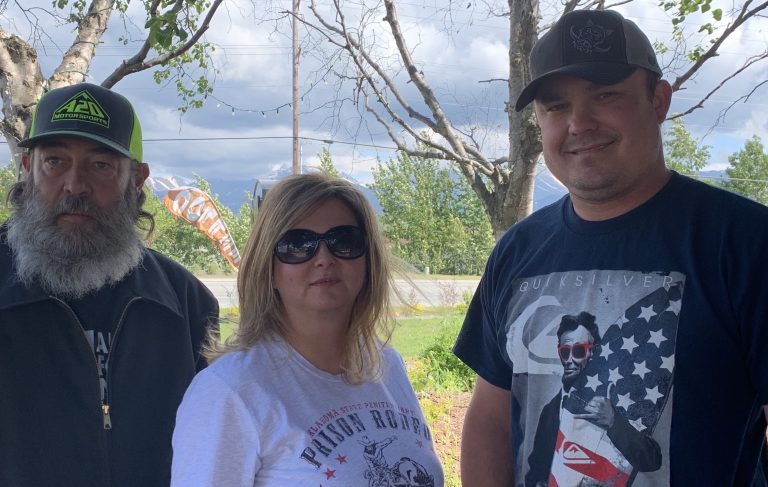
The trio of Floyd Hall, Candis and Chad are the core of the all-volunteer A-Team, and they have a unique knack for finding stolen cars. They can spot hot Chevy truck a block away. They’ve recovered or helped recover more than 500 stolen vehicles for people in Anchorage since 2017.
It all started in that year, when Chad had his “manhood stolen” from him: His truck, trailer, four-wheeler, Zodiac boat, fishing and hunting gear, and even his son’s clothing and his mom’s purse. He went all over town looking for his stuff, and even saw the thieves driving his truck and wearing his son’s signature hat. Police told him to not follow, not get tangled up in recovering his possessions.
Chad’s not like that. He tracked almost all of it down within a two-mile radius.
Floyd, who was already helping a few people find their stolen-and-abandoned cars, helped him get back most of his stuff. Chad and Candis, who are a couple, took a liking to the rough-cut Floyd, who between taking care of his aging parents and snowplowing in the winter, tracks down “cars and trucks gone missing.” The three just clicked.
Must Read Alaska spent the morning with the three on Saturday, digging into just what makes them so good at helping others get their rides back. They’re close, they talk over each other. They finished each other’s sentences.
Floyd is gregarious, a hippie biker at heart. Chad is quiet and “country.” And Candis is the girl next door who can competently figure anything out.
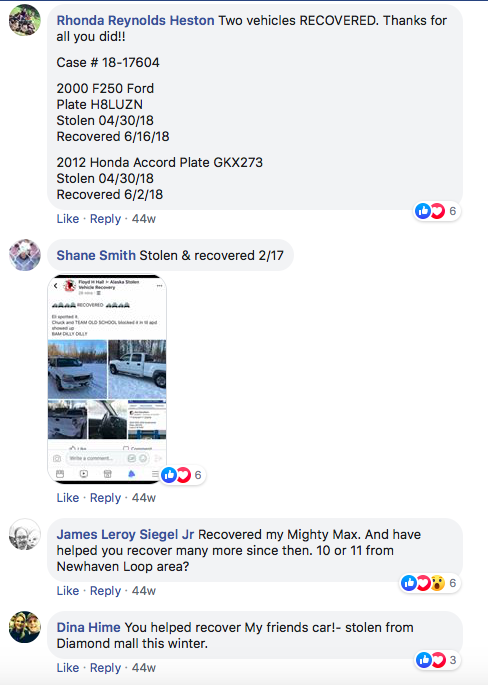
Floyd is notorious with police, who half-respect him and half-despise him, because he doesn’t back down, and because he has a large and loyal fan base on Facebook, where he runs a private group called Alaska Stolen Vehicle Recovery. Dozens of people have posted accounts there about how he has helped them find their vehicles:
Floyd will be in court again on July 13, when the date for his trial for reckless endangerment will be set. It’s a moving violation, but he’s been singled out by law enforcement and an aggressive prosecutor because, it appears, they want to stop what they see as vigilantism.
Back in 2017, Hall was offered a 30-day sentence with 30 days suspended, and a fine. When he arrived at court, there were fans to greet him, wearing “Let Floyd Go!” T-shirts. Ultimately, he’s turned down the plea agreement.
To the A-Team, they’re not vigilantes. They just see things that others don’t, and they care enough to follow up. They want to help people because they know that someone’s stolen car is probably their only means to get to work, or pick up their kids at daycare, or just live their lives in peace.
Too often, when the A-Team does recover cars, they are littered with spent hypodermic needles.
If you ask this band of do-gooders, something has gone very wrong in Anchorage, and they want to be part of the solution. It wasn’t like this 10 years ago, Chad said, but he’s been locking his doors for the past two years, since Senate Bill 91 went into effect.
The righteousness of their case is why Floyd is asking for a jury trial — and because he thinks the people of Anchorage are on his side. And he is being bullied by the justice system.
The moving violation got Floyd in trouble happened in 2017, when he was following a stolen car. The occupant of that car got out and shot at him. Police ticketed Floyd for what they said was a high-speed chase based on a witness statement. He disputes that. The shooter, meanwhile, has never been identified.
While sitting with the A-Team on Saturday, they spotted a truck that the three agreed was probably stolen; it was being driven like they stole it, and it had “that look.” They identified a drug deal going down just 20 yards away. Later on Saturday, Floyd filmed a car being taken apart on Academy Drive near Brayton Drive, in broad daylight, “by tweakers,” the colloquial name used for addicts. It was close to the place where, in 2017, the bad guys shot at his tires — next to a park.
This time, he just went live on Facebook and broadcast the car’s condition to the world while he narrated and read aloud the license plate.
And then he kept on rolling by, honoring what the judge told him he cannot do: Have contact thieves. That means he can’t stop to inquire about what other citizens can stop to inquire about.
Chevy Tahoe being stripped of parts on Academy Drive on Saturday.
HOW THEY DO IT
The A-Team has a gift. For one thing, they all know their cars, and they have the uncanny ability to retain information about those cars in their heads as they are out and about in Anchorage. They keep a mental tally about what cars have been reported stolen. And they and others work on Facebook to identify stolen vehicles. There are various groups that specialize in reporting stolen vehicles and other items. One group even has a member who posts spreadsheets with information about recent stolen cars. There’s definitely a wider Facebook community that the A-Team taps into.
They also follow police reports and know the names and nicknames of some of the more notorious criminals: Shane Muse, Lei Lei Robb, Tuna, Fatboy Fishman, Jason Robards, and others. Sometimes they get tips.
“People need to feel safe speaking out,” Candis said. Sometimes citizens don’t want to “rat out” someone to the police because the car thief is in the same apartment building, and they’re afraid of repercussions. Some people just feel safer with the A-Team.
Candis said that since license plates are often switched by the bands of thieves, she’s always keen to know other identifiers — dents, broken tail lights, or tinted windows — things that she can look for when she’s running errands. She and Chad own a couple of businesses, and they like to keep a low profile; when they spot stolen cars, they call them in to police, but they typically keep a safe distance, and leave once police arrive.
Recently, Chad and Candis helped recover a car for an 80-year-old man whose wife has cancer. It was filled with wire and gloves, and the two warned the man not to dig through the car, because it might have needles in it. Have it professionally detailed, they warned. These are things the police don’t think of, Chad said. He’s sick of seeing elderly people victimized and insurance rates going up, but even more so, he doesn’t want an elderly man to get stuck by a druggie’s needle.
“The police thinks we’re blazing guns, but we’re not,” Chad explained. They sense the community is strongly behind them and they try to stay out of the way of police, who have adopted a wary, even hostile attitude toward them.
Candis said that people she encounters are fed up with having to deal with the police, who don’t have the ability to track down stolen vehicles.
“Some people say ‘It’s just a stolen car. It’s not worth your life.’ But these cars are being used to commit other, bigger crimes — robberies, drug deals,” she said. “We recovered another one last week, someone had been gone for the weekend, and someone stole her car and robbed five homes.”
“It’s a weapon used to commit other crimes,” Floyd added.
The A-Team is an avocation for the three, not a money-making venture. Floyd runs heavy equipment in the summer, and Candis and Chad have their businesses. Floyd certainly feels the financial pinch from the legal fees he now has, but also for gas, and the wear and tear of helping others. He’s financially more marginal. People sometimes slip Floyd some cash for helping them get their cars back, and he’s grateful. But Candis and Chad are on more sound financial footing, and don’t take compensation. They see themselves doing what they can to be good citizens, and stay out of trouble with the law for taking an interest in fighting crime alongside Floyd.
The three said that car thievery is down slightly, but not so much as anyone would notice. Some of the more notorious chronic thieves are in jail, they said. But thieves are coming in from Soldotna and Willow, where they can easily hide the stolen vehicles.
For now, Floyd has been ordered by the courts to not follow stolen cars and to not have contact with car thieves. These were the same terms as the plea deal that he refused to take last month, but now it’s a court order, and he takes it seriously. He’ll be at the Boney Courthouse on June 13, with a court-appointed attorney, to fight what is essentially the moving violation ticket that just won’t die. He has to fight it, otherwise he has to hang up his rights to help people get their cars back, and that’s something he’s just not willing to do.