Two attorneys in Anchorage say Gov. Michael Dunleavy was not authorized by the Alaska Constitution to call the Special Session in Wasilla.
They filed a lawsuit in Anchorage Superior Court on Monday. It was assigned to Judge Herman Walker. [Update: Judge Walker has recused himself and it has been assigned to Judge Josie Warton.]
Dunleavy called the Legislature into Special Session starting July 8, and set the location as Wasilla, as allowed by Alaska Statute.
But attorneys Kevin McCoy and Mary Geddes say that because most of the lawmakers didn’t go to Wasilla, the governor’s call is unconstitutional as the Wasilla group does not have a quorum, while the lawmakers who decided to meet in Juneau do have a quorum.
They say the governor has deprived Alaskans of a functioning legislature.
The lawyers, who are a married couple, asked for an expedited hearing. Geddes, a registered Democrat, was a project attorney at Alaska Criminal Justice Commission. McCoy is a retired U.S. magistrate judge and a registered nonpartisan voter.
Their lawsuit appears to rest on the argument that if something is not specifically addressed in the Constitution, then it is unconstitutional.
If the couple wins, then governors in the future will be forced to call Special Sessions in Juneau.
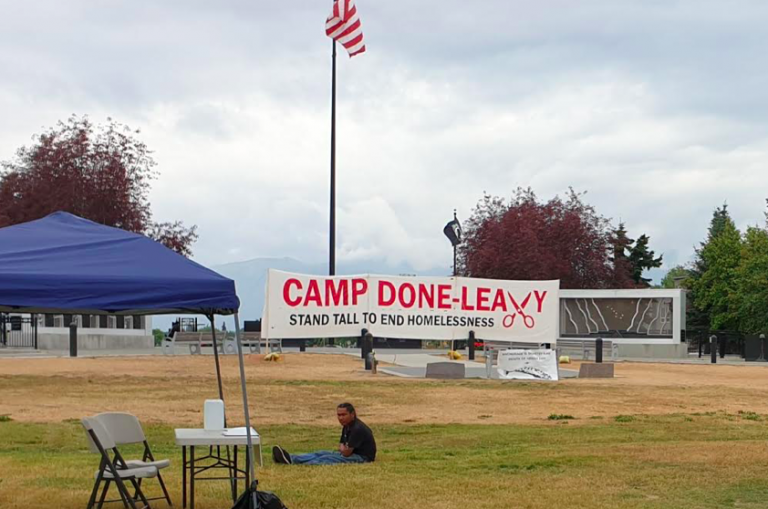
The bedraggled posse of anarchists who have occupied the Delaney Park Strip in Anchorage to drive home their objection to budget cuts?
They’ve decided to stay.
Sources tell Must Read Alaska that the group has never had a permit to camp on the park area, which is used by families, kite fliers, and soccer teams. They had a handshake deal with the municipality and promised to clear out by 4 pm Sunday.
So much for handshake deals with the radical Left. By 5 pm Monday, more tents were showing up, and going up. The organizers have invited the homeless to move in with them. While there were 14 tents on Saturday, there were 24 tents Monday.
A few weeks ago, the House representative for the downtown district, Zack Fields, penned a letter to Mayor Ethan Berkowitz telling him to clean up the homeless problem because it was causing a dangerous situation in Anchorage.
Fields convinced several legislators to sign his letter, which suggested that the homeless could move to the Chugach National Forest, where there’s plenty of room.
Since then, they’ve moved into the most visible park in Fields’ district, and show no signs of leaving.
Locals who live along the park strip say that noise continues night and day as partying and drumming disrupts the liberal-mellow neighborhood vibe.
The protesters have also been sleeping on the Veterans Memorial, to the irritation of some veterans.
Police are now trying to figure out how to evict the protesters, most of whom have new-looking tents and equipment and who are there under an expensive banner that set them back several hundred dollars.
Meanwhile, this afternoon a lawn bowling league tried to find a place to play alongside the growing tent city, which is now an eyesore, and a political problem for Mayor Ethan Berkowitz.
The House Finance Committee took House Bill 2001, which was written by the Rules Committee specifically to pay $1,600 Permanent Fund dividends to Alaskans…
"An Act making a special appropriation from the earnings reserve
     account for the payment of permanent fund dividends; and
     providing for an effective date."
…and the committee hoisted a substitute amendment that stuffed $444 million in spending into it, every cent of spending that Gov. Michael Dunleavy had vetoed out of the operating budget for the fiscal year that began July 1.
The dividend amount remaining would be about $929 per eligible Alaskan.
All in a day’s work.
A problem exists for the House and Senate Majorities, both of which are operating as bipartisan coalitions: Even the Legislature’s own attorney is hinting that the stuffing of the unrelated spending into the Permanent Fund appropriation is “outside the call” of the Special Session.
Because the session was called by the governor, he sets the agenda, just as he sets the location.
If the Legislature wants to restore those cuts, they need to call themselves into Special Session. They don’t have the votes to do that.
But the stuffing of the spending today served a purpose. Should it ever get to the floor of the House, and should the Juneau Special Session be deemed legal by the courts, such a spending spree only requires a simple majority vote, rather than the three-quarters vote needed to access the Constitutional Budget Reserve. The majorities have that vote, it appears.
Perhaps that is why the Board of Regents of the University of Alaska system took no action today to start the reorganization of the universities. They are hoping for one last miracle to restore higher education’s $130 million veto.
The governor would likely veto this spending a second time, and the Legislature still doesn’t have the votes to override his vetoes. He might even veto the $929 or $1,600 Permanent Fund dividend and send lawmakers back to the drawing board.
Today’s action was a clear message that spending comes first for the House and Senate Majority, and anything else left over will be used to pay Permanent Fund dividends.
That wasn’t the intent of Senate Bill 26 last year, when the Legislature agreed on a structured draw of the Earnings Reserve Account to pay for state operations. Nor was it the intent of those who created the Permanent Fund dividend program.
Critics of SB 26 predicted that this would be the result of an incomplete SB 26, however. The Legislature could not agree on how to restructure the formula for paying dividends, and punted the problem to this year.
In a Journal of Commerce article by Elwood Brehmer in May, 2018, Sen. Bill Wielechowski warned that “leaving the existing formula in place … means the Legislature will continue to bypass the PFD in law in favor of providing more cash to government agencies.”
“One statute will inevitably be violated and my prediction is it will probably be that statute that provides for a full dividend,” Wielechowski told the Journal. “In fact, that’s what’s happening this year, in this budget [2019 fiscal year]. That’s what’s happened the last two years.”
Also in the report by Brehmer, Rep. David Eastman, R-Wasilla, argued that SB 26 reversed the Legislature’s historic priorities by putting government funding ahead of the dividend and ahead of inflation-proofing the fund. Both Wielechowski and Eastman were prescient, as the first year after SB 26 was passed into law, the Legislature is still arguing over the Permanent Fund Dividend well into the second Special Session.
If we define “the Left” as the anti-establishment or anti-government factions in America, they’ve been singing songs, carrying signs, and sometimes breaking or blowing up things since the Seneca Falls convention in 1849.
America has been constantly beset by various “isms.” In the early days it was simply threat and intimidation followed by violence; police truncheons were met by brass knuckles.
By the late 19th Century, makeshift bombs were popular on the left. The occasional assassination was thrown in. Much of it centered on labor strife; sometimes it was company security versus strikers, sometimes police or National Guard v. strikers.
Usually the company or the government won because they had the guns. By the late 19th Century, the line between labor and communism/socialism was very blurred. The conflict between the government/establishment simmered but never subsided during the Spanish-American War and World War I. It rose to a boil in the 1920s and in the early days of the Great Depression. John Dos Passos’ works give a good view of the times.
To move to a Marxist vocabulary, FDR achieved an Historic Compromise with The New Deal. Most of the New Deal was essentially Marxist and served to placate the Left to some degree; enough to keep them sullen but not mutinous. I could write a couple thousand words on the communist Left and WWII, but I have word limits.
Suffice it to say that the Left largely made common cause with the US during the Great Patriotic War until the defeat of Germany. After that there is a good argument that the Hiroshima bomb was dropped on Tokyo and the Nagasaki bomb was dropped on Moscow. We don’t want to think about what would have happened had the US not been able to end WWII quickly.
This is turning into too much of a History class, so let’s rush through the Fifties and Sixties. The U.S. got really tired of Soviet interference in the U.S. government and its institutions and ran them to ground.
The communists of the Thirties, Forties, and Fifties became the liberals of the Sixties, Seventies, and Eighties. Ronald Reagan, Rush Limbaugh and others so damaged the liberal brand that by the ‘00s they decided to return to their old brand: Progressives. They thought they had damaged US education enough that nobody would remember that Progressive was just a term for a communist whose position wouldn’t allow them to be a party member.
The Civil Rights movement and the anti-war movement built modern leftism. Those of you old enough to have had any history in school remember the notions of the Old Left and the New Left.
The Old Left was the left of Stalin and the Comintern. The New Left was the world of the Trotskyites and ultimately Saul Alinsky. The Old Left believed in statism, in bureaucratic communism; that was the Soviet model. The New Left, the Trotskyites believed in the continuous revolution; there’s a reason Stalin had an ice axe put in Trotsky’s head.
Most of the U.S. Left adopted the Trotsky view and its primary apostle Saul Alinsky. I was still in the throes of a college education, so I read “Rules for Radicals” when it first came out in 1971. Ten or fifteen semesters of Life 101 got me over most of that and I consigned Alinsky to the dustbin of history.
I became reacquainted with Trotsky in the late 1980s when the American Federation of State, County, and Municipal Employees – AFL-CIO came to Alaska.
I dealt with our supervisors being mau-maued, our buildings being occupied and picketed. We dealt with it pretty well here in Alaska even with a Democrat Administration. I watched the attack on Scott Walker in Wisconsin as they mobbed the Wisconsin capitol.
Sane people believe public facilities are public. The problem is that the “public” shouldn’t include violent criminals.
So, here’s the problem for sane people: Should you give them their Saul Alinsky moment? People I like and trust are saying that the legislators out it Wasilla should have had the protestors hauled out in handcuffs. Why would you give them that opportunity?
Art Chance is a retired Director of Labor Relations for the State of Alaska, formerly of Juneau and now living in Anchorage. He is the author of the book, “Red on Blue, Establishing a Republican Governance,” available at Amazon.
The MRAK
Almanac is your place for political, cultural, and civic events, events where
you’ll meet political leaders or, if you are interested in getting to know your
state, these are great places to meet conservative- and moderate-leaning
Alaskans.
Alaska Fact Book:
Question: How much coastline does Alaska have?
Answer: One of Alaska’s most impressive geographic features is its immense coastline. Our state has 6,640 miles of coastline, over half of all of the coastline in the United States, and more than the entire coastline of the contiguous states (the Lower 48). The next time you meet someone from Rhode Island, you might remind them that their “Ocean State” motto really belongs to Alaska.
7/15:House Finance will meet in the Anchorage Legislative Information Office starting at 11 am, with public testimony beginning at 2 pm and ending at 7 pm. They will be meeting every day of this week and may physically be in a LIO near you (Fairbanks and Wasilla are on the schedule), so be sure to read their full schedule here.
7/15: Official premiere of Molly of Denali on PBS and PBS Kids. The American-Canadian animated series is the first children’s show broadcasted nationwide with an Alaska Native as the lead character. What’s more, these kids know how to solve conflict. Read more about this milestone here.
7/15:Girdwood Board of Supervisors will meet in Girdwood at 7 pm. Read more here.
7/15: Want to serve your community? Filing opens for elected offices in the Fairbanks North Star Borough (assembly and school board). Read more about how to run for office at this link.
7/15: Deadline to apply for the vacant seat (Seat C) on the Fairbanks North Star Borough Assembly. Application must be turned in at the borough offices no later than 5 pm. Read more here.
7/15: The Homer Public Library will hold a virtual guided recreation of the Apollo 11 mission, presented by the American Museum of Natural History. Great for kids and adults alike. Starts at noon. Further details here.
7/15: Do you live in House District 33? Rep. Sara Hannan will hold a town hall at 5 pm in the Douglas Public Library. A good chance for constituents to share their comments or concerns with one of their legislators.
7/15: Regular meeting of the Alaska Public Broadcasting Commission at noon via teleconference. The main purpose of the meeting is to discuss the plan moving forward in response to Gov. Dunleavy’s recent line-item vetoes of the FY2020 budget. There will be a chance for public participation. Read more about the meetinghere.
7/15: The University of Alaska Board of Regents will hold a special meeting in Fairbanks at 1 pm. The purpose of this meeting is to consider the possible declaration of financial exigency for the university system and to make necessary plans to accommodate UA’s recent budget reduction of $135 million. The meeting will be live streamed at this link.
7/15: The North Pole City Council will hold a regular meeting at 7 pm in the council chambers on Snowman Lane. There will be an opportunity for public testimony. Read the full agenda here.
7/15: 5 pm is the deadline for entry into Fairbanks’ Golden Days Parade which will take place on Saturday, July 20. If you want to enter a float or vehicle, visit this link to register.
7/16:Marine Transportation Advisory Board meeting in Anchorage at 10 am. The board will discuss general cost cutting measures and reform of the Alaska Marine Highway System for the coming year. Read the agenda at this link.
7/16: Regular meeting of the Delta Junction City Council at 5 pm. Read the agenda here.
7/16: The U.S. Senate Committee on Energy & Natural Resources (the Chair is Sen. Lisa Murkowski) will hold a business meeting at 10 am in Washington D.C. to discuss proposed legislation, a total of 23 pending bills. Read about them at this link. The meeting will also be live streamed here.
7/16: Do you live in House District 19? Representative Geran Tarr will hold a town hall and BBQ dinner for constituents at 5:30 pm. Read more at the Facebook link here.
7/16: RMG Real Estate Summer Fest at Kincaid Park in Anchorage, starting at 5 pm. Bring the whole family for a night of food, live music, and outdoor fun. Free to attend, learn more at the Facebook page here.
7/16:Lunch on the Lawn outside the Anchorage Museum at 11:30 am. There will be live music, food trucks, and fun for the whole family.
7/16: Regular meeting of the Valdez City Council at 7 pm. The council will be considering the license renewal for marijuana retailer Herbal Outfitters as well as considering changes to the local traffic code. Find the agenda here.
Alaska History Archive:
July 15, 1741—278 years ago: Alexei Chirikov, of the Bering expedition to Alaska, saw land for the first time since leaving mainland Russia a month before. It is likely that the land Chirikov saw was Prince of Wales Island in Alaska’s Southeast region. The day after, the crew saw a towering peak larger than any other they had seen on their journey—it was named Mount Saint Elias soon afterwards.
July 15, 1923—96 years ago: After two unsuccessful swings, President Warren Harding drove the Golden Spike into a stretch of railway north of Nenana. After years of hard work, the 470-mile Alaska Railroad was finally complete.
Just as Juneau’s Bartlett Memorial Hospital offered counseling to locals after the election of Donald Trump in 2016, Alaska Public Mediahas done a story on how Alaskans can deal with the vetoes of 12.5 percent of the proposed Gov. Walker budget (7 percent of the actual spending in 2019).
In an interview with reporter Casey Grove, licensed professional counselor Julie Shewman of Anchorage gave listeners advice on dealing with the stress, frustration, sadness, and anxiety.
“Simply put, the uncertainty over state politics and the cuts is getting to people,” Grove reported on Friday. He offered his interview with Shewman to provide counseling to “thousands of people on the radio all at once.”
Shewman said that a little bit of stress is usually manageable, but if stress gets to be too much, people go into the emotional side of their brains, and then into the fight-or-flight side of their brains, the “reptile” brain, if you will, where things are pretty primitive.
She said all of her colleagues in the therapy community have had an increase of clients with veto-related stress symptoms. Shewman acknowledged the fears and the sense of being threatened are real and said symptoms include irritability, insomnia and a general sense of being unsettled.
The first tactic, she said, is to get off of social media, unbalanced news, and the various memes that are stirring people’s fears. Talk to friends and family instead, and realize that if you are losing your job, you have many options; maybe they weren’t the options you wanted, but there are options nonetheless.
“You have time to make adjustments to these changes,” she advised.
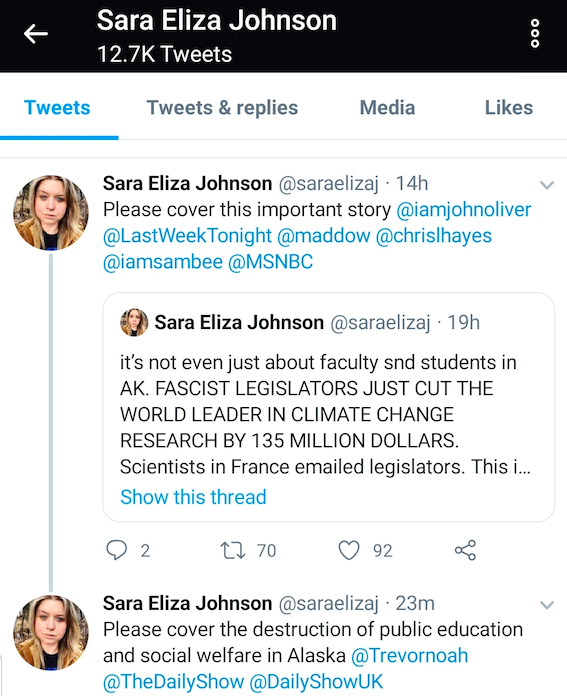
A creative writing professor at the University of Alaska Fairbanks has reached out on social media to the world’s most popular comedians, begging them to report on recent budget cuts to the University of Alaska system.
In numerous posts on Twitter over the course of many days, writing professor Sara Eliza Johnson calls the governor and legislators “fascists” who are anti-education.
Johnson sent her Twitter messages to comedians John Oliver, Samantha Bee, Trevor Noah and the Daily Show’s Jon Stewart, pleading with them to “cover” the downsizing of the university.
Johnson also notified television newscasters Rachel Maddow and Chris Hayes of MSNBC to enlist them in the cause of fighting the budget cuts.
Johnson teaches a variety of creative writing classes, including “Arguing Across Contexts” and her specialty, which is poetry.
“Sara Eliza Johnson’s Bone Map charts a dreamscape that mixes elements of folk tale into mysterious itineraries through the commingled fringes of the world of sacramental animals and a frail humankind,” according to her website.
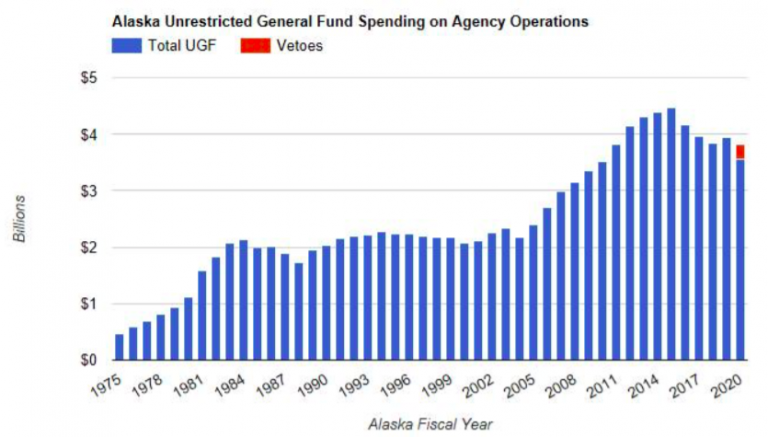
The State of Alaska budget has been cut 12.5 percent from the proposed budget of former Gov. Bill Walker, and approximately 7 percent from the actual spending of the last fiscal year. Programs developed during the oil boom years have been trimmed or eliminated as the state struggles to live within its means. The University of Alaska system budget has been trimmed by 17 percent, which will lead to layoffs in the days ahead as the system is forced to restructure its offerings.
MORE STATE LAND TO BE SOLD OVER THE COUNTER THIS MONTH
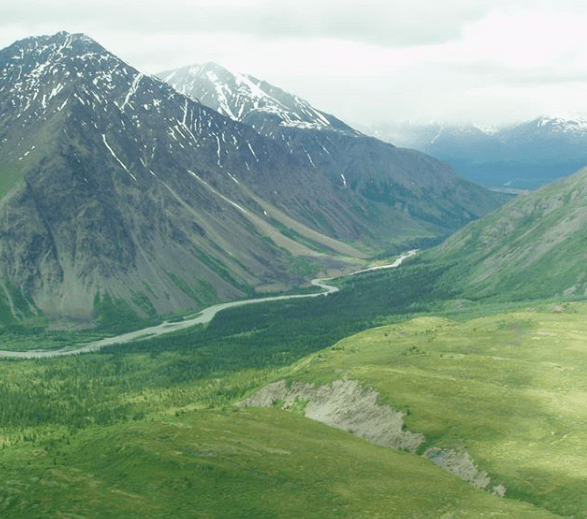
That 5.2-acre parcel near Mount Rich — a little piece of magnificence in that photo above? It went for $16,000 last week during the state’s annual land auction that took place on July 10. Eighty-two Alaskans had winning bids for 832 acres of land in 87 parcels across the state in an Alaskans-only opportunity to buy property at auction.
The bids totaled $2.1 million according to the Department of Natural Resources. And the department was happy with the sale.
“We were excited to see so much interest this year, and happy to be a part of putting Alaska lands into Alaskans’ hands,” said Rachel Longacre, chief of the state land sales section in the Division of Mining, Land & Water. “Many of the bids were above fair market value, which clearly shows Alaskans’ strong desire to become landowners.”
Parcels were sold in Southeast, Southcentral, Southwest and Interior Alaska, with a lot of interest in parcels in two new subdivisions: the Forest Highway in Yakutat, and the Sage Subdivision near McCarthy. Some parcels went for well above the minimum bid amount, while others were only slightly above.
About 130 parcels not sold at the auction will join the list of other parcels available for sale to Alaskans and non-residents in an over-the-counter offering, starting July 24 at 10 a.m.
DNR offers competitive, in-house financing for land purchases for up to 20 years for land sold by auction or over the counter.
And the State of Alaska offers Alaska resident veterans a once-in-a lifetime discount of 25 percent on the purchase of state land.
The web page for each Auction/OTC parcel provides an estimate of the purchase price with the veterans’ discount for that parcel.
Information on the upcoming sales, including a listing of parcels available for purchase, is available at the division’s land sales website, or on pages 119 and 124 of the official state land sales brochure.
Apparently, the tar-and-feather threats are out, for now. Doxing is in with the far Left in Alaska, as they look for ways to harass and punish legislators.
The “Save Our State” movement has some explaining to do:
Last week, those who oppose Gov. Michael Dunleavy and his budget trimming ways turned up the heat, cranked up the volume, and left their good manners at home. They occupied, vilified, and threatened lawmakers who don’t agree with them. For the Left, it was just another day at the office.
In their social media echo chamber, they cursed the governor, called Republicans names, suggested violence, and published the private cell phone numbers of lawmakers whom they consider enemies. The Democratic Socialists of America-Anchorage were effective in getting lawmakers harassed from as far away as New York by people who are clearly not their constituents.
DSA even posted the governor’s private cell phone number and encouraged people to call and harass him and thrifty Republicans who are in favor of rolling back government spending.
The Democrats hung banners on bridges and overpasses — banners that are not suitable for children, and not legal.
Banner in Juneau hanging from the bridge.
Even Rep. Harriet Drummond, a Democrat lawmaker from mid-Anchorage, got into the profane spirit of things, by posting a social media post that shows just how coarse the Left has become:
On the Delaney Park Strip in Anchorage this weekend, there is an “occupation,” taking place.
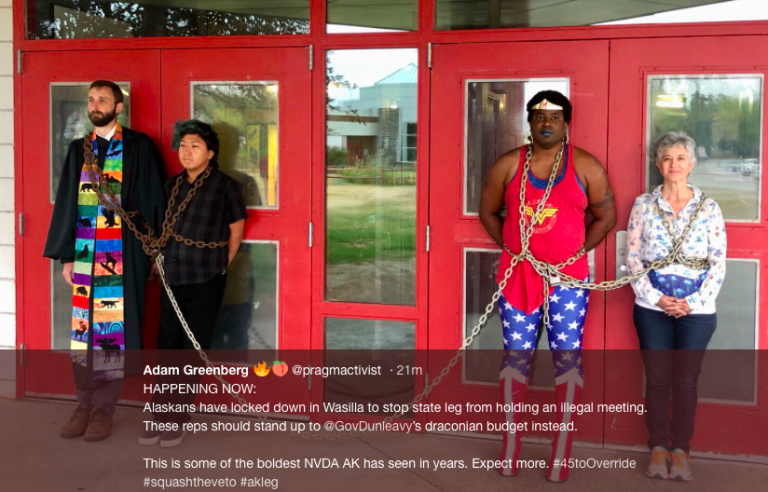
It is the continuation of the occupation that took place in Wasilla earlier in the week, when anarchists took over the lawful gathering of elected officials, sitting in the lawmakers’ seats and screaming throughout the proceedings.
Some of the groups participating also took over a meeting of the Department of Interior in Fairbanks this winter and drowned out the participation of others.
The press release from the Delaney Park Strip “occupiers” came from none other than Kati Ward, who was the political director for the failed Walker/Mallott gubernatorial ticket.
THE RHETORICRATCHETS UP
Nona Dimond, a Juneauite who formerly worked as an aide to Sen. Gary Stevens, posted this graphic, accusing Republicans of being political terrorists:
But have they gone too far?
Chris Dimond, husband of Nona and also a former candidate for House, thinks they have and is trying to tamp down the rhetoric:
“Late last night someone reached out to me for some assistance regarding the doxing of the “22” the governor and his chief of staff. Initially I found it all very funny. After all, these folks seem to have “shut down” in regards to listening to constituents and other Alaskans who are weighing in on the current situation. Hell, they seem to have shut down in regards to doing their jobs, and upholding their oath of office,” Dimond wrote. ” of those things may very well be true.”
“Unfortunately, the doxing that has taken place has only created a bigger mess,” Dimond wrote.
He then went on to describe how talks had been taking place between Republicans who are meeting in Wasilla, lawmakers who are meeting in Juneau, and the governor. And how the doxing had thrown a monkey wrench into those talks.
An example of the Left’s social media prowess.
“The doxing has resulted in further eroding trust and the ability to hold meaningful discussions. Some of the “22” and/or the governor are now blaming the group working in Juneau for releasing that info. This will just further break down the ability for the 3 groups to work to find a solution to the current situation…Unfortunately this doxing has ruined trust, and more importantly it has resulted in threats of violence, physical harm and even death threats (against all 3 groups). This is not productive, it is not how government functions and it is not who any of us are, or should ever be as Alaskans,” Dimond wrote.
Democratic Socialists want you to understand their vision.
“These threats have been extremely unnerving for all. It is resulting in fear, lack of trust, and for some it likely gives them an excuse to walk away from the negotiating table and others it may be creating a victim complex,” he wrote.
What Dimond failed to comprehend is that the Democratic Socialists of America-Anchorage are only temporary friends of the Democrats in Juneau. Their goal is not to override the vetoes, but to create chaos, and in the end, they’ll go after Democrats just like they go after Republicans. The DSA are authoritarian communists at heart.
The DSA folks are not letting this crisis go to waste, and they’re working with the tacit approval of those in power — like Rep. Drummond, who is acting as if she is one of the DSA faithful, and certainly not using her office to call for civility.
Chris Dimond, organizer at Pacific Northwest Regional Council of Carpenters,did use his position of influence. He went on to ask for people to throttle back the rhetoric, and he asked people to be respectful.
“I know our emotions (on both sides) are running at full throttle right now but we have an obligation as citizens to engage with our government in an appropriate manner,” Chris Dimond wrote. We absolutely should be showing up and protesting, writing letters, calling their offices and so forth. We should not be harming, threatening to harm or engaging in any other conduct that leaves our neighbors scared and feeling unsafe. Believe me, I’m fucking angry right now, and the temptation to engage in that manner is strong, but I’ve been reminding myself that I ran for public office last year, and had I won, it would be me and my family being threatened, insulted and attacked. I would not want that, my family would not deserve that.”
No. he would not deserve that. His wife Nona would not deserve that. But the Twitter handle of Devilsmile thinks it’s just the thing.
More social media threats of violence.
“Elected officials need to hear from us. Make it productive tho,” Dimond wrote. “Make it respectful, make it honest and heartfelt. Also, don’t trash legislative staff, they have a job. to do, and families to feed. Some staff may vehemently disagree with their bosses, but are in an unenviable position of having to decide between a paycheck to feed their families and a roof over their heads, or the unemployment line (what YOU would do in that situation is irrelevant as it is not you in that situation…also, PLEASE don’t compare this statement to the nazis statement “I was just doing my job” as this is not the same situation or comparable in any way),” Dimond wrote. He seemed to understand that equating Republicans with Nazis is a bridge too far.
Manners of the Left may be seen in their banners.
“The only threats any legislator or elected official should be receiving is the threat of someone looking to unseat them from their elected position…through the election process,” Dimond wrote.
Then, he proceeded to blame those who have been doxed for creating the problem:
“This part of my thread is for the “22.” Please stop blaming and accusing your coworkers in Juneau for this doxing. I believe you have wildly underestimated what Alaskans truly think and believe. My suspicion on the release of your phone numbers: look to your friends and neighbors, look to your staff and former staff. You are hurting Alaskans, your friends and neighbors, it is most likely those people you personally have a connection with who have released your personal info.”
Dimond didn’t get his memo of caution out in time for his fellow union brother Vince Beltrami, head of the AFL-CIO in Alaska.
Beltrami huffed and puffed to an “energy reporter” at Alaska Public Media’s “Energy Desk” that:
And with that sentence, the head of the AFL-CIO just admitted that this is all about partisan politics, and that he’ll blow the “red” house down with his big blue army of public employee union workers.