Thursday, April 30, 2026
Home Blog Page 1484

AG Kevin Clarkson has emergency surgery

1

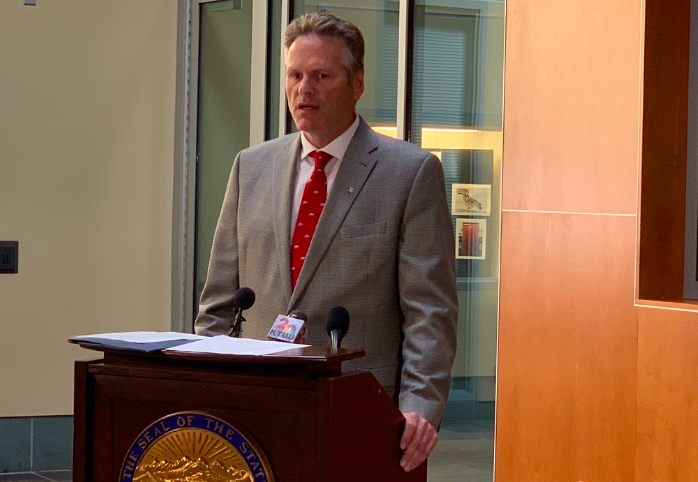
According to the spokeswoman for the Department of Law, Alaska Attorney General Kevin Clarkson is recovering from surgery in Seattle after a heart attack and will be home next week.

“The Attorney General was taken to the hospital after landing in Seattle Friday night. He had emergency surgery and is currently recovering and in good spirits. He appreciates the well wishes and expects to return to Anchorage next week.”

Clarkson was appointed by Gov. Michael Dunleavy in December and confirmed in mid-April by the Alaska Legislature.

[Read: Kevin Clarkson appointed attorney general]

Clarkson wrote on Facebook this morning his account of what happened:

“I’m doing fine. The surgery was almost a non event — very unnoticeable surgery except the wound on my wrist where they went into my arteries. The longest side effect is the sore chest muscles where the paramedics must have really gone to town dancing on my chest to resuscitate me. Thank God they were there. I almost didn’t hit the call button because I didn’t want to make a fuss. But I understood the signs enough to realize I needed to do so. Luckily there was a nurse on the plane to take my blood pressure—her eyes went wide—confirmation I made the right decision—and told the crew to call paramedics to meet us at the gate.

“The paramedics came on the plane and I walked off with them. Sat down and they ran an EKG—they said yeah you’re not going home tonight. They called medics to transport me and then I remember telling them I felt dizzy and I just blacked out. Next thing I remember was waking up on the floor with 5 guys looking down over me and my shirt cut off—I guess the buttons would have been too slow ; )

“Rushed me to the hospital and straight to an angiogram and angioplasty to put two stents in my artery on my heart. My brother is a doctor and lives in Mukeltio near Seattle and the cardiologist called him to come down. They were asking me questions about how old I was and I asked what time is it. They must have thought I was delusional because they just kept asking no sir how old are you? So I finally said well if it’s after midnight then I’m 60 otherwise I’m 59. They all laughed and then they all wished me a happy birthday. What a party.”

It’s a lawyer thing: Justin Schneider’s legal guy used to defend victims

(Editor’s note: This is the kind of story that can make an everyday Alaskan hopping mad. But hold onto your rage and just try to appreciate the irony.)

Everyone deserves counsel.

Even folks like Justin Schneider, the now-notorious Alaskan who prompted House Bill 14 and Senate Bill 12.

[Read: Bill closes the ‘Schneider loopholes]

Those bills are closing a loophole in the law. The gist of it is this: No more choking people until they become unconscious and masturbating on them in Alaska.

[Read: A horrific crime, a woman assaulted, and a perp walks free]

Schneider pleaded guilty to choking and masturbating on a woman in August, 2017. Under Alaska law, masturbating on someone is not now considered a sex crime. Schneider’s plea was for one count of assault in the second degree, a class B felony in Alaska, in exchange for the State’s dismissal of the remaining charges, particularly first-degree kidnapping.

With no criminal history, the sentencing range was zero to two years in jail. The time Schneider served under house arrest was used as credit against his sentence, which meant that he spent only a few weeks in jail, and the rest of the time at home with his folks in Homer, Alaska.

Now, the woman assaulted by Schneider is suing him for civil damages. James Davis with the Northern Justice Project is representing Jane Doe, as the victim is known.

Schneider has lawyered up with attorney Jon Katcher.

Katcher in 2016 received glowing accolades from former Attorney General Jahna Lindemuth, who  presented him the Attorney General’s Award for Pro Bono Service for his years of providing volunteer legal representation to, wait for it, victims of domestic violence.

Over 15 years, Katcher worked on nearly two dozen cases through the Alaska Network on Domestic Violence and Sexual Assault and the Alaska Legal Services Corporation, either personally representing the client or mentoring another attorney through the process.

“….volunteers like Jon Katcher are absolutely vital in combating domestic violence in Alaska. I commend him for his service to our state,” Lindemuth wrote.

Katcher is, since late March, representing the other side of the domestic violence equation, as he and Schneider fight the civil lawsuit filed by the Northern Justice Project, which is looking for financial damages against Schneider, and Jane Doe’s legal fees.

Schneider and his lawyer say that it is Jane Doe who should be paying for Schneider’s legal fees in defending himself.

[Read: The Schneider defense here.]

Such are the strange workings of the legal field. Victims may find it frustrating and observers may find it mystifying, but lawyers can, and often do, represent people whose actions the public finds indefensible.

Every person in a courtroom deserves representation, and if a guy can pay for it, he’ll get someone who has won the equivalent of an Eagle Scout badge from the State Department of Law — for representing victims. Katcher has a lot of goodwill built up in the courtroom in Anchorage. He’s about to spend some of that goodwill on one heck-of-a high profile client.

Spawned out story: The #metoo net unravels

6

By CRAIG MEDRED
CRAIGMEDRED.NEWS

Alaska Gov. Mike Dunleavy is now eyeing his next appointment to the Alaska Board of Fisheries with the dust stirred up around one of his last appointments still far from settled in the wake of a sexual harassment claim.

The Alaska Legislature on April 17 voted down the reappointment to the Board of retired Anchorage Superior Court Judge Karl Johnstone after Anchorage Rep. Ivy Spohnholz lobbed a #metoo bombshell into the proceedings.

Spohnholz said on the floor of a joint session of the House and Senate that “more than two” women who worked for the Board told her that Johnstone sexually harassed them. There was, and has been, no confirmation of those claims.

Johnstone was provided no hearing to defend himself against the accusation before his confirmation was blocked. It is widely believed the sexual harassment accusation was unleashed after Johnstone opponents concluded they didn’t have the votes to block the confirmation of a man who’d run into a firestorm of opposition from commercial fishermen accusing him of being biased in favor of sport fishermen.

Here’s what has happened since in the country’s biggest fishing state where major political battles have regularly erupted around fish:

[Read the rest of this column at CraigMedred.news]

House closes ‘Schneider’ jack-attack loopholes

The House has passed HB 14, a bill that makes certain sex-related crimes more serious. It partially closes the loophole in Alaska law made famous by Justin Schneider.

Schneider is the Anchorage man who strangled to unconsciousness a woman and then ejaculated on her. Schneider walked free because he was given credit for time served for wearing an ankle monitor during his months of legal troubles that resulted from his crime.

Schneider picked up the woman at a gas station in Spenard and offered to give her a ride to her home to Muldoon. Instead, he detoured to a dead end street in the nearby Turnagain neighborhood, where he struck her to the ground, strangled her to unconsciousness, and masturbated onto her. Then he left her to fend for herself and his gooey mess, and drove off.

Schneider spent just a few weeks in jail, but the rest of his “custody” was at his parents’ house in Homer, where he was on house arrest awaiting sentencing.

HB 14, sponsored by Rep. John Lincoln, is similar to SB 12, offered by Sen. Peter Micciche, which is currently under consideration in Senate Finance Committee.

The two bills came in response to the legal loophole allowing serious criminals to walk free without jail time, as Schneider did last September. That case garnered such attention that a local movement was born. For the first time in Alaska history, a judge was removed by voters, even though he was simply following the law passed by the Alaska Legislature to allow ankle monitor time to count toward a sentence.

HB 14 classifies unwanted contact with ejaculate as a sex crime, which means perpetrators can be required to register as sex offenders, and makes strangulation to the point of unconsciousness an assault in the first degree, which carries a sentence of 5 to 20 years. It also makes such strangulation an aggravating factor during sentencing. The bill makes it clear that a “dangerous instrument” can be hands or other body parts used to strangle another person.

Failing to pass the House was Amendment 2, offered by Rep. Lance Pruitt. That amendment stated that a court may not grant credit for time served in a private residence or under electronic monitoring, unless that person has spent time in a treatment program.

Pruitt  argued that with electronic monitoring being used for credit, defense attorneys can run out the clock for their clients by using judicial tricks of the trade, which means people convicted of these serious crimes can still avoid jail time.

But lawyer Rep. Matt Claman argued against that amendment.

The vote for the amendment went along caucus lines, with all members of the Democrat-led majority voting against it except for Rep. Geran Tarr.

Republicans, who are in the House minority, voted for the amendment.

With that amendment defeated the bill passed with all members present voting for it, with the exception of Rep. David Eastman, who said it needed more work because it was creating new, unintended loopholes that could sweep in innocent people.

[Read: Micciche, Lincoln bills filed to close Schneider loophole]

Icebreaker contract awarded; to be delivered in 2024

4

The U.S. Navy and U.S. Coast Guard have announced that Halter Marine of Pascagoula, Miss., was awarded the contract to build the nation’s first new heavy Polar Security Cutter in more than 40 years. The icebreaker is to be delivered by 2024.

Coast Guard Commandant Admiral Karl Schultz called the Alaska delegation to share the news and thank them for their efforts in support of the progress to update the icebreaker fleet.

The initial fixed price contract is $746 million for non-recurring engineering and detail design of the Coast Guard’s lead Polar Security Cutter. This will also allow the purchase of the long lead-time materials for the first icebreaker. The company won options to build two additional Polar Security Cutters, bringing the value of the contract to $1.9 billion.

The Polar Security Cutters are designed to conduct search and rescue, maritime law enforcement, environmental response and national defense patrols missions in the Arctic and Antarctic.

President Donald Trump signed a funding bill passed by Congress which has $675 million for the cutter, which fully funds the first cutter and has $20 million leftover for materials for the second one.

The Alaska delegation issued statements to the media:

“As a longtime advocate for Arctic domain awareness, I am pleased to see the United States Navy and Coast Guard award this new Polar Security Cutter contract. This award is a major step toward finally recapitalizing our aging Polar Security Cutter fleet,” said Congressman Don Young.

“This is an important and significant step towards an operational Polar Security Cutter to help meet our nation’s needs in the Arctic,” said Sen. Lisa Murkowski. “As a member of the Senate Appropriations Committee, I have worked tirelessly to fully fund a polar icebreaker fleet and will continue to support the Coast Guard to make a U.S. polar capable fleet a reality. The U.S. cannot stand on the sidelines as other Arctic and non-Arctic nations continue to expand their icebreaker fleets and with it, their Arctic presence.”

“The United States cannot realize the potential of the Arctic—both for our national security and for the people who live there—without the technology necessary to protect our national interests in the far north,” said Sen. Dan Sullivan. “Today, the Coast Guard has taken another vital step toward securing our country’s place in this strategically-significant region with a contract award for a new polar security cutter.”

The Coast Guard is the sole provider and operator of U.S. polar icebreakers and has just two that are operational — the medium-duty Healy, which is 20 years old, and the Polar Star, which operates in the Antarctic and was commissioned in 1976, later refitted and recommissioned in 2012.

Halter Marine and Glosten Associates of Seattle were the design-build c.mpanies for the Alaska State Ferry MV Kennicott in 1998, which was designed to be able to be transformed into a command center for emergency teams responding to an oil spill.

Halter has since changed hands, bought up in 2002 by Vision Technologies Kinetics Inc., a subsidiary of Singapore Technologies Engineering Ltd.

Sense of the House: Majority cedes moral high ground

HAD A CHANCE TO MAKE WRONG RIGHT, BUT DIDN’T

All heck broke out on the House floor today, after Rep. Ben Carpenter moved a “Sense of the House” vote to condemn the actions of legislators who trashed the reputations of citizen volunteers last week.

But Speaker Bryce Edgmon, leader of the Democrat-led House majority, would not allow the item to be heard or voted on, and attempted to bury it in the Community and Regional Affairs Committee without discussion.

[Read: Spohnholz attacks character of Johnstone — again]

The Sense of the House read:

“That on April 17, 2019, during Joint Legislative Session confirmation proceedings, unsubstantiated accusations made by certain members of the House defamed the personal character of several volunteer nominees on the floor of the House of Representatives. The members’ actions deprived Alaskans of due process and any opportunity to offer a defense of their character and were an abuse of the privilege of legislative immunity. Therefore, these members’ actions are hereby condemned as having undermined the dignity of the Legislature and resulted in a breach of trust with the people of the State of Alaska that must be restored.

Carpenter objected to the paragraph being sent to committee, saying that a Sense of the House is a formal determination of how the entire body feels through a freestanding simple yes or no vote.

Edgmon was having none of it.

“I’m going to allow one more comment on this, so you choose, Mr. Minority Leader,” Edgmon said to Rep. Lance Pruitt.

But no further comments were allowed by Edgmon. After a lengthy at-ease while Carpenter argued his case to Edgmon, House Majority Leader Steve Thompson, a Fairbanks Republican, moved to adjourn.

The Democrat-led majority, with the eight Republicans in it, voted for the abrupt adjournment, leaving the Sense of the House in committee a led by the hardest-left Democrat, Juneau Rep. Sara Hannan.

The House meltdown came over a week after Rep. Ivy Spohnholz accused a citizen volunteer, Karl Johnstone, of sexual harassment. Her claims came from anonymous “more than two women” and were delivered moments before the vote on Johnstone’s confirmation to the Board of Fisheries, denying the retired judge any ability to defend himself.

[Read: What Spohnholz did to me, she can do to anyone]

Rep. Ivy Spohnholz was the subject of the “Sense of the House” for her actions last week against an Alaska citizen. But her colleagues denied the vote from being heard.

Spohnholz is in a strong position to prevail in her behavior because eight Republicans joined the Democrat-led House majority earlier this year and all of them stuck with her today.

In 2017, Spohnholz led a move to censure Republican David Eastman, and it was approved by a vote of 24-14 by the Democrat-led House. The censure motion was a response to comments from Rep. Eastman claiming that some women in rural areas get pregnant so they can get a free trip to an urban center for an abortion and whatever other business they want to take care of. Edgmon allowed that vote to proceed, unlike today, when he would not allow a similar courtesy to the Republican minority.

It’s possible that Carpenter or others in the Republican minority will now move to formally censure Spohnholz, since Carpenter’s effort to get a Sense of the House has been foiled.

That will again put the Republican turncoats on record supporting Rep. Spohnholz, whose actions were so serious that they even elicited a letter from the governor to Johnstone, apologizing about his constitutional rights being violated by Spohnholz and her allies in the Legislature.

[Read: Letter from the governor]

Senate Finance approves $3,000 PFD

COMMITTEE ALSO MOVES TO BEEF UP PERMANENT FUND CORPUS

The Alaska Senate Finance Committee approved amendments boosting this year’s Permanent Fund dividend to about $3,000 and transferring $12 billion from the Permanent Fund’s Earnings Reserve Account into the fund’s constitutionally protected corpus. The Permanent Fund Earning Reserve Account currently has more than $18.6 billion.

“We must take effective action to protect the Permanent Fund,” said Sen. Bert Stedman, who co-chairs of Senate Finance Committee. “Today’s proposals recommend paying the full, statutory dividend amount this year, locking up $12 billion into a vault and throwing the keys away.”

Including a $3,000 dividend in the Senate’s version of the budget creates the possibility for a House and Senate conference committee to negotiate up to the full, statutory dividend amount.  Gov. Michael Dunleavy has said the state must return to the statutorily defined Permanent Fund dividend to avoid the mistakes of the past, which made the dividend a political football.

The Alaska Permanent Fund currently has about $65 billion in assets. The $18.6 billion in the earnings reserve account can be spent by the Legislature with a simple majority vote. The amendment adopted by the Senate Finance Committee today would move $12 billion from the earnings reserve into the corpus, which cannot be accessed without changing the Alaska Constitution.

“This amendment moves $12 billion into the Permanent Fund’s corpus, protecting those funds for future generations,” said Senator Natasha von Imhof, co-chair of the Senate Finance Committee. “It imposes a spending cap on state government and forces the conversation on a sustainable dividend calculation.”

Once the operating budget is moved out of the Senate Finance Committee, it will be considered by the full Senate.

The House has approved a budget that leaves about $1,200 for the Permanent Fund dividend. The differences between the House and Senate budget are worked out in conference committee.

“The Permanent Fund is not for us to squander,” Sen. Stedman added. “Our generation has been very fortunate over our working lifetime with the oil boom. We need to ensure this fund is available for our grandchildren and great grandchildren.”

MRAK Almanac: Miss Amazing, Talkeetna Fly-In

0

April 26, 1899: In Dawson City,  Yukon Territory, a devastating fire broke out when a saloon caught fire in the middle of a strike by the newly established fire brigade. Most major landmarks in the town burned to the ground, including 117 buildings destroyed, and damage was estimated at more than $1 million ($810 million in today’s dollars). 120th anniversary of the fire. Check out the historic sepia photos here.

April 28, 1959: Former President Harry S Truman announced at Columbia University that he had made the decision to drop nuclear weapons on Hiroshima and on Nagasaki, because an invasion would have cost millions of lives. 60th anniversary.

 * * * *

April 27: Healy Community Appreciation Day, hosted by Alaska State Troopers, at the Tri-Valley Community Center

April 27: Miss Amazing Alaska, with co-emcees Charisse Millett and Megan Baldino. A pageant for those with developmental disabilities. Dimond High School. 4:30-9 pm.

April 27: Spring graduation, UAA, Wendy Williamson Auditorium, 10 am.

April 27: White House Correspondents Dinner in Washington, D.C., and guess which U.S. president still isn’t attending? Read this Politico story about how the glitz and glamor is gone from the annual event.

April 28: Fairbanks Concert Association presents Overture to Don Giovanni, Symphony No. 36 “Linz” Mozart Requiem Mass,  C.W. Davis Concert Hall Fairbanks Symphony. 4 pm.

April 30: Emperor Akihito will abdicate his throne after 30 years, becoming the first emperor in Japan’s modern history to see his era end without ever going to war. He succeeded to the Chrysanthemum Throne upon the death of his father Emperor Shōwa on Jan. 7, 1989. According to Japan’s traditional order, he is the 125th member of the world’s oldest reigning dynasty. Crown Prince Naruhito will immediately succeed him and start a new Imperial Era.

May 2: National Day of Prayer. Practice makes perfect.

May 9: Boys Scouts of America honor Urban Rahoi and Cliff Everts for the “Legends and Heroes” Banquet at the Richard Wein Hangar, 3694 Hagberg Drive, opposite Northland Aviation in Fairbanks. Kenny Broker Prime Rib and Pulled Pork. $100. 6 pm Social, 7 pm Dinner.

May 12: Mothers Day. And also drag racing starts at the Alaska Raceway.

May 13: Prince William Sound salmon fisheries open in Copper River and Bering River districts.

May 14: 120th day of Alaska Legislature.

May 15: Last day of Alaska Legislature, per Alaska Constitution Article II, Sec 8

May 16: Elizabeth Pierce, former CEO of Quintillion, is scheduled to be sentenced for wire fraud. Read the story here.

May 17-19: Talkeetna Fly-in, hosted by Commemorative Air Force Alaska Wing (photo above). Details.

Dunleavy apologizes to Fish Board nominee for ‘appalling’ behavior of lawmaker

Gov. Michael Dunleavy on Tuesday sent a letter to retired Superior Court Judge Karl Johnstone, expressing his regret that the Legislature didn’t confirm his nomination to the Alaska Board of Fisheries, and thanking him for having gone through the process.
But then, Dunleavy went further:
“I am dismayed by the way our elected officials behaved during your confirmation,” he wrote.
“Sadly, we watched our elected officials forsake decorum and a fair process. In doing so, they trampled on your Constitutional rights and disenfranchised real victims of serious crimes,” Dunleavy wrote.
The governor was referring to a ruthless power play by Rep. Ivy Spohnholz and Rep. Louise Stutes to block the nomination of the judge, by accusing the judge on the floor of the House of sexual harassment of unknown persons described as “more than two women,” at unknown times, in an unknown place. Even the nature of the alleged harassment is still unknown. The accusation came just as the vote was about to be taken last week in a joint House/Senate session.
Johnstone had no opportunity to defend himself, and Spohnholz has, a week later, not revealed the secret accusers, whom she said wanted to remain anonymous, nor has she responded to reporters’ requests for even the slightest documentation. She has only stated that in the future, such allegations should be done in secret committee meetings.
Or, as some observers called it, Joseph McCarthy style.
“This is a disturbing example where politicians abandoned our sacred values and resorted to theatrics and character assassination,” Dunleavy wrote to Johnstone. “They left you without a voice, due process, the presumption of innocence, or the right to face an accuser and review evidence. It was appalling.”
“I pray that what you have gone through will be used as a wakeup call for our legislators and they will again take up the torch of vigorously defending all Alaskans’ rights,” he wrote.
Johnstone served two full terms on the Fish Board after retiring from the bench. He served as chairman and received a legislative citation that described him as the “Gold Standard” of board service.
But after being waived off the board by the Walker Administration, and then renominated by Gov. Dunleavy, Johnstone ran into heavy artillery fire from the powerful commercial fleet, which sees him as favoring sports fishing interests in Cook Inlet.
Johnstone has vigorously denied the allegations made against him by Spohnholz. In the contentious public hearing and committee process leading up to the floor vote, the commercial fishing community opposed him for policy, and no inference had ever been made that he had behaved inappropriately, until Ivy Spohnholz took the floor and made vague and unsubstantiated allegations.