Thursday, April 30, 2026
Home Blog Page 1483

This job will be competitive

0

Looking for a job? Just when you thought the State was out of money comes a bureaucrat position with a boring title (Financial Registration Examiner) but a sweet salary: $616,200 a month.

Obviously a typo, but an eye-catching one.

We checked the PCN from last year and it appears the actual salary is $23.34 an hour.

The Donnybrook ahead: Education funding for coming school year

Are pink slips ahead for teachers this summer? Maybe.

Gov. Michael Dunleavy has put the House and Senate on notice about education funding: He said the current budgets being worked on by the two bodies are missing education money for the coming fiscal year, which starts July 1. If there’s no money appropriated for education, he won’t be able to release funds to school districts without violating the Alaska Constitution (Article 9, Sec. 7, 13).

The attorney general on April 9 gave the Legislature notice too: His letter said that it’s unconstitutional for one Legislature to bind the hands of the next Legislature.

Therefore, according to Clarkson, what the 2018 Legislature did by saying it would forward fund education for 2020, was an exercise in imaginary budgeting: The money was never appropriated because the revenue had not yet even come into the state coffers.

Yes, in 2018, the Legislature theoretically committed future funds, but they still need to appropriate those funds this year, Clarkson said.

AG Clarkson letter on education

But the Legislature’s Budget Director is advising the House and Senate to ignore the warning. David Teal said that an appropriation has indeed been made in 2018 for the 2020 fiscal year, and so lawmakers can ignore the attorney general and proceed to only appropriate for the 2021 fiscal year, to keep the forward funding going.

Not so fast, say other budget experts. If it was appropriated last year, it would have been counted last year, and it was not. Back to the constitutional question of one Legislature binding the hands of the next.

Will the governor veto the education budget? He cannot, because in his opinion there is no budget to veto. He can’t veto a decision made last year that had no line item with it. And in any case, that budget has flown the coop — Walker signed it last year.

What Dunleavy can do, however, is not release funds to school districts. The more likely scenario is that he calls the Legislature back into special session to deal with the education budget. By that time, the rest of the budget will be on his desk for his potential veto consideration.

Or, they can all end up in court this summer, while pink slips go out across the school districts of Alaska.

One thing seems sure: If this governor believes something is unconstitutional, he’s shown that he’s not the kind of governor to just let it ride.

It’s a $1.2 billion question that is hanging out there unresolved as the House and Senate get close to negotiating final passage of the 2020 budget.

Why are legislators not putting the education money into the budget this year?

Teal has told them they don’t have to. And if they do, it becomes subject to the red pen — which is another thing this governor has also signaled he is ready to wield. Dunleavy has proposed in his budget cutting $300 million from the $1.6 billion education budget of this year.

Either the education money missing from the 2020 budget is a constitutional condition, like Teal is claiming, or it’s not, like the Attorney General is claiming.

But the matter is far from resolved as the Legislature heads into its 105th day, with the drop-dead date — May 15 — fast approaching. And the other date to consider is this one: In Anchorage and much of the state, the first day back for teachers is Aug. 15. In the Mat-Su, teachers return on Aug. 12.

Two perish in Napakiak jail fire

6

TRAGEDY HIGHLIGHTS CHALLENGES OF RURAL PUBLIC SAFETY

A fire allegedly set by an inmate in the Napakiak jail has killed two inmates and injured a guard.

The fire was reported about 1:27 am on Sunday. Two guards were able to escape the building, but one was injured attempting to free the inmates. The guard was airlifted for treatment of injuries that were described as serious.

The blaze spread when one inmate lit a mattress on fire and the entire building was engulfed. The bodies of both inmates have been sent to State Medical Examiner’s office and investigators were enroute to the community on Sunday.

It took Troopers 12 hours to get to Napakiak because they didn’t have an aircraft available and could not find a charter with a pilot who had not exceeded his FAA flight time.

The two who died were non-violent offenders who were locked up for some type of alcohol-related incident, likely a DUI situation, Must Read Alaska has learned.

The jail in Napakiak is operated by the village, not the State of Alaska, and is staffed by persons hired by the village. There was likely not an adequate search done on at least one of the men, who probably brought a lighter with him into the cell. In some villages, inmates are routinely allowed to go outside periodically to smoke cigarettes; thus, the possibility of an inmate having snuck a lighter back into the cell has been raised as a source for concern.

2 pm update: Alaska State Troopers identified the prisoner victims as Becca White, 24, and Isaiah Parka, 22. Both were Napakiak residents.

The tragedy highlights some of the challenges for public safety in rural Alaska, where in villages like Napakiak, most people are related to each other in some way and the village does the best it can to create a safe community with the resources and talent it has. Village public officers and tribal officers in Alaska’s small rural communities typically do not have the same training as village public safety officers (VPSOs), who receive training at the Alaska State Troopers Academy. But they also value autonomy and sovereignty.

Napakiak, population 367, is on a sandbar on the north bank of the Kuskokwim River,  about 15 miles southwest of Bethel, and about 407 miles west of Anchorage. A dry village, it is populated predominantly by Yup’iks and had first apparent contact with the western world in 1878.

A BIA school began operating in 1939, and by 1946 a Native-owned village cooperative store was opened. The community post office was established in 1951, and the airstrip was completed by 1973.

Film performed entirely in Haida, a language with 14 speakers

0

Edge of the Knife is a Northwest Coast Haida historical drama performed entirely in the Haida language, with English subtitles.

Haida is thought to have fewer than 14 living fluent speakers, and filmmakers Gwaai Edenshaw and Helen Haig-Brown utilized a dialect coach for this film.

The Haida populated the coast as far north as Prince of Wales Island and at the time of European arrival, there were more than 15,000 speakers of the Haida language. The Haida people are more spread out now, but still have a strong presence in their homeland that spans two nations.

The Canadian film takes its inspiration from the Haida story of Gaagiixiid/Gaagiid wildman, a tale of a man who is racked by the guilt of having caused the death of his nephew.  Watch the trailer for the film here:


University warning of data breach over a year later

7

SOMEONE HACKED THE EMAIL SYSTEM

The University of Alaska is notifying potentially affected students and others after an investigation into a data privacy incident revealed unauthorized access to some UA email accounts.

The breach took place over a year ago, but it wasn’t until Friday at 11 pm that the university made public the breach through third-party news release services such as PRWire.com.

The press release does not indicate how many people are believed to be impacted. The university has no notification on its own website about the breach.

[Read the entire Friday night press statement]

The university says it is notifying individuals whose records were or may have been in the email accounts at the time of the hack attack and is providing credit resources that can be used to help protect against misuse of information.

The problem dates to February 2018, when the university officials began receiving reports from people having problems accessing their university email accounts.

The university took steps to disable unauthorized access and started an investigation. The school worked with a third-party expert to determine the impact of the breach.

That investigation determined that certain users UAOnline account passwords were changed by an unauthorized third party. UA notified all of those whose accounts were affected and upgraded security protocols for password changes.

The information that may have been present in the affected email accounts varies by individual.

That information may include an individual’s name, government issued identification number, date of birth, digital signature, driver’s license number, usernames and/or passwords, financial account numbers, health and/or health insurance information, passport number, and UA student identification number. For certain individuals, Social Security number may also have been present in the affected email accounts.

UA is notifying potentially affected individuals of this incident, providing them with access to credit monitoring, and providing information and access to resources they may use to better protect against potential misuse of personal information, should they feel it appropriate to do so.

To assist individuals who may have further questions about this incident, UA established a toll-free hotline: 866-783-5580, operational weekdays, 5 am – 6 pm. Additional information may also be found at https://www.alaska.edu/news/it/dataincident.php.  The University will not contact people by phone to request any personal information.

Things you can send through the TSA checkpoint: Moose poop

1

TSA has made it official: You may not be able to bring that bottle of water or 16-ounce macchiato through the TSA checkpoints, but moose nuggets are good to go, so to speak. So says the media team for TSA, which had this to say about that on Instagram:

Mondays can really stink. After a weekend of relaxation, the first day back at work can be hard to deal with. Here’s a nugget of wisdom to help get you through the day: “Monday is the day where the slate from the previous week is wiped clean; It is a day of new beginnings.” ⠀⠀⠀⠀⠀⠀⠀⠀⠀
⠀⠀⠀⠀⠀⠀⠀⠀⠀
Our team at Juneau International Airport (JNU) recently dealt with “nuggets” of a different variety when examining a passenger’s carry-on bag. Upon inspection, a large organic mass turned out to be a bag of moose nuggets (or feces, droppings, excrements, etc.) that the passenger was taking home from their Alaskan adventure. ⠀⠀⠀⠀⠀⠀⠀⠀⠀
⠀⠀⠀⠀⠀⠀⠀⠀⠀
While TSA has no policies that would prevent you from traveling with a bag of animal poo, we would strongly suggest that you check with your airline on their policies. Several carriers do have rules in place to avoid smelly situations aboard their planes. Besides, having to leave your souvenirs behind would really stink. ⠀⠀⠀⠀⠀⠀⠀⠀⠀
⠀⠀⠀⠀⠀⠀⠀⠀⠀
#travel #traveling #traveltips#aviationlife #Juneau #Alaska#OnlyInAlaska


The Left’s big lie, and a complicit media

THE ANCHORAGE DAILY PLANET

If you tell a lie big enough and keep repeating it, people will eventually come to believe it.” – Joseph Goebbels

Joe Biden finally launched his 2020 presidential campaign the other day, basing it on a bald-face lie.

The lie, promulgated and spread by the Left and its complicit pals in the media, took flight after a white nationalist in 2017 plowed his car into a Charlottesville, Va., crowd, killing one and injuring several others. Trump’s reaction was labeled as “racist,” with him supposedly saying there were “good white nationalists and bad white nationalists” or “good neo-Nazis and bad neo-Nazis” at the rally.

That oft-repeated lie – Biden even spread it in his announcement to run – has been a cornerstone of the Left’s unending drive to smear Trump.

What Trump did say in a news conference three days after Charlottesville was that there were “very fine people” on “both sides” of the issue of whether it is appropriate to display Confederate monuments in pubic locations.

[Read the rest of this opinion at Anchorage Daily Planet]

MRAK Almanac: Of halibut and Whole Foods, blessing of the fleet

0

Photo: The halibut schooner “Sitka” in front of the Juneau Cold Storage in May of 1959. Alaska State Library item ASL-MS10-4-06-007-542

The commercial halibut fleet is on the grounds enjoying good spring conditions. The International Pacific Halibut Commission set the Northern Pacific and Bering Sea catch for 2019 at a whopping 29.4 million pounds. Alaska’s share will be just under 20 million pounds this year — three million pounds higher than last year.

Read about how Whole Foods (owned by Amazon) is the price-setting leader for halibut in the Northwest in this story at the Seattle Times.

 * * * * 

April 29, 1958: The very last Territorial Primary Election was held, a “lost” election because it was actually annulled by the first state primary in August that year.

April 30, 1913: The Alaska Pioneers’ Home bill was approved by Gov. Walter Eli Clark. Clark had been appointed governor of the District of Alaska by President William Howard Taft on May 18, 1909, as Taft considered him to be an expert of sorts on Alaska. Clark had prospected for gold near Nome during the gold rush of 1899-1900, and had traveled in Alaska in 1903 and 1906. He was the first occupant of the current Governor’s House on Calhoun Ave. in Juneau. The Sitka Pioneer Home was opened in September 1913 on a $10,000 budget.

May, 1899: Rumors of a new gold find near Nome led thousands of stampeders to abandon Dawson City, Yukon and head west-northwest, where people were said to be picking gold up off the beach. It’s the 120th anniversary of that wild summer. By the end of 1899, more than 3,000 prospectors were working the Nome beaches, and by the next year Nome had 20,000 men digging in the golden sands.

* * * *

April 26: Number of climbers on Mount Denali: 8. Number of completed climbs: 2. Number of summits: 0. Registered climbers for the season: 866.

April 27: That was a 4.0 earthquake on Saturday at 4:58 pm Saturday, 11 miles NW of JBER. Or, as they say in our part of the country, an aftershock.

April 27: Anchorage saw the warmest day so far this year on Saturday, hitting 56 degrees at the airport.

May 1: Alaska Space Grant Lecture. Leroy Chao, NASA astronaut, speaks on the topic of “View from the on-high: Adventures of a professional astronaut.” Experience spaceflight from the on-high of the Space Shuttle and the International Space Station. See breathtaking, awe-inspiring and provocative photos of the Earth from space and hear first-hand accounts from Leroy Chiao about his four space missions. Get the behind-the-scenes tour from the commander of Expedition X, and his view on where we are heading. Stunning photographs and personal stories make this an unforgettable experience. 201 Reichardt Building, 1930 Yukon Drive, Fairbanks, AK, 6:30 pm.

May 2: National Day of Prayer. In Soldotna, prayer warriors will meet at noon at the WKFL Park, next to the borough building.

May 3: Eaglexit, the group wanting to move Eagle River into its own municipality, meets at the Eagle River Lions Club, 18344 Eagle River Road. Educational meeting. 7 pm.

May 3 – 18: Juneau Jazz and Classics, a 16‑day festival in Alaska’s Capital City. Events include cruises, concerts, free events and workshops. Various venues, from bars to churches to auditoriums. Mostly free.

May 4: UAF Commencement. Also, UAS Ketchikan Campus commencement with 16 graduates.

May 4: Juneau Maritime festival. Blessing of the fleet. Details.

May 5: Cinco de Mayo, with enough guacamole to celebrate Mexican army’s 1862 victory over France at the Battle of Puebla in the Franco-Mexican War. According to the Pew Research Center, 7 percent of Alaskans are of hispanic origins, or 49,000 in all. Some 51 percent of those are of Mexican origin, and thers trace their roots back to other predominantly Hispanic nations. It’s all fairly inexact, but still, pass the picante.

That time when Ivy Spohnholz lectured on taking ‘responsibility’

28

HER FLOOR SPEECH CONDEMNING DAVID EASTMAN IS ONE FOR THE AGES

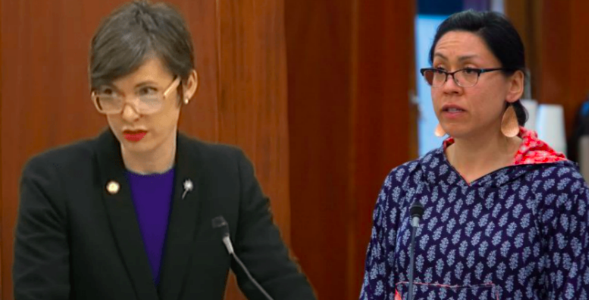
In light of House Speaker Bryce Edgmon refusing to allow a “Sense of the House” vote to be taken on the behavior of Rep. Ivy Spohnholz, who accused a 78-year-old retired judge of sexual harassment, Must Read Alaska reviewed the historic lecture Spohnholz gave on the House floor on May 10, 2017, as she moved to censure Rep. David Eastman.

“When one member of this body brings the dignity of this institution into question, it’s incumbent upon all of us to act to defend it,” she started. She was speaking of Eastman’s remarks made to the media regarding abortion in Alaska and how he felt it was misused.

“The representative from the northwestern part of the Mat-Su calls in to question the character of women from rural Alaska, and offended the dignity of all women,” she spoke, as the 39 other members quietly listened. She quoted Eastman as saying that women from rural Alaska were using pregnancies to get government-paid trips to the city for abortion.

“When asked for evidence, he provided none,” she said. “He’s continued to refuse to show remorse for these damaging and hurtful words.”

“As humans we all have failings, none of us are perfect…but a leader takes responsibility and ownership for those mistakes. They acknowledge the impact that they’ve had on somebody else’s life. Their feelings. Their thoughts. They own them and then they make amends. How is it that you make amends? You don’t say, “I’m really sorry that that made you feel bad.” That is not making amends. Making amends needs to go a little bit further. You don’t say “you’re welcome to come to my office and share your concerns and your perspective with me. That is not making amends.

“When you make amends you are internalizing the hurt that you inflicted on someone else. You have to go to the people that you’ve hurt, and you have to try to understand their perspective—and make it right. It means to mend, to put things back together again…that is what adults do. And as elected officials we have an even higher standard to meet. We’re supposed to be exemplars in our community.

“We are leaders. We are not the bare minimum. We are supposed to be rising above and setting an example for our colleagues and our constituents all across the state. …We are elected officials. We are leaders in our state. It is time to act like that and to call out bad behavior for what it is, and it is unacceptable…

“If you can get a majority of people to feel strongly enough about it that they think I deserve censure, then you should call me out on that behavior.”

[Watch Rep. Spohnholz speech in its entirety here.]

On April 17, Spohnholz rose in a joint session of the House and Senate and accused retired Superior Court judge Karl Johnstone of sexual harassment, charges she said she received from “more than two women.” She has since told the media it was “two women” but her floor speech was enough to sink Johnstone’s confirmation to the Board of Fisheries moments later, when the vote was taken.

[Read: Gov. Dunleavy apologizes to Johnstone for “appalling” behavior of lawmaker]