It may be unusual for legislators to start petitions on Change.org.
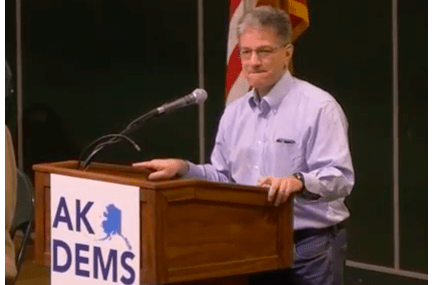
But Rep. Sara Rasmussen of District 22 said she wanted to find a way to reach the leadership of the House and Senate with a big message encouraging them to release the Alaska Permanent Fund dividend early this year. Asking constituents to write letters wasn’t impactful enough.
Rasmussen settled on a Change.org petition. Since launching her petition two days ago, she’s gotten over 2,000 signatures on it. It’s not too late, she said, to get the Legislature to change course, since it is technically in recess.
“Tens of thousands of Alaskans have been laid off or unable to work as a result of the COVID-19 pandemic. An idea with broad bipartisan support to pay the Permanent Fund Dividend early has been introduced by the Alaska Economic Stabilization Team and data shows an early partial dividend pay out in May/June – September/October would supplement any stimulus measures taken by the Federal Government. Alaskans need cash NOW to address some of the job losses, business struggles and failures, and overall hardship,” Rasmussen wrote.
“There is still time for the Alaska Legislature to get cash to Alaskans in a stabilizing way and they need to hear from Alaskans that this is a priority. This petition will be delivered to the legislative leadership in the Alaska State House and the Alaska State Senate. Sign today to show your support!”
SCORES OF ALASKANS SAY THEIR HEALTH IS BEING COMPROMISED
Must Read Alaska reached out to readers last week to hear from them about the urgent and non-urgent medical needs they have, ones that are not being met due to the mandated limits on non-emergency procedures and surgeries, and the confusion and refusal-of-service they have experienced.
It wasn’t the plastic surgery postponements that caught this writer’s attention. It was messages from doctors who are involved in the detection and treatment of breast cancer.
In any given month, 45-90 women in Alaska are diagnosed with breast cancer, doctors told MRAK under condition of anonymity. None wants the state Department of Health and Social Services to mess with their licenses.
Yet, in the past 30 days, only five women have been diagnosed by one clinic that routinely diagnoses 50 a month — a 90 percent drop in breast cancer detection.
It’s for myriad reasons, the doctors tell MRAK: Some primary care doctors have gone strictly to telemedicine, or patients are afraid to go to the doctor, or they are not sure that breast exams are urgent.
Maybe it’s something that can wait a few months, women think. It’s not a pleasant procedure, so it’s an easy one to brush off.
Or it’s because they are over 50, and there are no mammograms allowed for those over 50 during Health Mandate #5.
That means there are 85 women in Alaska walking around right now with undetected breast cancer — cancer that should have been diagnosed in the past month, but wasn’t.
Here are just a few of the situations readers described to MRAK about their personal medical conditions:
“The virus has all the surgery places messed up, for sure. Took an extra week to get a necessary port put in.”
“I know someone that also had to wait at least a week, and it delayed the start of treatment for a severe leukemia. They should have gone out of state for treatment, but because of all of this they had to stay and hope for the best here.”
“My husband needs medical attention like some diagnostic help with joints, and my sister-in-law is unable to find a doctor to get her heart meds refilled.”
“The day I was to have cataract surgery, I was contacted by the eye center and told they were shut down by Berkowitz. They tried to get it reversed, but it fell on deaf ears. This is a eye center, and their clients do not have elective surgery. We need them. Everyone working there was very upset including the staff and docs. They were told in would likely be July before they would be able to open agin. My eyesight is weekly getting worse and worse, it’s affecting my daily life. But if I want to buy booze, vape or get home supplies, those are all open for business.
“Like needing surgery was set to have and then canceled but in extreme pain.”
“Like dental surgery getting cancelled leaving me for a month with broken molars, live exposed nerves and having to have a liquid diet just to eat?”
“I have a friend who has stage 2 prostate cancer and ANMC canceled his surgery. Does that count?”
“Had my routine colonoscopy screening canceled till June 15. How many will die because of missed routine screenings?”
“My surgery center put staff on 1/2 time because there was nothing for them to do.”
“I have MS destroying my nerves and cannot get treatment. Additionally, I have been referred for a hysterectomy and it could be cancer. Having beat cancer once, it’s rather horrifying to not be able to get the care I need.”
“So, I had surgery planned for May 6 for a softball size uterine fybroid. It’s been cancelled and no reschedule date given. This fybroid has caused me to be extremely anemic to the point of almost needing a blood transfusion. I’m constantly in pain, I bleed heavily for weeks. I’ve changed my diet and am taking meds, but this still affects my daily life. I’ve had to leave work due to being in such pain that I can’t work and am in tears. Because I’m taking meds and have changed my diet my hemoglobin levels have gone up, they are still low, but they are not low enough for my surgery to not be considered necessary not elective. So I take my meds and eat healthy and stay in pain, or I quit taking meds and let my levels drop to the point of it becoming a ‘necessity.'”
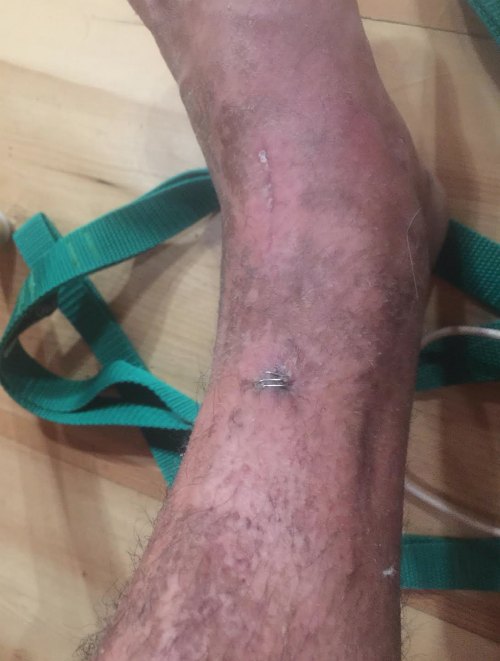
“Have the people you listed asked for a letter of necessity from their Drs? Tell them to be ‘pushy,’ and to not take no as an answer. My surgery center was empty. I’ll removal the staples myself-not worth the risk to go in. I got a medical staple remover from a dog mushing store.”
“I’m a doctor and I’ve just furloughed myself.”
The State’s Chief Medical Officer Anne Zink has established a survey to see how Alaska families are doing. If you have a medical issue that you cannot have resolved due to state health mandates, or if you are having trouble getting primary care because of the current COVID-19 hunker-down orders from your community, you can share your thoughts with Dr. Zink.
Alaskans who would like to respond to the survey can text “AKFAMILY” to 907-269-0344 or access the surveys at the MCH Epidemiology Unit website at http://dhss.alaska.gov/dph/wcfh/Pages/mchepi/.
Not comfortable giving your opinion to the State of Alaska? Send a confidential note to [email protected] or add your comments below.
Mayor Ethan Berkowitz’ emergency order expires on April 14 unless the Anchorage Assembly extends them.
Berkowitz has asked the Assembly to do so, allowing him extensive control over budgets and other major decisions until Nov. 15. It would allow Berkowitz to keep all businesses closed, and extend the “hunker down” order for seven months.
Not all Assembly members are comfortable with giving Berkowitz a blank check until after the General Election. But most who were up for reelection retained their seats. It’s uncertain how they’ll view such sweeping powers, but their decision comes after the municipal election is over, rather than while the public was still voting.
The Wuhan coronavirus has created a de facto lockdown Anchorage and many parts of the country, resulting in the arrest of citizens simply going about their family lives without the risk of putting others in harm’s way.
Meanwhile, the technology, medical knowledge and government recommendations have changed on nearly a daily basis since the coronavirus came to America.
Three weeks ago, Alaskans were told by officials that face coverings were not effective and needed to be preserved for medical professionals battling the coronavirus. Last week, the State of Alaska recommended face coverings be worn whenever people are out in public. Three weeks ago, the State didn’t have enough swab tests or hospital beds. Now, the testing kits are being developed in-state and the lab machines are more available. So are hospital beds.
The Assembly could, if it wants, review the emergency orders every week or every month because the Assembly meets every other week, unlike the Legislature, which has a more difficult time convening to approve emergency powers for the governor. Gov. Mike Dunleavy has had his emergency powers extended to Nov. 15 by the Alaska Legislature, which left Juneau last month. Legislators are now scattered across the state, hunkered down in their districts and subject to local and state travel quarantines.
Due to concerns over large gatherings amid the COVID-19 outbreak, community members are strongly encouraged by the Anchorage Assembly to provide testimony via email or by telephone. Because of the federal, state, and local health department guidance and emergency measures, the number of people allowed in the Assembly Chambers at the Loussac Library will be limited.
The Assembly encourages anyone wishing to provide Public Testimony to email written comments to [email protected]by 2 p.m. the day of the meeting. Comments will become part of the meeting record. In the subject line of the email, describe which agenda item you are providing testimony for (Example: “Emergency Powers of the Mayor.”)
To provide testimony on the phone, email [email protected] by 2 p.m. the day of the meeting with your name, phone number, agenda item number/title for which you wish to provide testimony. The subject line should read “Phone Testimony.” When the Assembly reaches your agenda item, the clerk will call you at the number you have provided. You will have 3 minutes to provide testimony on each item you wish to speak on.
Five more people were diagnosed with COVID-19 in the past 24 hours in Alaska. One more person was hospitalized since yesterday. A total of 277 coronavirus cases have been diagnosed in Alaska to date.
No new deaths were reported beyond the 8 already announced as being related to COVID-19 in Alaska.
The five new cases were reported in: Anchorage (4), and Juneau (1).
Sen. Bernie Sanders endorsed former Vice President Joe Biden for president on Monday during a live event on Facebook with the two men appearing separately, but together, telling Biden “we need you in the White House.”
Sanders left Democratic primary last Wednesday and the endorsement was not a surprise.
“I’m asking every Democrat, I’m asking every independent, I’m asking a lot of Republicans to come together in this campaign to support your candidacy, which I endorse,” Sanders said.
In January, Sanders was saying something different about Biden in an interview with The Washington Post. He criticized Biden’s “weak” record and his “baggage.”
“It’s just a lot of baggage that Joe takes into a campaign, which isn’t going to create energy and excitement,” Sanders said. “He brings into this campaign a record which is so weak that it just cannot create the kind of excitement and energy that is going to be needed to defeat Donald Trump.”
“People are tired of the traditional types of campaigns in which candidates like Joe are running to wealthy people’s homes and raising large sums of money,” Sanders told The Washington Post in January.
And in March, Sanders was still harsh about Biden’s record:
“One of us in this race led the opposition to the war in Iraq. You’re looking at him. Another candidate voted for the war in Iraq,” Sanders said.
“One of us has spent his entire life fighting against cuts in Social Security, and wanting to expand Social Security. Another candidate has been on the floor of the Senate calling for cuts to Social Security, Medicare, Medicaid and veteran’s programs,” he said.
“One of us led the opposition to disastrous trade agreements which cost us millions of good-paying jobs. That’s me. And another candidate voted for disastrous trade agreements.
“One of us stood up for consumers and said we will not support a disastrous bankruptcy bill. And another candidate represented the credit card companies and voted for that disastrous bill,” he concluded.
DEPARTMENT SAYS BREAKING UP AA MEETING WAS CORRECT
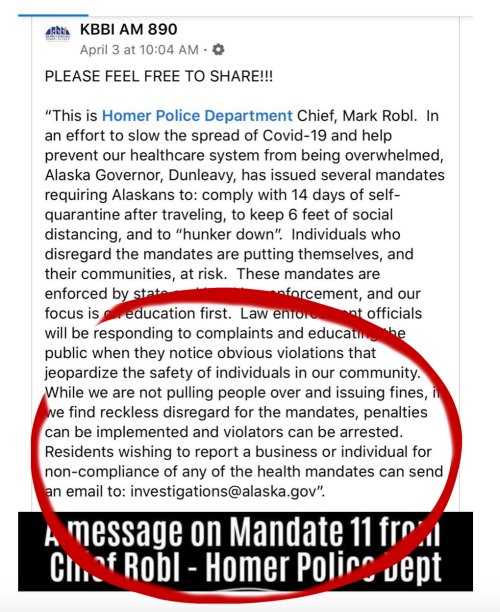
Homer Police Chief Mark Robl last week encouraged people to report on those not complying with the State health mandates. Must Read Alaskareported on the statement pictured below, and also that Homer Police raided a meeting of Alcoholics Anonymous, where participants said they were practicing social distancing.
Now, the police department is walking back that statement, as seen in the department’s statement on social media:
“Hello, this is Ryan, Lieutenant for HPD. I was enjoying a day off and spending some super quality time here on Facebook when I came across an article that got a little traction, suggesting we (Homer Police) are encouraging you all to “tell on” each other and that we are asking for your help in reporting violators of the governor’s health mandates….come on, really? We have enough to do already.
“Chief Robl recently put out a public service announcement saying our focus for enforcing the Governor’s mandates is educating the public and he shared the State’s email address for anyone who wanted to report non-compliance. Nowhere did he encourage anyone to tattle on their neighbors. We have actually received many calls from citizens concerned about others not practicing social distancing or self-quarantining after travel. If you’ve been paying attention, most of the cases of COVID-19 in our state are travel related.
“We here at HPD are doing our best to keep the spread down and the curve flat. To emphasize what Chief Robl said, we are focusing on education, not enforcement. That being said, we chose to stop an AA meeting last week. This was not an easy decision to make. We also made suggestions on how they could keep the group going while still following social distancing guidelines and health mandates, while staying close to the sobriety they work so hard for.
“Our goal is to work with you, our community. Together, we can find solutions as we navigate these crazy times. We’re all in this together,” Lt. Browning wrote.
Live From Duomo di Milano, Andre Bocelli on Easter Sunday, 2020, gave a solo performance representing a message of love, healing and hope to Italy and the world.
Be sure to stay with it (or forward it) to just after minute 18. And get out your tissue as he makes a tribute to America with Amazing Grace:
Small business owners who were not Johnny-on-the-Spot to apply for the Paycheck Protection Program loans, which are guaranteed by the federal government, may have to wait a bit longer.
Toward the end of last week, two Alaska banks stopped taking applications for what is called a “PPP loan” for small businesses, self-employed, nonprofits, and independent contractors who have lost their incomes due to the COVID-19 economic shutdown.
First National Bank of Alaska, Northrim Bank suspended their acceptance of applications, while AlaskaUSA Federal Credit Union is limiting the program to credit union members only.
Wells Fargo and Key Bank appear to still be accepting applications online, since all banks have closed their lobbies to the general public. Credit Union 1 is not participating in the PPP program.
The PPP is open with the SBA until June 30, 2020. Funded by a bill passed by Congress, the PPP gives small businesses, nonprofits, and “gig economy” workers access to short-term cash flow assistance to cover operating expenses and keep their employees. The loans will come directly from the banks, with interest as low as 1 percent, and no payment for six months.
One business owner who applied last week told Must Read Alaska the process involves a lot of paperwork and documentation.
“It’s not an easy loan to get, takes a lot of work. My application is two inches thick. My bank manager told me they were pausing applications. I think mine was one of the last in the door,” she said.
Alaska’s COVID-19 coronavirus case count rose by 15 since the last Department of Health and Social Services report, which was released midday on Saturday.
The current number of Alaskans known to have contracted the Wuhan coronavirus is 272.
There were no new deaths reported; the number of Alaskans who have died from complications associated with the coronavirus is 8.
Thirty-one Alaskans have been hospitalized since the COVID-19 outbreak, although not all of those people are currently in the hospital; eight died, and many have been released.
Meanwhile, hospitals across the state are nearly empty, as other serious and not-as-serious medical conditions are not being treated in order to make beds available for COVID-19 patients.
An illustration of the empty-bed syndrome is Bartlett Memorial Hospital in Juneau, where the city-owned facility is losing $250,000 a day due to not being able to admit non-COVID patients. Nurses across the state are reporting they have been laid off due to lack of regular patients.
To date, 8,038 Alaskans have been tested for COVID-19. With 272 Alaskans showing positive for the coronavirus, the infection rate is 3.3 percent of those tested, and .037 percent of the 730,000 population.
The community breakdown for all known cases in Alaska to date:
Anchorage: 127
Kenai Peninsula: 15
Ketchikan: 1
Fairbanks/North Star Borough: 79
Southeast Fairbanks Census Area: 1
Yukon-Koyukuk Census Area: 1
Mat-Su Borough: 14
Juneau: 16
Ketchikan: 15
Petersburg: 2
Craig: 1
Bethel: 1
Globally, 1,833,685 cases of COVID-19 have been confirmed, and 113,295 deaths are attributed to the virus and its effects. While the United States has the most cases of COVID of any nation, it also has a low death rate compared to many countries.
China, where the virus is believed to have originated, reports 83,014 cases, and yet reports just 3,343 deaths.
In the United States, 526,396 cases are reported, and 20,463 deaths have been attributed to the disease, although some criticize the reporting standards being used as possibly over-inclusive.