Thursday, June 4, 2026
Home Blog Page 1169

Alaska Permanent Fund tops $75 billion

46

On Thursday, the Alaska Permanent Fund, which is Alaska’s investment account and source of Permanent Fund dividends, topped $75 billion.

It had just hit $70 billion in December, 2020. A year ago in March, it was at about $60 billion.

The fund fluctuates, as all investments do, but at least for a moment last week stood at $75,073,000,000.

The Permanent Fund was a constitutionally established fund approved by voters in 1976. Since Alaska’s Constitution doesn’t allow for dedicated funds, an amendment was put to a vote of the people on the General Election ballot of that year, and passed 75,588 to 38,518. The proceeds from the fund are reinvested but also are skimmed off via a formula known as Percent of Market Value to pay for state government, and dividends are paid from the fund to qualifying residents.

Alaska Senate passes resolution for short-term health powers for governor

10

The Alaska Senate today voted, 11-6, for a resolution supporting the short-term exercise of health powers by Gov. Mike Dunleavy, in order to protect Alaskans from the COVID-19 pandemic and urged the reopening of Alaska’s economy.  

Senate Resolution 2 backs a new, narrowly defined public health declaration, not to exceed 30-days, and calls attention to the social and economic harm of the pandemic on Alaskans.

“A short-term declaration will provide assurance to the Alaskans most adversely affected by the virus – the elderly, families with children, those with health complications, small business owners, and the unemployed – that this government will not compound the harm they’ve already suffered by jeopardizing critical aid. We’re not going to kick them while they’re down,” said Senate President Peter Micciche.

“The Senate is working overtime to give Governor Dunleavy and his team the tools they need to maintain our nation-leading public health response, secure federal funding and deliver much-needed assistance to negatively impacted Alaskans. As we turn the chapter on this pandemic, I am confident we can protect the public while encouraging an end to unnecessary government mandates and the reopening of our schools.”

Alaska has been a nationally recognized success story during the pandemic, ranking near the bottom of all U.S. states in COVID-19 deaths per capita and leading the nation in vaccination rates.   

“The administration has used the words ‘monitor’ and ‘manage’ to describe their handling of the present situation,” said Senate Majority Leader Shelley Hughes, R-Palmer. “This tells me we are moving from a state of emergency to a state of recovery – which also means we are headed back to the Alaska we know. Rather than any additional declarations, I look forward to adjusting the particular statutes needed to give the administration the specific tools to allow us to transition from this recovery phase to a state of normalcy.”

Voting against the resolution was Sens. Elvi Gray-Jackson, Scott Kawasaki, Jesse Kiehl, Donny Olson, Lora Reinbold, and Bill Wielechowski.

SB 56, introduced by the governor, has no possibility of passing before midnight on Feb. 15 and has many provisions that give lawmakers pause. But federal funding could be jeopardized, and regulations may not be able to be suspended in order to meet the emergency.

The resolution basically asks the governor to just declare a new emergency for 30 days, and that would give the Legislature time to either deal with the provisions in SB 56 that need to be changed to satisfy critics of the “never-ending” emergency, or pass piecemeal legislation that address different aspects of the emergency.

Forbidden content: Project Veritas gets blocked, MRAK also gets blocked by Big Tech

35

Censorship is breaking out all over for conservative websites. Today, the conservative activist organization Project Veritas was “permanently suspended from Twitter for repeated violations of Twitter’s private information policy,” according to Twitter.

Must Read Alaska also was sanctioned today by YouTube for a video compilation of public testimony at the Anchorage Municipal Assembly.

In the video that YouTube has removed from view, numerous people approach the podium at the Loussac Library in Anchorage on Tuesday, Feb. 9, and tell of their personal stories that pertain to the current emergency mandate for masks and other pandemic emergency orders.

The stories are heart wrenching: Some people have lost loved ones to suicide or delayed health treatment, while others are watching their children become withdrawn from the world.

Must Read Alaska merely clipped the videos directly from the municipality’s own YouTube channel, where the testimonies are still posted and still visible in their entirety. We condensed the testimony into a nine-minute video.

To be clear, this is the same content that is on the Anchorage YouTube channel, but edited for length and with minor special effects added.

YouTube has said these Anchorage residents’ experiences are “misinformation” about Covid, and that breaks the rules at YouTube.

“Our team has reviewed your content, and, unfortunately, we think it violates our medical misinformation policy. We’ve removed the following content from YouTube:
Video: Holy Moses! Forrest Dunbar says these testifiers are spreading disinformation. Are they?”

“YouTube does not allow content that spreads medical misinformation that contradicts the World Health Organization (WHO) or local health authorities’ medical information about COVID-19, including on methods to prevent, treat, or diagnose COVID-19 and means of transmission of COVID-19. Learn more here.”

The public testimony video, with Assemblyman Forrest Dunbar commentary about how the public is spreading disinformation, is still visible on Must Read Alaska’s Facebook and will be posted soon at Rumble, an alternative video site.

Here is the link for the video at Facebook.

YouTube not only removed the video, but the platform has now targeted Must Read Alaska by penalizing it with a “strike.” This means Must Read Alaska cannot post videos for one week, and has evidently been put on a red-flag list at YouTube, which will enhance monitoring of MRAK’s channel for other perceived violations. A channel is only allowed two strikes. The third strike results in permanent deplatforming.

Must Read Alaska has about 2,400 subscribers at its YouTube channel, where most of the content is material from public meetings that is already in the public domain. Although MRAK has submitted an appeal of the decision, it appears likely that it will be deplatformed by YouTube at some point in the near future, as Big Tech continues to silence conservative voices.

Will Rep. Merrick pay the price for voting in Stutes as House Speaker?

44

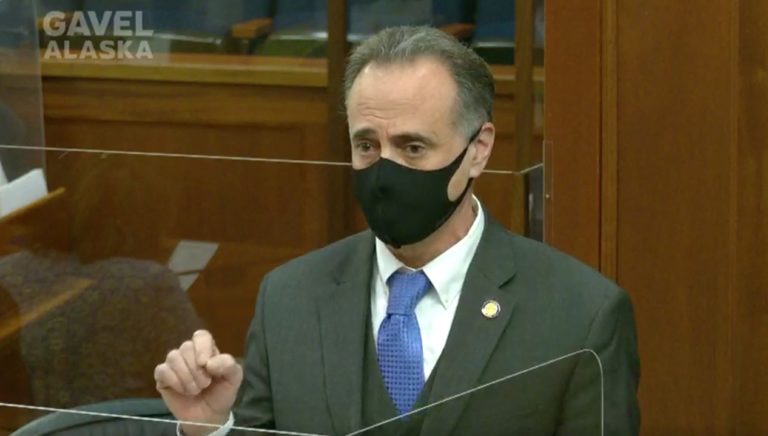
Rep. Kelly Merrick is a fighter, and she is married to one of the biggest political players in the state — Labor leader Joey Merrick, which has always given conservatives pause.

Joey Merrick is usually fighting against conservative candidates in his role with numerous political action committees, all backed by union interests. He is the business manager for Laborers’ Local 341. He’s got political muscle of the Democrat flavor.

But Kelly Merrick is the representative for District 14, one of the deepest red areas in the state. Her departure from the Republican majority to put Rep. Louise Stutes and the Democrats in charge isn’t going to be easy for her back home, where the district voted 6,714 for Trump/Pence, and 4,261 for Biden/Harris in November.

Merrick said in a statement that she is not joining the caucus she just put in charge of the House with her deciding vote:

“Today, I voted to elect Republican Representative Louise Stutes as Speaker of the House, ending more than three weeks of deadlock and allowing the Legislature to move forward. It was by no means an easy decision to make, but it ensured that no matter how organization comes together, there will be a Republican Speaker.

“To be clear, I have not joined the Alaska House Coalition. However, like most Alaskans, I have been frustrated by taking the same fruitless votes day after day and I felt we could no longer afford to delay extending the Governor’s emergency disaster declaration, crafting a fiscally conservative budget, and passing the construction jobs bill.

“Speaker Stutes has served many years in the Legislature, has personal relationships with lawmakers on both sides of the aisle, and is committed to bringing people together to tackle issues facing Alaska.”

In 2018, Stutes, the late Rep. Gary Knopp, and other Republicans formed a bipartisan coalition with the Democrats. Back then, Rep. Bryce Edgmon relinquished his Democrat-party affiliation and became “undeclared” so he could be the Speaker and still give the Republicans who joined the coalition sone political cover.

That didn’t work out for most of them — Jennifer Johnston, Chuck Kopp, and Gabrielle LeDoux lost their seats in the House. Tammie Wilson chose to retire. Stutes didn’t have an opponent. Knopp died in a plane crash.

When Kelly Merrick ran for reelection in 2020, her district supported her because she had not joined the Democratic caucus in 2018.

Must Read Alaska has learned that activists in Merrick’s district are preparing to discuss a censure of Merrick when they meet on Wednesday, Feb. 17.

Breaking: Louise Stutes becomes Speaker with Merrick going over for deciding vote

49

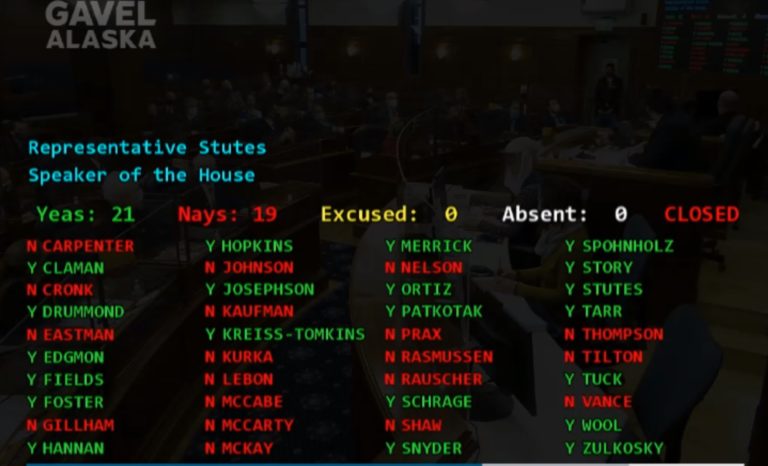
Rep. Kelly Merrick, a Republican from House District 14, was the one who became the 21st vote, putting Rep. Louise Stutes in as House Speaker today, in a Democrat-led majority.

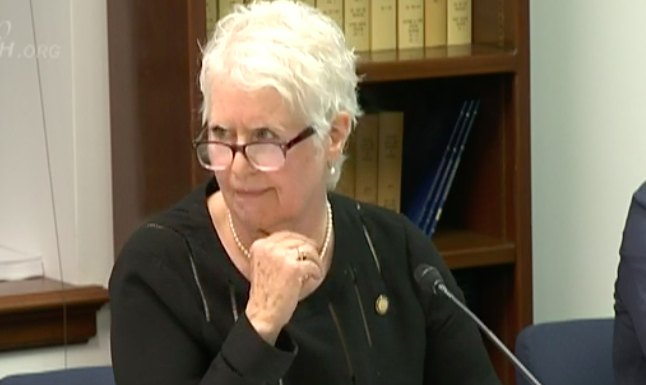
Speaker Louise Stutes

The vote was 21-19, with all other votes for Stutes being Democrats and Undeclared. The Republicans have, once again, lost the House.

Stutes had been negotiating with the Republicans, but she has not caucused with them in several years. Her demands to become House Speaker for a Republican-led body were too much for the 20 other Republicans in the House.

Except Merrick, who was first elected in 2018, and reelected last year for a conservative Eagle River district.

The Legislature has been in session for three weeks, and the House remained unorganized until the House session this morning, with Josiah Patkotak as Speaker Pro Tem.

Merrick may be bringing other Republicans to join the majority caucus. Republicans in the House are likely in disarray as they try to organize a minority, and will find out soon who else may go over to the Democrats’ caucus. It’s likely the Democrat caucus will offer Rep. Sara Rasmussen a key position, as some perceive her as a close ally of Merrick. Whether Rep. Bart LeBon also goes over is also considered a possibility.

Rep. Kelly Merrick

With 21, the Democrats have the majority, but if they can get that 22nd member, they win a seventh seat on Finance, which is very advantageous.

What position will Merrick get? A likely choice would be co-chair of Finance, since she served on Finance the past two years.

Democrats have recognized that an anti-abortion lawmaker like Merrick is in no position to hurt the pro-abortion cause because of the budget and Covid factors now dominating the Legislature.

With Stutes as Speaker, Rep. Bryce Edgmon will most certainly win a powerful position in the organization, possibly as Rules chair.

Stutes is a take-no-prisoners lawmaker who was known for having a bullwhip hanging on the wall of her office when she was majority whip for the Democrats.

District 14 Republicans said at their last meeting with Merrick she promised them she would not go over to create a Democrat majority. But with Stutes a Republican now as Speaker, she appears to have kept her promise.

This story is being updated. Check back.

Nearly 20 percent of Alaskan adults now vaccinated

29

POLICE OFFICERS STILL NOT ON THE LIST

Of the 593,000 adults over the age of 18 in Alaska, 114,117 have already received their first dose of Covid-19 vaccine. That’s a vaccination rate of nearly 20 percent.

Over 48,000 Alaskans have received both the initial vaccine and booster shot, and over 82 percent of residents of congregant care facilities, such as Pioneer Homes, have been vaccinated.

The State of Alaska has been the vanguard in getting vaccines out in an orderly fashion, and now is vaccinating those over 50 years old who have any underlying health condition that puts them at greater risk of complications or death from Covid-19.

Interestingly, all teachers are eligible, but only police officers over 50 are eligible for a vaccine at this time in Alaska. Most other states have prioritized police officers.

Those who are qualified for what is called the Phase 1b Tier 2, high-risk medical conditions include:

  • cancer
  • chronic kidney disease
  • chronic obstructive pulmonary disease (COPD)
  • Down Syndrome
  • heart conditions, such as heart failure, coronary artery disease, or cardiomyopathies
  • immunocompromised state (weakened immune system) from solid organ transplant
  • obesity or severe obesity (body mass index [BMI] greater than 30 kg/m2) (see calculator)
  • sickle cell disease
  • smoking
  • type 1 or type 2 diabetes mellitus
  • pregnancy
  • Frontline essential workers 50 years and above who must work within 6 feet of others
  • Education staff, limited to:
  • Childcare workers and support staff (e.g. custodial, food service, transportation);
  • Pre K–12 grade educators and support staff (e.g. custodial, food service, transportation);
  • Indigenous language and culture bearers
  • People living or working in congregate settings not covered in Phase 1a, limited to:
  • Acute psychiatric facilities;
  • Correctional settings, both inmates and officers;
  • Group homes for individuals with disabilities or mental and behavioral health conditions;
  • Homeless and domestic violence shelters;
  • Substance misuse and treatment residential facilities; and
  • Transitional living homes
  • Pandemic response staff who may come into contact with the SARS-CoV-2 virus during outbreak response activities

The State Health and Social Services Department announced the expansion of eligibility on Wednesday.

Dunleavy: ‘Do your research’ on misinformation being spread about virus

49

Gov. Dunleavy made a passionate plea to Alaskans to help stop the spread of misinformation about the COVID-19 virus.

In a press conference broadcast on Facebook, said he has never contemplated martial law, and there will be no forced vaccinations under his watch.

Dunleavy’s emergency declaration runs out on Sunday night and the House of Representatives is unorganized, so the Legislature cannot extend it with SB 56, the governor’s proposed emergency declaration extension. But he also seems reluctant to declare a new disaster.

He said that Alaska is a state that represents freedom and that the spirit of the people is what has made the state successful so far in combatting the coronavirus.

It was a direct blow to messages being relayed by Sen. Lora Reinbold, who suggested in her Senate Judiciary Committee that the governor might declare martial law.

Dunleavy also said that without an extension of the emergency declaration, the State would not have all the tools it now has to mitigate the spread of the virus, but that he anticipated everyone would continue to work to get the virus “behind us sooner rather than later.”

But he also said the virus will be with Alaska for many years, and that the state will need to deal with it as it has other problems in the past.

The State, he said, will lose some tools on Feb. 15, when the emergency declaration expires at midnight.

About 200 regulations that were eased to make decision making more responsive will be back in place. Many of these deal with how health care can be managed. It likely means the Alaska Airlines Center at the University of Alaska Anchorage campus will not be available as hospital overflow. Curbside pickup of beverages, pop-up vaccination sites, and even regulations eased for commercial fishing will go back to the way it was before.

Finally, the governor called upon Anchorage and Juneau to open their economies back up. Looking at the camera, he said the State has based its decisions on data, and first-class cities need to also look at the data, and open their businesses and schools back up.

Dunleavy gets support from 20 Democrats for new emergency declaration

13

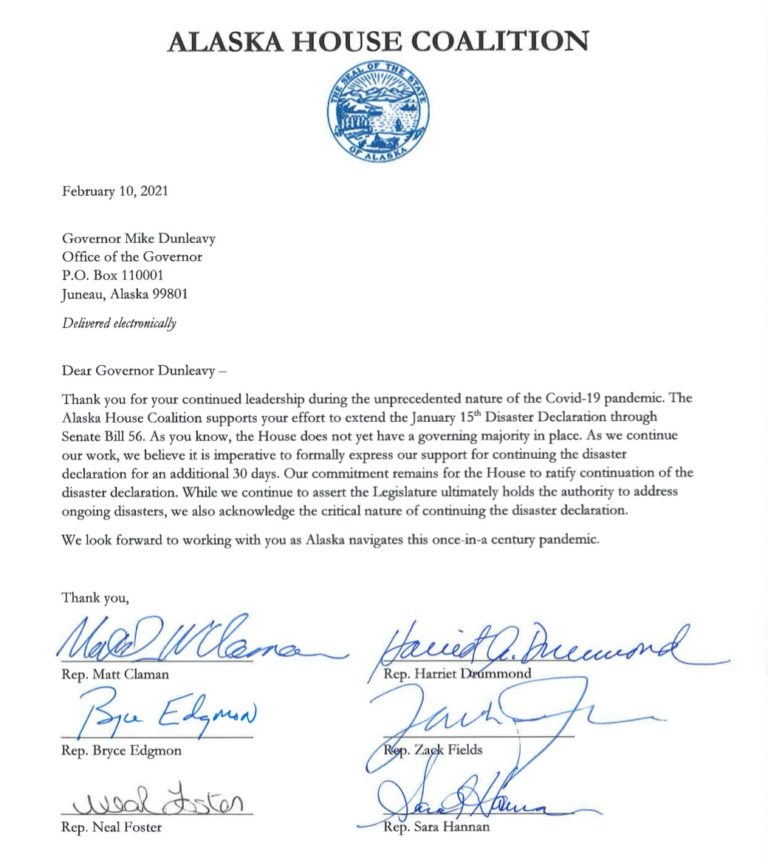
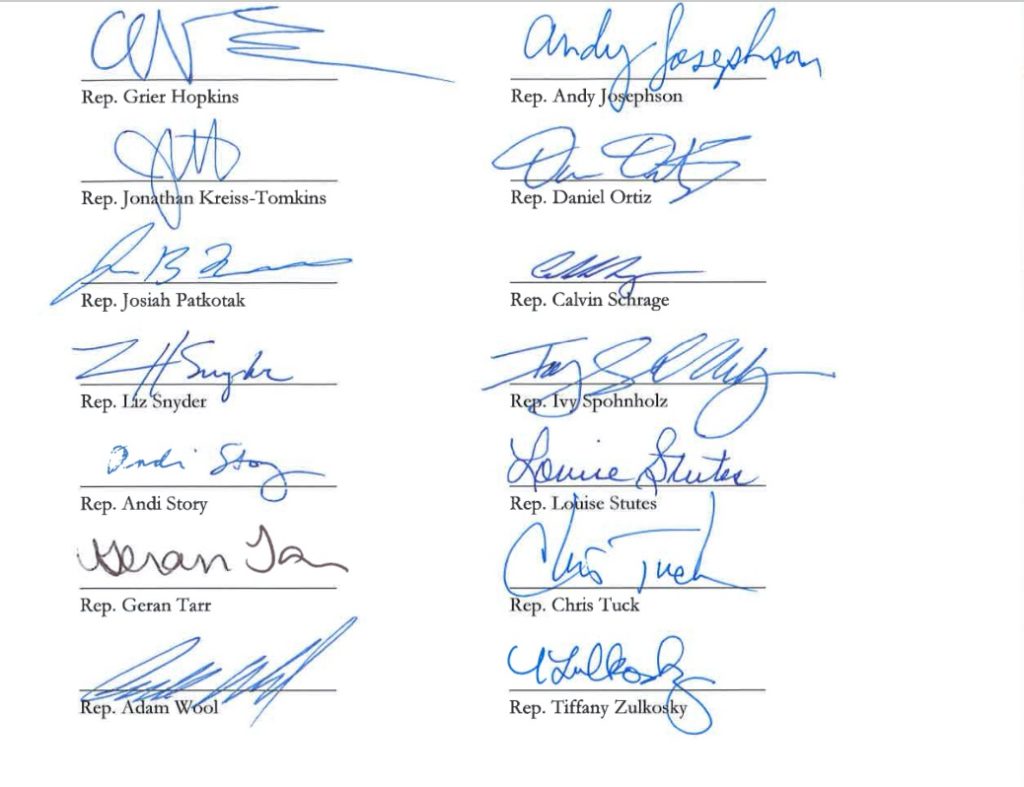
They may oppose the governor in every other way, but all 20 House Democrats (including the two undeclared representatives and one Republican who caucuses with Democrats) signed and sent a letter to the governor today in support of a new disaster declaration.

The letter to Gov. Mike Dunleavy said that although the House doesn’t have a governing majority, the group believes it’s imperative “to formally express our support for continuing the disaster declaration for an additional 30 days.”

The letter signals to the governor that half of the House will not buck him if he goes ahead to declare a new disaster, the more likely outcome, since he alone cannot extend the current disaster declaration.

He has stated that he is not prepared to declare a new disaster without the Legislature’s support.

Many Republicans in the House and Senate are not in favor of extending the current disaster declaration through the fall, as requested by the governor. But Democrats want the disaster declaration.

When it expires on Sunday night at midnight, Dunleavy could file a new disaster declaration, which would only last 30 days before either expiring, or being extended by the Legislature.

Signers of the letter include Speaker Pro Tem Josiah Patkotak, who is undeclared of Utqiagvik, and Daniel Ortiz, also undeclared, of Ketchikan. Louise Stutes of Kodiak is the Republican who left the Republican caucus years ago and shows no sign of returning.

The House is split 20-20 between Republicans and the “other” category.

The Montana Plan? Let’s take a look

3

Another February in an odd numbered year, and another unorganized Alaska State Legislature. 

Not that anyone is surprised by this. Hundreds of thousands of special interest dollars and unsavory tactics were used to knock off Reps. Lance Pruitt and Mel Gillis to ensure that Republicans did not have the chance to keep the organization under their leadership. 

How is this situation going to be resolved, and how is this different than two years ago? 

Let’s start with the latter: Two years ago the expectation that (now former) Reps. Jennifer Johnston and Chuck Kopp were going to jump and join the Democrats was widespread among politicos.  They needed their “reason” to jump and (now former) Rep. Gabrielle LeDoux-and-Crew had shown them the model two years prior.

Johnston and Kopp hesitated. They saw what happened to (now former) Rep. Paul Seaton and the flack that the others received. Hubris got the best of them. 

The Fairbanks caucus jumping ship from the Republicans just added to the carnage with (now former) Rep. Tammie Wilson and Rep. Bart LeBon being more of the surprise jump.

Rep. Steve Thompson had been courted for years and was rumored to be in his last term in office, so his jump to the Democrat-led coalition was not as big of a surprise. This year, Johnston and Kopp are outside looking in, and Wilson didn’t face the voters.

For LeBon and Thompson, the calculations have changed. They promised the voters back home they would not go anywhere, and their credibility is on the line. 

Thompson would be a great Speaker and sees a chance with Pruitt out of his way, and LeBon would like a shot at leadership and a path to possibly challenging Sen. Scott Kawasaki.

The rest of the Republicans have their own reasons for sticking together.  Many ran on getting a Republican majority back, and others have their own reasons for not going over to the Democrats, even though they have at least some disagreements with others on policy, a normal condition.

Basically the Republicans are not going anywhere.

Now to the Democrats: They are a top-down organization. 

They don’t go over to join with the Republicans because they have been told by donors that spent hundreds of thousands of dollars to get them to this place that they may not go over.

Sure, they may fight for who is the top and hate each other — the Spohnholz, Edgmon, Tuck savagery comes to mind — but stepping out makes their benefactors mad and puts their future in politics in jeopardy.  

Josiah Pakatok showed himself to be the most powerful person in the House when he was unanimously voted Speaker Pro Tem. Why? The Democrats don’t have the numbers, and can’t afford to lose him and Republicans cannot get over the hump without him.  

He also does not owe the Democrats anything; they did everything they could to prevent him from being there.  It was Republican donors and even the Republican infrastructure that helped him defeat the Democrat machine so Patkotak could win. 

But some of the policies or statements by the Republicans about things like Power Cost Equalization give him pause to jump in head first with the Republicans.  Both sides know they have to curry his favor, something even Reps. David Eastman and Chris Kurka understood by their vote to make him Speaker Pro Tem.

So what do you do in the light of all of this?  Maybe it is time to start talking about the Montana Plan. 

Alaska is not the first state to have an evenly divided body.  In the last 20 years, Montana has had it twice, Colorado and even Oregon have had splits.  Usually, but not always, over time it is the House with the split due to the likelihood that it is the House with an even number of members or a lieutenant governor playing a role in the upper chamber (much like the role Vice President Kamala Harris gets to play now in the U.S. Senate). 

As ranked choice voting will usher in a new environment of loyalty or non-loyalty to a party, and the fact that a split chamber has happened twice in the last two cycles and almost happened with the Senate, it is probably time to start talking about giving the lieutenant governor a role in tie breaking. But that is a subject for later.

What is the Montana plan?  

For the House, it would be shared everything:  Co-Speakers, Co-Committee Chairs, and agreement that nothing happens without the other side agreeing. 

Basically engineered so at least it allows the opportunity for the budget and other required things to make it through the process. 

How would this work? Some of the things to consider seem shallow to those of us outside the bubble of the Capitol, but are so important to the fragile egos of legislators.

There would still be two caucuses. The Speaker would be an agreed upon alternation of who presides maybe every other week or floor session between each side, and decisions would be agreed on by both co-speakers such as which committees a bill is assigned. 

When one Speaker is not presiding, the other is the Majority Leader.  Co-Rules chairs would have to sign off on bills being calendared, and they could both sign off on staff or let each one handle their own caucus.

Committees would also have similar agreements; alternating the gavel and no legislation would be heard or move out of committee without the agreement of both chairs. 

Montana did have a provision called a Silver Bullet that gave chairs one free pass that could move a bill without the agreement of the other chair.  It did not guarantee passage or even that it would move out of the next committee. It would help move the bill once. That could be a sticking point for the Rules committee, but the rest would have backstops. 

Committee membership is answered with the option of increasing or decreasing all committees to make them even numbered so there can be even numbers of both sides sitting on those committees.  For Finance, they might even have to have to have four co-chairs — two for the Operating Budget and two for the Capital Budget/bills.  

The problematic chairs, of course, are the joint Senate/House committees.  The House has the chair of the Legislative Council this term and the vice chair of the Legislative Budget and Audit Committee, as well as the yearly rotating of the Joint Armed Services Committee. 

In theory, the Chairs of Legislative Council and LB&A are protected by statute once appointed, as evidenced during the 1981 coup, but when Edgmon removed Rep. Sam Kito several years back, he set a precedent.

Now to the stuff only legislators care about — offices and staff.  Offices would be assigned by seniority. And Speaker and Majority leaders would swap after a year. Rules co-chairs would do the same unless they have agreement. 

Staff is where this could get expensive. Usually everyone in the majority gets a chair, which is how majority members get a third staff — usually Range 19. 

If the two Speakers get four or five staff, one of which is a Range 24, and two press people …. you get the drift: It gets expensive.

The reality is not everyone needs to be a chair this year. Maybe they do not need all four of the special committees. Or they just keep everyone at the 36 points they currently at which could help save some money. 

The last thing to answer is why do this?  For each side the reason is different, but with one unifying thing: The governor.

Gov. Mike Dunleavy has extended his emergency orders multiple times, to the disapproval of some legislators.  The legality has been questioned, but if the House is not organized by Feb. 15 what happens then? 

The governor can say the children in the Legislature failed their job. He may decide to extend the emergency orders. There will be those who will scream that it’s illegal, including legislators, but who is going to sue?  Who will have the nerve to sue to stop the distribution of the vaccine and all of the safety measures now in place, all the testing, and reduced regulations?  That person would be as popular as the Zobels.

Legislators can cry all they want, but without an organized House, Legislative Council cannot meet and therefore cannot authorize a lawsuit.  Leg Council cannot approve anything without the support of a member of each body.  All senators present can agree, but without a House member agreeing on any measure, it fails. 

Is the House going to give the governor that much power? If you don’t like how the governor is handling the declarations then you should want to be able to shape what it looks like. And if you love what the governor is doing, (speaking to all the Democrats out there) do you really want to allow him to look like the adult in the room (not good for the recall effort).  

The only solution for both sides may be to adopt the Montana plan. 

Let’s be clear: They cannot massage this mess into something where they take less responsibility for whatever is about to happen, so they might as well mitigate it. 

The first one to propose it gets to own the credit for breaking the logjam. Don’t all jump at once, now.