Wednesday, June 3, 2026
Home Blog Page 1112

Pebbled: The environmentalist who cries ‘Wolf!’ is louder than the scientific process

By MARK HAMILTON

(Editor’s note: This is the seventh in a series by Mark Hamilton about the history of the Pebble Project in Alaska.)

As Alaskans, perhaps more than any other state citizenry, we face a difficult future if we do not proceed in the responsible extraction of our natural resources.

Virtually every major development will be “controversial.”  There is nothing wrong with that word; it simply means there are opinions on both sides (or all sides) of the issue at hand. Still, it has become a reason to avoid involvement or even a deeper look. That is not a good plan.

Here’s why:  Every major development will be met by that narrative of fear I referred to in the previous column.  

“The project (fill in the blank) will destroy this, kill that, poison something… and so forth.”

That narrative of doom will be ended with: “Send your donation to X, so we can stop the destruction.”  This will never go away because these groups are making a fortune with this technique.

In Alaska, we have seen these narratives since 1968. You may look at those predictions now and see them as absurd; but think how they sounded in the moment.  These divinations prey on our fears. We all care about the animals, the Earth, the culture.  Here are people of some authority telling us the project will destroy things we care about.   

Today that message would appear on social media many times a day, and be on op-ed pages in newspapers multiple times a week. In the meantime, the would-be developer would be assessing the requirements that must be accounted for to receive the permit to develop the project.

There are criteria for approving resource projects. Lots of requirements. The rules tell you how to prepare. For mines, there is a book printed by the Environmental Protection Agency, called Hard Rock Mining in the Northwest and Alaska.  The book outlines the requirements for pursuing approval for a mining project, critical to the prospect of having any mining projects in our state since it simply costs too much money and time to enter the project without a clear understanding of the requirements. It is essential to the industry that the requirements are complete and understood, in order to balance the enormous time and financial commitment required to pursue the process.  As well, this listing of needed requirements is the public’s first assurance that no harmful project will be allowed.  Clear rules and clear requirements that must be met ensure a solid process.

Knowing the criteria allows outlining the work to be done prior to presenting the project to the appropriate federal agency. The preparation will take years and several tens of millions of dollars of scientific and technical work. 

At this multi-year stage, we are presented a very uneven dialogue. The alarmists are hard at work with their narrative of fear (still collecting donations), while the developer can only offer, “We are committed to following the rules and regulations.”  That doesn’t strike an emotional chord compared to “The mine will destroy, poison, and ruin.”

Many are familiar with the often-told children’s tale about the shepherd boy, who being bored, decided to alert the townspeople to visit him by crying “wolf!”  The town reacted in force and finding no threat cautioned the boy against such a prank. A short time later, bored again, he once again shouted “wolf!”  Again, the town reacted, and this time angrier at the false alarm.  As you may recall (or predict if you have not heard the story), one day a wolf did appear.  The boy called “wolf!” over and over as the beast slaughtered the precious flock. No one came.

I can’t endorse the ultimate inaction of the villagers. The flock was critical. They should have reacted again. If it was another false alarm, they should have replaced and punished the shepherd boy.

There have been several calls of “wolf!” in my lifetime. In the 1970s we were warned of an impending ice age. This got lots of attention in major newspapers and either Time or Newsweek magazines. Without the marvelous social media we have today, the doomsday prediction spread slowly enough for a large majority of scientists to offer a counter argument that demonstrated that the earth had actually warmed.  The ice age group was not a bunch of kooks.  They proudly presented their data and conclusions to include the computer program they used.  

Careful scrutiny by other scientists discovered the fault in the computer program that projected accurate data incorrectly.  No one created their own data; no one was called an ice age denier. Competent scientists used their skills to disprove the original conclusion. It was simply a case of misunderstanding of a pretty recent tool—the computer and its program. It was settled with fact.

A similar event happened a bit later that involved the warning that the earth would relatively quickly succumb to overpopulation.  This erroneous conclusion involved the extrapolation of measured population growth with the assumption that nothing would alter the birth rate.

Both of these predictions were ultimately dismissed, and both involved faulty techniques.  Neither presented false data, and so were easy to unravel and discover the operational error that produced faulty results.

How very different today, when doomsday predictions, or scare tactics move so quickly, presenting virtually no data, or suspect data at best.  They ride the cyber echo to viral status and become nearly impossible to erase or refute while they “pebble” you.

The “Pebbled” series at Must Read Alaska is authored by Mark Hamilton. After 31 years of service to this nation, Hamilton retired as a Major General with the U. S. Army in July of 1998. He served for 12 years as President of University of Alaska, and is now President Emeritus. He worked for the Pebble Partnership for three years before retiring. The series continues next week. 

Pebbled 1: Virtue signaling won out over science in project of the century

Pebbled 2: Environmental industry has fear-mongering down to an art

Pebbled 3: The secret history of ANWR and the hand that shaped it

Pebbled 4: When government dictates an advance prohibition

Pebbled 5: EPA ‘just didn’t have time’ to actually go to Bristol Bay

Pebbled 6: The narrative of fear

CDC: Fishing crews must still wear masks

In spite of pleas from Sen. Lisa Murkowski and others, the Centers for Disease Control and Prevention and the Coast Guard still say that fishing personnel must wear masks aboard boats.

For many Alaska fishermen, having a mask over their nose and mouth during fishing operations is akin to being waterboarded, as wet, slimy masks are difficult to breathe through, create visual barriers, and prevent communication.

Earlier this month, Murkowski and Sen. Maggie Hassan (D-NH) wrote to CDC Director Rochelle Walensky and Coast Guard Admiral Karl Schultz, requesting they update their mask policies.

Meanwhile, the CDC has updated its mask policies for cruise ships. Passengers who are fully vaccinated may remove masks when outdoors, as long as they are not in crowds, according to the CDC’s updated operations manual for cruise lines.

“Cruise ship operators, at their discretion, may advise passengers and crew that — if they are fully vaccinated — they may gather or conduct activities outdoors, including engaging in extended meal service or beverage consumption, without wearing a mask except in crowded settings,” the CDC manual says.

But CDC still requires passengers and crew to wear masks on all planes, buses, trains, and other forms of transportation, and that includes fishing vessels.

“In response to the CDC guidance published on May 13, 2021, the commercial fishing community has expressed confusion about the implementation of the new guidance on fishing vessels that are operating with all fully vaccinated staff. In response, we sought clarification from the Coast Guard about whether fully vaccinated commercial fishing crew are still required to wear masks. On May 14, 2021, Coast Guard personnel confirmed that the agency would need to wait for changes to the CDC Mask Order and associated CDC guidance for conveyances and transportation hubs before it could revise its Marine Safety Information Bulletin and address requirements for fishing vessels,” Murkowski wrote in her letter to the CDC and Coast Guard.

Murkowski noted that masks create a safety hazard on fishing vessels, where crew communicate over loud motors or machinery noises, and they rely extensively on lip-reading to help them understand each other.

“Masks are also frequently wet from sea spray, which can make it more difficult to breathe. This is a condition that the CDC has generally recognized is problematic,” Murkowski wrote, urging changes to the federal policy.

National Fisherman provided its readers with a list of activities in which wearing a mask would create a safety hazard for onboard workers:

  • On-deck tasks which necessitate removing a mask to perform duties due to safety hazards from slime- or water-covered masks causing difficulty breathing.
  • When the crew needs to communicate with each other or the captain, as the captain is hearing impaired and needs to see the facial expressions and lips of the crew.
  • Shoveling fish into bins.
  • Hauling in net and anytime the net reel is in motion.
  • Manning the net reel while in operation.
  • Stacking boxes of fish.
  • Wash down of the deck.
  • Unloading fish boxes at the dock.
  • Jumping on or off the boat while docking or departing.
  • Tying lines to secure equipment or the boat itself.
  • Any activity where there is communication between the crew and captain as the captain has hearing loss and needs to see facial expressions and lip movement.

The most recent Coast Guard bulletin states: “Operators of vessels and sea ports that fail to implement [the mask wearing order] may be subject to civil or criminal penalties. Vessels that have not implemented the mask requirement may be issued a Captain of the Port order directing the vessel’s movement and operations; repeated failure to impose the mask mandate could result in civil and/or criminal enforcement action. Additionally, after taking into account operational considerations, the COTP may issue orders prohibiting vessels from mooring at a sea port that fails to implement the CDC guidelines or refer non-compliance with CDC’s guidelines for further civil or criminal enforcement action.”

It’s unclear if this federal mandate pertains to sport fishing charters.

Jamie Allard: Memorial Day – Bearing witness to the sacrifice of fallen warriors

By JAMIE ALLARD

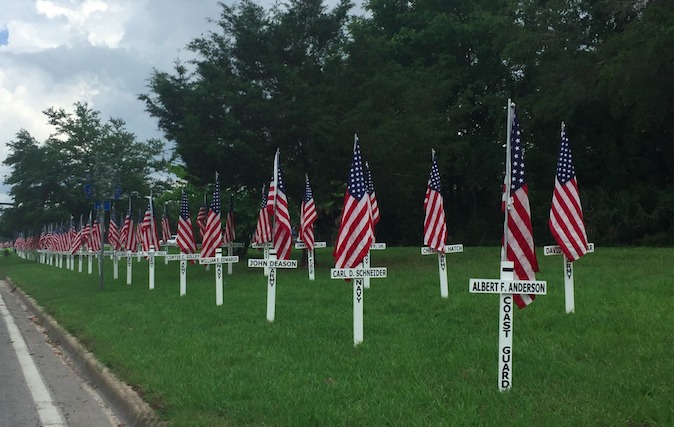
It is our most solemn day of the year: Memorial Day, a time to remember those who died while in active military service to our nation. 

This Monday is for the fallen warriors. It is for laying a wreath, playing “Taps,” and asking God to protect our nation. Flags come down to half staff. Tears are wiped away. Tombstones are brushed off and flowers are carefully placed.

For veterans, it’s an especially meaningful day. This day is not for us, for we served and lived. It is the day for our comrades who served and died. Some of the fallen were known to us as friends or fellow riflemen, some were parents or siblings blown apart in the prime of their lives. In our home, we honor the fallen as though they are our brothers and sisters.

The most poetically expressive words about the profound losses felt in war were written by Canadian physician John McCrea in World War I. I share it with you, as we keep covenant with our buried or missing American warriors:

In Flanders fields the poppies blow

Between the crosses, row on row,

    That mark our place; and in the sky

    The larks, still bravely singing, fly

Scarce heard amid the guns below.

We are the Dead. Short days ago

We lived, felt dawn, saw sunset glow,

    Loved and were loved, and now we lie,

        In Flanders fields.

Take up our quarrel with the foe:

To you from failing hands we throw

    The torch; be yours to hold it high.

    If ye break faith with us who die

We shall not sleep, though poppies grow

        In Flanders fields.

During this weekend, our family is also reminded of the Ranger Creed, which every Ranger has memorized. While not as poetic as McCrea’s words, the Ranger Creed is something we can live by, even for those of us not part of our nation’s fighting force. It tells us how to be our best:

Ranger Creed

Recognizing that I volunteered as a Ranger, fully knowing the hazards of my chosen profession, I will always endeavor to uphold the prestige, honor, and high esprit de corps of the Rangers.

Acknowledging the fact that a Ranger is a more elite Soldier who arrives at the cutting edge of battle by land, sea, or air, I accept the fact that as a Ranger my country expects me to move further, faster and fight harder than any other Soldier.

Never shall I fail my comrades. I will always keep myself mentally alert, physically strong and morally straight and I will shoulder more than my share of the task whatever it may be, one-hundred-percent and then some.

Gallantly will I show the world that I am a specially selected and well-trained Soldier. My courtesy to superior officers, neatness of dress and care of equipment shall set the example for others to follow.

Energetically will I meet the enemies of my country. I shall defeat them on the field of battle for I am better trained and will fight with all my might. Surrender is not a Ranger word. I will never leave a fallen comrade to fall into the hands of the enemy and under no circumstances will I ever embarrass my country.

Readily will I display the intestinal fortitude required to fight on to the Ranger objective and complete the mission though I be the lone survivor.

Rangers lead the way!

Finally, as you observe this Memorial Day, it’s always awkward to say “Happy Memorial Day.” It does not seem to fit. And yet those men and women who “Short days ago We lived, felt dawn, saw sunset glow, Loved and were loved,” would actually wish that for every one of us Americans. They wanted the best for their fellow countrymen, and they understood that America is truly exceptional and worth fighting and dying for.

It is our happiness, freedom, and human rights that they fought for, and therefore, we owe it to them to not only recognize their sacrifice, but to not squander that incredible gift they left us.

Jamie Allard is the Anchorage Assemblywoman representing Chugiak / Eagle River.

Kamala Harris says ‘Enjoy the long weekend, while Joe Biden says ‘Stay cool’

By SUZANNE DOWNING

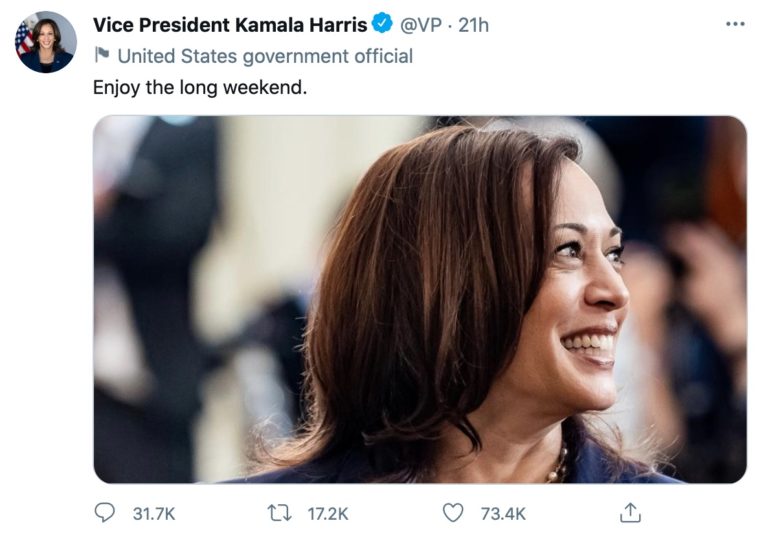
America’s own vice president missed the point of Memorial Day weekend by a mile when she tweeted on Saturday, “Enjoy the long weekend” as her social media acknowledgement of the three-day federal holiday, set aside to honor those who died serving our country. It caused many patriots to groan.

President Joe Biden’s message was in a similar vein: “Stay cool this weekend, folks,” as his staff posted a photo of him enjoying an ice cream cone while talking to what appeared to be an underaged girl.

Biden and Harris made the mistake that slips out when we forget, as we sometimes do, that the correct greeting is not “Happy Memorial Day” but “We will never forget those who made the ultimate sacrifice.” For the commander in chief and his surrogate, it appears to be a festive event, like the Fourth of July.

We presume the president really does know better. Of Harris, we’re not so sure.

Decoration Day, a time to lay flowers on the graves of the Civil War war dead, started back in 1868 and became Memorial Day over time, and was set for May 30 every year. In 1971, with the Uniform Monday Holiday Act, it was moved to the last Monday in May, thus providing a three-day weekend for federal workers.

With that three-day weekend came a more holiday atmosphere, the opportunity for mini-vacations, family reunions, beaches, and barbecues. Because the world of trade looks for any opportunity, Memorial Day sales became a popular enticement. As people left for the weekend, there were fewer around to lay the wreaths or tend the graves.

The Uniform Monday Holiday Act made some holidays, such as Labor Day and Presidents Day, a bit more festive. But through time, Memorial Day became a little cheapened around the edges as just another three-day weekend. It was not that way when it was a date certain. In the 1960s, it was a day of remembrance.

There are always patriots and families of the fallen who hold fast to the traditions of Decoration Day, the playing of Taps, and the laying of wreaths. For Gold Star families, it’s a day to reflect and remember, and wonder what might have been without the sacrifice they and their warriors made for our country. What children might have been born, what memories might have been created, and what evils would have occurred in the world without their warriors’ who stood to fight the battle.

For veterans, the day is also sacred, a time when memories flood their minds as they remember the day they stood to take their enlisting oath, and what it meant to them and their comrades: “I, (name), do solemnly swear (or affirm) that I will support and defend the Constitution of the United States against all enemies, foreign and domestic; that I will bear true faith and allegiance to the same; and that I will obey the orders of the president of the United States and the orders of the officers appointed.”

That oath of office, a promise to “obey the orders of the president,” is why it’s so important that the president and vice president choose their words wisely. Social media is an unforgiving landscape, and when it comes to the sacrifice of our warriors, our leaders must tread with care. In this case, both the president and vice president missed the mark with their unforced errors. Presumably by Monday their public relations teams will have steered them back on course.

Biden budget supports federally funded abortion by ignoring Hyde Amendment

President Joe Biden’s $6 trillion spending proposal did not include any acknowledgement of the Hyde Amendment, which since the 1976 has kept elective abortions from being paid for with American taxpayer dollars.

Biden’s budget was released Friday. With Democrat control of the House and a 50-50 split in the Senate, abortion foes fear that this is the year the Democrats could finally reverse the legislation that brought some semblance of balance to Roe vs. Wade by prohibiting federally funded abortions.

Alaska’s Sen. Lisa Murkowski is a pro-choice Republican and there are other House and Senate Republicans who may vote against the reinstatement of the Hyde Amendment should it be added via amendment, which is unlikely in the House or Senate, given the fact that Speaker Nancy Pelosi and Senate Majority Leader Chuck Schumer are in charge.

Biden, who is Catholic, was a supporter of the Hyde Amendment when he was in the Senate, but when running for president he reversed his position.

“Exciting to see the admin’s historic step! For too long, the Hyde amendment has put the gov’t in control of personal health care decisions for people with low incomes,” wrote Planned Parenthood on Twitter.

Recall Dunleavy data breach: Names, signatures, drivers license info revealed from petitions being mishandled

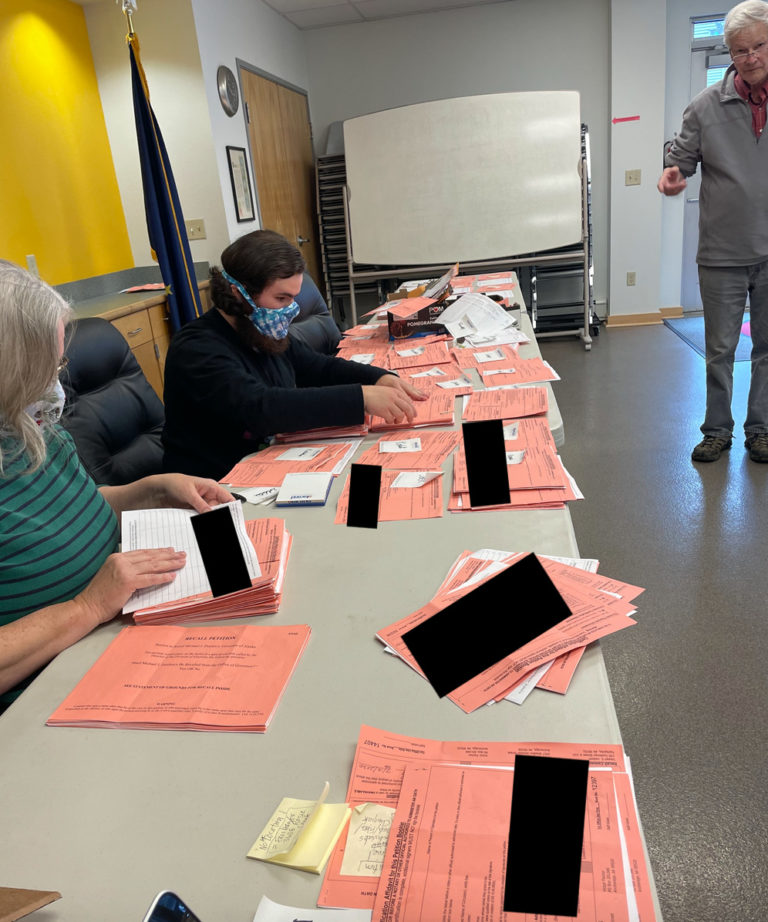
The Recall Dunleavy Committee has released names, drivers’ license numbers and signatures of some of their petition sponsors.

The committee, in an email to their supporters, posted a photo that showed the information that exposes at least two recall supporters to identity theft, possibly more for someone who has the technology to zoom in and decipher the data.

The committee has been collecting signatures on petitions for two years. Its efforts started in 2019, when the disgruntled Democrats started collecting signatures on an application for a recall petition from the Division of Elections. The group had registered the website Recall Dunleavy in February of 2019, shortly after the new governor had proposed a budget with many cuts in it.

Once that petition was granted, the actual petition booklets started circulating. But that means the Recall Dunleavy group has the names, addresses, signatures and, in some cases, the drivers license numbers for hundreds of Alaskans.

Security for that information does not seem to be a priority for the committee.

Several weeks ago, a website was established by the opposite group, called “Keep Dunleavy.” It allows people to easily remove their names from the petition. The people behind the website “remove signature.com” say they have been getting “a lot” of people taking their names off the Recall Dunleavy petition through the website.

Read: New website allows Alaskans to remove their names from Recall Dunleavy petition

Meanwhile, while others are honoring the war dead on Monday, the Recall Dunleavy Committee will be using Memorial Day to try to collect signatures at Pioneer Park in Fairbanks.

No, state pink slips will not go out June 1

The Alaska Legislature is not going to finish its work on the State of Alaska budgets before the end of the month, and without an operating budget, pink slips could be issued on June 1 for a government shutdown July 1.

That’s how the Walker Administration handled it twice during similar legislative delays, as he used “fear theater” to try to harass the Republican-led Legislature.

But there will be no pink slips on Tuesday. They are not required and there’s no evidence the Legislature won’t get its work done.

By law, the Dunleavy Administration must give workers 10 working days notice if the government is likely to shut down. That day would be June 17. The special session ends June 18.

This is not to say that supervisors in the State won’t let workers know on Tuesday that the budget hasn’t been finalized, but since the budget is really on the five-yard line, Gov. Mike Dunleavy has not seen it helpful to jack up the workforce. Nor is it his way to play the games that Walker played.

Both sides — House and Senate — are close on the Operating and Capitol budgets, and the Permanent Fund dividend will be reconciled, although not to the satisfaction of many. The way the budget bill has been designed this year, with everything crammed into one budget, has just made the whole thing trickier.

Sending out the “fear theater” pink slips resulted in needless harm in 2015 and 2016. It caused workers to become distracted, and many did something that seemed rational to them at the time — they rushed to their doctors and dentists to get work done just in case they were out of work and out of benefits. The run on medical services caused the state to have to pay enormous medical costs that year as an unintended consequence.

The House and Senate conference committee is hashing out the differences between the two budgets, but have no meetings on the schedule over the Memorial Day weekend. Work is planned for Tuesday.

The State is awash in money from the American Rescue Plan Act, but that is not a comfort for the tens of thousands of state workers who are hearing from the media that they might get laid off.

Anchorage muni clerk insults election observers as Washington Post picks up the story and blames Bronson volunteers

For Anchorage election workers, this month’s mayoral runoff was like no other, according to the Washington Post.

That much is true, but not informative: All election runoffs in Anchorage are unlike any other runoffs, but with the new all-mail-in election, this was the first mayoral runoff Anchorage has had under the new system.

This runoff stood alone in many respects, not the least of which that it appeared to be a close election. It deserved scrutiny, at least in the eyes of conservatives, many of whom are now less accepting that election centers around the country are being run fairly.

Also, since the mail-in elections started in 2018, there was an active campaign watching the ballot-counting process. It was more than apparent that Anchorage Municipal Clerk Barbara Jones didn’t like the scrutiny. She became more and more agitated as the days went by. Some days, observers said she was on the verge of “losing it.”

She told the Anchorage Assembly in her election report last week that her workers were accosted in the parking lot, when in fact, they were observed at the Election Office hours after they had told Bronson campaign volunteers they were done for the night, that they were going home. Bronson volunteers asked them what they were still doing there, after they had stated they were done for the night. This, according to Jones, is accosting.

The Washington Post reported that talk radio and blogs (really?) reported blank ballots being “smuggled into the Election Center, which Jones described as part of an effort to “sow distrust among voters.”

The reporter from the Washington Post was willing to allow these allegations to go unchallenged. The reporter’s call to the Bronson campaign came at 8 9 pm Alaska Time, the night before the Post published the story at 1 am. The Bronson campaign was not able to respond in time, but such are the techniques of fake news.

Jones’ and the Washington Post‘s parroting story is inaccurate: No one ever said the ballots were “smuggled in.” No blog has suggested that. No news agency ever suggested that.

In photos, Must Read Alaska showed they were brought in during broad daylight, and that caught the eye of Bronson elections observers who wanted to know, understandably, why boxes of blank ballots were arriving in the Election Center where marked ballots were being counted.

Read: What? Blank ballots hauled into Anchorage ballot counting center

In fact, Must Read Alaska wrote, “In what may be seen as an act of transparency or sheer cluelessness, election workers unloaded 50 boxes of blank ballots at the Anchorage Election Office on Friday, and stacked the boxes in one of the spacious rooms. In broad daylight, while counting is underway in the mayor’s runoff election.”

The Washington Post’s fake news machine interprets this as MRAK stating the ballots were “smuggled in.”

The boxes of blank ballots created a reasonable concern for observers, because this procedure was something never seen before by the public. Yet Jones acted as if this was an outrageous degree of curiosity.

It soon became clear to the Bronson campaign that the Election Office had not only blank ballots, blank envelopes but the ability to print bar codes on them — everything it would take to sway an election, and all in the same place where marked ballots were arriving. What could possibly go wrong?

It deserved an explanation, one that should have been offered to the campaigns in advance.

The Post also didn’t report that Jones had never faced any scrutiny before and thus was not emotionally prepared to handle it, nor did she have a good system in place to respond to challenges, many of which she has described as outrageous.

For example, when thermal totes filled with pizza boxes arrived at the Election Office, one Bronson volunteer asked to look inside, just to make sure those were pizzas in those big totes. Call it outrageous, but after the 2020 General Election, volunteers can’t take anything at face value.

The ramped-up scrutiny began when Jone and her staff failed to lock the door of the Election Center on election night. A citizen rolled through the parking lot and recorded a woman, after 11 pm, opening the door of the ballot counting building, because it had been left unlocked. Must Read Alaska posted the video. None of this is reported by the Post.

The next day, the Bronson campaign parked an RV outside the building and kept it staffed 24 hours a day with wide awake volunteers taking shifts to provide some sense of oversight to what was looking like a loose operation.

Jones also reported to the Assembly last week that observers were openly hostile to her. Losing candidate Forrest Dunbar reported to the Washington Post that those hostile observers were from the Bronson campaign, and the Washington Post ran with that as the truth. The sour-grapes candidate and the offended election clerk were the echo chamber corroboration for the fake news machine.

The Post reporter had not seen how collegial and “jokey” the Elections personnel were with surrogates of the Dunbar campaign, and how the Dunbar campaign had sent her flowers in the middle of the counting process. Those flowers came from Assemblyman Chris Constant, who was there on behalf of the Dunbar campaign daily.

The Post didn’t write about how a fire alarm went off moments after Constant had signed out of the building one day, and the building was evacuated for the false alarm. The Post didn’t report that the Fire Department union had endorsed Dunbar.

As both Assemblymen Constant and Dunbar are her employers, Jones is beholden to them and the other liberal members of the Assembly who had endorsed Dunbar. They can fire her at any time.

The Post did not report that the Dunbar election observers would appear just moments before the Clerk would announce the staff was going to do ballot adjudication, which gave Bronson volunteers the distinct impression that the Clerk had texted the Dunbar camp to let them know they should come over. An enterprising reporter should file a public records request for text messages sent between personnel at the Election Office and Constant and Dunbar and his campaign workers.

(Note to Jones and the Election Office in Anchorage: Did you destroy those text messages already? There are screenshots.)

What the Post did not know about was the open disdain that the election workers showed toward the volunteers from the Bronson Campaign.

Nor did the Post report on the ageism displayed by Jones as she told the Bronson campaign manager that, due to his age (all of 21) he could only speak when spoken to by his elders, including her. When he asked questions, she shouted at him and directed him to shut up. There is a recording of her bullying him.

What the Post doesn’t know is that the things Jones said was recorded by witnesses. What the Post doesn’t know is that Must Read Alaska has heard the recordings of her wild ranting and insulting of the Bronson campaign.

The Post doesn’t know that the attorney hired by the Municipal Clerk to oversee and consult on the the elections is the same attorney who has a separate contract with the company that runs the Dominion voting machines for Anchorage.

But Jones got the last word in the mainstream media, attacking the Bronson campaign volunteers with a vengeance. As with other stories placed in The Washington Post by leftists, this one was poorly reported and told but one side.

Jones released a report to the Assembly in which she complained loudly about the intensity of the volunteer observers, and how they were intentionally harassing her and her workforce.

She wrote the report not knowing that everything she said to Bronson volunteers is recorded, and that the campaign has been incredibly kind to her by not releasing the tapes to the media.

Read Barbara Jones’ report to the Assembly complaining about Bronson volunteer observers

Breaking: Permanent Fund hits $80 billion

The Alaska Permanent Fund hit $80 billion today, double what it was 10 years ago.

On Feb. 28, 1977, the Permanent Fund received its first deposit of dedicated oil revenues: $734,000. The fund has made money almost every year, except in 2009, when it lost 18 percent. It also lost money in 2001 and 2002, just 3.26 percent and 2.24 percent respectively. In 2020, the year of the pandemic, total return was 2 percent.

Back at the onset of the fund, investments were comprised almost entirely of bonds, while the Legislature had a four-year public discussion regarding whether the Permanent Fund should be managed as an investment fund or as an economic development bank.

In 1980, Gov. Jay Hammond signed a bill in 1980 creating the Alaska Permanent Fund Corporation for the purpose of managing investments.

That year, the Alaska Legislature also approved the first Permanent Fund Dividend program, and the first dividend check of $1,000 was distributed two years later.

This year, the statutorily determined dividend would be over $3,000, but the Alaska Legislature is debating how much to appropriate for the dividend. The House has appropriated nothing, while the Senate voted on a $2,300 dividend, and the governor has a proposal to settle the matter by putting the formula into ths Alaska Constitution, which would require a vote of the people.