Sunday, October 18, 2026
Home Blog Page 1100

More details released on shooting of trooper in Anchor Point

Troopers have released details about the events that preceded a man shooting at an Alaska State Trooper on Aug. 23, when an Alaska State Trooper assigned to Anchor Point observed 60-year-old Anchor Point resident Bret Herrick at a business in downtown Anchor Point.

Herrick was known to the officer to have multiple warrants out for his arrest. The trooper attempted to arrest Herrick on his outstanding warrants and Herrick produced a handgun and fired on the trooper, striking him multiple times.

The trooper also fired his service pistol, and as another trooper arrived, Herrick fled on foot.

“Law enforcement from across the region, Department of Public Safety aircraft assets, and Alaska State Troopers Special Emergency Reaction Team members from across the state descended on Anchor Point to search for Herrick. Search efforts were ongoing throughout the day and into the evening.

On Aug. 24, 2021, at approximately 0840 hours, an Alaska State Trooper SERT team located Herrick near his Anchor Point residence while following up on a tip.

Herrick was arrested without incident for his four outstanding arrest warrants, and additional charges are anticipated for yesterday’s incident.

The name of the trooper who discharged his weapon (and who was also wounded by the suspect) will be released, per department policy, after 72 hours.

Read: Troopers arrest man wanted in shooting of Alaska State Trooper

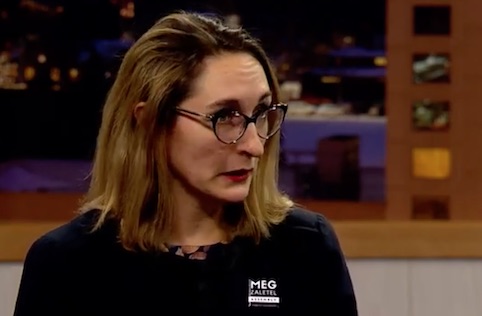
Zaletel adds sneak item to Assembly agenda: Mandatory masks in Muni

Assemblywoman Meg Zaletel put a “laid on the table,” which is a last-minute agenda item, into the Assembly meeting packet: It’s an ordinance requesting that the mayor enact a mask mandate in all indoor areas of municipal buildings, and to enact some unspecified mitigation measures for the entire municipality when Anchorage is in a “substantial risk or high alert level for community transmission of Covid-19.”

Zaletel represents midtown Anchorage and is the subject of a recall election that may reach voters in her district in October.

One of Bronson’s first acts as mayor was to lift any mask mandates for the municipality.

Read: No masks required or mandatory vaccines for Muni

Tonight’s Assembly meeting, which starts at 5 pm at the Loussac Library, may be contentious for that, in addition to the Assembly’s expected rejection of Sami Graham as the city librarian. Graham was nominated for the post by Mayor Dave Bronson. Numerous Democrats have lined up against Graham, who is the former principal of Grace Christian School. The Democrats have flooded the inboxes of Assembly members with letters of opposition.

Read: Assembly prepares for the kill of Sami Graham as Librarian

Breaking: Troopers arrest man wanted for shooting trooper

10

Alaska State Troopers arrested 60-year-old Anchor Point resident Bret Herrick in Anchor Point at a residence at about 8:40 am Tuesday. Herrick was wanted in connection with the shooting of a trooper on Monday in Anchor Point, which is a community on the Kenai Peninsula.

The shelter-in-place has been lifted for Anchor Point and surrounding neighborhoods. Herrick was on the lam for about 24 hours.

“The Alaska State Troopers would like to thank the Anchor Point community for the valuable information that was provided that resulted in Herrick’s arrest. There will be an increased law enforcement presence in Anchor Point today as Troopers continue their investigation in the incident that occurred yesterday,” the Troopers reported.

Herrick has a long list of prior contact with law enforcement and the court system for offenses such as kidnapping, robbery, and domestic violence.

Read earlier story here: Suspect on the lam, wanted for shooting trooper.

Barbara Haney: Alaska should not have to enact an income tax to pay for government

By BARBARA HANEY

In the recent revenue discussions in Alaska, there have been attempts to popularize the notion that economists judge taxes based on distributional analysis.  Economists do consider the fairness of taxes; it is not the ultimate rata of determining tax policy.  This brief missive is an effort to set the record straight on the matter. 

While I realize it is difficult to imagine with barrel prices in the $65 to $70, a Permanent Fund value over $80 billion, and a rate of return on the fund over 28%, that Alaska would even need to levy taxes, here we are, courtesy of the Percent of Market Value (POMV) statute imposed by a prior Legislature (SB 26 in 2017).

At the outset, I would like to point out that not all revenue proposals involve a “tax.” Governments have many tools they can use to generate revenues, and some governments have more tools than others.  In an earlier time when the state of Alaska faced a similar budget crisis, they chose land sales, lower permanent fund dividend checks and strict budgeting measures as part of their solution set. 

There are several revenue proposals in Alaska’s current crisis that do not involve taxing Alaskans. They could take an overdraw of 7-10% and still leave the permanent fund with a year-to-date return over 18%. Hopefully, these proposals will be given the serious consideration that they deserve. 

But this has not fully halted the tax discussion. In recent years, that three-letter word has been bandied about with this term called “distributional analysis.” Distributional analysis looks at how various taxes affect different income groups-and often a means by which revenue discussions are hi-jacked to become discussions of income and wealth redistribution. 

The truth of the matter is that the wealthiest people will find ways around a tax that is onerous- and they often regard it as a bit of a sport.  Indeed, there are entire industries that thrive on finding loopholes in the federal tax code. 

The poorest people also avoid taxes because they have no money to buy anything and no income to tax- those at the upper end of the poverty ladder on government assistance have tax-free EBT.

So, draw all the graphs you like of all the income strata you like- the richest and the poorest are almost never taxed by any appreciable amount and it is those in the middle income that always bears the brunt of a tax.

The primary objective of a tax is to obtain revenue to finance government operations, not to redistribute wealth.  Some people think it is an effort to legislate morality or altruism- and sometimes moral arguments are made to defend a particular tax measure, but that does not mean the principal goal of the tax is not revenue. 

If the objective was anything other than revenue, there would prohibitive alcohol and cigarette taxes- and they are levied on these products because the consumers of these products are a bit habitual and relatively insensitive to price changes in the short run; economists often called an inelastic demand.  If the goal was truly morality, the tax on alcohol and cigarettes would be twice what they currently are in Alaska. But if the tax was double, it would be worth the hassle to have friends send me cartons from a low tax area such as Missouri, or to engage in my own production. Clearly, the rate is set to maximize revenue, not to prohibit the activity.

Collecting revenue is only part of the equation in evaluating a tax; it should also be relatively low cost to collect. Collecting a million dollars in taxes and spending two million to collect the tax is counterproductive. Hiring a cadre of accountants to do audits (like 102 in Montana for their income tax) and the purchase of millions of dollars in software and equipment to collect an income tax, even if a low rate, is not exactly the lowest cost revenue option the state could select.

In fact, that is why “taxing” a portion of the Permanent Fund has been the preferred revenue source of the legislature — it yields revenue without the costly revenue agents.  The bigger the bureaucracy needed to collect a tax, the less profitable it will be relative to other taxes. 

Another consideration in collecting taxes is the disruption in choice sets those taxes create- often referred to in economics as distortions or inefficiencies. Optimally, one would like to minimize the disruption in choice sets and the actions of people in the market. One tax of sorts is the withholding of the permanent fund dividend, which has amounted to a 45-50% “tax” on that source of income.

Whether you are rich or poor, smart or dumb, newborn or dying, Alaskans have faced high tax rates on their PFD earnings — and this year it seems to be a 100% tax. 

Given the population data showing the net outmigration from the state since 2016, it seems Alaskan residents are likely to vote with their feet to warmer climates. While some banter the drum that the state needs to “fund services,” one has to wonder what services need to be provided to a depopulated state. 

In sum, the state of Alaska is in a position that it should not have to levy taxes, and it certainly has several non-tax revenue options. But should the Legislature decide to tax the people of the state, it should base its tax selection on its ability to obtain revenue at the lowest administrative cost and in a manner that is least disruptive to the economic decisions of those who are taxed.

However, I would encourage the legislators to give all other fiscal measures a full examination before implementing taxes. 

Barbara Haney received her Ph.D in Economics and Public Finance from the University of Notre Dame and previously served as the director of the Center for Economic Education at the University of Alaska Fairbanks and as a private consultant. She is currently staff to Rep. Mike Prax, House District 3. 

Covid vaccine added to list of shots students must have to live in UAA dorms

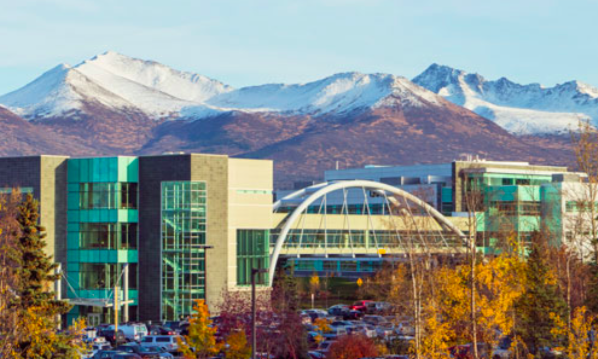
Move-in weekend just ended for the University of Alaska Anchorage dorms, and there was a new item students living in university housing need to pack — a Covid-19 proof-of-vaccine card.

The decision to mandate the vaccine for campus housing was made earlier this year. Students must have other vaccines also:

  • Meningococcal vaccine (required for students under 21 and highly recommended for students 21 and older)
  • MMR (measles, mumps, rubella)– 2 doses
  • Tetanus-Diphtheria– must have been within 10 years

Students also must show a tuberculosis test with a negative result within six months prior to moving in.

UAA has three large resident dorms, each of which can house about 200 students. There are also apartment-style options for students who are 21 and older.

Although Gov. Mike Dunleavy has said there will be no mandatory vaccinations required for state workers or facilities, he does not have oversight over the University System. That rests with the Board of Regents, and chancellors at each individual campus.

Students in the allied health sciences programs at UAA have an expanded list of vaccines with which they must be current:

School of Allied Health students are typically required to show proof of immunity either at the time of program selection or show proof of immunization prior to registration for:

  • Rubella/Rubeola/Mumps Vaccine or Titer
  • Varicella (Chicken Pox) Vaccine or Titer
  • Tetanus/Diphtheria/Pertussis Vaccine
  • Hepatitis B Vaccination Series AND Hepatitis B Immunity Titer
  • Hepatitis A Vaccination Series
  • Proof of freedom from active Tuberculosis
  • Annual Influenza Vaccine

Covid-19 vaccines have not yet been added to the list posted on the university’s website for that program.

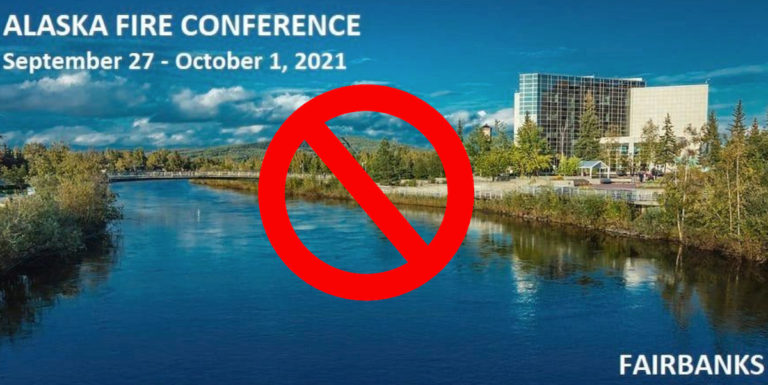
Fairbanks: Alaska Fire Conference canceled

The 2021 Alaska Fire Conference in Fairbanks has been canceled due to the surge in cases of Covid-19 around the state and country, the planning committee for the event announced today.

“The safety of the public and the state’s first responders is of utmost importance to the command staff and this decision was not made easily,” the group wrote.

The annual conference, which was also skipped last year, rotates to various communities around the state and was to be in Fairbanks on Sept. 27 through Oct. 1.

Usually, over 100 fire and emergency services professionals attend these training conferences, which are also a boon to the local economy. Plus, wherever there’s a fire conference happening, the public has an enhanced level of safety.

Trooper shot in Anchor Point, suspect on the lam

A man with a long history of trouble with the law is being sought by Alaska State Troopers in connection with the shooting of a trooper at about 1 pm in Anchor Point on the Kenai Peninsula.

Troopers seek 60-year-old Bret Herrick, while the trooper was taken to South Peninsula Hospital, where his condition has not been released.

The trooper was shot behind the Warehouse Store in and Alaska State Troopers are active in the area, searching for Herrick, who is considered armed and dangerous.

Herrick was charged in 2012 for kidnapping and robbery, but was released on a plea deal that his attorneys made with in 2013. He only served about five months.

Update: Herrick was last seen wearing work boots, dark pants, knee-length leather trench coat, black t-shirt, and a black do-rag on his head. Herrick is 5’10”, 200 pounds bald, and has brown eyes. He is bald.

Troopers are asking drivers to not pick up hitchhikers in the Anchor Point area. 

The trooper who was shot has been medevaced to an Anchorage area hospital for additional medical treatment. The trooper is in fair condition. 

Oil tax hike cabal shutting down operations

Vote Yes for Alaska’s Fair Share filed with the Alaska Public Offices Commission and said it is shutting down operations.

The group had formed two years ago to put an oil tax hike on the ballot, but voters in 2020 once again rejected their efforts by a margin of 58-42 against the The Fair Share Act initiative.

The filing with APOC on Aug. 13 indicated the group has no further plans for the ballot initiative and is closing its campaign account.

(This story corrects the item in the Monday newsletter, which simply indicated the group had refiled with APOC.)

Breaking: Mayor pulls all board nominees from Assembly agenda

This story has been updated: Mayor Dave Bronson on Monday has suddenly pulled all of his boards and commissions nominees from the Anchorage Assembly agenda.

They will not appear on Tuesday night’s meeting for confirmation.

They include:

  • Dr. Sean Degler, Health and Human Service Commission
  • Andria Dolan, Anchorage Women’s Commission
  • Bernadette Bradley, Bidding Review Board
  • Traci Willett, 49th State Angel Fund
  • Randy Suite, Budget Advisory Commission
  • Keith Manternach, Military and Veterans Affairs
  • Brian Flynn, Board of Building Regulations Examiners and Appeals
  • Keith Manternach, Public Safety Advisory Commission 

The Mayor’s Office has evidently realized that the liberal Assembly has declared war on his administration, which is seven weeks old, and that his nominees are all going to suffer harsh treatment, as did Sami Graham last week during an Assembly work session. Another nominee, Dave Morgan, withdrew after it was evident the Assembly would not confirm him to direct the Anchorage Health Department.

This is a developing story. Check back for details.

Read: Anchorage Assembly sets to kill nominee for library