Former President Donald Trump will host a fundraiser for U.S. Senate candidate Kelly Tshibaka in February.
The high-dollar event will take place at the Mar-a-Lago Resort in Florida on Feb. 10, 2022, according to the invitation obtained by Must Read Alaska. The minimum contribution is $2,900, which is the maximum campaign contribution allowed by federal campaign laws. Those who can bring in $25,000 in donations from others will get to have their photo taken with Trump and Tshibaka.
Trump earlier this fall hosted a fundraiser at his Trump National Golf Club in Bedminster, N.J. for Gov. Mike Dunleavy’s reelection campaign.
Trump endorsed Tshibaka in June, less than three months after she announced her run against Sen. Lisa Murkowski, who has been representing Alaska in the U.S. Senate since 2002.
“It’s a great honor to have the endorsement and enthusiastic support of President Trump and I am thrilled that he will be hosting this event. His policies were the best for Alaska, which we can all see even more clearly now that the Biden administration has launched an all-out assault on Alaska workers and our entire resource economy. I will be a senator who represents Alaska to Washington, D.C. rather than one who represents D.C. insiders to Alaska, as Lisa Murkowski has done,” Tshibaka said.
In what can only be described as a full refutation of a progressive agenda, Matanuska-Susitna Borough voters turned back a host of liberal candidates in the deep red heartland of Alaska.
On Municipal-Borough Election night 2021, voters overwhelmingly supported well-known conservatives for borough Mayor, Assembly, and School Board. Conservative candidates are averaging 62.8% of ballots cast in those elections.
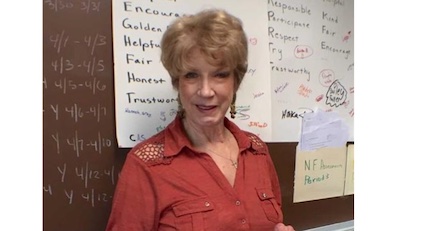
In a battle for the Mat-Su mayor’s post, longtime politico, current Palmer mayor and former State Senator Edna Devries handily defeated former Wasilla Mayor Bert Cottle and and former Assemblyman Matt Beck. In most precincts she garnered more votes than both her opponents combined.
DeVries was a formidable candidate. She served on the Palmer Council and was chairman of the Planning and Zoning Committee. She is a former member and vice chair of the Alaska Commission of Aging, and former member and chairman of the Human Rights Commission. She also has 29 years of business experience, including as a real estate broker, owner of three Christian book stores, and a pizza restaurant. Along with her husband Noel, she ministers to abused women and the homeless, and runs a School of Government class for the public. She was previously mayor of Palmer, borough Assembly member, borough mayor, as well as a state senator.
The unofficial final count for mayor was Devries-7,623, Beck-3,577, and Cottle-2,000
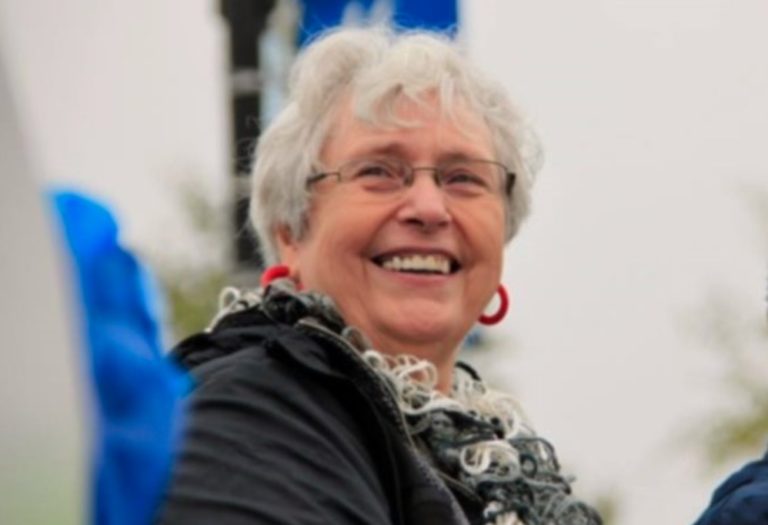
DeVries was not the only big winner. First-time candidate Dolores McKee mopped the floor with her liberal union activist opponent. McKee is wife of current Assemblyman George McKee, mother of former Americans for Prosperity Director Ryan McKee, and sister of former Senate President Pete Kelly.
DeeDee, as she is known, was heavily outspent, nearly 2-1 in the race. At the conclusion of election night, she was winning the race approximately 65%/35%, a landslide.
Dolores McKee
The unofficial final count in Assembly District 3 was McKee-1,180, Bailey-427, and Kruger-198.
Incumbent Assemblyman Jesse Sumner turned back two challengers, garnering over 66% of the votes on election night. He is a young and growing political force in the state after jumping in to serve on the Assembly three years ago. The unofficial final count in Assembly District 6 was Sumner-1367, Short-563, and Clippard-133.
Jesse Sumner
Conservative school board Chairman Tom Bergey took nearly 63% of the vote. The final count was Bergey-1,592, Berrigan-940.
Tom Bergey
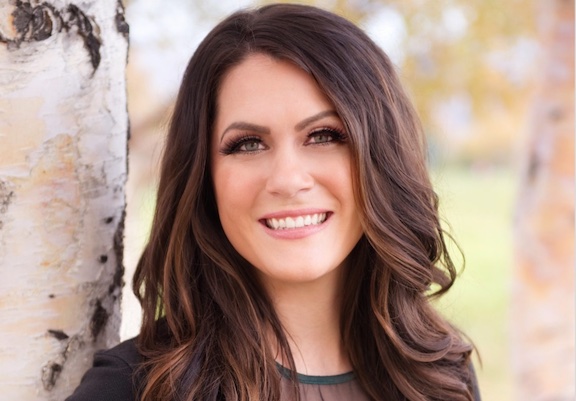
Newcomer to politics Jubilee Underwood claimed over 67% of the vote in her school board election. The final count was Underwood-846, Walther-413.
Jubilee Underwood
Ron Bernier, owner of JP Construction, won handily for Assembly District 7. The final count was Bernier-1,192, Boeve-737.
Ron Bernier
With the Mat-Su Borough being the second largest and fastest growing region of the state, these landslide election results must be deeply concerning for former Gov. Bill Walker, who seeks to return to that seat after being trounced by voters in 2018.
The Mat-Su Borough is home to Gov. Mike Dunleavy and the most conservative legislative delegation in the state. It counts House Minority Leader Cathy Tilton, Senate Majority Leader Sen. Shelley Hughes, and Sen. David Wilson on the Senate Finance Committee and Rep. DeLena Johnson on the House Finance Committee as delegation members. This is not an area that can be lightly dismissed. Any statewide election, including the U.S. Senate and House of Representatives seats, will depend on this region for a victory in November 2022.
Mat-Su voters changed their election date through a ballot measure in 2018 to line up with the national General Election; this is an off-year for a statewide election, and so the Mat-Su is the only borough or city in the state with election results.
The borough election appears to have been well run, with results coming in timely, unlike elections in communities that have moved to mail-in ballots, such and Anchorage and Juneau, where results are not known for many days and voters have grown wary of the chain of custody of ballots. In Juneau last month, hundreds of ballots were tossed because after they were mailed, the Post Office didn’t put a cancellation mark on them to indicate if they were mailed on time.
Conservatives appear to be sweeping the vote in the Mat-Su Borough elections, which ended Tuesday.
Palmer Mayor Edna DeVries appears to be handily winning in the Mat-Su Borough mayoral race. She has a lead in nearly every precinct so far, except for Talkeetna and the early voted ballots in the Borough Building, which is mostly where government employees cast ballots.
In most precincts, DeVries has more votes by herself than her two opponents combined, which would put her in the landslide victory category.
Delores McKee appears to be winning for Assembly District 3.
Jesse Sumner appears to be winning by a landslide for Assembly District 6.
Ron Bernier appears to be winning for Assembly District 7, but by a smaller margin than others.
Tom Bergey appears to be winning his re-election to the borough school board.
Jubilee Underwood appears to be winning for school board.
The bond issue on the ballot also appears to be winning.
Not all precincts have reported as of 10:30 pm Tuesday. Absentees have not yet been tallied.
A woman scorned? Bethel City Attorney Libby Bakalar, who was fired from the Alaska Department of Law in 2018, continues her profane attacks on the governor by redesigning the logo for one of his podcasts, which is called First Hand.
The podcast is meant to showcase members of the Gov. Mike Dunleavy Administration by having them talk about the various things going on in the departments. The first podcast was with Department of Health and Social Services Commissioner Adam Crum.
Bakalar published the logo by remaking it into male genitalia and labeling it First Hand Job. The result was crude in more ways than one.
Recently, Bakalar posted a graphic graphic of Sen. Lora Reinbold’s head on the end of a vibrator. She doesn’t actually live in Bethel.
As the city attorney for that Western Alaska hub community, she works from Juneau. Meanwhile, she has an active lawsuit against the governor and his former Chief of Staff Tuckerman Babcock for wrongful dismissal.
Bakalar, when she served as an elite attorney in the Department of Law, had been a key advisor to former Lt. Gov. Byron Mallott and his election task force, which was working to move Alaska’s elections to an open primary system, or else charge Republicans the cost of them having their own primary ballot. Mallott left office before that effort came to fruition, and Bakalar was released by the Dunleavy Administration against her wishes. She is represented by the ACLU in her lawsuit.
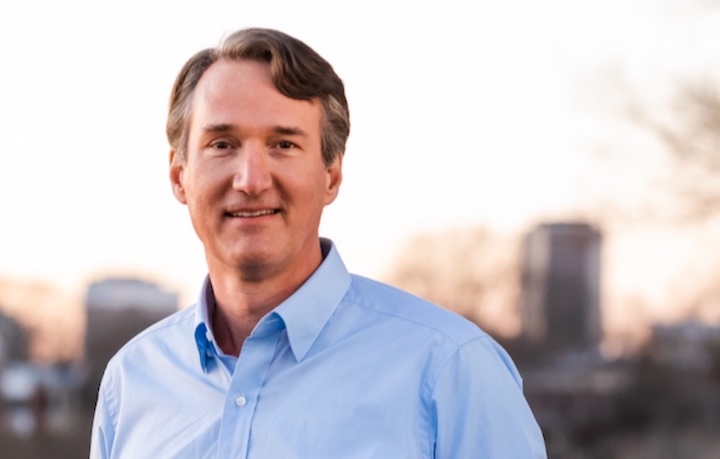
The new governor of Virginia will be Republican Glenn Youngkin.
Youngkin is a political neophyte who describes himself on his Twitter account as, “Former dishwasher, basketball player, player & businessman. Not a politician. Republican running for governor to make Virginia the best place to live, work and raise a family.”
Actually, he is the former co-CEO of the Carlyle Group, a major investment company, and he has a graduate degree from Harvard Business School in 1994.
With 2,505 of 2,855 precincts in, Youngkin is winning 51.6 to 47.7.
He’s new to politics, but Chugiak/Eagle River Assemblywoman Jamie Allard says it’s a repeat of what Anchorage saw in the spring election. Virginia, she said, seems has had enough of radical leftist politics, and a clear majority of them went with Youngkin.
“Virginia just pulled a Bronson,” Allard said, as she watched returns from her home. She was referring to Anchorage Mayor Dave Bronson, who upset the Democrat political establishment by winning the Anchorage mayoral race, when many thought he was too conservative to do so.
Youngkin defeated Democrat incumbent Gov. Terry McAuliffe, handing an embarrassing defeat to President Joe Biden and former President Barack Obama, both of whom campaigned for McAuliffe in recent weeks. During the last 60 hours of the campaign, the left-wing Lincoln Project pulled a stunt in which it paid men who were dressed as supposed white nationalists to pose in front of the Youngkin campaign bus with tiki torches. The stunt was an imitation of a supposed white nationalist rally in Charlottesville, Va., in 2017. The men declared “We’re all in for Glenn.”
The same kind of race-baiting tactics were used by mayoral candidate Forrest Dunbar’s camp in Anchorage, which tried to paint Mayor Bronson as a white nationalist.
Last week, the Lincoln Project claimed responsibility for the tiki torch white nationalist posers, and for paying the demonstrators to cast Youngkin in an ugly light. The Lincoln Project spent over $304,000 opposing Youngkin, who was endorsed by former President Donald Trump.
The shift in Virginia could signal a tidal change in America. Traditionally a blue state, seven of the last 10 governors of the state have been from the Democratic Party.
Tiana Lowe, a writer for the Washington Examiner, wrote that “Louden County voters voted like their daughters’ lives depended on it,” referring to the incident in Louden County where a high school girl was sodomized by a teenage boy who wore a dress and accessed the girls’ restroom under the school district’s “gender fluid” policy.
“Youngkin turned the traditionally blue state into a national bellwether by embracing what Barack Obama branded the ‘phony culture wars’ riling public school systems,” Lowe wrote.
“Youngkin managed to crush former Gov. Terry McAuliffe, a Democrat, in unprecedented time for a state that as recently as last November went for Joe Biden in the 2020 presidential race by 10 points. Despite McAuliffe’s best attempts to refocus the race on ex-President Donald Trump, Youngkin drew from parents’ fury not with partisan issues, but with academic curricula ridden with the racial essentialism of “critical race theory” and the school closures amid the pandemic,” she wrote.
“It was close, but then, in the weeks leading up to the election, something bigger happened — the horrific rape case in a Loudoun County public school and the school board’s brazen, transparently mendacious cover-up. While liberals tried to characterize the rape case, which culminated in two felony convictions against a “gender-fluid” teenage boy accused of sodomizing a teenage girl, as mere anti-trans activism, the school board’s decision to silence the victim’s father and allow the convicted rapist to attend another county school despite pending criminal proceedings likely influenced the county’s surge of support toward Youngkin,” Lowe wrote.
Virginia Republicans are set to win all three statewide races one year after Biden carried the state by 10 points.
Another odd tie between the campaign of Mayor Dave Bronson and Governor-elect Glenn Youngkin — they both used the same campaign consultant: Axiom Strategies.
Anchorage School Superintendent Deena Bishop announced today she will retire from the school district effective June 30, 2022.
She wrote to staff in the district: “I am reaching out today, as I want you to hear from me first, that I have made the decision to finish my six-year tenure in ASD effective June 30, 2022. (Soon this might make the news.)”
She continued, “It truly has been a fantastic opportunity for me and a highlight of my educational career to work with the amazing people in ASD. Thank you all for welcoming me into your schools, classrooms, and offices! My best days have been spent in schools where I have said often, the “gimba” happens. Schools should be a district’s gimba as that is where the real work and value are added to our mission with children.
“Over the years, we have faced unexpected obstacles and tough decisions. A quote attributed to Theodore Roosevelt articulates our journey – ‘Do what you can, with what you have, where you are.’ Whether the conditions have presented us with good things or trying conditions, ASD, I am so proud of the work you have accomplished. We have moved through both the best and most taxing of times!,” she wrote.
I have truly loved watching student learning happen, listening to our outstanding musicians, cheering for our teams, observing your lessons, and hearing about the successes and quick wins you have shared in the work,” Bishop wrote.
Bishop was the superintendent of the Mat-Su Borough School District from 2011-2016, when she was named Anchorage superintendent. After college, she taught in the Copper River School District, taught middle school for the Mat-Su Borough School District in 1993, and was assistant principal of Colony High School. She became assistant superintendent of instruction in 2007 for the Mat-Su Borough School District. This year she applied to become the chancellor of University of Alaska Anchorage, a job that was subsequently awarded to former Gov. Sean Parnell by Interim University of Alaska President Pat Pitney.
“I look forward to finishing this school year strong and working with the School Board to transition a new superintendent. Thank you again for all you have done and continue to do for the young people in our community,” she wrote.
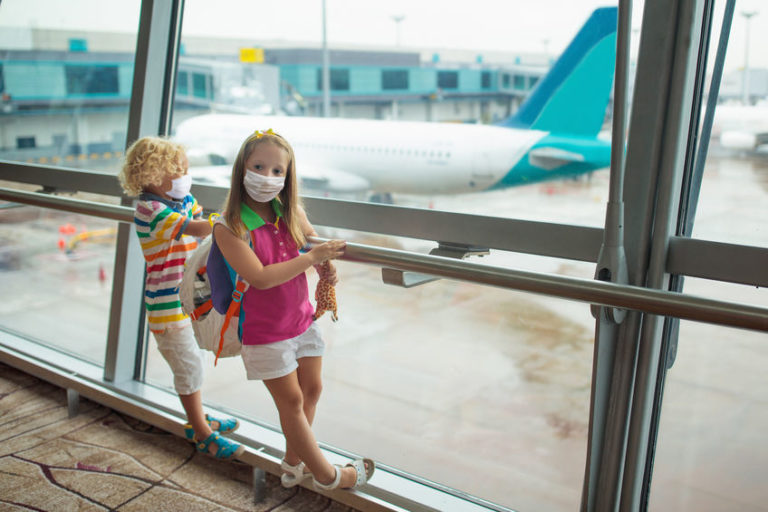
The head of the Centers for Disease Control and Prevention, the last hurdle to using the Covid vaccines on young children, has given its OK. As expected, CDC Director Rochelle Walensky on Tuesday gave her blessing to the Pfizer-BioNTech Covid-19 vaccine for children ages 5 to 11 years.
“As a mom, I encourage parents with questions to talk to their pediatrician, school nurse or local pharmacist to learn more about the vaccine and the importance of getting their children vaccinated,” Dr. Walensky said Tuesday.
Last week, another top health official in the Biden Administration referred to her trusted status as a mother in recommending the vaccine for children:
“As a mother and a physician, I know that parents, caregivers, school staff, and children have been waiting for today’s authorization. Vaccinating younger children against COVID-19 will bring us closer to returning to a sense of normalcy,” said Acting FDA Commissioner Janet Woodcock, M.D. “Our comprehensive and rigorous evaluation of the data pertaining to the vaccine’s safety and effectiveness should help assure parents and guardians that this vaccine meets our high standards.”
The approval process went exactly as planned, with the FDA giving its approval quickly last Friday after its advisory panel gave the agency the thumbs up.
There are 28 million children between the ages of 5 to 11. The vast majority of them who get Covid experience the mildest of symptoms, although future variants of the virus could effect them differently. According to the FDA, 146 deaths have occurred due to Covid in this age group.
The shot for kids is given in two doses, three weeks apart, and it is a lower dose than the adult versions. The dosage is based on age, not on size.
The state of Alaska has ordered 33,000 pediatric vaccine doses.
But not everyone is onboard. Last week, at a summit in Anchorage, leading doctors from around the country took the contrarian point of view and warned Alaskans to not use this vaccine on children — at least not now.
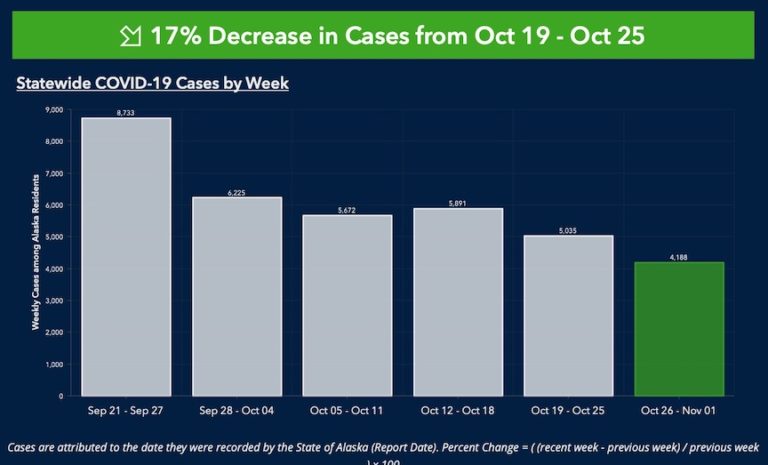
The number of new Covid cases on Monday in Alaska was 494. Six new Covid-related deaths were reported. The number of hospitalizations has dropped again, and is now 196. Overall, the trend is continuing toward, 17 percent lower than last week.
The cases by community are:
Anchorage (152)
Greater Wasilla Area (76)
Fairbanks (56)
Greater Palmer Area (29)
Nome Census Area (26 in 2 communities)
Kenai (18), Eagle River (16)
Soldotna (16), Utqiaġvik (13)
North Pole (12)
Juneau (10)
Kodiak ( 8 )
Chugiak (6)
Homer (6)
Petersburg (6)
Prince Of Wales-Hyder Census Area (6 in 3 communities)
Houston/Big Lake Area (3)
Kotzebue (3)
Nome (3)
Sitka (3)
Sutton-Alpine (3)
Anchor Point (2)
Dillingham Census Area (2)
Ketchikan (2)
NW Arctic Borough (2 in 2 communities)
Unalaska (2)
Willow (2)
One each in Bethel, Bethel Census Area, Bristol Bay/Lake and Peninsula, Copper River Census Area, Fritz Creek, Haines, Kenai Peninsula Borough-South, Kusilvak Census Area, Mat-Su Borough, Sterling, and Yukon-Koyukuk Census Area.
92 of the 117 staffed ICU beds across the state are full, leaving 24 ICU beds open.
318 of the 1,100 staffed non-ICU beds are available.
184 Alaskans are in the hospital with Covid, making up 18.8 percent of all Alaskans who are hospitalized right now. The number of Covid patients on ventilators has dropped to 27.
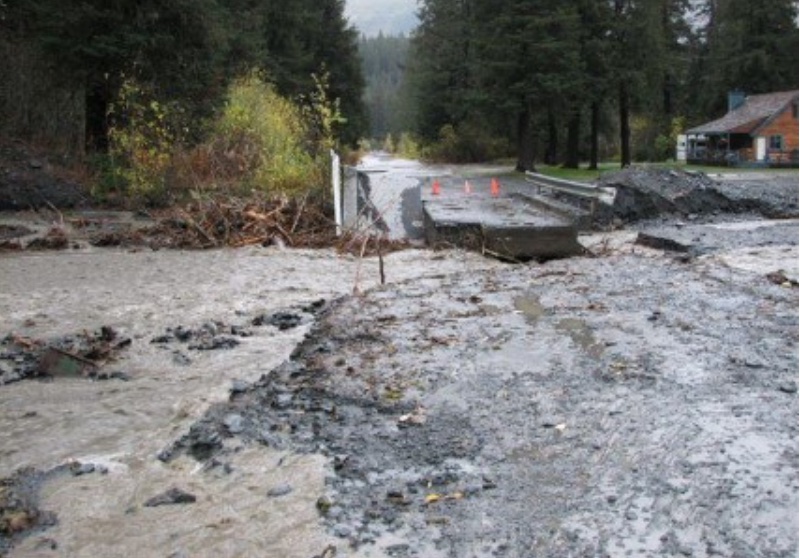
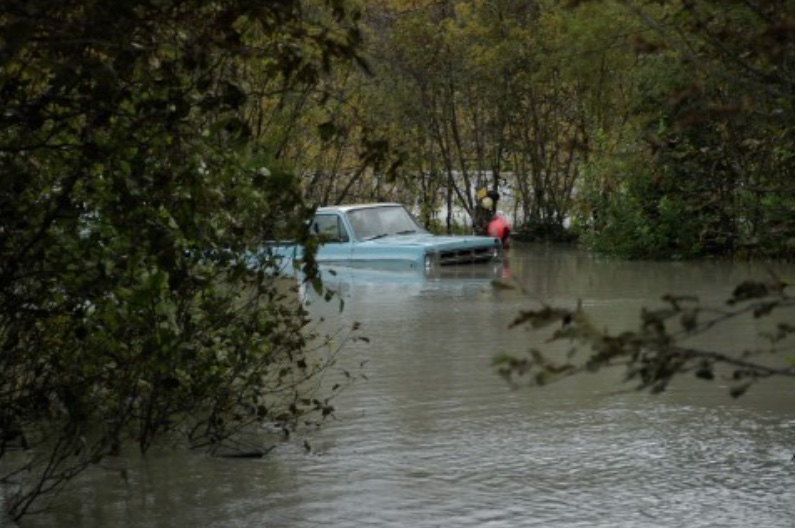
Heavy rain in Southcentral Alaska washed out roads from Girdwood, south of Anchorage, to the Sterling Highway on the Kenai Peninsula. Anchorage Mayor Dave Bronson went to Girdwood, the southernmost neighborhood of the Anchorage municipality, to survey the damage and express his appreciation to work crews working to restore the roads.
The Washington Post said the weather on the Kenai Peninsula was made worse by climate change.
“The deluge, intensified by climate change, has flooded communities south of Anchorage and transformed trickling waterways into raging rivers. Excessive amounts of snow, measured in feet, have buried the high terrain, and the long-lasting storm won’t fully relent until Wednesday,” the Post wrote, without evidence that the rainstorm had anything to do with climate change. But the climatologists said it it was so.
Girdwood is, of course, in a rainforest, as is much of the Chugach range, known as the most northern rainforest in the world.
The narrative is any change in the weather is climate change, but the Seward Highway and the Kenai Peninsula wash out in places on a regular basis.
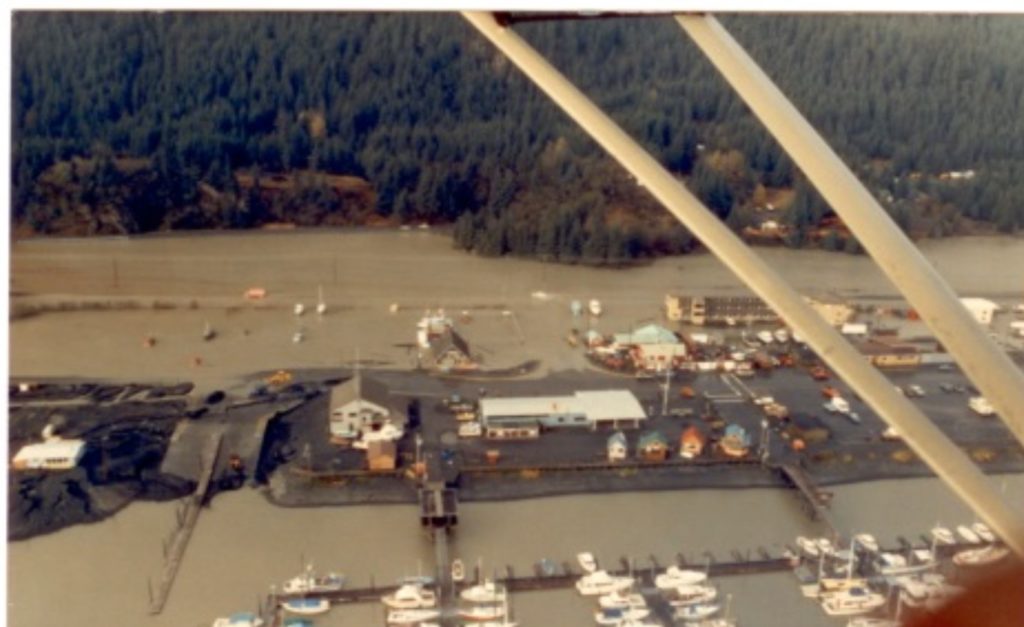
The 1986 Kenai flood in October was easily as dramatic, but climate change was not the rage back in the day with the mainstream media:
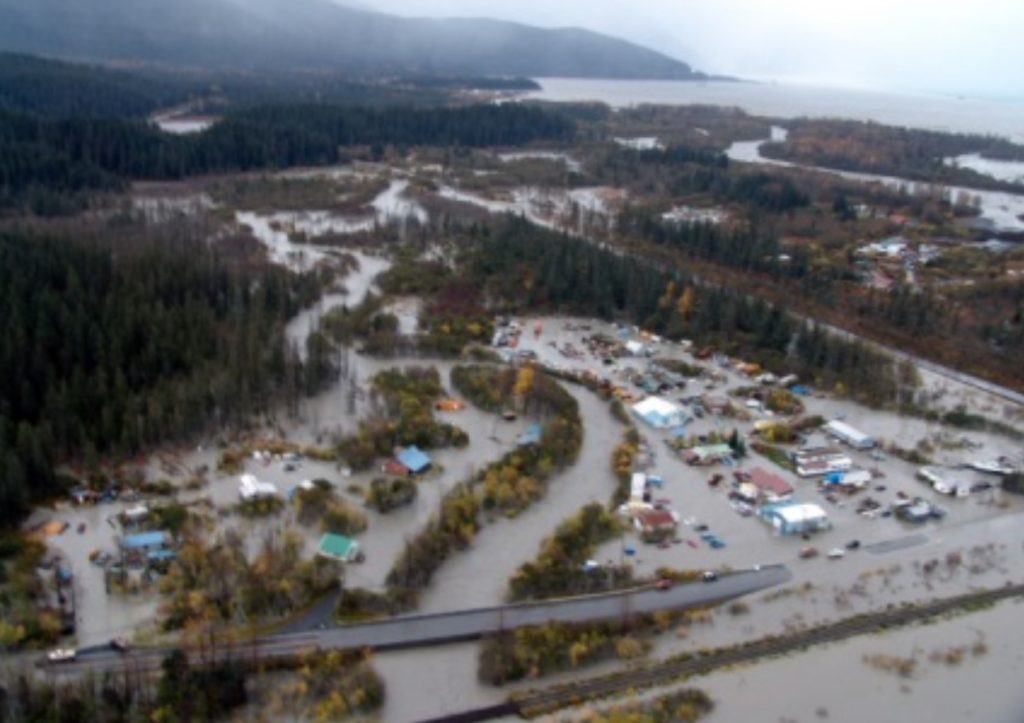
Then there was the Seward flood in September of 1995:
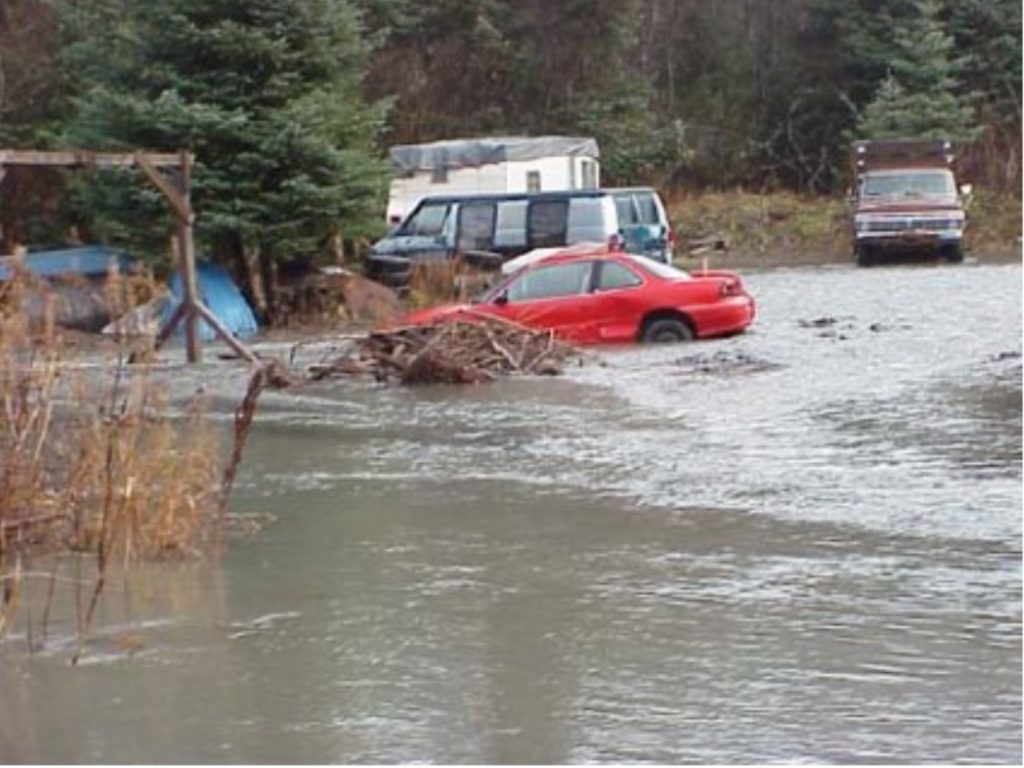
And the Kenai flood of October, 2002…
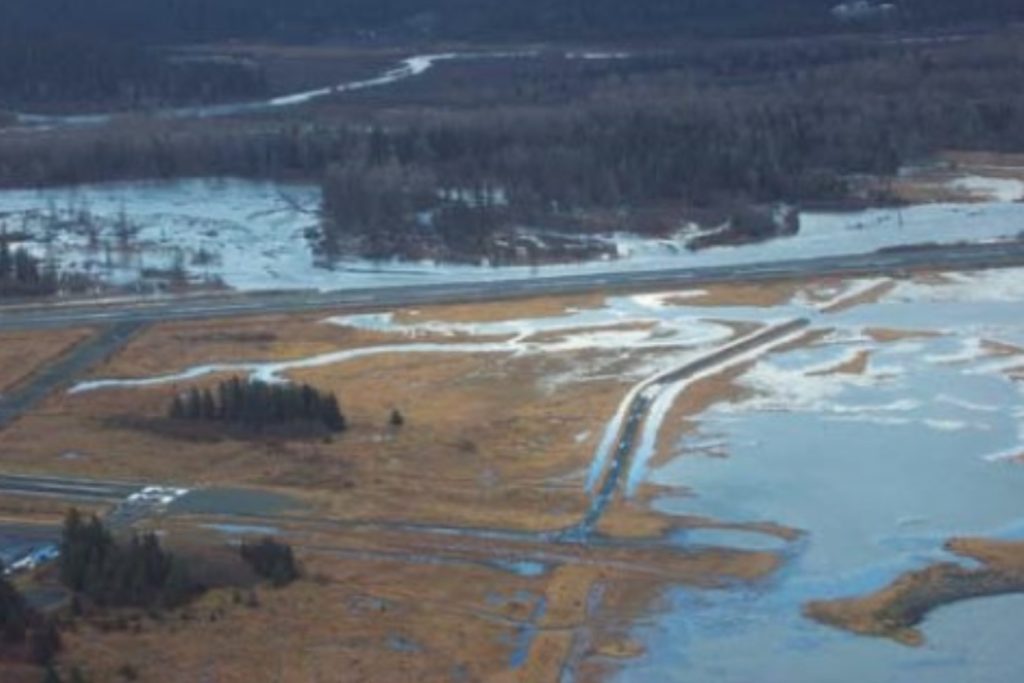
The Kenai 2006 flood was also in October …
View the Kenai Borough’s gallery of annual flood photos at this link. They go through 2012.