Friday, June 12, 2026
Home Blog Page 1016

Alaska signs onto letter to Biden: Vaccine mandate for contractors is unconstitutional

Republican attorneys general from 21 states, including Alaska Attorney General Treg Taylor, sent a letter to President Joe Biden on Wednesday saying that Biden’s Covid-19 vaccine mandate for federal contractors is “on shaky legal ground,” and may create problems in the nation’s already critically damaged supply chain.

Under the mandate, a private business would be required to force its employees to be vaccinated for Covid-19 before it could be awarded a federal contract or have an existing contract with the federal government extended or renewed. President Biden issued the mandate in a Sept. 9 executive order, and contractors have until December to comply.

“President Biden’s attempt to force vaccinations is, at the root of it, unAmerican,” said Gov. Mike Dunleavy. “These mandates cause division at a time where we need to work together. Forced medical decisions are counterintuitive – destroying America’s sense of fairness and liberty. My administration will continue to fight against these mandates to protect the inherent individual rights of all Alaskans. Medical choice is an individual American freedom.”

“Our laws prohibit this type of action, which is overreaching and inconsistently applied,” Taylor said. “This order improperly tries to use the force of law to punish federal contractors for decisions that should be left to them and their employees. Fortunately, federal and state law prohibits these bully tactics.”

Shortly after the Sept. 9 announcement by Biden that he will require all federal employees and contractors to be vaccinated,  24 GOP attorneys general sent him a letter warning that his actions were “unlawful and harmful” and “disastrous and counterproductive.” They threatened they would block it in court. Wednesday’s letter was yet another reminder that the states have legal remedies, but was not a lawsuit.

The letter maintains that the contractor rule is ambiguous and inconsistent with other regulations and existing laws. There is confusion about whether businesses with existing federal contracts would be subject to the mandate and how broadly the requirement would be applied across companies. Biden overstepped his legal authority when he issued the order, Taylor said.

“Like other mandates being imposed by the federal government, this mandate stands on shaky legal ground, cannot be reconciled with other messaging provided by the government, and forces contractors unable to make sense of its many inconsistencies to require that their entire workforce be vaccinated on an unworkable timeline or face potential blacklisting by the federal government or loss of future federal contracts. We strongly urge you to instruct agencies to cease implementing the mandate or, at a minimum, to provide clarity to agencies and federal contractors across the country and delay the mandate’s compliance date,” the attorneys general wrote.

“As an initial matter, agencies that implement the mandate may have their actions found unlawful and set aside as arbitrary and capricious. Many aspects of the mandate, as set out in Executive Order 14042, ‘Ensuring Adequate COVID Safety Protocols for Federal Contractors,’ and the subsequent ‘Safer Federal Workforce Task Force Guidance for Federal Contractors and Subcontractors,’ are internally inconsistent and at odds with actions taken elsewhere by the government to combat COVID-19,” their letter says.

Under the guidance issued by the Safer Federal Workforce Task Force, a “covered contractor employee” required to be vaccinated is any full-time or part-time employee “working on or in connection with a covered contract; or working at a covered contractor workplace.” The guidance defines employees working “in connection with a covered contract” as employees “who perform duties necessary to the performance of the covered contract, but who are not directly engaged in performing the specific work called for by the covered contract.”

That language appears to sweep in any employee with a tangential connection to a covered contract, even if that employee works remotely.

The attorneys general also questioned the logic for the mandate: “President Biden’s remarks in announcing the federal-contractor vaccine mandate highlight why the mandate is unnecessary. The President emphasized that ‘the vaccines provide very strong protection from severe illness from COVID-19 . . . [and] the world’s leading scientists confirm that if you’re fully vaccinated, your risk of severe illness from COVID-19 is very low.’ But the federal-contractor vaccine mandate seeks to protect the vaccinated—for whom the risk of severe illness is “very low”—from those who choose to remain unvaccinated. Not only is this reasoning illogical, but it is likely to increase skepticism about the vaccine in those who have chosen not to receive it.”

The attorneys said that implementing the mandate in the middle of a supply-chain crisis could have disastrous consequences in light of the approaching holiday season.

“As the Cargo Airline Association recently informed you, it will be ‘virtually impossible to have 100% of [the] respective work forces vaccinated by December 8.’ The ‘virtual impossibility’ of meeting this deadline is not unique to the cargo industry, and the inability of many contractors to guarantee compliance will have significant ramifications to the economy at large,” they said.

Trucker shortage now at historic highs

The American Trucking Associations says that by the end of this year, the truck driver shortage will hit a historic high of just over 80,000 drivers.

The ATA estimate is the difference between the number of drivers now working and the optimal number of drivers based on freight demand.

The need for long-haul drivers is the most acute, said the group, which cites the causes as many:

The average age of current drivers is causing a lot of retirements, and the field is heavily dominated by men, so the number of available workers is reduced. Also, some would-be drivers cannot pass a drug test, exacerbated by the growing number of states that have legalized marijuana, while it is still a federally banned substance.

Also, the Covid pandemic has caused some drivers to leave the field, at the same time truck driver training schools are training far fewer drivers than they did in 2020.

The group also cited a problem with having 21 as the federally mandated minimum age for truckers to drive commercially across state lines. Things like criminal records or poor driving records also contribute.

The ATA says that by 2030, there could be a need for more than 160,000 more drivers, if this trend continues.

“This forecast is based on driver demographic trends, including gender and age, as well as expected freight growth. As part of this study, ATA estimates that over the next decade, the industry will have to recruit nearly 1,000,000 new drivers into the industry to replace retiring drivers, drivers that leave voluntarily (e.g., lifestyle) or involuntarily (e.g., driving records or failed drug test), as well as additional drivers needed for industry growth,” the group announced.

The trends do not account for the impact of potential laws that may either alter the industry dynamics positively (e.g., lower the minimum age to drive across state lines) or negatively (e.g. regulatory mandates that push drivers to exit the industry or be less efficient), ATA wrote.

Recently, driver pay and earnings have gone up significantly, for a career that was already a path to the middle class for Americans without a college degree. Indeed.com says the average pay for a trucker in Alaska is $64,436. The U.S. Bureau of Labor Statistics estimates that most dump truck drivers earn a median salary of $34,000 per year.

The Department of Labor says the average earnings of production and non-supervisory employees, with the vast majority of those being driver occupations in the long-haul for-hire truckload industry, is increasing roughly five times the historical average.

“While this is good for drivers and those looking to enter this occupation, rising pay rates alone will not solve the driver shortage because some drivers will choose to work less at a higher pay rate, negating the impact of the increase. The solution to the driver shortage will most certainly require increased pay, regulatory changes and modifications to shippers’, receivers’ and carriers’ business practices to improve conditions for drivers,” according to ATA.

Assembly rejects mayor’s pick for Real Estate director for Anchorage

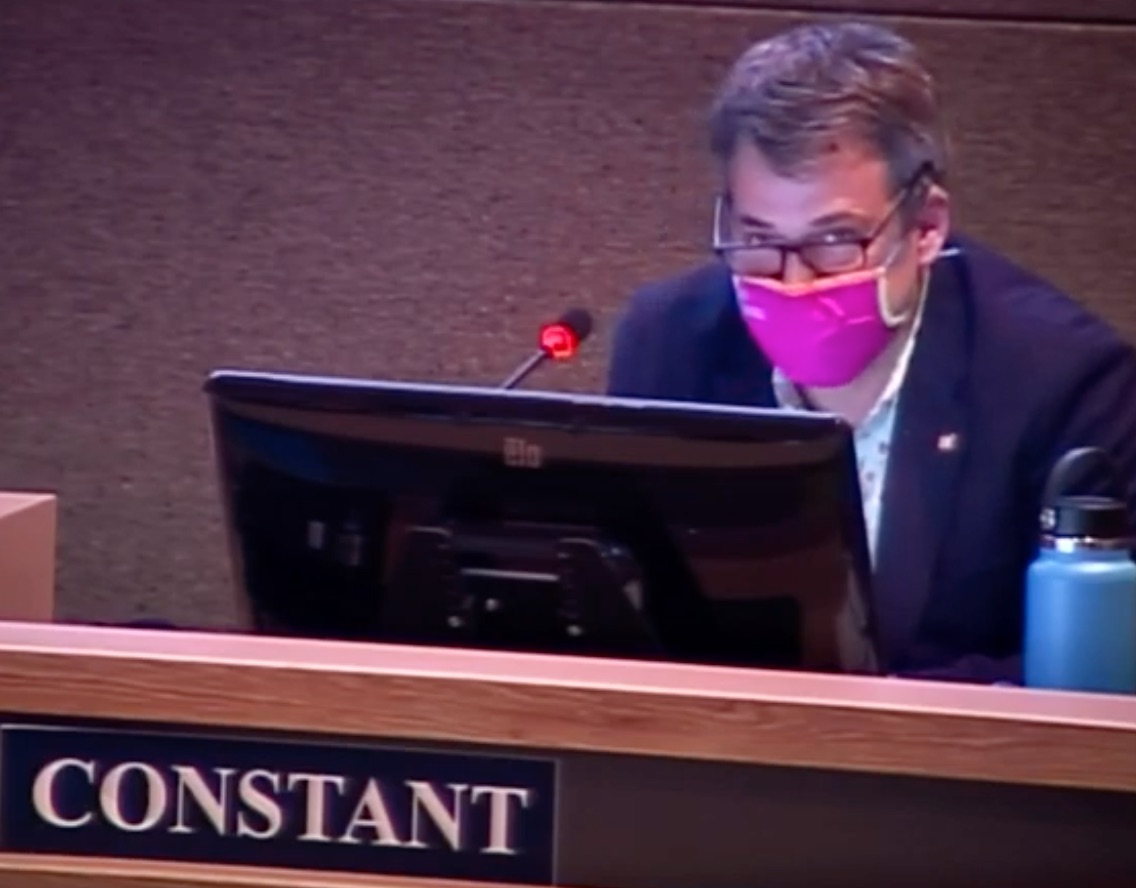
In a 5-5 vote, during which Assemblyman Chris Constant appeared to be unable to cast a deciding vote due to a possible technical problem on his phone, the Anchorage Assembly rejected the appointment of Jim Winegarner as the city’s Real Estate director.

The move and method to reject Winegarner appeared to be coordinated among the 9-member majority, and is seen as retaliation for the firing of the former Real Estate director, who had been hired in July, approved by the Assembly, and released in September. Christina Hendrickson is now suing Mayor Dave Bronson under the claim that she was a whistleblower, a claim disputed by the administration.

It’s no secret that the Assembly is trying every tactic to thwart the success of the Bronson Administration.

When Constant made his phone operational again after failing to vote on Winegarner, Assemblywoman Jamie Allard asked for reconsideration for the vote on Winegarner, but could not get support to get Constant’s vote on the record. Constant, the vice chair of the Assembly, was calling into the meeting from home Thursday after emotional outbursts during the Wednesday meeting.

The Assembly had earlier on the agenda voted to move to a later date the confirmation for Joe Gerace as the Health Department director, and Dan Zipay as director of Solid Waste Services. The nine-member majority said they wanted more input from the board of ethics on those two appointments. The assembly approved Brad Coy as the Muni’s Traffic Engineer.

Win Gruening: Vote-by-mail doesn’t deliver, but does the Juneau Assembly care?

The City and Borough of Juneau seems to be exempt from the fundamental principle that “measurement improves performance,” because, by any objective metric, their experiment with vote-by-mail has failed miserably.

Two weeks after Juneau’s second vote-by-mail municipal election concluded, election officials announced that 652 votes, an extraordinarily high number, were not counted. Over half of these votes were disallowed because they lacked postmarks – apparently because the US Postal Service failed to stamp them when mailed. The others were missing a signature or some other validating piece of information.

This development illustrates yet another problem with vote-by-mail. When relying on a third-party (USPS) to send out ballots and return them to be counted, the likelihood for mistakes is increased. In a conventional election, in-person voters are identified and their ballots are filled out at a local polling station, then immediately fed directly into a scanner and counted. Mistakes are routinely caught at the point of origin.

The Juneau Assembly has declined to address these concerns. Perhaps the Assembly believes that citizens who question the merits of vote-by-mail are partisan, un-American, and in favor of voter-suppression? Those accusations were made recently in an opinion piece in the Juneau Empire by Kim Metcalfe, who, as a former Alaska Democratic Party Executive Committee officer and Democrat Super-Delegate, whole-heartedly endorses vote-by-mail. 

In her op-ed, which was extremely critical of several carefully considered My Turns examining issues with vote-by-mail, Metcalfe alerts readers the My Turn writers are Republican and that vote-by-mail should be “applauded by people of all political persuasions rather than criticized and demeaned.”  

Metcalfe’s diatribe even draws comparisons of vote-by-mail concerns with what she describes as “discrimination against our Indigenous people” and “the  insurrection at the U.S. Capitol by members of the Republican Party to overthrow the 2020 presidential election!”

She defends mail-in voting by contending that “it gets more people to cast their votes.”

Except that it doesn’t.

It’s laudable to support efforts to increase voter turn-out – as long as such efforts actually achieve that. One would also expect the process would be efficient, and not overly cumbersome for voters. However, Juneau’s recent election experience, after sending unsolicited ballots to tens of thousands of voters, the majority of whom did not use them, failed to realize those goals. 

First implemented as a temporary measure in 2020 because of pandemic protocols, the Juneau Assembly steam-rolled permanent vote-by-mail through as a necessary expenditure with minimal public input. The Assembly justified the $1 million start-up costs by telling us that vote-by-mail increases voter turn-out. As evidence, city leaders pointed to last year’s election where voter turnout was 42.7%, a sharp increase over prior municipal elections. Voter turnout was 31.4% in 2019 and 35.5% in the 2018 municipal election.

However, a recent Stanford study debunks this theory, contending that a similar voting surge in 2020 across the nation had little to do with vote-by-mail.

Yet, Juneau vote-by-mail proponents took last year’s increase as proof-positive that vote-by-mail would boost voter turn-out.

As it turns out, that didn’t happen.

With 8,517 votes counted in the Juneau 2021 election, only 30.8% of registered voters cast ballots, 28% less than last year and lower than either 2019 or 2018 – two years when vote-by-mail was not used. 

This year, the city paid to print and mail out 27,684 ballots, over 18,000 of which ended up in post office waste receptacles, residential recycle bins, and the Juneau Landfill. 

What is the Assembly’s response? Radio silence.

This wasteful expense is concerning enough but taxpayers should take notice when, according to the city, the ongoing costs of conducting an election in the future could exceed $200,000 per year, triple the cost of a conventional election.

Juneau’s elected leaders need to come clean and admit that all the money being spent on VBM results in little benefit, only making it slightly more convenient for voters (assuming you don’t decide to drive to the post office and get your ballot hand cancelled to make sure it is counted). And this meager benefit mostly accrues to voters who would have otherwise voted anyway, either in person or by requesting an absentee ballot.

Furthermore, as I detailed in my column two weeks ago, the hacking of Alaska’s Online Voter Registration System along with vulnerabilities in vote-by-mail create opportunities for fraudulent ballots and “ballot harvesting” schemes that further undermine the public’s trust in our elections. 

Every invalid vote – whether through honest mistake, third-party carelessness, deliberate fraud, or partisan manipulation – disenfranchises a legitimate voter. The Juneau Assembly assured voters that their new election system guards against such problems and that above all, vote-by-mail would increase voter turnout.

Vote-by-mail did not deliver on that promise. It’s time for the Juneau Assembly to admit their mistake and rectify it.

After retiring as the senior vice president in charge of business banking for Key Bank in Alaska, Win Gruening began writing op-eds for local and statewide media. He was born and raised in Juneau and graduated from the U.S. Air Force Academy in 1970. He is involved in various local and statewide organizations and currently serves on the board of the Alaska Policy Forum.

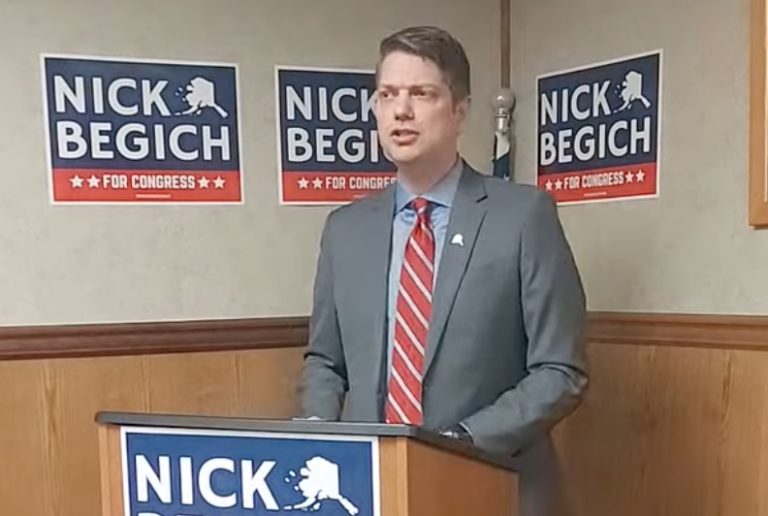
Wasilla roll-out: Nick Begich makes it official as he announces run for Congress

With his wife and son by his side, Nick Begich, the grandson of the late Alaska Rep. Nick Begich, announced he is a candidate for U.S. Congress.

He made the announcement to about 50 people in a hotel conference room in Wasilla, where he had told supporters last summer that he would make his announcement, if he indeed decided to run.

Nick was introduced to the room by Wasilla Mayor Glenda Ledford. Also in attendance was his mother, his maternal grandfather, brother, and sister-in-law.

“My name is Nick Begich and today I’m announcing my candidacy to represent this great state in Congress,” he started.

He acknowledge he comes from a large political family, but “We come to service from different political stripes,” adding that he developed his conservative values due to being raised in large part by his conservative grandparents.

“It’s time for change. It’s time we take back our country. It’s time the government start working for the people. After 50 years, it’s time to make this change,” he said. “A new level of energy, and new ideas are necessary for us to deliver on the great potential on this state, our nation, and its people.”

Nick promised to bring a “generational change of energy” to the job.

“We need to stop the Biden administration’s assault on Alaska resource development. We need to make the case to America of the importance of Alaska’s oil and gas and critical minerals, all of which are necessary as we embark on a decades-long energy transition,” he said.

He reminded the audience that the environmental standards in America are the strongest in the world. He warned of the danger of placing our security in the hands of China and Russia.

Nick, a Republican and private business owner, promised to work hard to earn the public’s trust and support. He made no mention of Congressman Don Young, the Republican who he is challenging in 2022.

Young had announced in the spring that he will run for his 26th term in office. He won the seat in 1973 after Rep. Nick Begich Sr.’s plane went down on Oct. 16, 1972, and Young has been Alaska’s congressman ever since.

After the event, Nick told Must Read Alaska he was very pleased with the event, grateful to his supporters who came out for it, and it was now time to do some campaign fundraising, and scheduling events across the state.

Michael Tavoliero: Now is the time for Eagle River to exit

By MICHAEL TAVOLIERO

There’s a great story about a Christmas roast that I think about whenever I have a challenge with the status quo.  

It goes like this:  On Christmas morning, Mom was preparing the Christmas roast.  She sliced the end off and puts it in the roasting pan first.  Her daughter seeing this immediately asked why she did this.  Mom thought for a moment and said that is the way her mom did it.  

Puzzled, the daughter asked why. 

Mom replied, “Let’s call Grandma and find out.”

A call went out to Grandma, and Mom and her daughter asked her why, indeed, she always cut off the end of the Christmas roast.  

Grandma replied, “I cut the end off to fit it in the pan.”

My point is, we often accept the status quo, never asking why things are done the way they are until we are nudged to consider.

This is your nudge, especially if you live in Anchorage.

Alaska local government is the same way.  It’s the same roast with a sliced end to fit in the pan, but few of us really understand the reason.

Consider this:  All Alaska local governments have elected representatives; all Alaska local governments have municipal employees; and most Alaska local governments have a property tax base.

What if I were to say to you that local government does not need any of these?

At first blush, many of you would consider me ridiculous, radical, or just rummy, but hear me out.

How is the current local government in Alaska’s largest population center, Anchorage, working for you?

How are your elected representatives working out?

How are your municipal employees working out?

How are your local property and other taxes working out?

My personal belief is that they aren’t.

At a few months’ short of 70 years young, I see elected representatives controlled by the Golden Rule.  That’s the rule that says he who owns the gold rules.  

In Anchorage, many elected officials are controlled not by what you or I want but by the collective hegemony of the unions, education industry, health care industry and the welfare industry. Why is this when we are the voters?  Well, because the municipal and school budgets are almost $1.5 Billion dollars and having control over elected representatives affords a great opportunity on how that money is spent.

This is a fact.

Municipal employment is controlled in such a way that the cost to the public never decreases and always increases.  This has become blindingly evident as we were witness to the greatest economic debacle Alaska has ever seen, driven by Covid.  Businesses closed, people were laid off and thrown on unemployment rolls, and some went bankrupt.  I could be wrong, but not one municipal employee missed a paycheck.

This is a fact.

Property taxes as well as other forms of fees, costs and taxes continue to grow with little seen in the form of service and program improvements. 

This is a fact.

What if we could have a local government with no elected representation, no municipal employees, and no property taxes?

I know most of you would be delighted at first blush but a few seconds later your BS meter would peg to total BS.

But take a minute.  Hear me out.  

How is the three-legged stool of Anchorage local government, elected representatives, municipal employment, and property taxes working for you?

In the past 2 years we have seen egregious demands on our personal rights only to be scolded, humiliated, and bullied by our local government and its minions.  We have seen 2 failed attempts at recalls of real Marxists.  We’ve seen the election of a righteous man as mayor only to watch a veto proof assembly neuter his every attempt to improve the quality of life in Anchorage.

Some will say that’s politics.  

I think that is a banal, superficial, and cursory remark. 

I believe Anchorage will never return to its more conservative roots.  As a result, if you haven’t noticed, there has been a decline in population in Anchorage and an increase in population in the Valley. While our mill rate increases, our property values go up and new taxes are brought into play.

There is literally almost nothing left for conservatives to do except bend over.

 I said almost.

There is Eaglexit.

Eaglexit is an education program designed to provide civics information to the residents of Assembly District 2, which includes Eagle River, Chugiak, and surrounding neighborhoods south to Tikhatnu and north to Eklutna.  With this information, it is hoped that the community will be engaged and prepared to discuss the question of detachment from the Municipality of Anchorage and the question of local government incorporation.

Many have assumed that it is a political campaign.  It is not.

It is an educational discussion on the benefits of decentralizing large municipal enclaves.

It is designed to discuss the question of local government formation, the foundation of liberty in local government, and the expectation of what results the residents want to see in their new local government.

The purpose behind Eaglexit is to actively engage the residents of Assembly District 2 on the options of local government establishment to discover if the residents of Assembly District 2 can develop a better system for its local government than the current model of the Municipality of Anchorage.

It has been my personal observation that over the past decades the current Anchorage local government has lost its connection to its communities.  The Municipality of Anchorage has since established a power and control hegemony through the unions, health care industry, education industry and welfare industry of the Anchorage local government.  

This is soft tyranny based on a collective local government system.  

In the early 1830’s, Alexis De Tocqueville described “soft tyranny” in “Democracy in America”, 

“It covers the surface of society with a network of small, complicated rules, minute and uniform, through which the most original minds and the most energetic characters cannot penetrate, to rise above the crowd. The will of man is not shattered, but softened, bent, and guided; men are seldom forced by it to act, but they are constantly restrained from acting. Such a power does not destroy, but it prevents existence: it does not tyrannize, but it compresses, enervates, extinguishes, and stupefies a people, till each nation is reduced to nothing better than a flock of timid and industrious animals, of which the government is the shepherd.”

What is the civics discussion of Eaglexit?

First and foremost, it asks the question can a smaller local government be economically more efficient and effective than the current model of the Municipality of Anchorage?

The two impartial analyses done by one of Alaska’s foremost economic consulting firms, Northern Economics, demonstrates the communities of Assembly District 2 have the economic foundation for a solvent local government. The question of will this increase costs to its community members?  Our answer is no it won’t, and it will enhance better community involvement and municipal service outcomes.

To those of you who believe costs will increase: The Municipality of Anchorage has increased costs to Assembly District 2 every year since we began the Eaglexit discussion.

Our communities include Eklutna, Thunderbird Falls, Peters Creek, Chugiak, Birchwood, Powder Ridge, Downtown Eagle River, Eagle River Valley, Hiland Road, Former Fort Richardson and Elmendorf Air Force Base, now JBER, Centennial Park, Muldoon and Tikahtnu.

Our population from the 2010 census shows population of 51,281 with 54% of households with children under 18. Chugiak-Eagle River is 45% Veteran per 2019 American Community Survey vs 30% for Muni of Anchorage.

Assembly District 2 includes a total of 1,050 square miles, bounded by Knik Arm on west, and the Mat-Su Borough north. 

Assembly District 2 is the only rail and road transportation corridor between the Mat-Su and the rest of the state and Anchorage and the Kenai Peninsula.

In our civics discussion, we explore a variety of local government types. These fall into two types of representative local government: one that uses elected representation and the other that uses direct representation.

We also explore the question of how municipal programs, such as education, police, fire, streets and roads and parks and recreation will be financed and managed.

I know many of you have witnessed with great disappointment as well as supported with great expense attempts to change for the positive the Anchorage local government, only to fail time after time.  The detachment of Assembly District 2 from Anchorage may be the last chance for meaningful change.

Eaglexit has a plan, and it continues to grow.  Won’t you join us and make it happen?

Michael Tavoliero is a realtor in Eagle River, is active in the Alaska Republican Party and chairs Eaglexit.

Mayor Bronson’s homelessness problem-solver quits

John Morris, who was Mayor Dave Bronson’s leader for reducing chronic homelessness and street drug addiction, has thrown in the towel.

Sources in the Bronson Administration, say Dr. John Morris, a medical doctor who was new to politics, had enough of trying to work with the Anchorage Assembly, and couldn’t take it anymore battling the leftists. All he wanted was to get something done, and the Assembly opposes the Bronson Administration at every turn.

The mayor, Morris, and other team members have been trying to get the Assembly to agree to a navigation center for people who are experiencing homelessness, who are abusing drugs, and who need services. The center could help at least some of the homeless get on a path to a productive life.

The meetings with the Assembly has run the course of 22 meetings and over 800 hours since July. At times, even the mediators nearly called it quits over frustration with the Assembly.

The Assembly has its own ideas for how to address the problem, and has made it impossible for the mayor to get the hundreds of homeless men out of the Sullivan Arena and into more permanent and safe housing.

I want to thank Dr. John Morris for his service and commitment to the Municipality of Anchorage. The focus and mission remains the same in helping our city’s most vulnerable get the compassionate care and resources they need. That includes working with the Anchorage Assembly with the strategy that involves housing, transitional housing, supportive housing, treatment, and navigation centers,” Bronson said.

Read Dr. Morris’ op-ed, penned in June:

Video: Did Assemblyman Chris Constant flash the ‘Loser’ sign at a citizen?

During Wednesday’s Anchorage Assembly meeting, a woman in the audience shouted to the front that Assemblyman Chris Constant had made the L-shaped “Loser” sign on his forehead at her. He denied it.

The official video from the Anchorage Assembly YouTube channel does not show the incident.

But a video taken by a citizen journalist shows it. Was it an itch that Constant needed scratch? Or was he being rude?

Here’s the video of the assemblyman from downtown Anchorage flashing the Loser sign:

And, take two, here’s the video of Chris Constant being called out for his actions by a member of the audience:

Will they arrest the unmasked citizens at tonight’s Anchorage Assembly meeting?

After the Anchorage Assembly hastily ended its meeting on Wednesday without taking up any business on the agenda except its new mask rule, it rescheduled the meeting to Thursday at 5 pm in the Loussac Library, 3600 Denali Street, on the main floor Chambers.

But after Chairwoman Suzanne LaFrance gaveled out on Wednesday, a woman in the audience shouted the question, “Are you going to arrest us?”

It was the question of the hour. The public attending was not amused by the antics of the Assembly, as it tried to enact a rule that everyone in the chamber be masked, and then tried to bully the Mayor’s Office into enforcing that rule, which is not compatible with the emergency ordinance the Assembly passed one week ago, requiring people to mask when in public. The rule for the Assembly Chambers says there are no exemptions to the mask ordinance, and City Manager Amy Demboski said she would work to enforce the law the Assembly passed, which does have exemptions.

The problem for the Assembly is that it wants the Mayor to use police to enforce its “room rules,” which do not have the force of law. The police are under the control of the Mayor’s office and city Manager Amy Demboski said she will enforce the law.

On tonight’s agenda, should the Assembly be able to get out of its own way and conduct business, is the big-ticket item of the year: The annual budget. This, and numerous other items that typically interest the public, await the Assembly and whether it can actually conduct a meeting.