Wednesday, June 17, 2026
Home Blog Page 983

State vet gives clean bill of health to Santa’s reindeer for travel from Alaska for toy drops

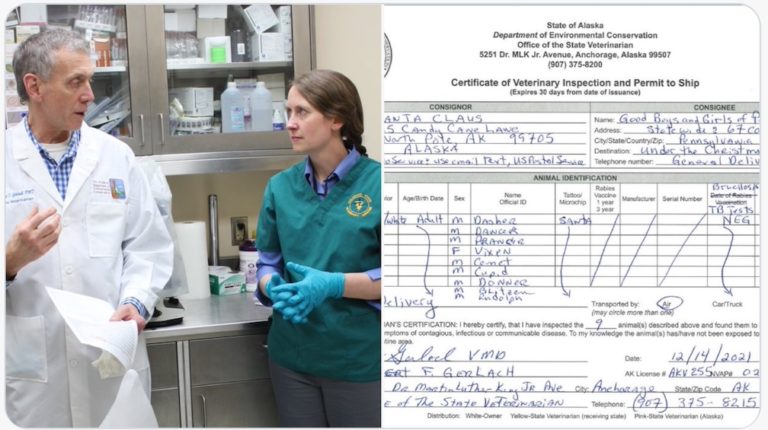
Alaska State Veterinarian Dr. Robert Gerlach issued a series of health certificates allowing Santa’s reindeer to travel from Alaska across state lines for toy delivery. While this annual effort attracts attention, it’s just a regular day for the Office of the Alaska State Veterinarian, the Department of Environmental Conservation noted in a press release.

Office of the State Veterinarian is part of the Alaska Department of Environmental Conservation’s Division of Environmental Health and is responsible for carrying out a wide variety of programs protective of both animal and human health, which in turn safeguards the health and food capacity of Alaska’s livestock, reindeer (both magical and non-magical), and poultry, and prevents the transmission of animal disease to humans, DEC wrote.

What does this look like on a day-to-day basis? The work that Dr. Gerlach, Dr. Sarah Coburn, and their team do includes:

  • collaborating with veterinarians and partner agencies across the state to address issues such as tick surveillance and rabies outbreaks in Alaska
  • conducting dairy inspections that look at both the health of the animals and the milk they produce to achieve a Grade “A” designation
  • ensuring all domestic animals are cared for in the event of an area-wide emergency
  • overseeing requirements for safely growing and selling produce in Alaska

“As you can imagine, I regularly work with livestock veterinarians around the world,” said Santa Claus, according to the DEC. “I can confirm that Dr. Gerlach and Dr. Coburn are top-notch, and are a real gift to Alaskans all year!”

The project has so far confirmed that Santa’s reindeer are safe to land on roof tops in Oklahoma, Pennsylvania, Nevada, and Texas.

In Pennsylvania, the governor even issued a press release about it, with quotes from the governor. Gov. Tom Wolf was joined by Secretary of Agriculture Russell Redding and Pennsylvania State Veterinarian Dr. Kevin Brightbill to meet Santa and his nine reindeer at Hersheypark Christmas Candylane on Thursday to announce that the reindeer had received a clean bill of health and are cleared for take-off on Dec. 24.

“I’m excited to announce that Santa’s reindeer are in good health–despite one’s very bright red nose–and ready to deliver toys to the good girls and boys of Pennsylvania tomorrow evening,” said Gov. Wolf. “I’m grateful to the Department of Agriculture for coordinating to ensure not only a merry Christmas morning across the commonwealth but keep animals in Pennsylvania safe and healthy. All nine reindeer are physically fit and in good spirits, they’re ready to fly this holiday season.”

Dasher, Dancer, Prancer, Vixen, Comet, Cupid, Donner, Blitzen and Rudolph received clearance to fly to Pennsylvania from Alaska’s Dr. Gerlach. This Certificate of Veterinary Inspection and Permit to Ship certifies them to fly from rooftop to rooftop across the commonwealth for the purpose of toy delivery on Christmas Eve.

“Thanks to Dr. Brightbill and his counterpart in Alaska, we can certify Santa’s reindeer are healthy and can safely fly across state lines,” said Pennsylvania Agriculture Secretary Redding. “Veterinary health inspections are a great preventative measure to ensure animals are healthy and able to travel. We greatly appreciate Santa taking these necessary steps to promote the wellbeing of his reindeer.”

(We just report the news here. Don’t be a Scrooge!)

Dunleavy names three judges

 Gov. Mike Dunleavy on Thursday announced three appointees today to the Alaska Superior Court. The judges were selected from a list of individuals nominated by the Alaska Judicial Council.

Juneau Superior Court: Marianna Carpeneti has been an Alaska for 36 ½ years and has practiced law for 9 ½ years. She graduated from the University of Washington School of Law in 2012 and is currently in private practice in Homer.

Anchorage Superior Court: Jack R. McKenna has been an Alaska resident for 12 ½ years and has practiced law for 14 years. He graduated from the University of California, Davis, School of Law in 2007 and is currently the Criminal Division Director at the Department of Law in Anchorage.

Utqiagvik Superior Court: Magistrate Judge David Roghair has lived in Alaska for 26 years and has practiced law for 15 years. He graduated from Lewis & Clark Law School in 2006 and is currently a magistrate judge in Utqiagvik.

Per the Alaska Constitution, the judges in Alaska are screened by the Alaska Bar Association-dominated Judicial Council and the governor must choose among the names provided to him by the council. View the applicants for the positions at this link.

Laddie Shaw: We lay Wreaths across America in honor of fallen warriors

6

By REP. LADDIE SHAW

This past weekend my wife and I participated in “Wreaths Across America” at the Fort Richardson National Cemetery. It is a ceremony whose mission is to remember and honor our fallen warriors and it is carried out across all 50 states at 2,500 locations.  

As you lay a wreath and say the name out loud, the recognition is honored and remembered. 

The holiday season is upon us and we gather together to celebrate Christmas and the New Year. But many of us aligned with military service, both family members and service members, know of an empty seat at some family’s dinner table.  

An empty seat, to remind us to remember those who sacrificed for our freedoms. Though for many of us, we carry those thoughts in the deep recesses of our soul for a life time. Participating in this event was a good reason to come together to collectively honor those warriors. In a simple gesture with the laying of wreaths, we share our deep appreciation to those men and women in uniform who gave their last full measure of devotion for the freedom we so enjoy. 

Since our nation’s founding, America’s sons and daughters have given their lives in service to our country.  From Gettysburg to Normandy, from Inchon and Khe Sanh, from Baghdad to Kandahar, they departed our world as heroes and gave their lives for a cause greater than themselves.

Rep. Laddie Shaw, laying wreaths on the graves of soldiers at Fort Richardson National Cemetery.

We cherish their memory and give thought to the lives they once shared with us.  We mourn with the families and friends of those we have lost, and hope they find comfort in knowing their loved ones died with honor.  Christmas is a time for giving, a time for sharing and a time for reflection. A time to share heartfelt memories with one another.

It is our sacred duty to preserve the legacy of these brave Americans, and it remains our charge to work for peace, freedom, and security.  Let us always strive to uphold the founding principles they died defending, let their legacy continue to inspire our Nation and let this solemn lesson of service and sacrifice be taught to future generations of Americans.

When we returned from Vietnam we had no need to be “reminded” of our service. We had each other and we had “The Wall” as our touchstone, where 58,000 names are etched in simple black granite as a reminder of the cost of freedom of just one generation. It’s our emotional “welcome home”, our eternal wreath so to speak. 

Though our generation was ostracized for our efforts on behalf of freedom, we said to ourselves that “Never again shall one generation of warriors forget another.” So, we in turn celebrate the memory of those fallen warriors not only of our generation but those who sacrificed from many wars past and those that continue to sacrifice for the cause of freedom. As veterans we do this out of mutual respect and admiration for service and sacrifice rendered, one warrior to another.

This holiday season, as in every holiday season past, Americans from all backgrounds and corners of our country serve with valor, courage, and distinction defending our liberties. They stand in spirit with those ‘ol soldiers of generations past who are an eternal part of our nation’s history, now writing their own chapter of service and sacrifice.  Most of today’s warriors know what it means to lose a comrade in arms before their time. The Gold Star families who know that loss as well, truly understand the value of the sacrifice given.

The day of laying wreaths at these humble stone grave sites was just another day to pay tribute to those who have paid the ultimate price to defend the United States and the principles upon which America was founded. 

We ask for God’s grace to protect those fighting in distant lands, and we renew our promise to support our troops, their families, and our veterans.  Their unwavering devotion inspires us all — they are the best of America.

Merry Christmas to Warriors all.

Rep. Laddie Shaw has represented South Anchorage since 2019.

Win Gruening: The Grinch who stole Christmas

By WIN GRUENING

 “I must stop Christmas from coming… but how? I mean – in what way?”

How the Grinch Stole Christmas movie – 2000

Dr. Seuss’s beloved children’s book and movie adaptation are playing out in real life as President Biden and Dr. Fauci vie for the title of the most insufferable grinch.  

When How the Grinch Stole Christmas was first published in 1957, it did not go unnoticed that the Grinch was the first adult and the first villain to be a main character in a Dr. Seuss book. Reviewers called the Grinch “easily the best Christmas-cad since Scrooge.”

Amid rising inflation and bitter discourse, exhausted Americans are now approaching their third year of living under the crushing weight of pandemic mandates. The never-ending demonization of the unvaccinated and the politically acrimonious rhetoric of the Biden Administration have divided America like no other time in recent history.

President Biden is now lecturing us that the Omicron variant is spreading fast and that unvaccinated Americans are facing a winter of “severe illness and death.”

White House chief medical adviser Dr. Anthony Fauci followed that grim prophesy with the possibility that more restrictions may be needed to curb the transmission of Covid-19 if cases continue to surge.

“If the counts keep going up and the test positivity keeps going up, we may need to be more restrictive.” When Fauci was asked, “Are we ever going to get to a point where we won’t need to wear masks on airplanes?”, he responded, “I don’t think so.”

Those dire predictions contradict initial research that shows, while the Omicron variant is highly transmissible (even among vaccinated individuals), the symptoms are typically mild and hospitalizations are significantly less. More importantly, Covid-19 treatments have come a long way since the early days of the pandemic.  

The availability of vaccines, effective monoclonal antibodies, and new therapeutics will continue to improve medical outcomes and apparently are useful against this variant in reducing severe symptoms. The increased availability of rapid at-home tests will help to further limit COVID-19 transmission. Some medical experts believe this variant could help us reach herd immunity and an endemic state where pandemic protocols will no longer be needed. 

Nevertheless, the Biden Administration and many politicians across the country continue to focus on number of cases and case positivity percentage while downplaying decreasing hospitalization and death statistics. Sadly, there is little recognition of the economic and social impacts of lockdowns and mandates – especially among young people.  

The relentless villainization and threats by Biden and Fauci haven’t significantly improved vaccination rates and only promote resentment, anxiety, and paranoia among the general population. They strain credulity and appear more designed to divert attention from administration-caused catastrophes home and abroad.

Will we ever reach the end of the story when the Grinch has a change of heart and strikes a kinder, more positive tone?  Not if our leaders continue to believe politics is more important than the power of religious faith and hope. 

As noted in Steve Malanga’s City Journal article, throughout history global events such as “famine, pestilence, and war have sent people seeking the comforts of religion.“  This hasn’t happened in this  pandemic, as evidenced by falling church attendance.  This is likely due, in part, to government mandates and pronouncements over the last two years preventing or discouraging church goers from consistently attending in-person religious services.  Many municipal and state governments labelled church activities as “non-essential,” in contrast to liquor stores and cannabis dispensaries which were allowed to stay open.

This only exacerbated the overall isolation and disruption of social connections created by the pandemic that has resulted in mounting apprehension, depression, drug use, and suicide. As educators discovered after school closures, religious leaders found that virtual Zoom meetings were no substitute for in-person services and, in fact, “eroded the  religious experience, disillusioning the faithful.”  

Christmas is a season of hope. Why can’t our nation’s leader craft a message of optimism instead of panic, fear and despair?

Americans should celebrate Christmas this year as they always have, with family and friends, encouraged and reaffirmed by our country’s ability to persevere and overcome, just as it has so many times throughout history.

After retiring as the senior vice president in charge of business banking for Key Bank in Alaska, Win Gruening became a regular opinion page columnist for the Juneau Empire. He was born and raised in Juneau and graduated from the U.S. Air Force Academy in 1970. He is involved in various local and statewide organizations.

Anniversary: Eight years since cruel federal decision to not allow road out of King Cove

IAN TUTTLE / NATIONAL REVIEW

“I’ve listened to your stories. Now I have to listen to the animals.” former Interior Sec. Sally Jewell, 2013

The 950 residents of King Cove, Alaska, have been trying to build an emergency road to nearby Cold Bay. They have been trying to build the road for 40 years.

King Cove is near the western tip of the Alaskan Peninsula; a few miles west begin the Aleutian Islands. King Cove has a school and two churches and a Chinese restaurant, and its economy is buttressed by the presence of PeterPan Seafoods, one of the largest commercial fishing operations in North America, whose seasonal employees constitute about one-third of the local population. But like most towns in the Alaskan bush, it has only a small clinic and no full-time physician. For everything from minor surgeries to delivering a baby, residents must venture to a proper hospital — 625 miles away, in Anchorage.

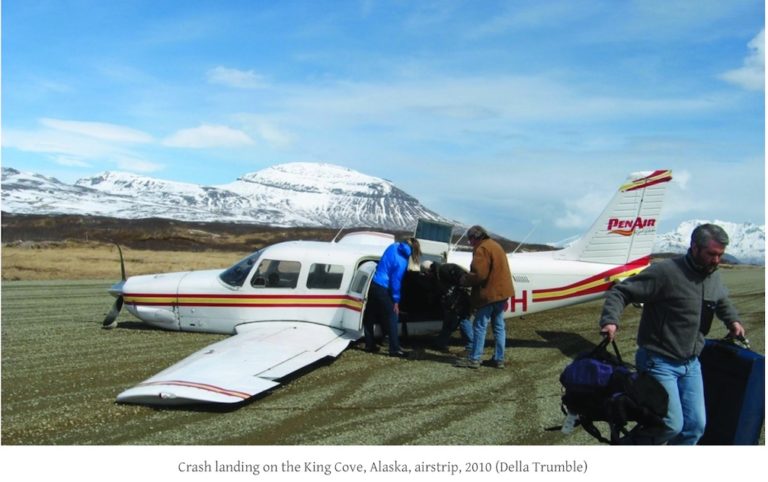
Rarely can that be done direct from King Cove. The town’s 3,500-foot gravel airstrip, built in 1970 in the Delta Creek Valley north of town, cannot accommodate large aircraft, and the single- and twin-engine aircraft that use it are particularly vulnerable to King Cove’s weather and geography — which are, to put it lightly, forbidding. The airstrip is situated between two volcanic peaks, which funnel into the valley winds that regularly reach 70 mph. And while clear, calm days do visit King Cove, bad weather — thick fog, lashing rain, driving snow — is Mother Nature’s curse on King Cove a third of the year, sometimes more.

So getting to Anchorage requires first getting to next-door Cold Bay, a hamlet of 100 people, mainly transient state and federal employees, that happens to be home to a 10,000-foot, all-weather airstrip capable of handling the long-distance flight to the state’s largest city. (Why tiny Cold Bay has such an outsized role in King Cove’s story is something of a historical accident: Cold Bay Airport was built in World War II, when this distant patch of the Alaska Territory became a strategic outpost against a possible Japanese invasion. The site chosen, Army engineers agreed then, and locals agree now, was the only one in the area suitable for an airstrip of such size.)

The problem is getting to Cold Bay. In clear weather, that can be done with an air taxi from King Cove’s airstrip. But when the weather is foul, making the trip to Cold Bay requires a boat (and calm seas) or a medevac helicopter (often supplied by the Coast Guard) — and, potentially, more time than a patient has.

To solve this problem, King Cove residents have sought to build a one-lane, gravel road from King Cove to Cold Bay, across the two-mile-wide isthmus that links the towns. Nineteen miles of the 30-mile road already exist. But eleven miles remain — and they traverse the Izembek National Wildlife Refuge.

This is one infrastructure project in which the Obama administration has not the slightest interest. In August 2013, with King Cove’s decades-long effort seemingly about to come to fruition — a bill having passed Congress, the president having signed it — Sally Jewell, secretary of the Department of the Interior, flew to King Cove and, to people who told her of loved ones waiting desperately for a rescue helicopter, and of friends perishing in plane crashes in the cloud-swathed mountains, announced: “I’ve listened to your stories. Now I have to listen to the animals.”

Read this story, first published in 2015, at National Review

Subscribe to National Review at this link.


On Dec. 23, 2013, former Interior Secretary Sally Jewell announced she would not allow the road from King Cove to Cold Bay, which had been approved by Congress on a bipartisan basis.

Since then, King Cove has had an additional 157 medevacs. Most occurred in dangerous weather conditions and many had to be carried out by the U.S. Coast Guard, risking the lives of crews and patients alike. 

“Sally Jewell made a horrible decision eight years ago, and it is the good people of King Cove who have paid the price ever since. A single medevac is too many, let alone 157. It is simply unconscionable that the federal government has failed to protect these Alaskans’ health and safety, especially in the midst of a global pandemic that has made emergency medical access all the more critical,” Sen. Lisa Murkowski said in a statement on Thursday.

Murkowski reiterated her request to current Secretary of the Interior Deb Haaland – who has prioritized tribal consultation – to visit King Cove and finally address this decades-long environmental injustice.

“I am calling on Secretary Haaland to visit King Cove to see the need to protect local residents’ health and safety as soon as possible. The federal government has a trust responsibility to the Tribes of King Cove, but it has been broken for decades. I also urge her to consider alternatives that could help us construct this road in an environmentally sound manner sooner than litigation will allow. As governments, Tribes must deliver a wide range of critical services, including healthcare, to their citizens. The Secretary must recognize this and act now, because King Cove needs this life-saving road more than ever,”Murkowski said.

Numerous King Cove officials today expressed hope that Secretary Haaland would uphold the federal government’s trust responsibility and help them. The officials held a teleconference with Haaland in August and have asked her to visit their community to better understand the need for a life-saving road.

“Secretary Haaland understands our deep-rooted connection to our ancestral land where we and our Aleut families have lived for thousands of years,” said King Cove (Native) Corporation Spokeswoman Della Trumble. “She recognizes the trust responsibility the federal government has to Native people.”

“We’re hopeful U.S. Interior Secretary Deb Haaland will visit King Cove soon to talk with residents and see first-hand the daily challenges we face,” said King Cove Mayor Warren Wilson. “Many people in King Cove have either been medevaced themselves or have family members who experienced dangerous medevacs during harsh weather.”

“We’re hopeful the Secretary will support us,” said Aleutians East Borough Mayor Alvin Osterback. “This issue is an injustice the federal government needs to correct so King Cove residents can feel safe when they require access to a higher level of care.”

Battle brewing over legislators’ per diem

A brewing battle is taking shape in the Legislature, as lawmakers prepare for the upcoming legislative session in Juneau: How much money do they get for their job as representatives and senators. 

Legislators get paid by the State of Alaska treasury in a handful of ways. Their annual salary is set in law at $50,400 a year (the Senate President and House Speaker get an additional $500 a year). In addition to salary, lawmakers are also reimbursed for their moving costs to and from session. Finally, lawmakers not from Juneau are entitled to take per diem every day the Legislature is in session.

Per diem is not meant to be a form of compensation. Instead, it is meant to offset the costs that people incur for living temporarily in a town away from their home. Yet, the per diem issue has raised eyebrows with government watchdogs for several years. While most Alaskans do not object to the people representing them being reimbursed for the expense of working in the state’s capital, the per diem amount can be shocking: While state workers are reimbursed at a rate of $30 dollars a day if they are working more than 30 days in another location, legislators receive $293 a day, nearly 10 times the state worker rate. 

Unlike a salary, per diem is not-taxable. This creates the opportunities for perverse incentives: The longer legislative sessions and special sessions go, the more tax-free money is issued to lawmakers.

Thus, legislators routinely earn up to $30,000 a year in per diem, bringing the total compensation closer to $80,000 a year, a little more than the average household income for an Alaskan family, which is $77,680. 

Numerous attempts have been made to rein in per diem. Former Rep. Jason Grenn introduced a ballot initiative in 2017. Among other things, the initiative had a simple message to lawmakers: If a state operating budget doesn’t pass after 121 days (which is the constitutional limit for a regular session) legislators stop getting per diem. No budget, no per diem. 

It was a simple idea, and popular. So popular in fact, that in the waning days of session, the Legislature passed a bill almost identical to the initiative, knocking it off the 2018 ballot. 

The 2019 session was long, and the operating budget was not completed in the 121 day time limit. When the budget finally did pass in June, months behind schedule and shy of a government shutdown, the Legislature maneuvered. Using a loophole in its internal bylaws, the Legislative Council, which is the committee that oversees the Legislature’s business, voted to pay lawmakers their per diem retroactively for the period the budget was not enacted passed the 121 day limit. Proponents of the limit, like Grenn, were publicly furious, but hapless to do anything. 

Per diem quieted down until this year. Once again, the budget process steamrolled over the constitutional deadline of 121 days. Yet again, the Legislature passed a last minute budget to keep the government doors open. And, in a repeat of 2019, the Legislative Council met within 24 hours of passing a get-out-of-town budget and paid lawmakers retroactively. 

Gov. Mike Dunleavy, in reviewing the budget before him, saw that Alaskans were, for another year, having their annual Permanent Fund dividends set by political bargaining rather than by law. The governor also noted the Legislature moved with excessive speed to pay itself before they boarded their planes and boats to return to their home districts.

Dunleavy threw down the gauntlet with his vetoes. After vetoing the entire PFD to bring the Legislature back to work on an amount that could be set in law, Dunleavy also vetoed the Legislature’s allocation for per diem in the budget for the year. The governor’s message was: “No per diem without a fair PFD payment. 

The reaction from many lawmakers was muted but furious. Only one, Sen. Bert Stedman of Sitka, made a public statement in opposition that foreshadows the fight to come, saying, “if there are going to be no rules (between branches of government) then there are no rules.” 

Per diem is back in the forefront, thanks to the State Officers Compensation Commission. Created to answer the question of how much to pay public officials in a more independent manner, the commission reviews the pay and per diem for the governor, lieutenant governor, commissioners, and lawmakers. 

The commission met this month and made several proposals on salary, including raising the pay for the governor, lieutenant governor, and commissioners. Dunleavy wrote the commission and declined the pay increase. 

Turning to lawmakers, the commission wanted to take on the per diem issue a certain way: Increase lawmakers pay but limit per diem. By the time the commission met a second time, however, there was a clear disagreement on moving forward. The commission is now considering simply capping legislative per diem. 

Like efforts before, the theory of capping per diem is simple: Get the work done in time, or there is a risk of incurring a cost. 

Dunleavy seems to have reiterated that point. When his budget was released last week for the upcoming session, it included a “fast track” supplemental bill for urgent items. Among the urgent items was a supplemental Permanent Fund dividend payment, and the vetoed amount of per diem. 

While Dunleavy’s budget was gathering the media attention, another meeting of the Legislative Council took place. One of the items to discuss was transferring money from elsewhere to pay lawmakers per diem retroactively for the fall special sessions since the funds were vetoed.

After debate, the motion to pay per diem failed by one vote: House Republican Leader Cathy Titlton’s no vote denied the Council the dight votes it needed. 

The Legislative Council will meet again before session, likely to take up the issue of retroactive per diem. 

In the meantime the State Officers Compensation Commission will finalize its pay recommendations, and submit those to the Legislature at the start of session. The recommendations cannot be amended: the Legislature will either accept what the commission proposes by not acting, or it will reject the entire recommendation in a vote from the House and Senate. 

The legislative session is scheduled to begin on Tuesday, Jan. 18.

Alexander Dolitsky: What is greed? Listen in on an intergenerational conversation

6

By ALEXANDER DOLITSKY

I recently had a conversation with an American in her late 20s about current events in our country—let’s give her the pseudonym “Rebecca,” in order to protect her anonymity.

In the course of our communication, it did not take long for me to recognize Rebeca’s leftist ideology: Christopher Columbus exploited native people during his four voyages to the Caribbean Islands in the late 15th century; the American Constitution was written solely to benefit privileged white people; women in America have been discriminated and suppressed throughout its entire history to the present; America is the mother of  capitalism, exploiting underprivileged people in the entire world; and, finally, the history of America must be rewritten in accordance with a far–left “truth.”  

I patiently listened to her progressive rhetoric and then attempted to explain the subjective and objective causes of historic events in America in their actual contexts, but with little success. Her radical progressive beliefs (brain washing) were already deeply rooted in a woke culture and far-left ideology.

Finally, she asked me, “What is greed and why are wealthy people are so greedy—for example, Jeff Bezos of Amazon?”

“Okay, first, let’s define this concept—greed,” I  proposed to Rebecca. We searched online for a definition and discovered that “…greed is an intense and selfish desire for something, especially wealth, power, or food.” 

“You see, all rich people are greedy—they are selfish, powerful, and unwilling to share their wealth with those who are in need,” Rebecca stated emotionally, with confidence.

“Certainly, this is a very general definition of greed,” I said. “Greed comes in many shapes and colors,” I suggested. “And who said that being rich is a crime. There have been many wealthy American entrepreneurs who shared almost their entire wealth with others: Andrew Carnegie, Henry Ford, John Davison Rockefeller, John Pierpont Morgan—just to name a few. In fact, they were engines of American prosperity,” I continued. 

“Yes, I am familiar with these names, but never learned about them in school, not in great detail,” Rebecca admitted sheepishly.

“Let me share with you my personal experience related to greed in America,” I offered; she was attentive and looked at me with interest.

“Soon after my arrival to the United States in 1978, Jewish Family Service of Philadelphia found employment for me at the Philadelphia Embroidery Inc.—a small embroidery and silk-screening business then located at the 12th and Race Street, in the vicinity of downtown Philadelphia. Fred Tischler and his wife owned this business of about 10 to 12 employees—Fred, his wife and two young designers, Robin and John, worked in the front office, four to six embroiderers and two silk-screeners, including myself and Dave, worked in the back. In short, it was a small mom-and-pop business, resembling America’s utilitarian businesses of the 1930s through 1950s.

“My starting salary was $3.50 per hour. I had no health benefits, no sick leave, and no paid vacation. In 1978, the minimum wage in America was $2.65 per hour. During the 11 months of my employment in the Philadelphia Embroidery, I asked for a raise three times. Each time Mr. Tischler honored my request with a raise of 25 cents per hour.

“I commuted about one hour each way to and from my work place via bus, subway, and a short 10-minute walk. One winter morning I was 15 minutes late for work due to heavy snowfall that caused severe traffic congestion in the city. Fred Tischler and his wife were on vacation in the Bahamas and their daughter, a student of the medical school at the University of Pennsylvania, was substituting for them. On payday, a week later, she issued me a check, deducting $1 for being 15 minutes late on the day of the heavy snowfall.

“Well, how would you describe this treatment of the employee—work discipline or petty greed?” I questioned Rebecca. She only smiled in silent response.

Indeed, Rebecca and like-minded Americans are a product of the neo–Marxist education system and intense indoctrination by far-left activists found in many of our educational institutions today. Unfortunately, so many young people in America are so confused and disoriented that any parent is truly lucky if their child manages to come through the system as an old–fashioned “normal,” preserving strong Judeo–Christian moral values. 

I use the term “old–fashioned” because today’s “normal” is certainly not a desirable outcome.

Alexander B. Dolitsky was born and raised in Kiev in the former Soviet Union. He received an M.A. in history from Kiev Pedagogical Institute, Ukraine, in 1976; an M.A. in anthropology and archaeology from Brown University in 1983; and was enroled in the Ph.D. program in Anthropology at Bryn Mawr College from 1983 to 1985, where he was also a lecturer in the Russian Center. In the U.S.S.R., he was a social studies teacher for three years, and an archaeologist for five years for the Ukranian Academy of Sciences. In 1978, he settled in the United States. Dolitsky visited Alaska for the first time in 1981, while conducting field research for graduate school at Brown. He lived first in Sitka in 1985 and then settled in Juneau in 1986. From 1985 to 1987, he was a U.S. Forest Service archaeologist and social scientist. He was an Adjunct Assistant Professor of Russian Studies at the University of Alaska Southeast from 1985 to 1999; Social Studies Instructor at the Alyeska Central School, Alaska Department of Education from 1988 to 2006; and has been the Director of the Alaska-Siberia Research Center (see www.aksrc.homestead.com) from 1990 to present. He has conducted about 30 field studies in various areas of the former Soviet Union (including Siberia), Central Asia, South America, Eastern Europe and the United States (including Alaska). Dolitsky has been a lecturer on the World Discoverer, Spirit of Oceanus, andClipper Odyssey vessels in the Arctic and sub-Arctic regions. He was the Project Manager for the WWII Alaska-Siberia Lend Lease Memorial, which was erected in Fairbanks in 2006. He has published extensively in the fields of anthropology, history, archaeology, and ethnography. His more recent publications include Fairy Tales and Myths of the Bering Strait Chukchi, Ancient Tales of Kamchatka; Tales and Legends of the Yupik Eskimos of Siberia; Old Russia in Modern America: Russian Old Believers in Alaska; Allies in Wartime: The Alaska-Siberia Airway During WWII; Spirit of the Siberian Tiger: Folktales of the Russian Far East; Living Wisdom of the Far North: Tales and Legends from Chukotka and Alaska; Pipeline to Russia; The Alaska-Siberia Air Route in WWII; and Old Russia in Modern America: Living Traditions of the Russian Old Believers; Ancient Tales of Chukotka, and Ancient Tales of Kamchatka.

A few of Dolitsky’s past MRAK columns:

Read: Neo-Marxism and utopian Socialism in America

Read: Old believers preserving faith in the New World

Read: Duke Ellington and the effects of Cold War in Soviet Union on intellectual curiosity

Read: United we stand, divided we fall with race, ethnicity in America

Read: For American schools to succeed, they need this ingredient

Read: Nationalism in America, Alaska, around the world

Read: The case of the ‘delicious salad’

Read: White privilege is a troubling perspective

Read: Beware of activists who manipulate history for their own agenda

Read: Alaska Day remembrance of Russian transfer

Read: American leftism is true picture of true hypocrisy

Read: History does not repeat itself

Read: The only Ford Mustang in Kiev

Dan Smith: School board majority gets ‘F’

On Dec. 16, 2021, Anchorage School Superintendent Deena Bishop announced, “I am confident that ASD is able to transition to parent-informed masking when we return to school on January 3. It means parents will consider the risk levels in their family and decide for themselves if they want their child attending school wearing a mask.” 

Read Bishop’s letter to parents here.

In other words, masks would now be optional upon return to school after the holiday break.

To those of us under the impression the superintendent has this authority, we politely thanked her and made happy announcements to our children. Perhaps common sense was still alive, as a faint heartbeat was detectable.

But this was not to be the case. The majority of the ASD Board had other plans.

Apparently, the ASD superintendent is only authorized to act in a totalitarian and tyrannical way on this issue. If at any time the superintendent acts in a freedom-minded or liberty-loving manner or attempts to return medical decisions to their rightful parental prerogative, that authority can be rescinded by the board.

At Monday’s School board meeting there was orchestrated public upheaval. This time, it was in favor of keeping our kids mandatorily muzzled. Almost without exception, those testifying to the board in favor of retaining the face diapers for kids projected their own fears and insecurities onto a defenseless youthful population.

There was one articulate counter-argument by board member Dave Donley, who spoke against continuation of the harmful face farce that is mandatory masking. Donley noted that Anchorage is the last vestige of mandatory school masking in Alaska. Everywhere else, people have come to their senses on this issue. It was clear that the only ASD Board member that did his homework was Donley

The other scared and shivering six have no intention of lifting their boot from the mouths and noses of the children in Anchorage. After return from Christmas break, they want at least two more weeks to flatten an already declining Covid case curve.

The paranoia of the six quivering ASD board members is in regards to a problem we do not have. The new Covid variant is a problem to very few indeed. In South Africa, where it was first discovered a month ago, the Omicron variant has already peaked and is on the decline.

Six of seven Anchorage School District board members receive a failing grade. They were asked to show their work but instead showed only their emotions. They do not possess the necessary qualifications to preside over the health and well-being of our children. This is the role of the parent.

Read: Superintendent Deena Bishop’s Dec. 21 message to parents

As a gesture of solidarity with our students and teachers, I suggest the six board members who voted for this policy extension, wear a mask for 6 to 8 hours a day without removing it. For Board member Donley, masking is optional.

Even the progressive, left-leaning Anchorage Assembly brought an end to their misguided mask mandate on Dec. 7. That was not enough for six.

Congratulations to Superintendent Bishop for exposing the root of the problem. The problem we have is fear and six ASD board members who do not want to give up their grasp of tyranny around the throats of Anchorage children. They are paralyzed by fear and unable to think rationally.

There is a growing realization by many that the Anchorage School Board is too big for its britches (with the exception of Donley) and in a practical sense, just too big to respond appropriately to anything that matters and in a timely manner. ASD is the fully loaded tanker ship that takes five miles and 25 minutes to come to a stop.

The Bligh Reef of declining enrollment, ever decreasing test scores and the resulting degradation of our Anchorage school system lies straight ahead.

It is time to consider breaking up the ASD monopoly and creating several smaller school districts in its place. It is also time to consider another option of creating school board seats based on specific districts and doing away with “at large” elections. Either one or both would be fine.

It takes a change of the municipal charter. That will not be easy, but nothing worth doing is easy. The current situation is intolerable.

Dan Smith is a lifelong Alaskan and Anchorage resident.

Jim Crawford: Who owns Alaska? Alaskans, and that’s why we need a Constitutional Convention

By JIM CRAWFORD

Every 10 years, Alaskan voters are presented with a simple but critical question.  Article 13, Sections 3 and 4 of the Alaska Constitution requires that a question to be asked of voters: 

§ 3. Call by Referendum

If during any ten-year period a constitutional convention has not been held, the lieutenant governor shall place on the ballot for the next general election the question: “Shall there be a Constitutional Convention?” If a majority of the votes cast on the question are in the negative, the question need not be placed on the ballot until the end of the next ten-year period. If a majority of the votes cast on the question are in the affirmative, delegates to the convention shall be chosen at the next regular statewide election, unless the legislature provides for the election of the delegates at a special election. The lieutenant governor shall issue the call for the convention. Unless other provisions have been made by law, the call shall conform as nearly as possible to the act calling the Alaska Constitutional Convention of 1955, including, but not limited to, number of members, districts, election and certification of delegates, and submission and ratification of revisions and ordinances. The appropriation provisions of the call shall be self-executing and shall constitute a first claim on the state treasury. [Amended 1970]

§ 4. Powers

Constitutional conventions shall have plenary power to amend or revise the constitution, subject only to ratification by the people. No call for a constitutional convention shall limit these powers of the convention.

Alaska has been governed by special interests for decades. These special interests fund the election of legislators and the subsequent organization of the State Senate and State House. Then they control you.

The people of Alaska should have the last word in Alaska law. 

If you believe, as I do, that the people of Alaska should be the ultimate decider of Alaska law, you might consider joining a growing coalition of voters who see the Constitutional Convention as the only remaining means of returning power to the people to curb the special interests.  

Let’s deal with three issues that the public supports but the court or a majority of a respective legislative house has blocked: 1.  the right to a corruption free government, 2.  the right to determine the amount of your Alaska Permanent Fund dividend and 3. the right to life.

The most important issue that Alaskan’s must change is the corruption of our judicial appointees through the Alaska Judicial Council. The Alaska Judicial Council is governed by seven members, four attorneys and three non-attorney members. The four attorney members dictate whom the governor can appoint to their list of “qualified nominees”.  A member of the Judicial Council should not be practicing law in front a judge they appointed. The Judicial Council should exclude those with a conflict of interest. For instance, excluding attorneys who could try a case after appointing their candidate.

The voters can correct this only through a Constitutional Convention.   

The right to determine the dividend of the Alaska Permanent Fund must be resolved by a vote of the people. The Legislature has proved through Special Session after Special Session that it cannot come up with a dividend policy that is fair, consistent and sustainable.   Convention delegates can and will.   

The right to life can be on the ballot in Alaska in 2024. The U. S. Supreme Court could shortly rule that Alaskans, instead of the federal government or courts, can determine the length of a baby’s in utero life. Will Alaskans continue to be bound by an elusive mandate that the right to privacy and reproductive rights authorizes the taking of innocent life? The only way for the people to overrule that precedent is through a Constitutional Convention.  Exempting babies with a beating heart could be passed by a majority of Alaskans.    

Each of these examples could be added or excluded by elected members of the upcoming Constitutional Convention as outlined in the Alaska Constitution. The original authors provided the path to restrain out-of-control, special interests that practice conflicts of interests by controlling Alaska law.  

Does Alaska have the Constitution it deserves?  Are there glaring conflicts in need of correction?  Are there issues that have been blocked by special interests who choose their own law above the public good?  

The National Education Association opposes your right to a Constitution Convention.  And we know why, the budget they hold hostage each year.  

I’ve been a registered voter in Alaska since I turned 18 in 1966. I’ve opposed a Constitutional Convention each time since then. But I will vote for the Convention in 2022. Why? Because there is no other path that gives the control of government back to Alaskan citizens. The voters of Alaska are smart and can be trusted to study the issues prior to a vote. Each Alaskan will have the opportunity to weigh in on issues they feel are important. The power will be back where it belongs, with the people.

Those who oppose the Constitution Convention appoint judges to put their thumb on the scales of justice, scoff at the public’s right to set the dividend of the Alaska Permanent Fund and campaign with fear to advocate taking a baby’s innocent human life.      

A Constitutional Convention is an opportunity to take back our government, to reclaim for the people good public policy in Alaska. We have a bright future if we do not forfeit our rights to a clean government, our right to healthy babies and our right to determine our earnings through our dividends. 

Each of those three rights share a common ancestry. Each has been controlled for decades by special interests. A majority of Alaskans can change that.     

Jim Crawford is a third-generation Alaskan entrepreneur who resides in Anchorage with his editor and bride of 38 years, Terri. Capital Alaska LLC is a statewide commercial lender which analyses and may sponsor projects of sustained economic growth for the Alaskan economy. Mr. Crawford, known as the Permanent Fund Defender, was a member of the Investment Advisory Committee, appointed by Governor Hammond to plan and execute the Alaska Permanent Fund Corporation