Wednesday, June 17, 2026
Home Blog Page 980

CDC says don’t cruise due to Omicron

42

On New Year’s Eve, hundreds of thousands of people crowded together in stadiums to watch football games, as they have all season. They yelled, they chanted, and they were inches from each other.

But the day before, the Centers for Disease Control and Prevention warned Americans to postpone cruise ship travel in 2022, due to the spread of the omicron variant of Covid-19. The most vaccinated and tested people in the world — American cruise travelers — are being told to stay away.

The latest version of CDC advice singling out the cruise industry says that even fully vaccinated passengers can catch and spread the newest version of Covid.

The CDC raised the risk level for cruise travel to its highest level. Previously, the agency said only unvaccinated people should avoid cruises.

The new CDC advisory says:

  • Avoid cruise travel, regardless of vaccination status.
  • Even fully vaccinated travelers may be at risk for getting and spreading COVID-19 variants.
  • The virus that causes COVID-19 spreads easily between people in close quarters on board ships, and the chance of getting COVID-19 on cruise ships is very high, even if you are fully vaccinated and have received a COVID-19 vaccine booster dose.
  • Outbreaks of COVID-19 have been reported on cruise ships.
  • If you travel on a cruise ship, make sure you are fully vaccinated before travel and get a COVID-19 vaccine booster dose if you are eligible.
  • People who go on a cruise should get tested 1–3 days before their trip and 3–5 days after their trip, regardless of vaccination status or symptoms.
  • Along with testing, passengers who are not fully vaccinated should self-quarantine for a full 5 days after cruise travel.  
  • People on cruise ships should wear a mask to keep their nose and mouth covered when in shared spaces. While CDC is exercising its enforcement discretion under CDC’s Mask Order to not require that persons wear a mask under certain circumstances on board foreign-flagged cruise ships subject to the Temporary Extension & Modification of the Framework for Conditional Sailing Order (CSO), including onboard cruise ships choosing to follow the requirements of the CSO on a voluntary basis, individual cruise lines may require travelers (passengers and crew) to wear masks on board the ship.

Cruise ships already have rules that say all people onboard must be vaccinated and tested before they board.

The 2022 Alaska cruise season officially begins on Saturday, April 23, 2022, according to Cruise Critic, when Regent’s Seven Seas Mariner makes a call on remote Dutch Harbor in the Aleutian Islands. On April 25, the Norwegian Bliss arrives in Juneau.

There’s no word yet from the major cruise lines as to whether they will cancel, as they did for the entire 2020 season. But likely not.

Bookings for Alaska begin in early January, so the news casts uncertainty for businesses across Alaska, which have suffered greatly from pandemic policies over the past two years. The 2021 cruise season was limited in Alaska, but considered successful because there were no great Covid outbreaks.

For 2022, one of the biggest challenges for Alaska businesses is going to be labor — tour guides, coach drivers, and small boat captains, for instance. Businesses will have to pay a lot more for those workers, and they may have fewer customers to support the businesses, so prices will be driven higher for tours. But if the cruise ships are booking people at cheaper cruise prices, those types of passengers won’t go on shore excursions in the numbers needed to support a business.

In Juneau, companies are so desperate for workers that $1,000 signing bonuses are being offered to seasonal bus drivers.

“A lot of tour operators decided not to open this season, mostly because they couldn’t get staff,” Skagway Borough mayor Andrew Cremata told Cruise Critic in September. “I think one of the biggest challenges for business owners next year is going to be getting people to come up here and work. The price of the tours is going to go up. The cost of doing business is going to go up. If you can work at McDonalds in Seattle for fifteen bucks an hour, and someone is telling you, ‘Hey, come work in Alaska, live in dorm-style housing for $12 an hour’…it’s a tough sell.”

At midnight on Friday, you can file for your 2022 Permanent Fund dividend

When the clock strikes midnight, one of the first thing many Alaskans do is have a glass of champagne — and then file for their share of the oil wealth in Alaska — their Alaska Permanent Fund dividend.

The link the PFD application is here. Or go to your MyAlaska.gov page, if you have an existing account with the State. The dividend is generally issued each October for qualified applications, which must be received by the Alaska Permanent Fund Division no later than March 31, 2022.

The Permanent Fund dividend was created by statute in 1980, as a way to share the royalties of the oil with Alaskans, none of whom has the ability to own subsurface rights. After a court delay regarding the residency formula for the dividend, the first dividend was issued on June 14, 1982 to all Alaskans who had been residents for six months or more. Later, by statute, the residency was changed to one year.

The statutory formula for the fund worked for decades until in 2017, when former Gov. Bill Walker vetoed half of the people’s PFD, preserving it in the Earnings Reserve Account of the Permanent Fund. He said the money was needed to pay for government but, in fact, it was not spent on government. It was simply retained in the fund. He issued a dividend that year, using political calculations rather than statutory calculations, and Alaskans got $1,000, half of the 2015 payout.

To understand the loss of value of that $1,000 through time and inflation, Alaskans would need to receive about $2,881 in their dividends today to equal what that $1,000 was to them in 1982.

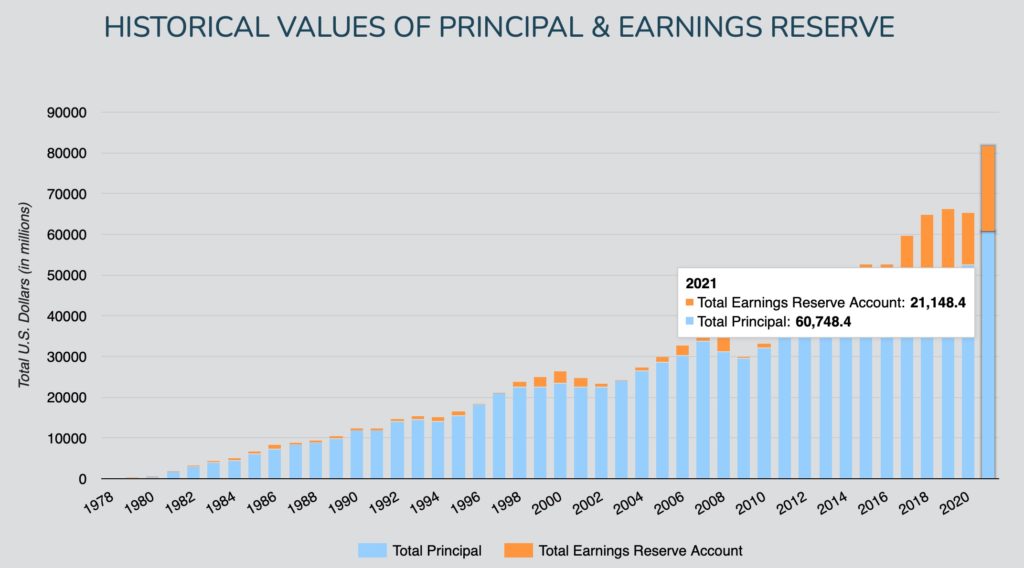
Every year since the Walker half-dividend, the Alaska Legislature has followed his path, taking over half of the people’s money for government or to just leave in the Earnings Reserve Account, which currently has more than $15.7 billion, with $8.9 billion of it uncommitted. The fund itself has over $83 billion in it.

In 2017, the Legislature and Gov. Walker also passed Senate Bill 26, and created a new way to draw down funds from the ERA to pay for state government. The Legislature has never fixed the remaining problem, which is that the previous statutory formula is a state law that the Legislature has broken every year since Walker’s fateful move to take the funds from Alaskans’ wallets as what is arguably the most regressive tax in America.

Gov. Mike Dunleavy has tried to restore the full statutory dividend to Alaskans but has run into headwinds with the Alaska Legislature every year of his governorship. Again in 2022, he will attempt to restore the other half of this year’s dividend to Alaskans, through a supplemental budget request he will make to the Legislature.

What are your thoughts on the Alaska Permanent Fund dividend? Leave them in the comment section below.

Start your engines: ATVs to be allowed on many state roads on Jan. 1

50

At midnight on Jan. 1, 2022, Alaskans will be able to legally drive their all-terrain vehicles on many of the state’s roads, as a new regulation, signed by Lt. Gov. Kevin Meyer, goes into effect.

Roads with speed limits of 45 mph or less, and in areas where ATVs are not otherwise banned by municipal governments, will be shared by standard vehicles, commercial vehicles, bicycles, and now ATVs.

ATVs must have certain safety features to be road-worthy, including a headlight, rear-facing red taillight, and a rear-facing red brake light. ATVs must have brakes, a muffler, carburetor and throttle. Drivers must have drivers licenses and insurance. Passengers must wear helmets. Young children must be in carseats and helmeted. If seatbelts are installed, they must be used. Snow machines are not included in the new regulations for on-road travel.

Anchorage is one location where ATVs are not permitted on the roads, because municipal rules apply, and prohibit them. In places like Bethel, however, several roads will be open to ATVs, including Chief Eddie Hoffman Highway, which stretches from the airport to downtown, First Avenue, BIA Road, Standard Oil Road, Front Street, and Hangar Lake Road.

Craig Compeau, of Compeau’s Inc. in Fairbanks said it has been a record year in both snowmachine and ATV sales. People are spending more time outdoors because of Covid-19, he said.

“There are 11 other states that have ATV on-road laws,” said Compeau Most of them are western states, but Louisiana is one as well. “We’ve talked to law enforcement elsewhere and they are not seeing the problems that some people are worried about. You still have to be a licensed driver. Some of the states are making revenue by selling permits, so there’s a revenue source for the state, if you want.”

Compeau added, “If there is only one state out of the 50 that allows four-wheelers on the roads, it should be Alaska. It saves on wear-and-tear on gas on your main vehicle. These are all four-strokes and are clean driving, and they burn a teaspoon of gas compared with your regular vehicle.”

Liberal white women’s cartel? Anchorage human resources director widens requirements for library director to allow diverse applicants

The director of Human Resources for Anchorage has changed the requirements for the position of Director of Libraries. The requirements no longer say a person must have a masters degree in library science.

The move by HR Director Niki Tshibaka is in part a response to a pilot project started at the library over a year ago. The Library division noted that candidates who had strong skill sets and diverse experiences were being excluded from jobs with the library. Libraries are now run by what is essentially a cartel of white middle-aged women.

At issue during the pilot project was equity, and making sure people working in the library may bring diverse backgrounds, skills, and cultural viewpoints. One of the reasons for the pilot project was that “Strong candidates who had skillsets and experiences applicable to the Library, but not directly in a library environment often did not make it through the HR screening, which led to more uniformity in hiring and hampered the Library’s ability to have a staff with diverse backgrounds and skills,” the Library management noted at the time.

Opening the hiring process to “more candidates with backgrounds outside of libraries . . . makes the candidate pool more diverse in terms of skillsets and cultural identities, because people with library experience tend to come from similar educational and cultural backgrounds[.]”

The Library also concluded that  “[b]y having access to a broader range of applicants, the Library is able to discover hidden gems who bring new perspectives and skills to the Library team whom we might not have found otherwise[.]”

According to the Zippia website, 81 percent of librarians are white and most of those whites are women around the age of 48:

“64.1% of all librarians are women, while 30.5% are men. The average age of an employed Librarian is 48 years old. The most common ethnicity of Librarians is White (81.4%), followed by Hispanic or Latino (6.8%) and Black or African American (6.0%),” the employment website notes.

The number of Native Americans with library science masters degrees is so small that it’s not even documented. But in the 1990s, it was fewer than 200 in the entire nation.

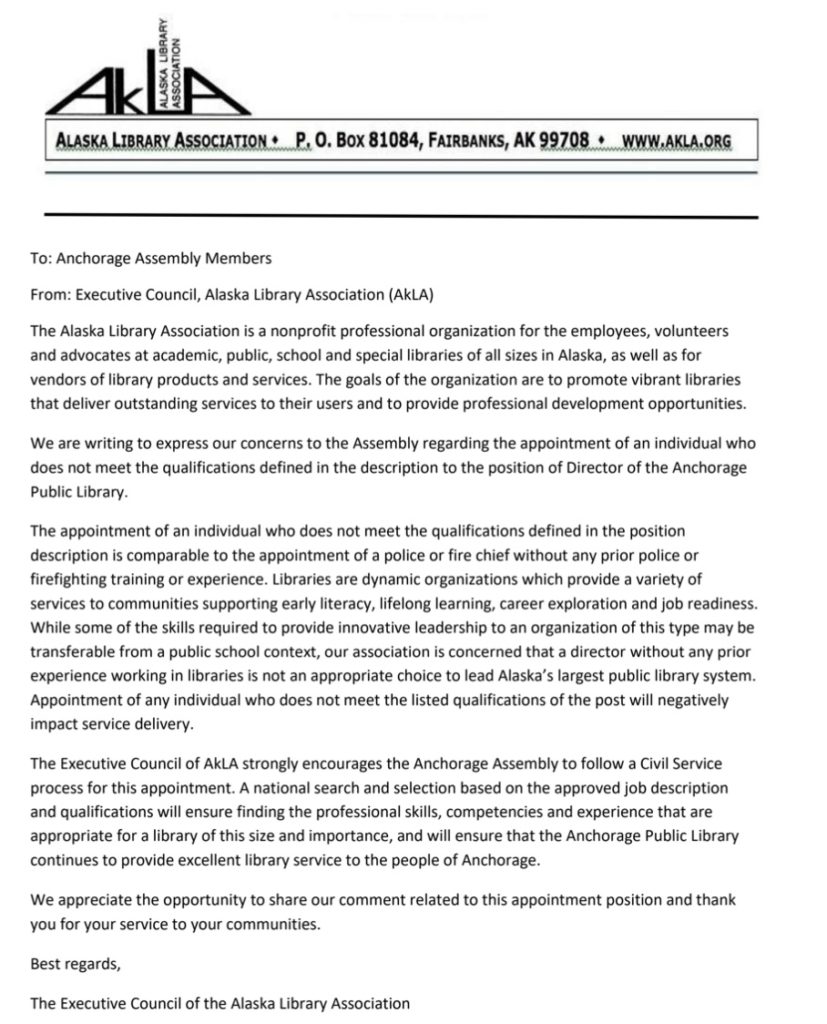
The American Library Association and the Alaska chapter of that organization is stridently opposed to the hiring of those without a MLS degree. The association compares it to hiring a police chief who has no police experience.

Earlier this year, the Anchorage Assembly refused to confirm the mayor’s choice of Sami Graham as director of Libraries, even though she had extensive experience running schools, including the schools’ libraries. After that, Mayor Dave Bronson named Judy Eledge, a teaching professional, to the post; she also does not have a library science degree and later, when it became apparent the Assembly would not confirm her, she dropped back to the deputy librarian position. The Bronson Administration is now on a nationwide hunt for someone to run the Anchorage libraries.

The matter has become especially political because the Loussac Library had, under Mayor Ethan Berkowitz and unelected Mayor Austin Quinn-Davidson, become a cesspool of drug users, drag queen story time for children, and people browsing porn on the internet.

Since her appointment, Eledge has worked to clean up the libraries and make them safe for children again, much to the dismay of the nine liberal members on the Assembly who oppose the Bronson Administration.

Breaking: Mayor Bronson asks Assembly to change Muni charter so Municipal Clerk is elected position, not appointed

Should the Anchorage Municipal Clerk be elected?

The Clerk now reports to the Anchorage Assembly. Among her duties, including helping the Assembly keep track of its work, she also manages elections that affect that very same Assembly.

Some in Anchorage observe that the current clerk, Barbara Jones, is biased toward the Assembly majority, and even more biased against the conservative mayor of Anchorage. Some have characterized her as an unelected 12th member of the Anchorage Assembly, and she has come into conflict with conservative campaigns, such as the Dave Bronson campaign for mayor in April and May. After Bronson was elected, she accused his administration of interfering with her work, simply because his office posted a notice advising people of an upcoming election. She blasted him in the media for “meddling” in her work.

Mayor Bronson seeks to remedy that condition that has wrought voter mistrust by asking the Assembly to make the Clerk’s position an elected one, as it is in hundreds of larger localities around the nation.

Under the charter change, which would need to be approved by voters in April, the Clerk would be elected at-large for a three-year term. A candidate for Municipal Clerk would be required to:

  • Be a qualified voter in the Municipality of Anchorage
  • Be a resident of Anchorage for two years prior to the election
  • Maintain residency in Anchorage, while in office

“The Municipal Clerk serves an important role in the administration, supervision, and execution of our elections. Anchorage voters should have a say in who does this job,” said Mayor Bronson. “Having the Clerk elected by the people will improve transparency, create accountability, and increase trust in the democratic process.”

As this ordinance proposes changing the charter, it requires a two-thirds vote by the Assembly, and then an affirmative vote by a simple majority of qualified voters to take effect. Should the Assembly pass it, a ballot proposition would appear on the April 5, 2022, election giving Anchorage voters a choice on whether the Clerk should be elected.

“I urge the Assembly to allow the voters of Anchorage have their say on this issue,” stated Mayor Bronson. “Clerks around our country are elected by the people, it is time Anchorage does the same.”

Click here and here to read the ordinance. 

Ghislaine Maxwell, gal pal to former owner of ADN, guilty on 5 sex-trafficking charges

It took the jury five days to deliver five guilty verdicts on sex-trafficking charges brought against Ghislaine Maxwell, who groomed and delivered young girls to Jeffrey Epstein, the millionaire and convicted sex offender who reportedly hanged himself in his own jail cell in 2019.

Maxwell is guilty on the charges of:

  • Conspiracy to Entice Minors to Travel to Engage in Illegal Sex Acts
  • Conspiracy to Transport Minors With Intent to Engage in Criminal Sexual Activity
  • Transportation of a Minor With Intent to Engage in Criminal Sexual Activity
  • Conspiracy to Commit Sex Trafficking of Minors
  • Sex Trafficking of Minors

On the second count, Enticement of a Minor to Travel to Engage in Illegal Sex Acts, Maxwell was not found guilty.

Maxwell and former Anchorage Daily News owner Alice Rogoff were friends and colleagues back in the days when Rogoff owned the political landscape of the state.

In 2014, when Maxwell came to Alaska to spend time with Rogoff during the Iditarod Sled Dog Race, the two adventured across Alaska, as detailed a few days later in the New York Post’s Page Six gossip column, when it reported on her at a glitzy soiree in New York.

“Maxwell traveled across hundreds of miles of icy wilderness to the finish line in Nome, where thousands of fans of ‘the last great race’ cheered on the mushers and their dogs,” the Post reported. They flew the race route in two of Rogoff’s private Cessna 206s. Three years later, Rogoff, who obtained her pilot’s license during her time in Alaska, crashed one of planes while visiting former Sen. Clem Tillion in Halibut Cove.

Maxwell is the youngest daughter of the late British publishing magnate Robert Maxwell, who was a member of Parliament, a suspected spy, and scandal-ridden fraudster, who stole millions of dollars from his companies’ pension plans, a fact only discovered after his death.

Adventuresses and millionaires both, Rogoff and Maxwell were increasingly involved in global Arctic politics, which was a growing fad among the elite in those days.

In 2012, Maxwell founded an environmental nonprofit called the TerraMar Project, which allowed her to jet around the world and gain credibility at various influential conferences. She was a featured speaker at the Council on Foreign Relations in 2014. She was also a featured speaker at the Arctic Circle Assembly, both in Reykjavik, Iceland and Seattle, Washington.

Sen. Lisa Murkowski serves on the honorary advisory board of the organization, along with HSH Prince Albert II of Monaco, Dr. Sultan Ahmed Al Jaber, and Artur Chilingarov. Rogoff to this day, although no longer a resident of Alaska, is still on the advisory board.

At the time of her Iditarod adventure, Rogoff was still in negotiations with McClatchy to have her Alaska Dispatch News purchase the Anchorage Daily News for $34 million, which she accomplished that year. It took Rogoff three years to run the newspaper into bankruptcy; she sold it in a bankruptcy settlement for $1 million in 2017, leaving many Alaska businesses out in the cold with their invoices to her company unpaid.

In 2019, Epstein, who was Maxwell’s companion and partner in sex crimes, was charged with sex trafficking, and the justice system started closing in around the person now known as the woman who arranged for Epstein’s parade of girl victims, with crimes going back to the 1990s.

When the charges against Epstein were making headlines, Maxwell had gone into hiding, remaining elusive for a year in a 4,365-square-foot home surrounded by 156 private acres in Bradford, N.H., which she had purchased a few months earlier. No longer was she splashed across the society blogs and news pages; in fact, she studiously avoided being seen in public.

On July 2, 2020, she was arrested there, and a federal appeals court twice denying bail requests from her attorneys, as she was considered a flight risk.

During the trial of Maxwell over the past two weeks, the sordid details came forward. One of the victims who testified told the jury that Maxwell and Epstein started abusing her when she was just 14.

According to The Guardian newspaper, the women – Jane, Kate, Carolyn and Annie Farmer – testified they met Maxwell as teens, “and that she lured them into Jeffrey Epstein’s orbit. While the dates and exact circumstances of their encounters with Maxwell differ, they all share striking similarities. Only Farmer used her real full name.

“These four women all describe being vulnerable when they met Maxwell, such as suffering financial precarity or strained family relationships. They said that Maxwell made them feel comfortable before Epstein’s misconduct and that she made them feel special by asking questions about their lives. She served as a reassuring presence that tempered concerns or suspicions about Epstein.

“They all said that Maxwell was involved in Epstein’s abuse or misconduct. Three said that Maxwell coordinated their appointments with Epstein. Three said that Maxwell touched them. They all described Maxwell as working to satisfy Epstein’s physical needs. Accusers’ testimony portrayed Maxwell as an enabler and, in some instances, an enthusiastic participant.

Click here to read the Guardian’s summary of each of their stories of abuse.

Maxwell’s attorneys say they will appeal the verdicts, but for now, the former high-flying Arctic expert is in jail, where she will remain for at least many months to come.

FAA warned by doctors in letter describing vaccine hazard, health, FAA violations

A group of doctors and others have penned a letter to the Federal Aviation Administration, explaining a problem that they’ve identified with the Covid-19 vaccine: Pilots are flying with unapproved medications in their bodies, in violation of FAA rules.

According to the letter signers, which include attorneys and medical doctors, the airline industry is operating in violation of Title 14 of the Federal Aviation Regulations, and related federal rules, which prohibit pilots from flying with non-FDA approved agents in their bodies, such as the Covid-10 vaccines, if those substances put the general public at risk for serious injury or death. The writers distinguish between FDA-approved vaccines and those that are actually being used to reduce the danger of Covid-19.

The authors of the letter are requesting the FAA medically flag all vaccinated pilots within four weeks of the Dec. 15 letter, until those pilots undergo thorough medical reexaminations to include D-Dimer tests; which check for blood clotting; Troponin tests, which reveal heart muscle damage; and EKG and MRI tests to determine cardiac health.

The signers of the letter are recommending that all pilots who fail the tests be immediately grounded until they can get a clean bill of health.

“From this point forward, only allowing commercial aircraft to be operated by pilots who can show D-Dimer and Troponin tests – as well as cardiac MRIs, ECGs and PULS tests – at aeromedically acceptable levels, and a clean medical examination undertaken a minimum of five (5) days after each COVID-19 vaccine and after each COVID ‘booster’ shot, as a review of reporting systems such as the Vaccine Adverse Event Reporting System (‘VAERS’) indicates that the current FAA wait time of two (2) days is insufficient to detect a significant number of blood clotting and myocarditis cases (which are manifesting more than 48 hours post-inoculation),” the group wrote.

“…the FDA has not approved any of the COVID-19 shots currently available in the United States. On August 23, the FDA granted BioNTech Manufacturing GmbH’s Biologics Licensing Application to distribute the Comirnaty vaccine in the United States once certain conditions are met; however, the Comirnaty vaccine is not currently available in the United States – and will not be until the supply of the Pfizer-BioNTech vaccine is first exhausted. See https://www.fda.gov/media/151710/download. The Pfizer-BioNTech vaccine is currently available only under an EUA, which the FDA extended on August 23, 2021. See https://www.fda.gov/media/150386/download. It is also important to note that the approved vaccine, Comirnaty, cannot be said to be interchangeable with unapproved inoculations,” the letter said.

The group said it knows of pilots who have died after getting the Covid vaccine, and others who continue to suffer side effects but are afraid to report them for fear of being grounded.

Some pilots have been forced to seek medical care, such as Cody Flint, whose story is included in the letter:

“I am a 33 year old husband and father of two young boys. I am an agricultural pilot by profession, with over 10,000 flight hours. I have been very healthy my whole life, with no underlying conditions. I received my first dose of the Pfizer Covid Vaccine on February 1. Within thirty minutes, I developed a severe stabbing headache, which later became a burning sensation in the back of my neck. Two days after vaccination, I got in my airplane to do a job that would only take a few hours.

“Immediately after taking off, I knew that something was not right with me. I was starting to develop tunnel vision, and my headache was getting worse. Approximately two hours into flying, I pulled my airplane up to turn around and felt an extreme burst of pressure in my ears.

Instantly, I was nearly blacked out, dizzy, disoriented, nauseous and shaking uncontrollably. By the grace of God, I was able to land my plane without incident – although I do not remember doing this.

“My initial diagnosis of vertigo and severe panic attacks – although I’ve never had a history of either of these – was later replaced with left and right peri-lymphatic fistulas, Eustachian tube dysfunction, and elevated intra-cranial pressure due to brain swelling. My condition continued to decline, and my doctors told me that only an adverse reaction to the vaccine or a major head trauma could have caused this much spontaneous damage.

“I’ve had six spinal taps over eight months to monitor my intra-cranial pressure, and two surgeries, eight weeks apart, to repair the fistulas. I have missed nearly an entire year of my life – and my children’s lives. Days of baseball games, playing in the backyard, and just picking up my kids to hug them have been replaced with living in a sick body, doctor’s visits, and more questions than answers. I don’t know if I’ll ever be able to fly again.

“This vaccine has taken my career from me, and the future I have worked so hard to build. I’ve used all of my savings just to pay my medical bills: my family and I are on the verge of losing everything we have. I was and still am pro-science and pro-vaccine. The main issue rests squarely on the fact that the FDA, CDC and NIH refuse to acknowledge that real lives are being absolutely destroyed by this vaccine….

The letter is signed by Robert F. Kennedy, Jr. and Mary Holland of the Children’s Health Defense, Dr. Ryan Cole, who was featured at the Alaska Early Treatment Summit in Anchorage; Lt. Col. Peter Chambers, M.D., Special Forces Flight Surgeon – Green Beret; Dr. Peter McCullough, M.D.;Lt. Col. Theresa Long, M.D., MPH Army Aerospace Medicine Specialist Aviation Officer Course & Mishap Training, and Leigh Taylor Dundas, Esq., Advocates for Citizens Rights.

The entire letter can be read at this link:

Anchorage reapportionment draft maps are posted, and have some big changes

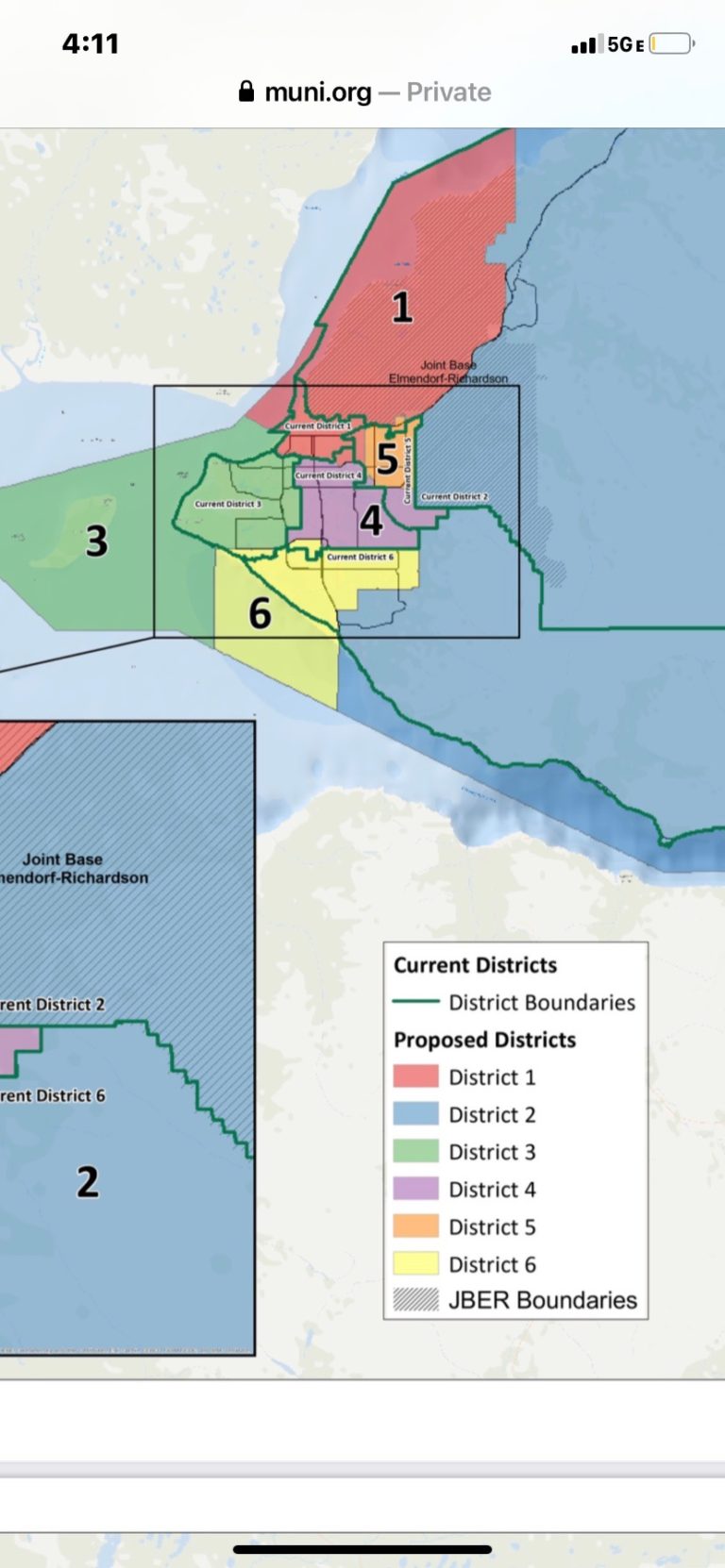
The first draft set of maps for the Municipality of Anchorage’s reapportionment have been released by the Anchorage Assembly. It can be found at www.reapportionANC.org.

The maps set forth the boundaries for each of the Assembly seats, including the new 12th seat that voters approved for downtown Anchorage.

The website has a comment portal, a fact sheet, and documents from the Reapportionment Committee meetings this fall.

In Anchorage, Assemblyman Chris Constant led the reapportionment process, with Assembly members Pete Petersen, Crystal Kennedy, and Austin Quinn-Davidson filling out the committee.

One of the five proposed maps, shown above, takes JBER and puts it all in the Assembly seat that Constant currently represents, robbing those voters from the Eagle River area, where they are currently linked. JBER voters are not typically engaged in the municipal elections, and have little in common with downtown Anchorage voters.

Two town halls will be held in late January, the Assembly announced.

Reapportionment takes places after the U.S. Census to ensure that all districts have roughly the same number of voters in them. It’s a political process that in Anchorage is controlled by the Democrats on the Anchorage Assembly.

Parents could use the help: Covid made the case for the state education tax credit program

By DAVID BOYLE

Many parents in Alaska’s public schools have removed their children due to the shutting down of the schools, masking of the students, and the teaching of Critical Race Theory and other Marxist ideals. Parents have sacrificed jobs and finances to either homeschool their children or send them to a private school.

These parents could use some help in paying for their child’s education. Fortunately, there is help in the form of a State of Alaska Education Tax Credit program. 

Most parents don’t know about this great way to finance their child’s education. But Alaska’s Education Tax Credit program has been in existence since 1987. It was expanded in 2014 to include private nonprofit elementary and secondary Alaska schools. 

Unfortunately, it has been below the radar of most families. 

The tax credits are also available for cash contributions for STEM programs by a nonprofit agency and certain qualified childhood early learning programs. 

If a company pays certain taxes to the State of Alaska, it may be able to claim an Education Tax Credit. If you work for a company that pays taxes (corporate income tax, fisheries landing tax, mining license tax, etc.) your company may qualify.

This tax credit can also be used to support Alaska universities and accredited nonprofit Alaska two/four-year colleges. It covers the entire range of education from kindergarten through college.

Here’s how St. Mary’s School in Kodiak implemented the tax credit program: It went to the local Chamber of Commerce and got the names of 200 companies/persons that could qualify for the credit. It sent these companies information regarding the program. Then it worked with these companies to get them to participate. 

The program was set to end in 2018 but the Legislature extended it to Dec. 31, 2024. There was bipartisan, almost unanimous, support for this extension. 

In 2019 the credit was changed to allow for equipment contributions as well as cash.  

The credit has been reduced as of January 2021. It is set at 50% of all contributions and a business can claim up to $1 million in education credits annually.  For example, if a company contributes $100,000 it can offset its corporate taxes by $50,000. A win for the company and for education.

From 2018-2020 the credits totaled nearly $17 million. This chart shows the calendar year 2020 credits (taxes saved by the contributors) and the various beneficiaries. The University of Alaska benefited the most.

The Education Tax Credit program is an excellent way to help those parents who want the best education for their children. Corporations win by reducing their taxes and improving the education of the citizenry. Parents win by getting help to fund their child’s education. And the State of Alaska wins by improving educational options for students.

For more information on the Education Tax Credit program, go to http://tax.alaska.gov/programs/programs/credits/index.aspx for a description of the program.

Click here for a copy of the form.

David Boyle writes about education for Must Read Alaska.