The people of Anchorage know our city should function better — much better. What has occurred during the past three years, the decline and decay of our hometown, has been heartbreaking to watch, and it’s unacceptable to us and our families.
We know crime and homelessness are severe problems the current Assembly has not effectively addressed over the past several years. We can see with our own eyes the boarded-up businesses, vagrancy and vandalism. This is what the current Assembly, including John Weddleton, has inflicted on us and small businesses across our city through its misguided policies, and it’s time for change.
That change started with Dave Bronson being elected to the mayor’s office. But Dave needs help to bring sane and sensible policies back to Anchorage. He can’t do it if the Assembly is fighting him at every turn.
My opponent in the South Anchorage District 6 race for Assembly is on the record in this newspaper saying things are going well in Anchorage government. He says the Assembly is getting along with the newly elected mayor. He says homelessness is being solved.
Weddleton says government is working well. He says you should not believe what you hear about dysfunctional government. He says all of this is normal, and that this Assembly is working cooperatively with the mayor.
The woman who was stabbed on Feb. 14 in the Loussac Library probably doesn’t agree with Weddleton, who is also on record saying that all people must be allowed to use the library, “no matter how vile.”
That woman is now paralyzed from being stabbed in her spine as she simply returned books to the library just feet away from where the Assembly meets. She was an innocent citizen whose life will never be the same.
The evidence shows that nine members control the Assembly — Weddleton among them. He alone could have shown leadership and stopped any of the numerous veto overrides.
The record shows that nine members of the Assembly, who Weddleton agrees with the majority of the time, are constantly searching for ways to sideline Mayor Bronson. They pepper his offices with endless and petty public records requests. They look for anything they can find that would distract and hobble him from being able to succeed in helping Anchorage get back on its feet. We need to work together despite our differences.
I am the conservative candidate running for Anchorage Assembly in South Anchorage. I have the support of Mayor Bronson. I will work to lower property taxes, fight the rising crime rates, and help rebuild the small businesses of Anchorage that the current Assembly has devastated.
I am not going to stand by and watch this dysfunctional and unproductive Assembly take the city down. I won’t align with the nine who are more interested in agendas than problem-solving.
Instead, I’m going to stand for what is fair, sensible and productive to help Anchorage get back on its feet.
Weddleton is wrong. If everyone on the Assembly was getting along with the mayor, and if everything in Anchorage is getting better, I would not see a need to run for Assembly. Our city needs all of us to stand up and defend it against an Assembly that has become hostile to the very citizens it serves.
Voters know better. Our eyes are open. I urge South Anchorage to vote as if their lives depend on it this year.
Randy Sulte is a candidate for District 6 for the Anchorage Assembly.
On April 1, some of my fellow Alaska Airlines pilots will be picketing to protest of our ongoing contract negotiations. I will not be joining them.
Currently, the average Alaska Airlines captain makes about $90,000 a year more than the average surgeon, according to the Bureau of Labor Statistics – and averages 15 days off every month, along with a month of vacation every year.
While recovering from two years of pandemic disruptions, Alaska Airline’s opening proposal to Alaska pilots contract negotiations includes more than 30 improvements to work rules. Additionally, the company has proposed pay increases that includes the highest pay rate in the industry for new-hire copilots and matches the current average pay rate of captains flying narrow-body aircraft at Southwest, Delta, United and American (the four US Airlines bigger than Alaska).
In addition to that, the company is offering an adjustment in pay rates after one year, if the pay pattern for other carriers increases during that year. Reasonable.
We’ve always been well compensated at Alaska but rarely at the top pay in the industry because we don’t have wide-body aircraft that bigger carriers use to supplement the higher cost per seat of their narrow-body fleets. Everyone who has ever interviewed to work for Alaska Airlines is aware of that.
My union bosses, who are encouraging a group think decision making process, are demanding a pay rate $34/hour abovethe highest paid narrow-body pilots at major passenger airlines with wide-body fleets. Unreasonable. They will say the pay demand is based on member polling data. They’re operating on bad data. I’ve taken the union polls. They’re not anything close to being scientific or at all balanced.
If you polled most Alaska Airlines pilots and asked if they want wages 15%-20% above the highest pay the industry, with no other context — most would probably say yes. Who wouldn’t? Everyone would like more money. If you informed pilots that wages at that level would make the airline significantly less competitive, drive-up ticket prices, and hamper the company’s ability to grow — there would be few who would be in favor.
If Alaska Airlines somehow granted 3,000 pilots a sudden 20% pay increase, it would be very difficult to do less for the other 20,000 non-pilot employees at the airline. We have chosen to work in a very competitive industry, where the balance between growth and stagnation are determined in very small margins. We must keep our costs competitive — to keep our ticket prices competitive — to attract more guests and grow.
When I joined Alaska in 2000, we were the 11th largest airline in the US with around 1,200 pilots. Today, Alaska is 5th largest airline in the US with 3,000 pilots, 238 aircraft and 145 new Boeing 737’s on order through 2026. Because of that growth, I’m in the top 20% of most senior pilots at Alaska. If we had not grown, I would still be around the middle of our pilot seniority list after 21 years.
Alaska Airlines was recently recognized as one of the Top 100 Best Employers in the US by Forbes and the Airline of the Year by Aviation Week’s Air Transport World. Alaska Airlines has a great culture, and a fantastic group of coworkers who collectively focus on giving our guests the award-winning service they deserve, at a fair price. There are plenty of airline industry jobs that will sometimes pay a little more. We all knew that, before we signed up to be a part of this great company.
Bob Griffin is a pilot with Alaska Airlines and lives in Anchorage.
At least 33 people who work in the Alaska Capitol have tested positive for Covid-19, including seven positive cases on Wednesday and four on Thursday.
The chief of staff to House Speaker Louise Stutes said that the cases were in members and legislative staff from both the House and Senate. Only those who are still in isolation are considered active mass, said Matt Gruening in a note to House members and staff. Five of those who are now quarantining are legislators.
Last weekend, numerous staffers were out on the town in Juneau, and many partied at the annual Sham Jam fundraiser at the Red Dog Saloon. After that, several tested positive for Covid. The House has not held a session this week because at least three Republicans won’t wear face masks, as ordered by the House Speaker. The budget is being held up by a combination of too many legislators from the Democrat-led Majority needing to stay in isolation, and some Republicans refusing the mask order.
At their Thursday meeting in Fairbanks, the storied Republican Women of Fairbanks endorsed Nick Begich for Congress. Nick also has the endorsement of one of the Republican women’s clubs of the Kenai, and three Republican districts.
The current chair of the club is Patty Weisel, and the members make up some of the most politically active women in the Interior. The club was formed and has been active before Statehood.
The Republican Women of Fairbanks’ endorsement is influential not only because of the statement it makes but because of the guaranteed volunteerism that comes with it in the Interior.
Nick is the Republican Begich who filed for Congress five months before Congressman Don Young’s death on March 18. Since Young passed on March 18, several others have joined the race, some from out of the state, and others who have various levels of name recognition with voters.
Josh Revak could have been at one time considered the Alaska Republican Party’s greatest gift. Now reported to be running for Congress, Revak could have been the clear front runner.
No more. Revak’s recent record and statements will come back to haunt him.
Revak is a wounded veteran who served honorably in Iraq, who overcame alcohol adversities and managed to go on and serve in the offices of U.S. Sen. Dan Sullivan and Congressman Don Young, who defeated a Republican incumbent in a primary for a State House seat, and later became a member of the state Senate.
However since becoming an elected to the Alaska legislature in 2018 Revak seems to be a different person. But why? Is Revak simply not the person he was portrayed to be in 2018? Or is there truly something about that Juneau water that makes people think differently?
Many have not yet forgotten his betrayal of another Alaskan hero: Rep. Laddie Shaw. When appointed by Gov. Mike Dunleavy to fill the state senate seat left vacant by the late Sen. Chris Birch, Shaw was essentially denied that seat by former Senate president Cathy Giessel.
Despite Shaw being undeniably qualified to take a seat in the Senate, Giessel and some of her fellow Republicans turned on Shaw due to his support for the statutory Permanent Fund dividend.
In wake of Shaw’s rejection, Gov. Mike Dunleavy was left with a clear message that the Giessel, Sen. Natasha Von Imhof, and Sen. Gary Stevens crowd were the true senators in control of the appointment process. Eventually, Dunleavy would replace Senator Birch with the young freshman representative Revak.
Initially, I thought Revak’s appointment was a good pick. He appeared conservative, campaigned on supporting the statutory Permanent Fund dividend formula, and was a likable fellow, but it should have said something to me when Giessel allowed Revak to take the position she had originally denied to Laddie Shaw.
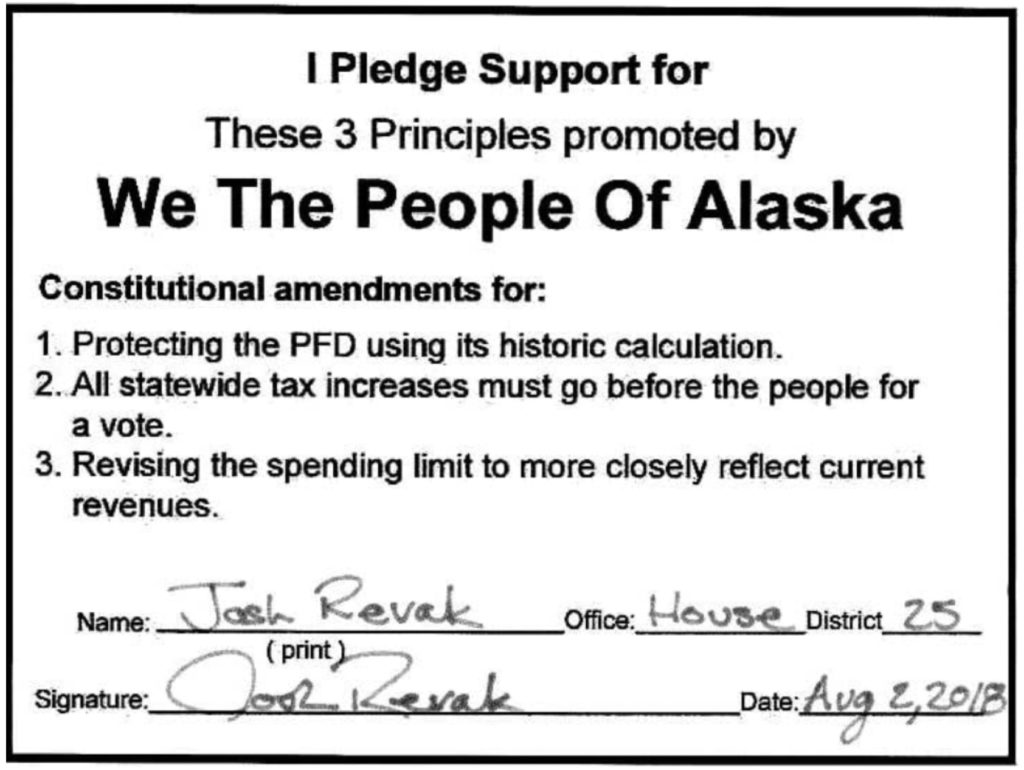
Then, on May 19, 2021, Revak joined 10 members of the Senate, and casted a deciding vote against the state funding the full statutory dividend. This was despite Revak’s initial written campaign pledge which he signed in 2018 that he would commit to supporting Alaskans statutory check.
Josh Revak signed a pledge, and then reneged on it.
In fact, not only did Revak vote against the statutory amount, but he even voted against the 50/50 Percent of Market Value plan suggested as a compromise by Gov. Dunleavy. Revak’s failure to adhere to his pledge, essentially joining the category of the Senate Republicans’ most anti-PFD members including Sens. Von Imhof, Stevens, and Stedman.
While Revak later explained himself on the evening drive Mike Porcaro Radio Show by saying that he regretted signing that pledge, as he now knows things that he didn’t know before, the truth is clear: He broke his contract with Alaskans in a time where Alaskans have a low level of trust in their Legislature for failing to uphold the law. Revak’s votes demonstrated he is not a man who can adhere to the promises he got elected by.
To be fair, Revak is not the only member of the Senate to demonstrate this behavior, but now that he may run for the seat of the late Congressman Don Young, Alaskans deserve to be reminded about Revak’s record before they mail in their ballots. If there is any one thing that should disqualify a person from running for office, in my mind failing to adhere to a written pledge would be a golden example.
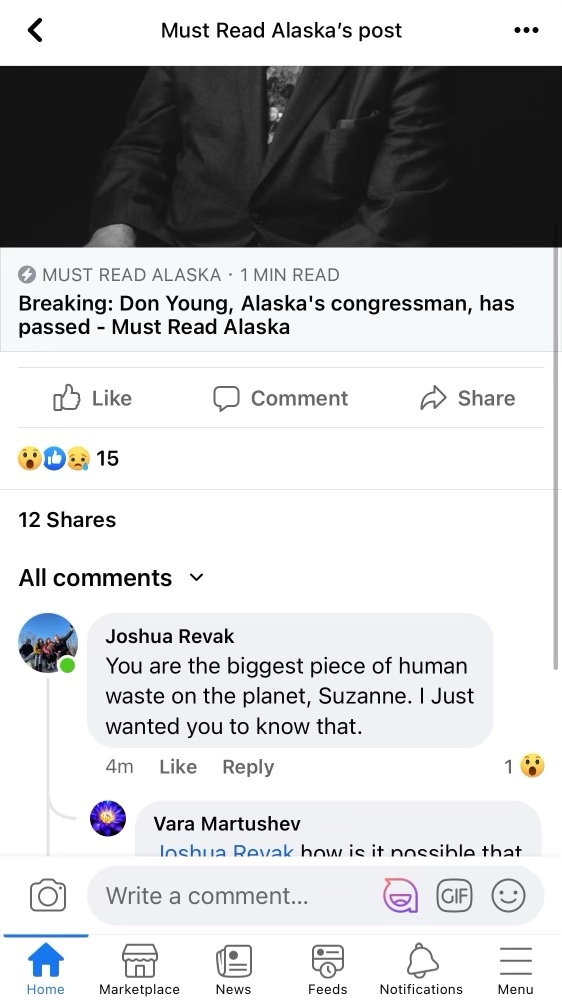
But for those who have forgotten of his betrayal of the PFD, Alaskans have recently had a good of his character when he explicitly attacked Must Read Alaska Publisher Suzanne Downing, calling her the “biggest piece of human waste on the planet.” To me, this incident not only exemplified my worst fears that Revak is not the conservative freedom fighter I once saw him to be, but it also appears to be an indicator he is not a man with the humility, or that he even has the temperament to be serving in this office.
Before you cast your ballot in the next election, take a good look at the record of your candidate before deciding whether they deserve an upgrade. You may just not like what you see.
The filing deadline for the special election to replace Congressman Don Young is 5 pm on Friday, and already 26 people have filed for office with the Division of Elections. Among them are people from Fairbanks, Soldotna, and even La Jolla, Calif.
Anyone can file with the Division of Elections for the special primary, which will be the first statewide election this year. For those who don’t live in the state, they would be required to move here if they won the final ballot in November.
There will be three other elections involving the congressional seat, vacant since Congressman Don Young died on March 18 on a flight to Seattle. The first is the special election primary. After that, a special election general election in August, held at the same time as the regular primary election. Finally, a the process ends with a general election in November, where other races will also be decided, such as state House, Senate, and U.S. Senate.
Many more people are expected to join the already crowded race for Alaska’s only congressional seat by the Friday deadline. The withdrawal deadline for a candidate to remove their name from the special election primary election ballot is noon on April 4.
The candidates as of 5 pm Thursday:
AGUAYO, DENNIS W. “DENNY” (NONPARTISAN) (CERTIFIED) NIKISKI, AK 99635
ARMSTRONG, JAY R. (REGISTERED REPUBLICAN) (CERTIFIED) FAIRBANKS, AK 99707
BEAL, BRIAN T. (UNDECLARED) (CERTIFIED) Fairbanks
BECK, TIM (UNDECLARED) (CERTIFIED) FAIRBANKS, AK 99706
BEGICH, NICK (REGISTERED REPUBLICAN) (CERTIFIED) ANCHORAGE, AK 99519
BRELSFORD, GREGG B. (UNDECLARED) (CERTIFIED) ANCHORAGE, AK 99524
BYE, CHRIS (REGISTERED LIBERTARIAN) (CERTIFIED) FAIRBANKS, AK 99707
CARLE, ARLENE (NONPARTISAN) (CERTIFIED) ANCHORAGE, AK 99516
COGHILL, JOHN B. JR. (REGISTERED REPUBLICAN) (CERTIFIED) FAIRBANKS, AK 99711
DUTCHESS, LADY DONNA (NONPARTISAN) (CERTIFIED) ANCHORAGE, AK 99504
FLORSCHUTZ, OTTO H. III (REGISTERED REPUBLICAN) (CERTIFIED) WRANGELL, AK 99929
FOSTER, LAUREL A. (NONPARTISAN) (CERTIFIED) ANCHORAGE, AK 99504
GIBBONS, THOMAS R. “TOM” (REGISTERED REPUBLICAN) (CERTIFIED) GLENNALLEN, AK 99588
GRIFFIN, KARYN (UNDECLARED) (CERTIFIED) SOLDOTNA, AK 99669
HEINTZ, TED S. (REGISTERED LIBERTARIAN) (CERTIFIED) ANCHORAGE, AK 99502
HIBLER, WILLIAM D. III “BILL” (NONPARTISAN) (CERTIFIED) FAIRBANKS, AK 99710
HOWE, JOHN WAYNE (REGISTERED AK INDEP) (CERTIFIED) FAIRBANKS, AK 99708
LOWENFELS, JEFF B. (NONPARTISAN) (CERTIFIED) ANCHORAGE, AK 99502
LYONS, ROBERT “BOB” (REGISTERED REPUBLICAN) (CERTIFIED) HOUSTON, AK 99694
MELANDER, MIKEL E. (REGISTERED REPUBLICAN) (CERTIFIED) FAIRBANKS, AK 99710
METTLER, SHERRY M. (UNDECLARED) (CERTIFIED) ANCHORAGE, AK 99503
MYERS, J.R. (REGISTERED LIBERTARIAN) (CERTIFIED) CUT BANK, MT 59427
PELLEGRINI, SILVIO E. (UNDECLARED) (CERTIFIED) FORT WAINWRIGHT, AK 99703
THISTLE, DAVID (UNDECLARED) (CERTIFIED) LA JOLLA, CA 92037
WELTER, BRADLEY D. (REGISTERED REPUBLICAN) (CERTIFIED) ANCHORAGE, AK 99516
WRIGHT, STEPHEN (REGISTERED REPUBLICAN) (CERTIFIED) WASILLA, AK 99654
Many readers have noted the extent to which the teachers’ unions idea of “science” has dictated federal, state and local governments’ policies regarding school closures, masking, and other Covid-related issues.
There has been quite the kerfuffle lately about how the teachers’ unions got to essentially write the Centers for Disease Control’s national policy on school closures. Allegedly, it went so far as the unions having been able to actually dictate the wording of the policy memorandum issued by CDC. I have no trouble believing the allegation: I’ve had it done to me. So, read , my friends, and you shall learn the story of what may well be the most expensive memorandum ever produced by state government.
We had a new commissioner and he had hired me. Behind closed doors, his directive to me was to get unions off his back and out of his buildings. I didn’t technically work for the commissioner but rather for a division director who wasn’t privy to my discussions with the commissioner and who would never in a million years have hired me if she’d had a choice.
The commissioner asked the director for a briefing memo on his rights and duties in dealing with union stewards and non-employee representatives. I assume the commissioner had told her to have me write it because I can’t imagine her assigning it to me of her own volition. One of the most valuable skills at the upper levels of government is being able to work with people who hate each other.
The law was pretty settled; NLRB v. Weingarten (1975) is the controlling authority and Alaska’s bargaining law has the same language as the federal law under which Weingarten had been decided. Alaska had never had any issues with union representation rights. What we were really dealing with was unions trying to preserve ill-gotten gains; the unions had lived a charmed life under Gov. Tony Knowles’ first commissioner of Administration, when the State’s labor policy had essentially been, “ask the unions what they want.”
By this time, early 2000, even the Democrats had figured out that they couldn’t actually run the government and keep their union allies happy. I was an experienced enough bureaucrat that I wasn’t going to step on a rake, so I gave them a very straightforward, black-letter law memo. There was absolutely nothing extreme or even controversial in it.
I respected State protocol and sent it up the chain through my director to the commissioner. She freaked out, and rather than sending it back to me with edits and comments or sending it on to the commissioner with her comments, she, instead, sent it to the head of the Alaska Communist Party, excuse me, the Alaska State Employees Association, AFSCME Local 52, AFL-CIO.
He came down to Juneau to discuss it with her and the commissioner. Even with one of the lefty lawyers from Department of Law in the room, they couldn’t come up with anything that was legally wrong in the memo. They just thought it was too controversial, too aggressive. Even almost 20 years ago something that a lefty punk didn’t like was considered “too controversial.”
The policy memo didn’t go out. Instead, we adopted the parasite, excuse me, Democrat method of governing; we applied for a grant from the Federal Mediation and Conciliation Service to help us resolve our labor-management relations issues, which were mostly of the feckless administration’s making. This was all under the Clinton Federal Administration and we still had Knowles’ Democrat Administration in Alaska. We got a half-million dollar grant and the services of a couple of FMCS mediators to facilitate the initial meetings until it could be taken over by local talent. We, though I was as little part of that “we” as I could get away with, put together what was styled Supervisor-Steward Joint Training, which came to be known as Super-Stew Training.
The first big event brought all of the State and ASEA’s professional staff together with a bunch of human resources people and some directors and section managers at the Kenai Princess hotel for two or three days of “collegiality.” We all flew into Anchorage and took a chartered bus to the Princess. I assume that at that stage of the thing all the costs were going to the grant, but that little party in the Alaskan wilderness cost $100,000 or more. There are some stories that could be told, but gentlemen don’t tell.
It went on until it died of its own weight; nobody cared anymore. We had something like adult leadership in State government as the 2002 election approached and labor relations people could just do their jobs. We had pretty much reined in the Saul Alinskyite disruptions in Juneau and Anchorage and peace seemed to have descended over the land. In the last years of the Knowles Administration they tried to become “born again” Republicans, so we got some peace with the unions. I believe that the total cost of all those goat-rope “training” sessions all around the State was the better part of a million dollars in federal and State funds.
What you are seeing today at the federal level is just business as usual in a Democrat administration. Of course the union got to write the policy. Of course the union knew all about it before it was announced to the public. I became the head of State Labor Relations in March of 2003. One of the very first things I did was publish that memo as State policy.
The million dollar memo remains formal State policy though I don’t know how conscientiously they follow it these days.
“The one great assurance of good public order and honest government lay in a literate citizenry,” Nock said.
Alaska desperately needs a literate citizenry now. If Alaska is to survive and even thrive in the next 10 or 50 years, our children need to know how to read, write, do math, and think for themselves intelligently.
On April 28, 1814, Thomas Jefferson, from Monticello, wrote to Luis de Onís, Spanish envoy to the United States from 1809 to 1819, regarding the newly adopted Spanish constitution, “…. there is one provision (found in the new Constitution of the Spanish Monarchy. Promulgated at Cadiz on March 19, 1812) which will immortalize its inventors. It is that which, after a certain epoch, disfranchises every citizen who cannot read and write. This is new; and is the fruitful germ of the improvement of everything good, and the correction of everything imperfect in the present constitution. This will give you an enlightened people, and an energetic public opinion which will control and enchain the aristocratic spirit of the government.”
When looking at Alaska’s Constitution, the above Jefferson quotation, and the Spanish constitutional requirement that all citizens must read and write or lose their citizenship, how would the constitutional delegates have reacted to the founder of American education theory?
Remember in addressing the question of public funding of education found in Article VII, Section 1, on January 9, 1956, Delegate R. Roland Armstrong, Juneau constitutional delegate, stated “The Convention will note that in Section 1 that the Committee has kept a broad concept and has tried to keep our schools unshackled by constitutional road blocks.”
With this understanding the delegates decided to neither allow competitive education to include both government and private education nor a free-market approach to education. Ironically, the delegates shackled Alaska education with a state constitution in the land of the free and the brave. They prohibited a free-market education system by chaining public funds to a bigoted public purpose which established all Alaska government schools “free of sectarian control” and excluded religious or other private educational institutions from the direct benefit of public funds.
Followed shortly after Armstrong’s quote, Delegate John B. Coghill in his defense of his amendment to include “and indirect” in Article VI, Section 1, he misquoted Jefferson to further try and close the door on competitive education and advance the irrational bigotry against private and sectarian educational systems in the name of public purpose.
But where does that put us now?
Because the Alaska constitutional delegates feared religious indoctrination in Alaska’s education, they got today’s result: Marxist indoctrination.
Government education is a failure for two reasons. Government runs it, and education is not the purpose of government.
What can we do?
My personal recommendations are simple: Take government out of education. Structure education in Alaska to be the antithesis of Alaska Statutes Title 14.
The first step is to amend AS 14.17.300. Instead of a Public Education Fund, why not establish an education fund which consists of appropriations for distribution directly to the parents for the education of their children?
I know the first response to this may be, “The parents! Are you kidding? They’ll blow the money.”
If I may offer a rebuttal question, what are school districts, especially the largest in the state, doing right at this moment, not only with the state’s money, but your property tax money?
Aren’t they blowing it?
Alaska student performance and outcome are one of the lowest in the nation while cost per student is one of the highest.
Despite Alaska school districts’ continuous shout for more money, the 1990’s conclusions of Alaska 2000 stated clearly, “Expenditures are unrelated to school performance as schools are currently operated.” John Chubb of the Brookings Institution and Teny Moe of Stanford University concluded similarly, “There is no connection between school funding and school performance.” Thomas Sowell in his book, “Inside American Education” agreed. This political shout by the NEA is about more money for them, which has nothing to do with the performance of your children.
Parents are smart and when it comes to their children, they can be awesomely creative.
Of course, put rules in place that make parents accountable and responsible for the money. There are other ways to both save money and ensure parents’ participation too. For example, why not give an incentive for parents to donate a certain number of hours to the school as volunteers, per school year?
When it is all said and done, government education has proven to be a failure in Alaska. Why not construct another approach?
I realize just about now some readers are pointing out Article VII, Section 1, which prohibits “public funds for the direct benefit of any religious or other private educational institution.” Something found unconstitutional by the SCOTUS in Espinosa – but our state leadership is afraid to change it. My contention is the public funds should go to the parents for the direct benefit of their children’s education. What the parent does with that money should not matter if this goal is achieved.
I recommend repealing state statutes for school districts and teacher tenure as well as reforming Title 14 to deregulate government education in favor of competitive education. If competition in our schools is really going to work, shouldn’t we remove all the barriers to give our children the best education possible coupled with the clear influence of the best people to influence them, their parents?
One of the central problems I see is our current interpretation of the definition of “public purpose.” When defined through the spectrum of top-down government, public policy is how government modifies individual behavior through regulations and ordinances to control them. In other words, government tells the people what to do.
When defined from a bottom-up government, public policy is how the citizens modify government behavior. This is vital especially on a local government level as this sets the public policy on the lower government strata with the purpose of upward policy development to the state and federal government.
In Black’s Law Dictionary, the term public purpose has been said to have the objective of “promotion of the public health, safety, morals, general welfare, security, prosperity and contentment of all the inhabitants or residents within a given political division.” Have we allowed local governments to pervert this objective by allowing local government to promote a collective authority?
The Alaska Legislature is the sole entity in the Alaska separation of powers doctrine with the power to make law. It has not just the authority to make law but the authority to restrict the two other branches of Alaska’s government, judicial and executive, when making law. It is also the only branch of government that controls education in Alaska.
Wouldn’t it be remarkable if the Legislature discovered that the current Alaska education model wasn’t working and decided to change it so we as parents controlled the educational outcome of our children?
Michael Tavoliero is a realtor in Eagle River, is active in the Alaska Republican Party and chaired Eaglexit.Part II of this series will be posted shortly.
When the Hillary Clinton for President campaign did opposition research in 2016, it logged it in as “legal” expenses.
Now, six years after the failed 2016 campaign paid for lies to be promulgated against Donald Trump, linking him to Russians in what became known as the Steele Dossier, the Federal Election Commission has given the Clinton campaign a hand-slap fine of $8,000 for lying about the work the campaign was actually doing. The FEC also fined the Democratic National Committee $105,000 for categorizing the opposition research as legal work.
The work in the Steele Dossier was enough in 2016 for the politically motivated FBI to open up an investigation into the Trump campaign. The dossier contains explosive and salacious claims about Trump’s sexual preferences, and indicates the Russians were out to get Clinton.
The Steele Dossier was originally leaked by BuzzFeed, a gossip and click-bait website, in January 2017, and then reported by mainstream media across the country. The report was made up of raw claims and unsubstantiated intelligence compiled by Christopher Steele, a former British spy. Steele was contracted by Fusion GPS, and Fusion GPS was paid by the Hillary Clinton Campaign and the Democratic National Committee.
There was also a link to Marc Elias, a partner at the Seattle-based Perkins Coie law firm who works on behalf of the Democratic Party. Elias actually hired Fusion GPS to do the work, which is how it came to be logged as “legal” work. The research tab was then picked up by Clinton and the DNC. Elias left Perkins Coie in 2021.
“What is being called the dossier was actually a series of single-source intelligence reports over a period of time, if you like, almost a running commentary on the election campaign and Russia’s perspective on it — and it comes from the Russian perspective of the telescope, if you like,” Steele told a reporter, in explaining the report. “The sources were Russian, they were reporting on how Russia saw it, and of course, that may in some cases be rather different than how it was viewed in America at the other end of the telescope.”
Former FBI director Robert Mueller was brought on as special counsel to investigate the origins of the dossier. In a 448-page report, he officially debunked the entire Steele Dossier and other non-dossier conspiracy charges that Democrats and the corporate media — from the Washington Post to every newspaper in America — had spun up against Trump in 2016.
In November, Department of Justice special counsel John Durham won an indictment against one of the main actors – a Russian spy — for lying to the FBI about sources he used in the conspiracy dossier.
According to that indictment, on July 31, 2016, the FBI, using the Steele Dossier as its shield, opened up an investigation it called “Crossfire Hurricane” to determine if the Trump campaign was coordinating with the Russian government. The investigation was exclusively based on the now-discredited opposition research produced by Clinton’s campaign law firm and a research group called Fusion GPS, all funded with millions of dollars from both the Clinton Campaign and the Democratic National Committee.
The indictment against Russian operative Igor Danchenko described that Clinton’s campaign was fully responsible for the ginned-up lies against Trump:
“Earlier that year, a U.S.-based international law firm (“Law Firm-1”) acting as counsel to the Hillary Clinton Presidential campaign (the “Clinton Campaign” ), had retained a U.S.-based investigative firm (U.S. Investigative Firm – 1”) to conduct research on Trump and his associates. In or about June 2016 , (“U.S. Investigative Firm – 1)”, in turn , retained U.K. Person-1, a former officer in a friendly foreign intelligence service (“Foreign Intelligence Service – 1 ), and his U.K-.based firm to investigate Trump’s purported ties to Russia,” the grand jury charged.
“During the U.S. presidential election season and afterwards, U.K. Person-1 and employees of U.S. Investigative Firm -1 provided the Company Reports to multiple media outlets and to U.S. government personnel,” the grand jury indictment said