Thursday, May 7, 2026
Home Blog Page 958

Congressman Brian Mast of Florida will keynote Alaska Republican convention

Congressman Brian Mast, who represents the 18th Congressional District of Florida, is the keynote speaker for the Alaska Republican Party convention in Fairbanks on April 21-23.

Prior to his election to Congress, Mast served in the U.S. Army for more than 12 years, earning medals including The Bronze Star Medal, The Army Commendation Medal for Valor, The Purple Heart Medal, and The Defense Meritorious Service Medal. While deployed in Afghanistan, he worked as a bomb disposal expert under the elite Joint Special Operations Command. The last improvised explosive device that he found resulted in the loss of both of his legs.

While lying in bed recovering at Walter Reed Medical Center, Brian’s father gave him advice that has stuck with him to this day–to ensure the greatest service he gave to our country and the best example he set for his children was still ahead of him. Brian took this advice to heart and dedicated himself to finding new ways to serve our country and his community.

Brian remained on active duty following the injuries and provided expertise to the National Nuclear Security Administration and the Bureau of Alcohol, Tobacco & Firearms during his recovery process. After his retirement from the Army, he continued working in counter-terrorism and national defense as an Explosive Specialist with the Department of Homeland Security. Brian subsequently received a degree from Harvard University and volunteered to serve alongside the Israel Defense Forces to show support for the freedom Israel represents throughout the Middle East and the world.

In Congress, Brian strives to serve as he did on the battlefield: without regard for personal gain or personal sacrifice. He is a member of two committees:

  • The Transportation and Infrastructure Committee, where his priorities include fixing the pressing water quality issues stemming from Lake Okeechobee; and
  • The Foreign Affairs Committee, where he uses his military expertise to help strengthen the safety and security of the United States

Brian lives in Fort Pierce, Fla.

Alaska Republican Party endorses Mike Dunleavy for governor

The Alaska Republican Party officers today unanimously endorsed Gov. Mike Dunleavy for a second term.

There was no consideration of Republican House Rep. Chris Kurka, who has challenged Dunleavy. No one among the party’s leadership made a motion to offer Kurka for an endorsement.

The nomination for Dunleavy’s endorsement was made by Ron Johnson, who is region representative for Region 2, the Mat-Su. Cynthia Henry of Fairbanks, who is the party’s National Committeewoman, seconded the motion.

Dunleavy appeared at the party’s quarterly meeting, held in Juneau to thank the party for its endorsement. Attending were over 50 members of the party, representing districts from Ketchikan to Barrow. Dunleavy, in his remarks, reminded the room that it’s been 44 years since the state has elected a Republican governor to a second term. And he thanked the party for its endorsement, and for Republicans and their efforts on behalf of the state.

Dunleavy told the room that he became involved in politics as a Mat-Su Borough school board member, before being elected to the Legislature just 10 years ago. He assumed office as governor on Dec. 3, 2018.

Angela Rodell’s personnel file shows festering troubles with Permanent Fund’s Board of Trustees

In the nearly 300 pages of the personnel files of former Alaska Permanent Fund Corporation CEO Angela Rodell, there’s everything from jury duty reports to usual financial disclosures. But in the most recent performance evaluation in December, there are numerous remarks about how she managed her staff and how she managed her relationship with the trustees.

In short, it wasn’t all roses. The board stated it felt Rodell pushed her own agenda and controlled what information she gave to the trustees.

She was fired by the trustees on a vote of 5-1 in December, and has stated that the firing was politically motivated. Board chairman Craig Richards has said it was due to performance, but did not elaborate. But upon request, the Permanent Fund Corporation has released Rodell’s personnel file to news agencies who have asked for it.

The matter of Rodell’s firing has become a fascination of the liberal-dominated media in Alaska and is the subject of a Legislative Budget and Audit Committee meeting on Monday, for which Chairwoman Sen. Natasha von Imhof has requested answers from the Board of Trustees. APFC Chairman Richards submitted his answers in writing late last week in advance of the Monday hearing, most of which is likely to be behind closed doors in executive session.

Rodell has sought to clear her name and has told the mainstream media that she may sue over her dismissal in order to restore her professional reputation.

She said the board “…got rid of me so they can have someone they can control and manipulate in the executive director’s seat.”

Utah’s biggest newspaper just called for National Guard to keep unvaccinated citizens in their homes

Two years ago, a reasonable reader might have chalked this up to a crazy conspiracy theory. Times have changed and what seemed impossible in the United States of American just got a little more possible.

This week, the Salt Lake City Tribune called for the National Guard to be used to keep people in their homes — if they are unvaccinated for Covid-19.

The editorial is titled, “Utah leaders have surrendered to COVID pandemic. Cowardice and misinformation at all levels have left each one of us to fight this battle alone.”

The editorial said the government should “deploy the National Guard to ensure that people without proof of vaccination would not be allowed, well, anywhere.”

Then the newspaper singled out Republicans as a special problem for combating the virus.

“Government officials, mostly but not exclusively Republicans, were apparently determined not to be caught governing in the face of this challenge. Any move or recommendation to mask up or, when safe and effective vaccines became available, to make vaccination a requirement of admission to public places and society in general was shouted down as an unwarranted imposition on individual freedoms,” the Tribune said, before going after Utah Republican Gov. Spencer Cox. “Cox and so many others have not carried the courage of their convictions. Cox, state legislative leaders, our congressional delegation and Utah Attorney General Sean Reyes have so proudly stood against the kind of vaccine mandates that civilized society has used for generations to effectively wipe out everything from polio to diphtheria to the measles.”

The editorial took a kinder, gentler approach to President Joe Biden, praising him for trying to mandate vaccines nationwide, and wishing he would do more, faster.

“President Joe Biden tried to pull a couple of useful levers by ordering vaccine mandates for health care workers and vaccine-or-test rules for workplaces of more than 100 employees. The U.S. Supreme Court this week upheld the former while quashing the latter, foolishly holding that a communicable disease is not a workplace hazard,” the editorial board said. “Not that Biden is blameless in all this. Seeing the obvious reluctance of so many people to get, or to require, vaccinations has only now moved him to push to make tests and the most effective kind of masks available to everyone. It’s the right thing to do, but months late.”

The Salt Lake City Tribune was purchased by billionaire Utah businessman Paul Huntsman in 2016. Huntsman is a Republican.

Who is the chief equity officer for Anchorage? Assemblyman Constant says it’s one guy, the Mayor’s Office insists it’s another

Assemblyman Chris Constant sent an email blast out to correct the record, as he sees it, on who is the real chief equity officer for Anchorage. Responding to an email about a Martin Luther King Day event announced by the Mayor’s Office, Constant wanted people to know that the mayor’s appointee is not the real equity officer.

Constant said that the real chief equity officer is Clifford Armstrong III, not Uluao “Junior” Aumavae.

“Just so folks know, Clifford Brown III is still the Chief Equity Officer and the individual names [sic] as Chief Equity Officer by the Mayor is in fact a special assistant,” Constant wrote, asking others to add their voice to the “permanent record.”

Mayor Dave Bronson’s City Manager Amy Demboski responded with an email of her own, which also went out to the wide group of people:

“On behalf of the Municipality of Anchorage, I am sending this email to correct the misinformation being spread by Assembly Member Constant. ‘Clifford Brown III’ (I think Mr. Constant meant “Armstrong”, not “Brown”) is not an employee of the Municipality of Anchorage. Furthermore, Uluao ‘Junior’ Aumavae is the Chief Equity Officer.

“If members of the press have questions as to the employment status of Municipal employees, those questions may be directed to Niki Tshibaka, Chief Human Resources Officer for the Municipality of Anchorage, at [email protected],” Demboski wrote.

Bronson released Armstrong in October and hired Aumavae. Armstrong had been hired by the unelected acting mayor Austin Quinn-Davidson, who named him to the role after it became apparent to her that Bronson was going to win election to the mayor’s office. It was a move intended to insert a leftist into the conservative administration. But Bronson wanted to pick his own team.

By the ordinance passed by the leftist Assembly and signed by former Mayor Ethan Berkowitz, the chief equity officer can be hired by the mayor, but cannot be fired by the mayor. The Assembly retained that power. Bronson says that is a violation of the separation of powers, hobbling the mayor from being able to enact an agenda he or she was elected on.

The matter is likely to end up in court, as Bronson in December sued the Assembly over his right to name his own team. The complaint was filed in Anchorage Superior Court. Former Municipal Manager Bill Falsey, who worked for former Mayor Ethan Berkowitz, is the lawyer representing the Assembly in this matter, which has not yet had a trial date set by Judge Dani Crosby.

The back and forth between Constant and Demboski continued, with Constant insisting that Armstrong is the chief equity officer.

“You are right.  I did mean Clifford Armstrong III.  It isn’t misinformation,” Constant wrote to Demboski. “The Mayor has sued the Assembly asserting that the Municipal Code is in violation of the Charter.  But until such a time, any assertion that another individual is the Chief Equity Officer is in fact misinformation.” Constant cc’d the entire list of email addresses, including all members of the Assembly.

Demboski responded: “There have been many discussions about the separation of powers between the Legislative Branch and the Executive Branch recently, and I think it would be helpful for you if we recap a basic principle: the administration of government (which includes Human Resources) is the responsibility of Executive Branch, of which you are not a member, nor do you have access to employee records. You Sir are incorrect and are spreading lies at this point. Mr. Armstrong is not an employee of the Municipality of Anchorage. Period,” Demboski wrote.

“If this is confusing, I welcome you (and members of the press) to reach out to the Mr. Tshibaka, who will be more than happy to confirm the employment status of past or current employees,” she continued.

“Furthermore, I view your continual cc’ing of Mr. Aumavae, and telling members of the community he is not in the position, which in fact he is in, is harassing a Municipal employee. I strongly encourage you to cease this harassment of this employee; it is inappropriate, unprofessional, and clear intimidation by an Assembly member who will be voting on this employee’s nomination.

“Lastly, I want to point out that your emails on this matter are a clear violation of the Open Meetings Act, as you have included all Assembly members while spreading your propaganda in this email chain,” Demboski concluded.

The Live your Dream Youth Summit is Monday, Jan. 17, at the Spenard Recreation Center from 12-3:30 pm.

The shockwave heard ’round the world: Tonga-Hunga Ha’apai eruption

The Hunga Tonga-Hunga Ha’apai volcanic eruption on Saturday morning was the shockwave heard around the globe, including here in Alaska, starting at around 3:30 a.m., according to the National Weather Service.

That’s 5,800 miles from the volcano itself deep in the South Pacific. The infrasound measurements from the @alaska_avo confirm that the sound some people heard was coincident with the volcanic pressure wave.

One person in Homer said he distinctly heard the pressure wave at about 4 am.

The eruption of the Hunga Tonga-Hunga Haʻapai volcano was heard across the South Pacific, and eventually as far away as the US.

Much of Tonga, whose capital is 40 miles south of the eruption, is covered in ash and the power is out, with no phone or internet service.

According to the National Weather Service, the pressure wave was not heard in Hawaii, much closer to the eruption.

“The fact that it wasn’t heard closer to the event (e.g., Hawaii) suggests there was an atmospheric component that caused a local/regional bouncing of the sound waves off some portion of the atmosphere. Just speculation. People will be researching this event for many years,” the NWS Alaska reported on social media.

Meteorologists and amateur weather station owners later picked up the pressure wave in places like New Jersey.

People on Twitter said their barometers picked up some unusual atmospheric pressures. These two posted on social media are from Alaska:

Meanwhile, social media users with their iPhones and barometers were crowd-sourcing the reporting on the tsunami that was documented across the West Coast, from piers in Oceanside to Crescent City, California.

The National Weather Service and National Oceanic and Atmospheric Administration were providing real time information on Twitter throughout the day. The tsunami advisory was called off at about 3:30 pm on Saturday, Jan. 15.

In respect: Martin Luther King Jr., a good American who would be 92 today

Born on this day in 1929, Martin Luther King Jr. became a Baptist minister who was awarded the Nobel Peace Prize and was the most well-known leader of the 1960’s Civil Rights Movement in America. He championed civil rights through non-violence and his deeply held Christian beliefs.

King helped organize and led the 1955 Montgomery, Alabama bus boycott, and a march on Washington in 1963, in which he delivered his now-famous “I have a Dream” speech. He and other activists were jailed for civil disobedience on April 12, 1963, during which he penned the famous, “Letter from a Birmingham Jail” to his fellow members of the clergy. King also founded the Southern Christian Leadership Conference.

He was assassinated by James Earl Ray outside a hotel in Memphis, Tenn. on April 4, 1968, an event that sparked violent and destructive race riots from coast to coast.

By the signature of Republican President Ronald Reagan, Martin Luther King Day became a federal holiday in 1983 and since 1986, when the law went into effect, federal and most state and local government workers have been given a day off every third Monday in January in recognition of his life and his life’s work.

Mark Hamilton: Could the Pebble Mine project have been done better? Here’s how

By MARK HAMILTON

There is no question the Pebble Project mine could have had a better beginning, and maybe a different outcome. I can’t tell you I would have done it differently, but with 20-20 hindsight, there was a better way.

There were some efforts to involve the Bristol Bay Native Corporation, but not enough efforts. The fact that the mine site was on state land was not a reason to fail to educate all the people in Bristol Bay.  

Mining was certainly not out of the question for Native corporations; BBNC had explored mining opportunities before. This campaign would have been very difficult, as forays toward this educational goal were met with demonstrations organized and funded by opponents. It was an early rendition of what is now too common—the denial of opportunity to present a position.

So, it would have been very, very difficult but failure in this step ultimately doomed the project.

From the beginning everyone knew that the salmon were the biggest concern and therefore the biggest issue to resolve. The developer spent too much emphasis on the value of the minerals. This is understandable, given the world class nature of the find. But it was the wrong approach. 

The involvement had to be more than giving BBNC a share (that was offered in several ways throughout the project). They needed a share and they needed to be involved. The developer had the data. They had conducted an impeccable baseline environmental survey. They were aware of the regulations they had to meet. But their knowledge of and commitment to doing the least harm possible to the environment was missing from their early presentations.  

Unfortunately, the “it’s big, it’s huge, it’s a 100-year mine” approach turned many very powerful Alaskans against the project from the beginning. 

I have talked to many Alaskans who felt they were treated like rubes, their questions dismissed or answered bluntly.  The sad part is that the developer knew the answers; they simply dismissed the questions.  I worked for the developers for three years. They are not heartless; they are not careless. In trying to square that circle, I can come up with only one conceivable reason — not an excuse, but a reason to explain this failure to truly listen. 

First, was their involvement with Anglo American. Anglo is sort of the Exxon of gold companies in the sense that they leave no I undotted or t uncrossed. It was never so much illustrated as with the baseline environmental study.  Typically, a developer would hire several environmental consultant firms to assist in the study. 

Anglo demanded “the best salmon person,” “the best waterfowl person,” and so forth, requiring the hiring of 60 consultant firms to supply more than 100 of the top people in their field.  Armed with this sort of second- and third- level assessment, the developers may have dismissed honest questions with an “of course we’ve looked at that” answer.

Regardless, the initial contacts with people who ought to have been courted were remembered as arrogant.

A companion miscalculation was underestimating the impact of absurd claims and fears. Many were ridiculous, but the proper treatment of them was not to ridicule, but to treat the claim and fear as a reality that needed addressing.  This was done well during the three-year NEPA process (where every claim must be addressed to the satisfaction of the cooperating agencies) not as well in the several years leading up to that 3-year event. 

As a result, by the time the scientific evaluation had determined that the project would not harm the salmon, that the process was not toxic, that earthquakes would not affect the structure, that there was minimal storage of water, and so forth, no one read it, because their minds had been made up with a decade of propaganda.

This is worth noting, since every development project will encounter a similar challenge. A project must convince the scientists and the cooperating agencies, but failure to address the fears of the badly informed will leave your efforts fruitless.

There will be more development projects in Alaska. Each will have its own detractors. Look for the efforts and phrases that remind you of the opponents of Pebble Mine; they worked once, and they will try hard to “pebble” you again.

The “Pebbled” series at Must Read Alaska is authored by Mark Hamilton. After 31 years of service to this nation, Hamilton retired as a Major General with the U. S. Army in July of 1998. He served for 12 years as President of University of Alaska, and is now President Emeritus. He worked for the Pebble Partnership for three years before retiring. This is the last in the Pebbled series, although Must Read Alaska will endeavor to get Hamilton to write in the future.

Pebbled 1: Virtue signaling won out over science in project of the century

Pebbled 2: Environmental industry has fear-mongering down to an art

Pebbled 3: The secret history of ANWR and the hand that shaped it

Pebbled 4: When government dictates an advance prohibition

Pebbled 5: EPA ‘just didn’t have time’ to actually go to Bristol Bay

Pebbled 6: The narrative of fear

Pebbled 7: The environmentalists who cried wolf

Pebbled 8: Build your media filter based on science, not narrative

Pebbled 9: The history of hysteria

Part 10: Here we go again, with EPA power grab

Pebbled 11: Mining 101

Pebbled 12: Climate change, predictions that never came true

Pebbled 13: You can go fishing in a modern tailings pond

Pebbled 14: Don’t let Alaska get ‘Pebbled’ again

Shocking: Muni Clerk Barb Jones says former Lt. Gov. Leman, an Alaska Native, would be a ‘huge disadvantage’ to election commission if he were to be elected chair

At the first meeting of the year of the Anchorage Election Commission, the first order of business on the agenda was to elect a new chair. Two new members had joined the commission and the previous chairwoman’s term had expired.

Commission member Glennis Ireland was nominated, and so was former Lt. Gov. Loren Leman, who was recently appointed to the commission by Mayor Dave Bronson. Even Ireland agreed that Leman should be chair.

But Municipal Clerk Barbara Jones, could not contain herself. Although she is merely staff to the commission, which oversees her work in the Election Office and is tasked with ensuring the public’s confidence in free and fair elections, Jones interrupted the commission meeting and said that Leman does not have the experience to chair the commission.

Leman, an Alaska Native and graduate of Stanford University with a master’s degree in civil engineering and a professional certification known as a P.E., was lieutenant governor of Alaska between 2002 and 2006. The lieutenant governor has oversight for the Division of Elections, which runs state elections, and also local elections for unorganized regions of the state called REAAs, and it manages services such as voter registration. The division keeps voting statistics, maintains candidate registration and eligibility lists, and trains hundreds of workers across the state on the rules for in-person, absentee, and special needs voting. The division develops information in many languages, provides audits of elections, and creates transparency.

Leman was the first person of Alaska Native ancestry to be elected to statewide office in Alaska, and he also was elected to represent Anchorage in both the House and the Senate, where he served as majority leader. He has taught the U.S. Constitution to youth through the Boys and Girls Club. For over 40 years he has worked in the private sector on transporation and engineering projects of great complexity across the entire state.

But Jones didn’t want him to chair the commission and she made it known on the record.

“I’m gonna, as a staffer, Mr. Leman has never served on the election commission and has not worked in an Anchorage election. He has worked for the State of Alaska. I think it will be a huge disadvantage to the election workers and election officials. We have a new commissioner who does not know what the commission is doing,” she said.

Former Lt. Gov. Mead Treadwell, also new on the Election Commission, had just nominated Leman to be the chair of the commission, and he registered his objection to what Jones had just said.

“That statement where you said you believe Loren is disqualified. You’re the City Clerk and you work for all of us and I hope you don’t believe that Loren is disqualified. I’ve worked with him and have known him for almost 40 years. And I’ve worked with him at the local, state, and national level on different issues.”

Treadwell pointed out that Mayor Bronson is attempting to change the Clerk’s position to one that would be voted on by the people, rather than appointed by the Assembly. And that she had now disqualified a nominee to chair the commission.

“That doesn’t feel right to me,” Treadwell said in the meeting.

Leman also commented: “Barbara, I didn’t come to cross swords with you but frankly I am appalled at you stepping in … and I consider you and others here to be staff to the commission. I have served on other commissions for the Municipality of Anchorage and I have never seen somebody step in and try to dominate a commission. The commissioners are responsible for commission business and I respect your years of service, and your experience, but for you to do what you did, I consider it to be out of order. Quite frankly, I’m offended by it.”

The audio on this incident is at this link.

In the end, the vote was taken, and the members who had been appointed by prior liberal mayoral administrations chose Ireland to chair the commission, with Treadwell and Leman voting in the minority.

Missing from the meeting was Bee Hanson, who had been nominated by Mayor Bronson but rejected by the Anchorage Assembly majority because she had challenged Clerk Jones over an incident that occurred in the most recent election of May, 2021. Jones had lied to Hanson on election night, telling her that all observers were to leave the building as all the staff work was done for the night. Hanson later returned to the building to discover that the workers had stayed long after the observers had gone home under Jones’ instruction.

Bee Hanson’s account to the Anchorage Assembly at this link.

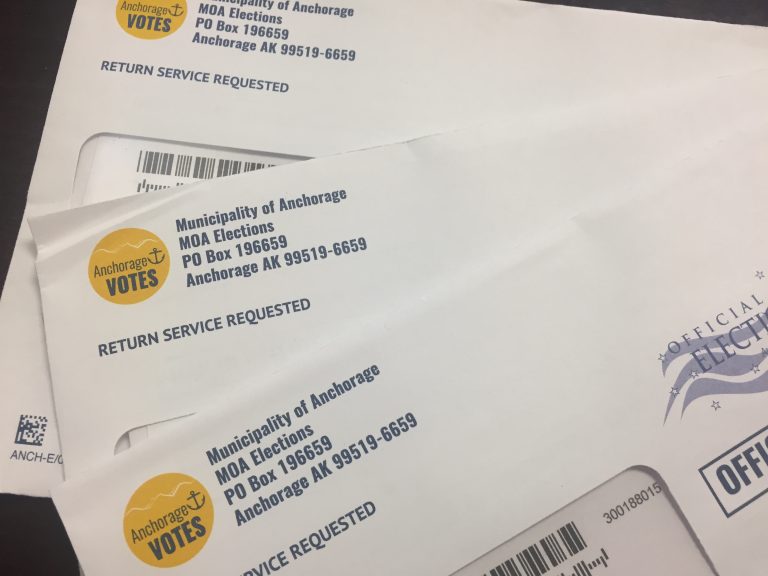
The Anchorage Election Office, run by Jones, has come under scrutiny since the Anchorage Assembly voted to create all mail-in elections, which operate in very different ways than traditional in-person and absentee voted elections.

Numerous people are finding their votes disqualified in this new system because their signatures do not match the ones that Jones has on file, which are primarily provided by drivers license signatures from state records. When the Anchorage Election Office managed the October election for Juneau, which was an all-mail-in election, one out of every 12.5 votes was thrown out for various reasons.