Friday, May 8, 2026
Home Blog Page 947

Don Young fundraising: $13,559 raised from Alaskans in the fourth quarter, campaign starts year with respectable cash on hand

In the financial disclosures posted at the Federal Election Commission, Congressman Don Young started 2022 with $630,000 cash on hand for his coming race.

Of that amount, $164,209 was raised by Young in the fourth quarter. In the fourth quarter report:

  • $33,173 came from the House 2022 “Take Back the House” Political Action Committee.
  • $138,400 came from union political action committees, or about 70 percent of funds coming in the door.
  • $13,559 came from individual Alaska contributions, or about 6.87 percent.

The donations from union political action committees include organizations such as the North America’s Building Trades Union PAC, the Seafarers Political Activity Donation, Laborers International Union of North America, Teamsters Drive Committee, UA Union Plumbers and Pipefitters, IBEW and several others, according to the FEC reports.

Young ended his 2020 campaign year with $249,173 in the bank after his most expensive race in his then-24 term history. He had raised $1.94 million for that cycle, with Democrat-endorsed Alyse Galvin raising over $5.2 million.

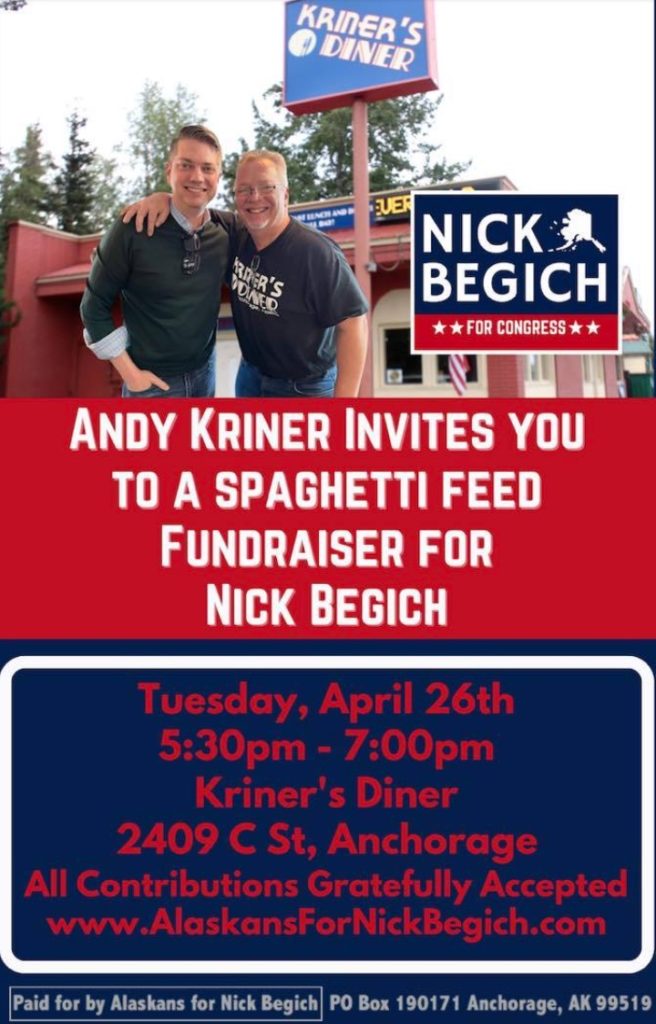
Young’s most likely competitor for for 2022 is his 2020 campaign co-chair Nick Begich, who raised $150,000 from Alaskans in the last 60 days of the fourth quarter of 2021 for his race; he didn’t file for Congress until the end of October and put $150,000 of his own money in at the start of his campaign.

Begich’s campaign account began 2022 with $227,336 and it received no PAC checks.

Campaign coffers are one sign of strength for candidates, because getting around Alaska, building enthusiasm for the candidates, and getting messages out over the airwaves takes cash. Inflation will be an influence on the 2022 cycle, as costs are going up for labor, fuel, and materials for candidates, just as inflation is pinching household budgets. This could be Young’s most expensive campaign in his 26 races.

Also running is no-party candidate Gregg Brelsford, who raised $26,027 last year and started 2022 with $6,308 cash on hand.

Randy Purham, a Republican, has raised $1,485 and started 2022 with $304 cash on hand.

Governor settles with 2 psychiatrists at API

Today a settlement was finalized over a lawsuit brought by two former psychiatrists at the Alaska Psychiatric Institute, who sued the Dunleavy Administration after being fired when the Dunleavy Administration took office at the end of 2018.

The state reached an agreement that all parties have approved and it settles all claims made, or that could be made, by the two former employees.

Neither Dunleavy nor his former chief of staff Tuckerman Babcock admitted to any wrongdoing as part of the settlement. The Dunleavy Administration decided it was in the State’s best interest to move on, with a reasonable settlement value that avoids the risk and expense of continued litigation.

Gov. Mike Dunleavy maintains that the state’s incoming chief executive officer must have the authority to make policy and staff changes, when those staff members have their fingers in policy decisions.

Psychiatrist Anthony Blanford was awarded $220,000, and John Bellville was awarded $275,000.

The Dunleavy Administration has, since taking office, made substantial changes to the clinical services at the Alaska Psychiatric Institute, which was in imminent danger of losing its accreditation when Dunleavy took office at the end of 2018.

Nick Begich wins fifth mayoral endorsement, this time from Cordova

Congressional candidate Nick Begich has won the fifth endorsement from an Alaska mayor. Cordova Mayor Clay Koplin has signed on with the Republican Begich who is taking on Congressman Don Young.

Begich has already received endorsements from Kenai Borough Mayor Charlie Pierce, North Pole Mayor Michael Welch, Wasilla Mayor Glenda Ledford, and Mark Jensen of Petersburg.

He also has the endorsements of Mat-Su Assemblyman Jesse Sumner, Mat-Su School Board member-elect Jubilee Underwood, and Alaska Outdoor Council and hunting enthusiast Carl Nelson, gunsmith and Valley political activist L.D. Howard, drone company founder Amber McDonald, and Republican activist Misty Steed, and former congressional candidate John Nelson. More recently, Waynette Coleman of Ninilchik, Richard Derkevorkian, assemblyman in Kenai, Cindy Glassmaker of Kenai, Taylor James of Wasilla, Jake Almeida of Palmer, Vonnie Pierce of Sterling, Former Sen. Pete Kelly of Fairbanks, Amber McDonald of Anchorage, Marcus Sanders of Anchorage, Ric Davidge of Anchorage, Pamela Melin of Palmer, Bill Elam of Kenai Assembly, Julie Gillette of Fairbanks, Kathy Toms of Homer, Dee McKee of Wasilla, former Rep. Lynn Gattis of Wasilla, Sen. Roger Holland of Anchorage, Janet Johnson of Palmer, Rep. Kevin McCabe of Big Lake, Rob Yundt of Mat-Su Assembly, Sen. Mike Shower, Sen. Shelley Hughes, and dozens of other well-known civic leaders around the state.

Begich, who announced his candidacy in late October, is taking on the Dean of the House, Alaska’s sole congressional representative, who has been in office since 1973. In the open primary system, they will be on the ballot with all others registered for that race, as there is no longer a Republican primary. Begich was Congressman Young’s co-chair for his 2020 campaign, but now has Young’s campaign manager, Truman Reed, working for him as his campaign manager as the young generation of Republicans try to retire the old warrior, Congressman Young.

Hours after leaving as chief of Anchorage Police, former chief appears in APD uniform endorsing Walker, an ethics violation

Former Anchorage Police Chief Ken McCoy, who was with the Anchorage Police Department for 27 years, ended his service on Monday to take a position with Providence Alaska Medical Center as the Chief Equity Officer.

Hours after he legally retired, he appeared in an ad supporting former Gov. Bill Walker and Heidi Dryas, who are running as a duo for governor and lieutenant governor.

He was wearing his APD uniform in the ad.

It’s unclear if Anchorage’s Code of Ethics anticipated former police officer using a uniform he is no longer entitled to wear in a campaign ad.

But Walker and Drygas saw no problem with the ad, and gushed about it on social media:

The Anchorage Code of Ethics Summary states that use of municipal property for partisan purposes is not allowed by public officials. Read the Ethics Code Official Summary here.

“Appearance of impropriety: Where provisions of this chapter differ from the common law principle that an appearance of impropriety alone is sufficient to establish a conflict of interest or an ethical violation, the provisions of this chapter supersede the common law,” the code says.

The code says municipal resources may not be used for campaign purpose and that this applies to employees, board members, elected officials, and public servants.

There may be no consequence for McCoy, who has become a political animal since leaving his post as Anchorage’s top police officer.

While chief, McCoy attended in uniform a “get out the vote” event for Anchorage mayor that was tailored for failed candidate Forrest Dunbar.

McCoy announced his retirement in November, with his final date originally announced as Feb. 1, but evidently moved to Jan. 31. Many are speculating he intends to run for mayor in the future.

Listicle: Who has the House Select Committee subpoenaed for Jan. 6 inquiry? Republican leaders from around country

The House “Select Committee to Investigate the January 6th attack on the U.S. Capitol” has published subpoenas for over 80 people, including members of the media. The subpoenas are released to the public nearly every week. The committee has no meetings scheduled for this week.

The list of those subpoenaed so far includes moms, veterans, Trump supporters, and Republican Party officers. This list has been compiled from CNN, New York Post and the committee itself:

1. Mark Meadows, former White House chief of staff

2. Daniel Scavino, former White House deputy chief of staff for communications

3. Kashyap Patel, former Defense Department official 

4. Stephen Bannon, former Trump adviser. He has refused and is charged with contempt of Congress

5. Rudy Giuliani, former Trump adviser, former mayor of New York City

6. Eric Trump, son of Donald Trump, phone records subpoenaed

7. Kimberly Guilfoyle, fiancee of Donald Trump Jr., and speaker at Jan. 6 rally, phone records subpoenaed

Organizers of rallies and events preceding Jan. 6

8. Amy Kremer, founder and chair of Women For America First

9. Kylie Kremer, founder and executive director of Women For America First

10. Cynthia Chafian, submitted first rally permit application on behalf of Women For America First for the Jan. 6 rally, and founder of the Eighty Percent Coalition 

11. Caroline Wren, listed on rally permit paperwork for the Jan. 6 rally as advisor

12. Maggie Mulvaney, listed on rally permit paperwork for the Jan. 6 rally as VIP Lead

13. Justin Caporale, of Event Strategies, listed on rally permit paperwork for the Jan. 6 rally as Project Manager

14. Tim Unes, of Event Strategies, listed on permit paperwork for the Jan. 6 rally as Stage Manager

15. Megan Powers, of MPowers Consulting LLC, listed on permit paperwork for the Jan. 6 rally as Operations Manager for Scheduling and Guidance

16. Hannah Salem, of Salem Strategies LLC, listed on permit paperwork for the Jan. 6 rally as Operations Manager for Logistics and Communications.

17. Lyndon Brentnall, of RMS Protective Services, listed on permit paperwork for the Jan. 6 rally as On-Site Supervisor

18. Katrina Pierson, former Trump campaign official, reportedly in direct communication with the former president about the rallies.

19. Ali Alexander, somehow connected to permit applications for the “Stop the Steal” rally

20. Nathan Martin, connected to permit applications for the “Stop the Steal” rally

21. Stop the Steal, LLC

22. Dustin Stockton, a key player in the “Stop the Steal” movement after the 2020 presidential election who helped organize a series of rallies including the rally held at the Ellipse in Washington, DC, on Jan. 6.

23. Jennifer Lawrence, engaged to Dustin Stockton, also helped a key player in the “Stop the Steal” movement after the 2020 presidential election who helped organize a series of rallies including the rally held at the Ellipse

24. Taylor Budowich, according to the committee solicited a 501c(4) organization to conduct a social media and radio advertising campaign encouraging attendance at the Ellipse rally. Budowich is currently the primary political spokesperson for Trump and serves as communications director for the Save America PAC. Budowich is suing the House select committee investigating the Jan. 6 event to block it from getting access to his banking records.

25. Roger Stone, Trump ally who was reportedly in Washington D. C. on Jan. 5 and 6. Stone spoke at the rally on Jan. 5 and was slated to speak at the rally on Jan. 6 where he previously said he was planning to lead a march to the Capitol from the rally. 

26. Alex Jones, of the Alex Jones Show, who allegedly worked with rally organizers to facilitate a donation to provide what he described as “eighty percent” of the funding for the Jan. 6 rally. The Select Committee claims that Jones said he was told by the White House to lead a march from the Jan. 6 rally at the Ellipse to the Capitol. 

27. Bryan Lewis, who had a rally permit for outside the US Capitol on Jan. 6 and whose purpose was to urge Congress to invalidate electoral votes, the committee says.

28. Ed Martin, an organizer with the “Stop the Steal” movement, who the panel says was involved in financing the Jan. 6 rally on the Ellipse.

29. Kimberly Fletcher, who is tied to an organization called Moms for America. Fletcher helped organize the January 5 rally at Freedom Plaza and the Jan. 6 rally at the Ellipse, according to the committee. 

Individuals who advised on election fraud claims and rallies subpoenaed 

30. James P. “Phil” Waldron, retired Army colonel who spread information about election fraud and circulated a PowerPoint document detailing ways to undermine the 2020 presidential election outcome.

31. Andy Surabian, strategist and adviser to Donald Trump Jr. and was communicating with individuals including Trump Jr. and Kimberly Guilfoyle regarding the January 6 Ellipse rally.

32. Arthur Schwartz, a strategists who, like Surabian, served as an adviser to Donald Trump Jr. and was communicating with individuals including Trump Jr. and Guilfoyle regarding the Jan. 6 Ellipse rally.

33. Jenna Ellis, an attorney who pushed various election fraud conspiracies on Trump’s behalf.

34. Sidney Powell, another attorney who pushed election fraud theories on Trump’s behalf.

Department of Justice officials subpoenaed

35. Jeffrey Clark, former Department of Justice official.

Trump campaign officials subpoenaed

36. William Stepien, Trump 2020 campaign manager

37. Jason Miller, former senior adviser to Trump 2020 campaign

38. John Eastman, an attorney who helped craft Trump’s argument that the election was stolen

39. Michael Flynn, former Trump national security adviser who was involved in meeting about how the Trump campaign wanted to promote the lie that the election was stolen

40. Angela McCallum, national executive assistant to former Trump’s 2020 reelection campaign

41. Bernard Kerik, participated in a meeting at the Willard Hotel centered around overturning election results.

42. Boris Epshteyn, a former Trump campaign adviser who was among those working with Giuliani at the post-election Willard Hotel “command center.”

Trump White House officials subpoenaed

43. Nicholas Luna, Trump’s personal assistant

44. Molly Michael, Trump’s special assistant to the President and Oval Office operations coordinator

45. Ben Williamson, Trump’s deputy assistant to the President and senior adviser to then-chief of staff Mark Meadows

46. Christopher Liddell, former Trump White House deputy chief of staff

47. John McEntee, Trump’s White House personnel director

48. Keith Kellogg, national security adviser to then-Vice President Mike Pence

49. Kayleigh McEnany, former White House press secretary under Trump

50. Stephen Miller, Trump senior adviser

51. Cassidy Hutchinson, special assistant to the President for legislative affairs

52. Kenneth Klukowski, former senior counsel to Clark, Assistant Attorney General

53. Max Miller, former White House senior adviser and current Ohio congressional candidate. The panel says Miller met with Trump in the White House on Jan. 4 to discuss the Jan. 6 rally on the Ellipse and who would be speaking.

54. Robert “Bobby” Peede Jr., former deputy assistant to the president. The panel says Peede was with Miller when he met with Trump on January 4 to discuss the Jan. 6 rally. 

55. Brian Jack, former director of political affairs for Trump. The committee says Jack reached out to several members of Congress on behalf of Trump to ask them to speak at the rally on Jan. 6 at the Ellipse. Jack was a former national director for ballot access for Ben Carson for President.

56. Ross Worthington, a former White House official who helped draft Trump’s Jan. 6 speech.

57. Marc Short, a former chief of staff to Pence. Short, interviewed last week, is cooperating with the panel. 

58. Judd Deere, a former deputy White House press secretary who helped with the White House’s response to the Jan. 6 attack as it occurred, according to the committee.

Groups and individuals linked to the Capitol Hill riot on January 6 subpoenaed

59. Proud Boys International, L.L.C. At least 34 individuals affiliated with the Proud Boys have been indicted by the Department of Justice in relation to the Jan. 6 attack on the Capitol, according to the committee. 

60. Henry “Enrique” Tarrio, chairman of the Proud Boys organization. The committee says Tarrio was prevented from entering Washington, DC on Jan. 6 but was allegedly involved in the preparation the Proud Boys did leading up to the events at the Capitol.

61. Oath Keepers, another constitutionally focused group whose members have been found to be participating in the Jan. 6 surge into the Capitol. 18 members of the group have been indicted by a federal grand jury for allegedly planning a coordinated attack to storm the Capitol.

62. Elmer Stewart Rhodes, president of the Oath Keepers. The committee claims that Rhodes was in contact with several of the Oath Keepers who were indicted before, during and after the Capitol attack, meeting some of them outside the Capitol.

63. 1st Amendment Praetorian and its leader Robert Patrick Lewis, an organization that the committee says provided security at multiple rallies leading up to Jan. 6 that sought to protest the 2020 presidential election results. The committee says that tweets from Lewis on Jan. 6 and 7 that seem to incite violence.

64. Nicholas J. Fuentes, affiliated with “America First” and “Groyper.” Fuentes promoted theories about election fraud and was “present on the Capitol grounds” on Jan. 6, the committee says.

65. Patrick Casey, who is also affiliated with “America First” and “Groyper.” Casey promoted theories about election fraud and was on the Capitol grounds on Jan. 6, according to the committee.

Individuals tied to alternate electors subpoenaed

(The select committee subpoenaed individuals listed as chairperson and secretary of each group of alternate electors, across seven states – CNN)

66. Nancy Cottle, chairperson, Arizona, listed on the Arizona Federation of Republican Women’s website as the group’s vice president.

67. Loraine B. Pellegrino, secretary, Arizona.

68. David Shafer, chairperson, Georgia. Shafer, the chair of the Georgia GOP, a plaintiff in some of Trump’s long-shot lawsuits to overturn the election in Georgia.

69. Shawn Still, secretary, Georgia, the Georgia GOP’s finance chair who is now running for a Georgia Senate seat.

70. Kathy Berden, chairperson, Michigan, a national committeewoman at the Republican National Committee who served as a Trump delegate at the 2016 GOP convention.

71. Mayra Rodriguez, secretary, Michigan, who ran for a Michigan House seat in 2020.

72. Jewll Powdrell, chairperson, New Mexico, who recently told the Albuquerque Journal that he had signed the alternative elector certificate at the behest of former Rep. Steve Pearce, the head of the New Mexico GOP.

73. Deborah W. Maestas, secretary, New Mexico, who previously served as the chairperson of the state GOP.

74. Michael J. McDonald, chairperson, Nevada, a former police officer who serves as the Nevada GOP chairman and reportedly promoted false voter-fraud claims in 2020. 

75. James DeGraffenreid, secretary, Nevada, national committeeman from Nevada for the RNC.

76. Bill Bachenberg, chairperson, Pennsylvania. Bachenberg is a board member of the National Rifle Association and spoke at a pro-Trump fundraiser in 2020.

77. Lisa Patton, secretary, Pennsylvania.

78. Andrew Hitt, chairperson, Wisconsin, former chairman of the Wisconsin GOP and a staffer for former Gov. Scott Walker.

79. Kelly Ruh, secretary, Wisconsin, an alderperson from the city of De Pere. 

Contacted for voluntary interviews

  • Kevin McCarthy, House minority leader
  • Jim Jordan, House lawmaker 
  • Scott Perry, House lawmaker 
  • Sean Hannity, Fox host
  • Ivanka Trump, the former President’s daughter and former senior White House adviser

Sources: CNN, Newsweek, and the House Select Committee to Investigate the January 6th Attack on the Capitol.

University of Alaska Board of Regents to consider making Pat Pitney permanent president

7

During its Jan. 31 meeting of the University of Alaska Board of Regents, Regent Chair Sheri Buretta announced that a motion will be taken up at the February board meeting to appoint now-Interim UA President Pat Pitney as the university system’s permanent president.

Pitney has been the interim president since the departure of Jim Johnsen effectively removing “interim” from her title. 

This motion has been brought forward “based on President Pitney’s performance and ability to create stability for the university as we navigated challenging times,” Buretta said.  

The Board of Regents selected Pitney to serve as the university’s interim president beginning on Aug. 1, 2020.

Previously Pitney served as the state’s Director of the Division of Legislative Finance. She was the former Vice Chancellor of Administration, University of Alaska Fairbanks and worked at UA Statewide for 17 years. In all, Pitney spent 23 years with the University of Alaska before leaving to serve as the director of the Office of Management and Budget in the administration of former Gov. Bill Walker. 

Pitney is expected to serve as interim president for a minimum of a year or up to 18 months or until the appointment of a president, whichever comes first.

Pitney moved to Fairbanks in 1987 from Billings, Montana. She earned her MBA from UAF and an engineering physics degree from Murray State University (Kentucky). She has three adult children and two grandchildren. All three of her children are UA graduates, with degrees from UAF, UAA and UAS.

Before moving to Alaska, she was a member of the 1984 U.S. Olympic Team and won a gold medal in women’s air rifle.

Alaska House Democrats are trying to take away First Amendment rights of Republican members, starting with Rep. David Eastman

The group known as Oath Keepers is a loose network of organizations made up of former military, police, fire, and first responders — people who have taken oaths at some point in their lives to defend the Republic.

Rep. David Eastman is a member of the Oath Keepers, and for this, he is being hunted and hounded by Alaska House Democrats.

The Democrat majority members have for weeks been acting to remove Eastman from all of his committee assignments because of his association with the group, whose leaders await trial for their activities leading up to and on Jan. 6, 2021 in the nation’s capital.

The charges against Yale University graduate and Oath Keeper founder Elmer Stewart Rhodes are serious, but as of yet unproven, as his trial does not begin until April 19.

The Department of Justice charges say Oath Keeper defendants were not just engaged in mere disorderly conduct on Jan. 6 at the U.S. Capitol, but that they organized militarily well in advance to stop the peaceful transfer of power from President Donald Trump to President Joe Biden.

On Wednesday, Rhodes is scheduled to appear before the U.S. House Select Committee to Investigate the January 6th Attack on the United States Capitol. The committee, formed on a party-line vote on July 1, 2021, has been subpoenaing citizens and documents ever since to testify about what they knew and in what manner they participated in the Jan. 6 surge into the Capitol. The committee has even subpoenaed numerous Trump Administration members and advisers, and people associated with other patriotic nonprofit groups, including Women For America First and Moms for America.

Among the dozens of Alaskans who also went to Washington, D.C. on Jan. 6, 2021 to attend a Trump rally and participate in a protest was Rep. Eastman of Wasilla, who stayed a good distance from the halls of Congress the entire time.

For months, socialist organizers in Alaska political circles and their Democrat surrogates in the House have been on Eastman’s trail, to try to get him removed from office altogether, due to his membership in Oath Keepers.

But there just are not enough votes for him to be expelled by the House, and Plan B is to redline him from all of his committees.

That failed on Monday because there were evidently not enough votes, but the Democrats plan to take the matter up again when Rep. Sara Rasmussen returns. Although she is a registered Republican, the Democrats are counting on her vote to punish Eastman, who is somewhat of his own caucus most of the time. Rasmussen is said to be out due to quarantine and votes with the Democrat majority frequently.

If the House does act against Eastman, it will set a precedent for the Legislature to punish members for their associations with various legally recognized groups — groups such as the Democrat Socialists, or Black Lives Matter.

Oath Keepers is not only a legal organization, it enjoys protection by the Internal Revenue Service as a charitable, non-taxable entity. The IRS recognizes several Oath Keeper affiliates as 501(c) groups, including:

  • Indiana Oath Keepers Inc.
  • Oath Keepers Educational Foundation
  • Oath Keepers Of Josephine County 
  • Oath Keepers United 
  • Pennsylvania Oath Keepers
  • Southern Nevada Oath Keepers 
  • Virginia Oath Keepers Inc
  • Oathkeepers, (Law Enforcement Motorcycle Club), NC

But politically motivated groups like the Democratic Party and Southern Poverty Law Center view Oath Keepers as “one of the largest far-right antigovernment groups in the U.S. today.”

In a court of law, what a nonprofit political group calls another nonprofit political group is one thing, but when a group is protected by the federal government as a charitable group, it’s quite another.

The Alaska House Committee on Committees was planning to meet at noon Tuesday to try again to remove Eastman from committees on its roster, but abruptly canceled its meeting, which had not even been advertised on the legislative calendar. That means it’s likely no floor action will be taken against Eastman on Wednesday.

The dispute is spinning the wheels of the House of Representatives, which is on Day 15 of its current 90- to 120-day session. Although Speaker Louise Stutes said this session was going to be more harmonious, she chairs the Committee on Committees, and she has verbally sneered at those defending Eastman.

Democrat Majority Leader Rep. Chris Tuck on the House floor on Monday said that some rights are simply not allowed. Tuck, who has not served in the military but has sworn an oath as a lawmaker, said there are distinct curbs on people’s free speech rights.

“We really don’t have the right to do whatever you want. It really is the right to do what’s best,” Tuck said.

But Rep. Kevin McCabe said that military men and women, when they take an oath, it’s for life, to defend against enemies foreign and domestic.

“Notice there is no expiration on that oath, Madam Speaker,” he said, saying that would be important for people to remember in coming days.

Rep. Ben Carpenter, also a veteran, spoke to the importance of defending the First Amendment rights of all Americans.

“One of the lessons I learned in the military, after I took my oath to defend this nation, is that the Marxist that sits in the tank next to me has the same rights that I do,” Carpenter said. “First among those are the right to free speech and to freely associate with the organizations that I choose.”

Carpenter continued: “If you can remove somebody from a position because you don’t like what they say or what they think, it’s only a matter of time before somebody else gets removed,” for some other topic.

Departure gate: Anchorage airport director leaving for Houston airport job

Jim Szczesniak, airport director for the Ted Stevens Anchorage International Airport, is departing for new opportunities, the Alaska Department of Transportation said in a news release today. 

Szczesniak led the airport through the challenges of the pandemic, as well as during record levels of passenger service and cargo activity. 

“I’ve had the privilege of working with one of the best groups of aviation professionals these past four years. I will miss Team ANC, but I am confident they will continue to deliver award winning levels of service and operational excellence,” Szczesniak said.

Szczesniak has accepted a new airport leadership opportunity in Houston, Tex., the news release said. 

In the interim, Deputy Commissioner John Binder will serve as airport director until a replacement is named. Binder has substantial aviation experience and has past experience serving as interim airport director. 

Szczesniak was hired initially by former Gov. Bill Walker, who surprised the aviation community by unceremoniously dismissing John Parrrot from the position he had served in since 2008.

Defense Sec. Austin pens letter to Dunleavy: National Guard members must be vaccinated

Defense Secretary Lloyd Austin penned an identical letter to seven governors, including Gov. Mike Dunleavy of Alaska, saying that their states’ Army and Air National Guard members are subject to the Defense Department’s to mandatory Covid-19 vaccine, or they will lose their Guard status.

Austin, ignoring the Dunleavy lawsuit against the Department of Defense and Biden Administration, wrote that the virus “takes our Service members out of the fight, temporarily or permanently, and jeopardizes our ability to meet mission requirements.”

The Associated Press obtained copies of the letters, which have not been publicly released, but were reportedly sent to the governors of Texas, Wyoming, Mississippi, Iowa, Nebraska, Alaska and Idaho.

Dunleavy and Abbott contend the unconstitutional vaccine mandate usurps state sovereignty and illegally undermines their authorities as commanders of state National Guard units.

“Our Alaska National Guard has recently responded to winter storm disasters in Yakutat, the Interior, and the Mat-Su. What happens in the next disaster if Guard members can’t be activated because they chose not to get a federally-mandated COVID vaccine?” said Gov. Dunleavy last week. “Protecting the freedom and liberty of National Guard members has fallen on responsible governors. The federal government has no authority to make health decisions for National Guard members who are at work under state authority. I pledge to protect that medical freedom and to challenge the trampling of our state’s rights under the 10th Amendment.”

The Alaska Constitution states that the governor is the “commander-in-chief” of the armed forces of the State, and it empowers the governor to order Guard members into active State duty.

The Department of Defense demand to members of the Alaska Army National Guard and Alaska Air National Guard is an improper assertion of federal authority, the Dunleavy-Abbott lawsuit maintains. Because the National Guard has not been placed into federal service, authority over the Guard falls to the states’ governors. The Pentagon has no legal authority to dictate actions or discipline against state Guard members, the complaint states.

“This is not a case demanding a position of pro- or anti-vaccine, nor is it a case that challenges any aspect of the federal government’s authority over National Guardsmen once federal authority has been properly established,” the lawsuit states. Rather, the Constitution is clear about the National Guard’s dual role of service to the United States and as a state militia. When not in federal service, authority to command the National Guard rests with state governors.

In August 2021, the Secretary of Defense ordered all military members, including the Guard, to take COVID-19 shots. In November, the Secretary directed the Department of Defense to withhold salaries of unvaccinated, non-federalized, Guard members or deprive them of credit for drills and training.