Thursday, July 30, 2026
Home Blog Page 944

Don Young’s office is now the Alaska At-Large Congressional Office

The late Congressman Don Young’s Communication Director Zack Brown wasn’t sure how long the facility managers of the Rayburn Building will allow Congressman Young’s name to stay next to the door of Room 2314. Young died on March 18 on a flight from Los Angeles to Seattle, where he was connecting to another flight to Southeast Alaska.

Thus, Brown had a poster produced that has one of the final portraits of Congressman Young, which is propped on an easel outside the offices. That way people can find Don Young’s old office.

The office is now known as the Alaska At-Large Congressional Office. Brown said he’ll remain the communication director for now, although his workload has changed.

Young will be the 37th person to lie in state in the Capitol, and only the 4th whose federal service was entirely in the House of Representatives, according to the House Historian. Speaker Nancy Pelosi would not allow him to lie in state in the Rotunda, but approved the request to lie in state in Statuary Hall.

For a complete list of people who have lain in state or in honor in the Capitol, visit this link.

Questions and answers: Special primary election season starts with filing deadline of April 1

Questions and answers about the special election for the temporary Alaska’s At-Large seat, in Congress as provided by the Division of Elections:

Why can’t the Governor appoint someone? 

The U.S. Constitution requires an election for a vacant U.S. House seat. It does not allow for appointments. 

When will the election be? 

State law requires two elections: a special primary election within 60 to 90 days and a special election on the first Tuesday that is 60 days after that. The Division of Elections prefers to hold the special primary on June 11 and the special election on Aug. 16, the same day as the primary election. Barring any changes to state law, the Governor needs to issue a proclamation for these elections by Friday, March 25 in order to meet all relevant federal and state deadlines. 

Does Ballot Measure 2 apply? 

Yes. The special primary election will be an open, non-partisan primary where the top four candidates advance. This election will not determine party nominees. The special election will be a ranked choice election, where voters may rank up to four candidates and a write-in candidate from first to last. 

Why these dates? 

By holding the special primary election on June 11, candidates would have time to declare their candidacy and the Division of Elections would have time to mail ballots to overseas and military voters 45 days before the election. This also allows the Division to hold the special election with the primary election on Aug. 16. The Division will also provide absentee and early voting for the special election. 

What about the witness requirement for by-mail ballots? 

Witness signatures will be required because they are required by state law. The Alaska Supreme Court only eliminated the witness requirement for the 2020 general election. 

What will the ballot look like on August 16? 

The ballot will include both the primary ballot and the special election ballot. It will list all of the state and federal races with primary elections, where voters can vote for one candidate in each race. It will also include the special election, where voters can rank the four candidates and a write-in candidate by filling in a grid. The Division of Elections will count all the votes in the primary and the special election and determine the winner of the special election using ranked choice voting. 

How does ranked choice voting work? 

Voters will rank the candidates from first to last. The Division of Elections will count the votes in rounds. If a candidate gets the majority of votes in the first round, that candidate wins. If not, the candidate with the least votes is eliminated. The votes for the losing candidate then go to the voters’ second choices. This continues until two candidates are left and the candidate with the most votes wins. 

To better understand ranked choice voting, visit the Division’s website: https://www.elections.alaska.gov/RCV.php .

What do candidates have to do to file for the vacant seat? 

Candidates must file a declaration of candidacy and pay a $100 filing fee, just like for a regularly scheduled election. They must file this declaration after the proclamation and before the deadline, which will be April 1 at 5 pm. The Division of Elections’ five regional offices will be open for in-person filing on: 

  • Saturday, March 26 from 10 AM to 2 pm 
  • Sunday, March 27 from Noon to 2 pm 
  • Seward’s Day, Monday, March 28 from 10 AM to 2 pm
  • Tuesday, March 29 through Friday, April 1 from 8 AM to 5 pm

The Division will also accept declarations of candidacy by mail, fax, and email, although these must be received by the Division by 5 pm on Friday, April 1. Due to state and federal deadlines, any candidate that wants to withdraw from the special primary or special election must do so by noon on Monday, April 4 or by noon on Sunday, June 26, respectively. 

If you have questions about filing a declaration of candidacy, please contact the Division. 

Can a candidate for state office run for the vacant seat? 

Yes. Candidates may only declare for one office per election. Even though the special election will occur on the same day—and on the same ballot—as the primary election, these are actually two different elections. So a candidate could run in the special election for the vacant seat and in the primary for state office. Whoever wins the election for the vacant seat cannot hold two offices at the same time. 

When does the elected representative take the vacant seat and how long will they serve? 

The person elected will take office after they are certified as the winner and sworn in to the U.S. House. They will serve for the remainder of the vacant term. 

When will we know the results? 

The Division of Elections plans to certify the results of the special primary election on June 25. It plans to certify the results of the primary and special election on Sept. 2. For the two weeks after the special election, the Division can only release preliminary first-choice results. 

What about redistricting? 

The 2021 Redistricting Plan is currently being litigated, with a decision from the Alaska Supreme Court expected on April 1. The Redistricting Board may have to amend its plan and the Division of Elections will have to implement the final plan. Voters may not be associated with their new districts in the Division’s systems by the time of the special primary election. However, because the special primary will be a statewide, by-mail election, all ballots that are properly cast will be fully counted, regardless of a voter’s district or precinct. 

Can the special primary election be held by mail? 

Yes, the Division of Elections can conduct elections by mail when they are not held at the same time as a general, primary, or municipal election. The decision on whether to hold a special primary election by mail falls to the Division Director. 

If the special primary is held by mail, will there be a way to vote in person? 

Yes. The Division still offers absentee-in-person voting at many locations for the two weeks before the election day for a by mail election. Voters could show identification and cast ballots with election officials. 

Betting markets say Murkowski will vote ‘yea’ to confirm Ketanji Brown Jackson to Supreme Court

PredictIt, the online prediction tool that allows people to essentially bet on real political outcomes, has a new game up: Will Sen. Lisa Murkowski of Alaska vote to confirm Judge Ketanji Brown Jackson to the Supreme Court?

With over 64,151 shares traded, the players are saying yes, Murkowski will be a “Yea” on Brown Jackson.

Murkowski opposed the Trump nominees to the Supreme Court and was a holdout vote who was lobbied heavily by Planned Parenthood and other left-wing organizations, who attempted to sway her.

She ultimately voted “present” on Justice Brett Kavanaugh’s nomination, after opposing him initially. She also opposed advancing the nomination of Justice Amy Coney Barrett, but in the end voted “Yea” to confirm her. Both were considered conservative jurists.

Murkowski is one of the senators who led the talks that ended with the reauthorization of the Violence Against Women Act, or VAWA, earlier this year, and is a champion for protecting women and children from being victimized. How she will respond to Brown Jackson’s protection of predators is anyone’s guess in this year, in which she is also up for reelection.

PredictIt is owned and operated by Victoria University of Wellington of New Zealand with support from Aristotle, Inc. The market was launched on Nov. 3, 2014 and its office is now headquartered in Washington, D.C.

Jodi Taylor: Time to focus on kids, not bonds and buildings; vote ‘no’ on Proposition 1

By JODI TAYLOR

We all want our kids to have the best chance of success in life. Our public schools play a vital role in that outcome.

Unfortunately, we are hobbling our kids’ academic opportunities by allocating far too many of our nation-leading education dollars to facilities. We continue to see the emphasis placed on facilities, not on educational outcomes. 

I first became aware of this a few years ago when the current Clark Middle School building was constructed. The per-square-foot cost of the new middle school exceeded the per-square-foot cost of the Anchorage VA Medical Center, which was built around the same time. How is that possible? At that time, the justification was that the fancy school facility was needed in order to improve student outcomes. Here we are, a dozen years later, still waiting for the promised improved educational outcomes. 

Perhaps these actions would make sense if our student population was rapidly growing. But it’s not; Anchorage School District enrollment peaked 20 years ago at about 50,000 thousand students. Fall 2021 enrollment for was below 40,000 (when accounting for charter school enrollment). The last time the district had fewer than 40,000 kids in its school buildings was 39 years ago, in 1983. Current demographic projections indicate this trend will continue for some time. In fact, the latest district capital improvement plan expects enrollment will drop by another 5,000 students by 2027.

With the rapid drop in student enrollment in the last 20 years, you would think there would be a corresponding drop in facilities. However, you would be wrong. The opposite has unexplainably happened. Since 1983, the last time we had so few students, the total size of ASD facilities has grown by 49.2 percent, a whopping 2.6 million square feet of extra space. Using a conservative number of $25 a square foot a year for heat, light, and maintenance, the additional space costs $65 million a year. When the extra cost of principal and interest are added in for this added footprint, the total additional cost to the residents of Anchorage is around $95 million a year.

Why are Anchorage residents footing a $95 million dollar bill for unneeded space, when student educational outcomes desperately need improvement? Alaska is ranked dead last in the U.S. in national reading scores for both low-income and upper/middle-income students. And before you think that the rest of the state is dragging ASD scores down, guess again; ASD is ranked 22nd in the state in language arts out of 54 school districts. 

Imagine what could happen if that $95 million dollars in facilities costs (over $2,000 per student or a $34,000 raise per classroom teacher with an average class size of 17 students per teacher) was redirected every year to improve student outcomes by retaining and attracting top teaching talent.

The school district’s Proposition 1 bond mailer includes the tagline “All of Our Children.” It’s time for the Anchorage School District to focus on the actual children, by spending more money in the classroom and not on fancy spacious buildings.

Join me in voting No on Proposition 1.

References:

1- Enrollment by District by Grade 2021-22.xlsx (live.com)

2019 CAFR .pdf (asdk12.org)

filedownload.ashx (asdk12.org)

Microsoft Word – 1Front Page 1011.doc (asdk12.org)

Jodi Taylor and her husband are the parents of six children; she’s a business owner and finds joy in serving to create an environment where families can thrive.

Special election challenges mean special primary will be by mail, special general will be on Aug. 16 primary ballot

Thanks, Ballot Measure 2. The crazy voting system designed by liberal lawyers Scott Kendall and Jahna Lindemuth has created a nightmare for Alaska voters already, and it has yet to be implemented.

Lt. Gov. Kevin Meyer tried to sort out the confusion that has arisen over how voters will elect a temporary replacement for Congressman Don Young. In short, he announced today, there will be four statewide elections this year, but two of them will be held simultaneously on Aug. 16.

The special election to replace Young has such a challenging logistical calendar this year with Ballot Measure 2 requirements, the best way to conduct the primary portion of that special election will be by mail, said Gail Fenumiai, the director of the Division of Elections.

Fenumiai said that over 2,000 workers would be needed to be hired by June to conduct the special election primary in a traditional way, and the division cannot possibly hire and train workers in time to make the timeline. There is a national shortage of workers, to begin with, and election workers need special training.

The special election primary done by mail requires a signature witness, Meyer said, unlike the election in 2020, when the Supreme Court said no witness signature would be needed due to Covid.

The current timeline for the special election to pick the temporary congressional representative for Alaska is:

April 1: Deadline for anyone who wishes to file for the seat. It costs $100 and the applicant must register with the Division of Elections, and the Federal Election Commission.

June 11: Primary special election for replacing Congressman Don Young temporarily. There will be in-person early voting at regional voting offices starting 15 days prior to June 11. But most voters will probably be mailing in their ballots to the Division of Elections.

June 25: Primary special election certified.

Aug. 16: General special election for the temporary replacement for Young will be included on the same ballot as the regular primary election.

Due to Ballot Measure 2, the temporary general question added to that regular primary ballot will be a Ranked Choice Voting method, while the other part of the primary — the regular primary for the congressional seat (and other seats), will be “pick one” style of voting.

The dates were the Division of Elections’ recommendation for how staffing, paper shortages, and other hurdles could be overcome in a timely enough way to certify the special election primary in time to get the four finalists onto the ballot on Aug. 16.

The governor will issue a proclamation by Friday as to the dates of the election, but all the details for how the election will be managed are up to the lieutenant governor, who is in charge of elections and does not report to the governor.

Hearings continue for Supreme Court nominee with soft-on-pedophiles sentencing philosophy

The Senate confirmation hearings for Judge Ketanji Brown Jackson, a far-left activist judge who was nominated by President Joe Biden to the U.S. Supreme Court, continued Tuesday in Washington, D.C. Jackson has a long history of embracing Critical Race Theory and a pattern of judicial activism that includes light sentences for child pornography traffickers and pedophiles.

In her short time on the bench, Jackson ruled against conservative policies. She blocked President Donald Trump’s executive orders to hold failing federal employees accountable, a ruling that was reversed by the D.C. Circuit Court.

Jackson also blocked the Trump Administration from expanding its  “Expedited Removal” program to deport illegal immigrants faster, saying the Department of Homeland Security did not consider the impact on illegal immigrants.

She was an advocate for terrorists detained at Guantanamo Bay, including the leader of a terrorist Taliban cell.

Jackson, her critics say, is a pedophile sympathizer. She has called for removing mandatory minimum sentences for child porn, questioned  making convicted child predators register as sex offenders,  and argued that those who collect child porn online are not actually trafficking in child porn. One of her sentences was for a perpetrator who received a three-month sentence, rather than the 10 years in the sentencing guidelines.

In Tuesday’s hearing in the Senate Judiciary Committee, Jackson pushed back against the accusation that she is soft on sex offenders. She said she puts great weight on victims’ experiences when addressing offenders. 

“I tell them [guilty perpetrators] about the adults who are former child sex abuse victims, tell me that they will never have a normal adult relationship because of this abuse. I tell them about the ones who say, ‘I went into prostitution, I fell into drugs because I was trying to suppress the hurt that was done to me as an as an infant,'” she said.

She continued to describe how she explained to perpetrators the harm they had done.

“Almost every one of these sentences, when I look in the eyes of a defendant who’s weeping because I’m giving him a significant sentence, what I say to him is do you know that there is someone who has written to me and she has told me that she has developed agoraphobia — she cannot leave her house — because she thinks that everyone she meets will have seen her, will have seen her pictures on the internet, they’re out there forever, at the most vulnerable time of her life and so she’s paralyzed,” she said. “I tell that story to every child porn defendant as a part of my sentences, so that they understand what they have done.”

President Joe Biden appointed Jackson, after stating that his criteria for the Supreme Court nomination to fill the seat of retiring Justice Stephen Breyer would be that the nominee must be black and must be a female.

Female swimmer sticks up for women athletes, says the trans swimmer took her spot at the NCAA finals

Reka Gyorgy, who swims for Virginia Tech, stood in defense of female swimmers on Sunday, something the NCAA has refused to do. Gyorgy wrote to the NCAA about the unfairness of bumping her from the finals so that Lia Thomas, a transgender swimmer with all the musculature, genitalia, and physical strength of a male swimmer, could compete at the NCAA Division I Swimming and Diving National Championships. Thomas went on to win the 500-yard freestyle and may have thrown the other races that s/he competed in at the championships.

Thomas, swimming for Penn, ended a collegiate career Saturday with an eighth-place finish overall in the final day of the championships, after competing in the 100-yard freestyle final on Saturday, finishing in 48.18 seconds, two seconds behind University of Virginia freshman Gretchen Walsh.

It’s not clear if Thomas was really competing in that 100-yard match. Thomas had set a record for Penn in that event earlier in the season in the 100 freestyle and had become the Ivy League champion in the 100 freestyle, the 200 freestyle, and the 500 freestyle. Thomas was the high point swimmer of the meet at the Ivy League Championships.

The Thomas record for 2021-22 includes: NCAA qualifier in the 100 free, 200 free, and 500 free; Ivy Championships qualifier; Ivy League champion in the 100 free; Ivy League champion in the 200 free; Ivy League champion in the 500 free; High Point Swimmer of the Meet at the Ivy League Championships; Part of Penn’s 400 free relay that won an Ivy title with a program record time of 3:17.80; Part of Penn’s 400 free relay that set a program record at the Ivy Championships with a time of 7:09.91; Set program records in the 100 free (47.63), 200 free (1:41.93), 500 free (4:34.06), 1,000 free (9:35.96) and 1,650 free (15:59.71). 

Meanwhile, Gyorgy was ready to hit the send button on her letter to the NCAA, explaining that she is a two-time champion, two-time all-American, and three-time honorable mention all-American who was robbed of her opportunity to compete by Thomas, because without Thomas being made eligible due to hormone treatments over the past year, Gyorgy would have qualified to swim on behalf of Virginia Tech.

Gyorgy’s letter pulls no punches. Here it is in full:

Before you read any further, I’d like to ask that everyone who wants to disseminate my statement would agree to release my statement in full. I do not want any partial releases of my statement and do not with to make further comments.

Dear NCAA,

I would like to address this past week’s events and express my thoughts. First, I would like to remind everyone that I am a human being and that as a human being I experience feelings and emotions. 

My name is Reka Gyorgy from Hungary. I am a 2016 Rio Olympian, represented Virginia Tech for the past 5 years, a 2 time ACC Champion, 2 time All-American and 3 time Honorable Mention All-American. 

With all due respect, I would like to address something that is a problem in our sport right now and hurting athletes, especially female swimmers. Everyone has heard and known about transgender, Lia Thomas, and her case including all the issues and concerns that her situation brought to our sport. I’d like to point out that I respect and fully stand with Lia Thomas; I am convinced that she is no different than me or any other D1 swimmer who as woken up at 5am her entire life for morning practice. She has sacrificed family vacations and holidays for a competition. She has pushed herself to the limit to be the best athlete she could be. She is doing what she is passionate about and deserves that right. On the other hand, I would like to critique the NCAA rules that allow her to compete against us, who are biologically women. 

I’m writing this letter right now in hopes that the NCAA will open their eyes and change these rules in the future. It doesn’t promote our sport in a good way and I think it is disrespectful against the biologically female swimmer who are competing in the NCAA. 

I swam the 500 freestyle at NCAA’s on March 17th, 2022 where I got 17th which means I did not make it back to the finals and was first alternate. I’m a 5th year senior. I have been top 16 and top 8 before and I know how much of a privilege it is to make finals at a meet this big. This is my last college meet ever and I feel frustrated. It feels like that final spot was taken away from be because of the NCAA’s decision to let someone who is not a biological female compete. I know you could say I had the opportunity to swim faster and make the top 16, but this situation make it a bit different and I can’t help but be angry or sad. It hurts me, my team and other women in the pool. One spot was taken away from the girl who got 9th in the 500 free and didn’t make it back to the A final preventing her from being an All-American. Every event that transgender athlete competed in was one spot taken away from biological females throughout the meet. 

The NCAA knew what was coming this past week. They knew opinions and minds will be divided and chose to do nothing. This week has been more about reporters, media and division in our sport than things like two women going under 21 seconds in the 50 freestyle, 3 women going under 50 seconds in the 100 butterfly and the first women IN HISTORY to go under 49 seconds in the 100 backstroke. Thursday was not a specific athlete’s fault. It is the result of the NCAA and their lack of interest in protecting their athletes. I ask that the NCAA takes time to think about all the other biological women in swimming, try to think how they would feel if they would be in our shoes. Make the right changes for our sport and for a better future in swimming.

Thank you for reading, 
Reka Gyorgy, Virginia Tech swimmer

Nick Begich gets unanimous endorsement from Eagle River District 22 Republicans for congressional race

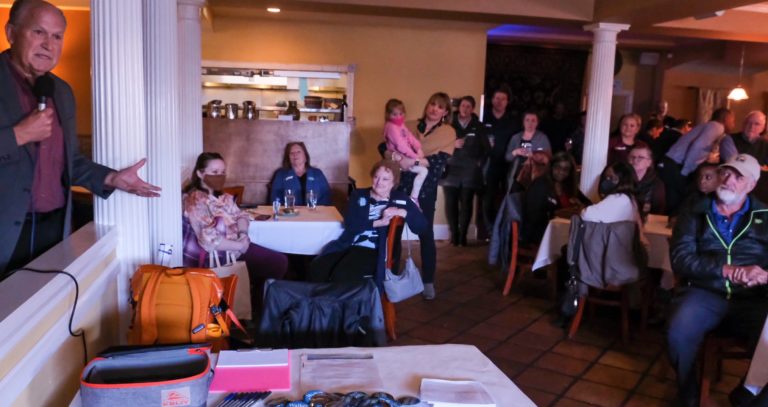
Adding to his growing list of endorsements, Republican congressional candidate Nick Begich was unanimously endorsed by District 22 Republicans. Those are the Republicans in the newly renumbered House district in Eagle River. About 20 people attended the district meeting, including the officers of the district, Alaska Republican Party Chairman Craig Campbell, and Assemblywoman Jamie Allard.

Begich also received District 6 in Homer and the Kenai Peninsula Republican Women’s endorsement over the weekend. Monday’s endorsement is a sign that Republicans are beginning to coalesce around a candidate to support for the congressional seat made vacant when Congressman Don Young passed away on March 18. Begich has over 100 other endorsements from Alaskans from Ketchikan to Fairbanks and has been raising individual-donor funds to mount a serious statewide campaign.

Will Palin jump in for congressional race? Maybe.

Former Gov. Sarah Palin said today she would love to be the next congressional representative for Alaska — if asked.

Palin, who in 2008 joined the presidential ticket of Sen. John McCain, told Newsmax host Eric Bolling, “If I were asked to serve in the House and take his place I would be humbled and honored … In a heartbeat, I would. We will see how this process goes in filling that seat – it would be an honor.”

The lifelong Alaskan then criticized the Biden administration, focusing on surging in gas prices, “because of their lack of education or purposeful destruction of so many sectors of the economy,” Palin said on Newsmax.

“Some people, certainly not in the White House, are aware of what petroleum products are, what transportation costs affect when it comes to supply chain. (But) because of their lack of education or purposeful destruction of so many sectors of the economy – they certainly look to blame somebody else,” she said.

She has done this before, hinting last year that she might run against Sen. Lisa Murkowski.

Already in the congressional race is Nick Begich, the Republican from Chugiak; Chris Bye, a Libertarian from Fairbanks; Bob Lyons, a Republican from Houston (AK); Randy Purham, a Republican from Soldotna; and Shannon Scott Evans, a Republican from Alaska.

Several others are rumored to be considering running for the seat, including Sen. Josh Revak, who was co-chair of the Alaskans for Don Young campaign.