Friday, May 8, 2026
Home Blog Page 935

Kelly Tshibaka gets standing ovation at ‘Awake, not woke’ CPAC gathering in Orlando

The Alaska Republican challenging Sen. Lisa Murkowski took to the stage at the Conservative Political Action Conference on Thursday in Orlando, bringing a pointed message about Murkowski to a national audience that has no love for Alaska’s senior senator.

Outside of the presidential contenders, Kelly Tshibaka is clearly one of the biggest celebrities in conservative circles at CPAC; people flocked to meet her and get their photos take with her on Thursday, and even more so on Friday at the Rosen Shingle Creek Resort, where the conference is taking place.

Right after she finished speaking, reporters from the New York Times and CNN rushed up to talk to her. She spoke to the Times reporter but did not appear to give CNN an interview, because others were pulling her away for photos. Potential donors said she did well. One person commented that their son and daughter-in-law live in Alaska, and they took a selfie photo to send to them.

Tshibaka’s remarks were a shot over the bow of the Murkowski dynasty, and at the end of her five minutes, Tshibaka received a standing ovation — the only standing ovation of Day 1 of the CPAC event.

At CPAC, the talk on Friday among attendees was all about Murkowski and whether or not she will be a repeat performance with the Biden nominee for the U.S. Supreme Court, announced on Friday morning. Will Murkowski vote with the socialist crowd or vote with Republicans? During the confirmation of Brett Kavanaugh to the Supreme Court, Murkowski was the hold-out vote, and in the end simply voted “present” rather than vote with Republicans to confirm the justice who had been nominated by President Donald Trump. In 2020, Murkowski voted to confirm Justice Amy Coney Barrett to the Supreme Court.

Other speakers at the event include former President Donald Trump, Alaska Gov. Mike Dunleavy, and myriad other politicos from the conservative side of the spectrum.

The conference, on the theme of “Awake, Not Woke,” ends on Sunday with a closing speech by Donald Trump Jr.

Tim Barto: Throwing the baseball out with the bathwater

By TIM BARTO

It’s February, a time when pitchers and catchers should be reporting to sunny southern climes for spring training, a benchmark that signals the baseball season is not far off.

The simple phrase “pitchers and catchers have reported” usually gives baseball fans butterflies in their stomachs, much like a middle school crush but without all the hormonal imbalances.

Yet, the well-groomed ballparks in Florida and Arizona are vacant this year due to a lockout, a defensive move by the billionaire owners to prevent an inevitable strike by their millionaire ballplayers. 

And not too many people in the general public seem to notice …. or care. And Major League Baseball should take notice.

The countless dozen or so of you who put up with my public whining and gnashing of teeth in 2021, are well aware that I have given up on Major League Baseball over their decision to inject politics and “wokeness” into what used to be our national pastime. I want desperately to have my game back but, in a perverted twist of Michael Corleone’s now-famous line in (the still disappointing and utterly unnecessary) “Godfather III, just when I thought I was being pulled back in they push me away. 

Major League Baseball lost viewers and followers in 2020 because it opted not to punish Houston Astros players who blatantly cheated, then thought it a good business decision to align with Black Lives Matter and their flag-kneeling minions. 

In 2021, Commissioner Rob Manfred doubled down on his decision to alienate his fan base by pulling the All-Star Game from under Atlanta’s feet because the players’ union hierarchy and a few “woke” corporations considered the laws that the State of Georgia passed to keep their elections fair and honest to be blatant evidence of racism, and therefore unworthy to host the Midsummer Classic. (The Atlanta Braves, by the way, were still allowed to play their full season of home games and, in rare moment of justice, won the World Series over the Astros, for which Commissioner Manfred had to present the Braves the victor’s trophy.)  

Baseball attendance is down. TV ratings are down. Merchandising is down. Sure, Covid was a factor in all that, but to put a halt to the season before it even begins, especially when fans are willing to forgive and return to the game, is not just stupid, it’s suicidal.

It’s like the commissioner, owners, and players had a Zoom call with Dr. Jack Kevorkian and asked him the best way to kill the goose who laid all those golden eggs that made the players millionaires and kept the owners in billionaire status.  

This makes no sense. The economic arguments being made by both sides, center around their collective bargaining agreement. The CBA sets the rules for almost all financial aspects of the game, including minimum salaries, free agency, revenue sharing, and luxury taxes. 

As a fan of the game – the game of baseball, that is – I would rather they concentrate on making the game more watchable. Three-and-a-quarter-hour games with an average of 17 strikeouts per game are boring. I can no longer argue with people who say the game is boring – because it is! 

And now we have contrived rules: Designated hitters, extra innings starting with a runner on second base, defensive shifts that are completely ignored by hitters who refuse to try and hit a ball through the gaping hole on the other side of the diamond, video reviews that disrupt the flow of the game, and most recently the idea of using clocks to speed up the game – the game that for over a century and a half prided itself on being the only major sport without a clock.

The two sides seem to not care that Dr. Kevorkian is actually plunging that needle into the goose, as well as their collective arms. 

Baseball should take a good, hard look at what just happened with the Winter Olympics. For various reasons, not the least of which was a totalitarian regime using the Games as a propaganda tool a’ la Nazi Germany in 1936, the 2022 Winter Olympics garnered the lowest TV ratings in history. It shows that American sports fans are willing to stay away from watching sports.  

And it’s about time.

Tim Barto is Vice President of Alaska Policy Forum, and President of the Chugiak-Eagle River Chinooks Booster Club.

Dunleavy at CPAC: Time to declare a national energy emergency and ‘turn the spigots back on’

Alaska Gov. Mike Dunleavy, in an appearance at the Conservative Political Action Conference in Orlando, Fla., said on Friday that it’s time for the Biden Administration to declare an energy emergency and get oil and gas flowing again in America, rather than have our nation dependent on Russian oil, the way it is now.

Dunleavy was speaking on stage with Sean Spicer about the damaging policies of the Biden Administration, not only for Alaska, but for the rest of the country. He said the current policies have put America in a precarious security situation that could be remedied by getting projects going again — projects halted by radical environmentalists both in and out of the Biden Administration. He mentioned the Willow project in the National Petroleum Reserve-Alaska, and the 10-02 coastal plain area of the Arctic National Wildlife Refuge.

Dunleavy spoke about how dirty the Russian oil is, and how environmentalists are actually working against a cleaner environment.

“When you push this stuff [oil and mining] overseas, you actually destroy the environment at an accelerated rate,” Dunleavy said.

Reached after his time on stage at the premier conservative conference in the country, Dunleavy expanded on the need for immediate action from Biden.

Gov. Mike Dunleavy speaking at CPAC.

“We’re not running out of energy. But we need to recognize what’s happening in the world. We’ve put ourselves in a precarious position. There are national security implications. And there could be more domestic unrest because our oil and gas prices have actually artificially increased because we refuse to access our own energy,” Dunleavy said. “We are victims of horrific policies that are destined to cause energy prices to increase.”

Dunleavy said America’s adversaries are “jumping for joy. If you were to design a playbook to weaken America, this would be it.” He said America’s adversaries know “If we turn on our spigots, they’re done.”

Dunleavy called the current Biden policies “bizarre. Do they really believe Russia and China are going to safeguard the environment like we are? And don’t forget the child labor and human rights abuses.”

Dunleavy closed by saying that it’s not the wealthy who are hurt by the Biden energy policies, but the working class people of America.

“It’s the mom with three kids, it’s the waitress, the carpenter, the workers of this country who have been left out of this whole discussion. That’s who is going to suffer,” Dunleavy said.

The United States currently imports about 700,000 barrels of oil per day from Russia, and the Biden Administration purposefully did not put a sanction on Russian oil imports to the U.S. during his sanctions over the invasion of Ukraine.

“Folks have now realized that they [environmentalists] have way overplayed their hand to the detriment of the country,”Dunleavy said.

Colleen Sullivan-Leonard: Tyranny in the House

By COLLEEN SULLIVAN-LEONARD

As a former Mat-Su legislator, and, long-time armchair quarterback, I have been involved with the Legislature and legislative process for many years. In most recent years I have seen a pattern that concerns me greatly. The Minority members’ ability to speak is being stifled based on a personal agenda and this is not in the best interest of the body.

In a legislator’s ability to represent his or her districts as a Minority member in the Legislature, many times their voices are heard during House “Special Orders.” This part of the floor proceedings allows a legislator to present on several topics, from the Iditarod, birthdays, news or topics of the day etc. It is a legislator’s time to discuss issues of interest on behalf of his or her constituents.

This session has shown that the voice of my district is not important, as time after time, my representative’s ability to speak on my behalf has been interrupted, stifled, and reduced to a few comments and then dismissed by the Speaker and House Majority Democrats.

This form of tyranny in the House is unacceptable. All legislators, whether you like them or not, are allowed a voice on the House floor. Instead, personalities have replaced what our Mason’s Rules sought to achieve — proper debate and the ability in the Legislature for the Minority members to be heard, on behalf of their constituents. 

Previous Speakers in the House of Representatives set a precedent of allowing members to speak, especially Minority members, who at that time were Democrats, so that they could use the special orders of the House floor proceedings to voice whatever subject matter they liked.

I recall former Rep. Les Gara going on for several minutes about the foster care system, an issue he was very passionate about, he was allowed this out of the courtesy of former Speaker Mike Chenault, who understood proper decorum on the House floor and the importance of allowing everyone to speak their mind, regardless of Majority or Minority status. Speaker Chenault is one of several great Speakers who are missed in the legislature today.

In previous legislative sessions there have been moments of challenges that our representatives have faced, ie., natural disasters, fiscal challenges, a pandemic, overreach from the Federal government, and more.

But what we see now is straight out of the playbook from the DC Democrats — shutting down discussion, decorum, debate, and overall freedom of speech in our Legislature. Again, this is unacceptable, and Alaskans should be outraged by this. In Mason’s Manual sec 578 (5) it clearly states that the Speaker of the House may not interrupt a member speaking who has the floor, if the member does not transgress the rules.

In the past year in a half the bias on the House floor is visible. Last week Rep. Zack Fields was allowed to speak poorly of a Minority member with no recourse. In the previous month, Rep. Ben Carpenter couldn’t finish his speech on the House floor because those in the Majority cut him down, believing he may possibly say something that may impugn the motives of another member.

These constant attacks on the Minority’s ability to articulate their positions on a certain bill, or present during special orders on behalf of their constituents shows poor knowledge of Mason’s Manual by leading officers of the Democrat-led House Majority. 

Do better, Speaker Stutes and House Majority members. Alaska is watching, even from our armchairs. 

Colleen Sullivan-Leonard served Wasilla in the Alaska House of Representatives from 2017-2021.

Murkowski: Deb Haaland does what White House tells her to do, and ‘We are where we are’ with Biden

Sen. Lisa Murkowski could not not answer the tough question posted by Big Lake Republican Rep. Kevin McCabe this week: Would she change her vote on Sec. Deb Haaland if she had to do it over?

Haaland has shut down oil, gas, mining, and even life-saving roads in Alaska. And that is only in Year One of the Biden Administration.

“I’d like to change her mind on the decisions that she [Haaland] has made that have negatively impacted the state of Alaska,” Murkowski responded. “Whether it’s with regards to the NPRA, or in regards to what we’re seeing with yet another pause on oil and gas. I’m planning on changing her mind. She hasn’t stated what her mind is but I’m worried about where her mind is on build out of the King Cove Road.”

Murkowski stayed on the fence, indicating that there is not much that can be done about the Biden Administration.

“The reality is we are where we are … We are where we are. We have a secretary who is putting in place policies and proposals that are not good for our state,” she said. But then she reversed herself and indicated that Haaland is irrelevant, because she is not actually driving the decisions. It’s the Biden Administration that has opinions that are different from those held by pro-resource Alaskans.

“I would suggest to you, though, that Deb Haaland is perhaps not the mastermind behind much of this,” Murkowski explained to McCabe. “You have an administration that has a different view of what it means to this country to be energy … less energy vulnerable … We can say energy independent, but our reality is we’re intertwined in many different ways.”

If Haaland was not running the Department of Interior, someone else would execute the Biden policies. Murkowski said that Biden doesn’t appreciate the value of our country producing its own resources.

“Even if we could do a do-over on Deb Haaland, I don’t believe for a minute we would in much of the same situation than we are now with an administration that just has a different view of resource development,” Murkowski said, not taking responsibility for her actions that led to Biden winning and President Trump being impeached.

Murkowski responded to McCabe and other legislators who asked her questions at the end of her annual remarks to the Alaska State Legislature on Tuesday. McCabe said he asked the question because all the other legislators seemed to be pandering to Murkowski.

“She gave me a politican’s answer. She pivoted smartly away from the question, so no I don’t think it was a good answer,” McCabe told Must Read Alaska.

Budget questions: With Alaska oil now over $100, what will Legislature do with all that money? Grow government or pay back the dividends to the people?

Oil prices soared by over 8 percent on Thursday, with Brent crude hitting over $105 a barrel for the first time since 2014, and Alaska crude oil prices expected in the same range. The price of Alaska North Slope crude is published a couple of days behind the other major oil markets.

The price surge came after Russia launched a widespread attack on Ukraine, where ports in the Donetsk region ship out commodities, including grain, steel, and gas from Russia to the European Union. The pressure on energy, with oil prices now at levels not seen since early 2014, adds to already extraordinary inflation in the United States, Europe, and around the world.

Russia on Wednesday launched the multi-prolonged attack on Ukraine by air, land, and sea, and captured the mothballed-but-toxic Chernobyl nuclear power plant.

What does the Russia-Ukraine war mean for the State of Alaska’s budget, now that the state is two-thirds of the way through the current 2022 fiscal year?

The Russian invasion means oil and gas commodities will remain high for months to come and that the State of Alaska budget this year will end up with a significant surplus. For 2022, the revenue forecast was based on $75.72 oil and $71 per barrel for Fiscal Year 2023. The prices were said to stay in the $60 range through 2030.

Will this mean the Legislature will act on the governor’s supplemental budget, which proposes to pay Alaskans the rest of last year’s Permanent Fund dividend — about $1,200 more than the half-dividend that was paid in October?

This is not a certainty, since many in the Legislature don’t want to set a precedent of giving Alaskans their full share of the oil wealth. But those who have argued that the money is not there for full dividends now have no argument to stand on. This is also an election year for all but one member of the Legislature, and they will be hearing about high fuel prices from their constituents.

What will high oil prices — say, extended periods of over $100 a barrel — mean for the 2023 fiscal year budget that is now being shaped by House and Senate Finance committees? If the past is any indicator, the pressure will be on to spend more, expand programs, and increase government worker wages and benefits.

In play now, for example, is a bill that would create a defined benefit package for Alaska State Troopers, police officers, firefighters and correctional officers — a plan that may lead to decades of increased state spending. House Bill 55 passed the House last year, 25-5, and is now in onto the Senate last year on a 25-5 vote. It would cost the state about $6 million more a year. There could be many more nickel-and-dime increases put into the state budget under the cover of having surpluses.

If prices remain in this ballpark, just from value of royalties alone, there will be an additional $1 billion deposited into the Permanent Fund this year.

The Department of Revenue published an update on prices on Feb. 15, before the conflict broke out in Eastern Europe.

That document is here.

Will the Legislature repay the borrowing from the Constitutional Budget Reserve? The Legislature owes at least $12 billion to the Constitutional Budget Reserve. That is supposed to be paid back, but nothing forces the Legislature to actually do that. It’s not likely that this Legislature, in an election year, will see that as a high priority.

Can the governor just give out an energy rebate like Gov. Palin did? The increase in oil prices, just like 2005-2014, is great for treasury of the State of Alaska, but now, as then, it is a punishing economic hardship for Alaskans who fuel up and who heat with heating oil. During the administration of Gov. Sarah Palin, Alaskans got a historically high dividend, and an energy rebate check as well. But this Legislature is not the same as the one that approved the energy rebate in 2008, when Palin approved the expenditure and then was given credit for it.

Gov. Mike Dunleavy cannot give the people anything without the authorization of the Legislature. The current Legislature will not want to give a rebate that would make Dunleavy look good during his re-election season.

Mask mandate dropped in Alaska Capitol complex

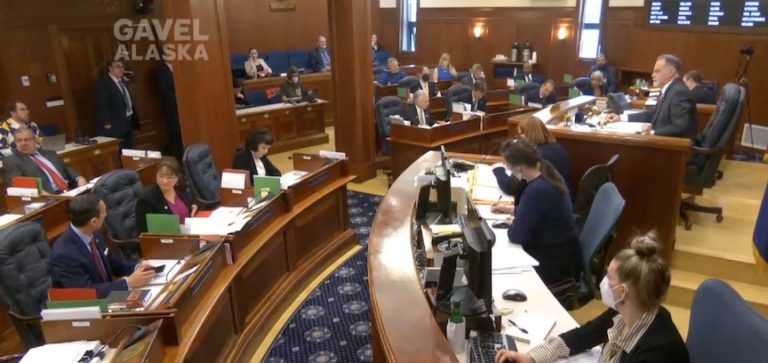
Reversing a decision it made prior to the start of the legislative session, the Legislature’s Legislative Council on Wednesday dropped the mask mandate for Alaska’s Capitol in Juneau.

The new rules say that individual legislators may mandate masks in their offices, but everywhere else in the building it’s a personal choice. The new rules also remove the requirement that legislators, staff, and media members get tested regularly. The testing requirement has not been enforced since the beginning of session.

During the House Finance Committee’s Labor & Workforce Development Subcommittee on Wednesday, only Anchorage Democrat Reps. Ivy Spohnholz and Liz Snyder wore masks; even former mask fanatic Democrat Rep. Zack Fields did not wear one during the meeting, and the committee staff did not. In Senate Resources, only Juneau Democrat Sen. Jesse Kiehl wore one. In House Resources, only Democrat Reps. Grier Hopkins of Fairbanks and Sara Hannan of Juneau kept their N95 masks on.

It’s been on-again, off-again for mask requirements in Alaska’s Capitol for the past two years.

Masks are still the local law for the greater Juneau area for those who are unvaccinated for Covid-19, in spite of data that shows that over 40 percent of those catching the virus in Alaska are vaccinated.

Those not “fully” vaccinated must wear masks while in indoor public areas and at crowded outdoor events in Juneau. Masks must be worn in all municipal facilities, regardless of vaccination status. Students are masked in the Juneau schools, although high school basketball and hockey players now can take their masks off while playing.

Chugach Electric withdraws its 4% rate increase request

5

While still blaming Covid economics for its fiscal situation, Chugach Electric Association on Jan. 20 asked the Regulatory Commission of Alaska for permission to withdraw Chugach’s request for a 4.1% rate increase, along with permission to “decouple’” its rate structure as it merges Municipal Light & Power into the company. Chugach had proposed that decoupling would require the 4.1% increase, and had proposed that increase go into effect Feb. 1, 2022.

Decoupling sets the revenue needed to cover known costs, then allows rates to change with consumption to meet the revenue target, according to the Alliance to Save Energy website. Decoupling also adds a “true-up” mechanism that adjusts rates more frequently based on consumption.

The RCA granted Chugach the request to withdraw the request on Feb. 9, and set a date of Feb. 28 for Chugach Electric to resubmit an alternate proposal to remedy the electric utility’s fiscal situation.  

Undiscussed are the effects of the $1 billion sale of Municipal Light & Power to Chugach Electric — a sale that was marketed to the voters by the Ethan Berkowitz Administration with the promise of “No Increase in Base Rates.”

You can read the RCA Order here:

Of the entire Chugach Electric Association customer base, the RCA received fewer than 15 public comments on the proposed merger, with its rate increase and decoupling proposal.

“Each of these comments opposed Chugach’s limited decoupling proposal in whole or in part.  In response to these comments, Chugach filed a Motion to withdraw TA514-8 and TA392-121,” the RCA order summarized.

You can read the Public Comments here:

In a separate RCA proceeding, Chugach Electric and Matanuska Electric disagree about the process for implementing their “Tight Power Pool.”  The formation of this power generation linkage between the two utilities was mandated by the RCA as a condition of the sale of ML&P to Chugach.

If the “Tight Power Pool” disagreements are not resolved, the fiscal state of Chugach Electric will be another issue for the RCA to deliberate.

Alaska Democrats endorse Perez-Verdia, Zaletel, Dunbar, and Weddleton in Anchorage local election

The Alaska Democratic Party has made its endorsements for local Anchorage elections. They are the candidates you’d expect for Democrats: Kameron Perez-Verdia, Forrest Dunbar, Meg Zaletel, and John Weddleton for Assembly, and Margo Bellamy and Kelly Lessens for Anchorage School Board.

In doing so, the Alaska Democratic Party used a secretly produced website that has no “Paid for” disclaimer, as required by the Alaska Public Offices Commission. Who runs the website? That’s none of your business. All you need to know is that the Democratic Party, using its newsletter links, endorses what the secret website endorses. APOC rules rarely apply to Democrats.

The Democrats are slipping through the campaign laws using the AlaskaBluEvolution, which says it is owned by a person who gets no donations and is not “endorsed by any candidate, candidate’s committee, or political party.” The proxy website depicts Democrats as a large group of (possibly) men crowded together with their arms in the air, and Republicans as a small group of men standing around wearing “Q” on their t-shirts. All of the endorsements were recently sent to registered Democrats in one of the party’s newsletters.

A page from the AlaskaBluEvolution.

The party’s endorsement of Forrest Dunbar, Meg Zaletel, and Kameron Perez-Verdia for Assembly are not surprising. They are Democrats or de facto Democrats.

But Assemblyman John Weddleton? He posits himself as a true nonpartisan, and earlier this month he even attended a meeting of the Young Republicans, where he went maskless — uncharacteristic for the south Anchorage Assemblyman who is mask-vigilant when on the Assembly and in public settings.

Weddleton has consistently donated to Democratic candidates and has never donated to Republican candidates. He supported (former) Sen. Mark Begich for Senate numerous times, and given directly to the Alaska Democratic Party, giving $500 in 2012. As an Assemblyman he has consistently supported property tax increases. He has, on his social media, associated himself with Black Lives Matter and Anchorage Democrats, as well as pro-Palestinian groups.

Weddleton is putting out requests for funds to help him provide “balance” to the Anchorage Assembly.

Running against Weddleton is Randy Sulte, a newcomer to politics, who hopes to replace the Democrats’ favored candidate during the April 5 Anchorage municipal election. Sulte has the endorsement of Mayor Dave Bronson.