Stanford University has entered the brave new world of language policing. Only you can’t use the word “brave” in this colorful new world. You can’t say “tribe.” You can’t say “he,” but should say “they” to refer to s singular male.
The university wants its campus community to stop using certain words and use other words that it says are not offensive. For instance, people should not say dumb, and should not say someone is an addict. They should not say someone committed suicide, when it’s more accurate, according to Stanford, that they “died by suicide.”
Among the more controversial entries in the new language guideline is the discouragement of the word “American.” Instead, the university wants you to use the word “US citizen.” Why? “This term often refers to people from the United States only, thereby insinuating that the US is the most important country in the Americas (which is actually made up of 42 countries).”
This “Elimination of Harmful Language Initiative” is a project to address what the campus sees as harmful language in IT at Stanford in fulfillment of the “Statement of Solidarity and Commitment to Action” published by the Stanford CIO Council and People of Color in Technology group in December 2020.
The goal is to eliminate many forms of harmful language, including racist, violent, and biased (e.g., disability bias, ethnic bias, ethnic slurs, gender bias, implicit bias, sexual bias) language in Stanford websites and code, the university report states.
Some of the words that are now discouraged are:
addict – say person with a substance abuse disorder
addicted – say hooked, devoted
basket case – say nervous
blind review – say anonymous review
blind study – say masked study
committed suicide – say died by suicide
confined to a wheelchair – say person who uses a wheelchair
crazy – say surprising/wild
cripple or crippled – person with a disability
dumb – say non-vocal, non-verbal
handicap parking – say accessible parking
insane – say surprising or wild
lame – say boring or uncool
mentally ill – say a person living with a mental health condition
OCD – say detail-oriented
The list goes on. You cannot say “Karen,” but should say “demanding or entitled White woman,” the document says.
Read all about the dumbing down of America by the language police at Stanford University at the PDF below:
Alaska Congressman Don Young, who died on March 18 at the age of 88, will be honored by having a volcano in the Aleutian Islands bear his name.
S.5066, the Don Young Recognition Act, passed the Senate earlier this fall, sponsored by Sens. Lisa Murkowski and Dan Sullivan. On Wednesday evening, the bill passed the U.S. House of Representatives, renaming Mount Cerberus, on Semisopochnoi Island, “Mount Young.” It is one of Alaska’s most active volcanoes.
The bill also designates the Jobs Corps center at 800 East Lynn Martin Drive in Palmer as the Don Young Alaska Job Corps Center; and the federal office building at 101 12th Avenue in Fairbanks as the Don Young Federal Office Building.
The bill now will be sent to the desk of the president for signature.
The Wall Street Journal calls it the “ugliest omnibus bill ever.” Congress will pass a 4,155-page bill most members will never read.
That’s more than three times longer than a copy of Tolstoy’s War and Peace.
The spending bill is full of $8,500 per American adult. Or in other words, that $8,500 in taxes per adult.
But since only half of adults in America pay taxes, it’s really about $17,000 per taxpayer for one year of government spending, not counting military spending.
In fact, it’s such an expensive package that you’d have to spend $2.3 million every day for over 2000 years before reaching $1.7 trillion. It’s going to add $15 trillion to the U.S. debt, bringing it to $47 trillion.
Some senators are balking at the bill to be voted on on Thursday.
“This process stinks. It’s an abomination. It’s a no good rotten way to run government. We’re standing up and saying NO,” said Sen. Rand Paul of Kentucky, who joined a few others in making a statement on Wednesday that the bill circumvents the proper spending process, ramming through wasteful earmarks.
A few of those superfluous spending items include:
$410 million for border security for other countries, such as Egypt, Jordan, Tunisia, Oman, and Lebanon.
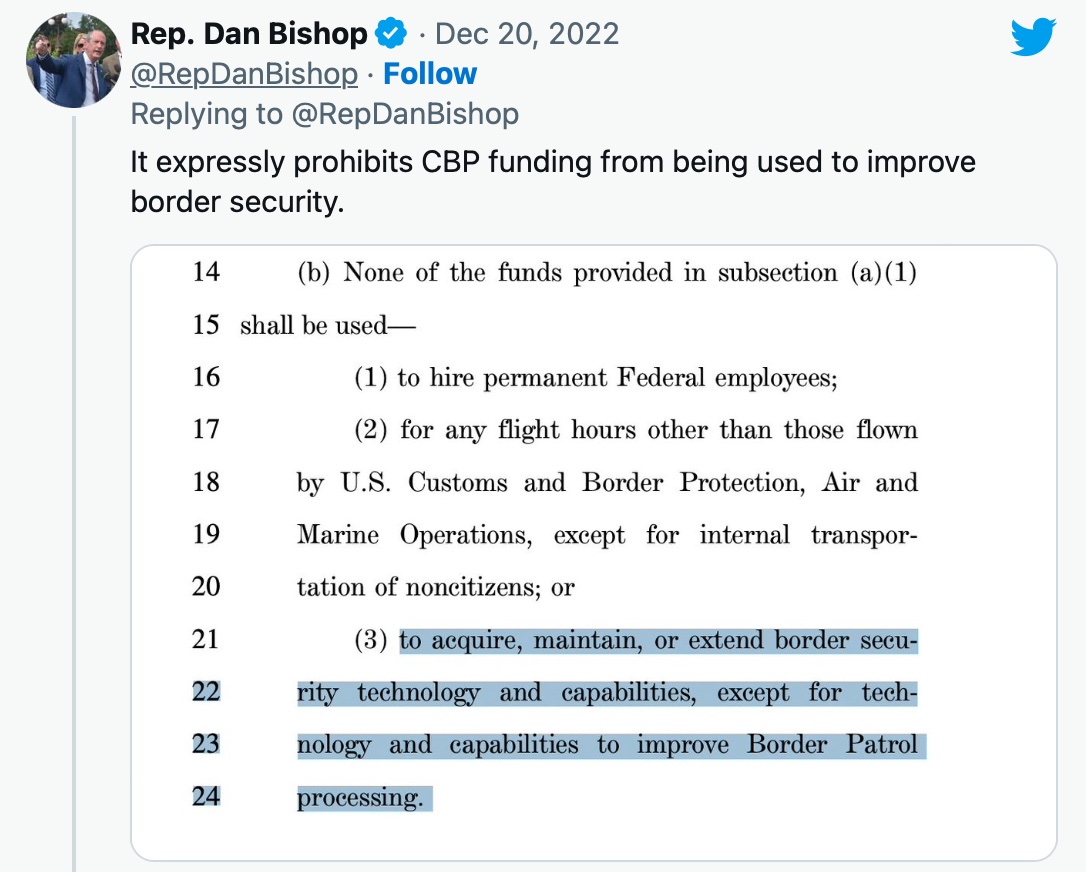
A specific prohibition on spending for border control for the United States’ southern border.
There’s also $45 billion in military and other aid for Ukraine. The United States has already given $68 billion to Ukraine in earlier military, economic, and humanitarian appropriations.
“If an additional $47 billion in Ukraine funding isn’t enough for you, the bill also authorizes a “Ukrainian Independence Park” right here in DC,” Sen. Dan Bishop wrote.
$3.6 million for the Michelle Obama trail in Georgia, under the Department of Transportation’s budget.
$200 million for “gender equity and equality,” with some funds to be spent to promote gender equality in Pakistan.
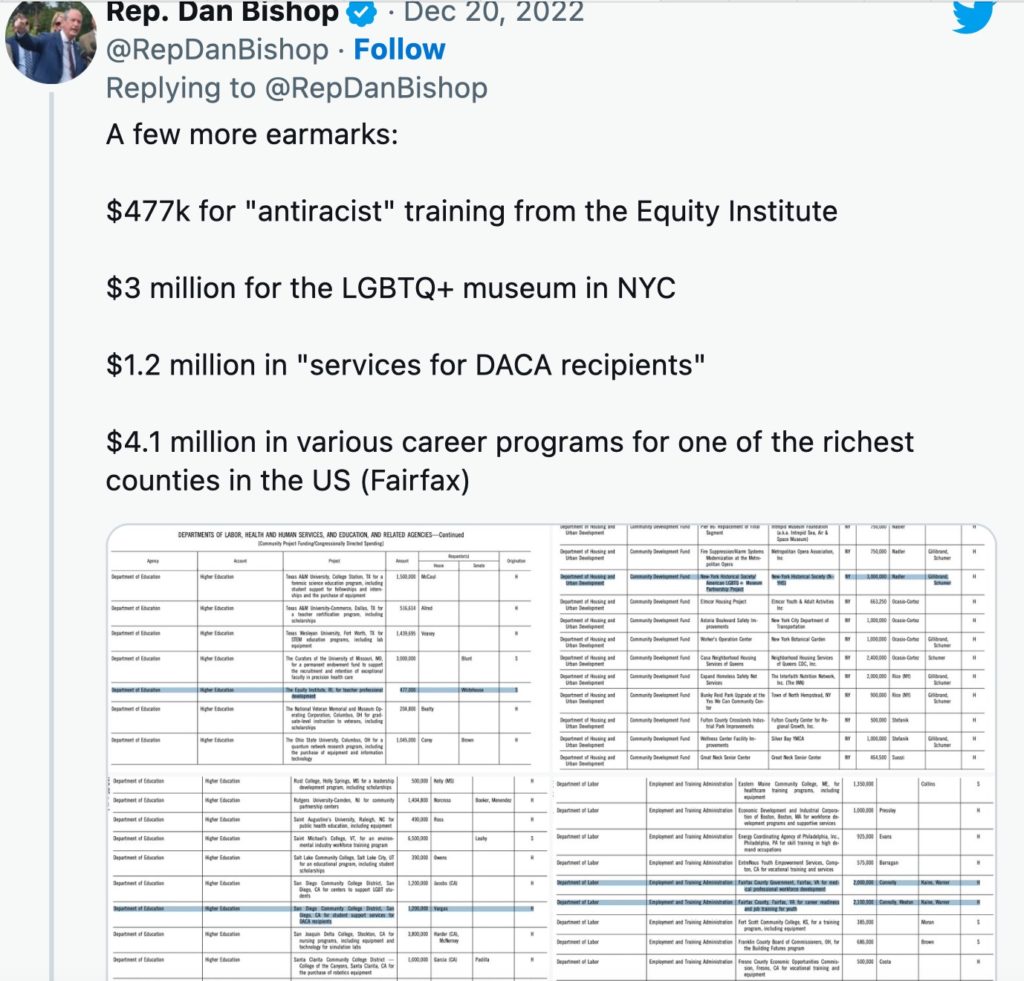
$447,000 for an Equity Institute, stuffed into the Department of Education budget. That’s anti-racism funding.
$3 million inserted into the Housing and Urban Development Department budget for an LGBTQ museum in New York.
$1.2 million for student services for DACA students at San Diego Community College.
There’s a $25 million funding increase for the National Labor Relations Board, a payoff to Big Labor.
Child Care and Development Block Grant Program gets a 30% increase.
“Congress is jamming through major changes in public-land management; a plan to phase out large-scale driftnet fishing; new oversight on horse-racing; a restructure of the U.S. Patent and Trademark Office; changes to help Boeing meet aircraft-certification deadlines; and alterations to lobster regulation. That’s before lawmakers shoe-horned in sweeping healthcare changes on everything from Medicaid eligibility to the Children’s Health Insurance Program to Medicare provider payments,” the Wall Street Journal notes.
“The political process here is as bad as most of the policy. Major changes in law deserve their own debate and vote. Instead, a handful of powerful legislators wrote this vast bill in a backroom. Members can use the need to fund the government as an excuse to say they supported, or opposed, specific provisions as future politics demands,” the Journal says.
It’s almost certain that Alaska Sen. Lisa Murkowski will vote for the massive spending package that will create even more hardship for the grandchildren of America, who will have to pay for a spending package that was spent long before they were of age to even know they were being shackled by more taxes for a spendthrift generation.
It’s almost as certain that Sen. Dan Sullivan, who has tacked hard to the left lately, will vote for the package, although conservatives might still be surprised at his occasional show of independence from the liberal forces that are increasingly bending him to their will.
Assembly Chair Suzanne LaFrance and Vice Chair Christopher Constant issued a statement regarding the termination of Municipal Manager Amy Demboski and her subsequent revelations to reporters regarding the circumstances of her termination, which she has indicated is retaliation for bringing contract irregularities to the mayor’s attention.
The Assembly is taking the incident “very seriously and are gathering as much information as possible before drawing a final conclusion. However, some of the accusations that have been made are alarming and we plan to conduct our own inquiry into the matter,” the Assembly leadership wrote.
While they said that personnel matters are the jurisdiction of the mayor, LaFrance and Constant said the Assembly is planning to investigate the allegations made by Demboski that contracts and purchasing rules and laws may have been broken and that there appears to be misconduct regarding public funds.
“As the stewards of the municipal treasury, it’s our duty to ensure that taxpayer funds are spent legally and effectively. We’ve already seen this administration put millions of dollars at risk due to alleged personnel and contract improprieties. We can’t afford to let any more poorly executed contracts put the municipality’s strong financial footing in jeopardy. Therefore, we as Assembly Leadership are committed to doing everything in our power to safeguard the municipality’s finances and protect the interests of residents,” they said in a statement.
The Assembly leaders also reminded Municipal employees that there are avenues for reporting further improprieties, including the Municipal Ombudsman’s Office (907-343-4461 or [email protected]), as well as Municipality of Anchorage Labor Relations, the Municipality of Anchorage Office of Equal Opportunity, the Anchorage Equal Rights Commission, the Alaska State Commission for Human Rights, and the federal Equal Employment Opportunity Commission.
The Assembly wasted no time in turning up the heat on Mayor Dave Bronson, whose firing of Demboski did not go well. Bronson’s staff leaked confidential personnel information to a blog that was damaging to Demboski and appeared to be motivated by malice.
In turn, Demboski gave interviews to KTUU and the Anchorage Daily News, detailing accusations about improper contracts being signed without the approval of the Assembly, and her attempt to alert the mayor to the situation. Bronson is running for mayor for his second term that would start in 2024, and has already begun fundraising for his reelection. Any investigation into illegal contracts would coincide with his campaign efforts and create a distraction from his accomplishments.
The Alaska Industrial Development and Export Authority Board of Directors announced the appointment of Randy Ruaro as the new AIDEA executive director, effective Jan. 3, 2023.
“We are pleased to announce that Randy Ruaro has accepted the position of Executive Director,“ said AIDEA Board Chairman, Dana Pruhs. “Randy has extensive experience leading departments for the State of Alaska and we look forward to working with him and AIDEA’s talented executive team as we advance economic growth and diversification for Alaskans.”
Ruaro was recently Gov. Mike Dunleavy’s chief of staff and special assistant for statehood defense. in his role as chief of staff, he managed the Office of the Governor and provided administrative oversight to state agencies, agency leaders, and implemented policies supporting resource development, infrastructure, and job growth.
Ruaro served as chief of staff in both the Senate and House Finance Committees as well as numerous other legislative roles such as legislative Budget and Audit Committee aide. He has extensive executive leadership experience with state agencies and has worked in leadership roles for Govs. Palin, Parnell, and Murkowski.
Ruaro holds a law degree from Willamette University College of Law and is an attorney with 28 years of experience working on access issues, permitting, and state land rights for Alaska. He has supported and advanced AIDEA projects including the Ketchikan Shipyard, Skagway Ore Terminal, the Ambler Access Project, and 1002 leases in the Arctic National Wildlife Refuge.
”I would like to acknowledge AlDEA’s Chief Investment Officer and Interim Executive Director, Morgan Nefi’, for his leadership during this transition and look forward to Randy working closely with the entire team to advance AIDEA’s mission,” said Pruhs.
The Alaska industrial Development and Export Authority is a public corporation of the State of Alaska. AIDEA’s purpose is to promote, develop, and advance the general prosperity and economic welfare of the people of Alaska.
Alaska, at the Northwest corner of the U.S., and hydrogen, at the top left of the periodic table, share more than a common location on their respective charts. Global energy consumption is forecast to grow 50% by 2050, and hydrogen from Alaska can provide solutions to the world’s energy and climate needs for decades.
Hydrogen demand is set to skyrocket. Alaska is in a great position to accelerate commercial-scale clean hydrogen production and capture an outsized portion of the market.
Hydrogen demand is driven by its energy and environmental advantages. Hydrogen is an abundant, energy-rich element with the highest energy mass of any fuel. We’ll never run out of hydrogen. Burning hydrogen to generate energy produces zero carbon and emits only harmless water and air.
Hydrogen energy is described more at this Department of Energy website.
Because of these advantages, policymakers are providing powerful incentives to spur the creation of a clean hydrogen energy industry. The 2021 Bipartisan Infrastructure Act, passed with the support of Alaska’s Congressional Delegation, includes up to $7 billion to establish six to 10 regional clean hydrogen hubs across America, and Alaska has everything going for it in this competition.
Expanding economies and populations in Asia are driving growing energy needs. Developed nations like Japan and South Korea are banking on hydrogen to meet 2050 net-zero carbon targets. These nations are our strongest allies in the region and have deep trade ties to Alaska due to our close proximity.
Japan’s long-term strategy is to create a complete, end-to-end hydrogen ecosystem, including “a global supply chain and constructing onsite storage facilities in Japan.” Mitsubishi Corporation and TOYO Engineering Corporation, two leading Japanese energy companies, are already working in Alaska with the state’s Alaska Gasline Development Corporation and Hilcorp to evaluate the commercial feasibility of producing clean hydrogen in the form of carbon-free ammonia. Similarly, South Korea is ramping up demand for hydrogen from 130,000 tons per year in 2018 to an estimated 5.26 million tons in 2040.
Hydrogen is effectively stored and used in fuel cells, which contain more power in comparable space than electric batteries, making hydrogen “suited for airplanes or ships that have to carry energy supplies long distances,” according to the Wall Street Journal.
Ted Stevens International Airport in Anchorage is the second-largest air cargo hub in the world, strategically located between North America and Asia, positioning Alaska to have a major role in global decarbonization by fueling this vital supply route with hydrogen. Alaska is also home to strategic North Pacific military facilities, and the Defense Department, the world’s single largest institutional user of petroleum, is closely examining the long-term prospects for incorporating hydrogen fuel into military operations.
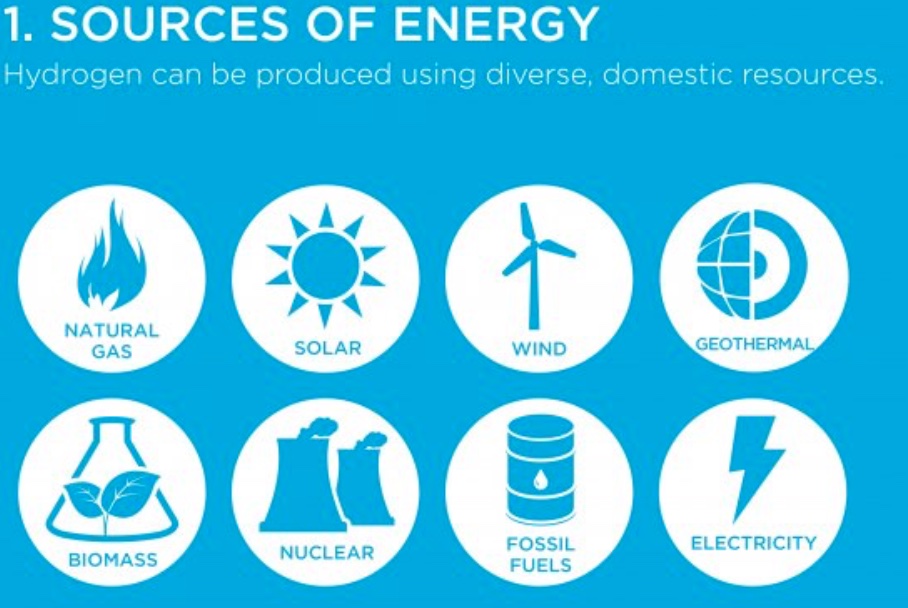
Alaska’s resources give us a major competitive advantage in the race to produce hydrogen. First, Alaska has an abundance of untapped natural gas. The North Slope reigns as one of the world’s great energy super basins in part because it contains 40 trillion cubic feet of developed and conventional, but stranded, natural gas.
Natural gas will not only enjoy decades of additional growth as a standalone clean energy source, but is also essential for producing clean hydrogen. The methane in natural gas is naturally rich in hydrogen, and natural gas accounts for 95% of U.S. hydrogen production today.
The Alaska LNG Project, with all major permits and authorizations in place, is poised to finally commercialize North Slope natural gas and is negotiating with developers and investors to complete engineering and begin construction.
Alaska LNG is already designed as one of the lowest-emissions LNG projects in the world. Further environmental benefits will be unlocked when Alaska LNG natural gas is used to produce hydrogen. By safely capturing and storing the carbon released in this process, the carbon intensity of hydrogen production is negligible. The Alaska LNG terminal will be located in Cook Inlet, which features geology capable of storing 50 gigatons of carbon, the highest capacity of any location on the U.S. West Coast according to scientists. For perspective, 50 gigatons is the equivalent of several decades of carbon emissions from the entire nation of Japan.
Establishing ourselves as an early dominant hydrogen provider ensures we will have the infrastructure, knowledge, and market acumen to also use renewables like hydropower, tidal, and wind to produce hydrogen as technology matures and scales. These resources are more plentiful in Alaska than any other region of the U.S., and tapping them gives Alaska the opportunity for a diversified, world-leading hydrogen portfolio.
But perhaps our most potent advantage in the shifting energy landscape is our people. Alaska is home to a highly trained energy workforce committed to some of the toughest environmental standards in the world. For generations, Alaskans have thrived by using our resources responsibly and sustainably.
Alaska has been an energy leader, fueling America’s economy for decades. Alaska has what it takes to become a global hydrogen powerhouse and lead the world into a new clean energy era.
Mike Dunleavy is Alaska’s 12th governor who began his first term of office in December 2018.
The report was commissioned by the Corps from the University of Pittsburgh in 2020 and completed in 2022. It says that half of the military services already have done away with gendered identifiers for training staff, the publication writes.
“The Army, Navy, and Coast Guard effectively de-emphasize gender in an integrated environment,” the report states. “Instead of saying ‘ma’am’ or ‘sir,’ recruits in these Services refer to their drill instructors using their ranks or roles followed by their last names. Gendered identifiers prime recruits to think about or visually search for a drill instructor’s gender first, before their rank or role.”
The proposal was under consideration by a Marine Corps leadership team assembled to guide service efforts to integrate boot camp, Col. Howard Hall, chief of staff for Marine Corps Training and Education Command, told the Defense Advisory Committee on Women in the Services in December, according to the publication.
The dysfunction in the Bronson Administration at Anchorage City Hall came to a head last week, when the mayor fired City Manager Amy Demboski, after she sent him an email detailing her concerns about contracts she believes were executed in violation of code.
The press release from the Mayor’s Office announcing Demboski’s replacement was stone cold — it just said she had been replaced by Kent Kohlhase temporarily. It gave no reason, and the Mayor’s Office handled the rest in salacious leaks to certain websites.
Demboski has been with Mayor Dave Bronson’s administration from the outset and many observers recognize that she guided him through perilous straits during his early days as mayor, when he didn’t exactly know how governments operate. Demboski had already served on the Anchorage Assembly and in the administration of Gov. Mike Dunleavy, and has a history of administration in the private sector.
She was a strong city manager. When the hostile members of the Anchorage Assembly peppered the mayor with questions he could not answer, he deferred to her. But along the way, Demboski got cross-threaded with a senior manager in the Bronson administration who has close ties with the mayor. And, from Demboski’s side of the story, she was concerned that the administration was approving contracts that were illegal because they needed to go in front of the Assembly, due to their amounts and other considerations. Demboski said that some of the contracts appeared to be for overlapping work, and she was not able to get the purchasing director’s cooperation.
Demboski left her keys on the desk, and quietly left City Hall. She had no intention of making a big scene. But then, someone high in the Bronson Administration leaked select details of the events to a gossip blog, and it appears the leaks were from someone close to the mayor — I’ll not say who, but it’s someone who has leaked a lot of information to the gossip blogger in the past. On behalf of the mayor, operatives started a whisper campaign against Demboski that was clearly intended to damage the former city manager. She decided to give interviews to the Anchorage Daily News and KTUU in order to clear her name.
Demboski admits she used foul language in describing the purchasing director, but she said that incident happened in front of a tiny circle of senior leaders, and that the subject of her scorn was not in the room. She takes responsibility for her foul mouth.
All of this points to leadership failure in the Bronson Administration. Leaks to bloggers like this show a lack of discipline among the people running the government. Who will be the next target of a leak? People working in the administration are now in a state of distrust; they know the source of these leaks. They know who to fear.
Unfortunately for the mayor, the statements that Demboski has now made to the press have given the Anchorage Assembly everything it needs to start impeachment processes — fairly or unfairly — against the mayor. The rest of their damage to him will be done in the court of public opinion.
And Demboski, through her own influence, will peel off conservative support that the mayor needs for his reelection. From her point of view, she sees the firing as retaliation for her bringing serious legal issues to the mayor’s attention. If she chooses, Demboski may have a retaliation claim for wrongful termination. The mayor will now be distracted from the running of the city while he tries to do damage control. Already, the trove of public records requests have begun, and documents are going to be made public that won’t make the Bronson Administration look good.
There aren’t any bad people working in the Bronson Administration, as far as this writer knows. There are a lot of good people. But Bronson is in trouble, and should take a look in the mirror and realize that with all the drama, the buck stops with the person he sees there.
As an aside, the other day I was wringing my hands because I had not been able to get any advance help for the state budget roll-out from the Gov. Mike Dunleavy administration. Looking back, I can now say that it’s a good sign that Dunleavy is running a tight ship, and that the leaks are few and far between to hostile forces. Let’s hope it stays that way.
As far as Bronson goes, the leaks he has been letting out are reflecting poorly on his ability to run a tight ship. He has very little time to get this situation under control and get the public on his side quickly. Can he move past the drama, and avoid ending up in court with Amy Demboski on the witness stand, during the same timeframe he is running for reelection?
This kerfuffle is not nearly as bad as the mess made by former Mayor Ethan Berkowitz. But Berkowitz had something that Bronson doesn’t have — a friendly press. The mainstream media knows blood when it sees it in the water, and has already begun to form the circle of sharks around Bronson.
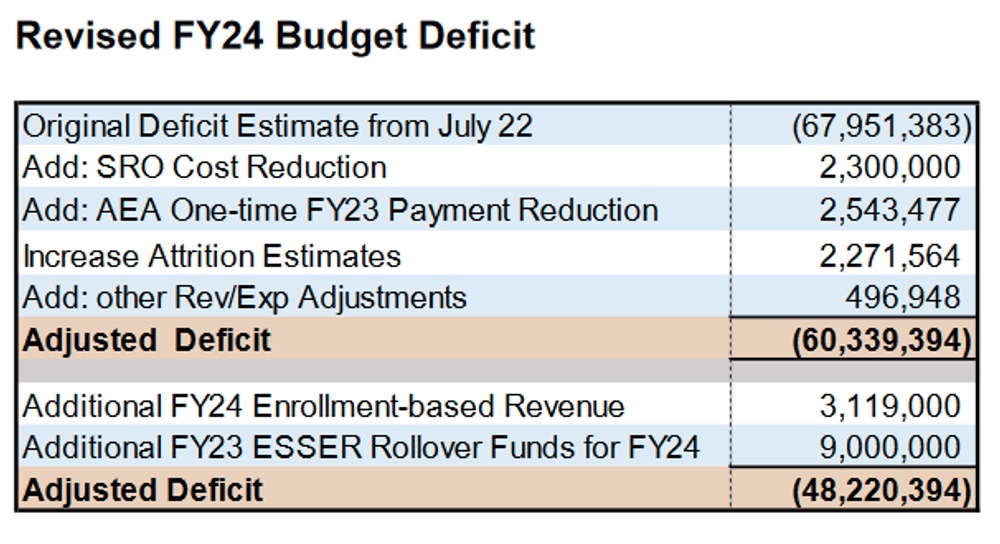
And just like that, the Anchorage School District was able to reduce the former $68 million deficit by $20 million. Now the deficit for the next year’s operations is only $48 million.
How were they able to do this?
– The mayor and the Assembly majority agreed to fund the School Resource Officers at $2.3 million.
– The school district has a credit of $2,543,477 due to a decrease in one-time payments to the teacher’s union which was supposed to be used to recruit for hard-to-fill positions.
– $2.2 million comes from attrition of personnel.
– The district has an increased student count, so it expects an additional $3.1 million from the State and the municipality. This increase includes an additional 44 intensive needs students at $77,480 each. These intensive needs dollars are not earmarked for those specific students, however. They go into the general fund.
– Finally, the district uses $9 million of one-time federal Covid-19 money to reduce the deficit.
Here is the ASD chart showing the specific reductions in the fiscal gap:
Next year, the district also loses the “hold harmless” dollars it has received for the past three years. Those state dollars are given to the school district, which holds the district harmless for losing students. If a district loses more than 5% of its students, then it receives funding for 75% of those lost students in the following year. This decreases to 50% and then 25% over the next 2 years.
For the current school year, the district receives $6.44 million for the 722 students it no longer has. Despite the increase in student enrollment this year, the district still gets monies for students it previously lost.
The Anchorage School District spends about 86% of its general fund on salaries and benefits.
Those salaries and benefits are projected to increase by $52.5 million (15.97%) in the next fiscal year, 2024.
Most of that cost increase is due to school board-approved union contracts.
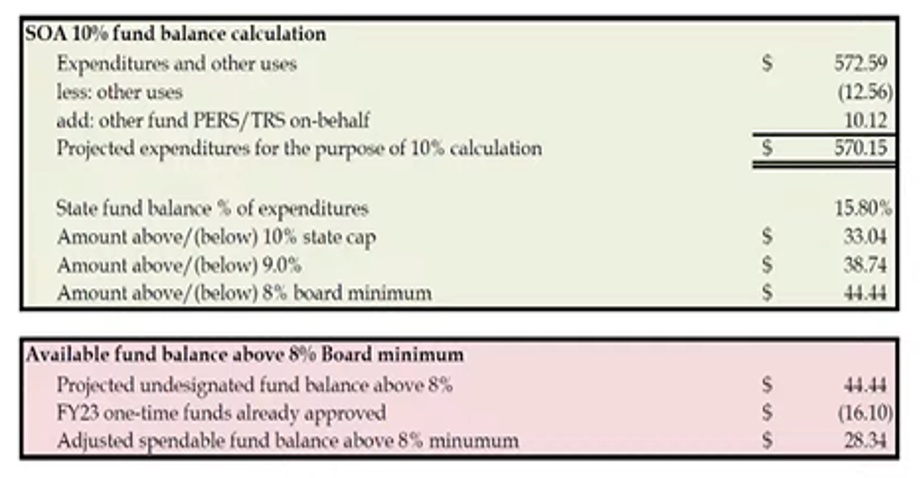
The district also has access to several fund balances—leftover money. It currently has a fund balance of $33.04 million above the State’s cap.
The district may use part of this fund balance, which is like a “rainy day” fund, to fill its budget gap this next fiscal year. It may also reduce the fund balance to a minimum 8% of expenditures level. That is $44.44 million extra money to use.
This would allow it to use $28.34 million to fill the budget gap as shown below.
The school board has dug this budget hole even deeper by using one-time federal Covid money to pay for recurring costs, in spite of being warned by the State to not do this.
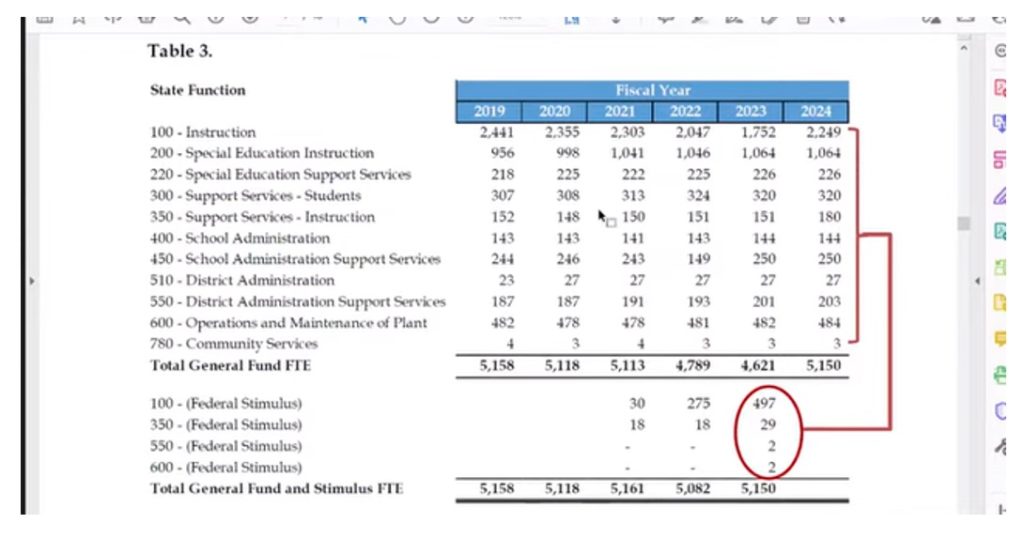
The one-time money has been used to pay for 529 full-time equivalent positions at a cost of more than $60.7 million.
Here is the district’s chart showing these positions:
Whatever the school board decides, readers may recall that the State Department of Education and Early Development warned every district not to use one-time federal Covid money to pay for recurring costs.
Apparently, the Anchorage School Board either did not listen or did not heed the State’s advice.
Now it wants the State Legislature to pay for its choice to ignore the warning by increasing the per student funding—the Base Student Allocation.
And the Legislature, in its current makeup, may look at your Permanent Fund dividend, which the governor has proposed to be set statutorily about $4,000, to pay for a poorly performing school district.
David Boyle is the education writer for Must Read Alaska.