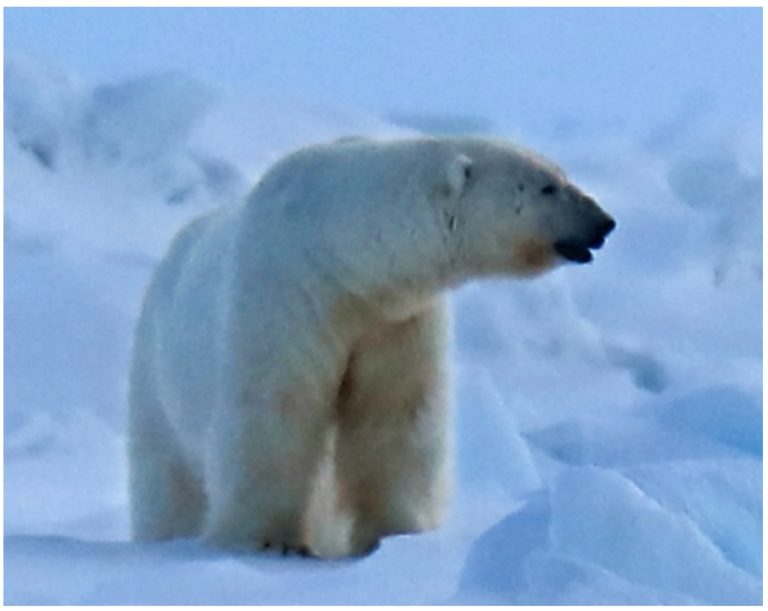
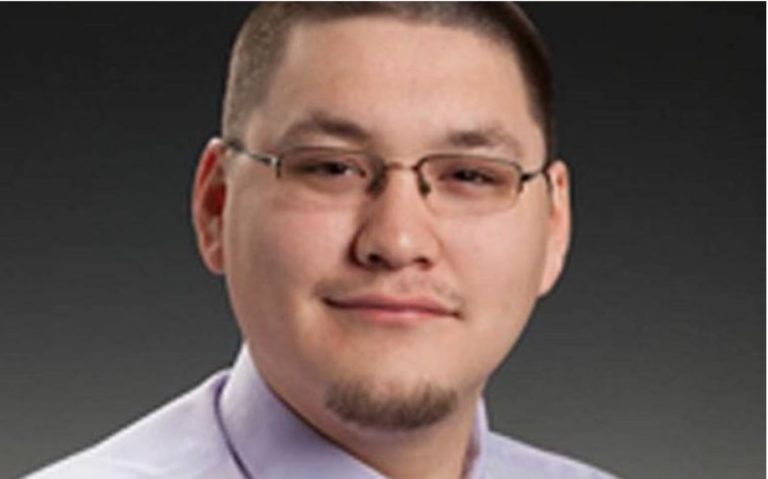
On Tuesday afternoon, Alaska State Troopers received a report of a polar bear attack in Wales, a community on the Seward Peninsula in Alaska’s arctic northwest.
The bear had entered the community and chased several people, then attacked an adult woman and juvenile male. It was shot and killed by a local resident as it attacked the pair. Troopers and the Alaska Department of Fish and Game are working to travel to Wales as weather conditions allow.
Update: Both the woman and the boy were killed by the bear before it was put down.
Wales has about 150 residents and is located about 100 miles northwest of Nome.
Committee assignments in the Alaska Senate were released Tuesday, after the Alaska Legislature gaveled in for the first time this year, and Democrats should be happy.
In half of the committees, Democrats outnumber Republicans, 3-2, even though Alaskans voted in a majority of Republicans in the Senate. The Senate is comprised of 11 Republicans and 9 Democrats, yet Democrats outnumber Republicans on five of the 10 committees, as three Republicans have been excommunicated from the bipartisan caucus, which is chaired by Republican Senate President Gary Stevens.
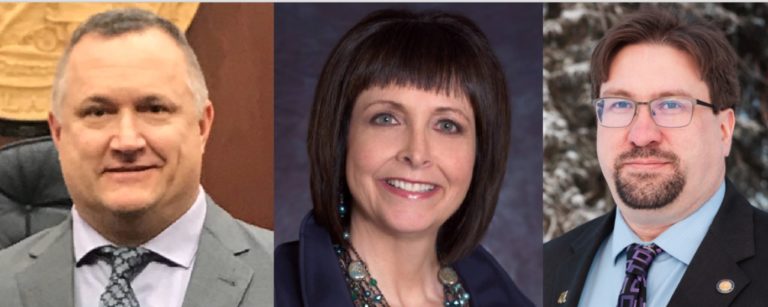
Here’s how the committee assignments shaped up, as assigned by the Committee on Committees, in the document signed by Sen. President Gary Stevens, Sen. Cathy Giessel, Sen. Click Bishop — all Republicans, and Sen. Lyman Hoffman and Sen. Bill Wielechowski — both Democrats:
Community and Regional Affairs: Democrats-3, Republicans-2
Dunbar, Olson, Gray-Jackson, Bjorkman, Giessel
Education:Democrats-3, Republicans-2
Tobin, Stevens, Bjorkman, Kiehl, Gray-Jackson
Finance:Democrats-3, Republicans-4
Stedman, Hoffman, Olson, Bishop, Merrick, Kiehl, Wilson
Health and Social Services:Democrats-2, Republicans-3
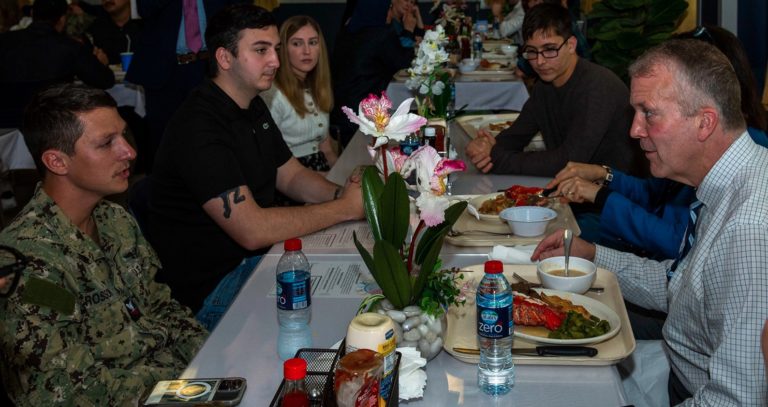
Sen. Dan Sullivan visited Alaska-based troops in the Middle East in recent days, as part of a bipartisan congressional delegation to a handful of Middle East countries that were part of apeace accord brokered by the former President Donald Trump.
Sullivan and the other senators visited Bahrain, Israel, the United Arab Emirates, and Morocco, as an effort to support full diplomatic relations between Middle Eastern countries, and in recognition of Israel as a sovereign country.
On the trip with Sullivan are Sens. Jacky Rosen of Nevada, James Lankford of Oklahoma Kirsten Gillibrand of New York, Mark Kelly of Arizona, Michael Bennet of Colorado, and Ted Budd of North Carolina.
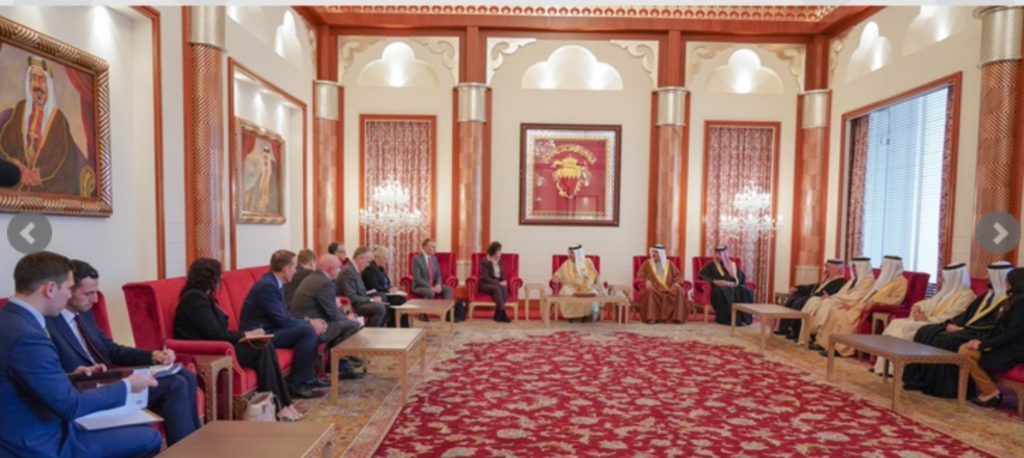
According to the Bahrain News Agency, His Majesty King Hamad bin Isa Al Khalifa received the delegation at the Al-Safriya Palace on Sunday.
The delegation meets with the king of Bahrain and diplomatic team.
The Abraham Accord signatories pledged that they recognize the importance of maintaining and strengthening peace in the Middle East and around the world based on mutual understanding and coexistence, as well as respect for human dignity and freedom, including religious freedom.
“We encourage efforts to promote interfaith and intercultural dialogue to advance a culture of peace among the three Abrahamic religions and all humanity.
“We believe that the best way to address challenges is through cooperation and dialogue and that developing friendly relations among States advances the interests of lasting peace in the Middle East and around the world.
“We seek tolerance and respect for every person in order to make this world a place where all can enjoy a life of dignity and hope, no matter their race, faith or ethnicity.
“We support science, art, medicine, and commerce to inspire humankind, maximize human potential and bring nations closer together.
“We seek to end radicalization and conflict to provide all children a better future.
“We pursue a vision of peace, security, and prosperity in the Middle East and around the world.
“In this spirit, we warmly welcome and are encouraged by the progress already made in establishing diplomatic relations between Israel and its neighbors in the region under the principles of the Abraham Accords. We are encouraged by the ongoing effmis to consolidate and expand such friendly relations based on shared interests and a shared commitment to a better future.”
The accord was signed by then-President Donald Trump, King Hamad’s foreign minister, and Israel Prime Minister Benjamin Netanyahu.
Word was all over the Alaska Capitol this week that the Soldotna Rep. Justin Ruffridge, a Republican who just took the oath of office, had made a deal with the Democrats to install him as Speaker Pro Tem. In fact, that rumor appears to be in the “correct” category.
No sooner had the Alaska House of Representatives been gaveled into order by Lt. Gov. Nancy Dahlstrom, than hardline Democrat Rep. Andy Josephson of Anchorage nominated Ruffridge for the temporary position. There was an immediate at-ease.
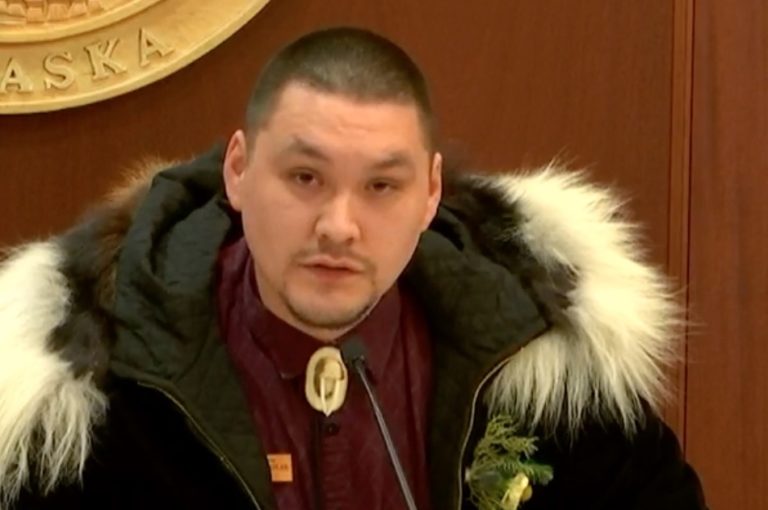
In the end, on the nomination of Rep. Laddie Shaw of Anchorage, Rep. Josiah Patkotak won the election for speaker pro tem, 40-0, with even the ever-contrary Rep. David Eastman voting in favor of Patkotak. The Ruffridge nomination never even went to a vote — it was dead on arrival with Republicans.
Patkotak, of Utqiagvik, thanked God, and then thanked the lieutenant governor. “I am humbled and appreciate the support of you electing me to be temporary presiding officer,” he said. The House Democrats, Republicans, and no-party members must now haggle over who has the votes to become the permanent speaker for the next two years.
Of the three senators who were banished from the Alaska Senate majority caucus, only one of them was assigned to any Senate committee. Sen. Robert Myers of North Pole was assigned just to Transportation.
Neither Sen. Mike Shower or Sen. Shelley Hughes, both representing the Mat-Su Valley, were given committee assignments, although between Shower and Hughes, they represent over 70,000 people in Alaska who have no representation in the Senate, due to their lawmakers being banished. Adding in Sen. Myers, the number is over 110,000 Alaskans without a senator on committees.
The Senate majority is made up of nine Democrats and eight Republicans, with Shower, Hughes, and Myers not invited during organizational talks this fall. There is no actual minority in the Senate, since it takes five to make up a minority. Therefore the three who have been politically excommunicated have little to say about their exclusion.
The Senate leadership and committee assignments are:
Community & Regional Affairs: Sen. Forrest Dunbar (D-Anchorage) Education: Sen. Löki Tobin (D-Anchorage) Health & Social Services: Sen. David Wilson (R-Wasilla) Judiciary: Sen. Matt Claman (D-Anchorage) Labor & Commerce: Sen. Jesse Bjorkman (R-Nikiski) Resources: Co-Chairs – Sen. Click Bishop (R-Fairbanks) and Sen. Cathy Giessel (R-Anchorage) State Affairs: Sen. Scott Kawasaki (D-Fairbanks) Transportation: Sen. James Kaufman (R-Anchorage) Legislative Budget & Audit: Vice Chair – Sen. Bert Stedman (R-Sitka) Joint Armed Services: Co-Chair – Sen. Scott Kawasaki (D-Fairbanks)
Committee assignments:
Community and Regional Affairs: Dunbar, Olson, Gray-Jackson, Bjorkman, Giessel
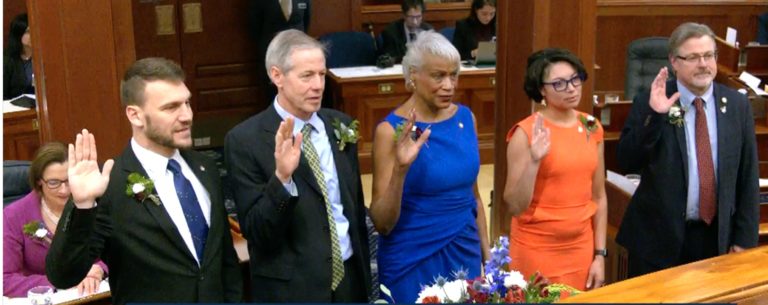
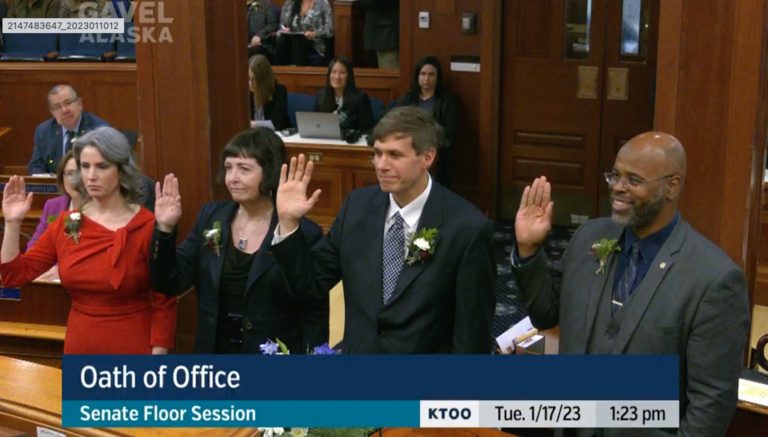
Nineteen state senators were sworn into office by Lt. Gov. Nancy Dahlstrom, who called the Senate to order at 1 pm and them up in groups of five. But when Dahlstrom called upon Sen. Mike Shower to join his group of five, he was nowhere to be found.
Must Read Alaska has learned that Shower had something come up in his personal life that made it impossible for him to come to Juneau.
The next order of business for the day was to elect a Senate President, which had already been done informally in private meetings before the session began. Sen. Gary Stevens of Kodiak returned to the podium once again in his long legislative career. He has served as Senate president from 2009 through 2012, when he led a Democrat-majority caucus of 10 Democrats and six Republicans. He now leads another Democrat-dominated caucus of nine Democrats and eight Republicans. Three Republicans were not asked to join the coalition — Shower, Sen. Shelley Hughes, and Sen. Robert Myers.
(Above, Sens. Kelly Merrick, Shelley Hughes, Bill Wielechowski, and David Wilson.)
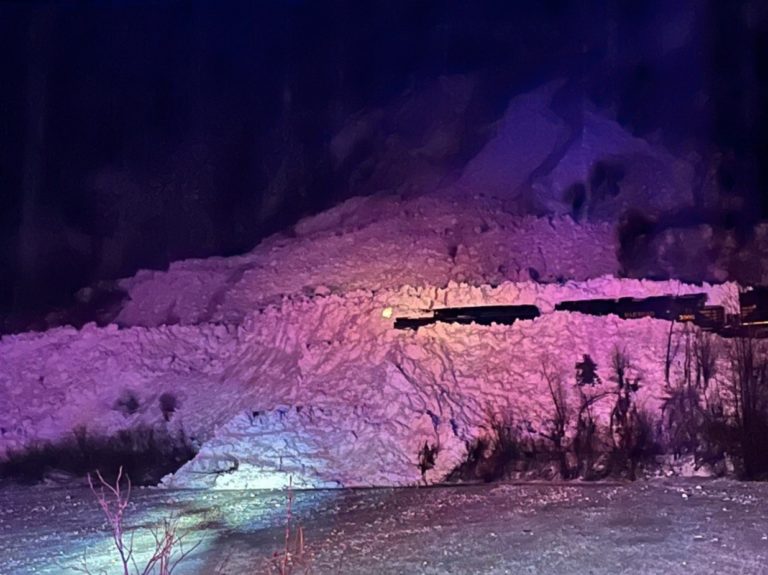
No one was injured when a 3,144-foot freight train belonging to the Alaska Railroad ran into an avalanche about three miles south of Girdwood on Tuesday morning and derailed.
The train had left Whittier at about 1 am heading north, when it ran into the avalanche field at about 1:58 am. The Girdwood Fire Department responded with seven firefighters to the train derailment at 2 am. A rescue team, including three Girdwood firefighters, Alaska Department of Transportation workers, and the Alaska Railroad, assessed the risk and then crossed the avalanche field and made it to the train, where the three train employees who were on the train were able to self-extricate and were escorted back to the Seward Highway for evaluation by Girdwood medics. Avalanche mitigation work is under way from 9 am to about 4 pm by the Alaska Department of Transportation and will cause intermittent delays of 45 minutes or more along the Seward Highway.
Meanwhile, the Alaska Railroad is assessing the situation to determine how it will get the derailed cars back on the tracks. Two cars were completely derailed and a third was partially derailed, sources said.
Turnagain Arm, where the avalanche took place, is a hazardous avalanche zone.
After Governor Bill Sheffield and Justice Jay Rabinowitz combined to gerrymander me out of my State Senate seat, I ran for the State House in 1984, hoping to figure out a way to get revenge.
I got elected, but the House Republican minority of the 14th Alaska Legislature had around 14 members, and we were completely ineffective.
Sitka’s Rep. Ben Grussendorf was the Democratic Speaker, but he was only a figurehead. The power in the House was Finance Chair Al Adams of Kotzebue.
In the 13th Legislature, Al had been Finance Committee chair in a Republican organization. R’s and D’s didn’t mean anything to Al. He was in Juneau for his people, the Alaska Natives. He led the six members of the Bush Caucus, and they called the shots.
I was from South Anchorage, originally from California, and I didn’t have any experience with Alaska Natives. I quickly learned that they didn’t allow personal ambition or vanity to interfere with what was good for the group. They were communal, and Al was a prime example.
He was a brilliant guy, and he worked his butt off. He never showed any ego, and was as mild mannered and kind as a guy could be. Everybody loved and respected Al. When I left the Legislature I was proud to call him a friend.
Right now the Alaska House is adrift, with no one able to form a majority organization. But there apparently is one legislator who has the potential to bring people together – Josiah Patkotak from the North Slope.
Al Adams didn’t just serve the Native people of Alaska. He served the whole state. In his spirit, perhaps Josiah should step forward and take a leadership role. At least for the next two years.
I never got my revenge on Jay Rabinowitz, but I played a significant role in taking Bill Sheffield down. Day after day I raised hell on the House floor, demanding the appointment of a special prosecutor to investigate his corruption. His Attorney General, Norm Gorsuch, was an honorable guy, and he knew I was right under the law. When he did as I was demanding, and appointed Dan Hickey, the die was cast. We almost impeached Sheffield, and he was resoundingly defeated in the 1986 Democratic primary.
Identity Inc, an Anchorage-based advocacy group for those with alternative gender and sexual preferences, is encouraging children to get in touch with the organization if the children want help getting puberty blocking chemical treatments. In a social media post, Identity Inc. tells kids they will be put in contact with the Rainbow Youth Project USA, which helps children get the chemical treatments that are the first step in transgenderism. Once children block their progress through puberty by using hormones, they can then later get surgically castrated, have their breasts removed, and get other surgeries to change their appearance so they look more like the opposite gender.
Boys who take these drugs can force their voices to remain at a higher range and they may be able to prevent facial and chest hair from appearing. For girls, they can prevent the onset of their menstrual cycle, and can slow down the growth of breasts. Children who are enticed to go this route face a lifetime of dependency on pharmaceuticals and many of them endure side effects in what is still uncharted and unregulated medical territory.
Rainbow Youth Project USA offers financial help for youth who wish to transition their gender appearance, which is also called “gender affirming care.”
But wait, there’s more: For those children living in states that prohibit Medicaid public funds from being used for such a purpose, the Rainbow Youth Project USA will offer help, including scheduling appointments for children with physicians who do this kind of work.
Identity Inc. offers a list of Alaska health care providers who are working in this field, which the group calls “LGBTQIA2S+ Affirming Physical Health Providers” at this link. The list of Alaska physicians includes what Identity refers to as pediatric endocrinologists, or those doctors who work with youth with hormone disorders.