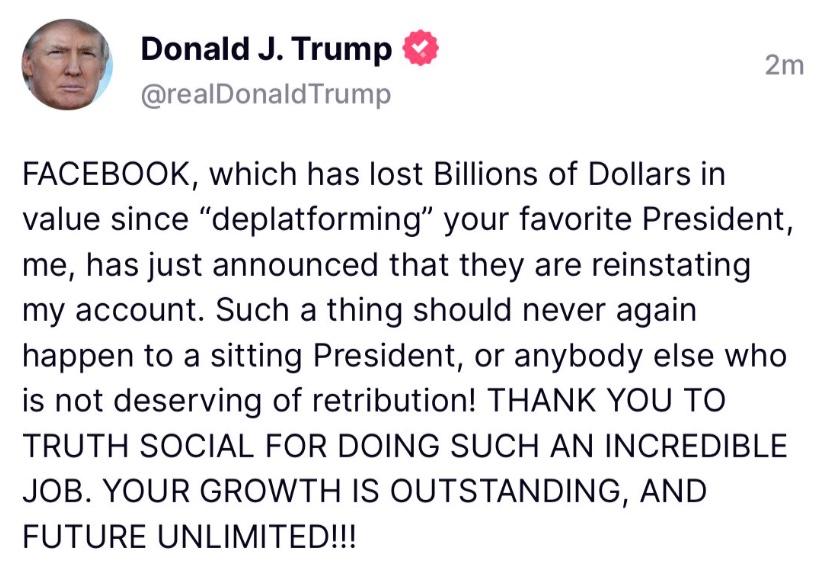
Facebook will restore the social media account of Donald Trump in the coming weeks, the parent company said Wednesday. This brings to an end the ban that the company put on the former president due to Facebook’s perception that he had a role in what they call the Jan. 6, 2021 riots at the U.S. Capitol.
Meta wrote on its blog:
We will be ending the suspension of Mr. Trump’s Facebook and Instagram accounts in the coming weeks.
We’ve put new guardrails in place to deter repeat offenses.
The public should be able to hear what politicians are saying so they can make informed choices.
The company said it recognizes it will be “fiercely criticized” for allowing Trump back on the platform, but said it values the free flow of ideas, especially as they are under threat in som many places around the world.”
Trump responded on his own social media site, Truth Social, by saying, that deplatforming a sitting president should never have happened.
“As a general rule, we don’t want to get in the way of open, public and democratic debate on Meta’s platforms — especially in the context of elections in democratic societies like the United States. The public should be able to hear what their politicians are saying — the good, the bad and the ugly — so that they can make informed choices at the ballot box. But that does not mean there are no limits to what people can say on our platform. When there is a clear risk of real world harm — a deliberately high bar for Meta to intervene in public discourse — we act,” Facebook’s blog post said.
“Two years ago, we took action in what were extreme and highly unusual circumstances. We indefinitely suspended then-US President Donald Trump’s Facebook and Instagram accounts following his praise for people engaged in violence at the Capitol on January 6, 2021. We then referred that decision to the Oversight Board — an expert body established to be an independent check and balance on our decision-making. The Board upheld the decision but criticized the open-ended nature of the suspension and the lack of clear criteria for when and whether suspended accounts will be restored, directing us to review the matter to determine a more proportionate response,” according to the blog.
In response to the Board, Facebook imposed a time-bound suspension of two years from the date of the original suspension, which was on Jan. 7, 2021, something Facebook admits is an unprecedented length of time for such a suspension.
“We also clarified the circumstances in which accounts of public figures could be restricted during times of civil unrest and ongoing violence, and introduced a new Crisis Policy Protocol to guide our assessment of on and off-platform risks of imminent harm so we can respond with specific policy and product actions. In our response to the Oversight Board, we also said that before making any decision on whether or not to lift Mr. Trump’s suspension, we would assess whether the risk to public safety has receded,” Facebook said.
The company admits the decision was “taken in extraordinary circumstances. The normal state of affairs is that the public should be able to hear from a former President of the United States, and a declared candidate for that office again, on our platforms. Now that the time period of the suspension has elapsed, the question is not whether we choose to reinstate Mr. Trump’s accounts, but whether there remain such extraordinary circumstances that extending the suspension beyond the original two-year period is justified.”
Further, the company appears to have set up special Trump rules: “In the event that Mr. Trump posts further violating content, the content will be removed and he will be suspended for between one month and two years, depending on the severity of the violation.
“Our updated protocol also addresses content that does not violate our Community Standards but that contributes to the sort of risk that materialized on January 6, such as content that delegitimizes an upcoming election or is related to QAnon. We may limit the distribution of such posts, and for repeated instances, may temporarily restrict access to our advertising tools. This step would mean that content would remain visible on Mr. Trump’s account but would not be distributed in people’s Feeds, even if they follow Mr. Trump. We may also remove the reshare button from such posts, and may stop them being recommended or run as ads. In the event that Mr. Trump posts content that violates the letter of the Community Standards but, under our newsworthy content policy, we assess there is a public interest in knowing that Mr. Trump made the statement that outweighs any potential harm, we may similarly opt to restrict the distribution of such posts but leave them visible on Mr. Trump’s account. We are taking these steps in light of the Oversight Board’s emphasis on high-reach and influential users and its emphasis on Meta’s role “to create necessary and proportionate penalties that respond to severe violations of its content policies.”
Facebook said it realizes people will disagree with the company decision, but “a decision had to be made, so we have tried to make it as best we can in a way that is consistent with our values and the process we established in response to the Oversight Board’s guidance.”
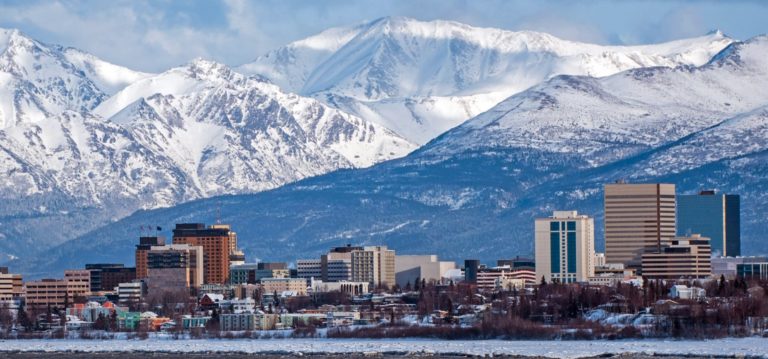
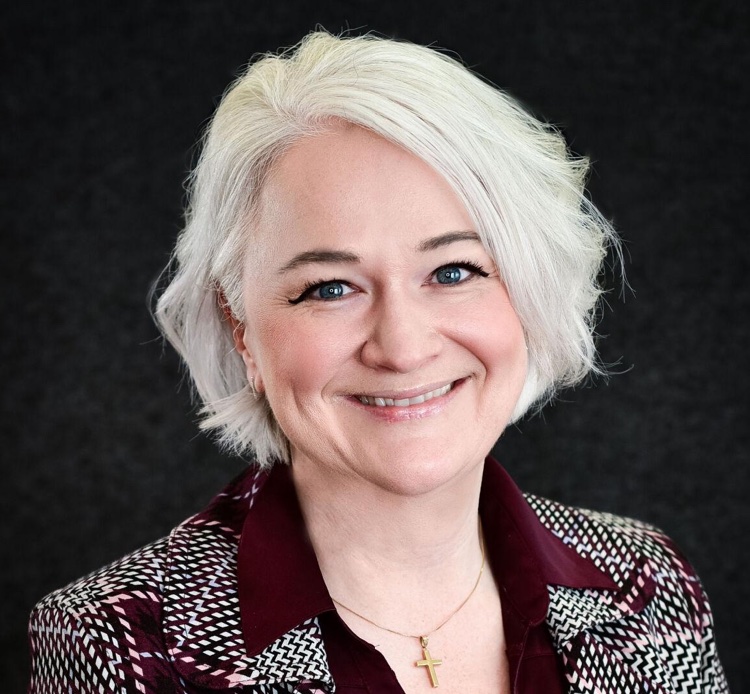
Acting Municipal Attorney Blair Christensen will be departing from the Municipality to pursue a new opportunity, the Mayor’s Office said.
Christensen has worked in the city’s Law Department for nine years. Her last day will be Feb. 8.
“I have valued my time working with Blair, and have found her to be incredibly sharp, professional, and a huge asset to the Municipality. I want to wish her nothing but the best in her future endeavors,” said Mayor Dave Bronson.
“My time working on behalf of the people of Anchorage has been one of the greatest jobs and honors of my life. The people I have had the fortune of working with and learning from have made this job something special,” Christiansen said in a statement. “I want to thank the Mayor for his trust in me over the last 5-months, as I served as Acting Municipal Attorney.”
Bronson had picked Patrick Bergt as his municipal attorney when he took office in June of 2021. Bergt left a year later to work for ACS, and the Anchorage Assembly refused to approve Bronson’s second choice, Mario Bird, who served only briefly as acting municipal attorney and who is now a senior policy advisor to the mayor. Christensen was likely to be confirmed, as she is well known by the Anchorage Assembly.
The Alaska State Troopers have released a statement regarding the arrest and forced mental health evaluation of the 2022 Alaska Principal of the Year.
Mary Fulp, principal of Colony High School, was taken away by Troopers after two people called in to request a psychological evaluation of the prominent educator.
Fulp has been a principal in the district for 15 years. On Jan. 15, she posted a Facebook Live video, in which she speaks about her faith, speaking in tongues, and her devotion to Christ.
After that post was seen by thousands of people, some members of her family decided she was not well, and evidently called the Alaska State Troopers to do a welfare check on her. One of the family members claimed they had a court order to have her taken into custody for a psychological evaluation.
Fulp also posted on Facebook that incident, in which she documented two Troopers detaining her. The episode was peaceful and she appears to be of sound mind in the video.
Principal Fulp is a lifelong Alaskan who has both a bachelor’s degree and masters in education from UAA, with a superintendent endorsement. She has worked in education for 25 years in Alaska and 17 years as a principal in the Mat-Su School District. Fulp is past-president of the Alaska Council of School Administrators and the Alaska Association of Secondary School Principals.
Today, the trooper’s issued this statement, explaining that the Department of Public Safety believes this is a situation that went wrong, and the agency promises to do better:
“Thank you for your recent inquiry regarding an incident that was broadcast on Facebook Live last week that showed the Alaska State Troopers involvement in a mental health call in the Mat-Su Valley.
“Typically, specific information regarding these incidents is protected under AS 47.30.845; the Alaska Court System has recently released information which contradicts the actions and statements of the Alaska State Troopers that responded to the call.
“The Alaska Department of Public Safety has opted to provide additional information regarding our portion of the incident that we would typically not provide to protect the privacy of the involved Alaskan. Please find a statement from the Alaska Department of Public Safety below:
“On January 18, 2023, at around 11:00 am, the Alaska State Troopers received a request from complainant 1 to conduct a welfare check on an adult female in the Mat-Su Valley. Complainant 1 told dispatchers that the female was not answering the door and that he had concerns for her mental health.
“Around 11:45 am, an Alaska State Trooper responded to the residence and spoke with the complainant 1 and the adult female.
“Troopers determined that the adult female was not exhibiting signs of grave disability from a mental health issue and was not likely to cause serious harm to herself or others and therefore did not meet the conditions for emergency detention under AS 47.30.705. The Trooper departed the residence at 12:10 pm.
“At 4:48 pm, complainant 2 contacted the Alaska State Troopers in a 911 call stating that she had a signed order from a judge that the adult female from the previous call was to be involuntarily committed to the nearest mental health evaluation facility.
“Two Alaska State Troopers arrived at the residence at around 5:10 pm and were presented a document that complainant 2 alleged was signed by a judge and authorized the transport of the adult female.
“Troopers observed that the document appeared to be signed by a judge and appeared to be valid. Troopers made contact with the adult female and advised her of the judge’s order.
“The primary Trooper assigned to the call acknowledged that the female was not exhibiting grave disability from mental health and was not likely to cause serious harm to herself or others.
“Under the authority of the court order Troopers proceeded to transport her without incident or force to Mat-Su Regional Medical Center. They arrived at around 5:45 pm for the mental health assessment. Troopers escorted the female into the hospital and staff from the hospital escorted her into the facility. At no time did Troopers exercise the authority granted to peace officers to perform an emergency detention of the adult female as allowed under AS 47.30.705.
“On Friday, January 20, 2023, it was brought to the attention of the Alaska Department of Public Safety that the documents that complainant 2 presented to Troopers may not have been a court order authorizing the involuntary commitment of the adult female.
“DPS Commissioner Cockrell ordered a full review of the incident.
“DPS immediately requested copies of the court documents associated with this incident from the Alaska Court System to determine if they were authentic. The Alaska Court System denied the DPS request. We also requested copies of the documents from complainant 2, however they declined to provide Troopers with copies of the documents. On January 24, 2023, the Alaska Court System issued a public statement stating that there was no valid court order for the adult female’s involuntary commitment.
“This was the first official confirmation from the Alaska Court System that DPS has received that the court order that was presented was not valid. With this new information Troopers now believe that the document that was presented to Troopers by complainant 2 was not a valid court order for involuntary commitment. Commissioner Cockrell has requested a full internal review of the policies and procedures of the Alaska State Troopers to ensure that incidents like this do not occur in the future.
“’Based on the limited information we have been able to learn about this incident from the Alaska Court System it appears that we made a mistake by transporting the adult female for an evaluation. Our staff should have taken additional steps to verify the information presented by the complainant and the validity of the court order,”’ stated Alaska Department of Public Safety Commissioner James Cockrell. ‘We take full responsibility for this and want to assure the public that we are taking necessary steps to ensure that incidents like this never happen again. This type of situation is unacceptable, and you have my commitment that we will do better.’”
My son is only eight years old, and already it is time for the talk.
No, not that talk; a talk that shouldn’t be happening, let alone at this age.
The talk is going to be on how, regardless of the hysteria around its “existential threat,” climate change isn’t anything to be worried about. The world isn’t going to end anytime soon, nor should my son change his happy, helpful, and high-emotional-intelligence-driven demeanor.
Unfortunately, this was not the first time my young son brought up this topic of climate change. First, he saw the character Molly grapple with her clubhouse sinking in the tundra during the animated PBS Kids show, Molly of Denali, which is set here in Alaska. Molly’s grandfather blamed climate change, and my son wanted to know what that was. I told him it was a naturally occurring situation that has happened numerous times throughout history. That appeased him.
Then, over Christmas break, his friends were discussing the tremendous snowfall levels in Anchorage this year, which led to contrasts with this winter versus the extreme heat in 2021. One of his friends’ older siblings told the group his parents blamed climate change for both, and how it wasn’t going to be good for Alaska going forward. We had a brief chat about seasons, and how weather isn’t always the same year after year. Some years have more rain, some have more sun, some are warmer and some are colder. All are beautiful here in our home state.
Don’t get me wrong: kids are naturally curious beings. They should be allowed to debate the issues, especially with each other. But there’s a difference between debate and indoctrination, and that is frustrating as a parent. They’ve led my impressionable son to wonder if his home state is in peril, just as if he’d ask if our pet throwing up means she is seriously sick. To him, without a basis to measure insignificant weather events against real-life catastrophes, questions arise.
Things took a turn last week when his friend’s father told my son that his dad (i.e. me) was helping “ruin” Alaska and “hurtling it toward a climate cliff.” His argument was based on my support for energy workers and advocating for Alaska’s resource-based economy. I verified this with the parent in a tense conversation later that night.
The other parent let me know he takes issue with my job as the Alaska state director for Power The Future. Our organization champions energy workers and fights for more jobs and opportunities, pushing back against the (false) narrative that traditional energy has no place in today’s society. We challenge the idea that there is a binary choice between the environment and responsible resource extraction.
It was clear that this had not been an in-passing comment by the parent. It was a calculated assault on my son’s innocence, full of hysteria and hyperbole. With the exception of the most ardent green extremists, most well-rounded people know that alarmism doesn’t work, isn’t accurate, and that those preaching their “climate cult” message are actually pushing people away with continuous, Chicken Little-esque fear. Yet, here was this parent, with an obvious agenda, attempting to both push his belief system on my son, and inflict damage on my trustworthiness as his provider and father.
My son’s questions were accusatory and direct: Why did I hate Alaska? Why was I making money hurting the Earth? Don’t I know Alaska is burning? Why don’t I sell my diesel pickup and buy an electric vehicle, since it is better for the planet?
The questions haven’t stopped coming. Lots of queries, and so, we’ll have “the talk” about climate, about weather, about how inventions over the past 175 years have made our lives comfortable, compared to Alaskans in past generations. How Alaska is blessed with extraordinary deposits of oil, gas, minerals, precious metals, timber, fish and God-given geography. How Alaskans work every day to safely and responsibly harvest and extract those resources, without ruining the beauty or staying power of our lands, or doing harm to our people. How those preaching doom and gloom have been doing so for decades, using worst case scenarios to describe situations that invariably do not come to pass. The same people telling us with certainty that Miami will be underwater next decade were saying the same thing about the Maldives in the 1980s.
We’ll talk about how my job isn’t liked by a small-but-vocal group of Alaskans, and how that’s OK. Everyone is entitled to their own opinions in this great country of ours, even those devoid from reality. We’ll talk about my wife and my unconditional love for him and each other, and how we, as a family, don’t need anyone else’s approval to live a happy and robust life.
We’ll talk about all of that and more, and I will let him know he should never be afraid of a bogeyman called “climate change”, nor of how others’ hysteria around the subject should cause him to stop living his life to the fullest, in the beauty surrounding him daily.
He’s eight. He’s innocent. He’s happy. He’s the most important person in my life. He’s not going to exist in a state of fear because of something as trivial as a changing cycle of heat, cold, wind and water; regardless of how his friends and their families choose to live. I owe him that, after all.
Rick Whitbeck is the Alaska State Director for Power The Future, a national nonprofit organization that advocates for American energy jobs. Contact him at [email protected] and follow him on Twitter @PTFAlaska.
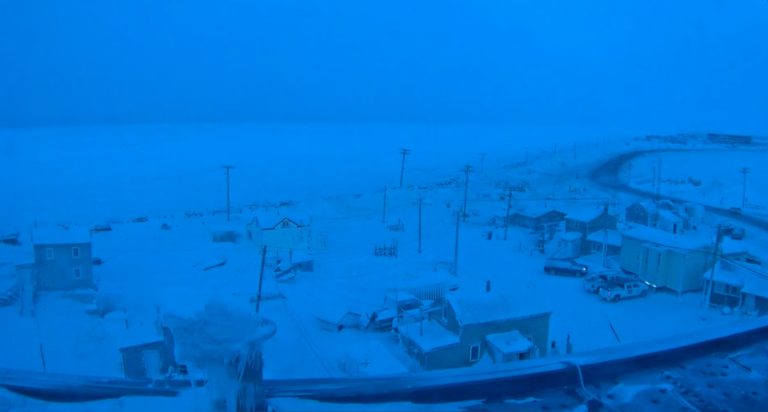
The sun rose in Utqiagvik (Barrow) on Monday for the first time in 2023.
The sun set for the winter on Nov. 19, 2022. On Monday, the sun peeked over the horizon for about one hour and 11 minutes, although the skies were not clear enough to see the sun. Tuesday, America’s northernmost city will get 1 hour, 44 minutes of daylight, although the sun will still be low on the horizon. By January 30, the daylight will have increased to 3 hours, 41 minutes, as sun quickly returns to the far north.
One of the largest Inupiaq communities in Alaska, Utqiagvik is on the Chukchi Sea and is called home by about 4,300 people, many who hunt whales, seals, caribou, and polar bear. It’s a subsistence city incorporated in 1959, and reached only by plane from the rest of Alaska. The town changed its name from Barrow to Utqiagvik after a vote in 2016. The word Utqiagvik means “‘”where wild roots are gathered” and relates to an Inupiaq word meaning “where snowy owls are hunted.”
Temperatures in Utqiagvik will remain below zero on Tuesday, reaching -19 overnight. By Sunday, the temperature may reach as high as 17, a brief respite from the subzero days, which will return next week.
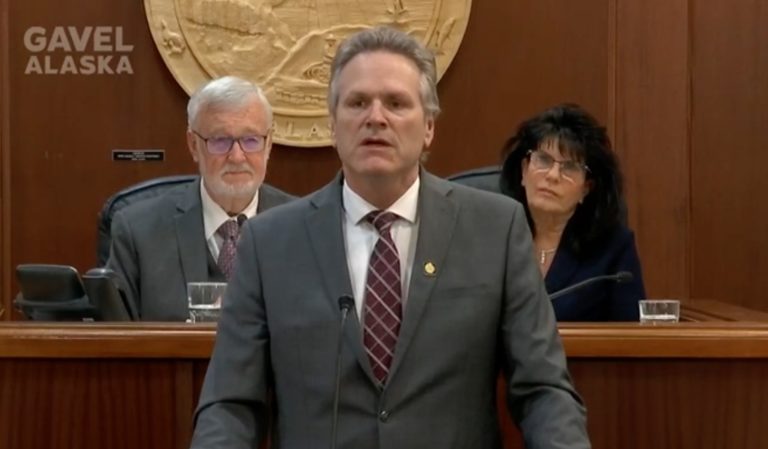
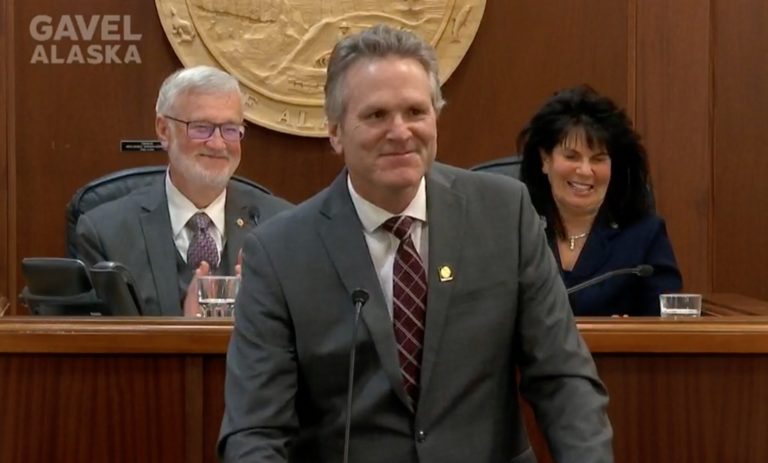
Gov. Mike Dunleavy spent a large portion of his State of the State Address highlighting the achievements of outstanding individual Alaskans — many of them from rural parts of the state. He named names, and told stories of heroism and Alaskans going out on a limb to create a better and safer Alaska.
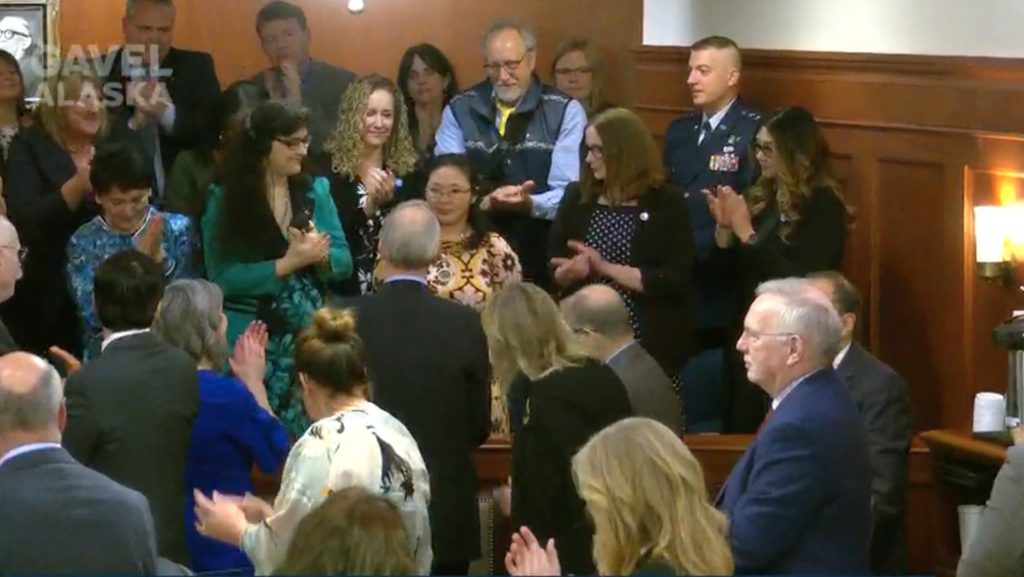
He lifted up Heidi Lieb-Williams, who chairs of the Governor’s Council for Disabilities and Special Education. He highlighted Daisy Lockwood Katcheak, the city administrator of Stebbins, a village hard hit by a fall typhoon. He introduced Sergeant Carlos “Julian” Navarro, hired by Kawerak Inc. to serve the community of Golovin as a village public safety officer. He asked Katie Botz to stand and be recognized for her work on behalf of victims, and he even introduced a psychiatric nurse from Alaska Psychiatric Institute, Rebecca Morrissey.
On almost every page of his 17-page speech, Dunleavy focused on specific Alaskans and their life purpose. In each story he told, and for each person who stood to be recognized, there was a theme of how one person can make a difference in a state like Alaska.
After listing the other usual subjects of such addresses over recent years — resource development, public safety, and reducing sexual assault — Dunleavy pivoted and talked about drone research, selling carbon credits, and finally, the need for more children to stem the outgoing tide of population. It became evident that children were the driving motivation for everything he had spoken about in the prior 40 minutes at the podium.
“It’s no secret to anyone that I’m a pro-life governor, and my administration is ready to work with all of you over the next four years to achieve my goal to make Alaska the most pro-life state in the entire country,” he said to the 60 legislators in the chambers.
“We need more people in Alaska, not less. We need more people in our jobs. We need more people in our schools. We need more people who create wealth. We need more people solving problems. We need more families.” He was talking about how every baby is human life.
Dunleavy’s team had not released this part of his speech to the media in advance.
“People are not a nebulous, abstract concept. People are what this is all about. Everything we do is for the people. Government is about serving people, and the people are why we’re here: the people of Alaska today and certainly the people of Alaska tomorrow,” he said.
The state needs to be the kind of place that promotes having families, and that is attractive to family life.
Woven throughout, Dunleavy hinted that there were things he wanted to do during his first four years that were hard to get to, under the circumstances and with the hurdles the state faced, such as the pandemic. But he said he was glad the state could hold the budget flat, and he emphasized that now is the time to revolutionize the Alaska economy with big, bold ideas that position the state as a place where families grow, and where children want to return.
Among the ideas for pro-life policies was to expand postpartum medical coverage for women, so they don’t turn to abortion instead. He also indicated he will still fight for a full Permanent Fund dividend.
Toward the end of his remarks, he asked Rep. Josiah Patkotak and his wife Flora, who hail from Utquigvik, to stand. He asked them to lift up their young children, Elijah and Francine, and then he asked the Alaska Legislature to dedicate themselves to working to build the kind of Alaska that would provide those two youngsters and all children of Alaska the future they deserve.
“To the Patkotaks, thank you again, for being here tonight representing the Alaskans of today, and the Alaskans of tomorrow,” Dunleavy said.
And by lifting up the Patkotaks, Dunleavy managed to get the entire Legislature to applaud for Dunleavy’s pro-life message.
Gov. Mike Dunleavy’s fifth State of the State Address in Juneau on Jan. 23 touched on many of the major topics he will focus on this year. Among other initiatives, he made the case for spending more to defend Alaska’s statehood development rights against the attempts by the federal government to lock the state down. He spoke to his initiative to protect Alaskans from sexual assault, and he said he would attempt, through legislation, to crack down on fentanyl traffickers.
Dunleavy did not speak much about oil and gas development, which is Alaska’s major economic driver, but did speak about expanding into carbon sequestration, strengthening the State Defense Force to be ready to respond to disasters, and increasing efforts to strengthen food security, including fisheries sustainability.
And he went off the speech officially released to the media talk about how he is a pro-life governor: There’s no tomorrow without people, he said. We have to make it ok to have families, to have children.” He spoke to the need to have policies that make Alaska a place where families want to live.
The state’s policies should not be a disincentive to having children, he said. Check back with Must Read Alaska for analysis of this State of the State.
His text follows, with the exception of the strong pro-life, pro-family message he included at the end:
Thank you, Lieutenant Governor Dahlstrom, Senate President Stevens, Speaker Tilton, and members of the 33rd Legislative Session.
I want to thank you for the invitation to speak to our fellow Alaskans tonight. First, I want to recognize my wife of 35 years, First Lady Rose Dunleavy.
It would be virtually impossible to do this job without your support, and so, thank you, Rose, for putting up with me.
I’d also like to recognize the members of my cabinet in attendance tonight. Could you please stand and be recognized?
Thank you for everything you’re doing for the great State of Alaska.
To the members of the Legislature: Welcome, and thank you for wanting to serve your constituents.
Tonight, as I stand before you and the great people of Alaska regarding the state of our state, there is much to be thankful for.
I’m also optimistic about the start of this session because I believe what we do now … in the next four months, will set Alaska’s course not just for the next four years, but for the next 50 years and beyond.
We have a chance in this session to change the course of Alaska’s history.
But we won’t change history by accepting things the way they are, or the way they’ve always been.
As an example of this, I want to introduce you to an Alaskan who understands this, and who actually lives by it.
Heidi Lieb-Williams is the Chair of the Governor’s Council for Disabilities and Special Education, and she’s a champion at the state and federal level for our fellow Alaskans who are facing physical or mental challenges.
Her work has changed policy. It’s changed attitudes and it’s changed laws like the minimum wage exemption that allowed employers to pay smaller wages to Alaskans like Heidi.
Her tireless efforts helped us repeal that exemption in a bill last year, and I was proud to sign that bill with her at my side.
Heidi is a parent, she’s an advocate, she’s an entrepreneur, she’s an author, she’s an artist, she’s an inspiration to me, and to all of us.
Heidi, could you please stand and be recognized for your public service to the great State of Alaska?
Thank you, Heidi, for working so hard to change Alaska for the better.
Alaskans are a people that show their poise under pressure.
Over the past four years, we’ve overcome a historic earthquake, wildfires, landslides, and yes, a once-in-a-century pandemic. Nearly everything has been thrown at us but locusts.
Just this past September, hundreds of miles of our Western coasts and dozens of our communities were inundated with a powerful storm surge that upended homes, roads, boats, vehicles, and fish camps.
Thankfully, we didn’t suffer any loss of life in that storm.
Rather, we saw our communities come together to offer shelter, meals, and helping hands.
With winter fast approaching, local, state, and federal agencies joined with volunteer groups, the private sector, and nonprofit organizations for a massive recovery effort that was a race against time.
Together, homes were reset and repaired, and roads and seawalls were rebuilt.
As I traveled the region to monitor the recovery efforts, I met people who embody the toughness, the tenacity, and the leadership that became familiar to me when I lived and worked in rural Alaska.
One of our stops was in the town of Stebbins after the weather cleared enough for us to land.
We’d heard the town’s seawall had been damaged, and I wanted to see what kind of assistance we could provide.
Upon landing, I met Daisy Lockwood Katcheak, who is the city administrator of Stebbins.
Daisy didn’t have much time for standing around, and she was giving orders like a sergeant in the Marine Corps almost as soon as we got off the plane. I was impressed.
“Governor,” she said, “we gotta go. We’ve got lots to see.”
I quickly learned that Daisy was ahead of the game. She already had a damage assessment completed, and she already had a contractor and the rock lined up to rebuild the seawall.
By the end of our trip, I knew that Stebbins was going to be in great shape, because of her focus, diligence, and hard work.
By the end of our visit, I also told my team that I felt like I should be taking orders from her.
It was an honor to present Daisy with the Shirley Demientiff Award at the annual AFN convention, and I’m so glad to see her here again tonight representing all the community members who rose to the occasion under such difficult circumstances.
Daisy, would you please stand and be recognized? Thank you, Daisy, for answering the call to serve your people, and Alaska.
How we answer that call to serve is a question for all of us.
I’m optimistic about the next four years – and the next 50 – because of everything we’ve achieved in the last four years to reach this moment in time, despite everything we’ve faced, such as:
– Natural disasters
– A $1.6 billion deficit, debts, and credit downgrades
– A record-breaking crime wave
– Negative $3 oil
– A pandemic
– Inflation at a 40-year highIn spite of all that, we’re still here, we’re still standing, and we’re moving forward.In the midst of it all, we delivered the biggest PFD in history last fall at a time when Alaskans needed it the most.Our credit outlook is improved, and our debts and liabilities are down. Over the past four years, most of our agency operating spending is also down.My proposed budget for operating spending next year is nearly 4 percent lower than the one I inherited in 2019.
In my second year, the pandemic descended on Alaska, and it was supposed to wipe us out.
Like other places, we have lost friends, relatives, and loved ones, but as I stand here today, Alaska is fortunate in having the second-fewest deaths, and the fourth-lowest death rate per capita in the country.
While this is not something to celebrate, it’s something to keep in perspective.
We had the best survival rate in the country and at the same time we kept our industries running.
We respected local control and individual freedom. We fought back and won against vaccine mandates and federal overreach.
While battling the pandemic and the asscoiated chaos, we kept the state moving forward.
We’ve also worked with the University to fund the world-class research that it does best: unmanned aircraft, heavy and viscous oil, critical minerals, hydrogen, micronuclear power, and mariculture.
We stabilized the ferry system with forward funding and are making it sustainable with a dedicated fund that’s not subject to the annual sweep.
With the help of the Legislature, we’ve increased funding for maintenance, we’ve upgraded the Hubbard to serve longer routes on the Panhandle and will do the same for the Tazlina in the upcoming year. We’re also replacing the old “Rusty Tusty,” the Tustumena.
And, our largest ferry, the Columbia, will be back serving Alaska beginning in February.
Thanks to bipartisan support from 41 legislators, another accomplishment that gives me great optimism for our future was the passage of the Alaska READS Act last session.
For the first time, we have an education policy that demands accountability, that sets benchmarks, that provides the tools our school districts and our teachers need to set our students on a course for success in life.
No longer will we measure achievements in education simply by how much we’re spending. We’ll measure achievements by how well our kids are performing.
Thanks again to bipartisan support, we’ve put record amounts of resources into Public Safety, and we’ve grown our ranks of State Troopers and Village Public Safety Officers.
When I took office, we had just 45 working VPSOs compared to nearly 100 in 2014. With increased funding and by working with our local partners to recruit and retain officers, we’re now up to 68 at the end of 2022.
We all know that being a public safety officer is a difficult job. But we’re grateful for the individuals who step up to do it for us.
One of those hard-working individuals is here tonight.
Sergeant Carlos “Julian” Navarro was hired by Kawerak Incorporated in 2009 to serve the community of Golovin as a VPSO.
For the past 13 years, Sergeant Navarro has served his community with a calm and quiet presence as he’s taken on bootleggers and drug traffickers, and worked with our State Troopers to hold offenders accountable.
Back in 2015, he also saved the life of a four-month-old child in distress by performing CPR for over two hours while waiting for a medevac flight to arrive from Anchorage.
His actions helped protect lives once again this past fall, as the remains of Typhoon Merbok approached the coast. He ensured the community was prepared and elders were sheltered.
He helped keep the power on and worked around the clock before and after the storm to meet everyone’s needs for food and water.
Sergeant Navarro represents the very best of the VPSO program, and the many roles they serve when called upon.
On behalf of Alaska, thank you, Sergeant Navarro, for all you’re doing to serve your community.
Will you please stand and be recognized for your hard work, and the work of your fellow officers?
Thank you, again, Sergeant, for everything you do. Our investments in protecting Alaskans have absolutely shown results. Alaska is safer today than it was four years ago.
Thanks to the work of our men and women in law enforcement, and the resources and the policies we’ve put in place, our crime rate in 2021 declined to a 41-year low, just four years after it reached a 19-year high in 2017.
This is unprecedented. And I have to thank the members of the Legislature past and present for their help with this, along with all of our law enforcement personnel and prosecutors.
This is why policy matters.
Over the past five years, we’ve cleared the historic sexual assault kit backlog and are currently collecting owed DNA, and this evidence has resulted in indictments as we pursue justice for victims.
We’ve also put policies in place to make sure these backlogs never happen again.
To be clear, we’re all well aware that there is more to do to protect all Alaskans no matter who they are or where they live.
We did take a major step to protect Alaskans last year when we reformed our outdated consent law.
Prior to this bill’s passage, as hard as it is to believe, in the state of Alaska under Alaska law, the onus was on the victim to physically resist the perpetrator.
As we know, when such crimes are being committed, physically resisting isn’t always possible.
And, as all of us know, no should mean no.
Now, it does. Now, we have the tools to prosecute these perpetrators.
Now, for the first time in Alaska history, no actually means no.
We celebrate this commonsense reform, but it took until the last day of the last session to get it done.
It took legislators who put the people over partisanship.
For that, I want to thank Senators such as Shelley Hughes and Jesse Kiehl, and former Representatives Geran Tarr and Sara Rasmussen in particular for getting this reform to my desk.
They refused to accept the possibility that this bill would end up as just another casualty of the clock running out in Juneau.
Legislators end up casting the votes, but there’s someone else I want to introduce you to who played an important part in getting this bill over the finish line.
Like Heidi before, she’s a champion for her cause. She refuses to accept things the way they are, or how they’ve always been.
Katie Botz is thanked by legislators for giving victims of sexual violence a voice, and making sureperpetrators face justice.
Katie Botz is here tonight, and I want to personally thank her on behalf of all Alaskans, and every survivor that may feel like they don’t have a voice, or worse, that they’re not being heard.
In spite of the pain it brought her, Katie raised her voice.
Katie believed that speaking up would help keep others from experiencing what she’s gone through, and that speaking up would ensure that justice would be served on those who victimize others.
In the end, we almost let her down when the passage of that bill was in jeopardy.
Thankfully, we didn’t, and I want to read you something she wrote in letters to newspapers after the bill passed:
“I’m feeling more positive now and I believe that one person can actually help make a difference after all.”
Katie, I’m here to let you know that you did make a difference. You demonstrated that one person can make a difference.
Thank you for not giving up.
Thank you for reminding us why we’re here.
We’re here to help the people of Alaska.
Katie, could you please stand and be recognized for all your efforts to make a difference for the better?
Thank you, again, Katie, for your courage and your dedication.
Several years ago, I ran for this office on issues that included reforming public safety and education, but the very first crisis my administration had to tackle was at the Alaska Psychiatric Institute.
Capacity had shrunk to just 19 beds. The Chilkat adolescent unit had stopped taking admissions for youths in acute crisis.
The facility was in danger of losing its ability to accept federal funds.
We didn’t run from this challenge. We rose to meet it.
As a result, the bed capacity has increased from 19 to 71 under my administration. The adolescent unit reopened in May 2021 and is fully utilized today.
Thanks to countless dedicated individuals in my administration and at API, we righted the ship.
It was thanks to people on the front lines like Rebecca Morrissey. Following in her father’s footsteps, she’s a second-generation psychiatric nurse at API.
Since 2016, she’s worked in the adult psychiatric unit and most recently in hospital education.
She’s seen the darkest days at API, and she’s also seen the incredible turnaround in the past four years.
Through her dedicated work and the work of so many others, now API is providing the services Alaskans expect us to deliver.
Rebecca, please stand and be recognized on behalf of your work, and the work of your colleagues at API.
Thank you, again, Rebecca, for serving Alaska.
The turnaround at API is an example of what’s possible when we focus on making government work. It proves we can fix broken systems rather than just accept the status quo.
This is why I’m optimistic. This is why I beleive we can get things done this year.
To fulfill our destiny as a state, one challenge we must overcome is the way we’re perceived by some Outside interests.
In many respects we’ve been stereotyped as a land of fish and igloos, frigid temperatures, and fat bears.
We’re a place everyone wants to visit and a good place to shoot a reality show, and that’s fine.
However, when it comes to policies impacting Alaska, all too often these perceptions, misconceptions, and stereotypes can do real harm to Alaska and our future.
Sixty-four years after we’ve joined the union, Alaska is still fighting for its rights to be treated as a sovereign by the federal government that’s on equal footing with the other states.
For example, the Biden Administration, through executive orders over the past two years, has restricted Alaska’s ability to capitalize on the resources within our borders.
No less than 41 executive actions – 41 – have been taken by the current administration to strangle Alaska’s promises of statehood.
Few other states have this challenge. For example, I’ve never heard an Alaskan worry about what they’re doing in Arkansas, or Rhode Island, or Delaware.
But there is a constant stream of people from outside of here, trying to turn Alaska into their fairy tale image of a national park where income can be produced merely on love and goodwill.
This isn’t reality, but this is a challenge we struggle with every day, and I’ll do everything in my power to defend the rights guaranteed to Alaskans at Statehood.
As Governor, and as legislators, we have a moral obligation to ensure that we fulfill the promise of statehood and are allowed to create our own destiny for future generations.
When federal agencies are clearly wrong, when they’re misinterpreting the Statehood Act, ANILCA, or other laws governing our relationship with the federal government, we have an obligation to stop them.
When environmental extremists, NIMBYists, and Luddites are wrong, they must be opposed as well.
We have a right to exist on equal footing with the rest of the 49 states. That’s a fact. We’re no longer a territory. We’re no longer a district. We’re the 49th state.
We won’t accept that we’re second rate, that we’re just a piece of the park system … that we’re just a billionaires’ playground to set up for glamping for a couple weeks and then take off for Davos in their private jets.
Those of us in this room have an obligation fight back against this elitist attitude, and to secure a future for our kids and grandkids.
For that reason, my Statehood Defense budget goes beyond additional funding for our legal efforts. It has to.
We need legal resources, but we also need to fund research to defend ourselves against these Outside actions that threaten to close down areas as large as Texas or California based upon flawed, contrived, or incomplete data and assumptions.
However, we can’t just play defense. We must also go on the offense as well.
For too long, we’ve allowed others to tell our story. The “North to Opportunity” initiative in my proposed budget is going to change that.
We know we’ve been the leaders in responsible resource development whether that’s mining, oil and gas, or fisheries.
We know we’ve been doing ESG since before ESG was the latest fashionable thing on Wall Street or in Washington.
We’ve never had a major mining accident here in Alaska.
We don’t flare our gas, and never have, and we don’t have to be told not to by the federal government.
We have stricter spill response rules than the federal government itself.
We’re going to tell this story, our story, the real story, and it’s not the story the extremists want everyone to believe.
Through multiple media channels and targeted industry outreach, we’ll promote our unmatched opportunities for investment and development.
From logistics to unmanned aircraft, from critical minerals to low and no carbon energy, and much more, Alaska is a resource powerhouse in a strategic position on the globe that has much more to offer than just our beautiful scenery and wildlife.
Now is the time to share our story – not their fairy tales – with the rest of the world, and I’m urging members of the Legislature to support this initiative.
I’m also calling on members of the Legislature to support the bills under my People First Initiative.
My administration filed several bills last year with commonsense measures to increase protections for survivors of sexual assault and domestic violence, to increase penalties for offenders, and to take on sex trafficking.
One of these bills expanded the definition of sex trafficking to include those predators who are coercing the most vulnerable into the sex trades with threats such as withholding basic needs like food, clothing, or shelter.
As incredible as it sounds, this is happening today, right here in Alaska, right now, in 2023.
Unfortunately, the bills we filed last year were left on the table, in some cases without receiving even a single hearing.
We’ll file these bills again because this issue is too important to wait another year.
And I’m calling on legislators to give survivors and their advocates the opportunity to testify and shape these bills, and send them to my desk for a signature. They deserve nothing less.
Protecting public safety, protecting our most vulnerable, is the most important job for any elected official.
Bringing an end to the scourge of sexual assault and domestic violence is a moral imperative, but, unfortunately, the issue of fentanyl is also a pressing issue we must address.
As I announced in October, I’ll be introducing legislation that declares war on those who are recklessly dealing fentanyl and fentanyl-laced drugs in our communities.
This drug is not your grandparents’ marijuana. This drug, taken in the smallest amounts, knowingly or unknowingly, can cause death in a matter of moments.
Last year, law enforcement seized 13.4 million potentially fatal doses of fentanyl here in Alaska.
That’s enough to kill the entire population of Alaska 18 times over, and I’m thankful to our local, state, and federal drug enforcement officers who no doubt saved countless Alaskan lives through these efforts.
Tragically, though, we have lost too many Alaskans to this deadly poison that has killed hundreds of thousands of Americans in the past few years.
The morally-bankrupt who are peddling drugs know that death is a possibility, and they don’t give a rip.
So we’re putting them on notice tonight.
I’ll introduce legislation to increase the penalty for a dealer who sells poison that results in the death of anyone.
Right now, under current law, this act can only be charged as manslaughter with a maximum sentence of just 20 years.
Under my legislation, we’ll increase this penalty to second-degree murder with a sentence of up to 99 years. These people deserve nothing less.
To those individuals who couldn’t care less about human life: You aren’t just gambling with the lives of others when you peddle this poison. You’re gambling with your own.
We’re going to lock you up and we’re going to throw away the key.
We’re not going to let you keep killing Alaskans and tearing families apart, and we’ll be relentless in the pursuit of justice.
As we focus on enforcement and intercepting this deadly fentanyl poison, we must also be focused on treatment as well.
If you’re struggling with addiction, we’ll work with you to help you find treatment.
Yes, this will cost money. But keep in mind, these people aren’t strangers. They’re our fellow Alaskans.
These are family members, friends, spouses, and coworkers that often times got addicted to opioids following accidents, injuries, or surgeries.
Through our Department of Health, and in conjunction with our schools and nonprofit partners, we’ll do everything possible to educate Alaskans so they don’t become addicted.
But if you do, we’ll continue our work to end the stigma around addiction so that people who are struggling will seek help, and get it.
These initiatives require resources, but we are better positioned to fund them today thanks to our work over the past four years.
We’ve paid off hundreds of millions in tax credit debts, and our pension obligations are reduced thanks to sound investments.
We’ve held agency spending in check, and we put some of last year’s windfall into savings.
So, while it’s true that we face a deficit at the moment, that deficit is far more manageable than the $1.6 billion gap I inherited.
Because of our improved fiscal situation, my proposed budget funds additional services and initiatives without increasing overall spending.
One area we’re proposing to add resources is the Healthy Families Initiative.
We are asking for funding to expand postpartum Medicaid coverage from 60 days to 12 months to ensure that moms and their children get off to a healthy start in life.
This initiative will also fund recruitment and retention of the health care professionals we need to fill the 5,000 jobs that will be required over the next 10 years.
The Healthy Families initiative will also add support to our efforts to battle tuberculosis. We have the highest rate in the country, at nearly three times the national average.
This problem dates back more than a century, and 70 percent of our TB cases afflict our Native populations.
With these increased resources, our goal is to eliminate TB as a health threat in Alaska once and for all.
Another area we’re adding resources is the Rural Professional Housing Program.
My proposed budget will expand eligibility to include agencies such as the Office of Children’s Services that are needed in our remote communities.
In keeping with our efforts to be prepared for anything, I’m also proposing to expand our State Defense Force, whose members proved to be a critical asset in our storm response and recovery last fall.
With more veterans per capita than any other state, we have a deep pool of individuals with a wide range of skills that we can draw from to build up its ranks.
A stronger State Defense Force won’t just be available for disaster response. Its members might also deploy to help run a power plant, or provide tech support, or operate heavy equipment, whatever the need may be.
A stronger State Defense Force will build a more secure and more independent Alaska, and I’m looking forward to working with legislators to support this proposal.
We’re also going to build on the work of the Bycatch Review Task Force and the Food Security and Independence Task Force.
We know that some of our most valuable fisheries are in trouble. Halibut, Western Alaska salmon, and Bering Sea crab are vital not only to our economy, but to Alaska’s way of life.
Fishing is the beating heart of Alaska. It’s provided food and shaped the culture of Alaska for thousands of years.
It’s the largest source of private sector jobs in the state. It generates millions of dollars in revenue for our coastal communities.
Anyone familiar with fisheries management knows how complex it can be among users, gear types, target species, and regions.
Like the price of oil, Alaska has also experienced boom-and-bust periods in our fisheries.
At the same time, we don’t have to accept that we’re mere bystanders at the mercy of forces outside our control.
My budget puts additional resources into Western Alaska salmon research, and the Bycatch Task Force will provide my administration with additional management recommendations.
We must do all we can to sustain our great fisheries and ensure that our resources are managed to benefit Alaskans first and foremost.
These fisheries are also a major source of food security, and the Food Security Task Force is wrapping up its work now.
As I await its final report and recommendations, we’re acting this year to invest in our existing producers.
In the Delta region, we’re expanding and upgrading access to three-phase power that will lower the costs to farmers and increase yields.
At our Corrections facility at Point Mac, we’re going to invest in equipment to process and flash freeze the hundreds of thousands of pounds of produce grown every year that supplies the Corrections system.
Once this facility is up and running, we’ll make it available to our local farmers who currently lack access to processing and preservation equipment.
Equipment like vegetable washers and flash freezers will allow farmers to both add value and make their Alaskan Grown products available year-round.
My administration will also continue to support the mariculture industry that’s been growing exponentially.
We have the fastest permitting process in the country, if not the world, and people are starting to take notice.
Acres under production or in the application process are up more than 1,100 percent from 2016 to 2022.
State, federal, and EVOS funds directed to mariculture initiatives and grants in just the past two years total more than $93 million.
Our work to increase our food security and build independence through economic development is just getting started.
I’m optimistic about the bipartisan support for these initiatives, and the ideas and enthusiasm from our stakeholders.
My vision for the next four years is to build momentum for food security and independence that’s unstoppable.
By setting the right public policies around regulations, land, and infrastructure, we’ll unleash the private sector that’s ready and able to feed not just Alaskans, but people around the world.
We’re blessed with the resources of today, but we’re also blessed with the resources of tomorrow.
We’ll continue to lead in the production of oil, of natural gas, of conventional and critical minerals.
At the same time, our potential will allow us to emerge as the global leader in new forms of low and no carbon energy.
We’ll unlock our stranded North Slope gas to power Alaska, to supply our Asian allies, and to produce zero carbon energy in the form of hydrogen and ammonia.
We’ll take advantage of Cook Inlet’s resources with nearly 20 percent of the world’s tidal energy and 50 gigatons of carbon storage potential for industrial and international customers.
We’ll attract investment and generate new revenue through our forests, our coastlines, and our oil and gas basins.
With support for our carbon monetization bill, we’ll change the conversation about new revenue from the tired thinking of the past.
Experts in this emerging industry have informed us that we can realize revenue to the tune of billions of dollars per year by creating a carbon management system.
We’ve been told by some that we can generate as much as $30 billion or more over 20 years, just from our forest lands. That’s an absolute game-changer.
This represents the means to fund services, to lower the cost of living and improve our quality of life, to create wealth and billions of dollars in economic activity, without taxing each other or eliminating the PFD.
As we look to the future, we’ll tap into new markets for our resources, we’ll responsibly develop them, and we’ll remain the good stewards of our environment that we’ve always been.
We’ll be a hub for energy, for logistics, for Arctic shipping, for unmanned aircraft, and for national defense. We’ll be a leader in renewable and nuclear energy.
We must create an Alaska for the next generation. It was often said by our parents that they wanted to pass on to the next generation a better country, a better Alaska.
Tonight, we have a pair of young Alaskans here in the room who represent that next generation.
They won’t be voting for any of us any time soon, but we work for them just the same.
I want you to meet Elijah Moses and Francine Jo Patkotak.
Elijah is 2, and Francine Jo is just 3 months old.
We owe it to Josiah and Flora, and parents like them across Alaska, to build a state that works for them, and works for their children.
We owe it to future generations to measure our actions today against what it will mean tomorrow for little Alaskans like Elijah and Francine.
Elijah and Francine are probably too young to remember this night, but eventually they’ll be old enough to remember what we did from this point forward.
Flora and Representative Patkotak, could you please stand with your beautiful children that represent Alaska’s future?
To the members of the 33rd Legislature: Will you please join me in committing to do everything we can to make Alaska the best possible place for Josiah and Flora, for Elijah and Francine, and for all the Alaskans we work for?
To the Patkotaks, thank you again, for being here tonight representing the Alaskans of today, and the Alaskans of tomorrow.
When I look around this room, I see folks who are just beginning their time in office, and I see others, like me, who are getting closer to the end with every passing day.
Whether we have a lot of days left to do what’s best for Alaska, or just a few, the question for all of us is how are we going to use that time?
Our history is always being written, including right now.
The question for all of us is what do we want that history to be?
Will we still be fighting over the PFD in 50 years?
Or will we have settled this issue long before by respecting the voices of Alaskans?
Will history show that we missed opportunities, or that we seized them?
Will we put politics and personalities ahead of the needs of the people?
Or, will we transcend politics and personalities, will we do what’s right for the people we serve who have become cynical about what goes on in Juneau?
I believe we are at just such a time. That time is now.
I believe what we do now, in the next four months, will set Alaska’s course not just for the next four years, but for the next generation.
Tonight, I’m not asking you to just acknowledge this moment in history. I’m asking you to seize this moment as an opportunity to write our history, starting today.
We can seize this moment together, or we can let it pass us by as individuals.
When you look at your fellow members on your right and on your left, literally, and politically, I hope you’ll see someone who wants to seize this moment with you.
I hope you’ll see someone who wants the best for Alaskans today, and for Alaskans 50 years from now.
That’s what I hope. That’s who I’m ready to work with.
And so, as I get ready to close, I want to thank you for the opportunity to speak with you and the great people of Alaska tonight.
The University of Alaska Anchorage has announced its new Pride Center has opened its doors last week. Located in the University Hub on the ground floor of the Student Union, the Pride Center provides programs, services and events for lesbian, gay, bisexual, transgender, queer, questioning, intersex, asexual and two-spirit members of the UAA community.
Although the budget for the center wasn’t advertised, the Pride Center at least has a staff member, UAA alum Jessi Saiki, who currently serves as one of the engagement and belonging coordinators in Multicultural Student Services, focused on leading Rainbow Initiatives.
Two years ago the university cut bachelor’s degree programs in sociology, hospitality administration, theater, environment and society, as well as master’s degree programs in early childhood special education, and creative writing. The dance minor program was cut. UAA also cut the hockey program, but reinstated it after a fundraising campaign raised more than $3 million for the program.
“Perhaps most importantly, the Pride Center is a visible space for all members of the UAA community to explore gender identity and sexual orientation in a non-judgmental atmosphere,” the University reported.
“When students find a sense of belonging and feel safe, they’re more likely to stay and finish school,” said Sara Caldwell-Kan, director of Multicultural Student Services. “So having this space matters because it will help keep students succeeding. But more than the space, it’s about demonstrating a commitment to queer and trans students. Even if students don’t ever go there, that visibility really does matter when it comes to building trust in the institution.”
“Before the Pride Center, MSS — whose mission is to support all people with marginalized identities — emerged as the de facto LGBTQ space on campus. To make this support more apparent, MSS introduced Rainbow Initiatives as an umbrella for MSS’s LGBTQ-centric efforts. Rainbow Initiatives will now fall under the Pride Center,” the university said.
Work on the Pride Center began in summer 2021 as one of two initiatives recommended by the LGBTQIA2S+ Advisory Committee. Similar to how Rainbow Initiatives sprung from MSS, the advisory committee originated as part of the Campus Climate Committee until the need for a group to focus more specifically on LGBTQ isses became evident, the university continued.
The advisory committee is working on its second recommended initiative: introducing inclusive bathrooms on campus.
“From researching to putting together a proposal and finally opening the space, the time frame we were able to open the Pride Center in really shows that UAA is committed to making inclusive spaces,” said Kim Morton, executive director of student engagement and inclusion. “And with inclusive restrooms, we’ll keep making sure we’re doing everything we can to keep the students that we have and for them to have very positive experiences on campus.”
Activist Laura Loomer, who also refers to herself as an investigative journalist, reported on Twitter that Alaska Rep. Mary Peltola called Capitol Police on her, while Loomer tried to ask her why Peltola would not call out Speaker Kevin McCarthy for “defrauding the Native American community.”
“BREAKING: Democrat, Native American Rep. @MaryPeltola just called Capitol Police on me for simply asking her if she thinks @SpeakerMcCarthy and his family should be investigated for defrauding the Native American community!” Loomer reported.
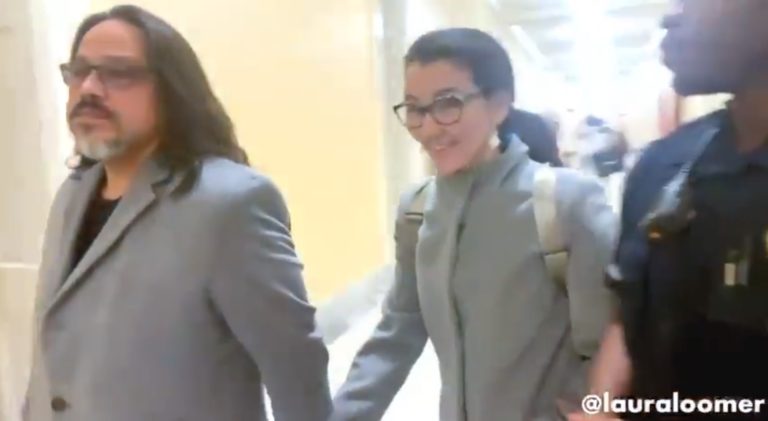
Video shows how the encounter went down. As Rep. Peltola was protectively led by her husband Gene down the hallway of the Cannon Office Building, where her office is located, and out to a waiting chauffeured vehicle, Loomer can be heard asking her questions, to which she smiled and ignored. Gene Peltola, dressed in a matching long gray jacket, kept a firm grasp on Mary Peltola’s arm and pulled her down the hallway, while two Capitol Police ran interference with the persistent Loomer.
Loomer is a former associate of Project Veritas, which is a group that specializes in getting the truth on tape with political figures. She ran for Congress for Florida’s 21st congressional district in the 2020, losing to Democrat Lois Frankel.
Gene Peltola, former Alaska regional director for the Bureau of Indian Affairs, left the BIA in July and set up Peltola Solutions LLC, through which he is said to be working on a new approach to the Ambler Road project to access a state mining district. It appears Gene Peltola is working as an unregistered lobbyist, while his wife is serving in Congress.
The video shows the encounter between Loomis and the Peltola’s:
MUST WATCH: Democrat, Native American AK Congresswoman @MaryPeltola who defeated @SarahPalinUSA via Rank Choice voting just called Capitol Police on me for asking her if she thinks @SpeakerMcCarthy & his family should be investigated for defrauding the Native American community! pic.twitter.com/aru7uq8JTL