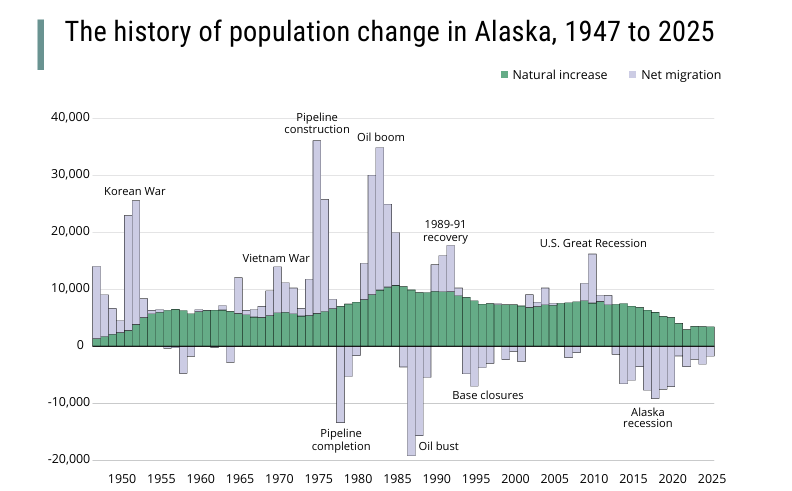
More people have left Alaska than have moved here for thirteen straight years. Before this run, the longest streak was four. The state’s own research chief, Dan Robinson, put it plainly: “This is not normal for us. It hasn’t happened before.”
It used to be the other way around. Alaska was the place people ran toward. For most of our history it was where young people came to start something, and the state kept refilling itself with ambitious people in their twenties. Then it flipped. By the late 2010s, even the twenty-somethings were leaving faster than they arrived.
I see it differently. This is what happens when a state asks young people to stay for a future that offers them too few ways to build a life and too little say in how it is written. A young person stays where there is work worth doing and a home within reach, and Alaska has the resources to offer both.
The economist Albert Hirschman saw the mechanism in 1970. When people can’t change an institution from the inside, the ones who care most tend to leave first. Alaska can break that pattern, and it can start now.
I know how open the doors are from experience. I have been the youngest person in a lot of rooms, and an opportunity was there every time I worked for it. I believe most of my generation would find one too, if they knew it was waiting.
Alaskans are turning out this fall. The August primary set a record for early voting, and nearly 12,000 people voted on the first day of early voting in October. Now imagine that energy carried by the youngest voters in the state. Elections here turn on thin margins. In recent years, Alaska House seats have come down to a dozen votes or fewer. One shift crew, one dorm floor, one group chat of twenty-year-olds who actually show up can decide who writes Alaska’s laws and who shapes its future. Politicians listen to the people who vote, and a state that builds the habit at eighteen will watch its priorities follow.
Alaska’s next golden age belongs to the generation willing to put itself forward, whether that means casting a first ballot, answering a call to serve, volunteering on a campaign, or filing for office.
Picture Alaska ten years from now. A 26-year-old from Nome helps decide how the state spends its resource money, and nobody in the room finds that remarkable. The graduating class in Fairbanks stays because the apprenticeships, the research jobs, and the chance to help shape the state are already here at home. The population line that has pointed down for thirteen years turns, and the story people tell about Alaska changes from the state that is losing its young to the state young people run toward again.
Here is how we get there. We step forward for the opportunities that shape Alaska’s future, and we earn them through preparation and hard work, not as a gesture. We make sure young Alaskans in every corner of the state know there is a place for them. And we use the openings that already exist, which are more than most people assume. Alaska is ready for a generation that decides to walk through, and nobody has to give us permission to begin.
The change Alaska has been waiting for is a state that keeps what it builds, where the people who live with the decisions are the ones making them. That change will not be handed down. It comes from a generation that starts with a ballot this November and keeps going: into the rooms, into public service, onto the ballot itself.
If you are under thirty and wondering whether this state has a place for you, it does. Alaska has spent years asking how to keep its young people. The better question is what it is asking us to build. Give us something worth building and a say in how it is built, and we will stay to build it.
Investing in the next generation of Alaskans is how Alaska’s conservative media endures. If you value honest, quality news and commentary from a conservative perspective, please consider supporting Must Read Alaska with a paid subscription: Click here to view our plans. God bless Alaska!
Early voting for 2026 general election is underway. Do your part— go vote today! All MRAK web content published until the end of election day won’t require a subscription to access. After election day, most web content is still FREE but requires a registered account.