Home Blog Page 754

Silicon Valley Bank, nation’s 18th largest, shut down

Silicon Valley Bank, the prestigious venture capital bank for Big Tech and biotech growth companies, has been closed by federal and state banking regulators.

The California Department of Financial Protection and Innovation closed down the bank on Friday, according to the Federal Deposit Insurance Corporation.

It was a classic bank run. Account holders had started pulling their money out, and the bank didn’t have the liquidity to cover all the withdrawals.

Silicon Valley Bank came to Alaska in 2019, with a group of cleantech investors and entrepreneurs to get to know the state as an investment opportunity, and to learn more about the startup tech group called Launch Alaska. The bank wrote about Alaska as an investment opportunity at its website.

FDIC said on Friday that insured deposits will be accessible no later than Monday morning, when the bank will reopen under federal control. The standard insurance from FDIC covers up to $250,000 per depositor, per bank. But SVB has massive accounts worth millions that belong to venture capital investors. Many of these accounts are greater than the insured ceiling.

It’s a crisis caused, in part, by the Federal Reserve, which is the most powerful economic institution in the world. The Fed has raised interest rates so high that investors and companies are taking money out of banks accounts and putting them into higher-yield U.S. Treasuries and T bills.

The collapse of SVB is a reminder of what happened during and after the real estate bubble of 2007-2010, when the five largest U.S. investment banks, with combined liabilities or debts of $4 trillion, either went bankrupt or were taken over by other institutions. Some of the largest were bailed out by the U.S. government. For example, Lehman Brothers went bankrupt, while Goldman Sachs and Morgan Stanley were bailed out. Washington Mutual Savings and Loan became largest bank failure in U.S. history; it had $188.3 billion in deposits when it collapsed.

Silicon Valley Bank has assets of $212 billion and market capitalization of $26.65 billion.

Silicon Valley Bank is also one of the banks used by FTX, the crytocurrency exchange run by the now-indicted Sam Bankman-Fried.

The statement from FDIC today, in its entirety:

 Silicon Valley Bank, Santa Clara, California, was closed today by the California Department of Financial Protection and Innovation, which appointed the Federal Deposit Insurance Corporation (FDIC) as receiver. To protect insured depositors, the FDIC created the Deposit Insurance National Bank of Santa Clara (DINB). At the time of closing, the FDIC as receiver immediately transferred to the DINB all insured deposits of Silicon Valley Bank. 

All insured depositors will have full access to their insured deposits no later than Monday morning, March 13, 2023. The FDIC will pay uninsured depositors an advance dividend within the next week. Uninsured depositors will receive a receivership certificate for the remaining amount of their uninsured funds. As the FDIC sells the assets of Silicon Valley Bank, future dividend payments may be made to uninsured depositors.

Silicon Valley Bank had 17 branches in California and Massachusetts. The main office and all branches of Silicon Valley Bank will reopen on Monday, March 13, 2023. The DINB will maintain Silicon Valley Bank’s normal business hours. Banking activities will resume no later than Monday, March 13, including on-line banking and other services. Silicon Valley Bank’s official checks will continue to clear. Under the Federal Deposit Insurance Act, the FDIC may create a DINB to ensure that customers have continued access to their insured funds.

As of December 31, 2022, Silicon Valley Bank had approximately $209.0 billion in total assets and about $175.4 billion in total deposits. At the time of closing, the amount of deposits in excess of the insurance limits was undetermined. The amount of uninsured deposits will be determined once the FDIC obtains additional information from the bank and customers.

Customers with accounts in excess of $250,000 should contact the FDIC toll-free at 1-866-799-0959.

The FDIC as receiver will retain all the assets from Silicon Valley Bank for later disposition. Loan customers should continue to make their payments as usual.

Silicon Valley Bank is the first FDIC-insured institution to fail this year. The last FDIC-insured institution to close was Almena State Bank, Almena, Kansas, on October 23, 2020.


Peltola votes to put water on private land under EPA control

In a vote on the House floor on Thursday, Rep. Mary Peltola continued her war on Alaska’s economy and private property owners of America.

The vote was to disapprove the Biden Administration declaration that all waters in United States fall under the control of government. Ponds in farm fields. Rain that drains into streams that drain into rivers. All water on Native Corporation land in Alaska would be impacted. Peltola voted to keep the Biden rule intact.

The rule Peltola voted to preserve sounds complicated because it is complicated. Simply put, Biden Administration has revised the definition of “Waters of the United States” to include nearly all waters.

The vote in the U.S. House on Thursday was to disapprove that rule, and it went 227 to disapprove, and 198 to not disapprove, with 9 not voting. Peltola voted with the Democrats to not cancel the rule and to therefore put all waters under federal authority, something that the State of Alaska has fought for years.

How much water the federal government would take under this rule would be up to interpretation by the Environmental Protection Agency and the courts, and would change year after year, through litigation.

“When upstream waters significantly affect the integrity of waters for which the Federal interest is indisputable—the traditional navigable waters, the territorial seas, and interstate waters—this rule ensures that Clean Water Act programs apply to protect those paragraph (a)(1) waters by including such upstream waters within the scope of the ‘waters of the United States.’ Where waters do not significantly affect the integrity of waters for which the Federal interest is indisputable, this rule leaves regulation exclusively to the Tribes and States. Additionally, it is important to note that the fact that a water is one of the “waters of the United States” does not mean that no activity can occur in that water; rather, it means that activities must comply with the Clean Water Act’s permitting programs, and those programs include numerous statutory exemptions and regulatory exclusions.

Essentially, what happened when the Clean Water Act was applied to State of Alaska-owned land at the Pebble deposit in Western Alaska will now be applied to all private land in the United States, including places like private land in Texas, where oil and gas leases occur on land that is occasionally prone to flooding.

House Joint Resolution 27, sponsored by Missouri Rep. Sam Graves, must now pass the Senate, and then must be signed by the president. It is likely to pass the Senate, because Sen. Joe Manchin of West Virginia is not amused by the federal overreach, but that vote will depend on whether Republican Sen. Mitch McConnell returns from the hospital, where he has been treated for a fall, and whether Democrat Sen. John Fetterman returns from psychiatric care at Walter Reed National Military Medical Center, where he is being treated for depression.

In any case, President Joe Biden is likely to veto it when it comes to his desk.

In December, when the rule was announced, Sen. Dan Sullivan blasted the Biden Administration:

“The Biden administration today announced its ‘final’ Waters of the United States (WOTUS) Rule, resuscitating the burdensome and overreaching Obama-era ‘final’ interpretation of the Clean Water Act and giving the EPA vast authority over lands across the country, particularly in Alaska, which has more wetlands than any other state in the country by far,” Sullivan said in December. “Remarkably, the Biden administration refused to pause issuing this WOTUS Rule just a few months until the Supreme Court rules in a case (Sackett vs. EPA II) that will determine the scope of the agency’s authority under the Clean Water Act. As a result, millions of hard-working Americans and Alaskans are left in regulatory limbo.”

“Under this rule, land owners face the potential for thousands of dollars in litigation and months of bureaucratic back-and-forth just to fill a ditch or build a structure on their own property. This rule abandons the balanced, bipartisan and statutorily-based implementation of the Clean Water Act that we had achieved working with the Trump administration, through multiple court victories, and through multiple field hearings I chaired as a member of the Environment and Public Works Committee—including in Alaska.

“The truth is, all Americans want clean water, and we have some of the country’s cleanest water right here in Alaska. But the federal government should not take authority from states and run rough shod over the law, good-paying jobs, and our economy—which is on the verge of a recession—to achieve that goal. I will do everything I can to fight this illegal federal power grab, and I look forward to the Supreme Court once again reining in this out-of-control federal agency.”

It’s the third change in 10 years to the definition of WOTUS, even as a landmark decision from the U.S. Supreme Court is expected within weeks, which could require another significant revision and further regulatory changes, the groups noted. December’s announcement contains literally thousands of pages of documents, which Alaskans have worked to understand.

Last year, trade groups in Alaska also voiced their criticism of the Biden Administration’s return to draconian water rules.

The Alaska Chamber, the Associated General Contractors of Alaska, the Alaska Oil and Gas Association, the Alaska Miners Association, the Alaska Support Industry Alliance, the Council of Alaska Producers, and the Resource Development Council for Alaska expressed dismay at the newest WOTUS Rule.

“RDC is disappointed to see this massive final rule released on the last business day of the year,” said Leila Kimbrell, Resource Development Council for Alaska’s executive director in December. “While we are still in the process of reviewing the hundreds of pages of the new final rule, we have significant concerns over our initial assessment that this rule unnecessarily expands federal jurisdiction over state waters and brings further uncertainty to federal permitting requirements.  The definition of WOTUS is of utmost importance to RDC and its membership because Alaska is uniquely vulnerable when it comes to EPA regulation and federal overreach.  This new rule will result in disproportionate impacts to Alaska and RDC’s members, from oil and gas, to maritime, fishing, tourism, timber, as well as Alaska Native corporations, and rural communities.  While we continue to review the final document released today, RDC is committed to working with our federal and state partners to ensure a workable solution for Alaska’s unique needs.” 

EPA prepares to undo Trump-era part of Clean Water Act, add back road ditches to federal wetland oversight

Peltola at risk in 2024, added to ‘rescue’ list for Democrats

Rep. Mary Peltola is considered to be at risk for the 2024 election cycle, so the Democrat Congressional Campaign Committee has put her on a list for special attention, and a lot of money. The list is known as the DCCC Frontline program to help Democrat incumbents in competitive seats. The committee will make sure these incumbents, who are now in the minority in Congress, have the campaign funds they need to retain their seats.

The Democrats are already working hard to save Peltola, placing two glowing stories in one week about her in the Politico online publication that is focused on national politics. They will use their prodigious fundraising machine Act Blue to raise millions in small-donor contributions from across the country. Peltola ended 2022 with over $691,000 cash on hand to seed the ground for her 2024 campaign.

The DCCC has set up a page devoted to Peltola on its website and has provided a link where people can donate to her. In its description of Alaska’s lone representative, it reminds people that Peltola spent over $7 million to win the seat in a state where former President Donald Trump won by 10 points in 2020.

“Mary has already accomplished so much for Alaskans. She has introduced eight bills already, one being The Food Security for all Veterans Act that was passed out of the House in her first three weeks in office. The Cook Political Report has labeled this district as “Lean Democrat,” but the GOP isn’t giving up just yet. Trump won this state by 10 points in 2020, and the GOP is eager to take back this longtime Republican stronghold. In 2022, Mary spent over $7 million to win this seat. We must ensure Rep. Peltola has the resources needed to keep AK-AL blue,” the DCCC said.

During the 2024 election cycle, there are 29 incumbent members that made the at-risk-seats Frontline list:

2024 Frontline Members: 

  • Mary Peltola (AK-AL)
  • Mike Levin (CA-49)
  • Yadira Caraveo (CO-08)
  • Jahana Hayes (CT-05)
  • Nikki Budzinski (IL-13)
  • Eric Sorensen (IL-17)
  • Frank Mrvan (IN-01)
  • Sharice Davids (KS-03)
  • Jared Golden (ME-02)
  • Hillary Scholten (MI-03)
  • Dan Kildee (MI-08)
  • Angie Craig (MN-02)
  • Don Davis (NC-01)
  • Wiley Nickel (NC-13)
  • Chris Pappas (NH-01)
  • Gabriel Vasquez (NM-02)
  • Susie Lee (NV-03)
  • Steven Horsford (NV-04)
  • Pat Ryan (NY-18)
  • Greg Landsman (OH-01)
  • Marcy Kaptur (OH-09)
  • Emilia Sykes (OH-13)
  • Andrea Salinas (OR-06)
  • Susan Wild (PA-07)
  • Matt Cartwright (PA-08)
  • Chris Deluzio (PA-17)
  • Abigail Spanberger (VA-07)
  • Marie Gluesenkamp Perez (WA-03)
  • Kim Schrier (WA-08)

Are you ready for ‘Spring ahead’? Daylight Saving Time heralds longer days to come

By DAN FAGAN

Ask Alaskans which is worse during the long winter: The cold or the dark? Most would say it’s the seemingly never-ending darkness. 

Daylight Saving Time, which begins Sunday at 2 a.m., won’t bring more daylight. But it will make evening light longer.

Daylight Saving Time runs between this weekend and the first Sunday in November. 

Standard Time runs between November and the second Sunday in March. 

A Monmouth University poll last year found 44 percent of those asked favor Daylight Saving Time while only 13 percent preferred Standard Time. Most Americans prefer more light in the evenings than mornings. 

Sixty-one percent of responders favored ending the twice-annual clock changes. In other words, they said, pick a time and go with it. 

The sun will set at 6:51 p.m. on Saturday in Anchorage. On Sunday, after adjusting clocks, it sets at 7:53 p.m.

The time change, along with a gain of five minutes and 44 seconds of daylight per day at this time of year, means more fun outdoors with more light. 

By the end of March, the sun won’t set in Anchorage until 8:42 p.m., extending evening daylight by two hours over sunset this Saturday. 

On June 21, summer solstice, the sun will set in Anchorage at 11:42 p.m., a far cry from the 6:51 p.m. sunset this Saturday. 

State Rep. Dan Ortiz, an independent from Ketchikan who caucuses with the Democrats, has introduced a bill this legislative session calling for year long Daylight Saving Time in Alaska. No more Standard Time and no more changing clocks. 

“Daylight Saving Time works better for tourism and the people of my district,” Ortiz told Must Read Alaska. “It also gives us   more daylight at the end of the school day.“  

Members of Alaska’s tourism industry have testified before the legislature that changing to Daylight Saving Time all year would boost the economy giving visitors more time in the evening to stay out and spend money. 

Ortiz says he believes other Western states are also looking to move to yearlong Daylight Saving Time. He says if his bill passes it will not disrupt trade or communication.

Ortiz’s bill only changes Alaska to yearlong Daylight Savings Time if the federal government acts first. 

Sen. Marco Rubio, a Republican from Florida, has introduced the Sunshine Protection Act of 2023, federally ending the need to change clocks twice a year. 

“This ritual of changing time twice a year is stupid,” says Rubio. “Locking the clock has overwhelming bipartisan and popular support. This Congress, I hope that we can finally get this done.”  

Hawaii and Arizona (except for the Navajo Nation) are currently the only two states on Standard Time all year. 

In the past four years, 19 states passed laws to permanently switch to Daylight Saving Time. But currently Congress must first approve any state’s wish to change to Daylight Savings Time all year.   

For Republican Sen. Rand Paul from Kentucky, Rubio’s bill is a states’ rights issue.  

“The sunshine protection act will allow states the freedom to decide if they want to permanently follow daylight savings time. without needing approval from Congress,” said Sen. Paul. “I’m glad to join Sen. Rubio in introducing this commonsense legislation.”

Last year, the U.S. Senate unanimously passed Rubio’s Sunshine Protection Act legislation, but it died in the House. Then, House Speaker Nancy Pelosi, a California Democrat, refused to allow a vote on the floor for the legislation, despite its bipartisan popularity. 

With Republicans now controlling the House, Rubio’s bill may have a chance of passing this year. 

Alaska has been doing the time swap for over 80 years, as it first began observing Daylight Saving Time in 1942. 

Many Alaskans dread that first Sunday in November, a season when daylight is already in short supply, and darkness comes earlier and earlier with each passing day. During the month of November, Anchorage typically loses more than five minutes of daylight a day. Then, it seems out of nowhere, the darkness advances like a tidal wave. On one Saturday, the sun goes down at 5:49 p.m. The time changes overnight Sunday, and darkness falls as early as 4:47 p.m.

By the time winter Solstice hits on Dec. 21, darkness descends on Anchorage as early as 3:42 p.m.  

Most Americans experience the mostly unwelcome advancement of evening darkness but with Alaska’s long, dark winters, the change is all the more pronounced.

Dan Fagan is a reporter for Must Read Alaska. Email tips at [email protected].

Ask MRAK: Whatever happened to ‘Westchester Goon’?

Dear MRAK, Where did Westchester Goon, the vicious Twitter political pundit, go? He’s not on Twitter anymore and his account is erased. Signed, Sorry to See Him Go

Dear Sorry,

We’re glad you asked. In fact, the question came first from former reporter/editor/photographer and itinerate political junkie Matt Tunseth who wondered aloud on Twitter as to where the prolific Twitter troll who goes by the name of “Westchester Goon” went suddenly last week.

Mr. Goon’s page on Twitter went dark. His troll friends miss him and were worried for his well being.

Never fear. We found him. His name is Barry Piser and for the past couple of years he has been sending snarling invectives, nastygrams, and snide vilification about Alaska conservatives.

We have the receipts to show that Piser has been sending hundreds of these unpleasant Twitter messages about people like Mayor Dave Bronson, his staff, and others in the political sphere. And it appears from the time stamps that he has been doing so from his desk at Chugach Electric, where he works for Julie Hasquet, the communications director, former spokeswoman for Sen. Mark Begich.

Evidently word got back to Hasquet that Piser had been “outed” and his identity was now known to a few caring folks. This is a very poor look for Chugach Electric to have a political operative pounding away on the keyboard while billing his hours to Anchorage ratepayers. It’s especially unfortunate that the board of Anchorage’s only electric company has a special meeting set for Friday — about unrelated personnel matters.

Piser’s Twitter account went “poof,” erased overnight last week.

That means the troll tribe will no longer see his well-designed fake news releases using Municipal letterhead that looked very real, and posting them accompanied by breathless commentary, such as this:

One of many elaborate Twitter pranks by Barry Piser aka Winchester Goon, which have landed him in hot water.

Piser not only has the aka of “Westchester Goon,” a pun on Westchester Lagoon, the body of water near his home in Anchorage, but he also has gone by another handle, “@bpfromnp,” meaning Barry Piser from North Pole, one of his hometowns.

We are in possession of dozens upon dozens of his tweets, many of which are quite elaborate and all of which appear to be posted during working hours, raising the question of what exactly are Chugach Electric Cooperative ratepayers getting for their money. Here is a slideshow of just a few:

Piser-Goon’s followers on Twitter include the entire press corps in Alaska, including the editor of the Anchorage Daily News and the reporting staff, most of the bloggers and other media personalities, such as Nat Herz, Liz Ruskin, Matt Buxton, as well as hundreds of leftists in the political realm on Alaska: Assemblyman Chris Constant, Assemblyman Daniel Volland, Assemblywoman Austin Quinn-Davidson, Rep. Andrew Gray, Rep. Maxine Dilbert, Sen. Forrest Dunbar, Jason Grenn of Ballot Measure 2, the Blue Alaskan (Matt Beck), 907 Initiative, the Alaska Center for the Environment and more on the list of more than 700 who have consumed Piser-Goon’s attacks on the mayor and his staff.

Goon used to work for the municipality as a public information officer for the Health Department, but now he’s parked at the power company, working for Hasquet, who can be none-too-happy that he has been discovered to be a political operative who is apparently not working on behalf of ratepayers, but on behalf of the Alaska Democratic Party. On the other hand, with her background, she may have been in on it all along. This is, after all, how the Deep State operates in 2023 — hand-in-hand with the media.

But a word to Piser — you should not only have erased your Twitter account, but also your Amazon wish list … Spicy!

Signed,

MRAK Cares

Girdwood, Whittier 911 calls will be routed to Sitka police dispatcher

Outsourcing is getting further out there. The communities of Girdwood and Whittier will now have their 911 calls routed to a dispatcher 600 miles away at the Sitka Police Department, which was awarded a contract to provide dispatch services for the next two years.

The Sitka Police Department says that the additional funds from the contract will help the agency attract and retain dispatchers. Currently, the department is recruiting for a dispatcher, and the wage starts at $22.50-$24.60 per hour with full government benefits.

In 2022 the Sitka Dispatchers answered a total of 25,495 phone calls and 2,921 of those calls were 911 emergencies, the department said. Dispatchers ended up spending a total of over 552 hours on the phone providing customer service to our community.

Whitter is a town of 273 people, according to the most recent census, and provides police response to Girdwood, which is within the greater municipality of Anchorage. Girdwood’s population is about 2,029.

The Anchorage Police Department was unable to expand to provide service to the Girdwood community due to staffing shortages. Anchorage police are paid by the Anchorage Police Service Area taxpayers, and Girdwood is outside that zone, which has a boundary at McHugh Creek. An Alaska State Trooper station was located in Girdwood for several years but was closed by former Gov. Bill Walker in 2016. Whittier was awarded a three-year contract in 2016 to provide policing services to Girdwood.

Biden’s grow-government budget: $6.8 trillion in federal spending, and a $5 trillion tax increase on businesses

President Joe Biden is tearing a page from Rep. Alexandra Ocasio-Cortez’s “Tax the Rich” playbook in his newly proposed budget, which includes $5 trillion in tax increases on on American businesses and individuals, and a total of $6.8 trillion in government spending for one year.

The budget proposal in its current form has little chance of passing the House, which is controlled by Republicans looking for ways to rein in the federal debt.

The new taxes on wealth and corporations would be used to create even more new programs for the poor and to shore up Medicare, which is an increasing burden on the federal budget. Biden said that his budget would reduce deficits by $3 trillion over 10 years, although that is an unproven claim.

The taxes don’t just stop at the corporate door. Taxes will show up in the most unexpected places. There even would be a new 30% tax on electricity used in cryptocurrency mining. The White House wants to make cryptocurrency unprofitable, and taxing it appears to be the easiest way, although the cover story is that crypto trading is using too much energy.

He also is asking Congress to approve $3 billion to help poor countries mitigate effects of climate change.

Mr. Biden will give a speech on his budget at 2:30 p.m. (10:30 a.m. Alaska time) in Philadelphia. Earlier this week he signaled that he would be going after the rich in his new budget, the third of his presidency.

Today, the national debt stands at $31.6 trillion, and it appears that Biden is not serious about reducing the debt crisis.

International Women of Courage Award goes to biological male

First Lady Jill Biden and Secretary of State Antony Blinken presented a biological male who is transgender an award created for women, during a ceremony recognizing International Women’s Day, which was March 8.

The annual International Women of Courage Awards ceremony at the White House recognized “11 extraordinary women from around the world who are working to build a brighter future for all,” according to the State Department’s press release.

Among those recognized was Alba Rueda, Argentina’s current special envoy for sexual orientation and gender identity in the Ministry of Foreign Affairs, International Trade and Worship.

Rueda, who was born male, was the first Argentine undersecretary for diversity policies in the newly created Ministry of Women, Gender, and Diversity. 

“Ms. Rueda was the driving force behind Argentina’s executive order on the transgender labor quota in the public sector which was converted into the Transgender Labor Quota Act,” the State Department wrote, applauding transgender quotas in the workplace.

“She previously worked in the Ministry of Justice and Human Rights in their National Institute against Discrimination, Xenophobia and Racism (INADI) as well as the Argentine Secretariat for Human Rights.  She is one of the founders of Argentina Trans Women (MTA) and actively engages with Notitrans, the first transgender magazine in Argentina. 

“She actively campaigned to change the name of the National Women’s Conference to the ‘Plurinational Conference of Women and Lesbian, Cross-Dresser, Transgender, Bisexual, Intersex and Non-Binary Persons’ to include diverse, dissident, and racialized identities,” said the State Department.

“Her activism led her to fight for the Marriage Equality Act, the Gender Identity Act, and the Diana Sacayán and Lohana Berkins Act on the Promotion of Access to Formal Employment by Cross-Dresser, Transsexual and Transgender Persons.  Her hope is to establish an LGBTQI+ foreign policy agenda and mainstream it into the various negotiation fora, including into multilateral fora and bilateral relations as well as represent the Global South,” the description said.

Rueda was described by the emcee of the ceremony as a “transgender woman who was kicked out of classrooms, barred for sitting for exams, refused job opportunities, subjected to violence, and rejected by her family. But in the face of these challenges, she worked to end violence and discrimination against the LGBTQ plus community in Argentina.” 

Others recognized for the award this year were women such as Professor Danièle Darlan, who is the former president of the Central African Republic’s Constitutional Court and who is her country’s most influential female public figure; Doris Ríos, an indigenous leader from Costa Rica working to improve indigenous lives; Meaza Mohammed, a veteran Ethiopian journalist, is the founder of Roha TV, an independent YouTube-based news and information channel; and Hadeel Abdel Aziz, a defender of Jordan’s most marginalized, including juveniles, refugees, migrants, and survivors of sexual and gender-based violence; and other women.

“Now in its 17th year, the Secretary of State’s IWOC Award recognizes women from around the globe who have demonstrated exceptional courage, strength, and leadership in advocating for peace, justice, human rights, gender equity and equality, and the empowerment of women and girls, in all their diversity – often at great personal risk and sacrifice.  Since March 2007, the Department of State has recognized more than 180 women from more than 80 countries with the IWOC Award. U.S. diplomatic missions overseas nominate one woman of courage from their respective host countries and finalists are selected and approved by senior Department officials.  Following the IWOC ceremony, the awardees will participate in an in-person International Visitor Leadership Program (IVLP) exchange to connect with American counterparts in cities across the United States and strengthen their global networks of women leaders,” the State Department said.

Governor takes a swipe at Anchorage Daily News over persistently biased reporting; reporters snap back

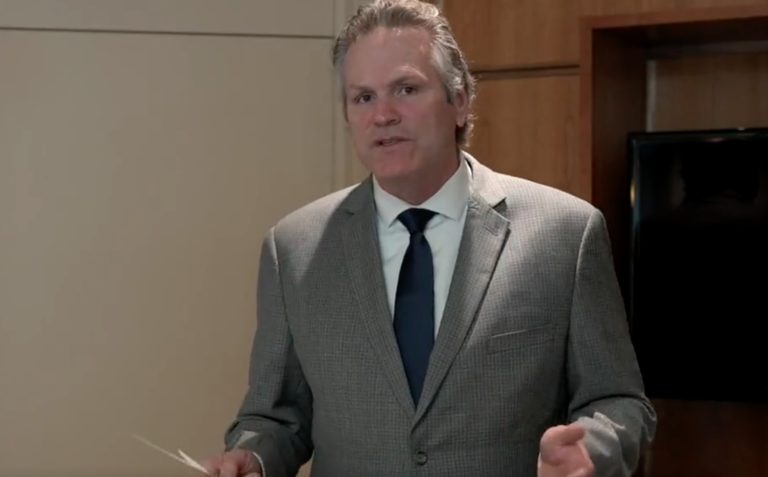
Gov. Mike Dunleavy is hitting back at fake-news the Anchorage Daily News. In a short video posted to Twitter on Wednesday, Dunleavy pointed out inaccurate items in the newspaper’s story about his parental rights bill.

House Bill 105 makes it clear that parents have rights over how their children are taught sex education.

In schools around the country, parents have been shocked to learn that their young children are being taught the specifics of things like how to have anal sex and even how to have sex with adults.

In one third-grade curriculum, children are taught, “You might feel like you’re a girl even if you have body parts that some people might tell you are ‘boy’ parts. And you might not feel like you’re a boy or a girl, but you’re a little bit of both. No matter how you feel, you’re perfectly normal.” Some parents may view this as gender identity training and would want to know if their third-graders are being indoctrinated.

Reports about teachers telling children that there are multiple gender identities have prompted widespread protest across the nation as parents flock to school boards to set their school officials straight.

Dunleavy encouraged people to read the bill he has authored for themselves, rather than through the filter of the newspaper, which painted the bill darkly.

The bill can be read at this link.

“Another example of fake news by the ADN. We introduced a bill yesterday on parental rights in education. And basically what the bill says is parents have the right to say yes or no to whether their child is going to receive instruction or be part of a program that touches upon the subject of sex or gender,” Dunleavy said.

“Here’s what the Anchorage Daily News says,” he continued. Then he read a sentence from the story the newspaper, which stated, “Gov. Mike Dunleavy on Tuesday introduced education policy proposals that would limit sexual education and the rights of gender non-conforming students in public schools.”

Dunleavy said, “This bill does nothing to limit the rights of anyone.”

Reporter Iris Samuels slapped back on Twitter, with a passive-aggressive response: “Thanks for reading our coverage, governor! Proud of the reporting we are doing at @adndotcom about this legislation and thankful to our readers who look to the ADN for fair journalism. Just like the governor say [sic]: read the bill (then judge our reporting for yourself).”

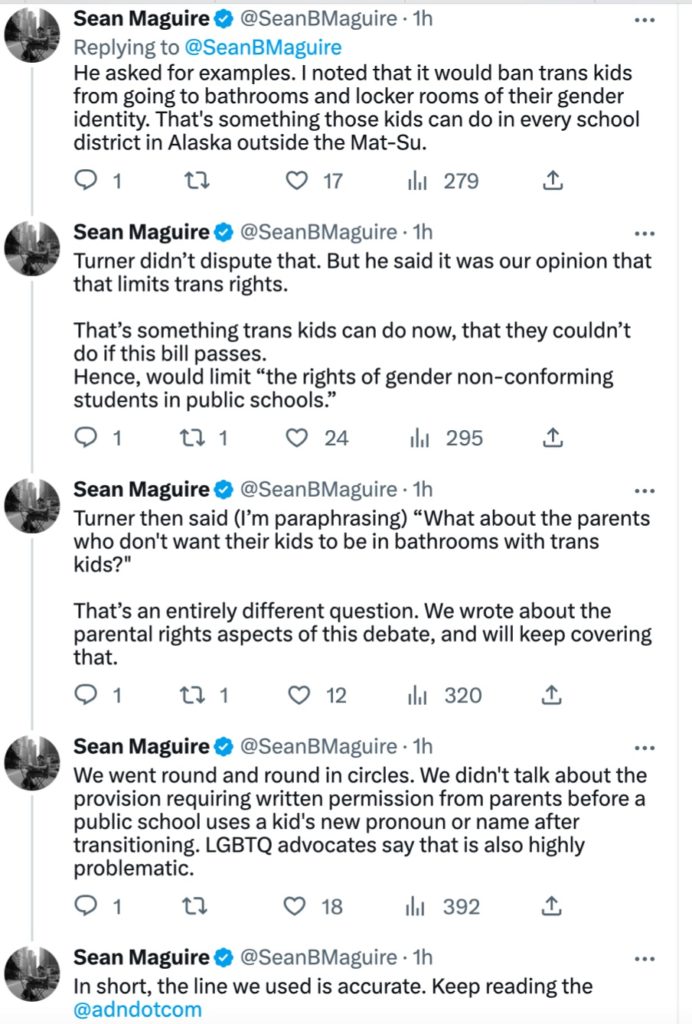
Reporter Sean Maguire for ADN also was defensive, summarizing a conversation he had with Dunleavy’s Press Secretary Jeff Turner:

The Anchorage Daily News is not the only liberal entity that has decided to take a hostile stance to the bill. The author of the ranked-choice voting system (Ballot Measure 2) now used in Alaska also had words of rebuke for the governor, and wrote that children are more likely to be abused at home because of the bill.

In a Twitter message, attorney Scott Kendall fantasized all manner of abuse that parents might inflict on children, should the bill pass.

The bill is unlikely to pass, of course, because the liberal-run Senate is going to bury it in a committee. Rep. Loki Gale (she/her), who chairs the Senate Education Committee, has said she will not allow the bill to even have a hearing.