Home Blog Page 714

Legislature confirms all of governor’s commissioner appointees

The Alaska State Legislature has confirmed all of Gov. Mike Dunleavy’s appointees to lead state departments.

In addition, Commissioner Jason Brune of the Department of Environmental Conservation was confirmed unanimously to be the Lt. Governor’s successor.

The confirmed commissioners are:

Commissioner Jen Winkelman, Department of Corrections

Commissioner Jen Winkelman started with the Department of Corrections in 2001. She has served as a Probation/Parole Officer in various capacities with the Division of Pretrial, Probation, and Parole (DP3) and the Division of Institutions in Fairbanks, Palmer, and Juneau. Most recently, she was the Director of DP3. Born and raised in Fairbanks, she has a bachelor’s degree in justice from the University of Alaska- Fairbanks. She previously served on the Fairbanks and Juneau reentry coalitions and the Interstate Commission for Adult Offender Supervision. She serves on the Governor’s Council for Homelessness and the Alaska Police Standards Council. 

Commissioner Heidi Hedberg, Department of Health

Commissioner Heidi Hedberg has been with the state since 2009, serving in various capacities within the Division of Public Health, Department of Health, and most recently, as the Director for the Division of Public Health. She holds a Bachelor of Science degree from Alaska Pacific University. She moved to the state in 1995 from Seattle, Washington. Prior to her state service, she worked with various non-profit organizations for twelve years. She also chairs the Governor’s Advisory Council on Opioid Remediation and serves on the Governor’s Council on Homelessness and State Emergency Response Commission.

Commissioner John Boyle, Department of Natural Resources

Commissioner John Boyle moved to Alaska in 2010 after graduating from law school to serve a judicial clerkship in Fairbanks. Following the conclusion of the clerkship, he moved to Utqiagvik to work as an Assistant Borough Attorney and later Chief Advisor to the Mayor and Director of the North Slope Borough’s Government and External Affairs department. In 2016 he moved to BP as their Director of Government Affairs before joining Oil Search (now Santos) as Government Affairs Manager. He earned a Juris Doctorate from J. Ruben Clark Law School at Brigham Young University and a Bachelor of Science in Management and Finance at Brigham Young University.

Commissioner Adam Crum, Department of Revenue

Prior to being appointed commissioner of the Department of Health & Social Services in 2018, Commissioner Adam Crum was executive vice president of his family’s company, Northern Industrial Training. Commissioner Crum is active in community service organizations and has served as a board member for groups like the Salvation Army and MyHouse, a group that works specifically with homeless youth. Both groups work with clients with mental health, substance use disorder, transitional housing, and workforce development issues. He has a bachelor’s degree in psychology from Northwestern University and a Master of Science in Public Health from Johns Hopkins University.

Commissioner Kim Kovol, Department of Family and Community Services

Commissioner Kim Kovol has over 25 years of experience in the private sector in executive leadership, management, operating licensed childcare facilities, organizational development, restructuring logistics, and working in the human and social services realm with youth and adults. Prior to being appointed commissioner, Commissioner Kovol was Special Assistant to Governor Dunleavy with a social services portfolio focusing on Domestic Violence, Sexual Assault, Missing and Murdered Indigenous Persons, Human and Sex Trafficking, Homelessness, Foster care, Early Childcare, Eldercare, Opioids / Fentanyl, and Suicide Prevention. Commissioner Kovol has a bachelor’s degree in liberal arts and studies (K-8 Education) from San Diego State University and a Master of Social Work from the University of Alaska Anchorage. 

Study: Alaska leads nation in traumatic brain injury deaths

Suicide, falls, violence, and snowmachines: A study of data gathered between 2016 and 2021 shows that Alaska has the highest traumatic brain injury-related death rate in the United States, surpassing the national average by more than double. The study was published by the State of Alaska’s Section of Epidemiology this week.

About 43% of all TBI-related deaths in Alaska were attributed to suicide, with young adults disproportionately affected.

Individuals between the ages of 25 and 34 experienced TBI-related mortality rates from suicide that were over three times the national average in 2019. Additionally, one in four deaths among individuals under the age of 30 were connected to TBIs.

Unintentional falls accounted for a significant proportion of traumatic brain injuries in Alaska, contributing to 39% of TBI-related emergency department visits between 2016 and 2021, and 44% of TBI-related hospitalizations from 2017 to 2021.

Among adults aged 15 to 34 years, motor vehicle crashes were the most common cause of both TBI-related emergency room visits and hospitalizations. Unintentional falls dominated as the primary mechanism of injury for emergency room visits among individuals 35 years and older, as well as for hospitalizations among those 45 years and above.

The study revealed several other demographic statistics:

  • The mortality rates were higher among those 85 years and older, and among males, American Indian/Alaska Native people, and those residing in the Northern Region of the state.
  • Patients hospitalized following a TBI in Alaska with evidence of intentional self-harm were over eight times more likely to succumb to their injuries than those with unintentional injuries.
  • Alaska Natives have a disproportionately higher rate of TBI-related mortality, with an age-adjusted rate exceeding three times the national average.
  • Rates of TBI attributable to assault were significantly higher among males, being 1.6 and 3.7 times higher than females for emergency visits and hospitalizations, respectively.
  • In terms of TBI-related hospitalizations, motor vehicle crashes took precedence in the Southwest and Northern regions, with all-terrain vehicle and snowmachine-related injuries accounting for a striking 39% of all TBI hospitalizations in the Northern region.

TBIs occur when individuals experience a bump, blow, or jolt to the head, or a penetrating head injury that disrupts normal brain function, ranging from mild to severe cases that can lead to prolonged unconsciousness, coma, or even death.

Ketchikan judge says ‘Creator’ statement can remain on Ketchikan school walls

A school district poster that promotes Native values that the district wants to instill in students does not violate the U.S. Constitution, a Ketchikan judge has ruled.

Two parents wanted the poster taken down from the walls of the Ketchikan Charter School because, among the values on the poster is “Reverence for Our Creator,” which pushes a religious perspective.

Students at the school are subject to a behavior modification program based on how well they expresse the Native values — values that were determined by Southeast Alaska Native leaders two decades ago.

The poster refers to things like having pride in clans, being strong, having courage, and being good stewards of the land and sea.

Judge Katherine Lybrand said that the parents, one of whom is a teacher at the school, didn’t convince her that “Reverence for Our Creator” is a religious statement. She added that even if the statement was religious, it didn’t force behavior on anyone.

“The mere display of the posters around the District’s schools does not foster excessive entanglement or coerce students to believe a certain thing (and in fact there was no testimony that any student has felt coerced in any way),” Lybrand wrote, and that the poster promoting values is “more akin to reciting the pledge of allegiance than the posting of the Ten Commandments because the poster as a whole demonstrates that its purpose is to promote place-based learning and cross-cultural understanding, not to promote a religious belief.”

Bill exempting electric bikes from motor vehicle regulations passes

The Alaska Senate passed House Bill 8 on Monday, which excerpts low-powered electric bikes from most state motor vehicle regulation. The bill had earlier passed the House. HB 8 specifies that bikes with electric motors generating less than 750 watts of power will not be subject to motorcycle regulations, and will be permitted on sidewalks and bike trails where motorized vehicles are not allowed.

Most ebikes stop providing electric assist while the rider is pedaling after the speed reaches 20 miles per hour, or 28 mph for what’s called a Class 3 bike.

The publication Bicycle Retailer and Industry News reported that ebike sales grew 300% in the past five years making them the fastest growing segment of the bicycle industry.

According to Precedence Research, the global e-bike market size was valued at $17.56 billion in 2021 and is expected to reach over $40.98 billion by 2030, poised to grow at a compound annual growth rate of 9.6% from 2021 to 2030.

The House bill was the brainchild of freshman legislator Rep. Ashley Carrick of Fairbanks, a member of the Democrat minority. The Republican majority has been supportive of several minority-authored bills like this one, and several Republicans signed on as cosponsors.

What was the winning time? Nenana River Classic tripod clock stopped

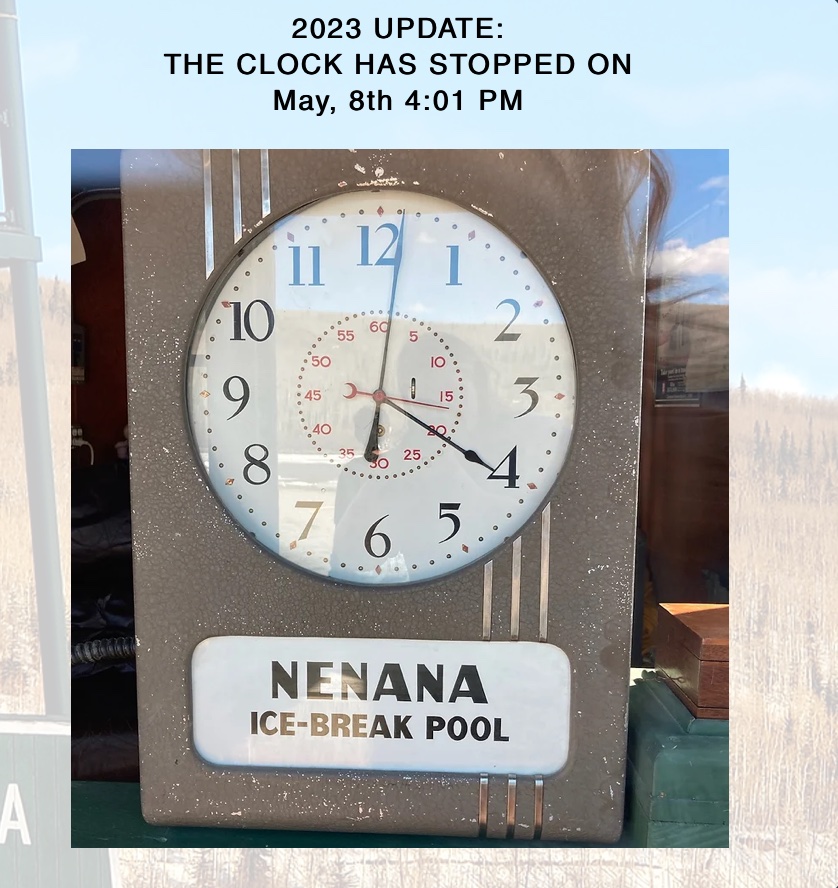
The alarm went off on the Nenana River tripod on May 8, and the clock stopped at 4:01.17 pm, marking the end of this year’s Nenana Ice Classic.

The Nenana Ice Classic is an annual ice pool contest held in Nenana, in which people buy tickets and guess the exact time the Tanana River ice will break up at Nenana.  The proceeds of the charitable gaming event go to nonprofit organizations.

The ice usually breaks up between April 20 and May 20, and as it flows downstream, it tips the tripod, which is tethered to a clock. When the clock stops, the winning time is set.

The Ice Classic is Alaska’s greatest guessing game, the organization says. “In 1917 a group of engineers surveying for the Alaska Railroad bet $800 putting in their guesses when the river would break up. This fun little guessing game has turned into an incredible tradition that has now continued for over 106 years!”

Find out more at Nenana Ice Classics.

Hunting discounts for nonresident students passes House

On Monday, the Alaska House passed House Bill 120, a significant achievement for freshman House Rep. Frank Tomaszewski, a Republican of Fairbanks. The bill introduces a new provision allowing non-resident students to obtain hunting, fishing, and trapping licenses at a discounted cost. This legislation maintains existing regulations and tag fees without any changes.

The bill passed with a vote of 36-4, with Republican Reps. David Eastman and Sarah Vance, and Democrat Reps. Sara Hannan and Andy Josephson voting no.

Over the past several decades, hunting and personal use fishing have experienced a decline, resulting in a reduction in funding for conservation efforts. To address this issue, various federal statutes such as the Pittman-Robertson Act, Dingell-Johnson Act, and Migratory Bird Hunting Stamp Act have tied conservation funding to excise taxes on items like firearms, ammunition, archery equipment, and fishing gear.

Subsequently, the revenue generated from these taxes is allocated to state fish and game departments to support vital conservation and management initiatives. Alaska, in its commitment to conservation, matches this funding through revenue derived from hunting and fishing licenses.

Rep. Tomaszewski emphasized the importance of fostering a love for hunting, fishing, and trapping among the younger generation to safeguard Alaska’s cultural heritage and conservation endeavors.

“We cannot overlook the direct connection between our hunters and our ability to conserve. Encouraging younger individuals to partake in these splendid outdoor activities is paramount,” he said.

By reducing the cost of licenses for non-resident students, the bill encourages their participation in these activities, especially considering the financial burdens already borne by many students due to college expenses.

The bill is now in the Senate for consideration.

Sen. Sullivan joins 42 senators saying ‘no’ to raising debt ceiling without spending cuts, budget reforms

Alaska U.S. Sen. Dan Sullivan is part of a group of 43 Republicans who put Senate Majority Leader Chuck Schumer on notice this weekend: They are committed to opposing raising the national debt ceiling without substantive spending and budget reforms. 

Sen. Lisa Murkowski did not sign the letter, and neither did Sen. Susan Collins of Maine, Sen. Mitt Romney of Utah, Sen. Rand Paul of Kentucky, Sen. John Kennedy of Louisiana, of Sen. Josh Hawley of Missouri.

As the national debt has soared since President Barack Obama took office, the U.S. Treasury Department has borrowed more money to pay for government spending. The curb on this borrowing is known as the legislative debt ceiling. The nation is at the point where the Treasury Department has spent the maximum amount authorized by Congress, and lawmakers must vote to suspend or raise the limit on borrowing.

“It is now clear that Senate Republicans aren’t going to bail out Biden and Schumer, they have to negotiate. I thank my colleagues for joining my effort to emphasize this point in the clearest possible terms,” said Sen. Mike Lee of Utah, who led the group.

The nation’s economy is in free fall due to unsustainable fiscal policies, the group’s letter said. The total national debt stands at over $31.7 trillion. In fact, the U.S. government has averaged nearly $1 trillion in deficit spending every year since 2001.

“This trajectory must be addressed with fiscal reforms. Moreover, recent Treasury projections have reinforced the urgency of addressing the debt ceiling. The House has taken a responsible first step in coming to the table with their proposals. It is imperative that the president now do the same.

“As such, we will not be voting for cloture on any bill that raises the debt ceiling without substantive spending and budget reforms,” the letter concluded.

The letter is signed by Senators Mike Lee, John Barrasso, Marsha Blackburn, John Boozman, Mike Braun, Ted Budd, Shelley Moore Capito, Bill Cassidy, Katie Britt, John Cornyn, Tom Cotton, Mike Crapo, Ted Cruz, Kevin Cramer, Steve Daines, Joni Ernst, Deb Fischer, Lindsey Graham, Chuck Grassley, Bill Hagerty, John Hoeven, Cindy Hyde-Smith, Ron Johnson, James Lankford, Cynthia Lummis, Roger Marshall, Mitch McConnell, Jerry Moran, Markwayne Mullin, Pete Ricketts, James Risch, Marco Rubio, Mike Rounds, Tim Scott, Rick Scott, Eric Schmitt, Dan Sullivan, John Thune, Thom Tillis, Tommy Tuberville, J.D. Vance, Roger Wicker, and Todd Young.

Sen. Chuck Schumer, majority leader, said the Senate might consider a bill that only raises the debt ceiling but does not address the demands of these Republicans. With a 51-49 majority in the Senate, Schumer needs nine Republicans to get to the 60-vote threshold to raise the ceiling.

At this point, he probably cannot count on all of the six who did not sign the letter but who are fiscal hawks, such as Sen. Paul, Sen. Kennedy, and Sen. Hawley. He may be able to count on Sens. Murkowski, Romney, and Collins, who often side with Democrats, but they would not be enough to raise the national debt.

Read up on deficit spending at this Treasury Department guide.

Peltola searching for a fundraiser

Rep. Mary Peltola is advertising for a fundraising associate, to be located in Washington, D.C., with opportunity to travel.

During her first quarter of fundraising for reelection, Peltola spent far more than she brought in. She raised $369,000 in the first quarter, spent more than $579,000 in the same time period, and a significant amount of the spending was on fundraising. She ended the quarter had $483,556 cash on hand, a 30% decrease over what she started with in January.

Peltola and her chief of staff, who was her former campaign manager, were spotted in Palm Springs, Calif. over the weekend; the well-heeled community is a fundraising destination for many politicians from both sides of the aisle.

According to the job description in Society of Financial Service Professionals, the successful applicant will:

  • Schedule regular call time sessions required to meet stated fundraising goals
  • Staff and support candidate during scheduled call time sessions by taking notes and conducting donor research as needed
  • Conduct pledge follow-up with donors, including timely emails, letters, and calls
  • Maintain integrity of donor database by accurately recording all notes, follow ups, and other donor information in NGP
  • Other fundraising duties as assigned to support event, email, and political fundraising programs.
  • Plan, manage, and recruit for small and large-scale fundraising events and build fundraising swings for the candidate
  • Provide regular, accurate, and timely projections to the campaign leadership for events and meetings
  • Maintain a working knowledge of donors and institutions engaged, identifying new potential funding partners and opportunities to collaborate with existing partners in new ways
  • Build and maintain relationships with donors and potential donors
  • Provide the necessary information and preparation for the candidate to maintain relationships with major donors, institutional partners, and allies
  • Manage and staff call time when needed
  • Staff events and finance meetings

Qualifications and Requirements

  • Must be willing to be located in Washington DC, this work can not be done remotely
  • Must have access to a laptop, smartphone, and driver’s license- access to a car is beneficial
  • Experience building and executing fundraising events of all sizes
  • Knowledge of campaign finance laws
  • Political strategy/acumen
  • Relationship cultivation and management
  • Flexibility to work outside normal business hours that include evenings and weekends, and work extended hours to accomplish the requirements of the position
  • Excellent and persuasive written, verbal, and public presentation skills
  • 3+ cycles of working experience in political fundraising
  • Alaska experience preferred
  • Knowledge of NGP, ActBlue
  • Willingness to travel

Tlingit & Haida Central Council leaves AFN

The Central Council of the Tlingit & Haida Indian Tribes of Alaska voted May 1 to leave Alaska Federation of Natives. The announcement was made May 8.

Tlingit & Haida is the largest federally recognized tribe in Alaska with more than 35,000 tribal citizens and has been a long-standing member of AFN, which was formed in 1966 and holds a mission to enhance and promote the cultural, economic and political voice of the entire Alaska Native community. 

Over the course of the past nine years, Tlingit & Haida President Richard Chalyee Éesh Peterson and the Executive Council have been working toward strengthening the Tribe’s sovereignty through economic development initiatives and building the infrastructure for advancing the Tribe’s priorities.

Below are statements from Peterson and other Executive Council members:

“We are working every day toward strengthening our sovereignty and preserving our way of life for generations to come. It has always been in the best interest of the Tribe to directly promote, advance and advocate for our people and communities, and we have positioned the Tribe and strategically built our capacity to do just that. The truth of the matter is our Executive Council has diverse areas of expertise and this has been a true strength in the governance of our Tribe. We have also built up a Governmental Affairs team that supports our work on important legislation, federal/state tribal issues, budget priorities, and funding opportunities. We will continue to collaborate with AFN where it is needed,” said President Peterson.

“The Alaska Federation of Natives has a long history of providing advocacy and they will continue to provide a forum for Alaska Native people. Tlingit & Haida will remain engaged in Alaska Native policy conversations nationally, across our State and within our region. We will continue to provide direct advocacy and advancing the goals and interests of Tlingit & Haida, our tribal citizens, and our communities,” said First Vice President Jacqueline Pata.   

“From protecting our lands, waters, and way of life, to advocating on behalf of our communities and for the need for wellness, healing, protection and support for our tribal citizens and families, we’ve carved our own path and know the solutions that are needed. It is critical we do the work every day exercising our sovereignty, and to be intentional and focused to elevate the voice of our Tribe and represent our people we serve,” said Second Vice President Rob Sanderson Jr. 

“No one knows the needs of our region, communities and people better than we do. We will continue to protect our way of life, exercise our inherent sovereignty and jurisdiction through self-government and self-determination, and promote the dignity and welfare of our tribal citizens,” said Third Vice President Catherine Edwards. 

“Tlingit & Haida has supported AFN from its inception and will continue to support the common interests of AFN member Alaska tribal governments and ANCSCA [Alaska Native Claims Settlement Act] corporations. Today, Tlingit & Haida makes clear we directly express our inherent sovereign powers and collaborate with other governments and entities,” said Fourth Vice President Will Micklin.

“Tlingit & Haida has seen tremendous growth. With a focus on economic sovereignty and the well-being of our tribal citizens, this growth has been very intentional as the Tribe’s policy priorities continue to grow and move forward. President Peterson has established strong relations within the federal government and, through our Executive Council’s advocacy at every level, we are strengthening our sovereignty every day. This all has a greater impact than relying on anyone else to do the work for us. We have the inherent right to self-govern and that is what we will continue to lean on,” said Fifth Vice President Clinton Cook Sr.

In 2019, two of the large ANSCA regional corporations — Arctic Slope Regional Corp. and Doyon — also left. But Doyon kept its reasons quiet until last week.

“Doyon’s decision to withdraw from AFN was made by the Doyon Board of Directors after significant deliberation and after a long history of sharing our concerns with AFN leadership.  Doyon engaged with AFN for over a decade, sharing our concerns and advocating for continued improvement in the AFN organization, decision-making, and services provided to its members; these requests were all made well prior to the decision to withdraw,” Doyon said in a statement that was released eight days ago.

“In the years following the 2012 reform effort at AFN, Doyon recognized that AFN reform efforts needed to continue.  AFN still needs to complete the work outlined by AFN Resolution 09-05, including a review of the AFN resolutions process. The needed work on conflict resolution among various Native constituents was highlighted at the 2022 AFN Convention when a proposed resolution addressing subsistence fish declines on the Yukon River was met with impasse and conflict,” Doyon said.

“Doyon remains engaged in Alaska Native policy conversations, whether across our State or within our region. Doyon’s membership in AFN does not preclude Doyon from direct advocacy or furthering and advancing the goals and interests of Doyon, Limited, our shareholders, and our communities,” the corporation said. The full release is at this link: