Sunday, August 16, 2026
Home Blog Page 660

A.G. Garland calls any criticism of Justice Dept. an attack on democracy, then attacks Supreme Court

Attorney General Merrick Garland last week called criticism of the Justice Department an “attack” on “democracy.” He was speaking of criticism that came after reports that the Justice Department ignored the IRS recommendation to charge Hunter Biden with felony tax crimes.
Responding to a reporter’s question about whether Americans should be concerned about the Department of Justice’s integrity, Garland said criticism “constitutes an attack on an institution that is essential to American democracy.”

This week, however, Garland’s boss President Joe Biden criticized the U.S. Supreme Court several times, and warned he would have the last word in his quest to reinstate systematic racism in college admissions. Biden said the Supreme Court cannot have the last word on the Constitution.

“While the court can render a decision, it cannot change what America stands for,” he said on Thursday from the White House. He said that the current Supreme Court is not a “normal court.”

Merrick did not then defend “democracy” when the president, who is the head of the Executive Branch, attacked the third branch of government — the Supreme Court.

Such is the double standard employed by the Biden Administration.

In the ruling on ending affirmative action practices in college admissions, Merrick said he and the Biden Administration would find ways to work around the ruling, which refocuses admissions practices on academic merit rather than race.

“The Supreme Court’s decision undercuts efforts by universities across the country to create a diverse group of graduates prepared to lead in an increasingly diverse nation. It will significantly set back efforts to advance educational opportunity for all Americans. And it upends nearly 50 years of precedent,” the Department of Justice said in a statement criticizing the Supreme Court.

“The Department of Justice remains committed to promoting student diversity in higher education using all available legal tools. In the coming weeks, we will work with the Department of Education to provide resources to college and universities on what admissions practices and programs remain lawful following the Court’s decision,” Garland’s department said.

Garland was once nominated to the Supreme Court by President Barack Obama to fill the position after the death of Antonin Scalia, but Garland failed to get Senate confirmation, after the Senate Judiciary Committee delayed hearings due to the political turbulence of the election year. Garland’s nomination expired 293 days after it had been made by Obama, and that allowed President Donald Trump, in 2016 to nominate a conservative to the court. He nominated Neil Gorsuch, who went on to win confirmation, 14 months after the death of Scalia.

Had Garland been confirmed, the ruling in favor of Students for Fair Admissions on June 29, 2023 would have been 5-4 instead of 6-3.

Joe Geldhof: Juneau Assembly is out of touch with the taxpayers

By JOE GELDHOF

If you pay attention to the workings of the City and Borough of Juneau, one hears a great deal about sustainability and diversity.  This is especially true with the Assembly and its senior management.

I’m a big fan of listening to diverse viewpoints. And sustainability is a worthy goal, one I try to follow in my personal life.  

The trouble with all the chatter about diversity and sustainability by our local politicians and senior management is that it often rings hollow. 

The current Assembly is oddly imbalanced and lacks diversity. Our assembly is “majority millennial,” while the fastest growing segment of our population is seniors. How is that “diverse?”

Our current Assembly is also composed mostly of members who are employed or were employed by government or by non-governmental organizations that are closely aligned with or dependent on funding from government or grants for their existence. The experience and aptitude gained from participation in the oft-discussed but infrequently reached private sector is lacking among this Assembly. The level of participation by the senior management staff at the city and borough in actual enterprises that are needed to efficiently deliver goods or services is miniscule.  

Lacking in genuine diversity, this group of elected officials and senior bureaucrats does not reflect the world in which most individuals live. Yet they have advanced a number of ideas and concepts related to “sustainability,” none of which are linked to the idea of a sustainable economic future for Juneau or a genuinely sustainable budget.

The truth is, the current Assembly and senior management team are in love with spending.  

Think I’m wrong?                                                                                          

Reflect a bit on the manner by which property taxes have been assessed and handled the last few years.  Our population remains stagnant, but tax increases have shot up dramatically and the municipal budget continues to spiral upward.

Do you believe we have a lean operating budget at the CBJ? The total, all-in budget is around $450 million dollars a year. More importantly, the General Government budget was stable for a long period at around $100 million for years but has jumped up to $133 million.    

Not only that, twice in the last couple of years the CBJ has discovered over-spending errors exceeding $2 million.  A couple of million here, a few million there; pretty soon you’re looking at real money being squandered without apparent accountability.   

The recent decision by the voters declining to fund a new city hall, complete with expensive underground parking, obviously had no impact and apparently counts for nothing among the Assembly.  The election results have been ignored in the pursuit of a personality driven agenda to build a new facility instead of focusing on the public interest as expressed by the electorate.

Juneau is a great place in most regards. But our local Assembly is ignoring the electorate and instead acting to rubber-stamp decisions cooked up by the City Manager and the City Finance Director, both of whom and heading out the door. This pattern of electorate abuse needs to stop.

We need to adopt a genuinely sustainable budget that will help the hard-working individuals and families who live in this community, most of whom don’t have time to spend hours trying to rein in an out-of-control Assembly.  Juneau needs a more diverse Assembly that reflects actual experience with finance, budgeting and the efficient administration of services.

A lot of the virtue signaling and talk about diversity or sustainability emanating from City Hall might make many of the current Assembly members feel good about themselves.  That would be really swell if we were operating a support group down at City Hall for politicians and government managers. We’re not.  

It’s time to focus attention on basic services and getting our local government finances and budget under control. Until we accomplish this essential task, Juneau will slowly and steadily stagnate and become a less desirable place for many individuals and families to live.

Joe Geldhof is a lawyer in Juneau. He has held a number of positions requiring administrative and financial skills. Joe still plays ice hockey at the Treadwell Arena, albeit very slowly.

Bidenomics: National debt explodes under current CBO scenario

The Congressional Budget Office issued a warning this month that the United States’ national debt is on an unsustainable long-term trajectory.

Under the CBO’s extended scenario in the Long-Term Budget Outlook, federal debt held by the public is projected to surge from 97% of Gross Domestic Product at the end of Fiscal Year 2022 to 181% by the year 2053 if current laws remain unchanged.

The “Alternative Scenario,” which incorporates assumptions of some expiring provisions being extended, faster discretionary spending growth, and weak revenue collections, predicts an even worse outcome, with debt reaching 222% of Gross Domestic Product by the end of 2053.

The report further highlights the explosive growth of budget deficits. If no changes are made to existing policies, the budget deficit is projected to grow from 5.8% of GDP in 2023 to 10% by 2053.

This deficit in 2053 would be the highest outside of World War II and the Covid-19 pandemic, nearly three times the 50-year historical average of 3.6 percent of GDP.

The CBO’s Alternative Scenario presents an even graver outlook, with the deficit potentially reaching 12.6% of GDP by 2053.

The government projections show that government spending will consistently outpace revenue.

According to the extended baseline, spending will decline to 23.1% of GDP by 2026 but will subsequently rise to 29.1 percent by 2053.

In contrast, revenue is expected to decrease to 17.4% of GDP by 2025 before edging back to 19.1% by 2053. The primary drivers of this spending growth are increased retirement, healthcare, and net interest costs.

The CBO estimates that by 2052, debt will total 177% of GDP, 8 percentage points lower than the previous estimate of 185% of GDP. The projected deficit for 2052 is expected to be 9.8% of GDP, down from 11.1% in the previous long-term outlook. These improvements are primarily attributed to the $1.5 trillion of 10-year savings outlined in the Fiscal Responsibility Act.

High levels of debt impede income and wage growth, increase interest payments on the national debt, reduce fiscal flexibility during recessions or emergencies, burden future generations, and heighten the risk of a fiscal crisis.

If left unaddressed, the government projections suggest that the national debt will grow rapidly, reaching unprecedented levels relative to the size of the economy. With a nominal increase of approximately $120 trillion, the debt held by the public is forecasted to surge from $25 trillion to nearly $144 trillion by 2053.

Daniel Turner: Radical eco-left funds groups like Alaska Center to attack American energy independence

By DANIEL TURNER | POWER THE FUTURE

Although America’s energy producers are already under daily attack from the Biden administration, the eco-left is not content to limit their crusade to Washington DC. They are funding local groups in energy producing states to put in place endless hurdles to responsibly extracting energy. While the tactics may differ by the state, they all share the same goal: stopping domestic production and American energy independence at the source.

In Louisiana, known as one of the nation’s worst “Judicial Hellholes,” environmentalists are achieving their goals through countless frivolous lawsuits. For example, last year, Deep South Center for Environmental Justice, Sierra Club, and Healthy Gulf filed a lawsuit challenging a permit for a liquefied natural gas (LNG) facility that exports American natural gas to reduce dependence on Russian energy abroad.

Although this lawsuit was ultimately tossed out by a state judge, the costs and headaches of the legal system create delays that can kill vital projects.

Activists in Pennsylvania are pursuing a similar strategy. The Philadelphia-based Clean Air Council seeks to “stop using fossil fuels”  by suing plants across the Commonwealth  to tie them down in endless litigation. This extreme group is funded by the national Energy Foundation, which is the largest recipient of grants from the foreign-funded Sea Change Foundation – a group whose funding has been tied to a Russian state-owned oil company.

Meanwhile, in New Mexico, activists are taking advantage of a green ally in the governor’s office to jam through reckless mandates. Radical groups like the Center for Civic Policy and Conservation Voters have been cheerleaders for Governor Lujan Grisham as she passed a “mini-Green New Deal” and crippling regulations on the oil & gas industry.

In Alaska, environmentalists are pushing to kill energy production through massive tax hikes. Despite oil and gas making up one half of Alaska’s entire economy, green groups have been working to pass  a 40% tax on oil and gas production that would devastate Alaska’s energy industry and the local economy.

To punish privately held companies that can’t be easily browbeat into their climate agenda through public pressure campaigns, they also proposed targeting these oil & gas companies with even higher tax increases.

The Alaska Center – previously known as the Alaska Center for the Environment – is one of the main drivers of this campaign, and they nearly succeeded in recent months. They are funded by national climate groups like the League of Conservation Voters and Tides Advocacy Fund and work to help elect allies in the state legislature that will do their bidding. They also work closely with the radical group Sierra Club, whose Executive Director Ben Jealous is slated to visit Alaska later this Summer.

While Alaska Governor Mike Dunleavy is widely respected nationally for fighting for American energy independence, jobs, and lower energy costs for Alaskans, these extreme groups are mobilizing to kill his vital projects that achieve these critical goals. 

(RELATED: DAVID BLACKMON: Another Silly Outburst From The ‘Green’ Globalists)

In 2020, before President Joe Biden took office, America was a net energy exporter. Now, America is once again dependent on imports, consumers are stuck with unaffordable energy costs, and our President fecklessly begs Saudi Arabia for oil. This won’t change without new leadership in the White House, but that won’t be sufficient. The eco-left is fighting a multi-front war on American energy. Restoring American energy independence won’t be possible unless we engage in it at every level.

Daniel Turner is the founder and executive director of Power The Future, a national nonprofit organization that advocates for American energy jobs. Twitter: @DanielTurnerPTF. This column first ran at The Daily Caller.

Setback for Biden: Supreme Court strikes down student loan write-off

President Joe Biden’s agenda suffered an embarrassment on Friday, as the U.S. Supreme Court halted the implementation of his plan to cancel up to $20,000 of student debt owed by tens of millions of young American voters.

The court’s decision, on a vote of 6-3, comes as Biden gears up for his reelection campaign, thwarting one of his major priorities.

The debt forgiveness plan, announced by Biden in August, would have canceled $10,000 in federal student loan debt for borrows making less than $125,000 per year or households with an income below $250,000. In addition, Pell Grant recipients, who often have greater financial stress, would have been eligible for an another $10,000 in debt relief, bringing the total to $20,000.

The plan encompassed borrowers with loans disbursed before last July 1, making around 43 million individuals eligible for debt forgiveness. According to the White House, 20 million would have their entire college debt erased.

Some 26 million Americans have applied for debt relief, and 16 million had their applications approved.

Biden used the Higher Education Relief Opportunities for Students Act — HEROES Act — as his guide for the policy, which the Office of Management and Budget said would cost the taxpayers $400 billion over the next 30 years.

The court said today that the HEROES Act does not authorize the Biden debt forgiveness plan. The HEROES Act was enacted after the Sept. 11, 2001, terrorist attacks on the New York Trade Center and Pentagon. The law was aimed at protecting service members financially during their deployment in Afghanistan and Iraq, relieving them of their student loan debt.

The Supreme Court heard two challenges to the Biden program. One involved six states that sued the administration: Arkansas, Iowa, Kansas, Missouri, Nebraska, and South Carolina. The court first had to determine that the states had standing. In this case, the court determined that at least Missouri had standing.

Then, onward to the opinion, Chief Justice John Roberts wrote, “The authority to ‘modify’ statutes and regulations allows the Secretary to make modest adjustments and additions to existing regulations, not transform them.”

The “modifications” by Biden to the loan program “created a novel and fundamentally different loan forgiveness program” and “expanded forgiveness to nearly every borrower in the country,” Roberts said.

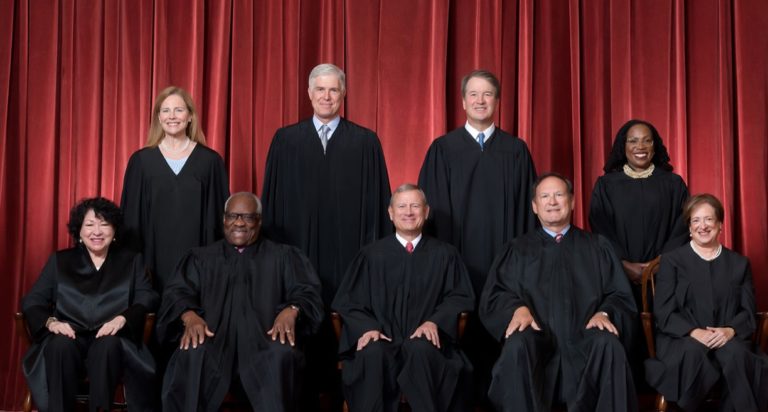
The three justices who dissented from the majority opinion were Sonia Sotomayor, Elena Kagen, and Katanji Brown Jackson. Those three routinely stick together on most decisions as a caucus.

The other challenge came from two students, Myra Brown and Alexander Taylor, who raised concerns regarding the Biden administration’s failure to follow the proper process in enacting the plan.

In that case, the justices found that the students did not have standing. However, the decision on the case brought by the states, provides the answer as well for the students’ case, as it invalidates the Biden loan forgiveness program.

Initially, a lower court had dismissed the states’ lawsuit, ruling that they lacked standing to challenge the program since they were not directly harmed by it.

This story is breaking and will be updated.

Breaking: Supreme Court says web designer can’t be compelled to work on gay wedding project

On the final day of its session, the U.S. Supreme Court has ruled in favor of Lorie Smith, a Christian Colorado website designer who refused to create a website for a gay wedding. The court’s 6-3 ruling said Smith could not be compelled to create speech that violates her beliefs.

Smith, an artist and owner of the design studio 303 Creative, specializes in graphic and website design. Her passion lies in visually conveying messages and she established her business to align her work with causes close to her heart, such as supporting children with disabilities, promoting overseas missions, aiding animal shelters, and honoring veterans.

Smith’s work includes websites celebrating traditional marriage between a man and a woman. That defied Colorado’s anti-discrimination law, which prohibits discrimination based on sexual orientation. The law requires her to create designs that contradict her deeply held Christian beliefs about marriage. Smith decided to challenge the law. Alliance Defending Freedom took up her cause to fight for her free speech rights.

The majority of justices, in the 6-3 decision, agreed that the government cannot compel Smith to create speech that she fundamentally disagrees with.

“Colorado seeks to force an individual to speak in ways that align with its views but defy her conscience about a matter of major significance,” the opinion, written by Justice Neil Gorsuch, says.

Gorsuch wrote that if the court had ruled for the State of Colorado, it would put Smith in an untenable position: “If she wishes to speak, she must either speak as the State demands or face sanctions for expressing her own beliefs, sanctions that may include compulsory participation in remedial training, filing periodic compliance reports . . . and paying monetary fines. As surely as Ms. Smith seeks to engage in protected First Amendment speech, Colorado seeks to compel speech Ms. Smith does not wish to provide.”

The three who dissented were Justices Elena Fagan, Sonia Sotomayor, and Katanji Brown Jackson, all deeply leftist.

Sotomayor wrote, “Today, the Court, for the first time in its history, grants a business open to the public a constitutional right to refuse to serve members of a protected class.”

Despite the existence of Colorado’s anti-discrimination law, the court ruled that it cannot be used to force individuals to express messages that go against their sincerely held beliefs.

Mainstream news outlets and advocates for LGBTQ+ rights argue that the court’s decision undermines legal protections for the LGBTQ+ community.

Supporters of the court’s decision contend that it upholds the principles of free speech and religious freedom. They argue that artists like Smith should have the autonomy to decide which projects they take on, based on the messages they are being asked to express, rather than being compelled by the government to create art that conflicts with their beliefs.

The Alaska Family Council in December joined family policy councils across the country to file a legal brief supporting Smith.

“Whether it’s Colorado, Washington, D.C., or Alaska, we’re proud to stand in defense of free speech and religious liberty,” said AFC President Jim Minnery.

In 2018, Colorado cake baker and designer won his case at the Supreme Court after he was sued for refusing to bake and decorate a wedding cake for a gay couple. He is now fighting a lawsuit because he won’t bake a cake celebrating a “sexual transition.” That case is working its way to the U.S. Supreme Court.

Hot take: Justice Ketanji Brown Jackson says racism will get worse

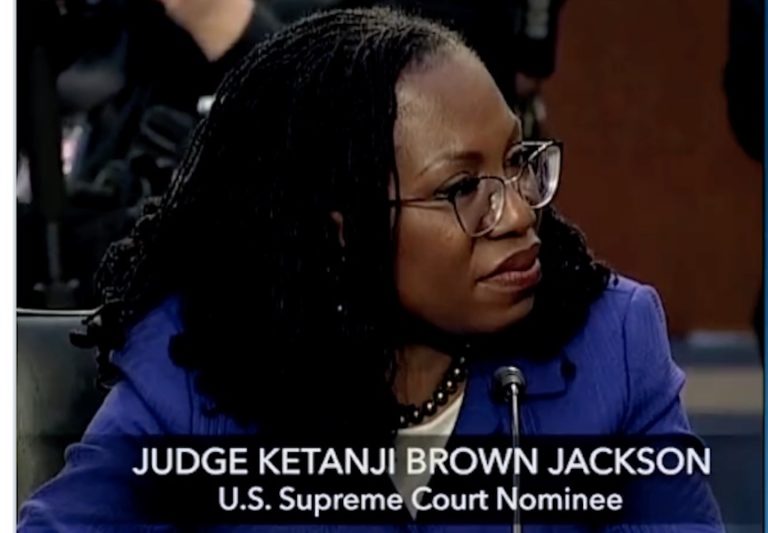
Supreme Court Justice Ketanji Brown Jackson famously refused to say during her confirmation hearings in 2022 what defines a woman.

Sen. Marsha Blackburn, R-Tenn.,  asked the then-Supreme Court nominee: “Can you provide a definition for the word ‘woman’?” Jackson responded, “I’m not a biologist.” 

But if she doesn’t understand what males and females are, Justice Jackson evidently knows what race is, as she scalded her colleagues on the U.S. Supreme Court over their decision to end college race-based admissions.

Jackson said in her dissenting opinion, “No one benefits from ignorance. Although formal race-linked legal barriers are gone, race still matters to the lived experiences of all Americans in innumerable ways, and today’s ruling makes things worse, not better. The best that can be said of the majority’s perspective is that it proceeds (ostrich-like) from the hope that preventing consideration of race will end racism. But if that is its motivation, the majority proceeds in vain. If the colleges of this country are required to ignore a thing that matters, it will not just go away. It will take longer for racism to leave us.”

Thursday’s Supreme Court decision rolled back the affirmative action law that allows colleges and universities to use race as screening tool. Harvard University and the University of North Carolina were the defendants in a case bought by Students for Fair Admissions. One of the problems the majority identified is that affirmative action programs have to end at some point, and there’s no clear way to say when system racism ends.

Chief Justice John Roberts, wrote that the programs that weed out Asian and white students “lack sufficiently focused and measurable objectives warranting the use of race, unavoidably employ race in a negative manner, involve racial stereotyping, and lack meaningful end points.”

Jackson recused herself from the Harvard case, because she has had a role on the university’s governing board. Her written opinion was in response to the University of North Carolina case.

“With let-them-eat-cake obliviousness, today, the majority pulls the ripcord and announces ‘colorblindness for all’ by legal fiat. But deeming race irrelevant in law does not make it so in life,” Jackson wrote. “It is no small irony that the judgment the majority hands down today will forestall the end of race-based disparities in this country, making the colorblind world the majority wistfully touts much more difficult to accomplish.”

Harvard University responded to its loss in the 6-3 decision with a statement that said it will instead now rely on college essays that have students discuss how race has affected “his or her life, be it through ‘discrimination, inspiration, or otherwise.’ We will certainly comply with the Court’s decision,” the school said, giving its carefully-worded middle finger to the Supreme Court in a reference that indicates it will continue to discriminate against white and Asian students in favor of other races, but in new ways.

President Joe Biden’s comments were to be expected. In a long statement from the White House, he told reporters, “The Court has effectively ended affirmative action in college admissions. And I strongly — strongly disagree with the Court’s decision.”

When asked if the court had gone rogue, he replied, “This is not a normal court.”

Shocker: Peltola cosponsors House bill to force girls’ bathrooms open to boys

In a show of solidarity during “Pride Month,” House Democrats unanimously threw their support behind the so-called Equality Act, an LGBT-rights bill with serious safety and privacy implications for girls and women.

The bill, cosponsored by Democrat Rep. Mary Peltola of Alaska, would amend the 1964 Civil Rights Act’s Title II by adding “transgender status” and “sexual orientation” as protected classes, expanding its scope to all public accommodations.

The bill explicitly states that public accommodations includes female-only facilities such as bathrooms, locker rooms, salons, and domestic violence shelters. These would be open to men who demand entry by declaring themselves women, according to this legislation.

One concern raised by opponents is the bill’s impact on religious liberty. The Equality Act is written in a way that supersedes the Religious Freedom Restoration Act. Schools, churches, and other religious institutions would not be exempt. For instance, a Muslim school would be required to allow boys who want to be known as girls to be allowed in girls’ changing rooms.

It would also apply in Anchorage to the Downtown Hope Center, a faith-based cold-weather shelter that houses women at night, keeping them off the streets and out of the hands of their abusers and traffickers. The Downtown Hope Center has successfully fought through courts to be allowed to keep transgenders out of the facility at night for the safety of the women.

The inclusion of “gender identity” in the bill says individuals cannot be denied access to restrooms and changing rooms, based on their self-identified gender, which could change at any time.

Critics cite the potential for conflicts already arising in women’s sports as males who identify as transgender competing against women and compromising fair competition.

While the Equality Act passed the House in 2021, it faced hurdles in the Senate due to the filibuster and the lack of support from Sen. Joe Manchin. This year, a companion bill in the Senate has the support of every Senate Democrat except Manchin. The Senate has a razor-thin majority of Democrats.

If House Democrats regain control in 2024 and maintain a favorable majority in the Senate, they are expected to prioritize the passage of the Equality Act. For now, the bill has been sent to a number of committees, where it is expected to stall.

Peltola also voted in April against a House resolution that has further protections for women’s and girl’s athletic teams, to ensure that females are not disadvantaged by transgenders competing in their category.

Downing: They’re coming for your children

By SUZANNE DOWNING

From the South Lawn of the White House to the pulsing heartbeats of North America’s bustling cities, Democrats are stepping into the 2024 electoral fray armed with a transgender-dominated platform that makes the riots of 2020 look like a block party. 

This time, the spotlight is focused on the very future of the country: our children.

In a repudiation of the family as the foundation of society, the Democrat platform contends, “Your children are not your children.” And it doesn’t stop there. The Democrats are loud and proud that they’re “coming for your children.”

This was echoed by President Biden himself in April when he proclaimed at a White House event, “There’s no such thing as someone else’s child. Our nation’s children are all our children.”

His sentiment was further reinforced by the LGBTQ activists during their Pride Month celebrations. The rallying cry of “We’re here. We’re queer. We’re coming for your children!” may have escaped the notice of those consuming mainstream media, but as Tucker Carlson has demonstrated, the traditional news platforms no longer control the narrative. 

America is turning to Twitter for an unfiltered snapshot of reality, and reality is not pretty. The videos of the radical LGBTQ agenda are being shared, as citizen journalists take over telling a truth that legacy media won’t touch.

One could write off a single declaration of seizing the children as a mere slip of the tongue, but the unwavering commitment of the progressives suggests deliberate intent to make it a bedrock principle woven into the very fabric of the Democratic Party.

The party finds itself flanked by a president whose mental acuity is questionable at best and demonstrators whose behaviors set a new standard for raunch. By raunch, I refer to the naked men dangling their parts at children along the parade routes, and naked women in heavy makeout sessions in a public fountain, while children played nearby.

These individuals are the ones taking over our schools, libraries, parks, and city councils.

Even a top cabinet official – Rachel Levine, the Secretary of Health and Human Services – has officially declared that it’s not just Pride Month but Pride Summer.

Levine, a transgender individual, is determined to see the Democratic Party transgender platform permeate the cultural fabric of America. Levine’s aim is to dismantle the traditional family unit and supplant it with the state, utilizing the powers of the DHHS to cement this agenda ahead of the 2024 elections.

Democrats like Levine appear to be drawing from the Marxist ideology of Frederick Engels and Karl Marx, who famously critiqued the family and foresaw its inevitable demise.

Engels said “On what foundation is the present family, the bourgeois family, based? On capital, on private gain. In its completely developed form, this family exists only among the bourgeoisie. But this state of things finds its complement in the practical absence of the family among the proletarians, and in public prostitution.”

Thus, he predicted, the family “will vanish as a matter of course.”

His colleague Marx explained how that would be achieved: “The education of all children, from the moment that they can get along without a mother’s care, shall be in state institutionsat state expense.”

The American middle class, with its inherent kindness and compassion, has proven to be fertile ground for this Democrat redefinition of “love,” which amounts to actual hatred of the nuclear family.

Leveraging the tolerance of centrists, the Left has weaponized the Christian principle of “What Would Jesus Do” to quell debate and sway major Christian denominations to their cause. It has worked with many mainstream Christians, who haven’t found a quick response to that rhetorical question.

The platform for 2024 looks set to feature a triumvirate of transgender dominance, the sexualization of children, and a critique of the traditional family. Why this direction? Because the Democratic Party, now under the influence of its most radical elements, finds itself incapable of reining in its fringe. The genie cannot be returned to the bottle.

Parents, brace yourselves: They are coming for your children. Alphabet agencies and unions like the National Education Association, and even the State of California, have made it clear and are leading the charge.

California Republican State Sen. Scott Wilk issued a warning: A new bill that would criminalize parents who don’t affirm their child’s “gender transition” is a bridge too far. It’s time for parents to run for the border.

“If you love your children, you need to flee California,” he said.

Democrats, seemingly emboldened by favorable polling in the 18- to 34-year-old demographic, are confident they have the winning issues for 2024. 

For much of America, however, Democrats have simply packed the powder keg, stretched out the fuse, and are holding a match aloft.

Suzanne Downing is publisher of Must Read Alaska.