Wednesday, August 19, 2026
Home Blog Page 592

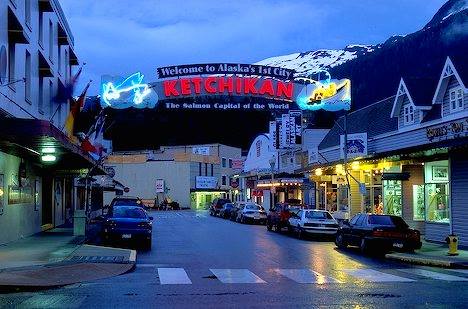
Is Ketchikan rural? Federal Subsistence Board considers reclassification request by Ketchikan Indian Community

A movement by the Ketchikan Indian Community to have Ketchikan reclassified federally as a rural area is the topic of a federal hearing on Wednesday evening that has the community in southern Southeast Alaska abuzz.

Ketchikan Indian Community has asked the Federal Subsistence Board to retract the non rural classification of Alaska’s First City. This would have implications for the distribution of fish and game in the area, with preference for rural residents.

The hearing is at 6 pm at the Southeast Alaska Discovery Center, and an additional hearing will take place in Klawock at a later time.

In March of 2022, KIC passed a resolution declaring its territory as rural, “to the greatest extent allowed under federal law, all lands, islands, waters, airspace, and surface and subsurface interests located within the current geographic boundaries of the Ketchikan Gateway Borough.”

The request to the Federal Subsistence Board, a function of the Department of Interior, says that the population for the Ketchikan area has declined in each of the last three censuses. 

Further, the organization says that there are other factors “creating pressure on food security for our isolated community including the loss of one of three local primary food vendors, COVD-19, inflation in food prices, fuel prices, and the constriction of the supply chain discussed in more detail below.”

“Ketchikan lies on the traditional territory of the Tlingit Aani, specifically the lands of the Saanya Kwaan and Tanta Kwaan. Ketchikan has a long­ standing history of Indigenous occupation well before colonizers ever stepped foot in Alaska. The community of Ketchikan (which is a Tlingit word that roughly translates to the ‘Thundering wings of an Eagle.’), and its home on Revillagegado Island are essentially separated and isolated from the rest of
the world. Ketchikan – a community that is comparable in size to both Sitka and Kodiak, Alaska and smaller in population that Bethel, Alaska, all three of which enjoy FSB’s rural designation – is heavily reliant on the natural resources in our immediate area including fish, wildlife, and terrestrial/aquatic plants. Whether indigenous or not, the residents of Ketchikan have strong ties to the food resources that can be gathered here. The area that we are proposing for rural status designation includes the entirety of Revillagegado Island, Pennock Island, Gravina Island, the southern portion of Cleveland Peninsula, and the surrounding waters in this area. This area is the footprint of both Ketchikan Indian Community and the Ketchikan Gateway Borough,” the proposal reads.

Ketchikan was a more populated community until the federal government ended commercial logging in Southeast Alaska through the Tongass Roadless Rule, which made the timber industry all but disappear. It is currently home to about 8,200 people and has a vibrant fishing and tourism economy, and is also the home of the Alaska Marine Highway System.

The proposal to the Department of Interior:

Jon Faulkner: Time to put PFD where it belongs — in our constitution

By JON FAULKNER

It is time to put Alaskans first and fix the PFD formula in our Alaska Constitution. 

We hear many objections why this is not workable, but none that honor the will of the people. Our Legislature is accountable for this impasse.   

In short, a showdown looms: The people of Alaska vs. the Legislature. Do we trust the voters with the Permanent Fund, or do we stand by and watch the political process destroy this legacy?

The adage “follow the money” leads us to the problem, and the solution. The big rub to politicians is the PFD. Every year since Gov. Bill Walker defied the then-existing law and bypassed 40 years of legislative practice, politicians have eyed the Permanent Fund with increasing appetite for your dividend. 

Former Gov. Jay Hammond would be upset over this turn of events.  He warned, “Of one thing I’m sure…as go dividends, so goes the Permanent Fund. Cap, reduce, or eliminate the PFD and the Fund will follow suit.” 

This is wisdom from a man who loved Alaska, who understood the meaning of “sustainability” and that oil wealth belongs to our people in common, for all generations, and that a fair return on that wealth belongs to residents. Hammond knew that once politicians found a chink in the Permanent Fund’s armor, they would invent endless schemes to grab it. His solution: A dividend that was large enough to incentive Alaskans to resist systematic plunder and to vote out politicians who mismanaged the Fund. 

A constitutional amendment must pass both houses of the Legislature so consensus is essential. But it must also garner a popular vote, so political compromise should consider the people’s wishes.    

Fortunately, years of discussion has focused the central debate.  It now centers on the right percent of market value (POMV) to draw for all expenses, including inflation proofing, vs. honoring the “Original Formula” for dividends.  But first, where are Alaskans in agreement?  

Few dispute anymore that some share of earnings from natural resource extraction belong to Alaska residents. Alaskans embrace the concept of an “owner state.”

Moreover, there is consensus that the PFD is not welfare. True, Alaskans don’t labor for their dividend, but we own the land. And although some spend their dividend recklessly, most spend it wisely.  

Alaskans find common ground with economic data that shows PFDs directly distributed to Alaskans have far greater economic impact to our state and local economies than money doled out to the public sector. We agree with the Institute of Social and Economic Research that lowering dividends disproportionately hurts the poor and that reducing our dividend by $1,000 pushes thousands of Alaskans below the poverty level. Likewise, Alaskans generally agree that among various policy choices to reduce spending, like reducing the state work-force or capital spending, cutting the PFD is the least favorable option. 

Also, Alaskans begrudgingly accept the Supreme Court ruling that annual PFDs require legislative appropriation. But there was legislative consensus for 40 years before that to follow the law and deposit PFD allocated earnings directly. The practice of “earmarking” or automatically appropriating funds is common practice, as $1 billion is declared “off-limits” via bi-partisan truce. All Alaskans expect is equal regard for the PFD.    

We also have consensus on inflation proofing. The Legislature inflation proofed all but two years between 1980 and 2015. Yet between 2016 and 2018, it failed to inflation proof five out of eight years. 2021’s record deposit of $4.18 billion helped offset the deficiency but inflation is real and Alaskans agree inflation proofing should not be optional.     

Finally, Alaskans share a profound sense of gratitude, both for our forefathers, and for the opportunity to show the world how to honor future generations by saving—not squandering—our inheritance.  

Consensus on budget priorities is not necessary to pass a Constitutional Amendment. Budgets are divisive, and a Legislative function. Disagreements on spending will always exist, as will lobbyists, special interests, and elections. The PFD is too important to be enmeshed in this.  

With respect to the PFD, most agree funding must be sustainable and yet the dividend amount can fluctuate. Thus, the original formula is ideal, insofar as it was 100% funded from realized earnings, saved and set aside for dividends. It was rock-solid sustainable until lawmakers wanted more. 

As a policy alternative, lawmakers now propose draws based on “Percent of Market Value” ostensibly to stabilize revenue streams, and to treat the dividend as part of its annual budget. This is understandable but problematic as recent history shows, because it projects what is expected based on past performance and then bakes it into a budget, regardless of whether the revenue materializes or not. This leads to unfunded budgets. 

Witness the returns of the Permanent Fund over the last five years: Barring the single year sell-off of 2021, an historic outlier, the other four years averaged only 3.047%–not enough to cover inflation and expenses. Lawmakers would need a fiscal cushion to protect the PFD. 

The original PFD formula is sustainable and provides for adequate inflation proofing, but is the amount too high? Consensus can derive from long standing, global precedent, which is the standard 12.5% royalty fee. This amount is paid to virtually every subsurface estate owner worldwide. Moreover, only 25% of all mineral-based revenues go into the Fund, while government takes 75%. Thus, the 50% of earnings (averaged over 5 years) mandated for the PFD derive from only 25% of the State’s royalties. Thus, the 12.5% of mineral-based earnings for Alaska residents as their royalty share is a wonderfully elegant solution with global precedent.  

Finally, in forging a path forward, Alaskans should heed the advice of those who created the Permanent Fund, like Oral Freeman and Hugh Malone, for without their wisdom Alaska would not have a Fund. These Alaskans rejected political interference, schemes to leverage the Fund, to invest in regional infrastructure or high-return ventures that invited risk. 

Alaskans are keenly aware of the challenges we face of declining oil, of downsizing government and diversifying our income sources. But we are amazingly unified in our desire to pass a constitutional amendment that protects the original PFD formula, and we trust the people will ratify it.

Jon Faulkner was born and raised in Alaska and owns businesses on the Kenai Peninsula.

King County wants more money from homeowners for a climate initiative

By SPENCER PAULEY | THE CENTER SQUARE

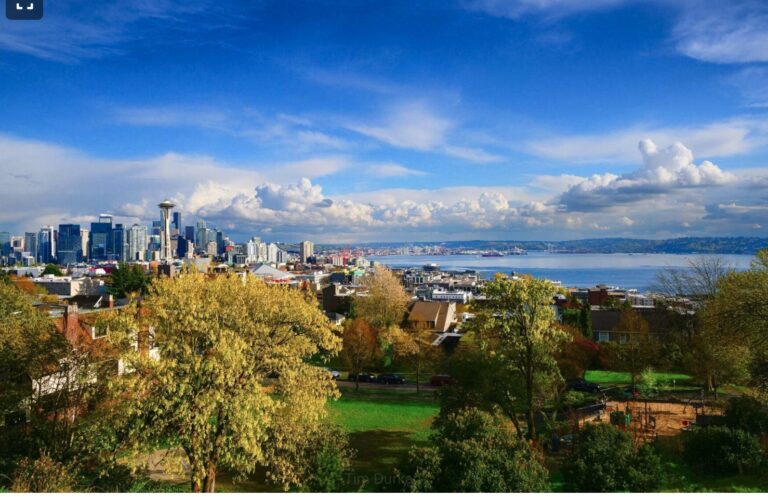
 King County voters may see a new climate levy lid lift on their ballots next year as county officials begin discussions to increase revenue to reduce climate impact efforts.

The new motion would request King County Executive Dow Constantine to develop funding options to generate $1 billion in funding over a six- or nine-year period. Funds would be used for greenhouse gas reduction efforts and response to climate impacts.

The motion requests that the executive’s proposal include a proposed property tax levy lid lift for voters to decide on in November 2024, as well as policy recommendations for how the money could be allocated among projects in areas including transportation, open space acquisition and response to climate impacts.

According to an estimate from the King County Office of Economic and Financial Analysis, a property tax levy would need an initial rate in 2025 of 11.5 cents per $1,000 assessed value in order to generate $1 billion over nine years, or an initial levy rate of 18.5 cents per $1,000 to generate $1 billion over six years.

Based on Redfin’s King County median home sale of $800,000, an average property owner could pay $92 per year if a nine-year levy is considered, or $148 per year if a six-year levy is considered. 

The motion does note that a proposed levy might not be used to generate the full $1 billion.

The King County Executive’s Office signaled its excitement for the opportunity to create the potential proposals to generate $1 billion at Tuesday’s King County Transportation, Economy and Environment Committee meeting. The committee approved the motion, forwarding it to a full King County Council vote in the near future.

The executive would convene a work group to develop the funding proposal once approved by the county council. Furthermore, the work group would be tasked to create an analysis of additional funding sources that could be used for climate efforts, including, but not limited to revenues related to solid waste and wastewater, according to the motion.

As of 2019, which is the most recent year with reliable data, greenhouse gas emissions had increased by 11% over a 2007 baseline. The county’s strategic climate action plan developed climate goals of a 50% reduction in emissions by 2030 compared to the 2007 baseline.

The county’s most recent Strategic Climate Action Plan was adopted in 2020. For many of the priority actions identified in the plan, the document states that the county lacks the financial resources to take the action.

The county stated that it is difficult to quantify the exact amount of climate-related expenditures it currently undertakes. However, some notable climate-related expenditures made by King County in the 2024-2024 budget include: $180 million to purchase battery-electric buses and $43 million in zero-emissions infrastructure to ensure that King County Metro’s 1,400 coach bus fleet is zero emissions by 2035; $2.3 million to create a new Office of Climate within the county; and $28.5 million in capital investments to remove blockages to fish passage habitat.

The proposal would take the form of a report transmitted to the King County Council by April 30, 2024, as well as accompanying legislation. The last regular county council meeting to pass the ordinance with minimum processing time would be July 23, 2024.

If approved by the county council, a property tax proposal could be on voters’ Nov. 5, 2024 ballots.

Wednesday: Alaska Day is a uniquely Alaskan holiday, but for how long?

One hundred and fifty-six years ago, the papers were signed, the ink was dry, and Alaska became the property of the United States of America.

Russia needed cash because the Crimean War had sapped its treasury, and Secretary of State William Seward thought the land of the north was a good addition to the growing nation, what with all the timber and fish. That was before gold was discovered in Alaska.

Russia, which had conquered and claimed Alaska during the explorations of Vitus Bering, had offered several times to sell the land beginning in 1859, and America had interest in buying it — but also had an ongoing civil war to fight starting in 1861 and not nearly enough resources to go around until 1867.

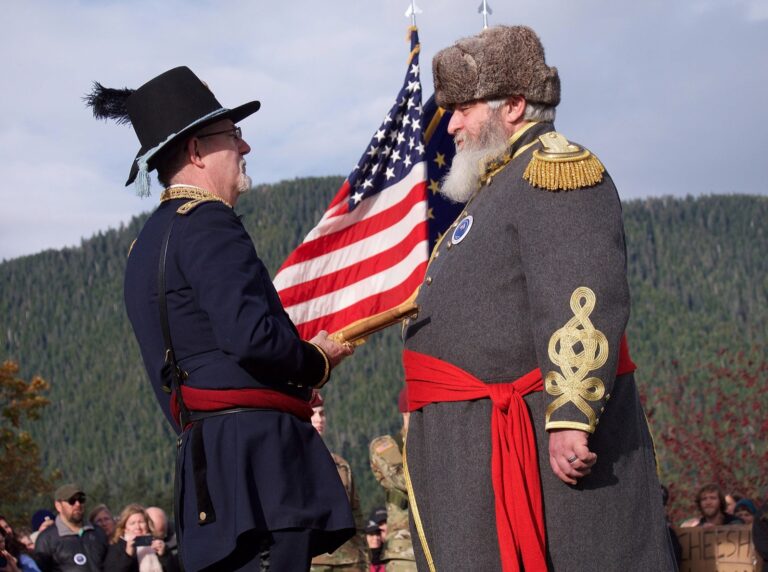
The actual transfer ceremony took place at Castle Hill in Sitka on Oct. 18, 1867, where reenactments are still done each year and where the day is most celebrated.

Alaska was not a territory until 1912, and just five years later, in 1917, the territorial legislature declared Alaska Day a holiday. It is now a paid holiday for state employees. 

Alaska Day is protested by some who view it as a celebration of colonialism and the unlawful taking of land from the Native people who lived on it.

Native groups say the land was not Russia’s to sell and therefore it does not belong to the United States. For the past few years, objectors have shown up at the Alaska Day celebrations to show their disapproval of the day and to ask for it to be rebranded as a day of reconciliation, or for reparations.

This year, Alaska Day comes just before the opening of the Alaska Federation of Natives annual conference in Anchorage. The AFN convention, Oct. 19-21 at the Dena’ina Convention Center, is a forum for the Native community to participate in steering public policy and to advance Native interests.

More about the purchase of Alaska at the U.S. State Department site at this link.

With Ravn out, Grant Aviation adds 50 weekly flights between Kenai and Anchorage

9

Grant Aviation will add 50 flights each week between Kenai and Anchorage, starting around Oct. 21.

The additional flights between the Kenai Municipal Airport and Ted Stevens Anchorage International Airport will fit in for the loss of Ravn, which has discontinued that route, as of this weekend, due to financial reasons. Ravn also discontinued service to Aniak.

Grant flies smaller aircraft than Ravn, which uses Dash-8s. Grant has a fleet of Airvan GA8’s, Cessna Caravans, Cessna 207’s, Beechcraft King Airs, and Piper Navajos.

In a news release, Grant says it wants to expand the Kenai route, which is used by those who don’t want to drive the Sterling and Seward Highways, and is a route popular with oil and gas workers.

“This is a route many of our customers count on, so we are grateful to be able to provide more service to the communities of the Kenai Peninsula when it is needed most,” said Grant Vice President of Commercial Dan Knesek.

Grant Aviation is owned by Westward Partners, a Seattle company that invests in companies around the Northwest and Western Canada. Westward is also an investor in Three Bears Markets in Alaska.

 Grant has bases in Bethel, Emmonak, Dillingham, King Salmon, Cold Bay, Dutch Harbor, Kenai, and Anchorage, and has scheduled air transport of passengers, cargo, mail, air ambulance and charter service. The company employs about 350 people and is advertising for a station manager for Kenai.

Mayor to veto Soros-linked ‘Welcoming City’ certificate program

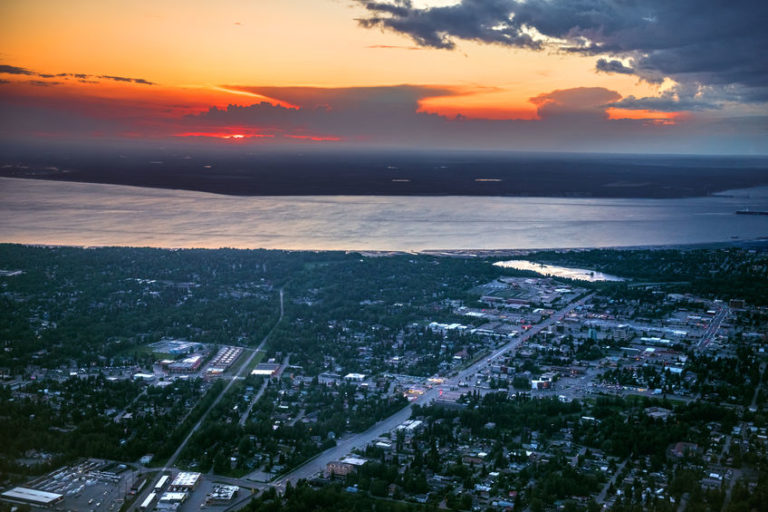
During the Mayor Ethan Berkowitz era, Anchorage became what is known as a “Welcoming City,” which is very much the same thing as a “sanctuary city,” but with a different name — it’s a place for illegal immigrants to feel welcome. The former mayor’s wife led the charge on the initiative and headed up the immigrant-welcoming program.

Fast forward to 2023: An ordinance by the Assembly that has the city work toward becoming an official “Welcoming City,” with a certificate as one, was vetoed by Mayor Dave Bronson today. There’s too much paperwork and redundancy, he said.

“This ordinance is a solution in search of a problem. Our Office of Equal Opportunity and Office of Equity and Justice recently passed their annual audit with flying colors. In addition, both offices have public visibility in advocating for their respective missions: equal opportunity, and equity for those who are disadvantaged. There is no good reason to burden these offices — and, by extension, Anchorage taxpayers — with additional data requirements as contemplated in the ordinance,” says the memo from Bronson to the Assembly.

WelcomingAmerica.org says that being a certified Welcoming City “is a formal designation for cities and counties that have created policies and programs reflecting their values and commitment to immigrant inclusion.”

But it also means more bureaucrats pushing papers for “diversity, equity, inclusion” goals, or DEI, as many call them.

“The Assembly has imposed this burden because some members want Anchorage to become a Certified Welcoming City, as determined by the national nonprofit Welcoming America. This is a misguided policy decision. Welcoming America is a grantee of George Soros’ Open Society Foundation. As the founder of Welcoming America wrote on the Open Society Foundation webpage over 10 years ago, this nonprofit attempts to attract thousands of individuals and organizations who want to replicate the Welcoming work in their own communities,” Bronson wrote. “In other words, Certified Welcoming City is a product, and the Assembly would like Anchorage to be its newest customer.”

According to Welcoming America, “A Welcoming City or County is one that joins the Welcoming America network and works across multiple sectors, such as government, business, and non-profit, to create inclusive policies and practices such as making it easier for entrepreneurs to start a business or having government documents available in multiple languages. Welcoming Cities are guided by the principles of inclusion and creating communities that prosper because everyone feels welcome, including immigrants and refugees.”

Bronson said that Anchorage is already a welcoming city and has the most diverse schools in the country and vibrant immigrant communities. He sees no need to divert Anchorage tax dollars to a national certifying group that will tell the city what it already knows.

The 12-member Assembly is politically very far left and is likely to override the mayor’s veto of the Welcoming City program.

Passing: Art Chance, labor negotiator, writer, and colorful Alaskan

Art Chance, 74, who wrote opinion, theater reviews, and political analysis for Must Read Alaska for many years, passed peacefully in his sleep on Oct. 17, 2023.

He was this publication’s first senior contributor and wrote regularly until about a month ago. “The circle has now been broken,” was the last sentence he ever wrote, said his wife Juno, describing how he started to write what would have been his last column for Must Read Alaska. It’s a column he never finished.

If he could have finished it, he might have ended with “Whiskey for my men and beer for my horses,” one of his favorite sayings, from the lyrics of Toby Keith.

He was the author of the book, “Red on Blue, Establishing a Republican Governance,” available at Amazon.com.

Born in 1949 in rural Georgia, he headed to Alaska during the Pipeline era in 1974, and got a job with the State of Alaska in 1987. He lived in Juneau for several years, before returning to Anchorage, where he lived in the Oceanview neighborhood.

“I went through the oil price crash and the Democrats’ ‘all bets are off’ period, Governor Hickel’s ‘owner state,’ Tony Knowles’ best government Greenies and Unions could buy, a stint working for the Republican-controlled legislature when I couldn’t stand the Knowles people any more, and finally became Governor Murkowski’s director of labor relations, from which I retired on July 1, 2006,” Chance wrote.

“Along the way I saw most everything that is stupid and venal about running a government,” he wrote.

Chance was the author of the political book, “Red on Blue.”

“‘Red on Blue’ is my observations of how Democrat structured governments work and why Republicans can’t run them. A few friends and I tried to restructure Alaska’s government in the early days of the Murkowski Administration so that it could actually be run by a Republican governor. Some things we got right, some not, but we got it better than it had been,” he continued.

Chance retired from serving as the state Director of Labor Relations. For Must Read Alaska, he frequently wrote about public employee and union negotiation issues. But at times he also did theater reviews, as he had for Must Read Alaska Publisher Suzanne Downing when she was editor of the Juneau Empire in the 1990s.

“Art was a friend, a mentor, a fierce advocate for the right thing,” said his good friend Tyler Andrews, who met Art in 1995 and was mentored by him during the Knowles Administration.

Although Chance was colorful, a prolific writer, and was known for his politically incorrect sayings, he always kept a courtly and appropriate demeanor during labor arbitration hearings, Andrews said.

“Art came across as full of bluster…. but he had integrity and he cared for those he mentored. His mentoring not only was passed on to those he taught but to the next generation that followed,” Andrews said.

Chance got his start in labor relations working for a union. He was a shop steward at a school and became involved with Laborers Local 71, and was a Democrat Party operative before he became a conservative.

In addition to working for the state of Alaska, he had worked at Stallone’s men’s shop, and worked at Cabela’s for about four years after he retired. He built greenhouses and solariums in Anchorage for a few years after the pipeline days, and did some contracting. He also wrote for Red State for a few years.

Chance had been in failing health for a few years, and after slipping on the ice and breaking his hip several years ago, he suffered from various health issues.

Some of his more memorable recent writing is linked below. More of his columns from the past seven years can be read by typing “Art Chance” into the search box at the top of Must Read Alaska.

Memorial service arrangements are being made at Heritage Memorial Chapel at Angelus in Anchorage. Juno said his ashes will be scattered later at Handtroller’s Cove near Juneau.

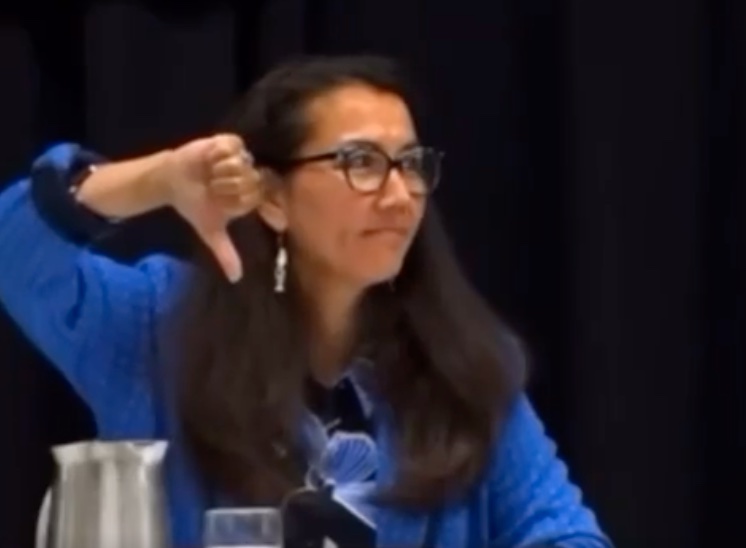
Peltola casts first votes in a month, and goes against Rep. Jim Jordan and for Rep. Hakeem Jeffries as speaker

Alaska Rep. Mary Peltola voted for the first time in Congress since the death of her husband five weeks ago, when a plane that he was piloting crashed while flying moose meat out of a hunting camp.

Peltola was given a standing ovation for returning to work by colleagues sympathetic to the trials she has gone through losing her husband in the tragic accident.

She wrote on Twitter that she wants a speaker who can work with both parties. In her mind, that appears to be Hakeem Jeffries, House minority leader.

“Let’s … elect a Speaker that’s ready to work with everyone. Republicans and Democrats do this in AK. We can do it in DC,” she wrote, attempting to put a bipartisan face on what is a partisan process.

Rep. Jim Jordan was the Republican nominee, and Peltola voted against him. In January, she voted 15 times for Jeffries as speaker, sticking with all the Democrats.

This time she also voted for Jeffries, who received 212 votes — all from Democrats.

Although 200 voted for Jordan (and 20 for other members), Jordan needs 17 more votes in order to win. So would Jeffries, but with the makeup of the House being Republican majority, it’s doubtful any Republican would vote for the far-left Democrat.

There will be upcoming votes, as early as Tuesday evening, Jordan said: “We’ve already talked to some members who are gonna vote with us on the second ballot,” he told reporters.

Several people identifying as socialists on X/Twitter said they want Peltola as speaker.

AFN’s missing speakers and sponsors

The governor of Alaska is sending a welcome video. The mayor of Anchorage is sending a welcome video. Sen. Lisa Murkowski is attending via Zoom, and it’s not clear that Sen. Dan Sullivan, a Marine reservist, will fly back from Washington, D.C. in time for the Alaska Federation of Natives convention in Anchorage that starts Thursday. After all, there is a war developing in the Middle East over ethnic and religious differences and land issues that divide Israelis and Palestinians, Jews and Hamas.

Even Rep. Mary Peltola, who is scheduled to speak to the AFN main body on Saturday, may be detained in Washington for the Speaker of the House vote. She is on the agenda for AFN’s Saturday afternoon lineup.

The reality is that AFN has become thought of as a radicalized organization, and some leaders in Alaska are actually relieved to be too busy to attend. After all, some leaders still remember when a few at AFN turned their backs on Gov. Mike Dunleavy and his wife Rose and raised their fists in the air while Alaska’s First Lady, who is Native, was on the stage in 2019.

The top sponsor for AFN’s convention this year is the group that brought open primaries and ranked choice voting to Alaska: Alaskans for Better Elections. AFN has a resolution supporting that new voting system that went into effect in 2022, which catapulted Mary Peltola into office.

Other top-level sponsors are GCI and Visit Anchorage. Missing from the sponsorship list are several Native corporations and groups. For instance, Arctic Slope Regional Corporation is missing, having separated from AFN. Doyon Ltd. also withdrew its membership in 2019 over disagreements with the direction of the organization. Sealaska, Aleut Corp. and Calista are missing as sponsors. These are some of the biggest companies in Alaska, created by the Alaska Native Claims Settlement Act, and are Native corporations that have vast resources, contracts, and sub-enterprises. Tanana Chiefs Conference is not a sponsor of the convention, nor is Tlingit-Haida Central Council, both powerful regional groups.

AFN still has other sponsors, but there appears to be strong differences between factions of Native leaders when it comes to the more controversial issues that have become front and center at the organization, whose leaders are President Julie Kitka, and co-chairs Ana Hoffman, and Joe Nelson, former husband of Rep. Peltola and father of two of her children.

An unspoken topic and one that isn’t being reported by mainstream media is the missing and indigenous leaders not playing a lead role at AFN in this era.