Home Blog Page 587

Second Amendment: Protect Gun Exporters Act introduced in House by Tennessee lawmaker

Rep. Mark Green of Tennessee introduced the Protect American Gun Exporters Act on Wednesday. The bill stops the current export license “pause” and prevents the Department of Commerce from taking any substantially similar actions in the future unless standard rule-making procedures are followed.

“President Biden’s antipathy for the Second Amendment is becoming more blatant every single day,” Rep. Green said. “There is clearly no action he won’t take when it comes to limiting our right to keep and bear arms. That’s why I introduced this bill. Someone has to stand up to this administration.”

The bill comes after Green wrote a letter signed by 88 members of Congress demanding answers on the unprecedented and reckless restriction on civilian firearm export licenses. Rep. Mary Peltola of Alaska did not sign the letter.

“As long as evil persists, there will always be a need for good people to defend themselves and their loved ones,” the letter said. “The need for the Second Amendment was not limited to the American Revolution nor the American Republic…Not only does BIS’s pause on firearms export licenses leave people even more vulnerable, but it will also push buyers to look elsewhere to meet their customers demands.”

The Department of Commerce announced Oct. 27 that it immediately suspended most export licenses for civilian firearms, components, and ammunition for 90 days to “advance U.S. national security and foreign policy interests.” The action was unprecedented, said Green.

“This pause leaves people vulnerable while directly hurting firearm manufacturing and shipping jobs,” Green said. “That’s where my bill comes in. It stops the export license pause and solidifies concrete steps the Department of Commerce must take if it wants to implement similar policies in the future.”

The bill requires the Department of Commerce to follow the normal rulemaking procedure allowing for notice, comment periods, communication with industry stakeholders, and conducting an industry impact analysis prior to any decision-making. If the Department follows all of these steps and still finalizes the rule, it would be eligible for expedited disapproval through the Congressional Review Act—a critical tool for stopping anti-gun bureaucrats.

The United States was, until the Biden restriction, the world’s largest exporter of arms, accounting for 40% of global arms sales, followed by Russia at 16%.

Read the bill at this link. 

Nikki Haley picks up a huge endorsement: AFP Action

Americans for Prosperity Action has endorsed Nikki Haley for president, the group announced on Tuesday, a signal that the national group, which has a branch in Alaska, plans to spend millions to bring Republicans together for the former governor of South Carolina, who has won five out of the five political races she has entered in her political career.

It’s a bold move, considering that most polling puts Trump in the lead among Republican likely voters. As of Nov. 29, Trump is polling with nearly 59% of Republican voters, followed by Florida Gov. Ron DeSantis at 13% and Haley at 10%, according to FiveThirtyEight.com, which compiles polling data.

An NBC poll conducted earlier this month shows that a record high 73% of Americans say the direction of the country is on the wrong track. “We have not seen this level of sustained pessimism in the history of the NBC News Poll going back to 1989,” the poll summary said. Also, a record high 69% of Americans use works like “downhill,” “disaster/hard times” or “wrong track” to describe where America is headed. In addition, majorities of voters from all political walks of life say President Joe Biden (70%) and former President Donald Trump (60%) should not run for president.

AFP says it has analyzed its own data, which shows it’s time to back someone other than Trump. AFP did not endorse in the presidential race in 2020.

“The results are incredibly encouraging: The American people are ready to move on, with nearly 75% of Republican primary voters saying they are open to supporting a candidate other than Donald Trump. In addition, nearly 60% of the Republican voters AFP spoke with who have never voted in a primary or caucus say they are ‘extremely enthusiastic’ to vote for the first time. It’s now time to help rally those voters behind a candidate who can win the primary and win the general election,” said AFP Action President Emily Seidel in a memo.

“At the outset of our strategy, we made clear that we would be business-like in our decision. We would support a candidate capable of turning the page on Washington’s toxic culture – and a candidate who can win. And last night, we concluded that analysis. That candidate is Nikki Haley,” wrote Seidel.

“AFP Action is proud to throw our full support behind Nikki Haley, who offers America the opportunity to turn the page on the current political era, to win the Republican primary and defeat Joe Biden next November. She has what it takes to lead a policy agenda to take on our nation’s biggest challenges and help ensure our country’s best days are ahead. With the grassroots and data capability we bring to bear in this race, no other organization is better equipped to help her do it.”

Haley responded that she is honored to have the support of AFP Action, “including its millions of grassroots members across the country.”

Gov. DeSantis said in a statement that the AFP endorsement of Haley should be considered an in-kind donation to the Trump campaign.

Trump, who is still popular in Alaska, faces headwinds, including the mainstream media, which reports negatively on him at every turn. While he was wildly cheered by a stadium filled with fans at a football game at the University of South Carolina over the weekend, the news media said he was greeted by loud boos.

Trump also has to fight multiple lawsuits, some of which will go to trial in the middle of the election cycle. The first major lawsuit with a court date was brought by the Biden Department of Justice. It’s related to the indictment of Trump on Aug. 1 for what DOJ’s Jack Smith says was an attempt to overturn the result of the 2020 presidential election during a rally on Jan. 6, 2021, the day the election was to be certified by the Senate.

Judge Tanya Chutkan, who has made negative statements about Trump on the record, set the trial to start March 4 — one day before Super Tuesday, the biggest day of the presidential election cycle in the spring.

Alaska’s Republican Party holds its Presidential Preference Poll, which is a nominating caucus-by-ballot exercise, March 5, Super Tuesday.

Jon Faulkner: The Silicon Valley conservative

By JONATHAN FAULKNER

Silicon Valley tech-giant, Marc Andreessen, recently published “The Techno-Optimist Manifesto,” which documents the belief system of our nation’s leading innovators. In it, Andreessen describes a very conservative-minded sector of influencers. His optimism in technology is coupled with a prescription for unleashing the spirit and ingenuity of modern America and delivers a message of hope for freedom-loving people everywhere. 

True, Andreessen avoids religion and the de-humanizing impacts of technology, but he boldly asserts the tenants of a philosophy that conservatives and libertarians will find authentic, coherent, and refreshing.

Declaring his Techno-Optimism to be a material philosophy, not a political one, Andreessen unapologetically embraces the ethos of material abundance that comes from free markets and technology, arguing that these forces create the leisure and freedoms that allow humans to choose how we want to live. 

Free enterprise is defended as the greatest force to lift humanity out of misery and into prosperity than any other in history. Believing free markets are an inherently individualistic way to achieve superior collective outcomes, Andreessen declares centralized planning as too complex and doomed to fail. Decentralization and free markets are far superior forces that harness complexity and exploit the best of us for the benefit of all. 

Andreessen’s heroes embrace accountability and individualism, competition, and achievement. They believe in unfettered discourse and reject censorship. They are unwavering in their belief that markets are the most effective means to relieve suffering for the greatest number of people, and that there is no antagonism between profits and social welfare. Rather, these interests are aligned, since it is the production capacity of free markets that generates the wealth that pays for virtually everything.  

“We believe free markets are the most effective way to organize an economy…only free markets impose lasting discipline…When market discipline is absent, there is corruption and craziness.  Markets prevent monopolies and cartels.”

Andreessen’s techno-optimist believes fundamentally that wages should be determined by the marginal contribution to production of the worker, and that technology drives wages and productivity up, not down. Rejecting universal basic income as leading to “…zoo animals farmed by the State”, he regards freedom as the central pillar of human pride and well-being.  Citing Adam Smith, he reminds the reader that this system does not rely on the good intentions of our fellow man: 

 “It is not from the benevolence of the butcher, the brewer, or the baker that we expect our dinner, but from their regard to their own self-interest. We address ourselves not to their humanity but to their self-love, and never talk to them of our own necessities, but of their advantages.”

Andreessen acknowledges enemies, but they are not bad people, only bad ideas—like anti-merit, anti-ambition and anti-achievement. He blames the last half century’s “demoralization campaign” on misguided infatuation with failed ideas like Communism, statism, collectivism, central planning, and socialism.  These distortions have been propagated by old institutions that were once invigorated by the search for truth. Now, they are “…compromised and corroded and collapsing – blocking progress in increasingly desperate bids for continued relevance, frantically trying to justify their ongoing funding despite spiraling dysfunction and escalating ineptness.”  He continues: 

“Our enemy is the ivory tower, the know-it-all credentialed expert worldview, indulging in abstract theories, luxury beliefs, social engineering, disconnected from the real world, delusional, unelected, and unaccountable – playing God with everyone else’s lives, with total insulation from the consequences.”    

Finally, Andreessen avoids globalist agendas in favor of narrower prescriptions for progress. He replaces climate change rhetoric with confidence in nuclear fusion and with harnessing human intelligence. Likewise, technology is the antidote to environmental destruction since only a technologically advanced society can protect and improve our environment, while a technologically stagnant society ruins it. He cites communist countries as the worst examples of environmental devastation.  “We believe in nature” he writes, “but we also believe in overcoming nature. We are not primitives, cowering in fear of the lightning bolt. We are the apex predator; the lightning works for us.”  

For the God-fearing among us, there is hope even in this last statement, since peaceful realization of our earthy gifts can still derive from–and serve–a Divine purpose.

Jon Faulkner is the president of Alaska Gold Communications Inc, the parent company of Must Read Alaska.

Passing: Charlie Munger, 99, was stationed at Nome during World War II before becoming Warren Buffett’s right-hand man

6

Charles Munger, vice president of Berkshire Hathaway, died Tuesday, just over one month before his 100th birthday. As Warren Buffett’s business partner for nearly 60 years, he helped overhaul Berkshire from an underperforming textile company into a legendary investment empire.

Born in Omaha, Neb. on Jan. 1, 1924, Munger studied math at the University of Michigan, but then enlisted in the U.S. Army Air Corps after Imperial Japan bombed Pearl Harbor, Hawaii and the United States finally was all-in on World War II.

Munger was sent to the California Institute of Technology to study meteorology before being posted to Nome. He served in Nome as a meteorologist at a time when 2,300 American troops were sent to the outpost after the Japanese invaded American territory in Attu and Kiska, in the Aleutian Islands.

Nome’s Marks Air Field was in operation from 1940 to 1950. After bombing and invading the Aleutians, Japanese were reported to be quickly moving ships into the Bering Sea and building up troops. That’s when the military sent 2,300 airmen, Munger among them, to Nome to build a defense against Japanese invasion. Nome, which went from non-existent to had as many as 10,000 residents during the Gold Rush of 1898, was only a town of about 1,559 in 1940 before the military arrived.

Munger said he learned the game of poker while in the Army Air Corps and that it taught him strategic thinking, pattern recognition, and risk management.

“You have to learn to fold early when the odds are against you, or if you have a significant edge, back it heavily because you don’t get a considerable advantage often. Opportunity comes but doesn’t come often, so seize it when it does come,” he said.

Munger married Nancy Huggins as the war ended and settled in Pasadena, Calif., where he eventually worked with Buffett. He was also engaged in real estate deals, was chairman and publisher of the Daily Journal Corp., and served on the Board of Directors for Costco. He was a supporter of Republican candidates and causes. He and Nancy divorced and he later married Nancy Barry, who died in 2010.

“Berkshire Hathaway could not have been built to its present status without Charlie’s inspiration, wisdom and participation,” Buffett said in a statement. Buffett is 93 years old.

Munger was said to be worth $2.6 billion in 2023. During his life, he donated at least $550 million to charitable causes, often for university student housing and similar projects. According to the Chronicle of Philanthropy, his largest gift was $200 million to the University of California at Santa Barbara in 2016, most of which was designated for an undergraduate residence hall, with $65 million designated for housing for visiting physicists. Over the years, Munger had sold or donated more than 75% of his Berkshire stock.

He was famous for his one-liners, including these:

“Take a simple idea and take it seriously.”

“Show me the incentive and I will show you the outcome.”

“Every time you hear ebitda, just substitute it with bullshit.”

“There is more dementia about finance than there is about sex.”

“To say accounting for derivatives in America is a sewer is an insult to sewage.”

“If mutual fund directors are independent, then I’m the lead character in the Bolshoi Ballet.”

“It’s not the adultery I mind. It’s the embezzlement.”

“The worshipping at the altar of diversification, I think that is really crazy.”

“Acquire worldly wisdom and adjust your behaviour accordingly. If your new behavior gives you a little temporary unpopularity with your peer group . . . then to hell with them.”

“I think when you’re buying jewelry for the woman you love, financial considerations probably shouldn’t enter into it.”

Munger’s family said he peacefully died Tuesday at a California hospital.

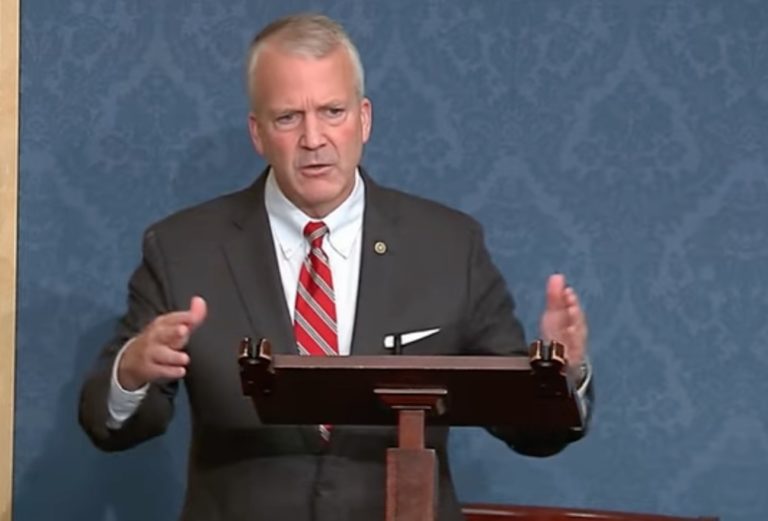
Dan Sullivan for vice president? Radio host Hugh Hewitt says Alaska’s senator should be on the list

Hugh Hewitt, a nationally syndicated radio host on the Salem Radio Network and law professor at Chapman University School of Law, says that Alaska Sen. Dan Sullivan should be on the list for any of the Republican candidates for president as a vice presidential pick.

Why Sen. Sullivan? Sullivan’s dedication to national security.

Hewitt’s column, which appeared in the Washington Post last week, put Sullivan on a short list for consideration as vice president or at least in a high cabinet position, along with these other Hewitt favorites: Sen. Tom Cotton (Ark.), Sen. Joni Ernst (Iowa), Rep. Mike Gallagher (Wis.), former secretary of state Mike Pompeo, and former national security adviser Robert C. O’Brien.

“All are serious about the state of the world; all are serious about national security,” Hewitt wrote at the end of his column that was primarily about the war between Israel and Hamas, and the sharp left turn that the Democrats in America have taken.

“Anyone watching what has happened on U.S. college campuses in the past seven weeks has to objectively evaluate the young left’s direction and consider its advance guard already in the House (in “the Squad”) or in the bureaucracy and objecting to President Biden’s support of Israel. They must conclude that the Democratic Party is not simply drifting leftward; it runs a real risk of heading to the hard left,” Hewitt wrote.

He pointed out that among Democratic voters age 18 to 34, a NBC poll shows that 70% of them disapprove of President Joe Biden’s handling of the war.

“This is a generational shift, and a dire one for Israel. It isn’t a huge leap to imagine that this hard left will shape the future of the Democratic Party. If Democrats win in 2024 or 2028, there would be an ever-increasing number of powerful people who are committed to the poisonous ‘oppressed/oppressor’ framework for interpreting the entire world,” Hewitt noted.

“Israel is engaged in what ultimately amounts to a war for survival against a genocidal enemy — Hamas is just its vanguard. The war right now is being waged in Gaza, but Hezbollah’s terrorist legions await on Israel’s northern border with Lebanon, and Iran, the deadliest threat, bides its time. There isn’t a middle ground here, any more than there is a middle ground regarding Russia’s invasion of Ukraine or China’s genocide of the Uyghurs. In fact, this is one confrontation — whether the front line is Gaza, or Ukraine or, eventually, Taiwan,” Hewitt wrote.

That’s why all the Republican nominees should start detailing who would be included in key positions in their administrations.

“Let’s compare that list with the new generation of Democrats, the voices who will likely shape the party for years to come,” Hewitt said. For him, the U.S. Marine Reservist from Alaska should be included in the next Republican Administration, possibly as vice president.

Hewitt writes for the Washington Post about law, politics, media bias, and society in general. He is a former official in the Ronald Reagan Administration, and former president and CEO of the Richard Nixon Foundation. Sullivan is a regular guest on his nationally syndicated radio show.

House hearing Thursday: Weaponization of federal government and ‘Censorship Industrial Complex’

49

The House Select Subcommittee on the Weaponization of the Federal Government will hold what could be an explosive hearing on Thursday at 10 am Eastern Time in the Rayburn House Office Building, with witnesses linking government censorship efforts back to the Obama White House.

The hearing takes place one year after the first Twitter Files report that showed how Twitter censored conservative Americans up until Elon Musk bought a majority stake in the company, now called X. The committee, chaired by Rep. Jim Jordan, will examine the federal government’s involvement in social media censorship, as well as recent attacks on independent journalism and free expression.

Witnesses include Matt Taibbi, Twitter Files independent journalist and author; Michael Shellenberger, Twitter Files independent journalist, author, and environmentalist; and Rupa Subramanya, Canada-based journalist for The Free Press.

The hearing can be watched live on YouTube at this link:

So far, at least six releases from the Twitter Files show how Twitter censorship worked for Democrats under the old management of Jack Dorsey, former Twitter CEO:

  • Twitter Files Part 1 shows how under the old management of Twitter, content moderation employees made decisions about allegations involving Hunter Biden’s laptop, prior to the 2020 presidential election, swaying the public and likely manipulating the election.
  • Twitter Files Part 2 demonstrates that Twitter used tools to lower the visibility of some accounts that liberals disagreed with. 
  • Twitter Files Part 3 revolves around Twitter’s decision to remove President Donald Trump from the platform after the Jan. 6 protest at the U.S. Capitol.
  • Twitter Files Part 4 includes more about Twitter’s banishment of a sitting president, Trump.
  • Twitter Files Part 5 contains more details on how Twitter decided to ban Trump.

In advance of the hearing on Thursday, Shellenberger has revealed that he has another damning trove of information on X/Twitter, that is even bigger than the Twitter Files.

“Many people insist that governments aren’t involved in censorship, but they are,” Shellenberger wrote on X/Twitter. “And now, a whistleblower has come forward with an explosive new trove of documents, rivaling or exceeding the Twitter Files and Facebook Files in scale and importance.”

The whistleblower explained there is an “anti-disinformation” group called the Cyber Threat Intelligence League, or CTIL, started by data scientists and defense and intelligence veterans whose tactics over time “appear to have been absorbed into multiple official projects, including those of the Department of Homeland Security (DHS).”

The CTIL documents, Shellenberger said, “offer the missing link answers to key questions not addressed in the Twitter Files and Facebook Files. Combined, they offer a comprehensive picture of the birth of the ‘anti-disinformation’ sector, or what we have called the Censorship Industrial Complex,” that is traced back to the Obama White House, when the whistleblower says she received instructions to create a counter-disinformation project to stop “a repeat of 2016.”

The Shellenberger story on this new trove of documents is found on his Substack website, “Public.”

In his report, he alleges that the U.S. Department of Homeland Security’s Cybersecurity and Information Security Agency (CISA) has been at the center for much of the censorship, “with the National Science Foundation financing the development of censorship and disinformation tools and other federal government agencies playing a supportive role.” He also fingers the Election Integrity Partnership, which in 2020 involved the Stanford Internet Observatory and other U.S. government contractors. EIP and its successor, the Virality Project, urged Twitter, Facebook and other platforms to censor social media posts by ordinary citizens and elected officials alike.

Shellenberger testified before this special committee in on March 30, but at the time, there was an entire year’s worth of information that was still missing.

Now, a large trove of new documents, including strategy documents, training videos, presentations, and internal messages, reveal that, “in 2019, US and UK military and intelligence contractors led by a former UK defense researcher, Sara-Jayne ‘SJ’ Terp, developed the sweeping censorship framework. These contractors co-led CTIL, which partnered with CISA in the spring of 2020,” Shellenberger wrote.

“In truth, the building of the Censorship Industrial Complex began even earlier — in 2018,” he wrote.

“I look forward to providing testimony to Congress, this Thursday, about the Censorship Industrial Complex’s clear and present threat to the United States of America and other liberal democratic Western democracies, and how we can shut it down,” Shellenberger wrote on X/Twitter on Tuesday, as he prepared his testimony for the nation to hear.

Link to the House Judiciary Committee.

EPA action over air quality could cost Fairbanks transportation funds

34

By KIM JARRETT | THE CENTER SQUARE

Despite federal assurances that the change would have no significant impact, the Fairbanks-North Star Borough could lose state transportation dollars after the U.S. Environmental Protection Agency rejected part of a plan to reduce winter pollution.

The EPA issued a conformity freeze that affects the 20-year Long Range Transportation Plan and 4-year Short Range Transportation Improvement Program, according to Jackson Fox, executive director of Fairbanks Area Surface Transportation Planning, or FAST.

“When these planning documents are frozen we cannot add any new transportation projects to these plans or significantly modify funding amounts for existing projects (anything that would trigger a Plan Amendment),” Fox told The Center Square. “We can only implement the projects that are already on the books with little to no modification. The nature of transportation projects, however, is a constant moving target with frequent funding and schedule changes so it will inhibit our ability to implement our program effectively and possibly even lose transportation dollars in some cases.”

The EPA said in a news release that state and local officials should have an air quality plan approved in July, and “formal approval of that plan would eliminate any practical impact of a freeze.”

However, Alaska has a short construction season due to winter weather. Without approved funding, projects slated to begin in spring could be sidelined.

The conformity freeze is part of the Clean Air Act, first enacted in 1970, when things were different, Fox said in a letter to the EPA sent earlier this year.

“The Clean Air Act of 1970 was passed to protect public health and welfare at a time when pollution from vehicles was serious problem in urban areas and included a correlated sanction for withholding Federal highway funding, yet in present time the EPA touts major successes in vehicle pollution control in the U.S. by stating vehicles today are 99% cleaner for most tailpipe pollutants than in 1960s and 1970s; thus, making the 53-year old sanction no longer relevant,” Fox said in the letter.

Vehicle emissions are responsible for only 6.8% of emissions in the area, according to Fox.

“The sanction would severely impact the Alaska Department of Transportation & Public Facilities and FAST Planning, which have no control or influence over other emission sources (i.e. woodsmoke) that are actually causing the problem,” Fox said in his letter. “These punitive measures on transportation make the appearance the EPA is not truly focusing on helping solve the problem (i.e. efforts where progress can be made in the highest emission source categories).”

The State of Alaska had one victory in the EPA’s ruling. The agency will not require the State to mandate ultra-low sulfur diesel for home heating. The move was considered “neither practical nor affordable” after further analysis, EPA said in its report.

David Boyle: Anchorage School District digs deeper budget hole with dishonest Inlet View Elementary School bond strategy

23

By DAVID BOYLE

At its most recent board meeting, the Anchorage School Board decided to ask voters to build a brand-new Inlet View Elementary School at a cost of $50 million. 

For several years the debate has centered on whether to remodel the current Inlet View School or build a completely new school.

In the previous 2022 election Anchorage citizens cast their votes against building this new school.  It seems voters did not like the total cost of the bond.

The 2022 election had an ASD bond on it that totaled $111 million, including $31 million for a new Inlet View School.  Other vital projects included roof repairs and necessary security updates such as secure vestibule entries. 

Unfortunately, the district jeopardized these vital maintenance and security projects by combining them with a new Inlet View School.

However, in the 2023 election voters did approve a $38 million school bond for the necessary roof repairs and security improvements.  

At a school board meeting, several people testified for and against the rebuild of the Inlet View Elementary School. One person questioned the wisdom of building a two-story school in the highest earthquake zone, Zone 5, in Anchorage.

State Rep. Zack Fields opined that, “There are anti-education special interest groups that will use any opportunity to attack public schools.  The haters will interminably repeat the lie that remodeling is cheaper.”

Yet the numbers say exactly that — $24 million remodel vs $50 million rebuild. 

You read that correctly: The alternative to building a new Inlet View School is to remodel the current school at a cost of $24 million — less than half of the cost to build a new school.

But the administration stated that if the school were remodeled, there would be added costs in the next 15 years. These additional costs would bring the total to about $48 million. 

Of course, the administration offered no data to back up this opinion and board members did not ask the question.

Now, the school board is going down the same road with its strategy of combining necessary and vital roof repairs and security upgrades with the building of a new Inlet View School.

The choice given voters is a Hobson’s choice — take the bad project with the good project.

This will be a very hard sell to voters.  They rejected the Inlet View rebuild in 2022. And yet the district risks vital upgrades to appease the Inlet View neighborhood.

What the district may not tell voters is the total cost of the Inlet View rebuild. That will be nearly $50 million. The bond will only list $18,998,200. Here is a breakdown from the ASD capital project list:

Board member Dave Donley offered an amendment that would provide the voters with information about the total cost ($50 million) and the specific funding sources. Donley’s amendment failed due to no second. 

Why wouldn’t the district want to honor one of its values — transparency?

In the above chart, board memo 151s allocates $26,158,119 of remaining State funding to the rebuilding of a new Inlet View School.  This money could also be used to fill in the very deep budget hole, which is $95 million, according to the district, rather than building a new school.

Board member Donley moved to separate the bond into two bonds. One would be the rebuild of the Inlet View School and the other would be the remaining vital roof repairs/security upgrades. Donley is concerned that combining the Inlet View School with the other projects would jeopardize the entire bond, just as it did in the 2022 election.

His motion did not receive a second, so it failed.

So, the board will present the bond to the Assembly in December. This is similar to the one two years ago with a higher cost and a nicer ribbon wrapped around it.  

And the rest will be up to the voters.  

Would you rather dig a deeper budget hole for the school district by spending $50 million on building a new elementary school while the number of students is declining rapidly?

Or would you rather remodel the current elementary school at half the cost?  The decision is up to you, Anchorage voters.

David Boyle is the education writer for Must Read Alaska. 

Sullivan’s judicial council receives 16 applications for federal judgeships

10

The Alaska Federal Judicial Council, convened by Sen. Dan Sullivan in September, has received 16 applications from Alaskans who want to be considered for a federal judgeship, Must Read Alaska has learned. Six of the 16 had not previously been identified as interested in a judgeship.

The Federal Judicial Council is led by Chair Sean Parnell, former governor of Alaska and current chancellor of the University of Alaska Anchorage. The group will interview the applicants, rank them, and then make a recommendation to Sullivan. The deadline for applying was Nov. 20.

Sen. Lisa Murkowski has been unfriendly to the process, preferring the bar association. Murkowski is on record saying the judicial council process will delay filling a vacant Alaska U.S. District Court seat.

But 26 states have separate councils to ensure that the bar associations do not have undue influence on judge selection. Before Sullivan convened the panel, the vacancy had already been in existence for two years, since Judge Timothy Burgess retired in 2021.

In addition, Sullivan said he was looking for the new council to “identify federal judiciary candidates of character, experience, and an unflinching commitment to the rule of law.”

The council is an alternative to the Alaska Bar Association, which is also accepting applications and has been the traditional go-to group in Alaska for such recommendations. The bar association, dominated by Democrats, received just 14 applications.

Senators forward recommendations to the White House, which gives the names significant weight when making a nomination for a vacancy. This tradition is based on the Senate’s “blue slip” practice and the Senate’s “advice and consent” role in the U.S. Constitution.

Read who is on the Federal Judicial Council for Alaska at this link: