Gov. Mike Dunleavy’s name is being tossed around as a possible candidate for secretary of the U.S. Department of Interior under the incoming Trump Administration. That’s been known for months, although he has not indicated he is seriously interested in leaving the Governor’s Office. But a new name has also arisen — Gov. Doug Burgum of North Dakota.
Both governors have been strong supporters of Trump. Burgum is leaving office this year after serving as North Dakota governor since 2016. Dunleavy is midway through his second term. If he goes into the Administration, Lt. Gov. Nancy Dahlstrom becomes governor and Commissioner of the Department of Military and Veterans Affairs Maj. Gen. Torrence Saxe would become lieutenant governor.
President Donald Trump has been close to Dunleavy for years. He taped a video message for Dunleavy earlier this year, in which he promised to help Alaska return to its standing as an energy powerhouse, and he thanked Dunleavy for his support and said they would be working together to also strengthen national defense, with the growing threat of China in the Western Hemisphere.
But while there will be a turnover in Washington, D.C., many will be vying for Trump Administration posts after his historic, nearly landslide win on Nov 5.
One thing is almost certain: Secretary of Interior Deb Haaland and her anti-Alaska, eco-minions will be retired from that job by Jan. 20, Inauguration Day.
The Alaska Division of Elections on Wednesday was able to report 15 of the 28 rural precincts that had not phoned in their results from the Nov. 5 elections. But there are still 13 precincts that had not reported their results by Nov. 6, and the Division has provided no explanation to the public.
“Good afternoon, we are posting results today that will include 15 more precincts that did not initially report on election night. We continue to try and contact our workers to get results prior to shipping materials back to the division,” the Division reported on Wednesday afternoon.
The results that did come in gave Rep. Mary Peltola about 550 more votes, but she needs about 11,000 votes to close the gap and achieve the 50%+1 that is needed to win reelection. Nick Begich, her opponent, only needs about 1,186 votes to reach the winning number to unseat Peltola.
It’s unclear when the Division will count more of the ballots they have in hand or even how many ballots they have that were not counted on Nov. 5 or 6. Those would include early votes cast from last Thursday through Monday, Nov, 4. About 3,700 ballots remain to be counted for the Senate Seat P (Fairbanks) seat, now being won by Sen. Scott Kawasaki. They include about 2,000 questioned ballots, 1,000 early votes, and 700 absentee ballots by mail.
Communication from the Division about the process has been subpar. There may be more ballots counted Thursday, Nov. 7, but there appears to be no guarantee.
The Division has decided to not release the raw data on any of the ballots that would give those candidates in ranked-choice races the opportunity to do they own analysis about where their race stands. This information is public information but is being withheld from the public by the Division for unknown reasons. The Division also withheld that information in 2022, the first year that ranked-choice voting was operating in Alaska elections.
The Alaska Senate will look a lot like it did during the past four years: Republicans Sen. Gary Stevens of Kodiak will remain Senate president, and Sen. Cathy Giessel of Anchorage will again be majority leader. Both are foes of Gov. Mike Dunleavy, a Republican. Democrat Sen. Bill Wielechowski will hold the gavel in the Rules Committee, which decides what legislation may advance.
The Senate majority organization is a mix of Democrats and Republicans. Three Republicans are not in the coalition government, which is dominated by Democrats. They are Sen. Shelley Hughes and Sen. Mike Shower of Wasilla and the MatSu, and Sen. Robert Myers of Fairbanks. It’s unclear if they will be invited to join this time.
It’s also unclear if newly elected Republican members will be invited or will join. Rep. Mike Cronk of Tok is joining the Senate, replacing Sen. Click Bishop, who was a member of the coalition. Rob Yundt of Wasilla will replace Sen. David Wilson, a Republican who also joined the Democrat-dominated coalition.
Other members of the coalition are Democrat Sens. Lyman Hoffman and Donny Olson, and Republican Sen. Bert Stedman, who all will continue as a trio to co-chair the Senate Finance Committee. Hoffman will manage the operating budget this time, Stedman will manage the capital budget, and Olson will be in charge of various legislation.
The group has not made committee assignments as some races are not decided. In Fairbanks Senate Seat P, another 3,700 votes still need to be counted, deciding whether Sen. Scott Kawasaki will retain his seat; he was challenged by Leslie Hajdukovich and that race is close, with Kawasaki in the lead.
The dust is settling on the 2024 election cycle in the United States. There will be many interpretations of the outcome, and a lot of shuffling in the world of statistics.
Before I dive into my thoughts, let me concede that imposing a mindset on 140 million voters is a fool’s errand. People vote the way they vote for many reasons. Some have one dominant and excusive issue; abortion for instance. Despite the secrecy of the voting booth, others feel pressure from family, friends, or co-workers. Some vote for a candidate, and others vote against a candidate. For most people, there is a combination of factors which include issues, personalities, and personal experience.
When I comment on the meaning of the 2024 election, I am looking at macro trends which become apparent (at least to me) from the way large numbers of people voted.
Many are calling this a “Red Wave” election. It is important to define that term before discussing it. A Red Wave or a Blue Wave means an election which because of the size and depth of a shift from one party to the other is a real inflection point. The outcome doesn’t mean merely that one of the major parties has been installed in power in a convincing way. The election outcome is a portent of future elections for, say, the next decade. It is a shift in attitudes that goes beyond the current candidates and current issues.
I don’t think the 2024 election was a Red Wave in the sense that the Republicans have cemented tenure of the White House and a majority in Congress for the next decade. The Trump personality phenomenon will pass in a little over four years, and, at 78 years old, Trump himself will pass through the veil in the not-too-distant future. Other Republicans will follow Trump, and their success will depend upon their personalities, the issues then current, and what the Democrats have to offer at the time.
If 2024 constitutes a Red Wave, I think it is as a revolt against the wonky ideas that pass for currency among the political elite, such as:
We can be nice to terrorist countries and they will be nice to us; We can spend the federal fisc like drunken sailors and it will result in general affluence, the federal debt will not be a problem, and any inflation will be “transitory;” we can transition the entire world economy from petroleum-based energy to wind and solar-based energy in 10 years with no depletion of essential resources and without any impact on the standard of living; your daughter can become boy and enjoy a sterile life without any ongoing medical, emotional, or psychological problems; your son can become a girl and play in girls’ sports with no effect on the fairness and safety of the game; we can admit men to women’s bathrooms and locker rooms without any increase in sexual assault; we can let tens of millions of illegal immigrants into our country and it will have no impact on our safety, security, and economy; we can threaten the SCOTUS with court packing and investigations, and it will result in beneficial court rulings; we can enjoy all manner of drugs recreationally without any influence on depression, suicides, and personal productivity; we can impeach, sue, and try our political opponents and deny we are acting like a banana republic; and we can discriminate based on race and pretend it will heal our country.
When one examines many of the issues listed above, one realizes that they do not draw lines on sex, racial, ethnic, or nationality bases. They cut across those lines. It turns out no man or woman wants a boy in the locker room of their daughter’s athletic team.
Amazing though it may sound, legal immigrants from Latin America do not want illegal immigration from Latin America. Blacks and whites alike want economic opportunity in obtaining employment and operating small businesses.
Although befuddling, people generally like to awaken in a heated or cooled homes, take hot showers, eat foods that have been gathered from around the world, put on petroleum-based clothing, drive cars that don’t cost an arm and a leg, and enjoy the company of family and friends. Hispanic, Native, Black or White, people see the inherent unfairness in lawfare as a weapon of political influence and determination.
Almost all people realize at bottom that the way to stop discrimination based on race is to stop discriminating on the basis of race. It is our elites who are out of step.
How else can you account for Trump’s amazing increase in voting share in Blacks, Hispanics and Asians? These folks are people first, sentient people with hearts and brains that can think for themselves. They can see the impact of a lousy economy in their lives. They know that humans come in two forms, male and female. They understand human nature and incentives and disincentives. They put the information available in this election in their calculator and concluded that more of the same from the Democrats was not going to help them and their families.
The ”Wave” … the movement of perception and perspective … is fragile at this point. The worst thing that could happen is for the Republicans to fail to understand what got them back in power. At that point, the newly interested voters would conclude that their 2024 vote was wasted.
There are two things that need to happen quickly to reinforce our constitutional system and general civility. First, the president and the Republican Congress need to deliver on the economy, crime, immigration, DEI, and transgenderism. They need to do so expeditiously but in a magnanimous, honest, open and constitutionally correct manner, with full transparency. They need to drastically cut the size and omnipresence of government in the lives of Americans.
Second, the Democrats need to forego the surface arguments like Biden would have been a better candidate, the minority voters were temporarily insane, the country is so misogynistic and racist that it can’t vote for a minority woman for president, etc. They desperately need to take a serious inward look about why the American people dumped them. In chief, they need to ignore the fringe elements that currently dictate the party agenda, and reconnect with the everyday folks they now only pretend to represent.
One more thing: America and Americans need to regain the moral basis for our constitutional republic.
We are currently driven by “expressive individualism,” a term coined by Robert Bellah. Expressive individualism holds that human beings are defined by their individual psychological core beliefs. Happiness and human flourishing are solely driven by each individual’s inner sense of psychological well-being or peace. Anything that challenges it is deemed oppressive. There is no such thing as a common human nature which ties us together and limits our activities to those which conform to and promote that human nature.
It turns out that this is a wholly dysfunctional basis for an operating society. People have obligations to each other in addition to the right to exercise freedoms. These obligations and rights come from something bigger than individuals or a collective. They come from a Creator, and they cannot be ignored with the hope that a free society can be maintained.
John Adams said, “We have no Government armed with Power capable of contending with human Passions unbridled by morality and Religion. Avarice, Ambition, Revenge or Gallantry, would break the strongest Cords of our Constitution as a Whale goes through a Net. Our Constitution was made only for a moral and religious People. It is wholly inadequate to the government of any other.”
We have spent the last half century undercutting the moral basis of public life. The foundation is now a shell, and yet we think we can keep the building intact. Rebuilding that foundation is more important than any other work on the building.
Rep. Bryce Edgmon of Dillingham wasted no time in organizing what he hopes to be a majority coalition in the Alaska House of Representatives, led by himself as House speaker, Rep. Louise Stutes as Rules chair, and Rep.-elect Chuck Kopp as majority leader.
Edgmon, who is a former Democrat but on paper is not aligned with a party, announced the new majority coalition to the Alaska Landmine publication.
Stutes is one of the members of the former Muskox Caucus, which made a deal with Democrats before most of the Muskox members were unelected, leaving Stutes of Kodiak as the only remaining legislator from that era. Kopp has been a member of Democrat-led organizations when he served previously in the House.
The trio said they support the “Percent of Market Value” program in statute that currently prioritizes government spending and limits the Permanent Fund dividend to Alaskans. They support “stable public education funding to reduce class sizes and improve outcomes.” They want to return the state workforce to the costly defined benefits plan. And they want energy development.
The group invited other legislators to join their organization. There has been no formal word about Republicans who have pledged to join, although several names are being mentioned as Republicans who are interested in inclusion in what would be an organization that would unseat Speaker Cathy Tilton of Wasilla.
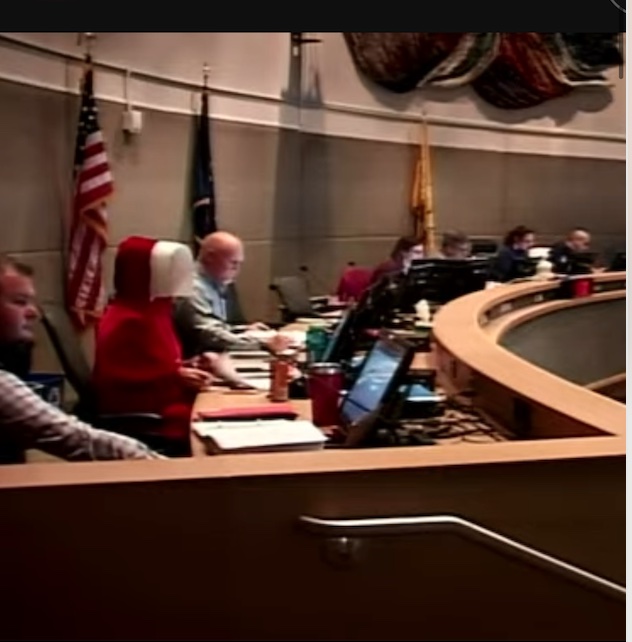
Anchorage Assemblywoman Karen Bronga is evidently upset with the national election of Donald Trump for president. So upset, she expressed her Trump Derangement Syndrome distress by dressing up as a concubine modeled after a character from Margaret Atwood’s “A Handmaid’s Tale,” a dystopian novel about a time when women are kept as breeding stock, due to low fertility levels in the human population.
Dressed in red with a white modesty bonnet, Bronga sat in her seat at the Assembly chambers for the official meeting, which had been postponed from its usual Tuesday time. You can see the meeting on YouTube:
Women like Bronga, who are often dealing with a lot of personal trauma, have worn these costumes to protest Donald Trump in general, as their way of calling him a fascist.
On Tuesday, one woman — not in Alaska — was observed wearing such a costume to her polling place. While Republicans wearing “MAGA” hats were removed from or forced to remove their hats at polling stations for “electioneering,” women dressed in these concubine outfits were not considered partisans by election officials.
Trump has won Alaska by 55% of the vote so far, his highest win ever in the 49th state.
After Donald Trump staged the biggest comeback in American political history on Nov. 5, 2024, the Alaska delegation had a decidedly mixed reaction.
U.S. Sen. Dan Sullivan was congratulatory, issuing a fullsome statement that was optimistic about Alaska and the future of the country:
“I want to congratulate President-elect Donald Trump and Vice President-elect JD Vance on their historic victory last night and I want to thank the hundreds of thousands of Alaskans who took the time to make their voices heard at the ballot box. I also want to congratulate my new and returning Senate colleagues on their hard-fought victories—returning Republicans to the majority in the U.S. Senate,” Sullivan said.“This election came down to the simple fact that millions of Americans were better off under a Trump presidency than under the last four years of the Biden-Harris administration. For Alaskans, the choice in this election was particularly stark, and in my view, it wasn’t even a close call. President Trump and his administration were an incredible partner to Alaska, listening to our concerns, taking actions to promote economic opportunity and good paying jobs, and putting Alaskans in the driver’s seat of our state’s destiny.
“Under the Biden-Harris administration, with strong help from Democratic Senate Majority Leader Chuck Schumer, Alaska sustained an unprecedented onslaught of negative, unwarranted federal actions—treatment no other state has ever experienced. With 67 executive orders and actions targeting our state, the Biden-Harris administration has sought to unravel the progress we achieved under the Trump administration by locking up our lands, killing our jobs, and harming our economy, all the while ignoring the voices of Alaskans and even defying federal law.
“As I did eight years ago, I will be working closely with President Trump, his administration, and my Senate colleagues to seize the opportunities before us, advance the interests and priorities of Alaskans, and make America stronger and more prosperous than ever before.
“This was a contentious and often heated campaign with strong, sincere feelings on both sides of the aisle. While we may disagree at times on what policies are best for our country, we should never forget that we are all Americans.”
Sen. Lisa Murkowski, who considers Trump a traitor and an enemy of the nation, did not issue a statement. She has indicated in the past that she may switch her party to independent if Trump is elected.
Update: Late on Wednesday evening, Murkowski issued a statement: “I congratulate President Trump on his clear victory. Alaskans, and Americans, have chosen him to lead our nation forward for the next four years, amid many serious challenges that will take all of us to overcome. As I have with every president, I will work with President Trump whenever and wherever possible to advance Alaska’s priorities. I also look forward to working with my colleagues as Republicans re-assume the Senate majority, which will provide additional opportunities for Alaska.”
Murkowski indicated in her statement that now that the Republicans have taken control of the Senate, she will remain a Republican.
Rep. Mary Peltola, who along with Murkowski refused this year to announce who they supported for president, also did not issue a statement. Peltola is currently losing her reelection bid to the U.S. House, which will likely be controlled by Republicans during the next two years. She has been mum for about 24 hours.
Vice President Kamala Harris conceded the election on Wednesday morning, but darkly: “There is an adage: Only when it is dark enough can you see the stars. I know many people feel like we are entering a dark time.”
Steve Schmidt, the political consultant who in 2008 convinced John McCain to pick Alaska Gov. Sarah Palin for his vice presidential running mate, said this: “Fascism has come to America, and as predicted, it is wrapped in the flag and carrying a cross.”
On Tuesday, Alaskans joined Americans in a record-breaking exercise of their right to vote.
While the country is rightfully processing the roar that is President Donald J. Trump’s historic electoral college and popular vote landslide return to the White House, citizens of the 49th state know that governance closer to home has the most direct impact on their daily lives.
The coffee is still taking its effect on the sleep deprived eyes, and data from the Alaska Division of Elections is trickling in and will be hampered as the state waits two weeks for Scott Kendall’s Frankenstein of ranked-choice voting to do its laboratory calculations.
Nevertheless, a lot of moves are being made as this is written to organize the state Legislature in January, and the speed of the commentary won’t be able to keep up with events as they unfold.
Without further ado, here is a preliminary list of winners, losers, and “it’s complicated” from Tuesday night:
WINNERS:
Alaskans won on national issues
The return of the Trump Administration, coupled with a Republican Senate Majority and the chance for the Republicans to hold the House of Representatives for the next Congress, opens the door to huge issues that matter to Alaskans.
Under President Joe Biden, V.P. Kamala Harris, and their environmental lobby-led leadership, Alaska has effectively been locked up, with no new development allowed. ConocoPhillips’ Willow Project, cited in the National Petroleum Reserve-Alaska (emphasis added), needed a near miracle to be permitted, despite the hundreds of millions the company spent to get this multi-billion effort sanctioned.
ANWR will likely remain in litigation for some time, but that could receive a friendlier ear before judges thanks to the Supreme Court scrapping the often-abused Chevron Deference, empowering bureaucrats to gaslight lawmakers on the bills they passed and snarl every type of project in endless administrative red tape.
The Ambler Road, which has been sanctioned by Congress and the (checks notes) Jimmy Carter administration over forty years ago, may be free from the shackles Biden’s BLM has placed on it illegally and unfairly.
Alaska’s clout in Congress … mostly
U.S. Sen. Dan Sullivan must be feeling the vibe today. Being back in the majority saddle will be huge to the Marine, and there is a laundry list of deferred Alaska issues that a Republican Congress and a Trump administration can move through next year.
Sen. Lisa Murkowski might be feeling the burn, as she has suddenly become on the outs with the White House, and possibly with the congressman-elect for Alaska.
Then there is Nick Begich III, possibly congressman-elect.
The grandson of Alaska’s former Democratic Congressman Nick Begich, a nephew to a Democratic former U.S. senator (Mark Begich) and nephew to a former state senator (Tom Begich), NBIII is a Republican entrepreneur who has never held elected office, but who is poised to return Alaska’s lone House seat to the GOP after the hiatus that has been Mary Peltola.
During Peltola’s term, every congressional district that touched the Pacific Ocean was represented in Congress by a Democrat. NBIII is going to change that.
Begich won the old fashioned way, going living room to kitchen to coffee shops in towns and villages throughout Alaska, listening (isn’t that a nice change?) and articulating a modern vision to keep Alaska relevant in the nation and the world, a prerequisite for an effective member of our Congressional delegation.
Despite the name, more associated with Democrats, Begich’s self-made resume contrasted sharply with an anointed special interest scion from Bethel, and the voters recognized that. With his young age, authenticity, and tenacity, there is a long potential public service path for this man.
Decision Desk HQ says Republicans have 92.4% chance of controlling the House, with a possible 223 Republicans to 212 Democrats, which bodes well for Alaska.
Rep. Mike Cronk of Tok and Rep.-elect Rob Yundt of Wasilla join the ranks of the somewhat ecclesiastical upper chamber of Alaska’s Legislature.
One couldn’t cast two more perfectly genuine men who are emphatically Alaskan.
Cronk, the legendary basketballer, teacher, and hunter from Tok via Northway, ascends to the Senate seat vacated by Sen. Click Bishop.
Yundt, the Mat-Su native son who spars in mixed martial arts rings, coaches kids, builds homes, and serves on the local borough assembly, takes aim with his practical small business sense at Juneau, unseating Sen. David Wilson, the incumbent who joined with Democrats in a coalition.
Alaska’s electoral system
Ballot Measure 2, which repeals the Rube Goldberg rewiring of the state’s election processes, looks like it may pass — barely. The wild card will be the mail-in ballots, which are trending toward “no.”
If the Yes result holds, it is national news, and a stunning repudiation of the state’s burgeoning upper political class who attempted to change this state through experimenting on voters every two years.
Alaskans had the benefit of the 2022 elections to see just how flagrant they were misled by the 2020 initiative that ushered in complicated voting that manipulates the voters.
Called ranked-choice voting for short, the initiative also did away with the primaries that allowed parties to choose their nominees, and it allowed unlimited dark money for ballot initiatives, while restricting such dark money for candidates.
Alaskans, we hope, grew wise to this gimmick, and the obvious reason it was created: to help re-elect Sen. Murkowksi and empower her affiliates in the state, such as her ally, the ever-litigious attorney Scott Kendall.
Expect this result to get litigated, and for Kendall to bill the public for his time in court.
LOSERS:
Alaska small businesses
Voters resoundingly passed ballot measure one, which will raise the state’s minimum wage to $13 an hour next year, eventually rising to $15 an hour.
More pernicious was the blanket requirement for all businesses to provide sick paid leave to employees, regardless of the size of the business.
The last part of the initiative (the real reason the AFL-CIO and all the unions pushed for this) was a ban on businesses effectively holding meetings with their workers when they are considering unionizing. The effect on this collectively will be absorbed by larger, well-capitalized employers.
Expect the hospitality industry in this state, which is overwhelmingly locally owned and operated, to reel pretty heavily. Between Covid lockdowns, inflation on all goods, a labor shortage, and government red tape, the entrepreneur is becoming an endangered species in Alaska.
Conservative leadership in the Legislature
If these results hold in state races, expect the State Senate to remain governed by a predominately Democratic-dominated coalition. The House looks similarly poised with the election of Chuck Kopp in south Anchorage and false flag independent Ky Holland.
If both bodies go “bi,” expect a bevy of bills that have been cooled in the conservative House to be unleashed, including a return to budget busting pensions, taxes, and new operating spending plans for government. The tabulations still have to run, and there is the chance for the course to change. But it will take a big one.
Sen. Lisa Murkowski
If the results nationally hold, Republicans look poised to pick up a 52-53 seat majority. With that margin, Murkowski, who wears her disdain for Trump and much of the state Republican voting base on her sleeve, will be out of the spectrum to be the wannabe power broker of the chamber.
Her political capital has dwindled in many fronts with her Republican colleagues in the Senate, and the return of President Trump does not bode well for facetime in the White House.
Additionally, her endorsement of Democrat Peltola in the congressional race and her opposition to repealing ranked choice voting has not aged well already.
The senior senator looks positioned for an ignominious exit from politics, following in her father’s tradition.
Pollster Ivan Moore
“IT’S COMPLICATED”
Governor Mike Dunleavy
Dunleavy’s guy won the White House, and the rumors will go from whispers to shouts about whether he will be offered a position in the cabinet of the 47th president.
If so, Dunleavy will cap an incredible run, being only the 3rd Republican governor to win two terms in Alaska, and the first governor since 2002 to be returned to the Third Floor in Juneau.
His support of opposing ranked choice voting resets elections back to where they were before 2020, which is a mean feat. And his support for candidates like Jubilee Underwood, if the returns maybe hold, deepens the bench of fresh conservative talent.
However, some of the governor’s key allies in the Legislature, such as Rep. Craig Johnson and Rep. Thomas Baker look like they were unsuccessful in re-election, and Dunleavy-supported candidates like Lucy Bauer are facing an impossible climb on the absentee votes.
The governor is potentially poised, if he is not selected or does not take a position in the Trump administration, to face a unified and hostile Legislature for the last two years of his tenure.
Third-generation Alaskan Nick Begich, on his second run for Congress, is the favorite to win the 2024 race to unseat Democrat Rep. Mary Peltola, who won in 2022 after Sarah Palin jumped into the race and the last minute and split the Republicans.
As of Election Night, with all Nov. 5 and all the early votes cast through Oct. 31, Begich, a Republican, is ahead. He has 124,632 votes, for 49.66%. Peltola has 113,612 votes for 45.27%.
Third-party John Wayne Howe has 9,710 votes or 3.87% and Democrat Eric Hafner has 2,446, not quite 1% of the vote.
Begich is on course to win Congress. There are not enough votes to get Peltola over the 50%+1 vote threshold.
It’s going to be hard for Peltola to catch Begich. With the outstanding ballots to be counted, she has to do 4.4% better than she has done with those ballots already counted. Begich only needs .2% to get to 50% of the remaining absentees, questioned, and early votes that came in over the weekend and Monday.
Then there is the ranking. Right now, there are about 10,000 votes from Howe and Hafner to be ranked. Peltola needs all of those, which is nearly mathematically impossible.
The caveat is Alaska has to wait to learn how many questioned, absentee and early votes have not been counted yet.
In Peltola’s favor is that the unreported precincts are all rural, and there are 28 precincts unreported.
However, these are tiny precincts, like Shishmaref, where Peltola got 78% of the vote — and prevailed there by a margin of 111 votes.
Not all the precincts that haven’t reported are that pro-Peltola. Shishmaref is one of her strongest. She might gain about 50 votes per precinct; that would be about 1,000 votes.
But with ranked-choice voting still in effect, Alaska may have to wait until Nov. 20 to have Begich declared the “official” winner. The delay in being able to call him the winner impacts Alaska’s role in Congress, as members are ranked in seniority depending on how long they have been in Congress. As happened for Peltola in 2022, ranked-choice voting put Alaska in nearly last place in seniority, another unwelcome gift by the ranked-choice voting scheme designed by Sen. Lisa Murkowski and her supporters.