Friday, July 31, 2026
Home Blog Page 328

Payback time: Murkowski cuts an ad for ranked-choice voting, which was designed for her

The latest ads paid for by $12.7 million in dark-money opposing Ballot Measure 2 star the very person the entire ranked-choice voting scheme was designed to re-elect: Alaska Sen. Lisa Murkowski.

Murkowski is asking voters to vote “no” on Ballot Measure 2, and keep the new system of voting, which voters barely approved in 2020.

The Alaska Republican Party says to vote “yes” and repeal the scheming system. Former Lt. Governors Craig Campbell and Loren Leman have said to vote “yes” in columns at Must Read Alaska.

Murkowski had been censured by the Alaska Republican Party for her behavior in the past, particularly her impeachment vote to convict President Donald Trump — after he left office. Without Republican support, her liberal followers, led by attorney Scott Kendall, put together a scheme whereby she would not have to run in a Republican primary, which she would not be able to win. With dark money from Outside the state, they painted a rosy picture for voters and concealed their main intent — turning Alaska blue.

Voters approved of the scheme, which combines no-party primaries and ranked-choice general elections.

Then, in 2022, the Alaska Democratic Party put up a place-holder candidate who was running in order to placate the national Democratic Party. Local Republicans advanced conservative Kelly Tshibaka, who was endorsed by not only by the party but President Donald Trump.

Using the new system, Murkowski easily won reelection in 2022, with the help of Alaskans who vote Democrat. In fact, Murkowski, due to ranked choice voting, ended up with the highest percentage of votes she has ever gotten, due to Democrat voters marking her either first or second on their ballot. Murkowski won 48.6% of the vote in 2004, 39.5% in 2010, 44.4% in 2016 and — due to the ranked choice advantage she and her supporters designed for her — 53.7% in 2022.

Now, with many Alaskans disillusioned with the false promises made by backers of ranked choice voting, the “No on 2” group brought in Murkowski, who is paying back the favor to the same people who helped her retain her seat in the Senate.

This month, Murkowski also endorsed Democrat Mary Peltola for Congress, the second time she has endorsed Peltola. Murkowski is once again on the outs with her own party, she continues to align more closely with the Alaska Democratic Party, which fully embraces ranked choice voting, after seeing how it worked for Murkowski and Peltola.

In the end, Murkowski became beholden to the Democrats because they helped her defeat Republican voters.

The $12.8 million in Outside money being spent to keep ranked-choice voting in Alaska is motivated by liberal entities who are in the process of spreading the system to other states. They’ve spent tens of millions of dollars and would be set back if Alaskans take back their elections from the outsiders like John Arnold of Texas, and the dark money entities that have taken over Alaska elections. Most of the funds they are expending this year are in Alaska — to save what they created as the model for other states.

Seeing the danger of dark money, five states this year banned the use of ranked-choice voting. They are Alabama, Kentucky, Louisiana, Mississippi, and Oklahoma.

On Nov. 5, Colorado, Idaho, and Nevada will vote on whether to adopt ranked-choice voting. Oregon and Washington, D.C. will also vote on adopting RCV in both party primaries and the general election.

Missouri will vote on a ballot measure to ban ranked-choice voting.

Peltola is all hat, no cattle in congressional Western Caucus, where she’s been a no-show

Rep. Mary Peltola paid her dues so she could claim membership in the Western Caucus, a congressional conservative group that works on issues impacting the West, especially land management and federal overreach.

But, just as she’s missed 40% of her votes in Congress this summer, Peltola has been a no-show for her Western colleagues.

Rep. Pete Stauber, the congressman from Minnesota who tried to help Alaska by sponsoring the Alaska’s Right to Produce Act, blasted Peltola this week in a statement:

“As a Vice Chairman of the Western Caucus, I have been proud to stand with my Republican colleagues in our fight for rural America. While Rep. Peltola has not been active in her membership in the Western Caucus, she also failed to support critical policies that will unleash American energy and mineral dominance,” Stauber said.

“For example, she was the only Western Caucus member to vote against the Lower Energy Costs Act, landmark legislation endorsed by the caucus that would have cut red tape, empowered American workers to responsibly produce our God-given natural resources, and would lower energy costs not only for Alaskans, but for all Americans,” he said.

When Peltola does vote on legislation, she’s been a disloyal member of the Western Caucus. When Stauber offered the Alaska’s Right to Produce Act to unwind the Biden sanctions on Alaska, Peltola signed on as a co-sponsor, but then she snuck notes to her Democrat colleagues to vote against the bill, and she voted only that she was “present.”

“Rep. Peltola has not stood up to support other important pieces of legislation that advance many of the Western Caucus’ priorities for rural America, including House-passed appropriations bills that would fund the Department of the Interior, all while blocking the Biden-Harris Administration’s harmful policies that are hurting Alaskans,” said Rep. Stauber, making it clear he is no fan of Peltola, who is running for reelection.

Congressman Don Young was a longstanding and active member of the caucus, and served as its vice chairrman for Indian Affairs and Oceans. The caucus is dedicated to working on issues such as forestry, land management, agriculture, energy, mining, endangered species, and water.

Nick Begich, the grandson of Congressman Nick Begich, is running for the seat to represent Alaska, which only has one “at-large” member of Congress.

Election roundup: Voted ballots burned in Arizona, court rules illegals allowed to vote in Virginia

As early voting is under way across the country, issues are popping up in several states. Here are some snapshots from various news sources around the country on Friday:

Arizona: In Maricopa County, home of Phoenix, about 20 ballots were burned when someone set fire to a mailbox.

Pennsylvania: In Lancaster County, election workers flagged 2,500 voter registrations dropped off Monday in Lancaster County for suspected fraud. Many of them had the same handwriting.

Virginia: A federal judge is ordering Virginia to return the names of more than 1,500 “noncitizens” to voter rolls following a lawsuit filed by the Department of Justice saying the commonwealth violated the National Voter Registration Act.

The Justice Department said the commonwealth unlawfully removed individuals deemed “noncitizens” from voter rolls within 90 days before an election, citing a “quiet period” in the National Voter Registration Act that mandates “no such voter cancelation or list maintenance programs may be conducted” within that time period.

Virginia Attorney General Jason Miyares is blasting the ruling, calling the move a “politically motivated stunt.”

Mississippi: The Fifth Circuit Court of Appeals ruled against a Mississippi law that allows ballots that are postmarked Nov. 5 to be counted if they arrive up to days later.

The ruling covers Mississippi, Louisiana and Texas, but the issue has been remanded to a lower court for further deliberation and will likely get appealed to the U.S. Supreme Court.

Georgia: Nearly 2.5 million ballots have been received in early voting. Secretary of State Brad Raffensperger said early voting this year is “shattering turnout records.” Thus far, 35% of all the state’s registered voters have cast their ballots.

Maine: Nearly 165,000 voters have already returned their ballots. Maine has 948,734 registered voters; thus one out of four have cast a ballot already, either by mail, in drop-boxes, or through in-person voting. Maine has ranked-choice voting.

California: More than two million California voters have already voted early, according to Political Data Inc. That is about 11% of California voters have returned their ballots.

Tim Barto: Owning a Biblical worldview

By TIM BARTO

We all have a lens through which we see the world; this is known as our worldview.

There is something remarkable going on in the United States: The trending worldview is non-Christian, even among Christians.  

The Family Research Council’s Center for Biblical Worldview studies this topic in depth, and Senior Research Fellow George Barna conducted a major survey that looked at how Americans see the world. The results are quite fascinating, if not alarming.

Take a look at these basic findings:  

  • 51% of American adults think they have a Biblical worldview, when – according to their answers to the survey – only 6% actually do. 
  • Only 31% feel it’s very important for their religious faith to influence every aspect of their lives. 
  • Of those who consider themselves Christians, only 68% think they have a Biblical worldview, but only 9% provided answers that indicated they actually have a Biblical worldview. 

So, the concern for American society is not just that society in general is non-Biblically based, but that even a majority of self-identified Christians do not see the world through the book on which their faith is based.

This probably comes as no surprise to those who witness our society crumbling on an almost daily basis. The line separating boys from girls, and men from women, is being blurred, dissipated, and mocked. Public school administrators and board members defend stocking library shelves with sexually explicit books. Parental rights are superseded by enlightened government officials.  The number of sex partners one has is laughed away as a person’s “body count.”

And, of course, claiming a pre-born baby is worthy of respect and life is labeled “fascist” and part of the patriarchy that needs to be smashed. 

The list goes on and reveals the fact that religion is decreasingly important in our country. As moral relativism increases, religious practice decreases. According to the American Survey Center, Gen Z is the least religious group of people in our country’s history, a strong indication that worldviews will continue to be more likely influenced by pop culture, Hollywood, and public educators. Gen Z is less influenced by church attendance and religious-based teaching. 

According to David Closson, Director of the Center for Biblical Worldview, there is hope in these survey findings. For those who see themselves as having faith but whose worldviews are skewed by secular philosophies, Closson sees an opportunity to open their eyes to what the world actually looks like when viewed through the lens of the Good Book.

Closson and his colleague, Joseph Backholm, Senior Fellow with Biblical Worldview and Strategic Engagement, are so committed to teaching people –- including pastors and church leaders –- about Biblical worldview, that they are traveling the country doing so. They will be in Alaska next week; in Sterling on Oct. 29, Chugiak on Oct. 30, and Palmer on Oct. 31. If you’re interested in attending one of their presentations, visit Alaska Family Council. 

Tim Barto is a regular contributor to Must Read Alaska, and vice president of Alaska Family Council.

Fritz Pettyjohn: Which Alaska voters will cast a ballot for Trump and then also vote for Peltola?

By FRITZ PETTYJOHN

The best way to see how the political winds are blowing is at Election Betting Odds.comEvery 20 minutes it averages the odds from six different betting sites. A month ago, Kamala Harris had a slight lead. Today Donald Trump is up 61 to 38.  What happened?

It started when Harris rolled out her new appeal to black men, offering them $25,000 to get into the marijuana business. It was stupid – deprecating and invidious. Her downward slide accelerated when, in an attempt to appeal to the macho man, she featured an endorsement from some doofus claiming he ate carburetors for breakfast.

The final weeks of the campaign revealed Harris as an empty suit. Like Hillary Clinton in 2016, she has nothing to offer except more of the same. The ultimate rationale for her candidacy is that she’s not a blithering idiot like Joe Biden. And she’s not Donald Trump.

It didn’t work for Hillary, and it’s not working for her.

In a telltale sign of desperation, her closing argument is to compare Trump to Adolf Hitler. The dreaded October surprise was the revelation that Trump’s embittered former chief of staff heard Trump saying complimentary things about Hitler’s generals. Her closing argument is that Trump is a fascist.

Miracles happen, and there’s a small chance this line of attack will propel her to the White House. But fewer and fewer bettors are willing to put their money on it.

This is all fabulous news for Alaska, its economy and work force. We may never see an economic boom like the old pipeline days, but good times are on the horizon. Gov. Mike Dunleavy may, or may not, be the next Secretary of the Interior, but in any event, he has Trump’s ear, and the development of Alaska’s natural resources will be high on Trump’s agenda.

Which brings us to Nick Begich and Mary Peltola. 

How is it possible for a voter to support Trump, and then turn around and vote for Peltola? She’s a Native candidate, amiable and attractive, it’s true. But does it make any sense for Alaskans to have their only member of the House to be as incompetent as Peltola has proven to be?

In contrast, Nick Begich shows promise of being as effective an advocate as his grandfather, the original Nick Begich.  Thousands of Alaskans have had the chance to meet Nick. He’s an impressive candidate, smart, affable, energetic, and ready to get to work for the people of Alaska. He’d be a great asset to the state, just as his grandfather was.  

The only way he can lose is if some of Trump’s voters desert him for Peltola. How, in the name of all that’s holy, can you explain that decision?

It can only be people who, for whatever reason, sympathize with someone who is clearly over her head. We can only hope there aren’t too many of them.

Fritz Pettyjohn’s first venture in politics was working for Goldwater for President in 1964. He served in the Alaska Legislature in the 1980s and writes the blog ReaganProject.com.

Fletcher turns her final Fairbanks Assembly meeting into a campaign stunt

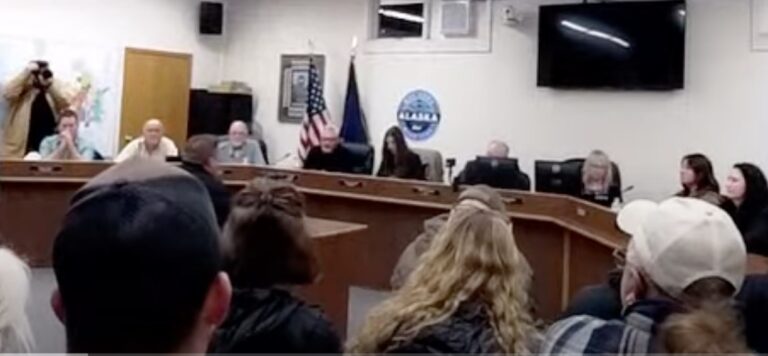
The final Fairbanks Borough Assembly meeting that Presiding Officer Savannah Fletcher managed was turned into a type of campaign event for her on Thursday, after two dozen people signed up for public testimony and used their time at the podium to show their support for her campaign for Senate. Much of the meeting was taken up by her campaign rally.

Community activist David Leslie spoke early during the public testimony period, thanking Fletcher for her work in stopping genocide in Gaza. Fletcher, originally from Washington State, has been an opponent of Israel’s right to exist. Others echoed the Leslie words of praise for Fletcher, a radical member of the Assembly.

Two of Fletcher’s major campaign funders — Kristen Schupp and Bobby Burgess — showed up to the meeting with flowers, which they presented to her. Burgess sat in the audience wearing a Fletcher for Senate pin.

The curious thing about the entire spectacle is that all of those who signed up had the same handwriting. It is against Assembly rules for a person to sign up others for public testimony, but in this case, all were signed in by the same hand and Fletcher did not object. A scan of names revealed nearly all were registered Democrats or Green Party members; Fletcher is one of the fabulous fakes who says she is not with any party, but she is paying the Alaska Democratic Party to use their coordinated campaign program and she volunteers with the Alaska Democratic Party.

Fletcher is running for the seat being vacated by Sen. Click Bishop. Her opponent, Rep. Mike Cronk, is a Republican from Tok who serves House District 36.

Early voting resumes in Craig, after car crash at City Hall closed building for three days this week

Early voting has been strong around Alaska, but not in the Southeast Alaska island community of Craig. A vehicle that crashed into City Hall in Craig, on Prince of Wales Island, ended up taking out early voting for the first three days of the week.

Voting and other city business was running again on Thursday. The vehicle didn’t do extensive damage to the building, but did impact the electrical system, requiring extensive repairs.

Craig residents said they were able to vote on Thursday.

City Hall is the only place in the community where voting takes place. Home to about 1,000 people, Craig is the largest community on the island, and is located about 56 miles north of Ketchikan.

Chair of House Natural Resources Bruce Westerman checks in with Alaskans before Election Day to support Nick Begich for Congress

In a devasting blow to Rep. Mary Peltola, House Natural Resources Committee Chairman Bruce Westerman has been in Alaska this week to share with Alaskans his frustration about Peltola’s lack of advocacy and effectiveness for responsible resource development.

Westerman hosted multiple events with congressional candidate Nick Begich and toured industrial sites where equipment was being made and shipped to the North Slope. Both Gov. Mike Dunleavy and Sen. Dan Sullivan attended events with Begich and Westerman. It was a rare move; usually a chair of a committee doesn’t support the opponent of one of his own members, but in this case, Westerman did, in a big way.

House Natural Resources Committee is arguably the most powerful committee for an Alaska congressional representative to serve on and Alaska has always had a presence on the committee.

But during a candidate forum this month, Rep. Peltola said she would gladly give up her seat on Natural Resources if she could only get a seat on the appropriations committee.

Westerman was taken aback at her statement. Alaska has a strong need for a resource-based economy and Peltola has campaigned on “fish” issues, all of which go through the House Natural Resources Committee.

But it follows the Peltola pattern. Earlier this year, Peltola refused to vote for the Alaska’s Right to Produce Act, and she snuck behind the sponsor’s back and told Democrats to vote against the bill, while she voted “present.”

It was a bill that would stop the Biden Administration from locking up Alaska’s congressionally designated oil and gas leasing areas. It’s a bill that Peltola had initially cosponsored before deciding to distance herself.

The Alaska’s Right to Produce Act would reinstate previously awarded, Biden-canceled oil leases in the Arctic National Wildlife Refuge.

Tom Boutin: Peltola’s food stamps and fentanyl economy just isn’t cutting it

By TOM BOUTIN

What follows is something I sent to newspapers in Alaska some time ago, and one or more have published it.   

I would guess that almost none of the readers here at Must Read Alaska are not voting for Nick Begich, but it’s extremely important to emphasize that we all must urge family and friends, store clerks where we shop, people we see at the gun range, old acquaintances we may see, and anyone else who will listen to the importance of sending Nick to Washington rather than Mary Peltola.   

Mary Peltola is guilty of joining the elites in trying to fool us into believing that Biden has the lucidity and situational awareness to actually be doing his job.   

In doing so she likely leveraged the fiction there to bring back to Alaska federally borrowed dollars, especially to rural constituencies it seems, and that reveals a contempt for most of us and for the seriousness of the federal deficit.   

She sometimes expresses an arrant misunderstanding of the inflation and economic dislocation Alaska is experiencing right now. Part of the reason many working-age Alaskans who want to climb the economic ladder (but not work for government) are leaving the state and other working-age Alaskans are choosing food stamps and fentanyl when there are plenty of well-paid jobs available is the very policies touted by Mary in her political campaign.  

I watched all the debates. Mary has never done anything foolish, but neither has she ever said anything wise. She trades for her own account, as we all do, but she identifies her constituency as only a small subset of Alaskans when she tells the rest of us that we should be satisfied that she supports fish, families, and veterans. Who doesn’t? And what in the world does that really mean?

She held out in the Alaska House to bring expensive projects to the rural Yukon-Kusko region in return for her deciding vote in converting PERS & TRS to defined contribution, but which of those projects can be remembered or even identified today?  Which village became self-sufficient upon completion of those projects?

Our entire state economy looks to government spending for food, health care, child care, housing, and investment. No state suffers as much from the federal borrowing and spending debacle, because we produce so little while consuming so much; too much bought from outside, and too little produced here for trade leaves us the most vulnerable to inflation.   

We are 700,000 people living on 400,000 barrels of oil and a Permanent Fund that loses spending power every day.  

Mary claims credit for bringing federal money home to the bush while not understanding that the spending causes the very inflation we fear and feel every day.   No matter which party wins the White House and Congress, inflation will return big time come November 6 because the 30, 50, and 70 percent raises are actually paid at the end of the supply chain – which is us.  Interest rates will again trend higher and federal banks will chase their tails.  In every debate Mary has made it clear this is all beyond her understanding.

As I watched those debates it was also clear that Nick Begich understands our economic and fiscal predicament while Mary does not. The economy we planned to build with our oil wasn’t built, and we are all to blame. Drone manufacturing, seed potato prodigy, water supplied to the southwest, cold climate data storage, plastics and fertilizer hegemony, natural gas pipeline, Watana dam, carbon credit magnate, hemp farming, and missile launch dreaming disappeared as soon we stopped paying consultants.   

Only two years ago state revenues were claimed to be on schedule to begin receiving hundreds of millions from standing timber carbon credits, but today there is no such entry in the state revenue forecast, so one more silly dream has disappeared. We tried to replace declining oil production with imaginary comparative advantage, and all we got are food stamps and fentanyl. Mary is the ghost of our misspent past, and sending her minority voice back to Washington would convert the office from a quaint embarrassment to a grave impediment.

The Washington to which we sent Ted, Frank and Don (and what a great job they did) was entranced by Alaska but that time is very distant. The investment banking firms that urge dismantling TAPS went from billions to trillions in measuring their capital while we were focused on keeping up with food stamp enrollments and funding the state budget.  

The debates also revealed that Mary is trending toward being imperious, always a hapless sign in a public official.   As a first impression she can appear as a heroine of excellent parts and not at all vain, but soon revealed as splenetic. She might be bound for Dancing with the Stars, or Saturday Night Live, but Nick will explain Alaska and help us find our place in this century.  

Mary looks backward to seek even more deficit spending but it’s Nick who shares our realistic vision for Alaska: so please be sure to vote that way.   

Tom Boutin is a Juneau resident who has served as chief of staff for the Alaska State Bond Committee, the Alaska State Pension Investment Board and the Alaska Retirement Management Board. He also was the CEO of the Alaska Industrial Development and Export Authority, a state-owned bank, appointed by Gov. Mike Dunleavy. In addition, he worked for many years in the forest products industry.