Wednesday, October 21, 2026
Home Blog Page 327

David Boyle: Round 2 of Anchorage school closures

By DAVID BOYLE

The Anchorage School District knows that it has too many schools for too few students. And the future is bleak for increased numbers of students showing up through 2028.

ASD is not alone with the problem of too few students for too many school buildings.  Some school districts take a courageous stand, rightsizing the school system to fit the population while still maintaining room for growth.  

The Denver Public School system, for example, is proposing to close 10 of its schools. And the Jefferson County School District in the Denver area has closed 10 schools with another four scheduled for next year due to lower enrollment.

 The Anchorage School District has too many elementary schools for far fewer students.  It currently has a “program” capacity of 26,432 students in its elementary schools. But there were only 19,484 elementary students in the 2022-23 school year.  And fewer this year.

That’s alarming enough. But the future looks even worse. The district projects it will only have 16,826 elementary students in 2027, almost 10,000 fewer students than the district’s school capacity.

People are just not procreating like they used to.

Realizing the excess capacity of elementary schools and the need to reduce costs, the district has developed a comprehensive strategy to close excess elementary schools. This strategy includes the following decision matrix:
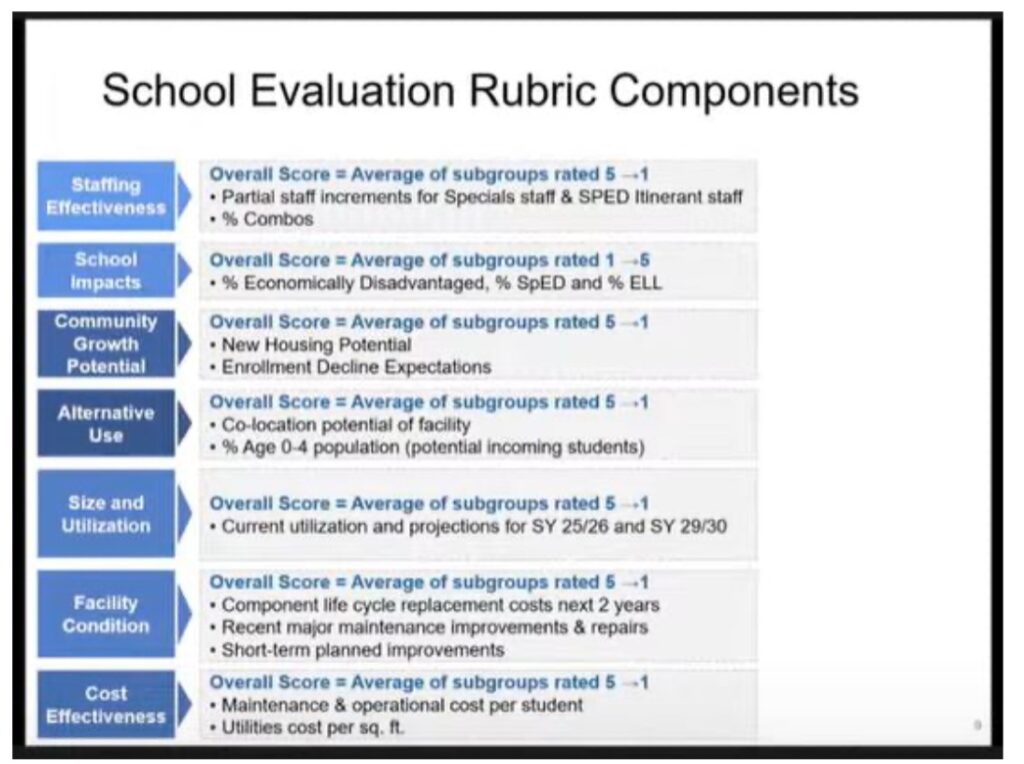
All the above rubric components give a grade from 1 (lowest) to 5 (highest) for elementary schools.

The components are pretty self-explanatory, but the “Staffing Effectiveness” does not really include the effectiveness of the staff.  It only shows the impact of the special education staff and other staff such as those that must travel from school to school, such as music teachers.

What it doesn’t show is the effectiveness of the classroom teacher.

That would be a much better measure of “Staffing Effectiveness”.  

Here are the AKSTAR standardized test scores of the 8schools that the district has selected for closure:

SchoolEnglish Language ArtsMath
Baxter2320
Bear Valley6771
Fire Lake3145
Lake Hood1612
Nunaka Valley3336
Tudor3224
Wonder Park2421
Anchorage Total (3-9)3637

Why would Bear Valley be selected for closure if its students have better outcomes than all the other elementary schools?  Does it make sense to break up a successful team of students and teachers, regardless of the building condition?

The school building seems to matter little when it comes to student achievement.

Here’s Eagle Academy Charter School in Eagle River which is housed in a former automobile showroom:

Eagle Academy

And guess what?  Eagle Academy Charter School is the top performing school in the district!  Seventy-seven percent of its students are proficient in reading and 80% of its students are proficient in math.

Here’s another outstanding charter school: Aquarian Charter School:

Aquarian Charter School is housed in a former school building that the district discarded many years ago. But the parents and kids don’t care. They want to learn and they have very effective classroom teachers. It shows in the scores: 69% are proficient in reading and 69% are proficient in math.

So, it’s not the school building. It’s effective classroom teachers, plus motivated students, plus an outstanding curriculum.

Board member Pat Higgins voiced that he was focused on academic outcomes that were not stressed enough in the rubrics.  Chris Opitz, academic officer, noted that when Abbott Loop school was closed that both math and reading scores increased marginally. And the attendance rate increased as well.

The district proposes to repurpose some of the excess schools to house charter schools, thus saving rent costs.  It also proposes to repurpose some schools to house PreK and special programs. 

So, it sounds like the schools may be closed; students moved to other neighborhood schools; the buildings repurposed; and no loss of jobs. Wow. That’ll close the budget gap?

That will be for the next chapter in the ASD school closure battle. How much will the district really save?

Here is a link to the ASD “Rightsizing Infrastructure Project.”

The Anchorage School District’s problem in a nutshell:

The total “program capacity” for elementary schools today would hold 26,432 students. 

The actual number of students in 2022 was 19,484, a nearly 7,000 student excess capacity.  

There is even a further downward trend in the future until the projected number of elementary students is 16,826 in 2027, nearly 10,000 students fewer than the district’s capacity.

A school building is just that and nothing more. What happens in the classroom is what is most important. An effective classroom teacher and an effective curriculum are the keys to student success.

David Boyle is an education writer for Must Read Alaska.

A message to the Alaska House ‘majority’: The people have, indeed, spoken

23

By REP. JAMIE ALLARD

“The people have spoken!”

It’s always interesting to hear who shouts that first and loudest after an election. The statement implies a fundamental truth about our democratic republic: Unlike dictatorships, we have a direct say in who writes our laws and makes the calls on how our government is run. But politics is, unfortunately, more based on optics and power than truth. 

Case in point: the opinion piece written by the supposedly incoming leadership (Bryce Edgmon, Chuck Kopp, Louise Stutes, Neal Foster, Calvin Schrage, Andy Josephson and Zack Fields) of the state House.

The whole thing was likely ghostwritten by Democrat political operatives, and we congratulate the Democratic Party for “flipping the House,” as they are now taking credit for it everywhere. Let’s give credit where it’s due:

The Democrats’ Tuesday op-ed is a bit “TLDR,” so let me save you the trouble and the clicks to the ADN and give a quick summary of what was said: “the people voted for us (Dems and friends) to oppose a conservative Governor and legislature, to ram budget busting pensions through, look at taxes, and jack up spending. We can prove it because we are here and in charge. And we are ready to get to work.”

Hold those horses people, especially what comes out of them.

The people of Alaska, like our country, did vote overwhelmingly in a clear voice for some things. They voted to change out the White House leadership, which is run either by an elderly mentally incompetent guy or a network of unelected advisors carrying out a shadow government, with our former and now incoming President Trump, who has been slandered, vilified, persecuted, and literally shot at. The people voted to send Mary Peltola, a nice, photogenic Democrat clone for the D.C. special interests, away from Congress and put a real conservative in. 

Here in Alaska, the people voted in waves for Trump, Nick Begich for Congress, and for Republicans in the House and Senate. Let me say that again: We have a majority of lawmakers in both bodies registered as Republicans. So the head scratcher to many folks is this: Why are four Republicans in the Senate and two in the House putting Democrats in power? 

To be crystal clear, in the state House, of which I and my fellow conservatives are members, there are 21 Republicans, exactly enough to lead in that chamber.

Instead, two Republicans have crossed over, and given power to 19 Democrats and “Independents,” those people who do not affiliate as Democrats and yet the Democrat party funds their campaigns and celebrates their wins. 

Why? 

There are two reasons. One is good old fashioned power. When you are in the majority, you get to be in charge of everything, from what bills get heard in committees and put on the floor, to what size the budget is, to whether the Permanent Fund Dividend is honored, to the petty issues of office sizes, travel allowances, and other perks. Members of the “big office caucus” like the trappings of power as much as what power can do. 

The other reason is more important, and Alaskans should make no mistake about why this majority got put together. Special interests want to gut the finances of this state and make you pay for it. I don’t have to say anything except what some of these people have said on the record and in their own opinion pieces. What is their number one priority: more education funding, and returning Alaska government employees to a pension system that nearly bankrupted us twenty years ago. 

Alaskans need to know how serious this will be. If pensions are returned for state workers, local governments get to bring them back too. That means property taxes, and local sales taxes will certainly go up to cover those costs just at the city level. 

At the state…that’s a whole other story. What is left of the PFD will be on the chopping block. But don’t worry: The majority will try finding a way to pay for it by bringing back statewide taxes. Don’t believe me? Just look at the current leadership coming in. They did it before, when the original PFD raider, Bill Walker, was governor. We were lucky we had conservatives in the Senate who killed those bad ideas. But we don’t anymore. 

And we haven’t touched one of the major issues Alaskans and Americans voted this year: declaring a war on woke. We have fought for years to make commonsense changes to our laws, like preventing biological boys from competing against our girls in school sports, and not pushing gender mutilation through government policy. I guarantee you the folks in charge do not care one bit about your concerns on these issues; in fact, they relish being against you on it.

The silver lining is this: Alaskans voted for really good conservatives throughout the state, and the House cannot run wild with such a thin margin of Democrats and supposed Republicans. Your conservatives will be in every room where your wallet, your families interest, and your rights are going to be threatened. But this is will take a team effort. Those in power think they can steamroll you, but working together, conservatives in Juneau and back in regular Alaska can shine the light of common sense and truth on them. 

Enjoy Thanksgiving — and be thankful change is coming to D.C., and be ready to roll in January. The people HAVE spoken; let’s remind those who cling to power about that.

Rep. Jamie Allard represents District 23, Eagle River, in the Alaska Legislature.

Trump signs MOU with Biden regime for transfer

The mainstream media will have to find something else about which to wring its hands, now that the incoming Trump Administration has signed a transition-of-power agreement with the Biden regime.

Susie Wiles, Trump’s White House chief of staff, announced that the Donald Trump transition team had signed an agreement to formally begin the transition of power, The signing of a Memorandum of Understanding allows cabinet nominees to begin their preparations to take over agency work.

“After completing the selection process of his incoming Cabinet, President-elect Trump is entering the next phase of his administration’s transition by executing a Memorandum of Understanding with President Joe Biden’s White House,” Wiles wrote in a statement. “This engagement allows our intended Cabinet nominees to begin critical preparations, including the deployment of landing teams of every department and agency, and complete the orderly transition of power.”

For several days, the media has been expressing shock that the Trump team had not yet signed the usual agreement.

Among the concerns of the Trump Team is that they didn’t want to use Deep State assets because of their prior experience with the Deep State actors in the alphabet agencies sandbagging Trump from before he took office in 2016. Instead, the transition team will use only private funds for the work. Here’s the statement from Wiles:

Terrence Shanigan: Under the hood of Alaska election data

By TERRENCE SHANIGAN

This is the second article in a three-part series on Alaskan election integrity. Part 1 is below.

Alaskans are frustrated with the state’s election system—delays in counting, late ballot swings, limited in-person voting, a push for mail-in voting, and proposals to eliminate identification requirements. Many issues could be fixed administratively, yet officials seem unwilling to challenge the entrenched bureaucracy. Are they prioritizing political safety over their constitutional duty? Reform is needed to prevent cheating and corruption and to restore trust in our election system.

Alaska’s election system faces challenges in four critical areas: data, voting, fraud exposure, and ballot security.

In this installment of a three-part series, the focus is on data, with particular attention to two pressing issues: inaccurate voter rolls and the vulnerability of voter data.

Since 2019, Alaska’s legislature has blocked several election reform bills aimed at reducing errors, corruption, and cheating, instead prioritizing protectionism and preserving control over meaningful change. Using tactics like the binding caucus, government-first policies, and sidelining citizens, officials have kept voters uninformed and excluded. Many Alaskans lack the knowledge to ask tough questions or demand improvements, but it’s time to change that.

Apathy is no longer an option for the executive branch. Indifference to flaws in the system undermines electoral integrity, and inaction amounts to nothing less than malfeasance.

Rather than addressing genuine election concerns, too many politicians rely on divisive tactics, dismissing reform advocates as “election deniers” to shift focus away from the need for accountability and reform. This strategy targets individuals, making debates personal instead of policy-driven, and seeks to discredit through demonization—akin to playground name-calling. The problem worsens when government surrogates amplify these attacks, whether on social media or behind closed doors. This climate of fear silences citizens and even lawmakers, as many avoid speaking out to escape being unfairly labeled and dragged into controversy.

Restoring public trust in our voting system is essential. Politicians and bureaucrats unwilling to face tough questions without becoming defensive should reconsider their roles—if they can’t stand the heat, they must leave the kitchen.

The reality is stark for Alaskan residents: Between 2012 and 2024, there’s a great chance that malicious actors have compromised your personal information from a state database. This is a wake-up call for urgent action and accountability.

On Oct. 27, 2020, the Alaska Division of Elections revealed a data breach exposing the personal voter profiles of 113,000 Alaskans, including Social Security numbers, birth dates, addresses, driver’s license numbers, signatures, and party affiliations. The lieutenant governor downplayed it, claiming the breach was intended to “spread propaganda” and asserting the division “believes” the 2020 election integrity was unaffected.

Given the breach’s gravity, the Division of Election’s solution—a year of Lifelock protection for Alaskans whose data was compromised—was insufficient.

Hackers gained all they needed to exploit Alaska’s vulnerable vote-by-mail system, where ballots can be requested online and printed at home. Officials delayed informing Alaskans about the hack until after the election was certified, leaving voters in the dark. Inactive voter rolls and weak safeguards further enable fraudulent ballots to be cast in the names of those who rarely vote.

Dismissing the breach as a “ruse” overlooks the real danger. If a bank mishandled a data breach this severely, offering only Lifelock as a remedy, it would be deemed unacceptable. Alaskans deserve better—accountability and real action to secure elections.

The Division of Elections is grappling with tens of thousands of inactive and ineligible voters on its rolls, making Alaska’s voter registration system the most inflated and inaccurate in the country. With 611,000 registered voters—approximately 117 percent of the state’s eligible voting population—the rolls should reflect closer to 500,000 voters more accurately. An Oracle election data expert testified to the Senate State Affairs Committee in 2021 that Alaska’s voter rolls could be cleaned up in just two hours.

From 2019 to 2022, the Division of Elections provided its full voter database to legislative offices upon request. A bipartisan review exposed significant inaccuracies: individuals with multiple profiles, non-citizens with foreign addresses, deceased individuals, felons, and voters who had moved out of state, including one serving as an elected official elsewhere. Senators Mike Shower (R-Wasilla) and Bill Wielechowski (D-Anchorage) submitted 30 detailed concerns to the division via the Lieutenant Governor’s Office. Still, instead of addressing them, the division denied future database access.

In communities like Anchorage, this dysfunction explains why households receive ballots for strangers or multiple ballots for the same person. The division spreads flawed data statewide, like a virus, by failing to maintain accurate voter rolls, eroding public confidence in the electoral process.

The Division of Elections must conduct a comprehensive, nationwide voter verification process but instead relies on a fragmented and incomplete system of database checks that fail to ensure accuracy.

The Permanent Fund Dividend application process automatically sends applicant data to the Division of Elections without proper filtering. Even if a PFD applicant is ineligible, their voting eligibility isn’t verified—an oversight confirmed by Department of Revenue officials in 2021, undermining voter registration integrity. Implementing Multi-Factor Authentication could address this issue. Already used daily for banking, email, social media, and more, MFA adds a layer of security by requiring verification through multiple factors like passwords or physical tokens. 

We must reject the notion that requiring proof of identity and reasonable time requirement before an election is discriminatory. Additionally, every ballot must be accounted for. A credible, high-integrity election system relies on trusted data and a reliable method to verify voter eligibility in Alaska’s elections.

Without accurate data and verified voters, the system is vulnerable to failure—what could possibly go wrong?

Without action, one thing is certain: Inflated voter rolls are a breeding ground for corruption. The executive branch holds the key to improving our election system.

Stay tuned for Part 3, where we’ll tackle Ranked Choice Voting, Fraud Exposure, and Ballot Security.

Terrence Shanigan is a lifelong Alaskan of Sugpiaq descent from Bristol Bay. He is also the co-founder of Mission Critical, is a combat veteran, an honored husband and a dedicated father.

Gary the wolf-dog DNA results are in

15

The mysterious and elusive creature dubbed “Gary the Wolf-Dog,” whose image was shared on social media from various people in Anchorage, died in October; the Alaska Department of Fish And Game has done a DNA test on the animal.

ADF&G collected samples and sent them to the Veterinary Genetics Laboratory (VGL) at UC Davis for a wolf-dog hybridization test, “recognizing the curiosity of both the public and ADF&G biologists alike,” the department said.

“Due to the potential for broad variation in physical and behavioral traits in a hybridized animal, a determination cannot be made by observations alone. It is illegal to possess wolves or wolf hybrids in Alaska; how the animal ended up suddenly appearing on the streets of Anchorage, and where or how she lived her days until then, remains a mystery,” the department said. Evidently, Gary was a female.

“Results from the UC Davis lab returned this week and indicate that ‘Gary; tested positively as a wolf hybrid. The degree of hybridization, or percentage of wolf DNA, is not determined. The wolf-hybrid test consists of 3-4 types of assays and analyses and can detect hybrids within 3 generations.”

“Anchorage is home to many species of wildlife, but wolves are rarely seen. The behavior of this animal, including traveling across the city on main streets and sidewalks at all hours of the day and night in close proximity to people, would be extremely unusual for a wolf—most wild animals try to keep their distance. If you see an animal behaving unusually, personal safety is most important,” ADF&G said.

Police found the carcass of the animal on Oct. 7 alongside Minnesota Blvd. It weighed about 67 pounds at the time.

A wolf hybrid is produced by mating a domestic dog with a gray wolf, eastern wolf, red wolf, or other wolf. Statistics show that wolf hybrids are difficult to manage, are likely to be more dangerous and more prone to attacking both humans and other animals. Wolf hybrids hold the No. 6 spot for dog-bit fatalities by breed.

Anchorage Assembly authorizes another $2.34 million for hotel rooms for homeless this winter

74

The Anchorage Assembly, which gave a grant to Henning Inc. to manage 200 beds at the Alex Hotel and Suites for homeless people needing shelter during the coldest months of winter, today gave a grant to a different provider, MASH Property Management, operated by Mark Begich, to operate up to 132 beds at the same hotel, which is located in Spenard.

It’s a grant that is 25% higher than what Henning got a few weeks ago.

The new grant, agreed on a vote of 7-4 during a special meeting called Tuesday, totaled $2,343,000 to run from Nov. 25 though April 15, 2025.

The reason given was that the city wanted to diversify its use of Henning, which some members of the Assembly don’t like, because of its association with the now-out-of-office Bronson Administration.

But the contract to Henning in September was for $98 per client per night, while the Assembly has given MASH, which was the second highest bidder, a contract for $125 per client per night. MASH is co-owned in a 50/50 split with Sheldon Fisher, former Department of Revenue commissioner in the Gov. Bill Walker Administration. Mark Begich was mayor of Anchorage from 2003 through 2009.

Between the two contracts, Henning and MASH have been awarded over $6 million since October to manage hotel rooms for the homeless. Henning and MASH will have some redundancies at the Alex Hotel, while Henning also operates hotel rooms at the Merrill Field In and Henry House.

There are several other homeless hotels around Anchorage, but a growing number of homeless are sheltered in Spenard hotels, increasing the crime and general lawlessness of the area along Spenard Road. The Chelsea Hotel serves as a cold-weather homeless shelter in Spenard, for example.

In addition to the cold-weather homeless hotels, the 56th Avenue congregate shelter (mass shelter) can accept 200 persons per night. The feeding of all of the homeless people being sheltered in hotels and at the mass shelter is done under separate contracts.

Assembly Chairman Chris Constant said the Assembly had little time to work on solutions, blaming the “stain of the previous administration” and referring to the homeless crisis as “the mess we were given.” The new mayor, who was on the Assembly before she ran for mayor, has now been in office for six months.

Read the authorizing document at this link.

Assembly members Zac Johnson, Karen Bronga, Randy Sulte, Mark Littlefield, and Scott Myers were no votes on the memorandum. The item had been “laid on the table” at the last minute, a technique used to avoid public scrutiny. The public had received no notification about the sudden expenditure.

Kaufman withdraws from Senate Democrat bloc, while four Republicans stay put for power

Although the Alaska Senate is made up of 11 elected Republicans and nine Democrats out of the 20-member body, the Democrats are in charge in 2025 once again because of the recent “transRepublican” phenomenon in Alaska, where GOP members align with the opposite party to form a power base.

The Alaska Senate Majority has announced committee chairs for the 34th Alaska State Legislature. That list shows that Sen. James Kaufman of Anchorage, a Republican, is not staying with the 14-member Democrat-led majority this time, as he did when it formed up in 2020.

Other Republicans decided to stay with the Democrats, including Senators Gary Stevens, Cathy Giessel, Kelly Merrick, Jesse Bjorkman, and Bert Stedman.

Bjorkman of North Kenai-Nikiski, Merrick of Eagle River, and Stevens of Kodiak were recently reelected by their districts, which are usual Republican strongholds, but voters did not punish them for staying with the Democrats. Voters also reelected Kaufman of Anchorage this time around, even though he was playing on the Democrat team; he left for reasons of his own, likely due to policy differences involving defined benefits and the binding caucus rule to keep the majority together on the budget vote. Must Read Alaska attempted to reach Kaufman but he is out of the country.

Republicans Stevens will continue as president, Giessel of Anchorage, will continue as majority leader, and Merrick of Eagle River will be majority whip. Finance co-chairs will be split between Democrats Lyman Hoffman of Bethel, Donny Olson of Golovin, and Republican Stedman of Sitka. Democrat Elvi Gray-Jackson of Anchorage will chair the Joint Legislative Budget and Audit Committee. Democrat Bill Wielechowski of Anchorage will continue to be Rules Committee chair. Those make up the leadership positions.

The Republican minority has doubled in size as a result of election of Mike Cronk and Rob Yundt, as well as Kaufman moving back over. It now is made up of six members, rather than the three (Hughes, Shower, Myers), which was such a small super-minority it did not even quality as a minority, under Senate rules.

The new Republican minority consists of:

  • Sen. Shelley Hughes, Republican of MatSu
  • Sen. Mike Shower, Republican of Wasilla
  • Sen. Robert Myers, Republican of Fairbanks
  • Sen. James Kaufman, Republican of Anchorage
  • Sen.-elect Mike Cronk, Republican of Interior
  • Sen.-elect Rob Yundt, Republican of Wasilla

Unlike the last four years, the group will at least have a couple of staff members budgeted to them, likely press and communications people.

Committee chairs for the 34th Alaska State Legislature:

  • Community & Regional Affairs: Sen. Kelly Merrick (R-Eagle River)
  • Education: Sen. Löki Tobin (D-Anchorage) 
  • Health & Social Services: Sen. Forrest Dunbar (D-Anchorage)
  • Judiciary: Sen. Matt Claman (D-Anchorage)
  • Labor & Commerce: Sen. Jesse Bjorkman (R-Nikiski)
  • Resources: Sen. Cathy Giessel (R-Anchorage)
  • State Affairs: Sen. Scott Kawasaki (D-Fairbanks)
  • Transportation: Sen. Jesse Bjorkman (R-Nikiski)
  • Legislative Budget & Audit: Sen. Elvi Gray-Jackson (D-Anchorage)
  • Legislative Council: Vice-Chair, Sen. Gary Stevens (R-Kodiak)
  • Joint Armed Services: Co-Chair – Sen. Scott Kawasaki (D-Fairbanks)
  • Special Committee on World Trade: Sen. Gary Stevens (R-Kodiak), Sen. Cathy Giessel (R-Anchorage)
  • Special Committee on Arctic Affairs: Sen. Gary Stevens (R-Kodiak), Sen. Cathy Giessel (R-Anchorage)
  • Full committee membership will be released on the first day of the legislative session once the Committee on Committees finalizes the committee report, the caucus said.

Trump says he’ll impose tariffs on Mexico and Canada. Here’s how the mainstream media spun it

62

President Trump on Monday said a 25% tariff on all products from Mexico and Canada until the invasion of illegal aliens invasion is stopped and the flow of deadly fentanyl into the United States is ended.

More than 15 million illegal aliens – most of them military-age males – have come through the open border since Joe Biden became president and relaxed border policies in 2021. The number of illegal immigrant men of fighting age now inside U.S. borders outnumbers the enlisted men in the U.S. military.

The fentanyl crisis, according to a congressional study, costs the United States a record of nearly $1.5 trillion in 2020, up 37% from 2017.

The mainstream media pounded on Trump’s tariff statement, saying tariffs will raise prices on everything:

New York Times: Trump Plans Tariffs on Mexico, Canada and China That Could Cripple Trade

Washington Post: Mexico and Canada push back against Trump’s tariff threats

USA Today: Trump’s tariffs on Mexico and Canada could raise the prices of these goods

BBC: Trump threatens China, Mexico and Canada with new tariffs

CNN: Trump ups the ante on tariffs, vowing massive taxes

Trump is delivering on a promise to Americans that he will do everything to stop the invasion, starting Day One. He said both Mexico and Canada have the power to stop the illegal alien invasion and the tariff will remain in place until the tsunami of deadly Fentanyl and illegals is curbed. Trump said he would add an additional 10% tariff to Chinese goods, most of which already have a tariff that he imposed during his first term, which President Biden did not remove.

Here’s what the mainstream media is not explaining:

The federal government spent over $66 billion on illegal immigrants in 2023 alone, not including what states, counties, and cities spent last year, or the pass-through funds given to nonprofit organizations working with illegal immigrants.

From testimony by Steven Camarota, director of research at the Center for Immigration Studies, before a congressional committee in January:

“The current surge of illegal immigration is unprecedented. Some 2.7 million inadmissible aliens have been released into the country by the administration since January 2021. There have also been 1.5 million “got-aways” — individuals observed entering illegally but not stopped. Visa overstays also seem to have hit a record in FY 2022.

“We preliminarily estimate that the illegal immigrant population grew to 12.8 million by October of 2023, up 2.6 million since January 2021, when the president took office. This is the net increase in the illegal population based on monthly Census Bureau data, not the number of new arrivals.

“Using the National Academies’ estimate of immigrants’ net fiscal impact by education level, we estimate that the lifetime fiscal drain (taxes paid minus costs) for each illegal immigrant is about $68,000, although this estimate comes with some caveats.”

Read the full Camarota testimony here.

Since Biden took office in January of 2021, over 54,366 pounds of fentanyl have been intercepted crossing American borders— more than enough fentanyl to kill the entire human population on the planet. Yet federal officials estimate they are only intercepting 5-10% of what is being smuggled across the border. Much of that fentanyl is coming from China, through Mexico.

According to a congressional study, the cost of the fentanyl epidemic was $1.5 trillion in 2020. The report can be read here.

Michael Tavoliero: Sen. Murkowski is caught in her own web of hype, hypocrisy, and hatred

By MICHAEL TAVOLIERO

Sen. Lisa Murkowski’s long-standing position as Alaska’s senior senator should, by now, have made her an unshakable advocate for her state’s prosperity. However, her record tells a different story.

Her antagonism toward former and now President-elect Donald Trump has been so all-consuming that it appears to guide her decision-making, even at the expense of Alaska’s interests. 

Nowhere is this more apparent than her potential and likely opposition to critical Trump Administration initiatives and appointees.

As one potential example, Trump has appointed Robert F. Kennedy Jr. as Secretary of Health and Human Services. Her expected opposition may reveal not just Murkowski’s disdain for Trump, but a glaring hypocrisy that undermines her self-proclaimed advocacy for Alaska.

Empty Rhetoric on Health and Reform

Sen. Murkowski likes to tout her commitment to addressing Alaska’s healthcare challenges, but her actions betray this claim. Not only does she continue to support the genocide of America’s unborn as a matter of moral convenience, but America’s health outcomes are horrifying:

  • Estimated 129 million Americans have at least one major chronic disease; 42% of these Americans have two or more chronic conditions with 12% having at least five.
  • 40% of school-aged kids have at least one chronic health condition.
  • Autism diagnoses have skyrocketed from one in 150 children in 2000 to one in 54 in 2024.
  • American life expectancy has declined to 76.4 years (lowest in 20 years).
  • One in nine American children are diagnosed with ADHD
  • Alaska’s rural communities face significant barriers to healthcare, nutrition care and physical education access.

Despite this, Murkowski may choose to oppose RFK Jr., a nominee who has pledged to tackle systemic corruption in federal health agencies, eradicate chronic diseases, and prioritize evidence-based medicine. His vision aligns with reforms Alaska desperately needs.

This may be more in line with Murkowski’s interest in opposing anything associated with Trump than in supporting initiatives that could benefit her constituents.

The Hypocrisy of Murkowski’s Covid-19 Record

Murkowski’s contradictions are glaring when it comes to her stance on Covid-19. On one hand, she voted to overturn vaccine mandates for private businesses, acknowledging the dangers of federal overreach. On the other, she championed federal health protocols during the pandemic — policies many Alaskans blame for unnecessary suffering and loss of life. Alaska recorded over 1,200 Covid-related deaths, many of which were linked to hospital protocols dictated by federal guidelines.

Her willingness to stand by these protocols, while simultaneously claiming to oppose government intrusion, exposes a troubling inconsistency. This isn’t the behavior of a senator committed to her state’s well-being; it’s the mark of a politician picking and choosing her principles based on political expediency and longevity.

A Loyalty to Bureaucracy Over Alaska

At the heart of DHHS lies a sprawling $1.7 trillion budget and a bloated bureaucracy, including 294 Diversity, Equity, and Inclusion staff members with a collective annual salary of nearly $40 million. These resources could be redirected to address Alaska’s pressing health crises, but under current leadership, they are squandered on ideological initiatives.

RFK Jr.’s implementation of Trump’s pledge to eliminate inefficiencies and focus on reducing chronic disease rates within two years offers a clear path forward.

The Food and Drug Administration, a subagency of DHHS, where Big Ag/Big Pharma/Big Labor feed Americans with chemicals and pesticides that contribute to the America’s health decay, is riddled with corruption. 

The National Institutes of Health, another subagency of DHHS, spent $34.9 billion to 59,000 recipients of its total $47.7 billion appropriation in FY 2023 for competing and non-competing grant awards. Many of these government funded projects intentionally are designed to back ideological and social transformation through the use of “science-based” propaganda.

As one example, the Committee on Oversight and Accountability revealed on Nov. 4, is that one of America’s most prominent gender-transition providers, Johanna Olson-Kennedy, recipient of an NIH $9.7 million grant to an ongoing research project, has intentionally not published the results of her “multimillion-dollar federal project” on puberty blockers in minors — because she found that “puberty blockers did not lead to mental health improvements.”

Olson-Kennedy “was concerned the study’s results could be used in court to argue that ‘we shouldn’t use blockers’” in minors.

Murkowski’s potential rejection of RFK’s nomination reveals her loyalty, not to Alaska, but to the Washington establishment, Big Pharma, Big Labor and the rest of the Big Cronies who have made Washington DC the cesspool it is today. 

Her potential opposition is a product of her irrational hatred for Trump and anyone associated with him. This vendetta blinds her to opportunities for reform that could directly benefit her state.

The Cost of Personal Vendettas

Murkowski’s disdain for Trump has led her to consistently prioritize personal grievances over Alaska’s needs. She could dismiss RFK Jr. as unsuitable, despite his clear alignment with conservative values of reducing waste, eliminating corruption, and prioritizing the public good. Her decision may also mirror her earlier dismissal of other Trump appointees, such as Matt Gaetz for Attorney General, as “not serious” — a critique grounded more in personal animosity than in substantive evaluation. 

Additional evidence of her hatred for Trump can clearly be observed during Trump’s first administration where she was a true embarrassment to Alaskans.

Her behavior underscores a dangerous pattern: Murkowski places political feuds above her duty to represent Alaska and her oath of office. Her choices hinder reforms that could address the chronic diseases plaguing Alaska’s children and reverse the state’s declining health outcomes.

Alaska Deserves Better

Lisa Murkowski’s actions paint an ugly portrait of a U.S. senator more invested in unreasonably and smugly opposing Trump than in delivering results for Alaska and America. Her rhetoric about supporting the state’s health and prosperity is empty, as may be evidenced by her future opposition to RFK Jr. and other reform-oriented nominees. Alaska faces real challenges, such as declining life expectancy, rising chronic illness, and systemic barriers to healthcare. Its children deserve a senator who prioritizes their future over political vendettas, not a senator who puts personal grudges over improving and saving the lives of Alaskans.

Murkowski’s hypocrisy isn’t just frustrating, it’s irreparably harmful. Her resistance to change keeps Alaska trapped under the weight of federal inefficiencies and bureaucratic overreach. If she truly cared about Alaska’s future, she would set aside her personal grievances and embrace the reforms with genuine constructive discernment that could secure a brighter, healthier future for the state.

We’ve had the unique pleasure of observing Murkowski perform her political theater over the course of the Trump administration, and what a show it has been! Her histrionics against the former president were nothing short of Broadway-worthy, a combination of sanctimonious indignation and procedural stonewalling. Yet, for all her dramatic flair, where are the results for Alaska? Spoiler alert: They’re nowhere to be found.

In the years since she became a prominent voice of “principled opposition” (read: unbridled Trump hatred), Alaska hasn’t exactly blossomed under her leadership.

Natural resource development? Stalled. Healthcare reform? A mess. Advocacy for Alaskan families and children? Lukewarm at best. But at least she’s consistently been there to “resist”, whatever that means, while federal overreach and bureaucratic bloat chug along unimpeded.

It seems Murkowski has mastered the art of throwing tantrums while avoiding responsibility. And sure, she claims to champion Alaska’s interests, but the receipts tell a different story. Instead of using her seniority to secure tangible benefits for her constituents, she’s spent years waging ideological battles that produce a lot of noise but very little impact.

Perhaps it’s time for Alaska’s senior senator to do some soul-searching. Grow up. Step into the adult world. Maybe even try something revolutionary, like focusing on results instead of rhetorical doublespeak. After all, Alaskans deserve better than a full-time embarrassment who moonlights as a senator.

Michael Tavoliero is a senior writer at Must Read Alaska.