According to a federal survey of school leaders, 40% of students in the nation’s public schools were behind grade level in one or more subjects at the beginning of the school year.
The National Center for Education Statistics announced its findings this week that the percentage of students school leaders estimated to be behind where they should be was down 7% from the 2022-23 school year but still 8% higher than before the pandemic.
School leaders told the federal education statistics agency in October that over a third of students were behind entering the 2024-25 school year. NCES data shows students are farther behind than before state and local governments closed schools during the Covid-19 outbreak.
Before the pandemic, school leaders estimated that 32% of students were behind grade level in at least one area. In 2021-22, it rose to 45%, and in the 2022-23 school year, it reached 47%.
The data shows school leaders were more likely to say students from low-income families and in schools where the population was 76% or more students of color were behind, with 52% of students estimated to be behind where they should be.
School leaders located in cities and at schools with fewer than 300 students reported that 48% of students were lagging academically.
The data follows with broader student academic achievement data and other metrics that show the effects of the pandemic closures were not equitable to minority students, who suffered more significant declines in academic achievement.
The survey also found that students were more likely to be estimated to be behind in specific subject areas studied.
“Ninety-eight percent of public schools reported that at least some students were behind grade level in mathematics and English or language arts,” the NCES said in its findings.
School leaders said 76% of students were behind in the sciences, and 55% were behind in social studies.
This story initially published at Chalkboard News, a K-12 news site that, like The Center Square, is also published by Franklin News Foundation.
By GREGORY WISCHER, MORGAN BAZILIAN, JAHARA MATISEK
Last week, China imposed export bans on antimony, gallium, and germanium—all of which are listed on China’s dual-use export control list. Other minerals on the list and, thus, at risk of future bans include aluminum, magnesium, and zinc, among others. Beyond their economic importance, many of these minerals have military applications. For example, tungsten superalloys are used in military turbines and armor-piercing munitions, while bismuth is used in ammunition and alloys for defense.
With many minerals, the U.S. government can increase domestic mining, processing, and recycling to help mitigate future supply cutoffs from China. Of course, building and expanding domestic capacity will take time, significant capital, and appropriate government policies, but it can be done.
However, for some minerals—such as bismuth and tungsten—the United States simply lacks the mineral reserves, scrap, and substitutes to fill supply gaps from a Chinese export ban. For instance, China supplied over 60 percent of America’s bismuth consumption from 2019 to 2022, and the United States has not produced bismuth since 1997. The U.S. National Defense Stockpile also has no inventory of bismuth.
For such minerals, the U.S. government—in addition to seeking to boost domestic production—should both increase inventories in the National Defense Stockpile and sign right-of-first refusal (ROFR) offtake agreements with existing overseas mineral producers. Such steps will help buttress the United States against future export bans.
With stockpiling, the U.S. government should acquire minerals from domestic producers when possible but prioritize acquiring supply wherever it is available including from China. For instance, with both bismuth and tungsten, China is far and away the world’s largest producer: it produces 80 percent of the world’s bismuth and 81 percent of its tungsten.
The second policy is signing ROFR offtake agreements with existing overseas mineral producers for their uncontracted production. In ROFR agreements, the U.S. government would have the first right—but not the obligation—to purchase a certain volume of mineral production before it is offered to other buyers.
To secure ROFR offtake agreements, the U.S. government could invest in overseas mineral projects or expansions. Already, the U.S. government has invested (through an intermediary) in two overseas mineral projects: a nickel-cobalt mine in Brazil and a rare earth processing project in South Africa.
While ROFR offtake agreements are common with prospective mineral producers, the timeline for commissioning new production is lengthy and often jeopardized by technical (e.g., ramp-up issues) and jurisdictional (e.g., regulations) risks. Moreover, ROFR offtake agreements for future mineral production cannot supply minerals if China imposes export bans with immediate effect. Having ROFR offtake agreements for existing production could immediately help fill supply gaps caused by adversarial export bans.
The U.S. government should prioritize signing ROFR offtake agreements with firms operating in allied and partner countries, such as Australia, Canada, Japan, and South Korea. The U.S. government should also prioritize inking agreements in countries least likely to face disruptions from a possible U.S.-China conflict in the western Pacific.
For example, Australia and Austria produce about the same volume of tungsten, yet because shipping across the Atlantic Ocean would be more secure than shipping across the Pacific Ocean in a U.S.-China conflict, the U.S. government should first prioritize agreements for tungsten with Austria over Australia. In other cases, avoiding the western Pacific is not possible. For instance, Japan and South Korea are highly exposed to a U.S.-China conflict over Taiwan, but they are the only major bismuth producers that are U.S. allies.
Demonstrating tungsten’s importance for the U.S. military, U.S. tungsten imports spiked during World War I, World War II, and the Korean War, and U.S. imports would likely spike again in a potential conflict against China. The U.S. government would be well-served in pre-emptively securing these imports and similarly important war minerals through ROFR offtake agreements.
Controlling the overseas supply of these military minerals can have direct combat implications, too. The Tungsten Institute writes, “Before World War II was started, Germany had bought up virtually the entire world supply of off-grade tungsten ore.” This tungsten proved critical in Germany’s nearly successful North Africa campaign: German tanks used armor-piercing munitions with tungsten carbide cores with dangerous effects against British tanks.
China’s recent mineral export ban is yet another wake-up call for the U.S. government to reduce America’s reliance on China for critical minerals. For many minerals, the United States can indeed rely on domestic resources to offset future mineral cutoffs from China, but for other minerals, it cannot—it must depend on foreign actors. In such cases, the U.S. government should preemptively stockpile and sign ROFR offtake agreements with overseas mineral producers. These proactive steps will help fortify the United States against future mineral export bans.
Gregory Wischer is a fellow at the Payne Institute for Public Policy at the Colorado School of Mines.
Morgan Bazilian is the director of the Payne Institute for Public Policy at the Colorado School of Mines.
Lt Col Jahara “Franky” Matisek is a military professor in the National Security Affairs department at the U.S. Naval War College and fellow at the Payne Institute for Public Policy. The views expressed in this article are his own.
This article was originally published by RealClearDefense and made available via RealClearWire.
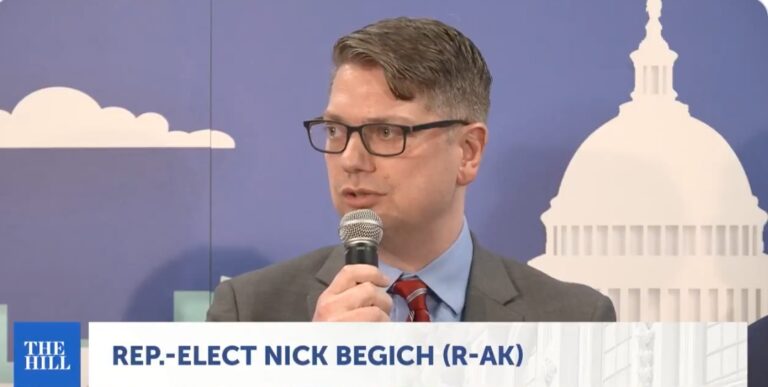
Alaska’s Rep.-elect Nick Begich III appeared on a panel made up of some of the newest members of Congress. It was pointed out by a moderator that Begich comes from a family of political figures, including his grandfather, who served in Congress for Alaska. Begich was quick to point out that the ones the moderator named are all Democrats (he is Republican.)
“What does Thanksgiving look like?” asked a baffled Mychael Schnell, congressional reporter for The Hill.
Begich isn’t the only Alaskan who has a family with mixed political opinions or alliances. Many Alaskans will be spending time over Christmas with members who vehemently disagree with them on policy and direction for the state and the nation. Begich gets it — with a family of partisan Democrats, some who even worked against him in his election for Congress.
Watch NBIII’s answer to the question at minute 29:14.
The U.S. Department of Justice last week announced a sweeping crackdown on distributed denial-of-service (DDoS)-for-hire services, seizing 27 domains tied to illegal cyberattack platforms and filing criminal charges against two alleged operators — one of them from Anchorage, and the other from Brazil. The move marks an escalation in the fight against cybercrime, targeting services that have facilitated millions of attacks on victims worldwide.
The seized websites, commonly referred to as “booter” services, enabled paying customers to launch DDoS attacks that overwhelm targeted systems with excessive internet traffic, rendering them inoperable.
Victims included schools, government agencies, gaming platforms, and private individuals. Law enforcement described the services as a major threat to internet stability, often disrupting essential services and causing significant financial and reputational harm.
The Justice Department did not say what kind of attacks were initiated by the Alaska-associated suspect.
Two individuals have been charged in connection with operating booter services:
Ricardo Cesar Colli (aka “TotemanGames”), 22, of Brazil, was charged in Los Angeles with running a service known as Securityhide.net. Colli faces conspiracy and computer fraud charges under the Computer Fraud and Abuse Act.
A defendant whose name remains under seal, was charged in Anchorage but has not been rounded up, as of Dec. 11. U.S. prosecutors are coordinating with international partners to secure the individual’s arrest and extradition, the DOJ said.
Both cases were developed through investigations led by the FBI’s Los Angeles and Anchorage field offices.
Booter services, often marketed as “stressers” for legitimate network testing, have long been a cover for illegal activities. Investigators revealed that communications between site administrators and customers made it clear these services were being used to attack third parties, not the customers’ own systems.
The seized domains collectively facilitated millions of DDoS attacks targeting organizations and individuals globally. The operation comes ahead of the holiday season, a period notorious for spikes in cyberattacks.
“DDoS attacks are a potent cyber weapon with the proven potential to disrupt critical information systems and infrastructure,” said Kenneth DeChellis, Special Agent in Charge of DCIS Cyber Field Office.
Operation PowerOFF builds on the Justice Department’s success in recent years, including the seizure of over 75 booter domains and prosecution of nine defendants in similar cases. This latest action targets all known booter sites, with ongoing investigations into their operators and customers.
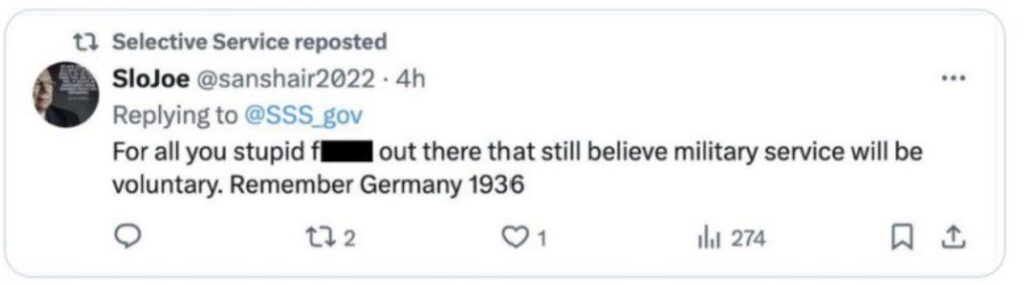
House Committee on Oversight and Accountability Chairman James Comer has opened an investigation into the U.S. Selective Service System, after the agency posted a message on X/Twitter that implied that under Donald Trump’s Administration, the draft would be mandatory, as it was under Nazi Germany.
The Selective Service is not denying that it posted the comparison of Trump to Nazi Germany on Nov. 6, immediately following Trump’s historic win, but after the agency was called out on it, it quickly took the message down.
Screenshot
In a letter to Acting Director of the Selective Service System Joel Spangenberg, Chairman Comer requested all documents and communications related to the agency’s internal investigation into the matter. He also called for Spangenberg to personally brief the committee on the incident.
“The Committee on Oversight and Accountability is investigating the Selective Service System’s promotion of a social media post stating individuals are ‘stupid’ if ‘they still believe military service will be voluntary,’ and to ‘[r]emember Germany 1936’ mere days after Americans elected President Donald Trump to be the 47th President of the United States,” Comer wrote. “The Committee is deeply disturbed that an independent federal agency, tasked with registering and maintaining a system of individuals potentially subject to military conscription if authorized by the President and Congress, would re-post a wholly unsubstantiated, false, and contemptible claim.”
Account-holders on X reported that the post was live for more than an hour. The Selective Service has since said it has launched an investigation to determine what happened and to prevent it from occurring in the future.
“Although the Selective Service should continue to investigate this matter and ensure that this not happen again, the individual at fault for reposting such an inappropriate and disturbing message on an Agency X account should be terminated,” Comer said. “In addition, to assist the Committee in investigating this matter, we request a briefing from the Selective Service with Committee staff. Please make arrangements to schedule a briefing with Committee staff on this matter as soon as possible, but no later than December 26, 2024.”
Trump says he has never even considered mandatory conscription.
The Selective Service states on its website: “While there is currently no draft, registration with the Selective Service System is the most publicly visible program during peacetime that ensures operational readiness in a fair and equitable manner. If authorized by the President and Congress, our Agency would rapidly provide personnel to the Department of Defense while at the same time providing an Alternative Service Program for conscientious objectors. Federal Law requires nearly all male U.S. citizens and male immigrants, 18 through 25, register with Selective Service.”
Read the letter to Acting Director Spangenberg here.
Democrats in Congress don’t want Republicans to be able to take credit or hogtie Social Security reforms that address inequities felt by some public employee pensioners. Thus Senate Majority Leader Chuck Schumer is saying there may be a vote as early as this week on the Social Security Fairness Act. The vote would take place before the Senate goes into Republican control in January, and the Senate will recess soon for the holidays, which gets them out of Washington Dec. 21-31.
The legislation would repeal two Social Security provisions: the Windfall Elimination Provision and the Government Pension Offset, which reduce Social Security benefits for millions of individuals who earned defined benefits pensions through public service jobs, particularly those in systems in which they did not pay directly into Social Security, such as many in Alaska who worked for the state or for school districts.
The cost to taxpayers is not insignificant. The Congressional Budget Office estimated the bill would cost nearly $190 billion over a decade. It also projected in a letter to Sen. Chuck Grassley last month that Social Security’s trust funds could “be exhausted roughly half a year earlier than it would be under current law” if the bill is passed into law.
Both Rep. Mary Peltola and Sen. Lisa Murkowski are co-sponsors of the legislation in their respective legislative bodies. If passed, it will bring hundreds of millions of dollars to the Alaska economy and encourage Alaska seniors to stay in state, as their benefits will somewhat offset higher costs of living. But the entire program is unfunded and adds to the $36 trillion national debt.
The bill is especially relevant for Alaska retirees who were part of the state’s old Public Employees’ Retirement System (PERS) and Teachers’ Retirement System (TRS).
Many of these retirees have seen their Social Security benefits significantly reduced due to current structure of Social Security. Under the WEP, individuals who worked in both Social Security-covered and non-covered employment often receive less than their full Social Security benefits. Similarly, the GPO affects survivors’ benefits, reducing spousal or widow’s benefits for retirees with a government pension.
Due to such a large state government workforce, Alaska has the highest percentage of WEP-affected beneficiaries of any state. Nearly 12% of all beneficiaries and 15% of all retired workers are impacted by the WEP.
If passed, the Social Security Fairness Act would eliminate these reductions, allowing public servants to collect both their earned pensions and full Social Security benefits.
Lawmakers supporting the bill say the existing provisions as punitive and outdated, penalizing workers who have contributed significantly to their communities.
If the Senate approves the bill, it will head to President Joe Biden for his signature.
President-elect Donald Trump’s pick to lead the Department of Defense, though not yet confirmed, has pledged to root out “woke” ideology in the military.
Other Republicans have lamented the same issue for years but done little about it, but if Peter Hegseth can be confirmed, the U.S. military may become ground zero in the Right’s war on woke.
Military veteran and Fox News Host Hegseth has repeatedly attacked the military leadership’s embrace of “woke” culture, which usually refers to the ideology around transgenderism, gender pronouns, and racial identity politics.
Despite allegations and attempts to end his bid, Hegseth has stood firm, though his fate in the Senate is unclear. A public statement from Trump last week put to rest any thoughts that Trump was considering withdrawing the pick.
“Pete is a WINNER, and there is nothing that can be done to change that!!!” Trump said in a statement.
The American Accountability Foundation released a list of 20 officers who Hegseth should fire.
Notably, during his viral podcast interview with Joe Rogan, Trump told a story about how military leaders in Washington, D.C. told Trump that destroying ISIS quickly wasn’t possible, but when Trump visited the military leaders on the ground, he heard a different story. Those commanders, Trump said, told him it was doable but Washington, D.C. had tied their hands.
“The woke takeover of the military is a major threat to our national security,” AAF President Thomas Jones wrote in a letter to Hegseth earlier this week.
“As global tensions rise, with Iran on the march, Russia at war, and China in the midst of a massive military buildup, we cannot afford to have a military distracted and demoralized by leftist ideology,” he added in the letter, first obtained by The New York Post. “Those who were responsible for these policies being instituted in the first place must be dismissed.”
That anecdote highlights growing sentiment on the Right that the effectiveness and mission of the military has been hijacked by a handful of leaders in the Pentagon.
Lawmakers have raised that concern for years, pointing to a slew of recent federal spending backing controversial Diversity, Equity and Inclusion policies.
Last year, Trump’s pick to lead the U.S. State Department, Sen. Marco Rubio, R-Fla., told The Center Square that woke policies were “hollowing out” our military.
A Department of Defense comptroller report from the same year included $86.5 million for “dedicated diversity and inclusion activities” as well as language showing the importance of DEI to the military.
“The Department will lead with our values – building diversity, equity, and inclusion into everything we do,” the report said.
The actual figure spent on backing the same kind of policies is likely much larger and impossible to know, as the language and ideology has permeated much of the employee training, H.R. policies, and more.
Other anecdotes highlight the prevalence of the newfound way of thinking for Armed Forces. For instance, as The Center Square previously reported, official training materials for West Point cadets included warnings about white privilege.
Rubio released a report detailing these same issues, which includes another example where a slide presentation for the Air Force Academy was titled, “Diversity & Inclusion: What it is, why we care, & what we can do.”
This same taxpayer-funded training warns cadets to avoid saying words like “mom” and “dad” because the language is gendered.
House Majority Leader Steve Scalise, R-La., spoke about the NDAA and blamed woke policies for the armed forces’ difficulties meeting recruiting goals. Even after lowering recruitment targets, the U.S. military has fallen short of its recruitment goals in recent years.
“We’ve seen under the last three and a half years of the Biden-Harris administration, it’s been hard to recruit and keep good service members, in part because of the bad woke policies, the loss of focus by this administration on what the mission is,” Scalise said at a news conference Tuesday.
With Trump and Hegseth in the executive branch and leadership like Scalise behind it, cleaning house of the Pentagon might be possible, albeit difficult.
“We start addressing that by routing out more of the woke policies over at the DOD,” Scalise continued. “Of course, that ultimately is going to get fixed when President Trump takes office next month. He talked about those things during the campaign, what he would do to restrengthen and reinvigorate our military.”
If confirmed by the U.S. Senate, Hegseth would lead the largest and most complex federal agency with an annual budget of $840 billion and 3.4 million military and civilian employees.
Hegseth, 44, was an infantry officer in the Army National Guard from 2002 to 2021. He graduated from Princeton University in 2003. He was later commissioned as an infantry officer in the Army National Guard. He served in Afghanistan, Iraq, and Guantanamo Bay. He left with the rank of major, according to the Army National Guard. Hegseth earned two Bronze Stars, two Army Commendation Medals and the National Defense Service Medal with Bronze Service Star, among others.
But Hegseth faces scrutiny over a 2017 sexual encounter in which a woman told police the former Fox News anchor blocked the door of a hotel room in California and sexually assaulted her. Hegseth has denied the allegation and said that the encounter was consensual. The woman reported the allegations to local police. Hegseth was never charged with a crime. He reached an undisclosed settlement with the woman in 2023.
Final decision on which schools will closed will be made at Dec. 17 school board meeting
By DAVID BOYLE
It was only two years ago when the Anchorage School Board proposed to close six schools.
In the end, no schools were closed. Superintendent Jharrett Bryantt stated that Abbott Loop Elementary School was closed when, in fact, it was “repurposed” into an ASD charter school.
So much for misinformation and misleading statements.
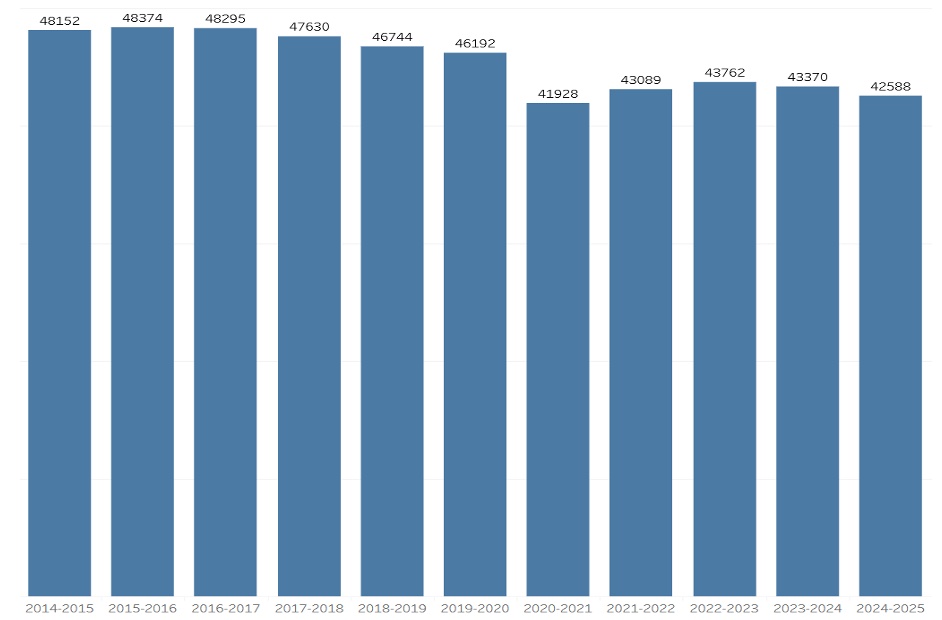
The district has too many schools and a decreased student population, now and in the foreseeable future. Here is the student enrollment trend for the past 10 years:
Fast forward to this year. The student population continues to decline. Schools are kept open with low occupancy rates. Once again to save money, Superintendent Bryantt has recommended seven schools for closure.
Not long after that announcement the district announced three of those seven schools will remain open.
Parents had come out against closing any of the seven schools the district recommended. Many parents testified that those schools were the center of the neighborhood and losing them would virtually destroy the neighborhood.
Somehow the physical structure of the school brought the community comfort, safety, and happiness.
Very few parents testified that those schools were teaching their kids how to read and how to do math. That’s probably because these parents don’t know how few of their children can read at grade level or do math at grade level.
Here are the standardized test scores (AKSTAR) for the proposed school closures:
As noted in the superintendent’s memo to the school board, the ASD enrollment has decreased by 6,453 students since 2010. The ASD is experiencing the same decline in studentsas many other districts across the nation.
Bear Valley was taken off the closure list because it will expand its childcare to six classrooms in 2026-27. While I applaud this school remaining open because its students are scoring well on the State’s standardized test, I don’t believe providing day care for some parents and school staff is the purpose of the K-12 school system.
Tudor Elementary School was taken off the closure list because some parents whose children were enrolled in that school’s Montessori program said they would not continue to enroll their children in the Montessori program at Denali Elementary School (the receiving school). Thus, these students would be enrolled in the Lake Otis Elementary School, which would not have the capacity to accommodate them.
It is not clear if these parents would actually remove their children from the Montessori program or was it merely a threat to keep Tudor Elementary School open. But the tactic worked.
Wonder Park Elementary School has a very low enrollment and has the very old (1970s) “open space” design. But the district wants to relocate the pre-K kids from Nunaka Valley to use the excess capacity of Wonder Park.
But Nunaka Valley students had much better test scores than Wonder Park students—maybe that would be a better criterion for determining which school to close.
And Wonder Park will need more money to “address major structural improvements” according to Board Member Carl Jacobs. It is unclear how much these improvements will cost and will they offset the savings of closing all the schools.
The Administration recommends the closure of the four schools by May 2025.
It has been said that none of the closed schools’ staff will be let go. Remember, about 85% of the district’s operating budget is made up of personnel costs. Will closing any of these schools save money?
Understandably, most of the teachers will move with their students to other schools. But will the support staff such as clerical and custodians be required at the receiving schools?
Here’s a breakdown of the expenses for the recommended closed schools taken from the ASD fiscal year 2025 budget:
School
Total Operating Costs
Non-Teacher Salaries
Other Expenses
Baxter
$2,323,000
$241,000
$199,400
Fire Lake
$2,216,000
$211,500
$219,000
Lake Hood
$2,182,000
$222,000
$205,000
Nunaka Valley
$1,753,000
$146,000
$197,000
The “Other Expenses” includes utilities, energy, supplies and other purchased services.
Note that if only the non-teachers are reduced and the Other Expenses are saved, the total is just $1,640,900. This does not include the saved non-teacher benefits which the district does not break out for analysis.
Will closing any schools save money?
The final decision on which schools are to be closed will be made at the Dec. 17 board meeting.
Do you believe the Anchorage School District has too many elementary schools for its declining student population?
Will any of the Anchorage schools actually be closed?
More importantly, is the Anchorage School District just setting the stage to garner public support to get the legislature to increase funding? It has already been successful in marshalling parents and staff with the school closure threat.
Will these parents and staff descend upon the legislature demanding an increase in the Base Student Allocation to keep their neighborhood schools open?
U.S. Sen. Dan Sullivan has announced that his years of work have finally paid off in getting Air Force refueling tankers to Alaska. The U.S. Air Force will station four KC-135 refueling aircraft at Eielson Air Force Base in Fairbanks. This long-awaited decision fulfills a commitment made by the Air Force in March 2021, but delayed for over three years.
The announcement came after persistent advocacy from Sullivan, who has spent more than a decade urging senior military officials to address Alaska’s aerial refueling capability gap. The KC-135 aircraft are critical for supporting Alaska’s growing fleet of fighter jets and securing U.S. airspace amidst increasing threats from adversaries.
“The Air Force has dramatically increased the fighter assets in Alaska in recent years, yet the necessary supporting refueling force has remained stagnant,” Sen. Sullivan said in a statement. “This strain on our refueling mission is unacceptable given the critical importance of Alaska as the hub of air combat power for the Arctic and entire Indo-Pacific, and the increasing aggression from our adversaries off Alaska’s coastline.”
Alaska is home to the largest concentration of fifth-generation fighters in the world, with 54 F-35A fighter jets based at Eielson Air Force Base, in addition to the state’s F-16 Aggressor Squadron and six F-22s stationed at Joint Base Elmendorf-Richardson. These assets are essential for responding to a surge in incursions into the Alaska Air Defense Identification Zone, including six incidents this year alone.
One of the most significant threats occurred in July, when Alaska-based F-16s and F-35s, along with Canadian CF-18s, intercepted a joint Russian-Chinese bomber formation of aircraft off Alaska’s coast, the first time such coordination between Russia and China had been observed near Alaska.
Decade of Advocacy Pays Off
Sen. Sullivan has repeatedly highlighted the need for additional refueling capacity to support Alaska’s unique operational demands. The state’s vast training ranges, harsh environment, and the long distances required to intercept potential threats make aerial refueling a cornerstone of its defense strategy.
“The KC-135 tankers are not just an upgrade—they are a necessity,” Sullivan said. “Over the course of just two months this year, Alaska-based Airmen intercepted six incursions into the ADIZ, each requiring a nearly 2,000-mile roundtrip sortie. These aircraft will ensure we have the resources to respond to escalating threats from adversaries like Russia and China.”
Sullivan’s advocacy included pressing every Secretary of Defense and Air Force since his election to the Senate, as well as hosting numerous high-ranking officials in Alaska to witness the state’s strategic importance firsthand.
Timeline of Delays
In March 2021, the Air Force committed to basing four KC-135 tankers at Eielson by fiscal year 2023. However, the delivery was repeatedly delayed, prompting Sullivan to write a letter to Secretary of the Air Force Frank Kendall on October 8, 2024, expressing frustration over the delay.
In his letter, Sullivan emphasized the strain on Alaska’s refueling operations and the urgent need to deliver on promises made three years earlier.
Local Community impacts
The arrival of the KC-135s will also bring 220 active-duty personnel and their families to Eielson Air Force Base.
“This is a win for Alaska and America’s national security,” Sullivan said. “We look forward to welcoming these critical aircraft, personnel, and their families to our great state and continuing to strengthen our nation’s defense posture in this vital region.”
With this long-overdue decision, Alaska further solidifies its role as a linchpin in U.S. military strategy for the Arctic and Indo-Pacific regions.