Another year, another lineup of meetings about homelessness in Anchorage Mayor Suzanne LaFrance’s increasingly dystopian realm.
Residents of Anchorage are invited to participate in a two-day summit focused on Anchorage’s coordinated response to homelessness, taking place on March 20-21, 2025, from 9:30 a.m. to 4 p.m.
That’s right in the middle of the Anchorage Municipal election, which ends April 1.
The event is organized by the Mayor’s Office, the Anchorage Assembly’s Housing and Homelessness Committee, and the Anchorage Coalition to End Homelessness.
Although she ran on reducing homelessness and claimed former Mayor Dave Bronson was incompetent, Anchorage’s homelessness scenario has only grown since LaFrance took office. Streets and trails aren’t safe and children’s playgrounds are routinely taken over by drug-addled vagrants, who leave their needles behind. She scrapped the plans made by Bronson and started over.
According to the latest report from the Anchorage Coalition to End Homelessness, the current number of people homeless in Anchorage is about 3,070, a dramatic increase from last year and likely an all-time high.
The Anchorage summit is marketed as providing residents with an understanding of the systems and strategies that the Municipality and its partners are using to, without success, address homelessness in the community.
“We’re working every day toward the goal of seeing a significant reduction in the number of people sleeping outside in Anchorage. It’ll take a team to get there,” said Mayor Suzanne LaFrance. “I hear from so many people who want to contribute to the solution but don’t know how. This summit will help residents answer that question and identify how to help in the way that makes sense for them.”
Two days of talk
On Thursday, March 20, attendees will learn about Coordinated Entry (CE), the system used by Anchorage providers to transition individuals from homelessness to housing while prioritizing those with the highest levels of vulnerability. CE professionals can complete their annual training, while community members can gain insight into the process, best practices, and methods for building trust to connect people to necessary care and housing.
Friday, March 21, will bring together community members, leaders, policymakers, municipal departments, service providers, and media to discuss the community’s multifaceted response to homelessness. Topics will include shelter, services, housing, behavioral health, camp outreach, and more.
“I am proud to welcome residents and community members from across the Municipality to join in our coordinated response to addressing homelessness that puts people first,” said Assemblyman Kameron Perez-Verdia, co-chair of the Assembly Housing & Homelessness Committee. “From service providers and policymakers to neighbors and friends, we all know that one person can make a difference, but we don’t have to do it alone. Together, let’s build a system to make a difference – and lasting change.”
The summit will be held at the Southcentral Foundation Nuka Learning Institute, located at 4085 Tudor Centre Drive in Anchorage. The event is free and open to the public, but space is limited, so advance registration is encouraged here.
Democratic California Rep. Robert Garcia called for “actual weapons” to be used against Elon Musk, who heads up President Donald Trump’s initiative known as the Department of Government Efficiency, or DOGE.
Garcia, speaking on CNN, indicated violence may be necessary protect democracy.
Garcia was asked by CNN host Brianna Keller if “calling Musk a dick is effective messaging.” Garcia had done so in a congressional committee.
Garcia responded:
“Well he is a dick, and I think he’s also harming the American public in an enormous way. What I think is really important and what the American public wants is for us to bring actual weapons to this bar fight. This is an actual fight for democracy, for the future of this country, and it’s important to push back on the chairperson of this committee.”
“We went into exactly what Elon Musk is trying to do. Dismantling the Department of Labor, dismantling the Department of Education, dismantling all of our consumer protection agencies, and so it’s all important, but it’s also important to get the attention of the American public and call Elon Musk out for what he is and to make people know that Marjorie Taylor Greene is not a serious legislator, and she shouldn’t be treated as such,” Garcia said.
In a meeting of the House Subcommittee on Delivering on Government Efficiency, Garcia had earlier this week pontificated about Rep. Marjorie Taylor Greene, who in 2023 held up a photo of a nude (and redacted) Hunter Biden during a committee hearing.
“Now, I find it ironic, of course, that our chairwoman, Congresswoman Greene, is in charge of running this committee. Now, in the last Congress, Chairwoman Greene literally showed a dick pic in our oversight congressional hearing,” he said.
Then Garcia held up a photo of photo of Musk. “So, I thought I’d bring one as well. Now, this, of course, we know is president Elon Musk. He’s also the world’s richest man. He was the biggest political donor in the last election. He has billions of dollars in conflicts of interest.”
Last month, Rep. Hakeem Jeffries, who serves as the House Minority Leader, called for violence in the streets.
DOGE Alaska has uncovered a massive federal grant to the Sitka Tribe of Alaska so that its members can buy king crab and king salmon from local fishermen, with the stated priority of buying from commercial fishermen who are also tribal members. That way the money circulated back into the tribe.
The $2.4 million grant award came from the Department of Agriculture in a grant program intended to help “socially disadvantaged farmers and ranchers.” The grant awarded to the Sitka tribe allows 1,000 tribal households the ability to buy king crab, Dungeness crab, shrimp, salmon, and halibut from local commercial fishermen through a contact by the Sitka Tribe. This is not subsistence, and it’s not SNAP benefits (although people can buy king crab with their EBT cards), but is supposed to ensure greater food security for the members of the tribe, by allowing them to get free seafood right off the boats.
Frozen king crab legs sell at Safeway in Juneau for about $80 a pound.
The Department of Agriculture food security grant indicates that commercial fishermen of Alaska fall into that socially disadvantaged category that the grant covers. Here’s the grant language:
“The purpose of this agreement is to purchase and distribute local food, targeting purchases from socially disadvantaged farmers and ranchers. Through this program, Sitka Tribe of Alaska will contract with local fishermen (prioritizing local fishermen who are tribal citizens) and local processors, as needed, for the purchase and distribution of crab (king and Dungeness), shrimp, and fish (salmon and halibut).
“Provide up to 1,000 tribal households with crab, shrimp, and fish during the appropriate seasons in 2024 and 2025 by establishing contracts between Sitka Tribe of Alaska and local fishermen (prioritizing tribal citizens) and processors, as needed. Create a central and accessible location where tribal citizens can pick up minimally processed (only to the level of maintaining freshness/quality—sealed) crab, shrimp, and fish that is ready for storage or immediate use. The plans for distribution will be included in the contracts between Sitka Tribe and the fishermen, ensuring that staff of Sitka Tribe can provide any necessary support.
“Establish strong, lasting relationships between Sitka Tribe of Alaska and local fishermen, preferably local fishermen who are tribal citizens, in order to ensure Sitka Tribe’s support of our local business operators and allow for local fishermen to contribute directly to their tribe and elders—honoring cultural traditions and fostering relationships between citizens, and between citizens and Sitka Tribe.
“Quarterly performance reports will be submitted to capture the number of producers, socially disadvantaged farmers and ranchers, distribution sites, and underserved locations, as well as funds expended for each category. Annual reports will provide percentages of new marketing opportunities and purchases distributed beyond current food distribution networks.
“The primary beneficiaries of this program will be the tribal households (up to 1,000 households) who will receive crab, shrimp, and fish during the appropriate seasons in 2024 and 2025, and the local fishermen we contract with to receive these goods. The recipient does not intend to subaward funds.”
Only one award per state was made out of the “Local Food Purchase Assistance Cooperative Agreement Program Plus (LFPA Plus)” grant that awarded $2.4 million to the Sitka Tribe.
DOGE Alaska is a group of citizens that are researching waste, fraud, and abuse. It is a project, not a formal organization. Read more about it at the link below:
The U.S. Senate today confirmed Robert F. Kennedy Jr. as the new secretary of the Department of Health and Human Services.
The department is the largest in the government, with over 80,000 employees and a budget that exceeds $1 trillion annually, vastly outpacing all other departments. To compare, the Department of Education’s budget for 2024 was $238 billion.
The vote was along partisan lines, with only Sen. Mitch McConnell, a Republican, voting against RFK Jr.
Vote
Total
Democrats
Republicans
Independents
Yes
52
0
52
0
No
48
45
1
2
Not yet voted
0
0
0
0
Before the vote, Senate minority leader Chuck Schumer took to the floor and called RFK Jr. “not remotely qualified to become the next secretary of health and human services. In fact, I might go further. Robert F Kennedy Jr might be one of the least qualified people the president could have chosen for the job. It’s almost as if Mr. Kennedy’s beliefs, history, and background were tailor-made to be the exact opposite of what the job demands.”
RFK Jr. is an unconventional pick, having never served in government before. He was a Democrat who ran for president in 2024 but switched to independent, and endorsed Donald Trump. His family of Democrat scions has excoriated him and painted him as a lunatic. But his views on vaccine safety and the poisons in foods have gained him more and more support, as Americans learn more about his concerns about toxins in America’s food supply and environment. He has support from both Democrats and Republicans on this topic. He has been an environmental lawyer for much of his career, focusing on food integrity and climate change.
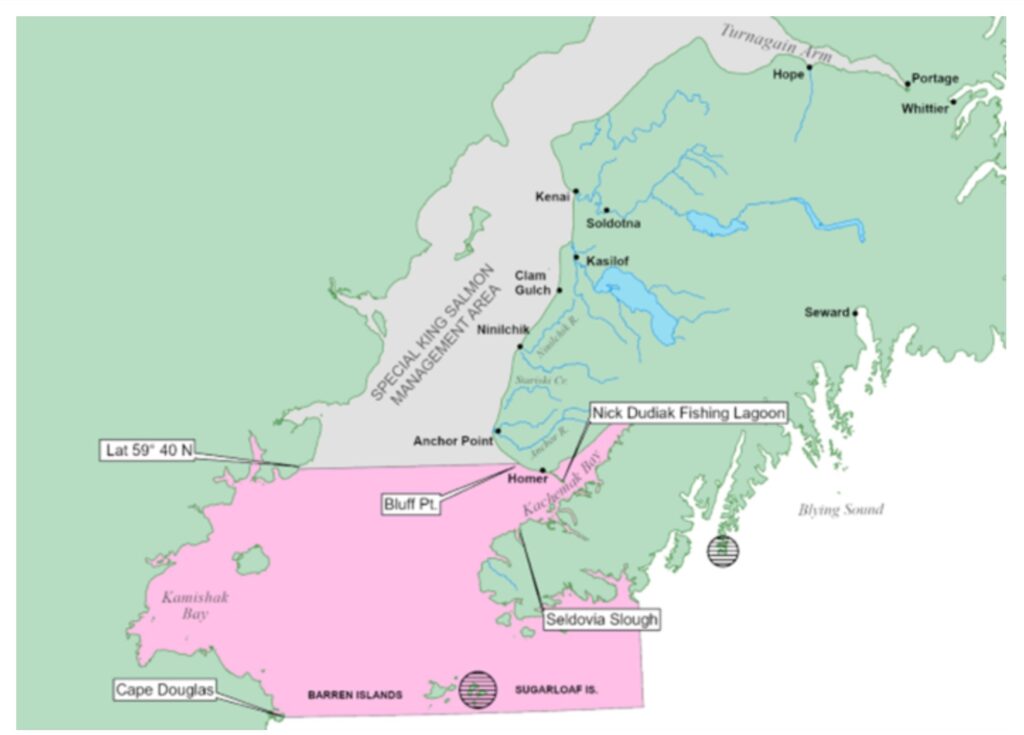
The Alaska Department of Fish and Game announced new sport fishing restrictions for Cook Inlet’s summer and winter saltwater king salmon fisheries. The order is in response to declining king salmon populations, the department advised.
Key restrictions for king salmon sport fishing include:
Cook Inlet Salt Waters north of Bluff Point (59° 40.00′ N. lat.)
Closure period: May 1 – Aug. 15, 2025
Regulations: King salmon fishing, including catch-and-release, is strictly prohibited. Any king salmon incidentally caught while fishing for other species must be released immediately without removing the fish from the water.
Lower Cook Inlet (south of Bluff Point to Cape Douglas and east of Gore Point, including Kachemak Bay)
Bag and possession limits: One king salmon of any size per day from April 1 – Aug. 31, 2025.
Winter fishery start: From Sept. 1-15, the bag and possession limit remains at one king salmon of any size.
Exemptions for terminal fisheries
The Nick Dudiak Fishing Lagoon on the Homer Spit and the Seldovia Slough and Lagoon Terminal Fisheries are excluded from the reduction in bag limits. These areas will retain the previous two-king salmon bag limit.
Recent monitoring of early-run king salmon escapement in the Kenai, Anchor, and Deshka Rivers indicates that 2025 runs are projected to be below the lower end of escapement goals. This has prompted preseason closures for in-river sport fisheries and an additional closure of Upper Cook Inlet salt waters north of Bluff Point from May 1 – July 15 under the Upper Cook Inlet Summer Salt Water King Salmon Management Plan.
Further, the Kenai River Late-Run King Salmon Stock of Concern Management Plan, adopted by the Alaska Board of Fisheries, mandates an annual closure to sport fishing for king salmon north of Bluff Point from June 20-Aug. 15 until the Kenai River late-run king salmon population meets recovery criteria.
The emergency restrictions apply solely to king salmon sport fishing and do not impact the sport fishing regulations for other species, such as halibut. However, they coincide with similar freshwater sport fishery restrictions throughout Cook Inlet.
“King salmon have continued to decline and were at historic low levels in 2024,” said Mike Booz, Area Management Biologist for ADF&G. “These restrictions aim to maximize escapements while taking a more precautionary approach to sport harvest opportunities in these mixed-stock fisheries.”
Anglers are asked to review the latest Southcentral Sport Fishing Regulation Summary booklet for more details on current regulations. The department said it will continue monitoring salmon populations and may adjust regulations as necessary to support the recovery of king salmon stocks in the region.
These closures follow a pattern of recent years with multiple closures. However, this announcement represents one of the more sweeping closures in recent years.
With so many closures over so many years, overfishing doesn’t appear to be the problem.
It may be that pink salmon being released in hatcheries are dining on king salmon fry in the ocean, which could be dramatically reducing the number of kings returning. Read this report from 2018 on the complicated issue of hatchery pink salmon and their life cycle:
Critics of Alaska’s education system argue that its entrenched, top‑down bureaucratic management has created a stagnant structure that not only drives up costs but also stifles innovation and accountability.
They point to the widening gap between escalating per-student expenses and persistently mediocre academic outcomes as stark evidence that the current model is failing the state’s youth and undermining Alaska’s long‑term economic competitiveness.
This failing system not only diminishes the quality of education but also burdens society with higher crime rates, increased welfare dependency, and a general erosion of civic vitality.
In response, a multi‑pronged plan of action for the Alaska Department of Law is suggested.
Alaska must draw on established legal precedents—such as the Supreme Court decisions in Espinoza v. Montana Department of Revenue and Carson v. Makin—to challenge policies that discriminate against religious or alternative educational models, thereby opening the door for more localized and diverse educational options.
These cases set a clear precedent that state policies cannot unjustly exclude certain types of schools from public benefits, and they provide a potential framework for reforming an education system steeped in outdated, one-size-fits-all approaches.
This also includes Alexander, et al. v. Acting Commissioner Heidi Teshner (July 2024), in which the Alaska Supreme Court upheld the state’s school correspondence program as both statutorily and constitutionally sound, ensuring that geographic isolation does not deny students a rigorous education.
These cases demonstrate that state governments can act as self-regulators when confronted with statutory provisions that conflict with constitutional mandates. But can state governments also act as self-regulators when their constitutional mandates run afoul of US constitutional requirements? This is answered below.
The Alaska Department of Law must adopt a robust legal strategy to establish standing by demonstrating that the Department of Education’s reliance on archaic, top‑down policies promulgated by the state constitution’s Article VII, Section 1, and Article IX, Section 6, directly impairs the state’s capacity to enforce education law, and protect constitutional rights, such as the Free Exercise Clause.
This could involve presenting concrete evidence—such as increased litigation, overwhelming administrative burdens, and budgetary distortions—that directly link the failing system to measurable harms affecting public safety and fiscal sustainability. For example, statistical data showing correlations between poor educational outcomes and higher crime rates or welfare dependency would help substantiate the claim that the current model inflicts a unique and quantifiable injury on the state, beyond the general grievances shared by its citizens.
Ultimately, if these legal and administrative reforms are not enacted, Alaska risks sacrificing not only the academic and economic future of its youth but also the very foundation of its civic society. The goal must be to create an education system that nurtures an informed and innovative citizenry—one capable of propelling Alaska into a prosperous future.
Alaska has failed to achieve this goal. Now is the time to correct it.
Only by dismantling the outdated, top-heavy bureaucratic structures and replacing them with truly democratic, locally accountable systems can our state break free from the corrupt grip of self-serving politicians and the special interests they serve. Without this fundamental change, our educational policies will remain hostage to a cycle of inefficiency and neglect, where decisions are driven not by the public good but by the greed of those who prioritize their own power and profits over the future of our children.
The next approach may be simpler but certainly extremely unpopular.
Reduce the size of the Alaska Department of Education.
Reducing the Alaska Department of Education to an office operation responsible for issuing 53 checks—one for each school district—offers several potential benefits and features.
This streamlined approach could result in significant cost savings by eliminating layers of bureaucracy and administrative overhead. With fewer employees and a centralized process, oversight could improve, reducing the likelihood of misallocated funds and inefficiencies. Additionally, a leaner department may promote quicker decision-making and a more agile response to budgetary needs across districts.
The implications for democratic legitimacy are stellar. Bottom-up control of education will bring a new sense of discipline to Alaska’s education system. Streamlining operations can increase transparency and accountability by cutting through bureaucratic layers, making state funding more directly observable by local stakeholders. This could empower communities to more easily track and influence the allocation of resources, thereby reinforcing the democratic principle of government responsiveness.
While critics warn that consolidating education management into a single office might diminish local autonomy, this very centralization will amplify local control over education funding. By reducing the sprawling bureaucracy of the Alaska Department of Education to one streamlined office responsible for only the distribution of funds to all 53 school districts, the process becomes more transparent and accountable, thereby empowering local communities.
With fewer administrative layers, individual districts and their stakeholders can more directly monitor and influence funding decisions, ensuring that resources are allocated equitably and according to local priorities.
What about meeting state education standards and teacher certifications? Why not include that in the domain of local district responsibilities, or even more innovative, allow individual schools to succeed or fail within districts by the implementation of their own standards which of course meet constitutional requirements.
Educators and administrators are on the ground level. They indeed have a much better understanding of education than someone in the complex bureaucratic universe of the Alaska Department of Education.
In this model, the single office concept acts as a responsive intermediary, cutting through bureaucratic inertia and making it easier for communities to assert their voice in the education process—potentially strengthening democratic legitimacy rather than eroding it, which is the current failing model.
However, such a reduction is not without challenges. Critics can contend centralized state funded education must have a bureaucracy as a single office concept may struggle with the complexity and diversity of requirements across 53 districts, each with its own unique financial and operational demands.
However, each district brings the ability to resolve subject matter issues through either statewide experience through organization of the 53 districts or from experiences of the lower 48. There really isn’t anything cryptic or complex about educating children in a well-monitored local environment.
Claiming that overburdening staff will cause errors, delay fund distribution, or lead to a loss of specialized expertise that undermines our ability to tackle complex educational challenges statewide is a logical fallacy—a convenient excuse to perpetuate a system that is already failing.
Finally, ensuring robust communication and accountability between a centralized office and a diverse array of local entities presents significant logistical challenges. However, as the organization is streamlined, these challenges can be mitigated through a careful balance between cost savings and the provision of tailored, district-specific support, ensuring that neither the quality of education nor effective financial management is compromised.
Michael Tavoliero is an Alaskan and senior writer for Must Read Alaska.
In the closing months of the Biden Administration, bureaucrats pushed through a staggering 1,500 new regulations, costing American taxpayers and businesses an estimated $1.3 trillion.
Congressman Nick Begich III said today that House Resolution 77, the “Midnight Rules Relief Act,” is critical legislation in that it streamlines the congressional review process and ensures Congress can roll back these 11th-hour rules, thereby preventing outgoing administrations like President Joe Biden’s from burdening the American people with job-killing regulations.
“This bill is about accountability. The Biden Administration knew its radical agenda wouldn’t pass through Congress, so they rammed through a mountain of regulations in their final days. These midnight rules hurt Alaska’s industries—our fishermen, miners, energy producers, and small businesses—all of whom are now forced to navigate costly, unnecessary red tape. Congress shouldn’t have to waste time unraveling a flood of last-minute overreach when we should be focused on securing America’s future,” said Congressman Begich, upon voting for the resolution.
By streamlining the Congressional Review Act process, HR77 allows Congress to repeal harmful midnight rules in one legislative package rather than individually.
Many of these 1,500 last-minute regulations rolled out under Biden directly impact Alaska, stifling resource development, raising energy costs, and making it harder for businesses to grow and thrive, he said.
From NPR-A to federal land withdrawals and excessive permitting requirements, the regulations threaten jobs and economic opportunities across the state, Begich said.
Congressman Andy Biggs of Arizona was the prime sponsor of the measure, and encouraged the Senate to move quickly to pass his resolution.
“Today’s passage of Midnight Rules Relief Act will make it easier for Congress to check the unelected bureaucrats who feverishly wrote new federal rules before the end of the Biden Administration. In 2024 alone, the Biden Administration imposed more than 1,400 new rules at $1.34 trillion in regulatory costs. Many of these rules are out of step with the mandate the American people gave us in November, and the tools provided under this Act will allow them to be swiftly addressed., he said.
The Midnight Rules Relief Act will allow Congress and President Trump’s Administration to follow through on our promises to rein in the out-of-control bureaucracy and return power to the American people and those they elect, Biggs said.
“I urge the Senate to quickly take up this legislation so it can be signed into law by President Trump. I look forward to working with my colleagues—in both the legislative and executive branches—to break down the massive administrative state that was propped up by Joe Biden and his cronies,” Biggs said.
President Donald Trump has nominated Kathleen Sgamma, a prominent advocate for the oil and gas industry, to be the new director the Bureau of Land Management. The agency under the Department of Interior is responsible for overseeing approximately 245 million acres of federal land in the United States, including 70 million acres in Alaska.
Sgamma has been the president of the Denver-based Western Energy Alliance since 2006, where she has been a vocal proponent of increased domestic energy production and has consistently pushed for policies favoring oil and gas development on public lands.
Sgamma was a staunch critic of harsh regulatory and shutdown measures promulgated by the Biden Administration. In 2024, the Alliance, along with petroleum associations from New Mexico, North Dakota, Wyoming, and Utah, filed a lawsuit challenging the Bureau of Land Management’s new leasing rules. These rules increased royalty rates, minimum bids, rental rates, and bonding requirements for companies drilling on federal lands. The industry groups argued that the updated regulations would close eligible lands for leasing and disproportionately harm smaller companies.
A graduate of Massachusetts Institute of Technology, she has never worked for the Bureau of Land Management.
“Her confirmation by the Senate into the position would represent a seismic change in direction for the bureau after the last four years under the Biden administration, during which BLM prioritized developing green energy to combat climate warming,” wrote POLITICO.
Sgamma’s nomination aligns with President Trump’s agenda to bolster U.S. fossil fuel production and achieve “energy dominance.”
If confirmed by the Senate, Sgamma would work under the direction of Interior Secretary Doug Burgum to implement policies aimed at expanding oil and gas drilling on public lands.
Her nomination will be strongly opposed by the environmental non-governmental industry. But she will likely have the support of many leaders in the western states. She would replace Tracy Stone-Manning, a radical environmentalist who served President Joe Biden’s anti-oil and gas agenda and had previously worked for EarthFirst!, where she was tied to a tree-spiking incident.
Newly minted Sen. Rob Yundt of Wasilla surprised his fellow Republicans when he submitted his first bill, and it was a tax increase.
The Yundt tax, Senate Bill 92, is designed to enact a specific 9.2% tax on Hilcorp, the company that runs Prudhoe Bay, having taken over for BP Alaska when it exited the state.
Hilcorp is an S corporation, and currently those are not taxed in Alaska. But the bill opens up the door to taxing all S corporations, large and small, and business owners will want to pay heed.
Yundt’s bill threatens to destabilize the oil industry in Alaska. Many conservatives are “livid,” according to Must Read Alaska sources, that Yundt effectively sandbagged his Republican colleagues by not having a conversation with them first. But Democrat Sen. Bill Wielechowski was pleased, saying that good ideas can come from all sides. Wielechowski has been trying to increase taxes on oil companies his entire career. He’s known in circles as “Bill Will Tax.”
SB 92 is similar to a bill offered in 2023, SB 114, which was act “establishing an income tax on certain entities producing or transporting oil or gas in the state; relating to the oil and gas production tax.”
Yundt’s bill has nearly the same language as Wielechowski’s : “An Act establishing an income tax on certain entities producing or transporting oil or gas in the state.”
The tax is supposed to close what some say is a loophole. The S-Corp tax category bypasses income taxes on the company, enabling tax liability to “pass through” and apply to earnings of the company’s shareholders.
In 1980 Alaska repealed its personal income tax, so the shareholders in Alaska do not pay an income tax on their gains.
The statement from the Senate Republican Caucus said the Republican minority was measured, but pointed: They said they are “a non-binding caucus, meaning our members are free to pursue policy proposals that align with their constituent goals and personal values. While Senator Yundt is a valued and respected member of our team, the entirety of the caucus does not align with the proposed legislation SB 92.”
In the House, the Republicans were equally surprised as the Republican minority in the Senate. No one was brought into the discussion before Yundt introduced the bill on Monday.
Although the House and Senate are controlled by pro-tax Democrats, Yundt will still have to appear in front of the respective Resource committees and testify, and he may not be able to answer detailed questions about his own legislation. Oil and gas tax is an extremely specialized and complicated subject that takes years to master.
Some in Juneau have suggested that Yundt is being used by Democrats to find a way to fund their big-spending items, such as returning massive pensions to state and city employees in Alaska through the defined benefits package, and enacting a major spending increase for Alaska’s woefully mismanaged schools. If the tax increase is tied to either of these spending programs, it may improve its chance of passing.
In the past, Gov. Mike Dunleavy has threatened to veto similar legislation.
Who put Yundt up to it as a freshman legislator who has only been in office for less than a month and who never mentioned oil taxes during his campaign against Sen. David Wilson? That’s the burning question among Republicans in the Capitol this week.