It’s Valentine’s Day and everyone celebrates it in their own way. Love is love, right?
Sen. John Kennedy of Louisiana, arguably one of the wittiest senators in the country, posted a video of him cleaning his revolver as he says he believes “love is the answer, but you ought to own a gun just in case.”
Love is the answer—but you ought to own a handgun just in case.
The Alaska Democratic Party had their own spin on Valentine’s Day: They want to get former Rep Mary Peltola married off — again. Her husband Buzzy Peltola died in a plane crash in 2023, and evidently she is back on the singles scene.
According to Alaska Survey Research, Peltola might be a candidate for governor in 2026, so having a new husband could be a political asset. Or she might be signed with a lucrative lobbying firm in D.C., as has been rumored around the Capitol. Either way, she’s in play.
The Democrats’ Valentine’s Day messages on X/Twitter showed some of their favorite lawmakers (and the former representative) featured on gift tags. Next to Peltola, shown on the left above, was House Rep. Carolyn Hall, Democrat for House District 16, Turnagain, Spenard, and Sand Lake in Anchorage.
From propulsion research to new power systems, the congressman from the Last Frontier wants to make sure Alaska is ready for the Final Frontier.
That’s the intent of Congressman Nick Begich’s most recent bill to ensure two government agencies — NASA and the Department of Energy — are working together on mission-critical energy technology.
Begich introduced the “DOE and NASA Interagency Research Coordination Act,” which will be of particular interest to scientists and energy researchers.
“For decades, the Department of Energy has played a pivotal role in supporting NASA’s mission—powering our spacecraft, developing advanced propulsion technologies, and enabling America’s dominance in space,” said Congressman Begich. “By formally establishing this partnership in federal statute, we can strengthen research collaboration, provide necessary congressional oversight, and ensure that the United States remains the global leader in space exploration and energy innovation.”
The Energy Department and NASA have indeed collaborated through time, with DOE and its predecessor, the Atomic Energy Commission, making significant contributions to America’s space program at NASA.
The development of systems that powered the Apollo missions and more than two dozen other space expeditions are an example of how Energy Department can work to advance space exploration. The agencies work together on cutting-edge technologies such as nuclear thermal propulsion systems and fission surface power technologies — critical components for future missions.
But there’s room for improvement to make sure agencies are not working on the same thing without coordinating their efforts.
The legislation would establish a structured and efficient research relationship between the two departments, which will help Congress direct resources toward groundbreaking technological advancements.
The bipartisan legislation is co-sponsored by Congressman George Whitesides (D-CA), who is a former NASA employee.
One thing the bill does not do is authorize additional spending. It mandates that DOE and NASA operate within their existing budgets and that both agencies submit a comprehensive report to Congress within two years of enactment, outlining how structured collaboration is working.
The legislation has been introduced in the House of Representatives and will be referred to the House Committee on Science, Space, and Technology for further consideration. Begich is a member of that committee.
In a case that has confounded law enforcement across the nation, Jack Amadeus LaSota, a transgender man-to-woman former Alaskan who was once declared dead, has re-emerged at the center of a sprawling and violent saga, with murders from California to Vermont linked to a cult LaSota is said to be part of under his pseudonym, “Ziz.”
A boating accident in 2022 began to unravel the web of cult-like extremism, murder, and deception that has left investigators scrambling.
On Aug. 19, 2022, LaSota was declared missing after falling overboard in San Francisco Bay. Despite an extensive Coast Guard search, his body was never recovered.
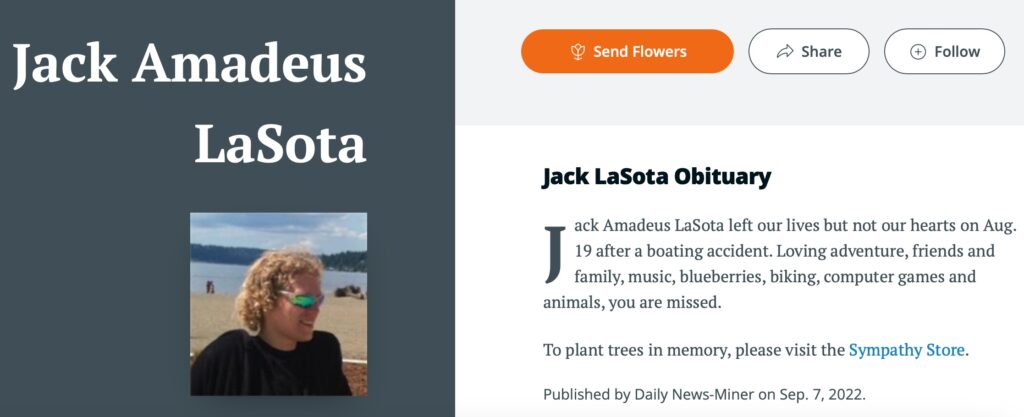
By Sept. 7, 2022, a short obituary had been published in the FairbanksDaily News-Miner, mourning the loss of the adventurous and highly intelligent 31-year-old.
Screenshot of Legacy.com obituary
It seemed like a tragic end for LaSota, who had moved from Alaska to the Bay Area to work in the tech industry.
Three months later, in November 2022, he/she was found alive—under suspicious circumstances.
It was that November when an 80-year-old man was brutally attacked in Vallejo, Calif. The assault left the man blind in one eye, and the assailant plunged a Samurai sword into his chest. Among those detained at the scene was none other than Jack LaSota, back from the dead.
Two years later, in 2024, an attacker returned to finish the job, slashing the now-82-year-old man’s throat in broad daylight. By then, LaSota’s name had surfaced in connection with other violent crimes.
On New Year’s Eve 2023, an elderly couple in Pennsylvania was executed in their home.
And on Inauguration Day 2025, a shootout in Vermont between suspects and Border Patrol agents left an agent and a suspect dead.
These seemingly unrelated cases all had one thing in common—connections to LaSota and a radical group known as the “Zizians.”
Exclusive: I have obtained the first known video revealing the voice of trans terror cult leader Jack Amadeus "Ziz" LaSota.
In 2013, at 22 years old, LaSota interned for NASA, developing space weather visualization software. He had just graduated from the Univesity of Alaska… pic.twitter.com/VKmoV8UPtR
The so-called “Zizians”—a loose network of highly educated, mostly transgender, vegan individuals—have been described as a cult with extreme beliefs. Their ideology appears to be an offshoot of what is called the rationalist movement, which emphasizes logic and reason as the ultimate sources of knowledge.
LaSota goes by the name “Ziz,” and is believed to be the group’s leader. According to Open Vallejo, the Zizians subscribe to a bizarre philosophy that involves a conflict between the two hemispheres of the brain, with only one hemisphere being “good.” The sides of the brain are trying to kill each other. Their belief system has been described by some as a “death cult.” Only Ziz says both hemispheres of his own brain are good.
BREAKING: Law enforcement has released the photo of Michelle Jacqueline "Jamie" Zajko, an armed and dangerous member of the trans terror cult linked to multiple killings.
Zajko, who is trans nonbinary, allegedly supplied the weapons to the trans duo who killed the Border Patrol… pic.twitter.com/Z92Yoryu6U
LaSota’s background is in Alaska. He was the son, but now the transgender “daughter” of an instructor at the University of Alaska Fairbanks. LaSota interned at NASA and Oracle and worked at Google, as well as at the Machine Intelligence Research Institute and the Center for Applied Rationality.
Now, LaSota is a wanted fugitive in multiple states. Law enforcement agencies are working to unravel the complex network of individuals associated with the Zizians and their potential involvement in multiple homicides.
Screenshot
Major news stories explain this bizarre case in greater depth. This news story is a summary of original reporting found at national media websitesand does not represent original MRAK reporting.
A grant made by the U.S. Department of Agriculture is an $18.5 million expenditure of taxpayer dollars that was given to the University of Alaska Fairbanks, Hawai’i Pacific University, University of Guam, Arizona State University to “build a diverse pipeline” of new federal workers for the USDA.
The grantwas made during the Biden Administration and is intended to build out the federal workforce with those who have been groomed into a certain ideology.
Now, the Trump Administration is working hard to cut the federal workforce dramatically — and without delay.
In fact, on Thursday, President Donald Trump’s Office of Personnel Management notified agencies they must lay off most of their probationary employees who have not yet worked long enough to obtain civil service protection.
The grant’s project start date was May, 2023, with an end date of June, 2028. Over five years, the grantees will focus on educating and preparing the next generation of “food policy leaders” for careers in the USDA and related federal agencies. Over the grant lifespan, 9,000 young people in Alaska, Arizona, Hawai’i, and Guam are to be put into the pipeline of food policy jobs.
Key activities in the program include role-playing simulations, “curated” internships, a “talent pipeline ladder,” USDA service gap analysis, and climate and food symposia. A trip to the nation’s capital for the young people in the program’s first year culminated in a professional photo of them taken with the Capitol Dome in the background.
The project seeks to demonstrate the importance of federal service in addressing climate and equity challenges and to strengthen the USDA workforce by increasing the number of diverse, food, agriculture, and nutrition-knowledgeable employees.
Although 9,000 “NextGen” students are to go through the program in five years, after the first year, only 91 had done so.
One of the courses offered in this program is “How to Land a Federal Job,” attended by 71 students.
From the grant report,it appears this grant is actually about climate and equity and recruiting into federal service a certain kind of federal worker — one who adheres to a certain ideology.
Another day, another proposed law limiting freedom in Democrat-run Washington state.
Democrats in the Washington State House of Representatives want to regulate the use of self-checkout machines at grocery stores.
A bill that has 10 Democrat sponsors, introduced in January, had its first committee hearing on Wednesday. House Bill 1739 would limit self-checkout use to times when at least one traditionally human-staffed checkout lane is open.
In addition, store employees who are assigned to monitor self-checkouts would be restricted to overseeing no more than two machines at a time. The law would apply to stores like Fred Meyer, where many goods are sold other than groceries. In many stores, the self-checkout monitors oversee about six stations.
Customers would would be allowed to scan only up to 15 items per transaction.
The proposed regulations would apply to grocery stores larger than 15,000 square feet but would exempt bulk goods stores requiring memberships.
The Department of Labor and Industries would be responsible for enforcing the rules, with penalties for noncompliance. Representative Fosse said the bill addresses concerns about automation and understaffing affecting grocery workers across the state.
A similar bill was offered in California, another Democrat stronghold, but failed to pass both houses of the legislature in 2024.
An investigation by The Alaska Landmine revealed that North Slope Borough Mayor Josiah Patkotak took numerous trips to places in the Lower 48 states and Peru, often accompanied by his wife and children.
In a December NSB Assembly meeting, members voted 8-3 to amend the borough code, allowing the mayor’s spouse and legal dependents, as well as the spouses of Assembly members, to have their travel expenses covered for official business.
However, records obtained by The Landmine indicate that the borough had already been funding Patkotak’s family’s travel since his election in 2023.
The released records detail lavish travel arrangements, including premium business class flights on LATAM Airlines from Los Angeles to Peru, first-class flights on Alaska Airlines and other carriers, and luxury hotel stays in New York City and Washington, D.C., and a lot of walking-around money for travel expense.
The North Slope Borough, with its main community of Utqiagvik, is the richest borough in the state, as it sits on top of the vast Prudhoe Bay oil field, which generates massive revenue for the borough through property taxes levied on oil and gas operations.
Despite having one of the most poorly supported public charter school systems in the country, Alaska charter school parents have managed to create the highest performing charter system in the US.
That’s the conclusion of two PhD’s who produced a scientific study for Harvard University in November 2023. The researchers from the Harvard study had no motivation to make Alaska’s charter schools look better or worse than any other state.
Recently, an Alaska public school teacher and an Anchorage-based political activist authored an opposing opinion to the Harvard study. These two individuals used an unusual statistical approach to make our high-performing charter schools appear less effective. Their motivation seems to be aimed at providing ammunition for those who oppose Gov. Dunleavy’s very modest plan to reinforce our very successful public charter school programs.
It’s pretty easy to see at a common-sense level that our charter schools perform very well, despite having significantly less support than our traditional neighborhood schools.
In the 2022 state testing of our 500 public schools, Eagle Academy Charter School was the top ranked public school for English/Language Arts proficiency. Eagle Academy was able to achieved the best results in the state despite having significantly less financial support than nearby neighborhood schools and despite operating from a 50+ year-old converted roller rink.
Also in 2022, Alaska was ranked 43rd in the nation for charter school support, out of the 45 states who allow charter schools, according and to the National Alliance for Public Chater Schools. This nonpartisan organization also had no reason to make Alaska’s support for charter school look better or worse than any other state.
When looking at Anchorage School District and comparing the results for the 52 neighborhood elementary schools to the seven elementary charter schools — four of the five highest performing district schools in English/Language Art proficiency were charter schools.
Some have implied the performance differences between our charters and neighborhood schools are because our charter schools are made up of mostly upper-middle/income students. That argument breaks down rapidly when looking at the outcomes for ASD’s Alaska Native Cultural Charter School (ANCCS). All of ANCCS students are considered low-income, in that 100% of their students qualify for free or reduced lunch. The school also has the disadvantage of operating from an old ASD campus that was slated to be demolished and replaced nearly a decade ago, because it was considered inadequate for neighborhood students.
In the 2022 state testing results, ANCCS had a significantly higher percentage of students who tested above “far below proficient” in English/Language Arts than the Alaska state average. In addition, the students outperformed 21 of the 52 ASD neighborhood elementary schools in that critical measurement.
The governor’s proposal is not asking for massive increases in resources go to charters. He’s simply asking that parents who want to organize a charter school be allowed to have more than one option for an authorizing authority.
Currently, Alaska is one of only five states where the local school boards are the only entity that can approve charter schools. This sets up a very asymmetric power relationship between the charter applicants and authorizers. With no other options, parents have to deal exclusively with local school boards for approval.
Local board are often openly hostile to new charter programs. They can dictate terms of approval. Local boards frequently set limits on size and scope of programs that are lower than the public demand.
Many parents that have been able to get charter approved, describe the process as “the most difficult thing they’ve ever done.” This has a hugely chilling effect on other parents contemplating the process.
The bottomline is this: Our charters schools represent one of the most basic levels of “local control” possible. The parents are literally in charge. Our charter schools are measurably higher performing and measurably more financially efficient than our traditional neighborhood schools — despite being subjected to one of the most poorly supported charter school systems in the US.
Bob Griffin is a former member of the Alaska Board of Education and Early Development and a life-long learner.
U.S. Sen. Lisa Murkowski has escalated her ongoing dispute with President Donald Trump by introducing a bill that would officially recognize North America’s tallest peak as “Denali” in all U.S. government references.
The legislation would mandate that all federal laws, maps, regulations, and records refer to the mountain by the name long used by one set of Alaska Natives — the Koyukon Athabascans. Other Natives have used other names for the mountain, which was officially named McKinley by President Woodrow Wilson, who signed a law passed by Congress to name it after the president who had been assassinated.
“In Alaska, it’s Denali,” Murkowski affirmed in a press release. “Once you see it in person, take in its majesty, and breathe in its cold air, you understand why the Koyukon Athabascans called it ‘The Great One.’ This isn’t a political issue – Alaskans from all walks of life have long advocated for the rightful recognition of its name. That’s why today I once again introduced legislation to ensure ‘Denali’ remains its official name.”
The dispute over the mountain’s name dates back decades. In 1975, the State of Alaska officially recognized “Denali” and requested that the U.S. Board of Geographic Names follow suit. In 1980, Congress renamed Mount McKinley National Park as Denali National Park and Preserve. In 2015, President Obama’s Department of the Interior officially named the mountain Denali.
However, last month, Trump signed an executive order titled “Restoring Names That Honor American Greatness,” directing the Department of the Interior to revert the mountain’s name to Mount McKinley.
Murkowski’s latest legislative effort follows a unanimous resolution passed by the Alaska State Senate recently, urging the President, the Secretary of the Interior, and the U.S. Board on Geographic Names to maintain the name Denali.
Sen. Dan Sullivan signed onto the bill as a sponsor.
Some have suggested an unlikely compromise, with a tongue-in-cheek combination of words to name it Mount McNali.
Another year, another lineup of meetings about homelessness in Anchorage Mayor Suzanne LaFrance’s increasingly dystopian realm.
Residents of Anchorage are invited to participate in a two-day summit focused on Anchorage’s coordinated response to homelessness, taking place on March 20-21, 2025, from 9:30 a.m. to 4 p.m.
That’s right in the middle of the Anchorage Municipal election, which ends April 1.
The event is organized by the Mayor’s Office, the Anchorage Assembly’s Housing and Homelessness Committee, and the Anchorage Coalition to End Homelessness.
Although she ran on reducing homelessness and claimed former Mayor Dave Bronson was incompetent, Anchorage’s homelessness scenario has only grown since LaFrance took office. Streets and trails aren’t safe and children’s playgrounds are routinely taken over by drug-addled vagrants, who leave their needles behind. She scrapped the plans made by Bronson and started over.
According to the latest report from the Anchorage Coalition to End Homelessness, the current number of people homeless in Anchorage is about 3,070, a dramatic increase from last year and likely an all-time high.
The Anchorage summit is marketed as providing residents with an understanding of the systems and strategies that the Municipality and its partners are using to, without success, address homelessness in the community.
“We’re working every day toward the goal of seeing a significant reduction in the number of people sleeping outside in Anchorage. It’ll take a team to get there,” said Mayor Suzanne LaFrance. “I hear from so many people who want to contribute to the solution but don’t know how. This summit will help residents answer that question and identify how to help in the way that makes sense for them.”
Two days of talk
On Thursday, March 20, attendees will learn about Coordinated Entry (CE), the system used by Anchorage providers to transition individuals from homelessness to housing while prioritizing those with the highest levels of vulnerability. CE professionals can complete their annual training, while community members can gain insight into the process, best practices, and methods for building trust to connect people to necessary care and housing.
Friday, March 21, will bring together community members, leaders, policymakers, municipal departments, service providers, and media to discuss the community’s multifaceted response to homelessness. Topics will include shelter, services, housing, behavioral health, camp outreach, and more.
“I am proud to welcome residents and community members from across the Municipality to join in our coordinated response to addressing homelessness that puts people first,” said Assemblyman Kameron Perez-Verdia, co-chair of the Assembly Housing & Homelessness Committee. “From service providers and policymakers to neighbors and friends, we all know that one person can make a difference, but we don’t have to do it alone. Together, let’s build a system to make a difference – and lasting change.”
The summit will be held at the Southcentral Foundation Nuka Learning Institute, located at 4085 Tudor Centre Drive in Anchorage. The event is free and open to the public, but space is limited, so advance registration is encouraged here.