A TIME TO OUTRANK ACTUAL VETERANS OR MERELY COSPLAY?
Gov. Bill Walker signed an administrative order, piggy backing it as a ceremony during the return of Last Frontier Honor Flight veterans who went to Washington, D.C. to visit the war memorials.
The event took place at the Ted Stevens International Airport, where veterans disembarked from the 10th Honor Flight and were wheeled in to the front of the pop-up event to be included in the picture.
In front of men and women who were wearing medals earned through service, and wearing his military-style incident command jacket, Walker wielded his pen while highlighting his role as commander in chief.
It was a contrast with U.S. Sen. Dan Sullivan, a lieutenant colonel in the United States Marine Corps Reserves, who had greeted the Honor Flight veterans in D.C. in his civilian suit and tie. No need to pull rank on these heroic veterans.
Senator Dan Sullivan greets a group of Alaska World War II, Korean and Vietnam veterans visiting Washington, D.C. as part of the The Last Frontier Honor Flight, Inc. The flight – the 10th since the Alaska Honor Flight was founded – brought the 275th Alaska veteran (125th from our Greatest Generation) to visit and experience the monuments and memorials built in honor of their service and sacrifice. “On behalf of a grateful state and nation, I say thank you,” Sullivan said.
Was Gov. Walker, who has not served in the military, borrowing glory from the heroes of World War II, the Korean War and the Vietnam War?
Were they being used as props for a photo op for the governor, who faces a tough re-election battle?
It’s a question for the veterans among us.
Normally, governors are issued incident command jackets by the U.S. Army National Guard to wear during disasters in the incident command environment, since constitutionally the governor is the commander in chief for the Army and Air Guard.
They are not typically worn during civilian events, although a governor can wear it whenever he chooses. The patches are merely decorative to inform everyone who the governor is in the hierarchy of command.
Back in 2007, Gov. Sarah Palin visited Alaska Air National Guard troops at Camp Virginia, Kuwait, and wore a loose-fitting T-shirt.
Gov. Sarah Palin looks over a squad from her state during a visit to Camp Virginia, Kuwait in 2007. The tour of the desert camp culminated at lunch with her Alaska National Guard Soldiers in the dining facility. Wikimedia photo.
MUSEUM TASK FORCE TO BE CREATED
Administrative Order No. 293 creates an 11-member task force to research and coordinate efforts, collect histories and artifacts, research funding and propose possible sites.
“Alaska has a rich and complicated relationship with the U.S. military,” states the administrative order.
“Major components of that history currently go unrecognized. The internment of Alaska Native people in Southeast Alaska during WWII. The role African-American soldiers played in the building of the Alcan, referred to as the “Road to Integration” in the Army. The Aleutian Islands’ role as the only part of North America to endure prolonged enemy occupation by Japan during World War II.”
“Alaska has more veterans per capita than any other state in the country, and Alaska Native people serve the armed forces in higher proportions than any other demographic. It is important to recognize this history, and honor those who sacrifice, those who continue to serve, and those who will serve the future,” the order says.
The task force, which will be appointed by the governor, is to produce an initial report by Oct. 1.
Gov. Walker declared a state disaster in February. The disaster is opioids, and his act made anti-overdose drugs widely available. It is the first such declaration in Alaska that didn’t pertain to an actual natural or economic disaster.
Last week, the Tlingit Haida Central Council marched on the Capitol to demand a “linguistic emergency” be declared.
The problem? The Senate majority, not completely sold on the House majority concept of a language emergency, was trying to tame a resolution and instead label Alaska’s dying languages an “urgent” problem.
That was not enough: Tlingits who marched through the halls wanted it to be declared an official state emergency by the governor.
Alaska Native languages are on the wane and most will be gone by the end of the century, if nothing is done to preserve them. Government must act, advocates say, although many conservatives would argue it is not the government’s role to save a certain language from extinction.
Indeed, none of the Alaska Native Corporations conduct their meetings in Tlingit, Yup’ik, or Deg Xinag.
Rep. Daniel Ortiz of Ketchikan, a member of the Democrat-led majority introduced HCR 19 this session to declare the linguistic emergency.
The declaration would set the state up to to budget funds that would be used to preserve the languages, although it’s unclear how such money would be made available, since the bill has a fiscal note of zero.
Likely, the next step would be to introduce a law that requires the dying languages be taught in public schools.
The movement started back in 2014, when Rep. Jonathan Kreiss-Tompkins got a bill passed that added 20 Native languages as official languages of Alaska. That bill also drew a Native-led sit-in that lasted 15 hours in the Capitol.
Official Alaska languages include Inupiaq, Siberian Yupik, Central Alaskan Yup’ik, Alutiiq, Unanga, Dena’ina, Deg Xinag, Holikachuk, Koyukon, Upper Kuskokwim, Gwich’in, Tanana, Upper Tanana, Tanacross, Hän, Ahtna, Eyak, Tlingit, Haida, and Tsimshian. It was a start, language advocates said. There will be more to do.
The “more to do” is lined out in the HCR 19 sponsor statement from Rep. Ortiz:
“The state has moved in the right direction by acknowledging and recognizing the 20 Alaska Native languages as official languages of the state; however, recognition is just the first step. The intent of this resolution is to heed the suggestions put forth by the Alaska Native Language Preservation and Advisory Council (ANLPAC).
“The Council strongly urges that the Governor issue an Administrative Order, recognizing the linguistic emergency that exists, and state that it is the policy of the State of Alaska to actively promote the survival and continued use of all of Alaska’s 20 Native languages.
“In their 2018 Biennial Report to the Governor and Legislature, ANLPAC warned that all 20 Alaska Native languages are in crisis, and most are predicted to become extinct or dormant by the end of the 21st century. The State of Alaska can no longer sustain these rates of language loss unless policy changes are enacted that support people who are learning and speaking Alaska Native languages throughout the state.
“The loss of language represents the loss of a critical piece of our history, culture, and a traditional way of life. I respectfully request the Legislature join me in support of ANLPAC and the languages that represent intergenerational knowledge.”
The bill is now in Senate Rules and is scheduled for a Monday vote on the floor.
Earlier this month, a UAF professor called on the governor to also declare a sexual assault emergency in Alaska.
Declaring a state of disaster “could catalyze public assistance measures at the state, local and tribal government levels, and direct the Alaska Division of Homeland Security and Emergency Management to establish funding for emergency protective measures,” wrote Alexander Hirsch, who teaches political science and directs Women, Gender and Sexuality Studies at UAF.
“The declaration would also allow the governor and his emergency management team to swiftly establish a sexual violence commission that could work closely with the Council on Domestic Violence and Sexual Assault to expand the exceptional services it currently offers in the form of emergency shelters, safety planning, community advocacy and batterers’ intervention programs. A state of disaster could also provide greater financial assistance for victims seeking legal redress,” he wrote.
Hirsch argued that a rape disaster declaration can have the same effect as the opioid disaster declaration — freeing up more money from the federal government.
WATCH FOR NEEDLES, STATE SAYS
Meanwhile, the Department of Health and Social Services is responding to the opioid disaster by not only getting overdose medication into the hands of drug users, but by issuing an unusual warning, telling Alaskans to watch for hypodermic needles during their spring cleanups.
Your local melting snow berm is part of this declared disaster zone. It likely doesn’t just have empty booze bottles and mounds of dog poop — there are needles to watch for, as this HSS poster warns. In future years, due to the linguistic emergency, we will see posters like this in the 21 different official language of Alaska, but for now, it’s in English and in pictures:
THIS IS A SPENARD STORY. THAT MEANS A BLUE TARP IS INVOLVED.
And just like that, it was gone. If possession is nine-tenths of the law, the U.S. Marshal owns the Spenard Palm Tree.
The six-month saga that started when the Marshal told Denali Disposal it could keep a broken-down neon palm tree ended with the fixture hauled off by the feds to another undisclosed site.
Bernadette Wilson, owner and manager of Denali Disposal, had a contract to clean up the old Paradise Inn last year. The motel had been seized by the federal government due to illegal drug activity and the trash needed to be taken out so the property could go up for auction. Trash, the marshal said, included that goofy sign.
Wilson told the marshal in charge that the sign seemed like something more than garbage. It was a bit of a landmark for Anchorage. Could she keep it?
The marshal told her to keep it — the government had no sentimental attachment to the sign. So she brought in a flatbed truck and carefully hauled it away, not at night, but in broad daylight and with the full support of the federal marshal. It would find a home somewhere, she thought, perhaps back in Spenard, where it had lived for 50 years. Somewhere near the Koot’s windmill, perhaps.
“It was Monday morning, November 6, 2017. For nearly an hour, we walked through the Paradise Inn, escorted and directed by a U.S Marshal who told us what we were to dispose of. Roughly 50 pictures taken within the same 1 hour window would serve as reference for what we were to haul away – washers, driers, refrigerators, TV’s, glassware, dressers – and a neon palm tree,” she wrote.
“As we wrapped up our tour through the cold and dark Paradise Inn, we made our way outside. There, at the base of the palm tree, we were told to get rid of it. As we snapped pictures, I commented that I thought it was ‘kind of cool’ and asked of the US Marshal ‘ Do you care if we keep it?’”
“NO, he replied– we don’t care if you keep it. Unequivocally, positively he responded – we don’t care, just get it down. People were attempting to cut through the fence, it was a ‘liability’ we were told. Why would you want to keep it? The neon doesn’t work, it’s busted up and junk I was told. We talked and snapped pictures.”
But later, as Wilson found out, the federal government can change its mind. A U.S Attorney called her and demanded the tree be returned. If it was worth something to her, he said, then it wasn’t trash and it should be returned so the Feds could auction it.
IT’S ALL OVER BUT THE SHOUTIN’
Wilson disagreed with the U.S. Attorney, and he didn’t take kindly to her not giving him the tree. Her righteous indignation at being told one thing by one agency, only to be found “in the wrong” by another seemed to scratch some itch in him that only ramped up the attorney’s resolve to seize the tree. The two sides went to court. A judge ordered her to return the tree to the feds.
The Palm Tree, now in the possession of the U.S. Federal Government.
At 11:30 am on Friday, April 20, Vulcan Towing pulled up to the vacant lot where the tree was being stored under a blue tarp. After all, this is a story about a Spenard piece of yard art.
Two members of the U.S. Marshal’s office showed up, and the custody transfer began. A reporter from KTVAdocumented it. An hour later, the tree was rolling down the streets of Anchorage. Only a few broken bits of neon light were left behind.
“The judge gave the order and, just like all along, I’ve followed all the orders of the government,” said Wilson, who hasn’t figured out if she’ll appeal the judge’s ruling.
She says she’s out at least $30,000 for having preserved the palm tree from being trashed during the cleanup of the disreputable motel. If she had just hauled it off to the transfer station … Nah. That’s not Bernadette.
What now? The feds plan to auction it off along with the motel, but these things happen on government time, which can take a while.
“I hope it sells for $50,000 because that is how much it will have cost them in the end,” she said.
Wilson also maintains that she was bullied and harassed by a member of the U.S. District Attorney’s office. She wrote about her experience and even set the saga to music.
[Read: Bernadette vs. the Feds: The Musical]
On Friday, Wilson told Must Read Alaska that the entire situation had become surreal to her. Now that she doesn’t have the tree in her possession, she also has no leverage and no apparent path to making the federal government pay her for her expenses.
The U.S. Attorney won the Palm Tree. The Feds own a rusted tree it once thought was worthless and it may get $5,000 for it at auction. Or maybe someone will be $10,000.
Meanwhile, Wilson is trying to figure out which Kafkaesque part of the federal swamp is in charge of making her whole for the $30,000 she’s put into preservation — $30,000 that could buy her a few vacations in Hawaii under a real palm tree.
LETTER TO DIVISION OF ELECTIONS OUTLINES EXPECTATIONS
Alaska Republican Party Chairman Tuckerman Babcock sent a letter to the Division of Elections last week, informing Director Josie Bahnke that the party will enforce its rule and its constitutional right to remove three legislators from its primary ballot in the August, 2018 cycle.
Babcock said that with the Alaska Supreme Court ruling that AS 15.25.030(a)(16) is unconstitutional, the political parties in Alaska have the right to make rules about who is on their primary ballots. And who is not.
The party has such a rule. Its central committee — the corps of volunteers who serve from the 40 districts around the state — voted to prohibit Rep. Gabrielle LeDoux-Muldoon, Paul Seaton-Homer, and Louise Stutes-Kodiak from running as Republicans on the primary ballot.
Now the party intends to assert that constitutional right.
Reps. Paul Seaton, Gabrielle LeDoux, and Louise Stutes argue with Alaska Republican Party Vice Chairman Rick Whitbeck during a meeting where they were being sanctioned by the party in 2016.
The Republican Party maintains a closed ballot for the primary, which means only registered Republicans, or voters not registered as members of another party, can vote on its ballot.
Babcock said that the party concurs with the Supreme Court’s decision, and now wants the Division of Elections to implement the law in the manner that is consistent with the party’s rules.
“I wrote to you on December 4, 2017 (see attached) declaring ARP’ s internal ruling that Representatives Gabrielle LeDoux, Louise Stutes, and Paul Seaton were ineligible to appear on the Republican Primary ballot in 2018. Your response dated December 7, 2017, declined to act on ARP’s request, citing several objections. I chose not to respond at that time in light of the fact that the State had appealed the summary judgment of the Superior Court to the Alaska Supreme Court.
“With this correspondence, it is ARP’s intent to re-assert what we believe are constitutionally protected rights of association, now affirmed by our Supreme Court. ” – Tuckerman Babcock
The Supreme Court in March ruled that the Alaska Democratic Party could include on its primary ballot those who were not associated with the Democratic Party, but who wanted to run in their primary. That ruling honored an internal rule of the ADP that is promoting the use of “undeclared” or “fake independent” candidates on the Democratic Primary ballot, in an effort to distance them from what had become a problem: People were not voting for Democrats in numbers that would allow the party to gain power in Alaska.
The Democrats were successful running fake-independents such as Rep. Daniel Ortiz of Ketchikan and Rep. Jason Grenn of Anchorage, and most famously Gov. Bill Walker — providing them money and extensive resources normally available only to Democratic candidates.
The Division of Elections originally objected to the Democrats’ effort to fool the voters by going to the next step — allowing them to be on the actual primary ballot under the Democrats’ header. The matter when to court last year.
Superior Court Judge Philip Pallenberg ruled in favor of the Democrats.
While the Democrats were trying to add people to their ballots, Republicans were busy trying to kick what they consider “fake-Republicans” off of their primary ballot.
The State Central Committee had over a year ago voted to kick three sitting House members out of the party because, after winning their elections, they immediately formed an alliance that turned over control of the House of Representatives to Democrats. It was seen as a betrayal of the voters and of the party that had put money into their campaigns.
It became so toxic between the three “Musk Ox Caucus” members, as they are sometimes called, and the Republican Party, that the party asked Rep. Stutes to return the $1,000 the party gave her campaign. She wrote a scolding public letterand donated $1,000 to the Kodiak Salvation Army instead. She had no intention of giving the money back, she said.
The Republicans held an airing of the problem at its quarterly meeting, and allowed the three renegades to defend themselves by giving their own speeches about why they should still be allowed to run as Republicans.
Then a vote was held among the Republican State Central Committee. It was nearly unanimous: The three would be sanctioned from any support from the party. And the party already had a rule in place allowing it to disallow false-flag candidates.
Now it was time to assert the rule.
But when Babcock wrote to Bahnke in December,telling her the three were not allowed on the ballot under the Republican header, she said she didn’t plan to honor the request.
Babcock waited, knowing the Supreme Court ruling would likely come back favoring the Democrats’ wishes, and that meant the Republicans’ wishes would also have to be honored.
Last week, he wrote to Bahnke, “We further assert the absence of any legitimate interest which might be invoked to prevent the party from implementing validly adopted rules regulating our internal affairs — specifically those pertaining to who can, and who cannot run under our party’s label in the 2018 Primary election.
“To be clear, Representatives LeDoux, Stutes and Seaton are not members in good standing of the Republican Party of Alaska, and are ineligible to appear as candidates representing our party in the 2018 Primary Election, according to our rules.
“ARP is not asking the Division of Elections to concur with this determination, only to acknowledge it and not to intervene in a manner that frustrates ARP’s internal administration of our rules.”
The Alaska Republican Party is the largest political party in Alaska, with 140,000 members. Its rules allow it to withdraw support for candidates who have organized with an opposition party when a majority of Republicans has been elected, as occurred in 2016. The only reason the Alaska House of Representatives is now run by a Democrat-led majority is because duly elected Republicans chose to organize with them rather than their own party, something the party seeks to avoid in the future by exerting more discipline over its ballot.
“These individuals are free to seek election as unaffiliated petition candidates or the nominees of another Party,” Babcock wrote. In other words, the Alaska Republican Party is not asking the Division of Elections for permission — it’s relying on a Supreme Court ruling that says it has the authority to enforce its rules, and asking the State to cooperate accordingly.
Gov. Bill Walker on Wednesday announced his choices for those who will go to China with him on his trade mission in May. They include three economic development agencies, three Native corporations, five seafood companies, six tourism-related groups, and one local government — the Mat-Su Borough.
Out of the 40 who applied, the chosen delegation includes:
A2A Railway Development Corporation – The Alaska to Alberta Railroad Corporation, a Canadian company
Alaska Pacific University – School is interested in developing relationship with Chinese competitive skiers
Alaska Skylar Travel – The only Mandarin-speaking trip planner in Alaska owns and operates Alaska Skylar Travel & Charlene’s Express Travel
Alyeska Resort & Hotel Alyeska
Anchorage Economic Development Corporation
Bambino’s Baby Food – Anchorage start-up business
Bering Straits Native Corporation – interests include Arctic port at Port Clarence
Borealis Basecamp – owned by AIAX LLC
Chena Hot Springs Resort and Holdings
Copper River Seafoods
Denali Visions 3000 – 49th State Brewing Co.
Explore Fairbanks
Fairbanks Economic Development Corporation
Golden Harvest Alaska Seafood
Icicle Seafoods
Kachemak Bay Seafoods
Matson – ocean transportation, shipping
Mat-Su Borough
Mat-Su Economic Development Corporation
Nana Regional Corporation
PT Capital, LLC – Hugh Short, CEO, who is also on board of Alaska Gasline Development Corporation
RIM Architects & Design, LLC – Larry and Barbara Cash
Sealaska Corporation
Trident Seafoods – major exporter of seafood to China
Trilogy Metals US Inc. – Ambler Mining District interests
Visit Anchorage
Gov. Walker’s entourage will travel to China May 19-30 to meet economic partners, engage with key decision makers, expand Alaska markets, and meet potential customers, industry, and government officials. Each participant will be paying his or her own way
Tucked into the Anchorage Municipal Code governing business licenses are regulations for those who operate massage parlors and strip clubs.
Between those, one finds Code 10.40.020 — Private Detectives.
Senator Tom Begich of District J — downtown Anchorage — is Anchorage’s newest private detective. He is going to be paid to troll people.
Private detectives in Anchorage must be older than 18, not addicted to narcotics, dangerous drugs, or intoxicants, and have not been convicted of a felony within two years, nor of a misdemeanor involving assault or dangerous weapons within one year. Also, they cannot have been convicted of a crime involving moral turpitude, assault with a dangerous weapon, traffic in narcotics or dangerous drugs or traffic in women for immoral purposes within 10 years.
The bar, it appears, is set quite low.
Although his constituents might feel uneasy answering the door to him next time he campaigns for office in 2020, his political opponents — and that includes all registered Republicans — should note that as a sitting senator, he has instant access to all voter files in Alaska, which gives him an advantage over his private sector competitors. He has information for which others have to pay and that others receive on a delayed basis.
What is Sen. Begich intending to snoop on? It’s a target-rich environment in Juneau, but he could perform all kinds of political opposition research under the guise of being a private detective.
The municipality defines a P.D.’s duties this way:
The term “private detective” means a person who engages in the business of making investigations for remuneration concerning any of the following matters:
A. Crimes or criminals or discovering information or evidence relating to crimes or criminals.
B. The identity, location, character or activities of a person or thing.
C. The habits, conduct, movements, whereabouts, associations, transactions, reputation, credibility or character of a person.
D. The cause, origin or responsibility for a fire, accident or injury to real or personal property.
E. The truth or falsity of a statement or representation.
F. Evidence to be used before an investigating committee, board of award or arbitration or in the trial of a civil or criminal case.
Who will he get said “remuneration” from?
Seeing as Begich comes from a family whose primary business is politics, it could be anything, from destroying opponents of his Democrat colleagues to assisting his brother Mark Begich in finding his political footing once again.
As a part-time musician, Tom Begich may have a hard time making ends meet, although his $50,000 plus salary as a senator is good money for a local musician.
Is this a way for Alaska Democratic Party to pay him? Is this just a license to be a voyeur?
His 36,300 constituents in Anchorage — Fairview, Mountain View, Bootleggers Cover and Downtown Anchorage — will want to know. And Gov. Bill Walker, who is keeping an eye on Mark Begich, will also be watching his back.
Despite the disturbing circumstances that led to the recent arrest of the company’s former CEO, I am incredibly proud to be working for Quintillion and with its team.
I have been in the telecommunications business for 35 years and have yet to see a team as dedicated to its mission as the one I lead today. The small team of women and men of Quintillion, together with our investors and partners, have remained focused on the job and our clients. As a result, we have built and now operate a world-class fiber optic network that is transforming communities, businesses, and lives in Alaska’s Arctic.
I want to acknowledge that what is alleged to have occurred is appalling, and not representative of the way Quintillion or its people do business.
Equally important to note is that Quintillion’ s board of directors were the ones who discovered the wrongful activity, conducted a detailed and extensive internal investigation, voluntarily reported these findings to the U.S. Department of Justice, and were the first to notify Quintillion’s customers and lenders.
Quintillion itself, along with its investors and lenders, were the victims of the charged conduct. We will continue to fully cooperate with the U.S. Department of Justice as they prosecute this matter.
While all this transpired, we nevertheless still had an important job to do. Our management team focused on completing construction and providing commercial service to all of our clients and end users across our complete network.
I am tremendously proud that our team responded aggressively to this challenge and diligently executed the plan to construct and operate a remarkable system, in a place where nothing like this had ever been done. Along with a new 500-mile terrestrial fiber system from Fairbanks to Deadhorse, Quintillion’s team built a 1,200-mile subsea fiber system, the first-ever submarine cable system in the North American Arctic, which, in fact, did go live on time on Dec. 1, 2017, and has performed flawlessly for our customers ever since.
That network has the ability to serve some 20,000 residents and businesses in the Alaska Native communities of Utqiaġvik, Point Hope, Wainwright, Kotzebue, and Nome — communities that have epitomized the term “digital divide.”
The majority of these communities have been without reliable, affordable, high-speed broadband, or any kind of meaningful modern cell service.
The Quintillion network is now providing access to high speed broadband capacity for telecommunication service providers at a significantly lower cost per megabit, providing dramatically improved quality of service over existing satellite and microwave options.
Quintillion’s infrastructure is enabling isolated communities to connect to the outside world in a manner that is historic. From telemedicine to virtual classrooms and on-line training programs, these communities are starting to leverage our system to the benefit of their patients, students and consumers. One school has had its internet bill cut by two thirds. Downloads are faster. Businesses are able to order supplies faster. One community has a public center offering free wi-fi and video conferencing. Entrepreneurs are selling their wares on-line.
What is happening is truly transformative, and given we have only been in service for four months, this is only the beginning.
Quintillion is seeing success in all of our markets, and we and our investors are confident that we will continue to deliver unique value to those who we serve, and we view our mission as greater than any individual parts.
At Quintillion, our focus is on the future we can achieve for the benefit of many. Our management team and investors are fully engaged and committed, and we will remain steadfast and in pursuit of these goals until the job is completed.
George Tronsrue III is the interim CEO of Quintillion. He is the founder of MFSI Government Group, supporting federal, state, and local government agencies and other clients. He also founded the Jericho Fund, an investment and strategic advisory company focused on early stage opportunities in the wireless broadband, media, internet technology, software and entertainment industries; and the Jericho Alliance charity, a non-profit organization that provides humanitarian aid, medical and relief services through partners in Iraq (Mosul), Kurdistan, and to refugees in Burma’s war zones. A graduate of the US Military Academy at West Point, he served in the US Army as an airborne, ranger infantry officer from 1978-1983, until a line of duty accident resulted in his medical/disability retirement from the Army.
FOCUS SHIFTED FROM HONEY BUCKETS TO CLIMATE CHANGE
Joel Neimeyer’s last day as the federal co-chair of the Denali Commission is Friday. The grant making agency has had eight years that at times were about as drama-filled as a slightly feral arm of the federal government can get.
The Alaska delegation has interviewed candidates for Neimeyer’s replacement; Sens. Murkowski and Sullivan along with Congressman Young will forward the name of their preferred candidate up their chains of command and on to Secretary of Commerce Wilbur Ross, who will make the appointment. This could take a while.
Corrine Eilo, who serves as Denali Commission financial administrator, will likely become acting co-chair, the day-to-day manager of the agency.
The Denali Commission was a creation of the late Sen. Ted Stevens in the late 1990s to funnel grants into rural Alaska that would improve infrastructure. After all, rural Alaska lagged behind in basic services that urban Americans take for granted, and Stevens was a master at getting grants for Alaskans.
The commission’s congressional charter was limited to providing job training and other economic development assistance to distressed rural areas, and providing for rural power generation and transmission facilities, modern communication systems, water and sewer systems, and other infrastructure.
In plainer language, much of the purpose was to bring safe water and sewer systems to remote areas, where sewage lagoons, honey buckets, and unsafe wells were the norm; and to get power generation and safe fuel tanks in place.
Over the years, it has helped build power plants and fuel tanks in dozens of rural communities, and also health care facilities. More than 2,000 projects have been funded or partially funded.
But the agency is often criticized for a lack of accountability.
The agency’s own inspector general wrote to Congress and recommended the agency be shuttered: “I have concluded that (my agency) is a congressional experiment that hasn’t worked out in practice,” he wrote. “I recommend that Congress put its money elsewhere.”
In 2013 Sen. Lisa Murkowski called on the Government Accountability Office to review the auditors report. He was, after all, reviewing the Denali Commission from his office in Phoenix, Ariz., and Alaskans thought maybe he didn’t understand the full picture. Soon, a report on the watchdog was issued that was critical of his work.
That was a low point.
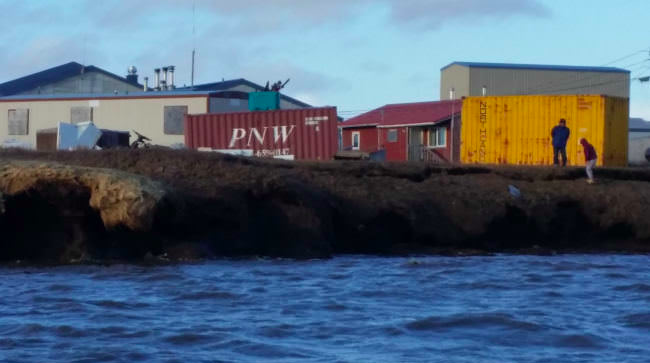
By 2015, President Barack Obama added a climate change component to change the focus toward relocating villages that are too close to the water and are being threatened by the lack of shore ice to protect them during fall and winter storms.
Although it hasn’t made the news lately, fiscal conservatives mutter about mission drift. With the focus shifting to climate change and a $15 million federal award to the Denali Commission for help move Newtok away from the Ninglick River, the commission has a new lease on life.
That award represents half of the commission’s budget and has influenced the entire course of its work.
But moving Newtok is going to cost up to $130 million — just for the infrastructure, according to the U.S. Army Corps of Engineers. $15 million doesn’t move a village.
In fact, there’s no one agency that seems to have the responsibility for Newtok’s relocation, which doesn’t bode well for federal funds being moved around between cooperating agencies. Bureaucracies act like sponges whenever funds are around and no one has ultimate responsibility.
A visit to the Denali Commission web site finds few goals or deliverables outlined, no specific accomplishments heralded, no timelines or milestone dashboards to view progress, and no transparency about whether the agency has established its worth.
Instead, the reports refer to the agency’s role in various activities, how the agency “works with” other agencies, its involvement with work groups, cooperative projects, its participation at the table, and its “special role in increasing government effectiveness.” The definition of a bureaucracy.
At the very least, the commission has a communications problem: It needs to establish its value proposition better.
The next federal co-chair will be taking over a federal agency that has drifted. He or she will want to explain better to funders — the American taxpayers — what the return on their investment has been over the past 20 years, how Americans’ lives have been improved, and what the agency will produce as a work product in the next four years.
As far as I know, Henri Landwirth never made it to Alaska, but he will be remembered on the Last Frontier at least by one person — me.
A Holocaust survivor, Henri Landwirth has passed at age 91. I will never forget him.
Henri and his family were forced into a ghetto in Krakow, Poland, during the Nazi occupation. His father wanted to flee Poland because the anti-Jewish sentiment was rising, but his mother would not leave. Germans invaded their home and robbed them of every valuable possession. The suffering was unimaginable, but would only get worse.
As a young teen, Henri survived Nazi death and labor camps, including Ostrowitz and Auschwitz. His father was arrested, shot in the back of the head and dumped in an unmarked mass grave.
After months in the prison at Ostrowitz, Landwirth learned his mother was living on the other side of the camp. He snuck over to see her, and found her at death’s door. She asked him, “You wouldn’t have an extra piece of bread, son, would you?” He did not have anything to feed her and he never spoke with her again, never heard her voice nor felt her touch, although later in Auschwitz he thought he saw her from a distance.
At the end of World War II, Henri was marched into the woods to be shot, but a Nazi soldier spared his life and ordered him to run. Miraculously, he limped into the woods. “I never knew what my life would be like. Frankly, I didn’t know if I would live,” he said.
He made it to an empty house, where he collapsed. Covered in sores and down to skin and bones, he was found by kindly country people who nursed him back to health.
Later he learned that his mother had been loaded on a boat with a thousand Jewish prisoners and then floated into a harbor and blown up.
Then somebody told him they had seen his twin sister, Margot. Against advice, he hitched a ride back into Germany and to the village where she was believed to be housed with several other women. Using a secret whistle that only she would recognize, he walked through the village whistling, until he heard her whistle in response: They were reunited on their 18th birthday. Margot died last year.
WHAT HENRI DID NEXT
Henri survived and chose to forgive the atrocities he witnessed. He chose love over hate, and grace over fear. He came to America with $20 and a Torah and started out at the bottom of the hotel business.
In 1954, he became the manager of the Starlight Motel in Cocoa Beach, Florida, in partnership with astronaut John Glenn. As he worked his way up and learned his trade of hospitality, and grew his fortunes in hotels. And ultimately, he gave it all away to help disabled and dying children and their families experience one last vacation together, a holiday that is filled with joy, where Santa visits every day, and the tooth fairy comes and leaves presents every night. The rides at “Give Kids the World” are all accessible to disabled children, and it’s all free.
In his late 70s, Henri finally returned to Auschwitz to visit. His children went with him and a documentary crew filmed his experience and made a documentary, “Borrowing Time.” The trip was not easy for Henri and the film has not been shown but a few times.