A legislative ethics committee issued a ruling against Rep. Geran Tarr, who used her legislative staff to perform organizing and fundraising activities for the Mountain View Street Fair Festival in 2017. In other words, she used government resources and government workers on her campaign.
However, the committee recommended no punishment for the Anchorage Democrat.
“Representative Geran Tarr violated the Legislative Ethics Act by instructing staff to perform organizing and fundraising activities for the Mountain View Street Fair Festival in 2017. Representative Tarr and staff performed these organizing and fundraising activities on government time with the use of government assets and resources for a nonlegislative purpose. These activities provided a private benefit to the legislator and the Mountain View Street Fair Festival.”
The House subcommittee offered a suggestion to the legislator that will help her prevent future violations, saying that “Representative Tarr [should] seek guidance of the Ethics Office before committing government resources to a project which would provide a clear private benefit in violation of the Legislative Ethics Act.”
One part-time aide to Tarr spent over 120 hours of government-paid time working on her campaign event. Other staff members of the government provided her similar services for this event.
A dark and stark vision of Alaska is the theme of Gov. Bill Walker’s second campaign video, posted just a week after his first one, which was poorly received by Facebook critics.
The first Walker campaign video was almost cartoon-like, with the governor shoveling show endlessly, then shoveling it again, while his critics, pictured as clowns and idiots, made snide comments from the other side of the road.
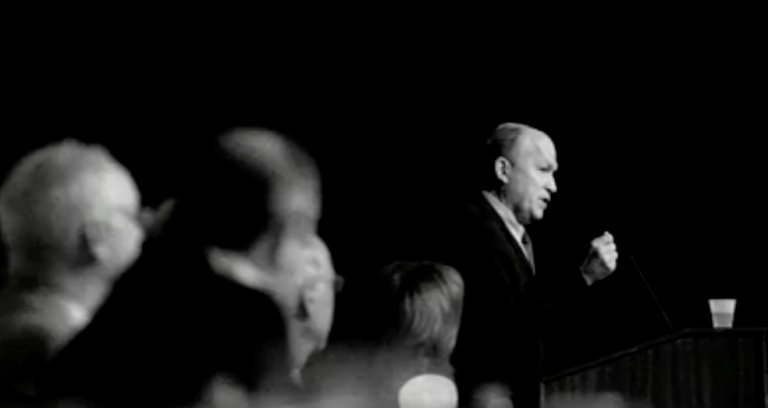
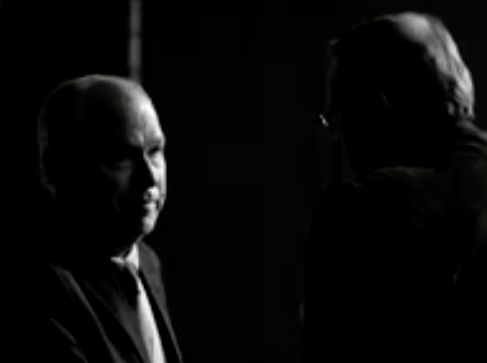
But now, in high contrast black and white — and mostly black — the governor is shown as wooden. In still photos with tense and mournful music as the audio, he speaks to shadowy figures, or looks craggy and tired in an apocalyptic landscape that has little vegetation, beauty, or hopeful vision for the future.
The ad speaks to the problems that Alaska has and how we need a governor who can fix it. Was this “50 Shades of Gloom” ad done by a Mark Begich infiltrator in the Walker camp, or could it really be the governor’s own campaign team producing it?
“The dark theme fits perfectly with someone whose budgets are up, where his SB-91 has driven crime up, where his economic policies have driven unemployment up, where education scores are down, Permanent Fund dividends are down, and economic prosperity is down. It fits well with his record,” said Tuckerman Babcock, chairman of the Alaska Republican Party.
Film critics are invited to leave their comments below on Walker’s second effort at communicating his vision for Alaska.
Gov. Bill Walker has a tough re-election season ahead of him, and he’s looking to share a bit of good news with Alaskan voters.
He claims to have found that “good news” in a poll conducted for his campaign by a liberal polling firm hired out of Portland.
Walker didn’t release the actual question or who answered it, but he squeezed news out of it. It’s from a February poll, one that Jim Lottsfeldt, a Democratic-focused strategist, was shopping around to politicos several weeks ago. Lottsfeldt partners with Patinkin Research and lives and works much of the time in Portland.
Patinkin, which recently did work for the Stand for Salmon initiative to shut down development in Alaska, gives Walker/Mallott a 3 percent lead over contenders Mike Dunleavy and Kevin Meyer. Dunleavy is a Republican candidate for governor, and Meyer is a Republican candidate for lieutenant governor.
That 3 percent advantage is within the margin of error for any poll with a sample size of 1,200.
But the Patinkin poll contacted just 600 respondents, according to Walker/Mallott. That means the poll likely has a greater margin of error than the three-point victory that Walker is claiming.
STRIKING RESULT
The Walker campaign called it a striking result. Some 50 percent of Democrats support Walker, according to the poll.
But that’s his base, and it means 50 percent of Democrats are not supporting him, political pundits said this morning.
And fully 64 percent of all respondents are not with the Walker/Mallott camp — or are not yet willing to commit.
That is actually the most striking news of all, said Tuckerman Babcock, chairman of the Alaska Republican Party: An incumbent whose face is in the daily news cycle does not yet have the confidence of 64 percent of the electorate.
“Even their own propaganda poll they are pushing shows 64 percent of Alaskans want someone else. The best he could do is a third of the vote? In the most biased polling he could buy, it still confirms what other legitimate polls have shown, and that is how hopeless his campaign is this year,” Babcock said.
The poll is a clear shot at Mark Begich, the former mayor of Anchorage and former U.S. Senator, who is making the rounds and lining up commitments. Walker is worried that Begich is jumping in as a Democratic challenger and is trying to signal to Begich that he has half of his voters.
And to release this poll is an indication that his campaign either thinks Dunleavy is the frontrunner on the GOP ticket or is trying to push him as such for Walker’s own strategic calculations. Perhaps Walker’s campaign thinks he can beat Dunleavy in the General Election, but not Scott Hawkins or Mike Chenault, the two other Republican candidates.
It’s also an indication that Walker intends to stay unaffiliated, rather than join the Democrat primary ballot.
“To share a poll to show that you are ‘in the running’ when every reputable poll shows ‘you’re done’ is a sign of desperation. I hope the governor’s whole campaign is based on his fantasy.” – Tuckerman Babcock, Alaska Republican Party
“We are excited and humbled by the momentum the Dunleavy campaign continues to build,” said Brett Huber, campaign manager for Alaskans for Dunleavy. “We’ll continue to share Mike’s message for an optimistic future for Alaska. In the end, the only poll that matters is the one in November, when voters make their choice.”
DEMOCRATS MAY EXPAND THEIR BALLOT, BUT REPUBLICANS MAY NOT RESTRICT THEIRS
Division of Elections Director Josie Bahnke has determined the Alaska Republican Party will be forced to accept three turncoat Republicans on its primary ballot.
The party has no right, she said, to remove candidates who have been voted by the party as ineligible to run as Republicans.
Bahnke was responding to a letter from Alaska Republican Party Chairman Tuckerman Babcock, who told the Division earlier this month that the party has specific rules and plans to enforce them.
Those party rules make Reps. Gabrielle LeDoux, Paul Seaton, and Louise Stutes ineligible to run in the Republican primary. These three were elected as Republicans and a majority of Republicans were elected that year, but these three quickly formed a caucus with the Democrats and seized power, leaving their fellow Republicans in the minority.
[Read Tuckerman Babcock’s letter to the Division of Elections here: Chair to DOE Apri 6]
Bahnke’s response to Babcock says the Division disputes the party’s interpretation of the ruling by the Supreme Court and, without legal authority forcing her to do so, she will not prohibit a candidate from running on a party’s ballot, regardless of party rules.
The Alaska Republican Party is preparing a recommendation to the party’s executive committee to either file for an injunction or to file a lawsuit against the Division of Elections.
“Since a party has a right to limit who can vote in a primary to select a candidate, as determined by the Supreme Court, the party also has a right to limit who the candidates can be,” he said. “It’s far more damaging to a party to have Democrats running to be nominated than it is to limit who can vote on a primary ballot.
But Bahnke said she has no authority to honor the party’s rules. The recent Supreme Court ruling only referred to the broadening of the Democrats’ ability to allow nonpartisans, independents and undeclared candidates to run under the Democrats’ banner, but was silent on whether that applies to restricting candidates from running under a party’s banner. Her interpretation is that there is no correlation.
Josie Bahnke, Director of the Division of Elections.
Bahnke wrote: “You assert that because of that case, the Division of Elections (”Division”) must implement the Republican Party leadership’s desire to exclude from the primary election any party member who you conclude has ‘engaged in actions detrimental to . . . Republican values and goals.’ The Division of Elections does not agree with your analysis. In AS 15.25.030, the Alaska legislature adopted broad, inclusive primary candidate eligibility requirements. The Alaska Democratic Party case instructs that parties must be allowed to further broaden the choice of candidates for voters. But nothing in the superior court’s analysis or the Supreme Court’s order creates a new right for party leadership to eliminate candidate choices for the party’s voters. And history demonstrates strong public policy reasons to legislate against that.”
“Absent controlling authority to the contrary, the Division of Elections must follow existing law. The Division will allow any eligible Republican who files a timely declaration of candidacy to appear on the ballot, and the voters will decide.” – Josie Bahnke.
Bahnke did not buttress her decision with an opinion from the Department of Law, but simply said that the Division disagrees with the Alaska Republican Party and will use its own judgment.
“What is the interest of the state in enforcing this to happen? She has not articulated any State interest in forcing parties to accept turncoats,” Babcock said, as he prepared to take the matter to court.
(Update: Rep. Justin Parish has endorsed Rob Edwardson for his seat for District 34.)
Robert Edwardson, a Juneau assemblyman and former aide to Juneau Rep. Justin Parish, has filed as a candidate for State House of Representatives for District 34.
That’s the office that Parish won just a year and a half ago. Edwardson, who joined Parish’s staff immediately after Parish was elected in 2016, resigned only recently.
Parish, a Democrat, filed in January for the Mendenhall Valley and “Out the Road” portion of the City and Borough of Juneau. And he has nearly $13,000 in his campaign account, which is not a small amount for Juneau.
Now, his aide has filed as well? He answered the question mid-morning on April 24 on Facebook:
WHO IS EDWARDSON?
Edwardson is 53 years old and a registered nonpartisan. But he’s clearly a partisan, regardless of his label and would likely caucus with the Democrats. He has also skipped the usual step involving a “letter of intent” filing, which allows candidates to raise money and explore a race. He simply filed as a declared candidate, but as a nonpartisan he can now run in the Democrats’ primary, or he can collect signatures and appear on the ballot separately.
In October, Edwardson unseated Debbie White for the Assembly District 2 seat.
Rob Edwardson has filed for House District 24.
Originally from Ketchikan, Edwardson came to Juneau with the Coast Guard. He also worked as cruise ship program manager for the Alaska Department of Environmental Conservation and as a Southeast Alaska regional manager for the Division of Mining, Land and Water at the Department of Natural Resources.
He and Parish are not the only one running for Parish’s position: Jerry Nankervis filed earlier this year. Nankervis retired from the Juneau Police Department after 24 years and has been serving on the Assembly, where he is deputy mayor of Juneau. He’s also a commercial fisherman, and hockey coach with an extensive record of volunteering.
District 34 was represented by Cathy Munoz from 2009 to 2017. She also rose to the Legislature from a position on the Assembly. A moderate Republican, area Democrats did the math on their district and targeted her for removal in 2016, painting her as soft on crime.
BE CAREFUL OUT THERE — CAR THIEVES HAVE UPPED THE ANTE
Since Thursday night, car thieves have been shooting at citizens.
These were not just any citizens, but those who seemed to have a sense that the vehicle in question was stolen. Citizens who were a bit too curious about the occupants and took a second look, if you will. Citizens who know a car theft when they see it.
Hall doesn’t like the trend he sees of Wild West shooting, and he wants people to take it seriously. Although he has recovered as many as 80 cars so far this year, he’s also been shot at, and he and his loose knit team of car recovery enthusiasts are rightfully wary, with this latest trend.
Floyd Hall recovers stolen cars as a citizen patroller. He has a knack for it, but warns people that thieves may be getting more dangerous. Be careful out there.
The first in the string of car theft-related shootings occurred in Muldoon around 11:45 pm on Thursday. A couple who had a vehicle stolen from them in recent months were on their way into Anchorage from Eagle River, when they had to make a stop in Muldoon.
Because they now follow some of the citizen Facebook pages in Anchorage devoted to crime stopping, they are tuned to looking for stolen vehicles — after all, they know what it’s like to be victims.
They noticed vehicle they had recognized as stolen. They followed the car, a maroon Ford Taurus. But they didn’t follow closely.
When they came out of the 2nd and Fern Street area, the car suddenly was on them, following them back, and it started speeding up, slowing down, pulling alongside them, and finally a shot was fired at them. The couple was on the phone with police, and also was texting with Hall.
Hall told them the safest place they could go was to the nearest gate at JBER. The maroon Taurus sped away at about Turpin and Boundary. It was later recovered in a driveway at 35th and Baxter — with some tobacco and telltale cotton balls left behind. Cotton balls are typical for drug users who strain heroin before injecting it. Through cross-checking, the vehicle was found to have plates from a different vehicle.
The stolen car was found on Baxter and 35th.
Meanwhile, the couple was able to make a report to the police, but they were unnerved by the experience.
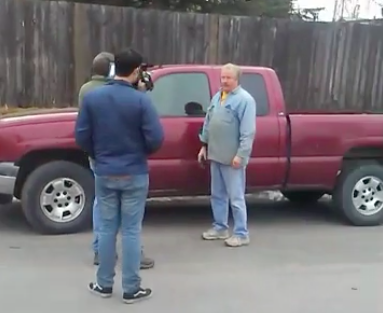
The vehicle that suspicious persons were working on are the top two photos, and at the lower right, the vehicle from which shots were allegedly fired.
The second incident happened on Sunday. A woman in Mountainview drove her vehicle near Rose Davis Park, where she noticed a maroon SUV and two other SUVs that were silver and gold.
Some people — at least one described as Pacific Islander in origin, in the age range of 20-30 and with a beard, seemed to be engaged in an activity around them.
When the woman circled through a nearby street and came back to see if it still seemed suspicious to her, she decided to call 311, the non-emergency police line.
She saw the gold Tahoe-type vehicle with black wheels take off, and she snapped a blurry picture of it. And then she heard the pop and realized she was being shot at. She was still on hold with police and was sending text messages to Floyd Hall. Police finally arrived. One silver SUV was recovered, but one is still out there — with possible shooters driving it.
NOT AGAIN!
The third vehicle theft of the week that involved a shooting came Monday, April 23, at 4:25 am. Randy Rice woke up to find his maroon truck being stolen. He’d been a victim of a stolen car a year earlier.
He followed where he thought his truck was going and saw it at the Fred Meyer store parking lot in midtown.
Rice tried to block it but the person in his truck, a light-skinned black male, took off down Fireweed, going west. Just past C street, Rice’s stolen truck turned left, and that’s when about 10 rounds were popped off toward Rice, who was still pursuing in his other vehicle. He called police. The vehicle was found by one of the spotters that Floyd Hall works with. It was parked alongside the side street less than eight hours after being stolen. Rice was able to drive it home.
GAS STATION HEISTS
But those aren’t the only shootings of late. Gas stations are under attack, and now weapons are being brandished in broad daylight robberies.
On Tuesday, April 17, police responded to the Shell station at 810 W Tudor Road. The manager said four men approached the station in an older-model Chevy SUV. The driver stayed in the vehicle while the three passengers got out and walked into the business. Two of the suspects each grabbed a cash register off of the counter.
At that time, an employee walked out of the back room into the main area of the store. A third suspect saw the employee and fired a round with a shotgun. The three suspects backed out of the store carrying the cash registers and merchandise, as the shooter fired off two more rounds.
Fortunately, no injuries resulted.
That same night the Tesoro station on 500 Hollywood Drive in Government Hill was hit. Three men got out of a black Chevy Tahoe; one carried a shotgun, while the others took the cash register. No shots were fired. The Tahoe was later found burned and smoldering on Baxter Road.
DRUG DEALS GOING ON? CALL POLICE, DON’T GET SHOT
On March 17, police were dispatched to the 6600 block of Fairweather Drive, where a man saw two suspicious vehicles parked in front of an apartment complex he manages.
He approached and told the two men in the vehicles to leave the private property, and then he snapped pictures with his cell phone before getting into his car, where his pregnant wife was waiting. That’s when his rear windows were shot out.
Police determined that 26-year-old Rasean Daniels was responsible for the shooting and he was arrested on April 5 for attempted murder. The other suspect hasn’t been found.
The suspect sought in the shooting on Fairweather Drive on March 17.
Gov. Bill Walker signed an administrative order on Saturday to create a task force to study the creation of a military museum in Alaska. Must Read Alaska reported on it on Sunday.
But no sooner was the ink dry on the internet, when readers informed us that there is already a military museum, and there has been one for many years. Our bad.
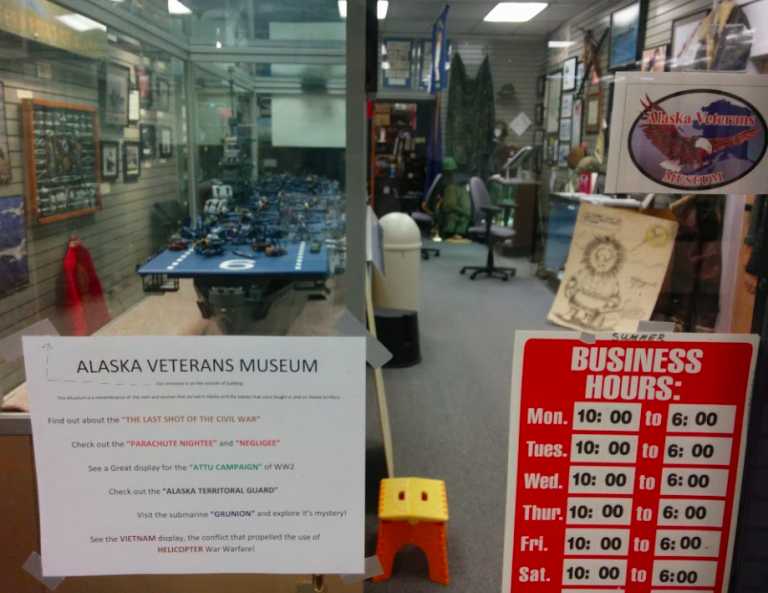
The Alaska Veterans Museum is located at 333 W. 4th Avenue in downtown Anchorage. The modest storefront museum, run by volunteers and supported by donations, was a project of Veterans of Foreign Wars members who started laying the groundwork for it in 2001 to honor the rich military history in Alaska. It took them years to launch it fully, and they partner with several groups to put on events and displays around town.
Walker didn’t mention or pay tribute to the little museum during the signing of his administrative order to establish the task force that will recommend a large, world-class museum. It’s almost like he didn’t know about it.
Gov. Bill Walker signs an administrative order to create a task force that will recommend establishment of a military museum.
ALASKA VETERANS MUSEUM
The Alaska Veterans Museum “is focused on honoring our nation’s veterans and insuring that because of the sacrifices they made to defend America’s freedom, ‘They Shall Not Be Forgotten.’ ”
“There was no place to hear the stories of Servicemen and Servicewomen, or learn of the military’s contributions to the growth of Alaska, or how Alaskans defended the United States. The idea for Alaska Veterans Museum was born,” according to the group’s web site.
Early founders began gathering historical artifacts; weapons, uniforms, photos, posters, models, dioramas, and oral histories.
The Alaska Veterans Museum will mark the 75th anniversary of the Battle of Attu on May 17-19.
AVM became a 501 (c) (3) non-profit corporation in 2002 and started enlisting community support. By 2008, the group had its first public exhibit in the Anchorage Museum: “Castner’s Cutthroats: Forgotten Heroes,” launched with a panel discussion that included the last three living Alaska Scouts, Lt Earl Acuff, Sgt Ed Walker, T5 (Corporal) Billy Buck, and author Jim Rearden. The group paid tribute to T5 (Corporal) Buck Delkettie who died just before the exhibit was open.
“Oral Histories from these fine men still play at the museum today. Nineteen months after our debut, our exhibit was finally taken down. When it was taken down, the Anchorage Museum’s Historian Marilyn Knapp said it was the most popular local exhibit the museum had ever had,” according to the web site.
Other exhibits followed: The Aleutian Tigers, (11th Fighter Squadron), displayed at the Alaska Aviation Museum, and work done assisting the 11thAir Force Warbirds exhibit and the USS Grunion exhibit, also at the Aviation Museum.
At the Native Heritage Center, the group had an exhibit on the Alaska Territorial Guard (ATG) and Major Marvin “Muktuk” Marston, with many of his items on loan, entrusted to us by the Anchorage Museum.
“We also had displays on the Aleutian Campaign: A Forgotten War at the Chugiak-Eagle River Library and at the Loussac Library.”
On April 17, 2011, the group opened a museum on 4th Ave. and has welcomed thousands of visitors. Must Read Alaska was unable to reach the museum’s director, Michael Haller, who has a day job with the federal government.
We’ll update this story when it becomes clear how the proposed museum will incorporate, displace, or replace the existing Alaska Veterans Museum, which is run on a shoestring.
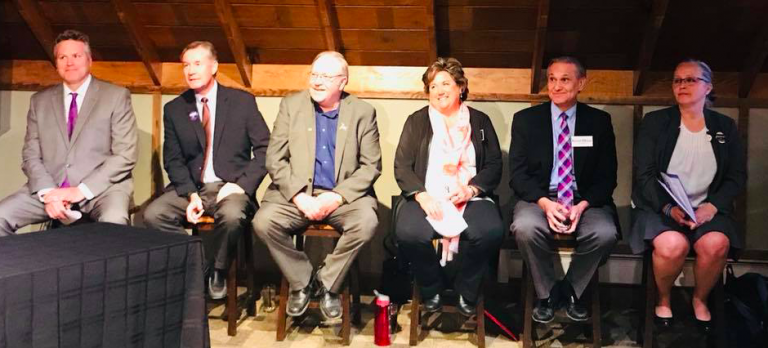
The Kenai Peninsula Republican Women of Alaska hosted six candidates for the state’s two highest offices on Saturday night — and put them on the hot seat for round-robin questions and a lightning round of word association. Over 70 people attended the event at the Cannery Lodge, which also featured food and beverages, and a smattering of candidates for other offices.
The candidates who were invited were Mike Dunleavy, Scott Hawkins, and Mike Chenault for governor, and Kevin Meyer, Lynn Gattis, and Edie Grunwald for lieutenant governor.
The governor candidates were paired with lieutenant governor candidates for questions that generally were tough, multi-faceted, and typically had no easy answers. It gave the audience a chance to see them as teams, and each set of questions had a new team to evaluate, so that by the end, all gubernatorial candidates had sat alongside each of the participating Republican candidate for lieutenant governor.
Not participating in the forum was Steven Wright, who attended and sat in the audience. He is a Republican candidate for lieutenant governor, running on a ticket with Michael Sheldon of Petersburg. Also not in attendance was lieutenant governor candidate Sharon Jackson, who only recently announced her candidacy.
View the entire forum, which Must Read Alaska broadcast live on Facebook — or view a slightly shorter version on our YouTube channel embedded here:
MID-EAST TENSIONS TOO HIGH TO LET F-15s OUT OF COUNTRY
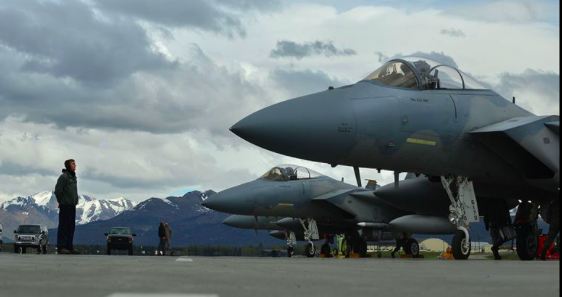
Israel’s Air Force is not sending F-15s to participate in the Red Flag exercise due to tension on the country’s northern border with Syria.
“In light of the situational assessment by the air force it was decided to adjust the planes’ participation in the exercise,” according to a statement by the Israeli Defense Force.
The two-week international drill starts April 26 and runs through May 11 at Eielson Air Force Base in Fairbanks and Joint Base Elmendorf-Richardson in Anchorage. The exercise is repeated several times a year. Local residents can expect noise.
Israel’s Syrian border is a growing concern for the nation, as Iran gets more aggressive with Syria. The region is unsettled and Israel’s F-15s are considered the backbone of the Israel Air Force, with continuous operations over the Gaza Strip and the border.
The Israel military has been on high alert since mid-April, when it carried out an air strike against Syria, shooting guided missiles from Lebanese air space and killing seven alleged Iranian Revolutionary Guard Corps soldiers who were operating drone strikes from a base inside Syria.
On Saturday, the commmander-in-chief of the Iranian army General Abdolrahim Mousavi shook his fist at Israel, after warning Israelis, “You have nowhere to flee except into the sea. Only 25 years remain until the destruction of the Zionist entity.”