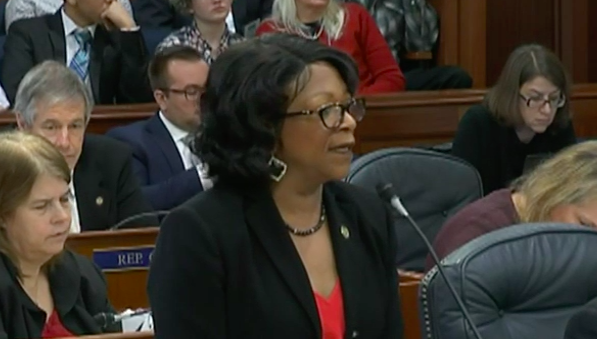
COULD BE DEATH KNELL FOR RETURN OF PAST FUNDS TO ALASKANS
Gov. Michael Dunleavy’s bills to pay back the portion of the Permanent Fund dividend that was taken from Alaskans by Gov. Bill Walker has hit its first major roadblock: The Democrat-controlled House has referred the bills to three committees.
HB 46 and HB 47 were sent to State Affairs, Judiciary, and Finance Committees. State Affairs is chaired by Sitka Democrat Jonathan Kreiss-Tomkins, and vice chaired by Anchorage Democrat Zack Fields. Judiciary is chaired by Anchorage Democrat Matt Claman.
HB 46 and HB 47 would pay back between $600 and $700 million a year over three years to Alaskans who were eligible for the dividend in the years it was cut roughly in half by Walker.
SB 23, the companion legislation in the Republican-controlled Senate, was only referred to two committees: State Affairs and Finance. A similar bill by Democrat Bill Wielechowski, SB 13,also received just two committee referrals in the Senate.
At the same time, HB 31, sponsored by Kreiss-Tompkins, proposes to take $5.5 billion out of the Permanent Fund Earnings Reserve Account and place it into the principal of the Permanent Fund.
Kreiss-Tompkins’ bill would be an unstructured, one-time draw of nearly one-third of the reserve account, a profound impact on the fund, considering the other pressures on it. Yet the bill only received two committee assignments, one being Kreiss-Tomkins’ State Affairs Committee, which will be friendly to it. The other being Finance, where it will be managed by Democrat Neal Foster, the co-chair of Finance who is in charge of the operating budget.
ELECTION COMING: AFL-CIO WANTS TO ORGANIZE LOCAL PUBLIC EMPLOYEES
By ART CHANCE SENIOR CONTRIBUTOR
Vince Beltrami, AFL-CIO president for Alaska, is looking for new worlds to conquer.
Vinnie isn’t really a goon, but he’d like everyone to think he is. Even though he comes out of the International Brotherhood of Electrical Workers, he isn’t even a wireman; he’s more of a salesman they recruited for their apprenticeship program.
Once upon a time you had to have at least made some pretense of handling a 135Kv line in the dark while enduring a 50-mph wind to get far in IBEW leadership.
Art Chance
I don’t know that Vinny is such a good political operative or that his opposition has been so inept or oblivious, but he has turned Alaska purple. I’ll give him that.
Now he’s trying to add Seward, Alaska to the AFL-CIO fold.
A March 19 special election in Seward will be held to do just that, and if he succeeds, Vinny will have Seward no longer exempt from the Public Employee Relations Act, so he can organize the public employees.
Anchorage and Fairbanks have been union towns since Territorial days. The port towns had some union presence on the docks and ships, but not much else.
Alaska split between longshoremen of the Harry Bridges’ communist West Coast Longshoremen’s Union and the Teamsters, who had more loyalty to Washington, D.C. than to Moscow.
To the extent that public employees bargained at all, it was under local ordinances and the unions were subsidiaries of the trades unions, styled as “joint crafts councils” and the like so that the operation and maintenance employees of public employers weren’t eligible for the out-of-work lists of the construction trades unions.
Juneau had a bit of a reputation for being anti-union in those days. Most of the big money federal work in Alaska in those days was being done by Seattle unions and Outside labor unions that wouldn’t even allow Alaskans to apply for the jobs.
The State was so solidly Democrat that it could only be admitted to the Union concurrently with equally solidly Republican Hawaii to maintain the balance of power in the US Senate.
Fast forward to the late 1960’s and early ’70’s. Alaska was run with liquor’s money, labor’s organization, and Natives’ votes.
The only State employees who were unionized were the vessel employees of the Alaska Marine Highway System. They bargained under AS 23.40.040. That half-page of statutes can best be summarized as “the commissioner of the Department of Highways will do what the Seattle maritime unions want him to do.” The ferry system has been a hole in the water Alaska pours money into for a very long time, but it was thought to be an improvement over privately operated Alaska Steamship Company.
There were beginning to be lots of stress cracks in the Democratic Party at the national level in 1968. The Solid South had abandoned the Democrats in 1964, and since I was there I can say it: It was entirely over race. The South didn’t look to be coming back into the fold anytime soon. The war in Vietnam overwhelmed President Lyndon Johnson, and he didn’t seek re-election, but Hubert Humphrey was too Northern, too liberal, and started too far behind.
Alaska Democrats tried to give public employees a collective bargaining law, but it failed to pass the Legislature. Nixon carried Alaska handily and in another harbinger of things to come, George Wallace got 12 percent of the vote as the American Independence Party (pro-racial segregation) candidate.
By 1972, America was as fractured as it had been since the Civil War. The draft, the war, and the counter-culture drove the Democrats far to the left, at least as left was understood in those days.
With the ascendency of George McGovern as the Democratic nominee for president, Alaska Democrats looked for something — anything — to stay in power. Democrats are one-trick ponies and they’ll do something over and over until it blows up in their faces, so they trotted out another public employee collective bargaining law to try to keep public employees in the Democrat fold.
What became the Public Employment Relations Act (AS 23.40.070 – .260), officially has no legislative history because there was almost no debate. These were the days when laws were made and broken in the long-gone Latchstring Bar at the Baranof Hotel in Juneau, and if a committee chairman had a bill number, he or she could put any topic under that bill.
Duane Carlson was “Vinny the Goon” of those days, as head of the AFL-CIO. You can read all you want about Duane in John McPhee’s 1976 classic “Coming Into the Country.”
Duane went to an AFL-CIO meeting in Hawaii, naturally, and he brought back some AFL-CIO “model legislation” for public employee bargaining. He gave it to Sen. Joe Josephson, who introduced it as a committee substitute for some other bill of no relation. As if from the head of Zeus, it emerged fully clothed.
I’ve never found any record of real debate on it, but by 1972 there were Republicans in the Legislature in significant if not majority numbers, and much of the State wasn’t really enamored with unionized public employees.
Then we must consider the Kosloski Amendment. It isn’t actually in the Public Employment Relations Act but in the Session Law. It allows a political subdivision of the State to opt out from coverage by the PERA so long as the political subdivision doesn’t do it in the face of and to escape from a union organizing campaign.
Old timers sometimes call this the Petersburg Amendment because it was a current controversy in Petersburg. The Petersburg Amendment is why many political subdivisions do not have unionized employees or only allow unionization under their own local ordinance.
Now we’re back to Beltrami and the public employees of Seward, Alaska, the voters, and the March 19 special election.
Seward doesn’t have a local bargaining law and long ago opted out from the Public Employment Relations Act. Vinny is tooling up his PAC and his hordes to overturn Seward’s opt-out so he can unionize Seward’s public employees.
Fear and greed are good politics in Alaska so a promise of a union getting you “free stuff” plays pretty well.
I don’t know Seward politics, but in most places it is easy to get police and fire personnel to become union under the Public Employment Relations Act because of its arbitration provisions.
The State does well enough in arbitration when it wants to, meaning the State can hold its own if the union hasn’t bought the governor.
But the political subdivisions have been mau-maued by the unions in arbitration; the unions have eaten their lunches and taken their girlfriends.
It takes real money and serious skill to adequately represent the employer in interest arbitration with a police or fire union, particularly when your comparables are Washington, Oregon, and California. I was pretty good at it, but I’m also one of only a mere handful of people who’ve ever even seen adversarial interest arbitration from the first chair and all the others either worked with or for me.
So, the unions are continuing their tour through the municipalities. So long as political subdivision elections are held when the moon is in the Seventh House and Jupiter lies with Mars, these special elections will be dominated by unions. The Democrats/unions cannot win a Statewide election and there are only a handful of districts in which a Democrat who actually talks and acts like a Democrat can win a district election. Yet, they control most municipalities and boroughs in the state.
The conclusion is obvious. When conservatives/Republicans can get control away from communists and quislings, we need to make the General Election Day in November the ONLY Election Day in Alaska.
Art Chance is a retired Director of Labor Relations for the State of Alaska, formerly of Juneau and now living in Anchorage. He is the author of the book, “Red on Blue, Establishing a Republican Governance,” available at Amazon.
(2-minute read) INSTEAD OF GIVING IT BACK TO HIS DONORS, HE KEEPS IT
Former Gov. Bill Walker may not be done with his political life.
In his latest “year end report” with the Alaska Public Offices Commission, which was due on Feb. 15, he shows that he clawed back advance payments his campaign had made for ads that never ran.
Walker paid a few bills and payroll that was due during the period.
But surprisingly, he set aside $47,000 into a “Future Campaign Account” for himself. It was the biggest payment by far in the list of about 75 expenditures, most of which were nickel-and-dime bills.
Walker pulled out of the governor’s race on Oct. 19, 2018, and threw his support to Mark Begich, who he said aligned more closely with his values than now-Gov. Michael Dunleavy.
Walker received a partial refund of $8,286 on his radio ads placed with Alpha Media that he cancelled when he quit.
He received another $3,300 in partial refund for his ads placed on Anchorage People Mover buses through the vendor, Alaska Channel Inc.
The Anchorage Daily News refunded him $16,875 for ads he cancelled with the state’s main newspaper.
Last Frontier Mediactive in Fairbanks refunded him $10,173.65 for unused air time.
Juneau Alaska Communications gave him back $6,269.27 for his unused air time.
IHeartMedia gave him back $12,570.65.
Ohana Digital Services refunded him $10,752.50 for air time placed by that company, which he no longer needed.
The total amount of advertising refunds he reported was $68,227.
He also paid each of his daughters Tessa and Lindsay $3,000, as “appreciation for campaign work.” His brother Bob got an appreciation payment of $2,000, and another check for his work removing signs.
$6,000 went to the Fraternal Order of Alaska State Troopers for the K-9 fund.
But the largest payment made was the one to his “future campaign,” whatever that may be.
(3-minute read) BIPARTISAN ORGANIZATION DOMINATED BY DEMOCRATS
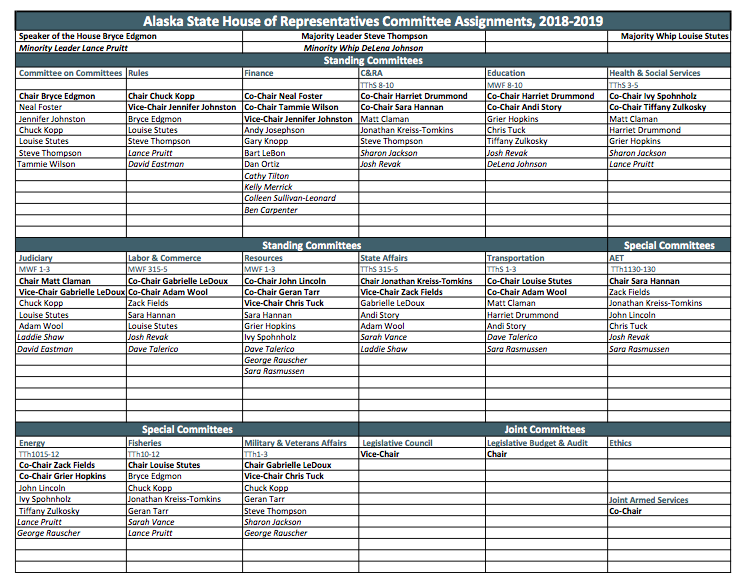
The House bipartisan majority announced committee assignments today and the Democrats won hands down.
Republicans who joined the bipartisan caucus seem to have traded all other positions of influence for control of the Rules and Finance committees.
Democrats control all other committees, which means that the governor’s requested statutory changes will run into a lot of hurdles in this House organization. Most of the governor’s bills will likely die in committee.
The Rules Committee includes Republican Minority members Lance Pruitt and David Eastman. Breakaway Republicans that joined the Democrats give it a 5-to-2 Republican control. But if bills aren’t moved out of committees, the control of the Rules Committee is less of a concern.
The Judiciary Committee is controlled by Senate Bill 91 defender Rep. Matt Claman. The governor has a suite of bills to roll back some of the leniency of that controversial crime bill that Claman has supported.
The Resources Committee chairmanship is split between Rep. John Lincoln, who is generally for common-sense development, and Rep. Geran Tarr, who is solidly anti-development and who has tried to ram through various taxes on oil companies. Her efforts may be stopped before they ever get to the floor by Republicans in Rules and Finance.
But five of the nine members of the Resources are anti-development, including Tarr, Reps. Sara Hannon, Grier Hopkins, Ivy Spohnholz and Chris Tuck.
Rep. Gary Knopp of Kenai, who led a breakaway group of Republicans joining the Democrats to take control of the House, won a seat on Finance, as did Rep. Bart LeBon of Fairbanks, who joined the bipartisan group. Finance now has eight Republicans and three Democrats. That committee is the one bright spot for conservatives.
A surprising number of freshmen are on this committee: Kelly Merrick, Ben Carpenter, and LeBon, but all three offer a lot of experience.
Community and Regional Affairs, where the governor’s SB 57 (oil tax authority of local governments) will likely be heard first, is dominated by legislators who will make sure that bill is dead on arrival: Democrats Jonathan Kreiss-Tomkins is chair, with Zack Fields as vice chair; Gabrielle LeDoux, Andi Story, and Adam Wool creating a voting bloc on that committee that can advance or stop legislation.
Health and Social Services is co-chaired by far-left Democrats Ivy Spohnholz and Tiffany Zulkosky, with Matt Claman, Harriet Drummond and Grier Hopkins sure to kill any measure that rolls back Medicaid spending.
All committees except Rules and Finance are co-chaired or chaired by Democrats, and dominated by Democrats, which for the purposes of this article includes Reps. Louise Stutes and Gabrielle LeDoux, who have caucused with Democrats historically. Stutes managed to get on six committees, with two chairmanships.
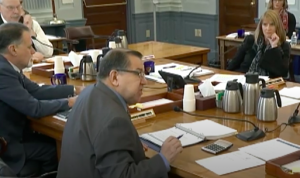
Interesting things come to light in legislative committee hearings. Take, for example, the Senate Finance Committee hearing on Gov. Mike Dunleavy’s education budget, which aims to help close the state’s $1.6 billion spending gap.
There was the usual ho-hah, snuffling and chest pounding about the size of the proposed state cuts to education, which amount to about 25 percent, something Sen. Lyman Hoffman, D-Bethel, said was “completely unacceptable.”
But, then, there was this: Sen. Natasha von Imhof pointed out overall enrollment in Alaska’s schools has dropped from 131,000 in 2006 to 129,000 in 2018. Despite that, state funding for schools in 2006 was $805 million. It climbed to $1.2 billion in fiscal year 2018. Fiscal year 2019? It is $1.34 billion. She said employee benefits are the driving force behind increased expenditures in the face of falling enrollment. They went up from $302 million in 2006 to nearly $600 million in 2017, the latest figure she said she had.
“That is a $294 million increase in 11 years, or 97 percent,” Must Read Alaska reported Von Imhof as saying. “So districts are spending less on books and curriculum and more on health care for their teachers.”
(3-minute read) ‘FISCAL TYRANNY, MALPRACTICE AND FOLLY’
The Mayor of Valdez is distraught with Gov. Michael Dunleavy’s budget proposal, believing the State’s $1.6 billion fiscal gap can be fixed if the governor would simply resign.
In a caustic missive posted on Mayor Jeremy O’Neil’s Facebook page on Saturday, the official from Valdez called the Dunleavy budget a “lesson in fiscal tyranny, malpractice and folly.”
Alaska’s most recent governor was from Valdez, and was popular in the wealthy oil terminal town, where the average household income is more than $90,000.
O’Neil, who was a big Bill Walker supporter over the years, is still nursing a wound from Walker’s devastating loss in 2018, when he only got 2 percent of the vote statewide, and fewer than 50 votes from his hometown in Prince William Sound, which was one of his strongholds.
O’Neil’s letter is a cannon shot from Valdez over Gov. Dunleavy’s bow, yet it’s unclear if he’s speaking in his official capacity on behalf of the whole city, or as an unelected Alaskan.
“Never in my wildest dreams could I have imagined a more paternalistic, uninspired or destructive response, from our State’s highest official,” O’Neil wrote.
“My own family has weathered the economic ups and downs in this State over several generations, and it goes without saying that stewardship at the State level has brought us to the crossroads we find ourselves today. I appreciate and sympathize with the difficult fiscal road ahead of us. Nevertheless, your proposal turns Alaskans against each other, picks massive winners and losers, and turns the hard-fought gains of over 50 years of statehood into an ash heap of lost time and opportunities. Yours is a lesson in fiscal tyranny, malpractice and folly.
“You campaigned on a platform of little details and massive promises. A child’s story speaks of a village with a huge rat problem. One day a “savior” came to town with a solution to solve their infestation. We know, as that story goes, when the Pied Piper was dissatisfied with his compensation, he ran off with the village’s most precious asset, their children. I’m struggling to see how your vision of the future is not paralleled by the moral of the Pied Piper’s story. In legal circles we call this fraud in the inducement. Many of my close friends and family chose to, “vote you in, to figure out what you’re all about,” and now that we know, it’s time for you to go.
“The nightmare proposal of SB 57 is a State power grab, wrapped in a malignant cost shift, wrapped in the age old government fallacy of “we know what’s good for you, better than you do.” You would expect such tactics from extremists who ultimately turn their citizens into beggars. Mr. Dunleavy, never in the history of our state has this worked. Creating a structure of massive losers to fill budget gaps, creates division, implants fear, and hurts everyone,” O’Neil wrote.
SB 57 would repeal the authority of Valdez to keep its municipal tax on the pipeline property that goes through the community. It’s doubtful that O’Neil would be so vigorous in his wrath if not for this piece of legislation.
Currently, the town of 3,862 people gets $38.4 million from taxing the Trans Alaska Pipeline, which goes through the community. That’s a tax on oil property that gives the city nearly $10,000 of services per resident.
The Valdez total revenue is $54,551,110, or more than $14,000 per resident. Because it is so rich, it has an enviable quality of life with many good-paying public jobs.
For comparison, the City and Borough of Juneau’s budget is about $10,500 per resident.
No city wants to give up its local oil tax and share it with other communities, so this will be a battle royale for communities such as Valdez and the North Slope Borough, which will fight back against SB 57, as they seek to keep taxes on pipeline properties for local uses.
O’Neil’s letter shows the passion with which communities will fight:
“Mr. Dunleavy, make no mistake, your vision hits the poor & vulnerable the hardest. I am open to change my opinion, but as of right now, I can’t bear to see anymore destruction. Please resign. Good day,” he concluded.
(4-minute read) ‘SHOOT THE MESSENGER’ DAY IN SENATE FINANCE
Senate Finance members didn’t like the Education Department budget rollout, and Republicans and Democrats alike told the Office of Management and Budget Director their opinions, in no uncertain terms, during a hearing that was at times a bit of an inquisition.
“The question was asked why we’re doing what we’re doing. We’re doing this because the State is out of money, and we need to balance our budget,” OMB Director Donna Arduin had said to the committee.
“We’re draining reserves to do it, and we’ve run out of reserves to drain. We’re proposing this so we can get our budget balanced and our fiscal house in order,” she said.
Sen. Click Bishop
“With all due respect, ma’am, that’s the wrong answer,” said Sen. Click Bishop of Fairbanks, who had asked the question: How does less money lead to better outcomes?
Sen. Lyman Hoffman of Bethel called the 25 percent cut to the state’s portion of education funding “completely unacceptable.”
But Sen. Natasha von Imhof had a different perspective. She acknowledged that overall enrollment in Alaska’s schools has declined from 131,000 in 2006 to 129,000 in 2018, but that funding has gone up and up.
In 2006, state funding for schools was $805 million, but rose to $1.2 billion in Fiscal Year 18, and $1.34 billion in FY 19.
“So student count is going down, money is going up. What is going on? I’m not really hearing that from you. What I’m hearing is, we’re just going to cut it.”
von Imhof then explained that employee benefits had gone up from $302 million in 2006 to nearly $600 million in 2017, the latest figure available to her.
“That is a $294 million increase in 11 years, or 97 percent,” von Imhof said. “So districts are spending less on books and curriculum and more on health care for their teachers.”
Rather than making an across the board cut that leaves all 53 districts to figure it out on their own, a better approach might have been to help districts with their highest cost driver, and see if the State can come up with a solution that makes sense.
“And I’m not really hearing that,” she said. “And I think that’s a problem because Education is dealing with it, all the departments are dealing with it.”
“Why didn’t you address the largest cost driver in Education?” von Imhof asked.
Arduin was ready: “The first part is that we don’t control school districts and we don’t control how they spend their money. We have data that is similar to that, that shows that money is being spent elsewhere rather than for instruction.”
Only 54 percent of State dollars that go to districts is used in the classrooms, she said. They also receive local funds, referring to those school districts in organized boroughs.
Arduin said that the Education Department would be open to proposals to help drive down the cost of employee benefits, which have exploded.
But Hoffman piled on testily: “It’s all about the checkbook. It should not always be all about the checkbook. It can’t be only about the checkbook. It has to be about our obligations to educate students.”
Sen. Lyman Hoffman addresses OMB Director Donna Arduin.
The Education budget proposed by Gov. Michael Dunleavy cuts the State’s $1.34 billion contribution to education down to $1.03 billion. This doesn’t count the local contribution.
Included in the plan is a 50 percent travel reduction for Department of Education employees, $269 million in reduction to the per-student funding known as the base student allocation, and clawing back $30 million that last year’s Legislature had promised to schools for FY 20. The proposal also plans to end the WWAMI medical school exchange program for a $3 million savings,
At one point committee Chairman Sen. Bert Stedman reminded the members who were getting agitated as the hour went on, that it is not the OMB director’s budget but the governor’s budget.
Thirty-nine months is a long time for a state to have a job losing streak.
Alaska is creeping up on the Big 4-0 loss streak, and already has set a new record for the longest string of job losses since the economy nosedived in the late 1980s.
The cumulative number of jobs that vanished during the present recession is 12,700, putting the job count back to 2011 levels, according to the Alaska Department of Labor. Alaska has been losing jobs since October, 2015.
As go jobs trends, so go the workers. Since 2013, more people have left Alaska than have moved here. While births made up for some of the outmigration, the cumulative net migration loss was 35,000, larger than the city of Juneau.
Anchorage shed 6,084 jobs between 2015 and 2018, a drop of 3.9 percent. The majority of those jobs were professional class jobs, including attorneys, engineers, and architects.
The Matanuska-Susitna Borough bucked the employment trend, and actually grew jobs between 2015 and 2018, adding 769 workers, according to the State Department of Labor. But those jobs were largely in health care and social services, not in the private for-profit sector. The Mat-Su Borough added 10,000 residents from 2015 to 2018.
Alaska’s overall unemployment rate in December was steady at 6.3 percent, or about 22,390 Alaskans unemployed, while the overall unemployment rate in the United States was 3.9 percent.
(3-minute read) THE LAWMAKER OVERCAME A HUGE CHALLENGE
African-American history was made in January when the first African-American Republican woman lawmaker was sworn in as a legislator in the Alaska House of Representatives.
Rep. Jackson has got style, that much is obvious. But she also has more grit and determination than most Alaskans. Maybe that comes from her six-year stint in the U.S. Army. Or maybe it’s her deep faith in God.
Few Alaskans know that in 2015, Jackson suffered a stroke and was hospitalized. The stroke affected her speech, and she had to retrain herself how to form words again. The stroke also took away her stamina for several months, requiring a lot of bed rest. For a couple of years, she needed plenty of naps and made few public commitments.
But this Army veteran was not giving up. She continued to work for Sen. Dan Sullivan as a constituent liaison with a focus on the needs of veterans. She started a diverse Republican women’s club in Anchorage. She ran for lieutenant governor. All this, while fighting to regain her full power of speaking.
Rep. Sharon Jackson
It wasn’t until after the November election that she had her chance again: Gov. Michael Dunleavy appointed her to fill the District 13 spot left vacant in Eagle River when Dunleavy tapped Nancy Dahlstrom to run Alaska’s Corrections Department.
Jackson got caught in between Democrats and Republicans at the beginning of session when Democrats refused to seat her, because she would have been a critical vote for a Republican Speaker. That matter was finally settled after Republicans caved in and allowed Democrat Neal Foster to become Speaker Pro Tem.
You’ll see Rep. Jackson on the floor of the House — speaking with the conviction of someone who has not only served her nation in uniform but one who has fought her way back to full health — if you watch House floor sessions on 360North.org. She is making history in the Alaska Legislature, representing one of the most conservative areas of the state.