Friday, October 16, 2026
Home Blog Page 1570

Surprise: University budget is not being cut by 50 percent

STATE SUPPORT IS ONLY 42 PERCENT OF UNIVERSITY SYSTEM BUDGET

The numbers are astonishing: “The University of Alaska budget is being cut by 41 percent!” Or 42 percent! Or, as Rep. Gary Knopp told a crowd in Kenai on Friday, it’s being cut by 50 percent and the Kenai campus and all other regional campuses will have to close!!!

The Anchorage Daily News reported the university “faces a $134 million cut, or about 40 percent of its total budget. The cut is the largest ever proposed in the university’s 100-year history, University of Alaska President Jim Johnsen said in a news conference Wednesday after the cuts were announced. For scale, that cut exceeds the total operating budget for the University of Alaska Anchorage.”

100-year history? Are we really going to compare the budget of 1919, when it was established as the Alaska Agricultural College and School of Mines, when it had a student body of six? Today, the UAF alone has six rural and urban campuses: Bristol Bay Campus in Dillingham; Chukchi Campus in Kotzebue; the Fairbanks-based Interior Alaska Campus, which serves the state’s rural Interior; Kuskokwim Campus in Bethel; Northwest Campus in Nome; and the UAF Community and Technical College, with headquarters in downtown Fairbanks.

40 percent of its total budget? This sounds serious. But what is the Dunleavy budget actually proposing?

The correct answer is 17 percent of the university system’s total budget. It’s a good haircut, but it’s not 40-50 percent.

This is because the State of Alaska only funds about 42 percent of the university budget, and the proposal is to reduce that contribution to the University of Alaska by 40 percent. The University of Alaska needs to look elsewhere for the funds or restructure to adapt.

$135 million is proposed to be reduced from the 2019 management plan — that is the budget of the current year.

The university system is also being given $149 million in designated general fund receipt authority, which means it can raise its funds from tuition, federal land grants, alumni efforts or other funding sources.

AN OVER-RELIANCE ON STATE FUNDING

In a study of land grant universities, the University of Alaska Fairbanks ranked third for schools that received the most state funding. It’s only exceeded by the University of Puerto Rico and and University of the District of Columbia.

While the Alaska university system receives more than 40 percent of its funding from the State of Alaska, the average among land grant universities across the United States is 25 percent.

Oregon State University, where some Alaskans get their higher education, receives less than 17 percent from the State of Oregon. OSU gets $182 million in state funds to support the teaching of its 29,000 students.

Washington State University gets 20 percent of its funding from that state’s budget. And UC Berkeley gets only 14 percent of its funding from California taxpayers.

UAF gets $164 million from the State of Alaska, according to an analysis by the National Center for Education Statistics at the U.S. Department of Education. That supports 9,330 students, and comes out to a state subsidy of $17,577 per student per year, more than the state is spending for K-12 students’ education.

The University of Alaska’s over-reliance on state funding has been noted in the past by Moody’s.  In 2017, Moody’s downgraded UA as a result:  “The downgrade to A1 reflects the university’s material reliance on the State of Alaska with the resulting exposure to the fiscal and economic challenges of the state caused by low oil prices.  With about half of UA’s operating budget, including on-behalf payments for pension and other post-retirement benefits, derived from state funding, we expect increased operating pressure at the university as the state addresses its significant structural imbalance.”

The top performing land grant universities intentionally diversify their funding sources by building endowments and developing substantial sources of non-state support from the private sector and federal government. They also develop educational programs of true national excellence, attracting students who will pay tuition and stay for more than two years. In so doing, these universities ensure organizational resilience.

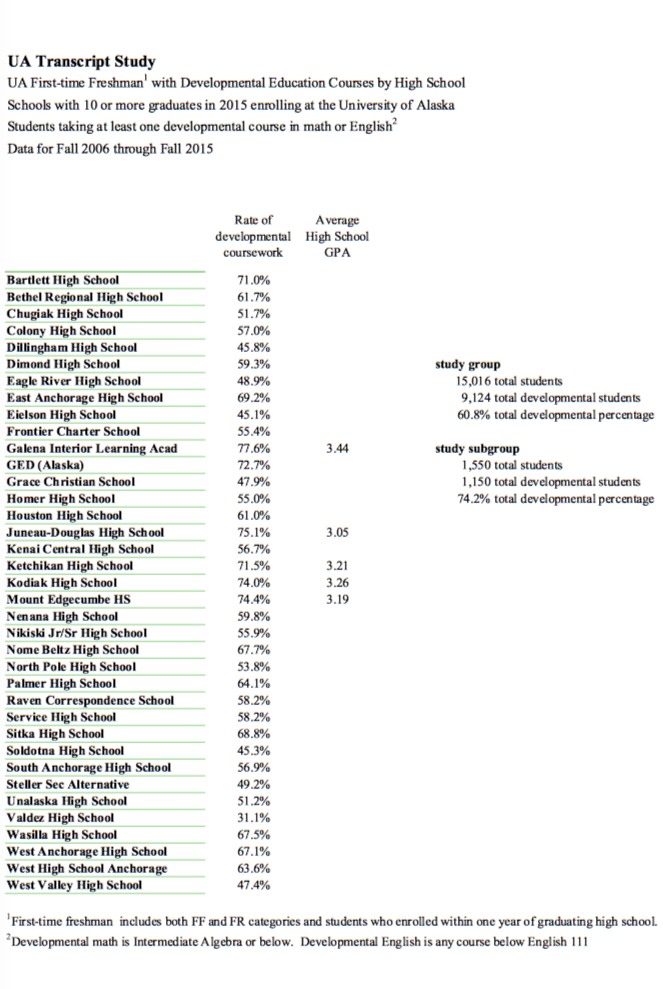
At the same time the State of Alaska is underwriting the learning of students, the University of Alaska system is having to offer “zero level” classes to more than 61 percent of its incoming students, who are simply not ready for college coursework.

In a study by the university, freshmen are not coming into college prepared for four-year university work. Instead, they are having to retake high school classes once they enroll.
A RETURN TO THE COMMUNITY COLLEGE MODEL

As the governor suggests, now is an opportunity for the Board of Regents to restructure and return some of its satellite campuses to community colleges, where that remedial coursework is more appropriate. He is challenging the University system to meet the needs of students where they are, which, for more than half of them, means extended high school education.

The proposed UGF budget is based on $11,000 per full time equivalent student and is allocated into two components based on the current population of students: University Campus and Community Campus.

By refocusing funding toward student instruction on community campuses, the Dunleavy budget suggests that the University system can substantially reduce tuition for the first two years, and help finish the high school education that students didn’t get in their local school districts, so they’re prepared to complete either a four-year college degree or vocational training.

UNIVERSITY HAS QUALITY TROUBLES

The recent loss of accreditation of the University of Alaska Anchorage teaching programs is a red flag that stretches well beyond students who are unprepared for higher education. Higher education itself is struggling to come up to standard.

The programs that lost accreditation include the Early Childhood Education Bachelor of Arts and post-baccalaureate programs, Elementary Education Bachelor of Arts and post-baccalaureate programs, Secondary Education Master of Arts in teaching, and initial licensure programs in special education and early childhood special education. (University of Alaska Fairbanks and University of Alaska Southeast were not affected.)

Some 250 students who have invested months or years into their future profession can’t be sure they’ll have legitimate degrees when they graduate.

The university’s answer to this is ask the State Board of Education to allow the graduating seniors to be able to get a state license without accreditation, and to have the other students transfer to University of Alaska Southeast or Fairbanks to complete their degrees. It will take UAA’s Education program three years to get its accreditation back.

The Dunleavy Administration wants to encourage the university to transition the lowest-priority services to a self-sustaining funding model, suggests that research should seek private and federal funding, duplicated schools should be eliminated, and that a major fundraising campaign with the private sector is long overdue.


Amazing photographer documents life in Bethel

2

In Bethel, Alaska, photographer and writer Greg Lincoln has his fingers on the pulse of the mostly Native Alaska hub community on the Kuskokwim River, and has his lens on the extraordinary beauty of the land and its people.

Check out his work at DeltaDiscovery.com, with this link going to a collection of the best photos that he has taken over the past year.

Enjoy the efforts of this community scribe and photographer!

‘The warrant was defective’

13

SO MUCH MORE THAN THAT WAS DEFECTIVE

By ART CHANCE
SENIOR CONTRIBUTOR

In my Feb. 3 column I wrote of the sorry affair of former State Assistant Attorney General Erin Pohland, who was dismissed from her job and convicted of official misconduct for her role in forged “union interest cards” being presented to the Alaska Labor Relations Agency by her friend and landlord, a union organizer.

[Read: Former state lawyer gets away with crime — again]

The Alaska Court of Appeals found that the search warrant on which the charges were based was defective. The judge set aside her conviction. She’s free as a bird, and since she appears to be at least the sociopathic version of smart, she’s probably working on her wrongful discharge suit against the State in which she’ll seek reinstatement and back pay, but what she really wants is a nice settlement.  She’ll likely get it.

[Read: Conviction of former Assistant AG overturned]

This is just one of the screw-ups by the Department of Law and law enforcement recently and it is worth a look into what went wrong. Several questions come to mind.

  • Why wasn’t she fired and all her State devices and communications secured before law enforcement was involved?
  • Why wasn’t there a full administrative investigation?
  • Why wasn’t the investigation based on her communications on the State network and State devices, which wouldn’t have required a search warrant?
  • Who actually owned the cell phone and computer at issue?
  • How many of the emails and texts found on the computer at issue were from or to a State device or transmitted through the State network?
  • Why was the nature of her living arrangement not known before seeking the search warrant?
  • And why in the world would the Department of Law pursue this matter all the way to the Court of Appeals with what even a layman can see as a flawed search warrant?

There are a lot of things wrong with the way this matter was handled.

[Read: Shoplifting shoes leads to a pair of disbarments]

Back when State government was run by Baby Boomer troglodytes like me, it was iron-clad dogma that you carried out the administrative investigation first, and at least got the subject off the payroll with an unpaid suspension and preferably a dismissal. Then you involved law enforcement.

The preferred course of action was to fire the employee and then have the supervisor call the police or the District Attorney and make a complaint.

That course of action has a long and painful history: Commissioned public safety officers, Troopers and similar employees, were carved out of the General Government Unit of State employees in 1979. They formed the Public Safety Employees Association.

PSEA’s business agents and lawyers proceeded to eat the State’s lunch and sleep with its girlfriends for the next decade, literally. I can, but won’t, tell stories of these liaisons.

When I joined State Labor Relations in the Spring of 1987, the staff was still reeling from losing an arbitration over the dismissal of a State Trooper caught shoplifting — while in uniform — at Long’s drugstore in mid-town Anchorage. The State was on the front page a lot over that. Some of us resolved that we weren’t going to share either girlfriends or the front page with PSEA anymore and we got serious about figuring how to beat them.

As a general rule, in an administrative investigation a public employee cannot refuse to answer a question and can be dismissed for insubordination if s/he refuses.

In Garrity v. New Jersey the US Supreme Court held that if the alleged misconduct might also constitute a crime the employee cannot be compelled to answer questions that might lead to self-incrimination and that compelled statements might be inadmissible in court.

Loudermill v. Cleveland Board was handed down by the U.S. Supreme Court in 1985 and was followed closely by Storrs v. Municipality of Anchorage in the Alaska Supreme Court.

Loudermill and Storrs set out the contours and limits of the due process rights of public employees and set the format of a predisciplinary interview before a disciplinary action. Garrity informs the limits of the questioning in such an interview if the alleged misconduct also involves a crime.

There was a lot of turnover in State labor relations early in the Hickel Administration and we who remained there were tired of being famous for losing. We resolved that the days of headlines about how the noble union had defeated the evil State and got the pure as the driven snow employee’s job back were over.

In the early 1990s, we standardized our disciplinary notices and our interview processes and it didn’t take long to stop being famous. We lost one here and there, but that is normal for a healthy collective bargaining relationship; if you always win you’re being too conservative.

We managed to not be famous even through the bad years early in the Knowles Administration, though I’ll admit that our disciplinary standards lapsed because the unions didn’t need a grievance procedure if they had the commissioner of Administration’s direct line number.

When I came back to the Executive Branch in 1999, I committed that there would be no evil State defeated by noble union headlines again and I made it stick for the seven years I remained there and it held for almost ten years after I retired.

I’ve taken you on this history rampage to drive home the point that when I left government in 2006, handling the Pohland matter would have been in muscle memory for anyone in State human resources administration or labor relations as well as the Governmental Affairs lawyers, and prosecutors who live in a somewhat different legal environment would have known what they didn’t know and brought in Governmental Affairs or labor relations.

There are only a handful of people still around from those days, but they’re in pretty high places. Either the institutional knowledge and culture have faded away or the State has become so decentralized that nobody is in charge of things like the Pohland matter.

I remarked back during the National Guard sexual abuse scandal that it would never have happened on my watch.   No governor that I worked under, Cowper through Murkowski, would have left that in the hands of the operating department, and especially not in the hands of the Department of Military and Veterans’ Affairs, which is notorious for trying to keep everything away from Administration and the Governor’s Office.

The congenital bureaucrats and the shape shifters in State government were bitterly resentful of me and some of my associates in the Murkowski Administration for taking away much of their authority over human resources and labor relations.

Then, Dianne Corso retired as director of Personnel in 2005, and I retired as director of Labor Relations in mid-2006. Our successors came under immediate and intense pressure to give the departments’ authority back and now they obviously have it back.

The State’s organizational culture has become the culture of Millennials and Gen-X-ers. Things like standard procedures, formal processes, and chains of authority if known at all are just archaic relics of a bygone time. Things that nobody in my time would have put in writing or even discussed other than behind a locked door are discussed in emails with three lines of cc: addresses.

Even in the notorious confrontation between Sarah Palin and Randy Ruedrich, the Governor’s Office called the commissioner of Administration, and the commissioner, or at least his deputy, called me. We sat down and wrote up that boilerplate notice of interview memo that I still have pretty much memorized. There are probably at least some musty copies of memos like that in labor relations and HR offices. If they had just followed long-established practices there would have been no National Guard scandal and there would not have been the Pohland debacle.

I’m still looking into it, but I suspect if they’d have just followed some established practices even the court ruling that the Democrats took advantage of to remove a Republican-appointed judge (Michael Corey) wouldn’t have happened either. (I defended the judge at first but on reflection, he should not have accepted that plea and he should have made the Department of Law find the victim and produce her testimony.)

I’m still looking into it but I’m beginning to think that the plea deal made by prosecutors in that case was just a “cover your butt” move for not taking the necessary steps to find the victim.  I’ve heard just about every excuse for how the workload was what made State employees slow and slovenly, but usually it is lax supervision and failure to follow established procedures.  I’m beginning to think that the procedures are nothing more than an artifact these days.

Art Chance is a retired Director of Labor Relations for the State of Alaska, formerly of Juneau and now living in Anchorage. He is the author of the book, “Red on Blue, Establishing a Republican Governance,” available at Amazon. 

Kenai fishing group wants ‘feed Alaskans first’ rule

7

PERSONAL USE FISHERY WOULD HAVE HIGHEST PRIORITY

The Kenai River Sportsfishing Association is asking the Board of Fisheries to prioritize the food needs of Alaskans over commercial fishing interests, when allocating Alaska’s seafood resources.

With 15 percent of people on the Kenai experiencing food insecurity or actual hunger, the group says its time to make personal use fishing the highest priority among the competing interests in non-subsistence fisheries.

The group made Proposal 171 in advance of the fish board’s March meeting. KRSA argues that allocation of seafood resources are too aligned with the historical use of the resource, and that fish management requires the board adapt to ongoing conditions “to ensure they are relevant to current conditions and needs.”

When allocating fishery resources that are in non-subsistence use areas, KRSA says the board should consider:

  • The importance of each fishery for providing residents the opportunity to harvest fish for personal and family consumption.
  • The number of residents and nonresidents who have participated in each fishery in the past and the number of residents and nonresidents who can reasonably be expected to participate in the future.
  • The importance of each fishery to the economy of the region and local area in which the fishery is located;
  • The importance of each fishery to the economy of the state;
  • The history of each personal use, sport, guided sport, and commercial fishery with emphasis on the previous 20 years.
  • The importance of each fishery in providing recreational opportunities for residents and nonresidents.
  • The availability of alternative fisheries resources of similar characteristics.

Sec. 16.05.251 currently says that the Board of Fisheries “may allocate fishery resources among personal use, sport, guided sport, and commercial fisheries. The board shall adopt criteria for the allocation of fishery resources and shall use the criteria as appropriate to particular allocation decisions. The criteria may include factors such as:

(1) The history of each personal use, sport, guided sport, and commercial fishery;
(2) The number of residents and nonresidents who have participated in each fishery in the past and the number of residents and nonresidents who can reasonably be expected to participate in the future;
(3) The importance of each fishery for providing residents the opportunity to obtain fish for personal and family consumption;
(4) The availability of alternative fisheries resources;
(5) The importance of each fishery to the economy of the state; Rev. Jan. 2018
(6) The importance of each fishery to the economy of the region and local area in which the fishery is located;
(7) The importance of each fishery in providing recreational opportunities for residents and nonresidents.

Using the  current allocation criteria, KRSA says that 98 percent of Alaska’s fish are exported for use by non-Alaskans, while just one percent is harvested for subsistence in rural areas of the state and the remaining one percent is split between the resident-only personal use and sport fisheries for residents and non-residents.

Annually, some 6 billion pounds of seafood is exported to feed people elsewhere in the world, KRSA says

KRSA submitted to the board Proposal 171, which ranks the 7 allocation criteria now used by the BOF and would require as the highest priority the importance of each fishery for providing residents the opportunity to harvest fish for personal and family consumption.

The Board of Fisheries meets March 8-12 in Anchorage.

Brutal town hall as Knopp faces angry voters

AND SOME PRO-KNOPP DEMOCRATS WHO SHOWED UP TO SUPPORT HIM

Rep. Gary Knopp left Juneau on Wednesday to fly back to his Kenai district for the purpose of explaining to constituents why he broke away from the Republican majority in December, and why he thinks he made the right decision.

He was greeted with skepticism, some shouting, and a few supportive Democrats like former House member Mike Navarre, who appreciated his new alliance with the bipartisan coalition, which Knopp says gives Democrats in the House 50 percent of the power.

Mostly, the reaction to Knopp was one of profound disapproval.

Knopp started his public events with a talk show on Thursday morning, where callers were 8-to-1 against his recent decisions. On Friday morning, he was the featured speaker at the Kenai/Soldotna Chamber of Commerce and it was a polite crowd, with mainly softball questions.

Friday night, with a police officer present, he faced a crowd of about 60 at a town hall meeting. Most were angry and called out loudly that he had deceived them and that they felt he wasn’t representing them.

Before the meeting, about 10 people stood at the intersection of Tern and Sterling Highway, holding signs calling on Knopp to resign.

The town hall began with a display of anger toward him.

“He broke his trust with the public,” one man said loudly.

“Who’s side are you on?” asked one woman of Knopp.

Knopp said:

He was there to explain what he did (leave the Republican caucus) and why he did it. Key points he made were:

  • He didn’t think a caucus of 21 Republicans was viable. “The 21 members had no chance of success.”
  • On the Republican side, he said the Fairbanks, Mat-Su, Anchorage, and Kenai Republican caucuses were too far apart on the issues to have one binding caucus, one where they would vote together on the budget. The Democrat-majority caucus that he has joined is a binding caucus.
  • He admitted he had tricked his fellow Republicans when he switched his vote at the last minute after agreeing to vote for Rep. Dave Talerico, but he referred to it as a “sleight of hand” rather than an outright dishonesty when he said he would vote for the Republican nominee, and then decided that he should be that nominee.
  • What he did had nothing to do with the governor’s budget, he said. “Those are completely separate issues.”
  • There are too many freshmen in the House Republicans who don’t have any experience and the Republicans are a “very green, weak group of people, very fractured in our beliefs and our policy decisions.”
  • “My fear, when we started talking about this was we were going to get down to Juneau as an organization and simply implode and completely fall apart way late in the session.”
  • He believes that as many as four more House Republicans will join the bipartisan coalition with him and the other five who went over (Gabrielle LeDoux and Louise Stutes were already over).
  • During the question and answer part of the town hall, several episodes of shouting and interrupting broke out, including people from the Mat-Su Valley, who had driven 200 miles to attend the meeting.

In addition to supporter Mike Navarre, who was commissioner of Commerce for former Gov. Bill Walker, a handful of Democrat supporters voiced their appreciation for Knopp’s decision to join the Democrats.

(Were you at the town hall? Add your comments and impressions in the comment section below.)

What is it with Republicans and jumping ship?

ANCHORAGE DAILY PLANET

Why is it, do you think, that Democrats seldom jump ship on their party? Their loyalty often is impressive and they prove smaller numbers do not always predict defeat.

On the other hand, some Republicans, especially in the Alaska House of Representatives, too often appear to be political opportunists willing, if not eager, to sell out their party for personal political gain.

More galling, in doing that, they hide behind late Sen. Ted Stevens’ missive, ““To hell with politics, do what’s right for Alaska,” as if denying voters’ their wishes is, somehow, a good and honorable thing, the right thing for Alaska.

Make no mistake, Alaskans went to the polls last year and voted to put Republicans in charge of the Legislature. There are 23 Republicans in the House. Two of them were those who jumped ship last year to join a Democrat-led coalition to lead the chamber – and were rewarded with powerful positions. That left a 21-20 Republican majority in the House this year.

Rep. Gary Knopp, a Kenai Republican and a former Democrat, no less, thought that was not good enough and derailed for 30 days Republicans’ efforts to organize a leadership caucus by refusing to vote for a Republican speaker, causing a 20-20 tie.

Read more at:

http://www.anchoragedailyplanet.com/148315/what-is-it-with-republicans/


Dunleavy says he’s onboard with Trump border plan

7

Gov. Michael Dunleavy released a short statement today, saying he notified the White House that Alaska and the Alaska National Guard – if called upon – stand ready to support the national security crisis on the U.S. border with Mexico:

https://vimeo.com/317596575

Breaking: Cold case solved? DNA links to the Sophie Sergie murder

15

ARREST MADE IN MAINE

The Alaska State Troopers think they have arrested the murderer of Sophie Sergie, who was found dead in a dorm bathroom at University of Alaska Fairbanks in 1993.

Law enforcement executed an arrest warrant today in Auburn, Maine for a man, Steven H. Downs, believed to be the murderer. He is a 44-year-old nurse. The news was announced during a 3 pm press conference at the State’s crime laboratory in Anchorage. The man will be brought to Alaska to face charges.

Steve Downs, booking photo

The perpetrator’s DNA was found at the scene, Troopers said today. But until recent technology, no link had been made to any person, although the hunt for the killer went on for decades.

Last year, the investigators began working with a lab in Virginia that had more sophisticated systems for linking DNA and genetic histories of families.

Must Read Alaska has learned that the man’s aunt took a DNA test, and the link was made to someone who may have once been interviewed about the death.

Sergie was 20 years old when she was murdered early on April 26, 1993. She was from Pitkas Point, a Native village of about 125 people in Western Alaska. At about 2 pm on the second floor of the Bartlett Hall dormitory, a janitor found Sergie’s body stuffed in a bathtub.

Last known photo of Sophie Sergie, taken just hours before her murder.

Sergie  had been brutally raped, her pants pulled down around her ankles. The cause of death was a gunshot and investigators determined she’d been dead about 13 hours. Her body had gone undiscovered because it was in a private tub room.

Sergie was not a student at the time. She had taken the semester off, but had returned to Fairbanks to have her braces adjusted by an orthodontist, so she was staying in the dorm with a friend.

In those days, people came and went freely from the dorms and it was not uncommon for friends to come from out of town to stay a night or two with a student. It was the end of the term and people were coming and going from campus. Anyone could have accessed the women’s floor via the elevator or the stairs, and the student population was in a state of transition.

Investigators concluded that it was a random killing, and that Sergie didn’t know her murderer. One of the mysteries in the case was why no one in the dorm heard the gunshot, and later theories developed that the woman was killed elsewhere and then her body placed in the bathtub.

The solving of this case closely follows that of the Golden State Killer case, where the culprit was found through a family member’s DNA test.

[Read: Death in Bartlett Hall]


Commissioner of Public Safety Amanda Price makes the announcement with the family of Sophie Sergie in attendance.

“Despite the arduous and meticulous effort done by a variety of investigators over the years, a suspect had not been identified. However, in April of 2018, the Golden State Serial Killer was arrested following identification through Genetic Genealogy. Encouraged by the new investigative method, the Cold Case Unit (CCU) submitted the unknown DNA profile from Sophie’s case in July of 2018 to Parabon Nanolabs, a Virginia-based company which utilizes extracted DNA to perform the genetic genealogy testing,” the Troopers wrote in a press release.

“Finally, after a little over a quarter of a century, CCU had a likely suspect, identified through the same method that lead to the Golden State Killer, that was alive and living on the opposite end of the country.  Armed with the new information, the CCU was able to conduct follow up investigation to determine that Downs (18 at the time of the killing) had been a student at UAF at the time Sophie was killed. Furthermore, Downs lived in Bartlett Hall at UAF. From there, CCU worked with Maine authorities to bring the case to fruition. Steven H. Downs was taken into custody at a local business in Maine. He will be extradited to Alaska to face charges in connection to the murder and sexual assault of Sophie Sergie.”

“I commend the Department of Public Safety and the Department of Law for their exemplary work in cracking open a cold case that has haunted the family of Sophie Sergie and the UAF community for decades,” said Gov. Michael Dunleavy. “While today’s arrest may bring a measure of relief to Sophie’s family and friends, First Lady Rose and I know nothing can completely heal their pain and sense of loss. We hope and pray for Sophie’s family as the case unfolds in the judicial system in the months ahead.”

Juneau puts out banana peel welcome mat for OMB director

43

Juneau is a government town, except for May through September, when it’s a tourist town.

But the best jobs in the Capital City are with state and municipal government, and locals treasure them. Especially valued are the union-protected jobs.

Maybe that’s why one woman decided to verbally harangue OMB Director Donna Arduin as Arduin was shopping in a local (and locally owned) store on Seward Street.

The woman was described by witnesses as emotionally overwrought and hostile, but she didn’t present an actual threat.

A posting on Facebook shows that such encounters could be more common for Arduin in this Big Government, Big Public Employee Union town.

Malena Marvin, a Bernie Sanders supporter, posted a request that people in Juneau “educate” Arduin, and post videos of themselves doing so onto their Facebook timelines.

Marvin’s post has now been shared more than 212 times, and by many Juneauites.

Arduin is in charge of producing a budget that is no more than the actual revenues that Alaska has, which is $4.6 billion. She’s made $1.6 billion in cuts from the budget offered in December by Gov. Bill Walker (which had grown substantially from the year before.)

Should Arduin be assigned a security detail? Must Read Alaska has asked the Governor’s Office to comment on whether the OMB director needs a body guard or if she’s going to have to fend for herself, but has not received an answer.

However, the first step has already been taken: As of 10 days ago, the door to the offices of OMB have been locked for the protection of the workers.

Juneau, it should be noted, is the third wealthiest city in Alaska, after the Denali Borough and Skagway. Juneau has 1,109 millionaire households out of a total of 12,986.

[Read: Juneau tops small cities with most millionaires.]