Friday, October 16, 2026
Home Blog Page 1571

Hollis French report: Chronic, unexplained absences

11

GOVERNOR PLACES OIL AND GAS CHIEF ON LEAVE

A hearing officer has determined that Alaska Oil and Gas Conservation Commission Chairman Hollis French was indeed chronically absent from his job and that his absenteeism “had a deleterious affect on office morale, employees and staff and caused a reallocation of work away from Commissioner French and to others.”

Gov. Mike Dunleavy has placed French on administrative leave, with pay. Not all of the charges against French were found to have merit, but there were enough that the governor must now decide if he should simply dismiss him.

In Petumenos’ report, Petemunos said the commission’s work was not delayed or affected in any material way because the other commissioners chose to cover for French by doing his work for him.

“While the notes/journal/diary contain some errors, the document presents substantial evidence that the overall pattern of Commissioner French’ s presence in the offices of AGOCC was perennially and significantly less than a full day. Leave slips did not account for these absences, which were more norm than the exception,” Petumenos wrote.

“Testifying witnesses presented by the State from the offices of the AOGCC agreed that Commissioner French’s absences had a deleterious affect on morale, showed poor leadership and created tension within the office. Witnesses from the office stated that workload was affected by Commissioner French’s absences such that others had to take on more responsibility. The Hearing Officer finds that Commissioner French routinely was absent from Commission offices for substantial parts of the normal workday and that this affected morale at the office, constituted poor leadership and resulted in reallocation

In other words, French was taking a paycheck from the State of Alaska, but not working. The other two commissioners kept things on track while French’s whereabout were unknown. They could not assume that they’d get relief in a complaint to the former governor, who appointed French to pay him back for a political favor. So they waited, and documented his offenses.

[Read: Where in the world is Hollis French?]

Ultimately, when Gov. Dunleavy was elected, the two other commissioners wasted no time in filing a complaint about French’s complete disregard for his duties.

On the other hand, the charge that French was browbeating the other commissioners was found to be lacking evidence. The hearing officer said that French was forceful in his opinions, but that didn’t constitute grounds for removal. Other complaints from the two oil and gas commissioners against French also didn’t stick.

But the charge that French violated security measures did seem to concern the hearing officer. French revealed the location of well data to a reporter, and later to a law student. French didn’t dispute that he revealed the safe where the well data was hid, and his action prompted the other two commissioners to write more specific rules about revealing locations of sensitive information.

The other two commissioners ended up moving the safe to another location without informing French, who only discovered it was moved when he again was revealing the safe to someone, which is when French discovered the safe had been moved.

In all, the report indicates that the governor has enough grounds to remove French from his position. It’s just a matter of him deciding whether he should do so.

House bipartisan majority team shaping up

7
CHUCK KOPP IS RULES CHAIR
The House Bipartisan Coalition, made up of 16 Democrats, one nonpartisan, two Republicans who have for years caucused with Democrats and six Republicans who crossed over, has formed its leadership group:
  • Bryce Edgmon, D-Dillingham, is Speaker (on Monday he switched his party registration to U)
  • Chuck Kopp, R-Anchorage, is Rules Chair
  • Steve Thompson, R-Fairbanks is Majority Leader
  • Tammie Wilson, R-North Pole, is Finance Co-Chair for Capital Budget
  • Neal Foster, D-Nome, is Finance Co-Chair for Operating Budget
  • Jennifer Johnston, R-Anchorage is Finance Vice Chair

Thursday marked Day 31 in the current legislative session.

The new bipartisan coalition has yet to announce other seats on committees. It appears there are 25 members of the caucus. No official announcement has been made.

OVERALL COMMITTEE MEMBERSHIPS – INCOMPLETE

Finance Committee Republican minority members: Cathy Tilton, Kelly Merrick, Colleen Sullivan-Leonard, Ben Carpenter.

Finance Committee Bipartisan majority members: Jennifer Johnston, Tammie Wilson, Adam Wool, Neal Foster, Bart LeBon.

Committee on Committees: Bryce Edgmon, Chuck Kopp, Jennifer Johnston, Tammie Wilson, Steve Thompson, Louise Stutes, Neal Foster.

A Republican minority has formed and their leadership team is announced in this story:

Republican minority announces leadership team


[This is a developing story. Check back]

Republican minority announces leadership team

3

PRUITT, TILTON, JOHNSON LEAD THE 15

The Alaska House Republican Caucus has elected Rep. Lance Pruitt (R-Anchorage) to serve as Minority Leader of the 15-member caucus. Rep. Cathy Tilton (R-Wasilla) will serve as the Republican Finance Leader and Rep. DeLena Johnson (R-Palmer) will serve as Minority Whip.

“Representative [Dave] Talerico has done a masterful job executing a strategy to get our caucus to this point,” said Rep. Pruitt. “The Governor has presented a budget to try and align spending with revenues, and we’ll be working closely with our colleagues to put Alaska on a sustainable path forward.”

The group is organized separately from the Republicans who have formed a leadership coalition with Democrats this morning. Those Republicans include Gary Knopp, Chuck Kopp and Jennifer Johnston, and the caucus is believed to be as large as 28, with 17 Democrats (including Rep. Daniel Ortiz of Ketchikan who identifies as an independent). The bipartisan caucus also claims two Republicans who have caucused with Democrats for several years — Louise Stutes and Gabrielle LeDoux.

The bipartisan caucus has a committee on committees meeting today to develop its leadership structure, including Rules chair, Majority leader, and Finance co-chairs.

Because Republicans have split into two groups doesn’t mean they won’t vote together on various bills that they receive in their committees or on the floor.

The House Republican Leadership Team, now a minority group rather than the 21-member majority that Republicans had in December, will hold a press availability tomorrow morning, Friday, February 15th, at 9 am.

Bryce Edgmon becomes Speaker: 21 to 18

25

By a vote of 21-18, Rep. Bryce Edgmon has become Speaker of the House of Representatives.

The Republicans who voted in favor of the Democrat-turned-undeclared Speaker were Anchorage Reps. Chuck Kopp and Jennifer Johnston.

Rep. Gary Knopp of Kenai had left town, dodging the vote. Democrats voted to allow him an excused absence.

[Read: New power group forms for Edgmon as Speaker]

Republicans Gabrielle LeDoux and Louise Stutes also voted for Edgmon, but these votes were expected, as the two are in lockstep with Democrats.

Kopp said on the floor that it was time for the House to organize, and he indicated that Speaker Edgmon was the only apparent way forward to break the impasse.

Rep. DeLena Johnson of Palmer nominated Rep. Dave Talerico, a Healy Republican, but with a motion on the floor to vote on Edgmon, she was not able to move an actual motion to vote on Talerico.

Tuck spoke on behalf of his motion to vote on Edgmon, saying Edgmon was a fair and quiet leader, and said that he had been a good Speaker during the past two years.

[Read: Edgmon reregisters as undeclared]

Rep. Jennifer Johnston said she was following the words of the late Sen. Ted Stevens, who said, “To hell with politics, just do what’s right for Alaska.”

Edgmon appointed a Committee on Committees to form up the leadership on committees, and that included himself as chair, Chuck Kopp, Steve Thompson, Neal Foster, Tammie Wilson, Jennifer Johnston, and Louise Stutes. The committee is made up of three Democrats — Edgmon, Foster, and registered Republican Louise Stutes, who caucuses with the Democrats, and four Republicans — Kopp, Thompson, Wilson, and Johnston.

They will come up with a Rules chair and the other committee leadership appointments. The House took a recess so that work can be completed.

[This story will be updated]

Opposition groups react to budget: ‘State of despair’

31

THE FIGHT OVER SCARCE DOLLARS BEGINS

The governor’s budget had no sooner been released, when 30 union members, led in song by AFL-CIO President Vince Beltrami, swarmed the Third Floor of the Capitol, in front of the Governor’s Office, singing the old Pete Seeger union organizing song:

Oh workers can you stand it?
Oh tell me how you can.
Will you be a lousy scab
Or will you be a man?

Which side are you on, boys, which side are you on?

Watch the AFL-CIO video here.

Union members from various shops roamed the floors of the Capitol, going into each lawmaker’s office and asking them or their staffs, point blank, “Which side are you on?”

Outside the Capitol, a group of education, climate, and health care advocates, along with several Democrat lawmakers, stood in protest. Spotted were House members Andi Story of Juneau, Zack Fields (Anchorage union worker in his other job), and Grier Hopkins of Fairbanks.

The press releases went out from the Democrats:

Sen. Donny Olson issued a statement, calling the governor’s budget a declaration of war on rural Alaska. “It’s one of those things where it appears to me that he’s declaring war on rural residents in particular,” said the Golovin Democrat.

“It is quite clear that Governor Dunleavy does not take his job and our state’s Constitution seriously. The trend he is setting for the state is evident; strip public assets to fill private pockets. This is unacceptable, and quite frankly a dereliction of his constitutional duties,” said Sen. Tom Begich, and Anchorage Democrat. “The Senate Democrats will continue to work across party lines to build a proper budget that rebuilds safe communities, provides a world-class Pre-K through UA system, and delivers access to quality, affordable healthcare.”

“Governor Dunleavy is declaring war on seniors, kids, and the most vulnerable among us while holding harmless the most profitable companies in the world. Cutting Senior Benefits, education, and healthcare while increasing his own budget and not touching $1.9 billion in oil tax credits shows where his priorities lie, and it is not with Alaska,” said Sen. Bill Wielechowski, an Anchorage Democrat.

“Governor Dunleavy continues to ignore the cause of over 90 percent of crime in Alaska. Solely locking people up and throwing away the key is not the fiscally prudent answer. Substance abuse treatment and mental health services, combined with a strong education system, are the key to rebuilding safe communities and saving the state money for the long-term. Continuing to paralyze public safety with significant cuts to Troopers and VPSOs, who are the first line of defense for thousands of Alaskans, shows his lack of understanding of rural Alaska needs. If the Governor’s goal is to create more criminals, then this budget succeeds at that,” said Sen. Scott Kawasaki, a Fairbanks Democrat.

“Alaskans should be shocked not only at the debilitating budget cuts to education, health and social services, transportation, and the university, but at the callous disregard shown by the governor and his Outside budget director as to how these cuts affect the lives of people who live here,” said Jay Parmley, executive director of the Alaska Democratic Party. “Alaskans have the right to expect constitutionally mandated adequate education for our children, a high-quality university system, a Health and Social Services department that is equipped to care for Alaskans in need, and a transportation system that serves the unique needs of our state.”

Anchorage Mayor Ethan Berkowitz was also ready:

“We’re gonna fight this. We’re gonna make sure that as many improvements can be made, as should be made, because this is not who we are. I am confident that the people of the state of Alaska are gonna rise to the occasion. This budget represents an attack on who we are. It represents an attack on individual Alaskans, on Alaskan families, on Alaskan communities, on Alaskan businesses. And we have, as we showed in the earthquake, demonstrated an ability to come together in order to combat adversity. This is adversity.

The Alaska State Hospital and Nursing Home Association sent out a blistering statement, calling the budget “outrageous,” and said it will lead to “a state of despair for the future.”

New power group forms in House: Speaker vote tomorrow

18

EDGMON TO RETURN AS SPEAKER

Rep. Bryce Edgmon has told people in his district that since he’s switched over from Democrat to undeclared, he’s been able to gain enough votes to emerge as Speaker in the House organization.

He’s bringing over Anchorage Reps. Jennifer Johnston, Cathy Tilton, Tammie Wilson, [this information is incorrect, according to Wilson] and Chuck Kopp to an organization that involves power sharing between Democrats and Republicans.

The Republicans will have the majority on the leadership team: Majority leader, Finance, Vice Chair of Finance, Rules, and majority seats on the Finance Committee as well as majority on all committees.  It will be a co-chair situation so nothing goes out of committee without both co-chairs agreeing.

It’s a fiscal caucus, Must Read Alaska has learned, built on policy, built on a budget that is within projected revenues with a structured draw of the Permanent Fund, and will not raid any fund balances or savings, including the dividend.

If Alaskans want more services, people will have to accept a smaller dividend. The caucus forming is taking a very serious look at the Governor’s proposed budget.

The House Democrats didn’t show up for work today, although all Republicans did, with the exception of Gabrielle Ledoux and Louise Stutes, who caucus with the Democrats, and Gary Knopp, who headed home to Kenai to appear on a morning radio show and attend a Chamber of Commerce meeting and a town hall.

Knopp won’t be there to vote on Thursday, but will be part of the new organization, Must Read Alaska has learned. When he returns to Kenai, he’ll be greeted by protesters, some who are coming in from around Southcentral Alaska on Friday.

The House has voted four times for Speaker, but always ended with a 20-20 split. House Republicans who are joining this power-sharing caucus believe this is the only way forward.

Giving Edgmon the Speaker’s gavel effectively gives the Democrats one seat on the five-member redistricting board, something Republicans are opposed to.

Those Republicans who don’t join the caucus may be sitting it out, but they’re going to have weekly meetings with the governor, Must Read Alaska has learned tonight.

[This is a developing story. Check back for updates.]

Judge rules Rogoff must pay Hopfinger legal fees

2

(3-minute read) ROGUE PUBLISHER LOSES AGAIN IN COURT

A judge has ruled that former Alaska Dispatch News publisher Alice Rogoff must pay 75 percent of her former business partner’s legal fees, after he won in court a $852,752 judgment against her for a contract written on a bar napkin that was signed by the former newspaper owner in 2014.

Hopfinger is entitled to $191,334 in attorney fees, Judge Andrew Guidi wrote in a decision filed today.

“The facts are fairly simple,” the judge started in his two-page decision.

Rogoff had tried to convince the court to allow her to pay just 15 percent of Hopfinger’s legal fees, or $28,749.66.

But Guidi, in his writing, appeared incredulous.

He said the paltry sum could not be taken seriously “as it is literally invented out of thin air. And its credibility is not enhanced by the feigned precision of carrying the figure out two decimal places. Rogoff’s rationale appears to be that, in spite of the amount of the jury’s verdict and the language of Rule 68 Hopfinger did not prevail. In the court’s view, this is entirely incorrect.”

RULING DOC- ALICE ROGOFF TO PAY LEGAL FEES

“Rogoff does find several minor instances in which the fees charged can be nitpicked,” the judge allowed, “but Rogoff doesn’t challenge the reasonableness of the hourly rates nor suggest that the overall amount billed for over two years of litigation and a two-week trial is unreasonable.”

Tony Hopfinger

Hopfinger and his former partner Amanda Coyne started the online news organization Alaska Dispatch News. They brought Rogoff in as an investor and majority owner. Coyne left, and Hopfinger stayed on until the relationship between he and Rogoff soured, as she purchased the Anchorage Daily News and merged the operations, against the advice of Hopfinger.

When he wanted out, he could never pin her down on the terms of the agreement for her to buy his share, until during one spat between them, she wrote a contract offering him $1 million over 10 yearly payments.

The contract was written in her own hand on a paper napkin. She told Hopfinger to “show this to the judge if I don’t ever pay you.”

Hopfinger did so after she stop making payments after the first $100,000 installment.

Rogoff has since filed for bankruptcy, sold the entire operation to the current owners of the Anchorage Daily News, and has continued publishing with a new online entity she calls Arctic Today.

Hopfinger hasn’t quite been made whole. He’s suffered a great deal of opportunity cost since he first filed a lawsuit against her in 2016. He likely had tens of thousands of dollars in attorneys fees that he paid for before the lawsuit was filed, and since the lawsuit was concluded, and these could reasonably add up to $90,000. Those are fees he can’t recover from Rogoff.

And now, he’ll be on the hook for 25 percent of the legal fees that grew once the lawsuit was filed. All those will eat into the $852,752 that he won in the judgment.

Rogoff has had other court cases, and she’s lost and settled most of them.

She settled with GCI for $1.5 million in back rent that her collapsed media empire owed to him, and she settled with Arctic Partners for an unknown amount.

She still is fighting with M&M Wiring over money the company claims she owes for electrical work done on behalf of her and the now bankrupt news organization.

Other companies have simply walked away, knowing it would cost more to recover their outstanding receivables than they would ever be likely to get from her.

Rogoff’s own legal fees fighting Hopfinger are estimated to be twice or three times what he spent, which could mean that she’s spent $650,000 or more fighting to not pay the $852,257 the court says she clearly owes Hopfinger. Her other court fees are estimated to reach more than $1 million.

Even the judge appeared irritated that she would “nitpick” some of Hopfinger’s legal bills, considering her vast wealth and influence.

[Read: Rogoff vs. reporters: Outtakes from oral arguments]

[Read: The summer of Alice Rogoff’s discontent]


Breaking: Jack Coghill, ‘Mr. Republican,’ passes

4

HE SIGNED THE STATE CONSTITUTION

John B. “Jack” Coghill, former lieutenant governor of Alaska, has passed. He was 93 years old.

Coghill was a political leader who was witness to and participant in some of the most dramatic events of Alaska’s short history, including Statehood. He was one of the last surviving authors and signers of the Alaska State Constitution.

Born Sept. 25, 1925, Coghill was a businessman who served as lieutenant governor from 1990 to 1994 with Gov. Walker Hickel. He had run as a Republican, but he didn’t abide the views of his running mate Arliss Sturgulewski. He switched over to join Hickel on the Alaska Independence Party, and the two of them denied Sturgulewski a Republican victory. They then governed as Republicans.

Coghill was mayor of Nenana for 22 years and served in both the territorial and state Legislature. He was elected to the territorial House in 1952  and 1956, representing the 4th District, which at the time was Interior and Southwestern Alaska. After Statehood, he was a senator in the first three Alaska Legislatures. He then chose not to run in 1964, but later he was again elected to the Senate in 1984-1990, when he became lieutenant governor.

Born in Fairbanks and educated in Nenana public schools, Coghill was elected to Alaska’s constitutional convention, serving as one of the “55 Club,” the 55 who wrote the Constitution in 55 days, and his personal copy of the Alaska Constitution is on display in Constitution Hall on the University of Alaska Fairbanks campus.

The only remaining signer of the Alaska Constitution is Vic Fischer.

Jack Coghill, Constitutional Convention photo

CONSTITUTIONAL CONVENTION SPEECH

In a speech given on the 48th day of the Constitutional Convention, Coghill spoke on behalf of public education and an education tax:

“I believe that the way our government was set up 175 years ago, that the founders felt that public education was necessary to bring about a form of educating the whole child for civic benefit through a division of point of the home taking a certain part of the child, the church taking a certain part of this education, and the government or state through public schools taking the other part. I adhere to that principle… I think that sectarianism segregation in our educational system is bad for the children. I do not deny the right of people to have their own schools. However, I think that we should always look to the interest of the founders of our nation when they brought about the separation of church and state. The problem was brought, and it was brought about by Thomas Jefferson quite well when he said, ‘If a nation expects to be ignorant and free in the state of civilization, it expects something that never shall be.’ Therefore out of his deliberations with James Madison they brought about a form of free public education starting in Virginia, and it has come forward ever since under the intent of having the tax dollar only brought to the public educational system.”

Public offices and organizations held by Coghill include:

  • Territorial House of Representatives – 1953-57
  • State Senate – 1959-65, 1984-90
  • Mayor, City of Nenana – 1962-85
  • Lieutenant Governor – 1990-94
  • Nenana City Council
  • Veterans of Foreign Wars

Coghill was often referred to in Alaska political circles as “Mr. Republican.”

[This story will be updated]

Dunleavy budget reduces education, Medicaid, ferries, and much more

43

FERRY SYSTEM TOO COSTLY TO RUN AS CURRENTLY OPERATED

The top takeaway from the 2020 budget proposal by the Dunleavy Administration, which was rolled out today, include consolidations and efficiencies, and also the elimination of major programs:

Overall, state spending would be $4.6 billion, which is $1.6 billion less than the budget presented in December by former Gov. Bill Walker.

Education: $280 million reduction to the base student allocation. The BSA would be reduced by $1,100 per student, going from $5,900 to $4,880. Only 50 percent of state dollars goes into classrooms now, and the other 50 percent is used for school administration.

Medicaid: $270 million in cuts. The Department of Health and Social Services is in the process of negotiating with the Centers for Medicaid and Medicare Services for greater percent federal reimbursement for many services. CMS has visited Alaska and met with DHSS Commissioner Adam Crum about restructuring. Some of the reductions will come with reduced reimbursement rates. Alaska reimburses at a higher rate than any other state in the country. There is no proposal to eliminate coverage for any population.

Ferries: $98 million. Alaska Marine Highway System takes a 65 percent cut. Service would remain through October of this year, and a marine consultant would be contracted to come up with a divestiture plan. Currently, the state subsidizes each passenger’s ferry mile with $4.58 of public money, whereas road miles only require 2 cents per mile subsidy. 2018 passenger capacity was 42.6 percent and 51.6 percent for vehicle capacity.

University: $155 million reduction in general funds. The Board of Regents will be asked to restructure, possibly focusing on research at the Fairbanks campus, and teaching at the Anchorage campus. University of Alaska Southeast would be a hub for the community college level, and $20 million will be added in for community campuses, such as Ketchikan and Kenai. The idea is to return them to the community college model.

Corrections: $32 million reduction. Save $12.8 million by moving some long-sentenced prisoners out of state. Save another $6 million by closing a wing at Wildwood. Inmate cost in Alaska is $168 per day. 500 sentenced inmates would be sent out of state.

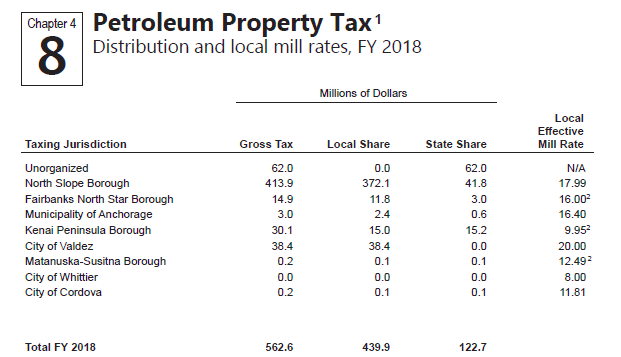
North Slope Borough Special Tax: The Dunleavy Administration seeks to repeal a law that gives over $400 million in property taxes from the Trans Alaska Pipeline to the North Slope Borough. That money would go into the General Fund. The North Slope Borough is awash in money and has five years of reserves, enough time for new oil to come from the Willow and Greater Moose’s Tooth fields, as well as the National Petroleum Reserve Alaska. The borough has about 9,000 residents.

Alcohol and Marijuana Control Board: Repeal board and have the Department of Commerce manage the issues.

State Council on Arts and Humanities: Repeal.

Public Broadcasting: Zero out the $3.4 million funds.

Revolving loan funds: Eliminate all but commercial fisheries.

Student loans: Eliminate program.

WAMI program: Eliminate program.

Live Homework Help: Eliminate.

Best Beginning Program: Eliminate.

Early Childhood and Pre-K: Eliminate.

Curriculum Fund: Repeal.

Power Cost Equalization: Eliminate special fund and roll into General Fund, then give out to communities. The program is not reduced, but the special fund is eliminated. This will be a multi-year effort to look at every designated fund established by statute and determine if that dedication should be repealed. Intended to increase the flexibility of state budgeting and decrease stakeholders having their own fund.

Pioneer Homes: Raise rates to cover cost of service. New customers will pay actual costs. Current residents will be grandfathered in. Payment assistance program will be put in place for current residents, based on need. Intent is no one removed from homes.

State Human Resources and Procurement: Consolidate all departments’ HR and procurement . Put under Department of Administration.

Investigators: State’s over 100 investigators — for everything from fraud, crime, to environment, moved to Department of Law as part of a new statewide investigative unit.

Travel: Reduce state travel budget by 50 percent across departments.

Public Safety: No increases to troopers at this time, since the unit has 40 unfilled positions. The reduction to Walker’s proposed increase is due to no additional trooper positions until Public Safety fills its existing vacancies.

Actual Personnel Reduction: Over 620 State positions eliminated, plus 320 in the ferry system.

Alaska Oil and Gas Conservation Commission: Moves to Department of of Commerce from Department of Administration.

Rural Airports: Reduce number of public airports owned or funded by the State, especially air strips where there is 0 population.

Property Disposal: Possible sale of some of the 1,800 structures it owns.

Exempt positions: Some fully exempt employees would be placed into partially exempt services and placed on salary schedules. This will be done through an “Exempt Position Reform Bill,” capping exempt job salaries at $300,000. Creation of exempt positions would be subject to approval of the Office of Management and Budget.

Permanent Fund Dividend: The funds for paying the Permanent Fund dividend is a separate appropriation bill. The governor does not see this as an appropriation, so it is not part of the proposed operating budget.

This story will be updated. Check back.